Maslow’s
Hierarchy of
Human Needs
Need: a lack of something
required or desired.
*Needs motivate us to act!
Here I Am
In The
Picture!!
Copyright © Texas Education Agency, 2017. All rights reserved. 2
Maslow’s Hierarchy of Needs
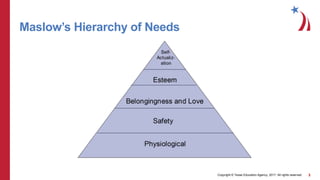
Maslow defined a Hierarchy of Human Needs that stated the
lower needs must be met before an individual can strive to
meet the higher needs.
Copyright © Texas Education Agency, 2017. All rights reserved. 3
Maslow’s Hierarchy of Needs
Copyright © Texas Education Agency, 2017. All rights reserved. 4
PHYSIOLOGICAL - necessary for life; unmet,
these needs lead to death
> Food
> Water
> Oxygen
> Sleep
> Protection from extreme
temperatures
> Elimination
> Sensory needs
> Motor needs
Copyright © Texas Education Agency, 2017. All rights reserved. 5
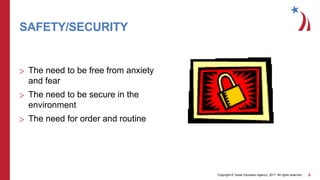
SAFETY/SECURITY
> The need to be free from anxiety
and fear
> The need to be secure in the
environment
> The need for order and routine
Copyright © Texas Education Agency, 2017. All rights reserved. 6
LOVE AND AFFECTION
> Social acceptance, friendship, to
be loved
> Need to belong, to relate to others
> Sexuality
• a person’s feelings/attitude toward
their masculine/feminine nature
• the ability to give and receive love
and affection
• -reproductive capabilities
Copyright © Texas Education Agency, 2017. All rights reserved. 7
ESTEEM
> Feeling important and worthwhile
– includes respect, approval,
appreciation
> We engage in activities that bring
achievement, success, and
recognition
> We gain self-confidence and
begin to direct our actions toward
becoming what we WANT to be
Copyright © Texas Education Agency, 2017. All rights reserved. 8
SELF-ACTUALIZATION
> Self-realization; obtaining our full
potential; becoming confident,
eager to express our beliefs, and
willing to reach out to others to
help them
Copyright © Texas Education Agency, 2017. All rights reserved. 9
SELF-ACTUALIZATION
> Self-actualization involves
setting goals and achieving
them, while self-realization
involves letting go of the
ego and surrendering to the
present moment
Copyright © Texas Education Agency, 2017. All rights reserved. 10
To meet our human needs we usually learn
what works by
> Trial-and-error
> Direct methods v. Indirect
methods
> Stress reactions
> Challenges and responsibilities
Copyright © Texas Education Agency, 2017. All rights reserved. 11
INDIRECT METHODS
> Suppression
> Projection
> Denial
> Rationalization
> Compensation
*Note: These are unhealthy when used too often, but sometimes allow us
to cope!
Copyright © Texas Education Agency, 2017. All rights reserved. 12
When defense mechanisms are inadequate,
stress reactions develop:
> Chronic complaining and demanding behavior
> Agitation with manipulative behavior
> Restlessness
> Sleeplessness
> Depression-be alert for potential suicide
> Withdrawal
Copyright © Texas Education Agency, 2017. All rights reserved. 13
To meet the needs of others…
…personalized healthcare focuses on the patient and
meeting their needs and expectations
Copyright © Texas Education Agency, 2017. All rights reserved. 14
Challenges
> Meet the patient’s needs to the best of your ability
> Set standards of excellence for yourself
> Sometimes only you will know (I.e., sterile field)
> Let your conscience be your guide
> Anything less than 100% is not acceptable
Copyright © Texas Education Agency, 2017. All rights reserved. 15
Responsibilities
> Take advantage of the opportunity to learn, develop basic skills, see the
purpose of each assignment
> Set your standards for your performance
> Establish study habits that work best for you
> Relate learning to past experience
> Measure each achievement in terms of progress toward your career goal
> Be honest with yourself and take responsibility for your own actions

Maslows-Hierarchy-of-Human-Needs-Grade 7.pptx

  • 1.
    Maslow’s Hierarchy of Human Needs Need:a lack of something required or desired. *Needs motivate us to act! Here I Am In The Picture!!
  • 2.
    Copyright © TexasEducation Agency, 2017. All rights reserved. 2 Maslow’s Hierarchy of Needs Maslow defined a Hierarchy of Human Needs that stated the lower needs must be met before an individual can strive to meet the higher needs.
  • 3.
    Copyright © TexasEducation Agency, 2017. All rights reserved. 3 Maslow’s Hierarchy of Needs
  • 4.
    Copyright © TexasEducation Agency, 2017. All rights reserved. 4 PHYSIOLOGICAL - necessary for life; unmet, these needs lead to death > Food > Water > Oxygen > Sleep > Protection from extreme temperatures > Elimination > Sensory needs > Motor needs
  • 5.
    Copyright © TexasEducation Agency, 2017. All rights reserved. 5 SAFETY/SECURITY > The need to be free from anxiety and fear > The need to be secure in the environment > The need for order and routine
  • 6.
    Copyright © TexasEducation Agency, 2017. All rights reserved. 6 LOVE AND AFFECTION > Social acceptance, friendship, to be loved > Need to belong, to relate to others > Sexuality • a person’s feelings/attitude toward their masculine/feminine nature • the ability to give and receive love and affection • -reproductive capabilities
  • 7.
    Copyright © TexasEducation Agency, 2017. All rights reserved. 7 ESTEEM > Feeling important and worthwhile – includes respect, approval, appreciation > We engage in activities that bring achievement, success, and recognition > We gain self-confidence and begin to direct our actions toward becoming what we WANT to be
  • 8.
    Copyright © TexasEducation Agency, 2017. All rights reserved. 8 SELF-ACTUALIZATION > Self-realization; obtaining our full potential; becoming confident, eager to express our beliefs, and willing to reach out to others to help them
  • 9.
    Copyright © TexasEducation Agency, 2017. All rights reserved. 9 SELF-ACTUALIZATION > Self-actualization involves setting goals and achieving them, while self-realization involves letting go of the ego and surrendering to the present moment
  • 10.
    Copyright © TexasEducation Agency, 2017. All rights reserved. 10 To meet our human needs we usually learn what works by > Trial-and-error > Direct methods v. Indirect methods > Stress reactions > Challenges and responsibilities
  • 11.
    Copyright © TexasEducation Agency, 2017. All rights reserved. 11 INDIRECT METHODS > Suppression > Projection > Denial > Rationalization > Compensation *Note: These are unhealthy when used too often, but sometimes allow us to cope!
  • 12.
    Copyright © TexasEducation Agency, 2017. All rights reserved. 12 When defense mechanisms are inadequate, stress reactions develop: > Chronic complaining and demanding behavior > Agitation with manipulative behavior > Restlessness > Sleeplessness > Depression-be alert for potential suicide > Withdrawal
  • 13.
    Copyright © TexasEducation Agency, 2017. All rights reserved. 13 To meet the needs of others… …personalized healthcare focuses on the patient and meeting their needs and expectations
  • 14.
    Copyright © TexasEducation Agency, 2017. All rights reserved. 14 Challenges > Meet the patient’s needs to the best of your ability > Set standards of excellence for yourself > Sometimes only you will know (I.e., sterile field) > Let your conscience be your guide > Anything less than 100% is not acceptable
  • 15.
    Copyright © TexasEducation Agency, 2017. All rights reserved. 15 Responsibilities > Take advantage of the opportunity to learn, develop basic skills, see the purpose of each assignment > Set your standards for your performance > Establish study habits that work best for you > Relate learning to past experience > Measure each achievement in terms of progress toward your career goal > Be honest with yourself and take responsibility for your own actions