ABOUT RUPEE BOND
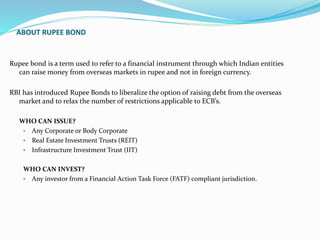
Rupee bond is a term used to refer to a financial instrument through which Indian entities
can raise money from overseas markets in rupee and not in foreign currency.
RBI has introduced Rupee Bonds to liberalize the option of raising debt from the overseas
market and to relax the number of restrictions applicable to ECB’s.
WHO CAN ISSUE?
• Any Corporate or Body Corporate
• Real Estate Investment Trusts (REIT)
• Infrastructure Investment Trust (IIT)
WHO CAN INVEST?
• Any investor from a Financial Action Task Force (FATF) compliant jurisdiction.
KEY FEATURES..
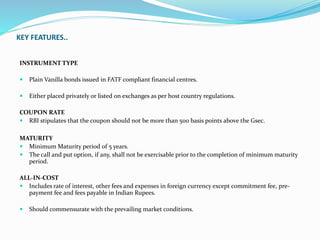
INSTRUMENT TYPE
 Plain Vanilla bonds issued in FATF compliant financial centres.
 Either placed privately or listed on exchanges as per host country regulations.
COUPON RATE
 RBI stipulates that the coupon should not be more than 500 basis points above the Gsec.
MATURITY
 Minimum Maturity period of 5 years.
 The call and put option, if any, shall not be exercisable prior to the completion of minimum maturity
period.
ALL-IN-COST
 Includes rate of interest, other fees and expenses in foreign currency except commitment fee, pre-
payment fee and fees payable in Indian Rupees.
 Should commensurate with the prevailing market conditions.
END-USE
The proceeds can be used for all purposes except the following:
 Real estate activities other than for development of integrated township / affordable housing projects
 Investing in capital markets and using the proceeds for equity investment domestically
 Activities prohibited as per the Foreign Direct Investment (FDI) guidelines
 On-lending to other entities for any of the above objectives
 Purchase of land.
AMOUNT
 Under the automatic route the amount will be the equivalent of USD 750 million per annum.
 Cases beyond this limit will require prior approval of the Reserve Bank.
CONVERSION RATE
 The foreign currency - Rupee conversion will be at the market rate on the date of settlement for
the purpose of transactions undertaken for issue and servicing of the bonds.
HEDGING
 The overseas investors will be eligible to hedge their exposure in Rupee through permitted
derivative products with AD Category - I banks in India.
 The investors can also access the domestic market through branches / subsidiaries of Indian
banks abroad or branches of foreign bank with Indian presence on a back to back basis.
KEY FEATURES..
BENEFITS
TO THE ISSUER
 Borrowing overseas can be relatively cheap compared to India, with average costs at least 200 basis points
lower.
 Offers a new and diversified set of investors for Indian companies.
 As pricing and issue of bonds is in rupees, there is no currency fluctuation risk.
 More liquidity in exchanges.
TO THE INVESTOR
 The Finance Ministry has cut the withholding tax (a tax deducted at source on residents outside the country)
on interest income of such bonds to 5 per cent from 20 per cent, making it attractive for investors.
 Also, capital gains from rupee appreciation are exempted from tax.
 By the way, these bonds are bought by retail investors as well as big institutions overseas.
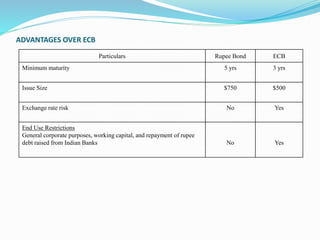
ADVANTAGES OVER ECB
Particulars Rupee Bond ECB
Minimum maturity 5 yrs 3 yrs
Issue Size $750 $500
Exchange rate risk No Yes
End Use Restrictions
General corporate purposes, working capital, and repayment of rupee
debt raised from Indian Banks No Yes

Rupee bonds

  • 2.
    ABOUT RUPEE BOND Rupeebond is a term used to refer to a financial instrument through which Indian entities can raise money from overseas markets in rupee and not in foreign currency. RBI has introduced Rupee Bonds to liberalize the option of raising debt from the overseas market and to relax the number of restrictions applicable to ECB’s. WHO CAN ISSUE? • Any Corporate or Body Corporate • Real Estate Investment Trusts (REIT) • Infrastructure Investment Trust (IIT) WHO CAN INVEST? • Any investor from a Financial Action Task Force (FATF) compliant jurisdiction.
  • 3.
    KEY FEATURES.. INSTRUMENT TYPE Plain Vanilla bonds issued in FATF compliant financial centres.  Either placed privately or listed on exchanges as per host country regulations. COUPON RATE  RBI stipulates that the coupon should not be more than 500 basis points above the Gsec. MATURITY  Minimum Maturity period of 5 years.  The call and put option, if any, shall not be exercisable prior to the completion of minimum maturity period. ALL-IN-COST  Includes rate of interest, other fees and expenses in foreign currency except commitment fee, pre- payment fee and fees payable in Indian Rupees.  Should commensurate with the prevailing market conditions.
  • 4.
    END-USE The proceeds canbe used for all purposes except the following:  Real estate activities other than for development of integrated township / affordable housing projects  Investing in capital markets and using the proceeds for equity investment domestically  Activities prohibited as per the Foreign Direct Investment (FDI) guidelines  On-lending to other entities for any of the above objectives  Purchase of land. AMOUNT  Under the automatic route the amount will be the equivalent of USD 750 million per annum.  Cases beyond this limit will require prior approval of the Reserve Bank. CONVERSION RATE  The foreign currency - Rupee conversion will be at the market rate on the date of settlement for the purpose of transactions undertaken for issue and servicing of the bonds. HEDGING  The overseas investors will be eligible to hedge their exposure in Rupee through permitted derivative products with AD Category - I banks in India.  The investors can also access the domestic market through branches / subsidiaries of Indian banks abroad or branches of foreign bank with Indian presence on a back to back basis. KEY FEATURES..
  • 5.
    BENEFITS TO THE ISSUER Borrowing overseas can be relatively cheap compared to India, with average costs at least 200 basis points lower.  Offers a new and diversified set of investors for Indian companies.  As pricing and issue of bonds is in rupees, there is no currency fluctuation risk.  More liquidity in exchanges. TO THE INVESTOR  The Finance Ministry has cut the withholding tax (a tax deducted at source on residents outside the country) on interest income of such bonds to 5 per cent from 20 per cent, making it attractive for investors.  Also, capital gains from rupee appreciation are exempted from tax.  By the way, these bonds are bought by retail investors as well as big institutions overseas.
  • 6.
    ADVANTAGES OVER ECB ParticularsRupee Bond ECB Minimum maturity 5 yrs 3 yrs Issue Size $750 $500 Exchange rate risk No Yes End Use Restrictions General corporate purposes, working capital, and repayment of rupee debt raised from Indian Banks No Yes