Group Members:
MuhammadJawad 42 (TL)
Sajid Raiz (15)
Muhammad Salman (47)
Ahmad Mehmood (35)
3.
Objectives
Theorist’s Overview
Publications
Introduction
Components
Roger’s Theory and Nursing Metaparadigm
Application of Roger’s Theory
Strengths
Weaknesses
Summary
4.
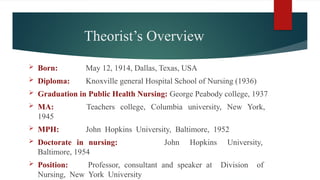
Theorist’s Overview
Born:May 12, 1914, Dallas, Texas, USA
Diploma: Knoxville general Hospital School of Nursing (1936)
Graduation in Public Health Nursing: George Peabody college, 1937
MA: Teachers college, Columbia university, New York,
1945
MPH: John Hopkins University, Baltimore, 1952
Doctorate in nursing: John Hopkins University,
Baltimore, 1954
Position: Professor, consultant and speaker at Division of
Nursing, New York University
5.
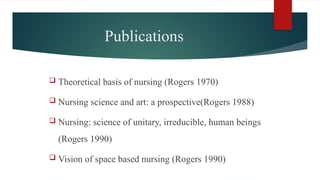
Publications
Theoretical basisof nursing (Rogers 1970)
Nursing science and art: a prospective(Rogers 1988)
Nursing: science of unitary, irreducible, human beings
(Rogers 1990)
Vision of space based nursing (Rogers 1990)
6.
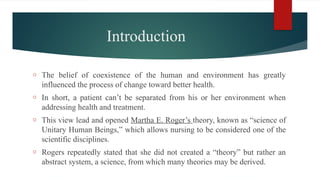
Introduction
o The beliefof coexistence of the human and environment has greatly
influenced the process of change toward better health.
o In short, a patient can’t be separated from his or her environment when
addressing health and treatment.
o This view lead and opened Martha E. Roger’s theory, known as “science of
Unitary Human Beings,” which allows nursing to be considered one of the
scientific disciplines.
o Rogers repeatedly stated that she did not created a “theory” but rather an
abstract system, a science, from which many theories may be derived.
7.
Components
This theory comprisesof five assumptions, four major concepts and three
major principals.
Assumptions: Wholeness, Openness, Unidirectionality, Pattern and
organization, sentence and
thought.
Concepts: Energy field, openness, pattern and pan
dimensionality.
8.
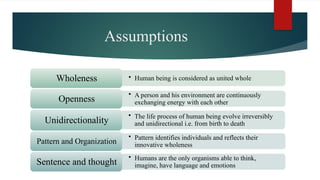
Assumptions
• Human beingis considered as united whole
Wholeness
• A person and his environment are continuously
exchanging energy with each other
Openness
• The life process of human being evolve irreversibly
and unidirectional i.e. from birth to death
Unidirectionality
• Pattern identifies individuals and reflects their
innovative wholeness
Pattern and Organization
• Humans are the only organisms able to think,
imagine, have language and emotions
Sentence and thought
9.
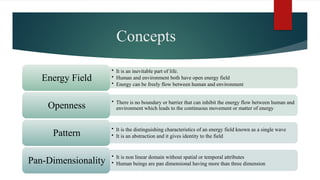
Concepts
• It isan inevitable part of life.
• Human and environment both have open energy field
• Energy can be freely flow between human and environment
Energy Field
• There is no boundary or barrier that can inhibit the energy flow between human and
environment which leads to the continuous movement or matter of energy
Openness
• It is the distinguishing characteristics of an energy field known as a single wave
• It is an abstraction and it gives identity to the field
Pattern
• It is non linear domain without spatial or temporal attributes
• Human beings are pan dimensional having more than three dimension
Pan-Dimensionality
10.
Homeodynamic Principles
o Homeodynamicrefers to the balance between the dynamic life
process and environment
o These principles help to view humans as unitary human being
o Three principles of homeodynamics
Resonancy
Helicy
Integrity
11.
Homeodynamic Principles
1. Resonancy
Wavepatterns are continuously changing in environmental and
human energy field.
2. Helicy
The nature of change is unpredictable, continuous and an
innovative.
3. Integrity
Energy fields of humans and environment are in a continuous
mutual process.
13.
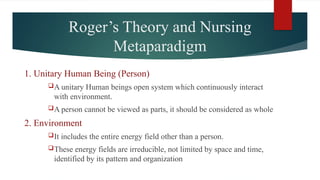
Roger’s Theory andNursing
Metaparadigm
1. Unitary Human Being (Person)
A unitary Human beings open system which continuously interact
with environment.
A person cannot be viewed as parts, it should be considered as whole
2. Environment
It includes the entire energy field other than a person.
These energy fields are irreducible, not limited by space and time,
identified by its pattern and organization
14.
Roger’s Theory andNursing
Metaparadigm
3. Health
Not clearly defined by Rogers. It is determined by the
interaction between energy fields i.e. human and environments
Bad interaction or misplacing of energy leads to illness
4. Nursing
Nursing exists to serve people
Nursing is both science and art
It is the direct and overriding responsibility to the society
16.
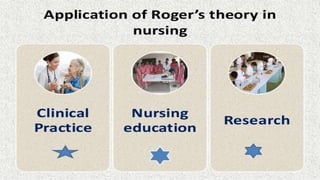
Clinical Practice
Nursingaction is always focused on unitary human being and change the
energy field between human and environment.
Nursing action always include all non-invasive actions such as guided
imaginary, humor, therapeutic touch, music etc. which are used to increase the
potential of human field.
The more importance be on the management of pain, supportive therapy and
rehabilitation.
17.
Nursing Education
Emphasisshould be given on the understanding of the
patient and self, energy field and environment.
Example
Training should lay more focus on teaching non-invasive
modalities such as therapeutic touch, meditation, humor,
regular in service education program etc.
18.
Research
Rogers theoryhas been used in many research works and has
always found testable and applicable in research.
Example
A study to assess the effectiveness of music therapy on stress
reduction among postmenopausal women in Lahore, Pakistan.
19.
Strengths
Rogers conceptsprovide a worldview from which nurses may
derive theories and hypotheses and propose relationship specific to
different situations.
This theory is not directly testable due to lack of concrete
hypotheses, but it is testable in principles.
20.
Weakness
Overall thistheory is considered as very complex concepts and
quite difficult to understand.
Rogers’ model does not define particular hypotheses or theories for
it is an abstract, unified and highly derived framework.
Testing the concepts’ validity is questionable because its concepts
are not directly measurable.
Rogers claimed that nursing exists to serve people; however,
nurses’ role were not clearly defined.
21.
Summary
The Scienceof Unitary Human Beings is highly generalizable as the
concepts and ideas are not confined with a specific nursing approach
unlike the usual way of other nurse theorist in defining the major
concepts of theory.
Rogers gave much emphasis on how a nurse should view the patient.
Her statement, in general, made us believe that a person and his or her
environment are integral to each other.
22.
Case Study:
Patientwas 28 years old and suffers from emotional agitation,
auditory hallucinations, religious delusions, kneeling to worship,
and disturbing behavior at home, so she has been hospitalized in
the psychiatric ward of a medical center in southern Taiwan for the
second time. The medical diagnosis of this patient was
Schizophrenia. The patient has five elder brothers and elder sisters.
Both the elder brother and the second eldest sister are mentally ill.
The patient lives with her family. After graduating from senior
high school, the patient chooses to work first instead of continuing
to go to school. At the age of 24, she was admitted to university.
23.
Contii..
Due tointerpersonal problems with friends and classmates, she
went to the psychiatric outpatient clinic for medical treatment. At
that time, the patient was a freshman at the university. Because she
was older than other students, she had difficulty in interacting, and
persecutory delusion appeared. She felt that her classmates were
going to be unfavorable to her and called her a bad classmate. It
was the first time that she was hospitalized for treatment in a
psychiatric ward. After being discharged from the hospital, her
family members sent her to the hospital and she was hospitalized
again for treatment due to irregular medication and a large degree
of disturbance in her mental symptoms
24.
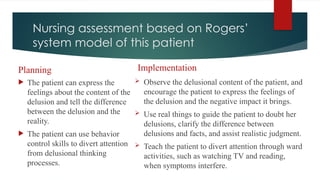
Nursing assessment basedon Rogers’
system model of this patient
Planning
The patient can express the
feelings about the content of the
delusion and tell the difference
between the delusion and the
reality.
The patient can use behavior
control skills to divert attention
from delusional thinking
processes.
Implementation
Observe the delusional content of the patient, and
encourage the patient to express the feelings of
the delusion and the negative impact it brings.
Use real things to guide the patient to doubt her
delusions, clarify the difference between
delusions and facts, and assist realistic judgment.
Teach the patient to divert attention through ward
activities, such as watching TV and reading,
when symptoms interfere.
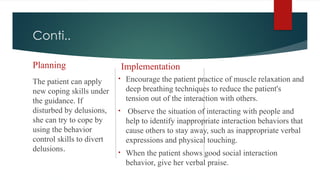
25.
Conti..
Planning
The patient canapply
new coping skills under
the guidance. If
disturbed by delusions,
she can try to cope by
using the behavior
control skills to divert
delusions.
Implementation
• Encourage the patient practice of muscle relaxation and
deep breathing techniques to reduce the patient's
tension out of the interaction with others.
• Observe the situation of interacting with people and
help to identify inappropriate interaction behaviors that
cause others to stay away, such as inappropriate verbal
expressions and physical touching.
• When the patient shows good social interaction
behavior, give her verbal praise.
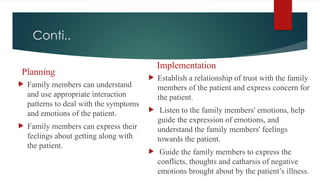
26.
Conti..
Planning
Family memberscan understand
and use appropriate interaction
patterns to deal with the symptoms
and emotions of the patient.
Family members can express their
feelings about getting along with
the patient.
Implementation
Establish a relationship of trust with the family
members of the patient and express concern for
the patient.
Listen to the family members' emotions, help
guide the expression of emotions, and
understand the family members' feelings
towards the patient.
Guide the family members to express the
conflicts, thoughts and catharsis of negative
emotions brought about by the patient’s illness.
#7 Helicy means continuous innovative, unpredictable, increasing diversity of human and environmental field pattern
Homodynamic means producing a continuous succession of generation until interrupted by adverse circumstances
#9 temporal attribute relates to the perception of the outside world with particular attention to temporal elements while spatiality represents the things we perceive with a focus on the spatial features. The inside world in our mind correlates with the outside world through language.











![Safe__motherhood_and_newborn_related_care_CHN[1][2].pptx](https://cdn.slidesharecdn.com/ss_thumbnails/safemotherhoodandnewbornrelatedcarechn12-241020071235-acc39199-thumbnail.jpg?width=640&height=640&fit=bounds)


