Is Traditional
Environmentalism
Fading?
e m p o w e r i n g e n g i n e e r i n g e x c e l l e n c e
Volume 13 | Issue 12 | June 2017 | `150
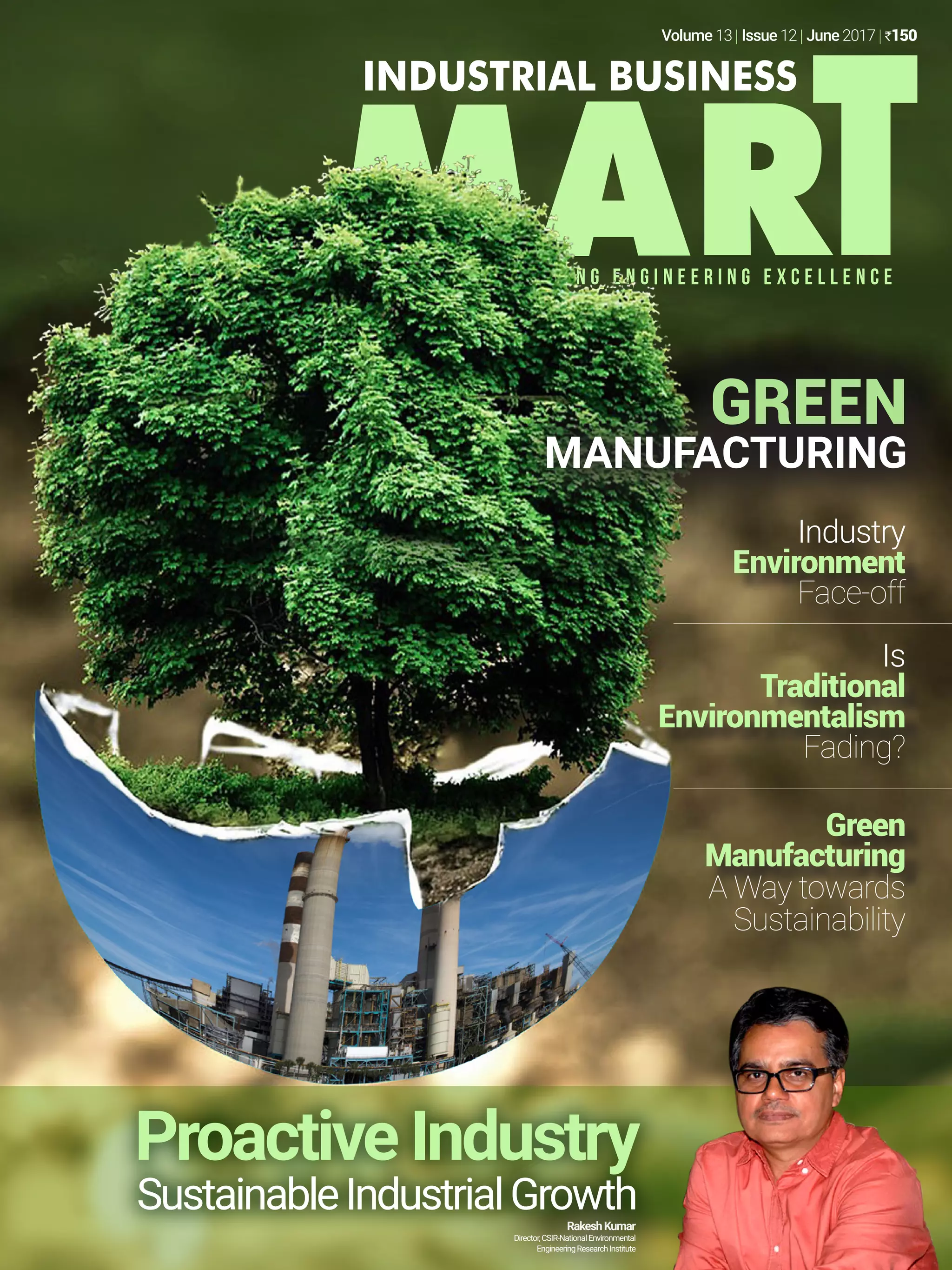
Industry
Environment
Face-off
Is
Traditional
Environmentalism
Fading?
Green
Manufacturing
A Way towards
Sustainability
RakeshKumar
Director,CSIR-NationalEnvironmental
EngineeringResearchInstitute
ProactiveIndustry
SustainableIndustrialGrowth
GREEN
MANUFACTURING
3 June 2017 www.martupdate.com 3
4 www.martupdate.com 4 June 2017
+91 79 40305602 | +91 9328899503 | bjhala@imtos.com | www.kdclglobal.com
Organized By
Supported By Gold Participant
www.martupdate.com 5
Publisher & Managing Editor
Hari Shanker	 hari@martinfotech.in
CEO & Associate Editor	
Hiya Chakrabarti	 hiya@martnifotech.in
Executive Director	
Siji Nair	 siji@martinfotech.in
General Manager Sales
Bishnu Priya Kundu	 priya@martinfotech.in
Correspondent	
Arnab Mondal	 arnab@martinfotech.in
Digital Marketing	
Akshay Shinde	 akshay@martinfotech.in
Sales	
V. Subramaniam	 chennai@martinfotech.in
Hr & Admin	
Neha Hedawoo	 info@martinfotech.in
Creative Assistant	
Trupti Rakshe	 martcreative@gmail.com
MART Editorial Advisory Board
MART Editorial Council
Manoj Kabre
Vice President
Indo MIM Pvt Ltd
Saravjit Singh
Quality Consultant
& Trainer
P S Satish
Consultant &
Trainer, SIS
Harish Pant
Managing Director
Hampson Aerospace
Dr. U Chandrasekhar
Pro Vice Chancellor
Vel Tech University
Venkitachalam V
Director
EFENP Automation
4A S Shetty, Chief Executive, Sedvik Industries
4Laxmikant Bhakre, Director, Deven Infotech
4S M Dangi, Marketing Consultant
4Surendra Kumar, Chief Executive, Pitech Services
4J R Mahajan, Industry Consultant
4Rajesh Angadi, IT & IETS
News Portal: www.martupdate.com
Email: www.martonline.in
Volume 13 4Issue 12 4June 2017
Annual Subscription `1800 4Member INS
MART INFOMEDIA PRIVATE LIMITED
Second Floor, Ariana, Bhumkar Chowk
Marunji Road, Near New Poona Bakery,
Wakad, Pune - 411057 India
Email: info@martinfotech.in
Editorial +91 70 3093 2700
Circulation +91 70 3093 2697
Advertisement +91 70 3093 2699
Accounts & HR +91 70 3093 2698
‘GREENMANUFACTURING’
MANUFACTURING, AS ONE
OF THE MAJOR INDUSTRIES
WORLD OVER, HAS A SIZEABLE
SHARE IN THE DEGRADATION
OF ENVIRONMENT. THE SECTOR
HAS TO REALIZE ITS SHARE OF
RESPONSIBILITY TOO.
Grow with Green
Industry and environment cannot go hand in hand, or so, at least, do we tend
to believe. It is, indeed, when one grows at the cost of other. Immediate and
incremental benefits reaped out of the rapid industrial growth have been too
strong that overlooking the degradation of environment was too obvious.
Only when the environmental degradation reached a precarious stage, we the
beneficiaries of industrial growth started noticing it. Soon ‘Sustainability’ and
‘Sustainable Development’ became words of prominence for us.
It is with this view that the MART spoke to an eminent exponent of environmental
science and technologies, Dr. Rakesh Kumar, Director, CSIR-NEERI. In his
enlightening interview, Dr. Kumar opines that environment has always been at
the bottom of industry’s priority list as compared to other performance areas,
suggests how industry and competent government bodies can work in tandem to
curb environmental impact, and how NEERI is making efforts in this direction.
The cover story on industry environment face-off cites how environmental rules
have been tweaked or violated to maximize economic benefits of industry over
the years.
The article on traditional environmentalism seeks to delve into the depths of old
religious practices and their scientific reasons which were in sync with balance
of nature. Today, these have lost their
actual meanings and importance or are
simply discarded in face of technological
advancements.
Alternative 2017, a debutante event
with a noble aim of creating awareness
about the depletion of conventional
energy resources and need for
alternative energy, has been covered in
the event section of our June issue.
Green manufacturing is not just limited
to adopting a few technologies for
reducing emission. Rather it requires
a holistic approach and changes at
multiple levels to actually become
environment friendly manufacturing
business. Venkitachalam V in his article has discussed these as much as he has
discussed the notion of Indian companies act from pressures and not voluntarily
to follow environmental norms.
Green practices for environment protection, are equally important for brand
image and long term benefits for a company in the eyes of its employees and
customers. In his article, Sanjeev Himachai analyses how employees in an
organization can be encouraged to follow environmental rules and regulations and
contribute to nature.
Besides, the June issue has regular columns on other areas of manufacturing
along with a special feature Theory of Constraints by Praddep Kumar.
We hope you’ll enjoy and encourage our effort.
6 www.martupdate.com 6 June 2017
08
28 Innovative ways of CSR
24 Proactive Industry Sustainable Industrial Growth
32 Intelligent Manufacturing
50 Similar price double the performance: New plain
bearing all-rounder from igus
52 Specialists for micro cutting now in sealed 	
design available
38 Immediate Improvement by applying TOC
40 The Rosemary Kenned Incident
42 The Green Era
44 Welding Wonder36 Optimize Invetories with right control methods
12 Is Traditional Environmentalism Fading?
14 Think Nature, Think Alternative!
16 Green Manufacturing A way to Wards Sustainability
20 Environment Training and Green Programmes
for Employees in Manufacturing
22 Save Water, Save Lives, Save Future!g
08 Industry Environment Face-off
#INNOVATIONS
#COLUMN
#ONFACE
#TOC
#leArningcurve
#Cuttingedge
#SUCCESSSTORY
CONTENTS
44
#COVERSTORY
24
48 Hypertherm XPR 300 Enthralls Participants at
Meet the new plasma
#posteventreport
54 Announcement
56 Mart Update
#FAIRMART
7 June 2017 www.martupdate.com 7www.martupdate.com 7
A kit to save
costs ...drylin®
W
igus®
dry-tech®
... lubrication-free bearings made easy
Lubrication-free linear technology from the biggest tool kit.
drylin®
W: linear bearings for quiet and easy running, insensitive to dust and dirt. Configured and installed
quickly and easily. For line, flat and room gantries. Developed individually as a custom-made solution
or delivered as single components and complete system in a minimum of 24h. www.lineartoolkit.in
igus®
(India) Pvt. Ltd.
36/1, Sy. No. 17/3, Euro School Road,
Dodda Nekkundi Industrial Area - 2nd Stage
Mahadevapura Post Bangalore - 560048
Phone +91-80-45127800 Fax +91-80-45127802 info@igus.in plastics for longer life®
IN-1094-drylinW Baukasten 210x297.indd 1 27.10.16 16:03
8 www.martupdate.com 8 June 2017
An UPA-era crisis wouldn’t be
improper to begin with: a
Ministry of Environment and
Forests (MoEF) committee
on the Posco project in Odisha recorded
“serious lapses and illegalities” as per
the Environment Impact Assessment
Notification, 2006 and the majority of
members recommended revocation of
clearance granted in 2007 for a minor
port and steel plant. The Ministry had
to subsequently ignore the report and
conditionally clear the project.
Mr. Jairam Ramesh, then Minister of
MoEF planned to strike the right balance
between GDP growth and conservation,
reduce carbon emissions without
sacrificing growth — and vitally, to steer
the MoEF away from the path of rubber-
stamped environmental clearances.
But the sheer pressure on the Ministry,
including from other Ministries, proved
so hard that it had to show causes why
it was implementing fundamental laws
such as the Forest (Conservation) Act.
Environment and industry take such
polar positions that often involve clashes
of interests of the presiding ministries.
Globally, this clash of interest has
often taken proportion of debate over
the existence of such a clash at all.
Despite scientific evidences showing
anthropogenic role on climate change,
which includes industrial development
among other, industry still casts aside
climate change as a hoax. If they admit
climate change, they deny role of
humans for climate change. Even as the
argument is proved wrong, the next
of denial comes by playing down the
climate as a serious problem at all.
Industry 	 	
Environment
Face-off
Regimes change but instances
of tweaking rules and
regulations remain constant.
More so, when it comes to
one of the persistent issue –
environment vs. industry.
While role and need of
industrialization cannot
be denied, growth of it in
an unmindful and rapid
manner makes it hazardous
to environment. Those who
should bring in a concerted
effort to find solutions prefer to
walk their comfort ways. And
sustainable industrialization,
remains far cry.
Arnab Mondal
arnab@martinfotech.in
#greenmanufacturing
9 June 2017 www.martupdate.com 9
Scientists, in the United Nation’s
International Panel on Climate Change
(IPCC), reported with “extreme
confidence,” or 95 per cent certainty,
that humans are the dominant cause of
global warming. The report projected a
global average temperature rise of 0.3
to 4.8 degrees Celsius by the end of the
century, and a seal level rise of 10 to 32
inches.
Pro Industry Approach
Advancement of the society is
undeniable with the technological
advancements due to industrialization.
In this regard, many argue that it is
important to take care of the millions
of people who are starving instead of
spending resources on saving the natural
resources. The developing nations of the
world cannot be expected to share the
green concerns of the developed nations
particularly while these countries have
to face dire poverty and are engaged in a
battle for survival.
The emphasis of the industrialized world
on green issues holds the developing
countries back. The reason is that it
is considered as interference in the
internal affairs of these countries and
at the same time it also increases the
divide that exists between the first
and third world countries. There are
many who believe that the emphasis
on environment is only an attempt
to prevent the possible economic
competitors. In this regard, an example
is given of the high tariffs imposed by
the US and the European Union on the
products that are made cheaply in the
developing countries and can be sold
in Europe or America. By restricting
the development of profitable but
polluting industries, these countries are
forcing developing countries to remain
economically undeveloped.
In this regard it can also be argued
that industrialization economic
development is necessary for fulfilling
the basic requirements of the
increasing population of the developing
countries. Another ironical situation
of industrialization is that although it
appears that the world will become a
better place if all the countries of the
world follow the strict environmental
rules however the reality is that a
number of these rules are not in the
interests of some of the countries of
the world. For example, the iron and
steel works in China, which is a major
source of pollution, also provides a
large scale employment to the people.
Therefore the equal application of such
strict environmental laws may result
in creating barriers in the economic
progress of some countries and may also
result in causing political instability.
Besides, it is not necessary in all cases
that rapid industrialization places more
pressure on the environment. Due
to the latest scientific developments,
the industries have become much
less polluting and energy efficient as
compared to the past. Similarly the
developing countries can also learn
lessons from the environmental mistakes
that have been made by the developed
countries of the world after Industrial
Revolution as well as the industrial
disasters that took place in Russia and
China.
For example, due to the recent scientific
developments, much less water, power
and raw material is being used by
the new steelworks and as a result,
much less pollution is being treated as
compared to the traditional industries.
Similarly, nuclear power plants can
provide much more energy as compared
to the thermal power plants and at the
same time, the nuclear plants contribute
much less in global warming. In the
same way, the alternative sources
of energy like solar power, wind and
hydropower are also being explored for
rapid industrialization. It is not correct
for the rich and developed countries to
require that the poorer nations of the
world should also make the conservation
of environment their priority.
Now, when these countries have
become richer, they have become more
concerned regarding the environment as
now they can afford to do somethi ng
regarding this issue. On the other hand,
the conservation of environment can
wait till the developing countries also
become rich.
Balancing Act
At the same time, there are many who
prefer the protection of the environment
as against industrialization. These people
believe that huge natural resources have
already been destroyed and wasted.
These people claim that environmental
damage is also related to poverty. The
advocates of environmental protection
are not against economic development
that has the potential to make the
life of a lot of people better. However
they insist on achieving sustainable
development that is able to combine
environmental protection with economic
growth and social justice.
For example, the companies in the
developed countries are already paying
the higher costs of production as a result
of the environment protection rules
enforced in these countries. It will be
unfair for these companies if they have
to complete with the codes that have
been produced in developing countries
at a lesser cost but by damaging the
environment.
Due to pollution, countries are losing
more than they are gaining as a result
of industrialization. A perfect example
in this regard can be given of China.
Serious air and water pollution has been
caused the country after two decades
of unrestricted economic development.
As a result, health problems have
increased and the farmers also have to
face losses worth billions of dollars every
year. In this way, unrestricted economic
development is not only harmful for
the environment, it is not economically
The developing
nations of the
world cannot
be expected to
share the green
concerns of
the developed
nations
particularly while
these countries
have to face
dire poverty and
are engaged
in a battle for
survival.
10 www.martupdate.com 10 June 2017
beneficial also.
Situation Upfront
The question how India is going to strike
a balance between industrialization and
environment – going by the eagerness
of the Narendra Modi government to
promote industrialization and ensure
high economic growth – is gaining
traction.
India, being one of the world’s largest
greenhouse gas emitter – though beset
by a high population growth rate – has
one of the lowest per capita rates
of greenhouse gas emissions, about
roughly 1/20th of the US and Australia.
Millions of people in small islands,
least-developed countries, landlocked
countries as well as vulnerable
communities in Brazil, India and China,
and all around the world – are suffering
from the effects of a problem to which
they did not contribute. The argument
for industrial development for countries
such as Brazil and India are thus
compelling.
The one-third of the world’s population
lives in the most heavily industrialized
and developed nations accounting for 85
percent of the global personal income
and a like fraction of the annual use of
global resources. The people living in
the less industrialized or developing
nations must apportion the remaining
15 per cent of global income and
resource use among two-thirds of
the world’s population. The result is
an unconscionable prosperity for the
majority of people in the developed
countries and crushing poverty for the
majority in the developing or third world
countries.
The prosperity of the developed
countries has been built on exploitation
of the richest soils, the most accessible
fossil fuels, and the most concentrated
mineral deposits of the entire earth. As
they now struggle to maintain and even
expand their massive consumption from
a resource base of declining quality,
the developing countries, as they try
to follow the same path to economic
development, they remain laced with
barriers as rapid industrialization based
on the expensive resources that remain,
is probably foredoomed by enormous
if not insurmountable economic and
environmental obstacles.
Therefore, however much developing
countries clamour for the natural right
to seek industrial development with
greater rapacity to catch up with the
industrialized west; odds are heavily
stacked against the environment. Thus,
if all the people in India and China seek
to own passenger cars at the rate of the
US or own as much air conditioners, that
would be an environmental disaster.
Is there no middle path between the
industrial growth and environmental
activism? The answer lies probably in
sustainable development of industry
and protection of environment in the
process. A whole range of environmental
protection legislation including the
Environment Protection Act, the Wildlife
Protection Act, the Forest Conservation
Act, and the Water and Air Pollution Act
has come under fire possibly in the plea
that they are major irritants in the path
of India’s industrial growth.
Take the instance how the ruling
NDA steered clear of the direction
in September 2013 by the UPA’s
environment ministry to the Central
Pollution Control Board to reassess the
Comprehensive Environmental Pollution
Index, an important criterion for
project clearance, while keeping intact
the moratorium on new industries in
critically-polluted areas.
The ministry has lifted the moratorium
in eight critically polluted areas –
Ghaziabad, Indore, Jharsuguda,
Ludhiana, Panipat, Patancheru-Bollaram,
Singrauli and Vapi. The report of the
high-powered committee to review six
top environmental laws of the country,
headed by former cabinet secretary TSR
Subramanian, prepared in just three
months, justified the hyper-ventilation
of the NDA ministry, on the grounds of
“doing business easier in the country”.
India cannot be denied its right to
industrial growth but that should not
happen at the cost of our environment
in view of the larger and the more
entrenched costs it might impose on the
economy.
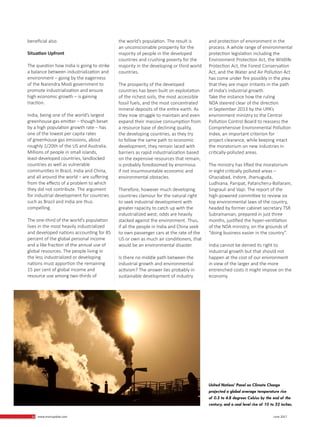
United Nations’ Panel on Climate Change
projected a global average temperature rise
of 0.3 to 4.8 degrees Celsius by the end of the
century, and a seal level rise of 10 to 32 inches.
11 June 2017 www.martupdate.com 11
12 www.martupdate.com 12 June 2017
Amajor part of the
phenomenon of traditional
environmentalism is
formed by Traditional
Ecological Knowledge (TEK). According
to the Secretariat of the Convention on
Biological Diversity (CBD Secretariat)
Traditional Ecological Knowledge is
“Knowledge, innovations and practices
of indigenous and local communities
around the world.
Developed from experience gained over
the centuries and adapted to the local
culture and environment, traditional
knowledge is transmitted orally from
generation to generation. It tends to be
collectively owned and takes the form of
stories, songs, folklore, proverbs, cultural
values, beliefs, rituals, community
laws, local language, and agricultural
practices, including the development
of plant species and animal breeds.
Traditional knowledge is mainly of a
practical nature, particularly in such
fields as agriculture, fisheries, health,
horticulture, and forestry.”
Traditional Environmentalism is following
and making use of this traditional
ecological knowledge with the motive
of conservation and preservation of the
environment. In Indian culture, they are
translated into customs and traditions
in some form or another. While most of
these started with a scientific concept
and a logical reason behind them; in
current times they have taken the face
of practices which are considered merely
orthodox or boring. By taking a closer
look into the nuances of a few practices,
we can decipher the scientific thought
behind them. In Vedic culture nature
is considered to be an integral part of
Is
Traditional
Environmentalism
Fading?
Do you go away from your culture
when you gather more knowledge,
or you lose knowledge when you
go away from your culture? As
complex as it may seem, this
question lies at the roots of all
the advancements and all the
catastrophes that human being
has created for himself.
Environment degradation is one
such catastrophe that mankind is
continuously facing, and certain
environmentalists claim that it can
be tackled by following the age old
traditional practices given to us by
the Indian culture; i.e. by the path
of traditional environmentalism.
But is it so?
Nishanshi Shukla
martupdate@gmail.com
#greenmanufacturing
13 June 2017 www.martupdate.com 13
human life. According to Isvarakṛṣṇa’s
Sankhya-Karika, an old Hindu philosophy
of metaphysical dualism, the world
exists because of two elements, namely
Purusa (pluralistic person) and Prakriti
(singularistic nature); a balance in both
is what enables the creation and smooth
functioning of this entire world.
Probably, in order to imbibe this
philosophy and generate a culture
inclined towards the preservation of
cosmic balance between Purusa and
Prakriti, Purusa was said to be the
manifestation of Shiva and Prakriti was
said to be the manifestation of his wife
Shakti (Parvati). But today, while Shiva
and Parvati are worshipped, the hidden
meaning behind them is overlooked.
The same phenomenon is seen in
various other natural elements. While
the river Ganga is called Ganga mata
(mother Ganges) and worshipped by
words like Har Har Gange (Hail Ganga);
it is polluted, dirtied and ruined, but
scarcely preserved. While Peepal tree
(Ficus Religiosa) is worshipped by being
considered as the abode of Lord Vishnu,
the hidden message of importance
of oxygen given by trees and thus
established necessity of tree plantation
and preservation is comfortably ignored.
While Surya Deva (Sun God), Vayu
Deva (Air God), Varun Deva (Water
God), Bhoo Devi (Earth Goddess) etc.
are still devotedly prayed, they are not
devotedly preserved. Instead these
natural elements are exploited by
continuous and incremental pollution.
During the festival of Diwali, while the
original practice was that of lighting
diyas (earthen lamps), and the thought
behind it was to purify the air and
keep away the mosquitoes and insects
roaming in the atmosphere after
monsoons; the practice has now taken
a toll by excessive bursting of crackers,
contaminating air more than purifying it.
In the ten day long festival of celebrating
Lord Ganesha, the last day is that of
Ganesh Visarjan wherein after days of
worship, the idol is immersed in water.
Originally these idols were made of
clay dug out from ponds/lakes, in order
to make more place for rain water
conservation. These clay idols were
then worshipped with natural herbs,
which when immersed in river/sea water
would help the marine life, as their
bearer clay would dissolve easily. Also,
this festival symbolized the importance
of worshipping natural elements like soil,
and giving back to other natural beings.
But today, the idols are made from
harmful materials like plaster of paris,
which not only harm natural water,
but also cause damage to the marine
life. Similar story is with the practice of
havans (holy pyres), where the smoke
from the offerings made to the pyre
purify the air, and the mantras (hymns)
create positive vibes and optimistic
atmosphere; the practice is now majorly
looked upon as overtly religious, boring,
and outdated.
Aforementioned practices, along with
innumerable others under traditional
environmentalism were developed
owing to years of knowledge and
research by the Indian sages (scholars);
but its face is changing. Major reasons
of the traditional environmental
practices becoming boring or seemingly
uninteresting to humans can be
attributed to factors like changes in
lifestyles and food habitats owing to
modernization, occupational shifts from
farming and agriculture to modern
hi-tech jobs, hype around the western
cultures, non-communication of reasons
behind the faith in cultural practices
and resulting ignorance towards blind
faith, erosion of reading of ancient texts
and writing in vernacular languages,
migration of young generations away
from their roots, forest degradation, and
others. It can also be attributed to the
modern human psychology of avoiding
things which don’t guarantee immediate
profit or fun.
The need of today is to translate
the meanings behind the traditional
practices as promotional tool of the
custom, instead of the custom itself.
This cultural knowledge should also be
incorporated in the formal educational
system. The solution to the problem
of environmental degradation was
formulated around 2000 years ago in
ancient scriptural text, the Isopanishad,
which says, “This universe is the
creation of the Supreme Power meant
for the benefit of all his creation. Each
individual life-form must, therefore,
learn to enjoy its benefits by forming a
part of the system in close relation with
other species. Let not anyone species
encroach upon the other’s rights.”
Is it wise not to follow it?
When the
culture has the
knowledge,
the need is of
awakening
instead of
ignoring.
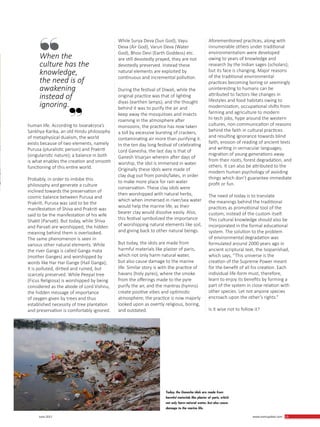
Today, the Ganesha idols are made from
harmful materials like plaster of paris, which
not only harm natural water, but also cause
damage to the marine life.
14 www.martupdate.com 14 June 2017
Alternative energy sources
- solar and wind and such
– are no longer an option,
they have become necessity
in the face of depleting conventional
natural resources and consequent
carbon footprint. It is with a view to
create this awareness among the people
‘ALTERNATIVE 2017’ was organized.
The one-day event organized on 2 June
in at New Horizon Engineering College
in Bengaluru by UV Green Energy, green
energy start-up, in the lead up to the
World Environment Day 2017.
The event proved to be a highly
successful in its first edition with
large participation of citizens,
environmentalists, NGOs, CSR teams
from corporate houses etc. among its
target group. “Through this initiative, we
wanted to create more awareness about
the environment among the citizens
of Bengaluru, and encourage them to
choose alternatives. Instead of using
natural resources, people need to bring
in change in their lifestyle, and should
opt for sustainable forms of energy like
wind, solar and such,” Vinay Shinde,
head of UV Green Energy and organizer
of the event said.Luminaries and experts
discussed environmental issues and
enlightened with innovative ideas in the
course of this day-long conference. The
event covered various aspects of the
environment including tackling garbage
disposal, water management, protecting
the green cover and more.
Among the participants were Rajendra
Singh, who is well-known as the
‘Waterman of India’, and Varadaraj
Rangarajan, who is called the ‘Plastic
Man of India’. Varadaraj, who is also the
brains behind roads made of plastic,
urged people to ‘use plastic for the roads
and not on the road.’
ThinkNature,
ThinkAlternative
Alternative 2017 was a highly
successful environmental event
with innovative ways and
illuminating ideas, creating
awareness among people
about their reasonability to
save the nature.
Along with other awareness
programmes, ‘Alternative 2017’
also witnessed a special musical
performance by Grammy
winner Ricky Kej and sand art
by Raghavendra Hegde. On
this occasion 400 saplings were
distributed among participants.
Arnab Mondal
arnab@martinfotech.in
#greenmanufacturing
15 June 2017 www.martupdate.com 15
What was the driving motto behind
‘Alternative 17’?
UV Green Energy is start-up green
initiative firm, primarily focusing on
CSR framework and competency
development to the corporate world in
the field of environmental solar projects
and solutions.
An initiative of ALTERNATIVE 17 is
the education program of campaign
and awareness to the corporate
world, NGOs, institutions by way of
environmental music consciousness,
green talks from contributors to
sustainability, nature art and few niche
product exhibitions.
We feel every social entrepreneur
should have larger objective of social
need of the development. This is the
1st initiative of 2 year old start-up firm
UV Green Energy, connecting people
to the nature by celebrating World
Environment Day with own funding and
taking the collaborative approach from
various partners.
What were the target groups of the
event? And how spontaneous was their
participation?
Targeted intended group was corporate
employees, CSR & sustainability team,
NGOs, institutions & community. The
event witnessed good participation from
corporate and institutions.
Did the event focus on the role of
industry which is the biggest consumer
of conventional energy and contributor
to carbon footprint?
The focus is more with bringing
awareness to every citizen of the
country to GO WITH ALTERNATIVES to
protect the planet and our mother earth
with the concept of greener together.
Our focus is more towards highlighting
alternative options to bring the change
in every part of our life cycle including
the organic food to water, waste plastic
and alternative energy.
Could you share with us some of
the innovative and alternative ideas
for protection of nature that were
discussed or unveiled at the event?
As for Green Talk Series the various
topics for the discussion were...
• ‘River Rejuvenation, Making Drought
free Karnataka’ by Dr. Rajendra Singh-
Water man of India,
• ‘Innovative Bio Gas Production’ by Mr.
Sanjay Kumar Patel, CEO, SP Ecofuel
• ‘Biotech Solution for Global warming’
by Mr. Sampath Kumar, CEO, Nualgi
• ‘Plastic Waste Management’ by Dr. R.
Vasudevan- Plastic Man of India
• ‘Widening the way of Organic
Farming’ by Mr. H. R. Jayaram, CEO, The
Greenpath
• ‘Corporate Responsibility for
sustainable development of villages’ by
Dr. Ashok Das, CEO, Sunmoksha
• ‘Urban Lakes Rejuvenation for water
security’ by Dr. T. V. Ramachandra, IISc
• ‘Citizen Role to Greener Bengaluru’ by
Mr.Clement Jayakumar, Whitefield Rising
• ‘Future of Electric Mobility’ by
Mr.Kartik Gopal, Head-strategy &
Business Planning, Mahindra Electric
• ‘Save water Save Bengaluru’ by Mr. A.
R. Shivkumar, Principal Scientific officer,
IISc
Do you plan to emulate the strategies
adopted for Bengaluru in other Indian
cities as well which are equally or even
more in the perils of environmental
degradation?
After the successful event, we received
feedbacks from industrialist & corporate
as part of their sustainability program
that ALTERNATIVE concept should
reach to every major Indian city to
connect the people to nature by ways of
ALTERNATIVE.
This awareness was largely needed to
the corporate world CSR teams, so that
corporate social responsibility team
should brainstorm and come forward
for protecting the nature and alternative
source to reach social need way of CSR
funding.
Inaugral ALTERNATIVE 17 – Lighting the lamp by WATER
MAN OF India ( Jal Purush) –Mr Rajendra Singh & Namma
Bengaluro Foundation CEO –Mr Sridhar Pebbishetty &
Vinay Shindhe ( CEO –UV Green Energy)
Grammy Winner Ricky Kej & Team Performed
ALTERNATIVE 17 on the occasion WED. Vinay Shindhe
( CEO UV Green Energy ) & Mahesh Babu ( Mahendra
Electric CEO
“We feel every social entrepreneur should have larger
objective of social need of the development.”
-Vinay Shindhe
CEO-UV Green Energy
Alternative 17 is the stratagem of Mr. Vinay Shindhe,
CEO-UV Green Energy. Excerpts from the conversation:
16 www.martupdate.com 16 June 2017
G
reen Manufacturing (GM) is
also known by different names
viz. clean manufacturing,
environmentally conscious
manufacturing, environmentally benign
manufacturing, environmentally
responsible manufacturing, and
sustainable manufacturing. GM is about
the techniques, policies, and procedures
a firm uses to create manufactured
products, that use process that minimize
negative environmental impacts,
conserve energy and natural resources,
are safe to employees, communities
and consumers and are economically
sound. GM focuses around minimising
environmental impact by reducing
toxics, waste, pollution, optimising
use of raw material, and energy. The
society’s rising concern for Green can
be grouped into three broad categories
– (a) Rising emissions and associated
Green
Manufacturing
AWaytowards
Sustainability
Green Manufacturing includes
a holistic approach towards
adopting green initiatives
throughout the business
from green energy use, green
product development and
green process chain. It offers
benefits in terms of enhanced
brand value, customer loyalty,
better tax traction etc. while
also fulfilling the environmental
commitment for a company.
In India, companies are still
primarily driven by ‘RoI’ and
‘regulations’ while adopting
green initiatives.
Venkitachalam V
abijitindia@yahoo.co.in
climate change, (b) Fast depletion of
scarce natural resources and (c) Growing
waste generation and pollution. Being
a green manufacturer means being
efficient with the ways you manufacture,
saving energies, recycling, and being
environmentally aware of your footprint.
When a business makes the decision
to become a green, or environmentally
friendly, manufacturer, it consciously
decides to promote certain values.
Ever since Industrialization,
manufacturing of various goods
exploited our natural resources,
depleted them without thinking of
future implications and polluted
environment in various forms. GM
is a manufacturing mode with full
consideration of resource consumption
and environmental impact which focuses
at minimizing the environmental impact
#greenmanufacturing
17 June 2017 www.martupdate.com 17
and maximizing resource utilization
during the whole product life cycle
design, manufacturing, packaging,
use and subsequent disposal or
recycling along with making enterprises
harmonize the economic benefits
with that of environmental benefits.
Apart from efficient use of inputs and
reducing wastes, GM also creates higher
environmental awareness among the
customers and at the same time shows
the company as a propagator of green
initiatives improving its brand image
among the customers.
Many of us think that green production
simply entails instituting pollution
controls or recycling programs while
manufacturing goods. The reality,
however, is that Green production
focuses upon three fundamental goals:
1) minimize emissions, effluents, and
accidents; 2) minimize the use of virgin
materials and non-renewable forms of
energy; and 3) minimize the life-cycle
cost (cradle to grave) of products or
services seek to minimize the impact
of the manufacturing process on the
environment at every stage.
Growing concerns over depletion of
forests and other natural resources,
and environmental degradation
created by mining and fossil fuel
production. Reliance on recyclable
or renewable materials, new energy
and material conservation initiatives,
and “replenishment” programs (such
as forest replanting programs) have
all been touted as effective tools in
establishing processes that do not
unduly harm the environment focuses
on profitability through environmentally
friendly operating processes
Manufacturing companies can address
these concerns by focussing on three
areas:
1. Green energy- Green energy involves
production and use of cleaner energy.
This is the first and most obvious step
given the dependence of industry on
energy. Green energy includes both
deploying renewable energy sources
like CNG, wind, solar and biomass, and
achieving higher energy efficiency in
operations.
2. Green products- Developing greener
products is the second step in this
transformation. ‘Recycled’, ‘Low carbon
footprint’, ‘Organic’ and ‘Natural’ are
becoming popular buzz–words which
are associated with Green products.
Developing Green products can often
mean higher costs. However, by
developing Green products that are
sought by consumers, and effectively
marketing them, companies can
derive additional volumes and price
premiums, which can offset their cost of
development.
3. Green processes in business
operations- The third area is
implementing Green processes in
operations. This entails efficient use
of key resources, reducing waste
generation through lean operations,
bringing down the carbon foot–print
and conserving water. Employing
Green processes improves operational
efficiency and lowers costs.
A number of companies have started
adopting Green initiatives as an integral
part of their operations. These initiatives
are driven by five factors (i) Rising
energy and input costs. (ii) Growing
consumer pull for Green products. (iii)
Increasing regulatory pressures as policy
makers introduce new and stricter
environmental and waste management
laws. (iv) Technological advances
which open up new attractive business
opportunities. (v) The need to enhance
competitive differentiation, particularly
for first movers or those who are able
© 2016 Fluke Process Instruments. Ad 09/2016 Raytek, Ircon and Datapaq – Together we are Fluke Process Instruments
www.flukeprocessinstruments.com
■ Ratio and fibre-optic pyrometers
■ Wide temperature range: 550 to 3200°C
■ Superior optical resolution to 150:1
■ Multiple sighting options: Laser, LED, Video – manual variable focus
■ Innovative intuitive user interface
■ Ethernet interface with PoE, using TCP/IP, HTTP and HTML protocols
■ Best-in-class 4 year warranty
Endurance Series
New High Temperature Pyrometers
for Harsh Industrial Environments
GM is about
the techniques,
policies, and
procedures a firm
uses to create
manufactured
products.
18 www.martupdate.com 18 June 2017
to break the compromise between
short–term higher costs and numerous
benefits (eg: brand premium, new
customer segments).
Green manufacturing involves
transformation of industrial operations
in three ways: (1) using Green energy, (2)
developing and selling Green products
and (3) employing Green processes
in business operations. Even in tough
market conditions, the business case
for Green remains compelling. There is
greater recognition of the imperatives
of becoming Green and understanding
that Green has to address all three areas
– Green energy, Green products and
Green processes. However, companies
face challenges on various fronts, most
critically in providing leadership for
such an effort. Balancing People, Planet,
and Profit is the Challenge of Green
Manufacturing.
Manufacturing companies that adopt
Green practices benefit not only through
long–term cost savings, but equally
importantly, from brand enhancement
with customers, better regulatory
traction, greater ability to attract talent
and higher investor interest. However,
these benefits require a long term
commitment and making tradeoffs
against short term objectives, as the
economics of Green manufacturing is
still evolving and not well understood as
yet. Some of the benefits of embracing
sustainability and Green Manufacturing
are – (i) Reduce energy-related costs
– for eg. use of Solar and wind energy,
switching to energy-efficient lighting
(ii) Attract new customers and increase
sales- Consumers are more conscious
of the environment, and making
improvements will strengthen your
reputation (iii) Tax Incentives from
Government (iv) Boost workforce morale
and innovations (v) Societal impact by
implementing changes, you will have
a smaller carbon footprint and reduce
the number of toxins released into
the atmosphere. Future generations
ultimately benefit from improved air and
water quality, fewer landfills and more
renewable energy sources.
4Rs (reduce, reuse, recycle,
remanufacture) is slowly being accepted
and adopted as the model of growth
and sustainability the world over.
Green manufacturing in India is at the
take–off stage. While there has been
significant policy development and
adoption by the manufacturing industry
in the area of Green energy, there is
substantial scope on both the policy
front and its adoption in the areas of
Green products and Green processes.
Successful transformation into Green
manufacturing will bring tremendous
benefits, both tangible and intangible,
for the nation and the business
community.
The manufacturing sector has been
one of the largest single contributors
to environmental pollution. Over the
last decade, there has been an increase
in the adoption of green technologies;
however, it is still largely driven by
‘return on investment’ and ‘regulatory
requirements’ as the key evaluation
criteria. India Green Manufacturing
Challenge (IGMC) is an awarding
platform that is designed to recognize
manufacturing firms that have shown
consistent progress in improving
sustainability factors associated to
a manufacturing facility. List of few
Indian companies who adopted green
manufacturing practices and is deploying
sustainability- VE Commercial Vehicle
(VECV). Pithampur, Larsen & Toubro
Rubber Processing Machinery in
Kanchipuram, USV, a pharmaceutical
company at Baddi, Himachal Pradesh,
Bharat Petroleum Corporation Ltd.
(BPCL) Mumbai refinery and JK Tyre
Industries Ltd. Chennai tyre plant.
Companies that wait in adopting Green
manufacturing until they are forced
to change often find themselves in an
expensive, last-minute scramble to meet
the requirements. As a result, they end
up throwing more money at the problem
for a less effective solution than their
more proactive counterparts. Green
manufacturing is not an option, but a
necessity for our well-being and survival.
“When a business makes the decision
to become a green, or environmentally
friendly, manufacturer, it consciously
decides to promote certain values.”
“Many of us think that green production
simply entails instituting pollution
controls or recycling programs while
manufacturing goods.”
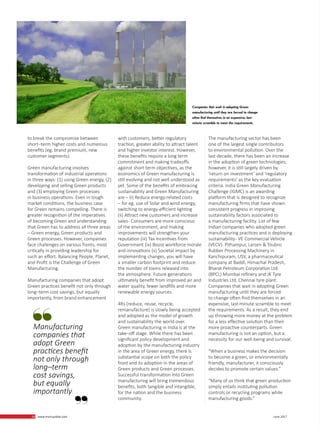
Manufacturing
companies that
adopt Green
practices benefit
not only through
long–term
cost savings,
but equally
importantly.
Companies that wait in adopting Green
manufacturing until they are forced to change
often find themselves in an expensive, last-
minute scramble to meet the requirements.
19 June 2017 www.martupdate.com 19
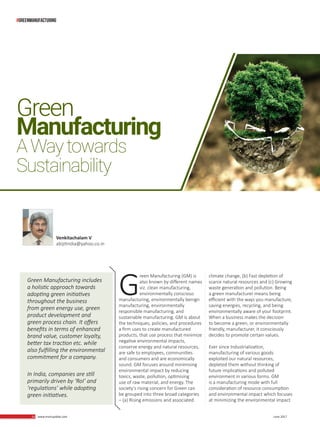
20 www.martupdate.com 20 June 2017
I
n our science textbook of 9th grade
(CBSE Syllabus) we had a chapter on
Environment Pollution. It was the
last chapter of the book. Our teacher
told us to do self-study without investing
too much time on it as only one question
of two marks was expected to come in
the exam from that chapter. Now, it’s
been close to three decades since then
and, guess what? Environment pollution
is still the least important chapter in our
lives. It is given least weightage.
With the dawn of the industrial
revolution, a global economy has
emerged, and our population has
grown exponentially. With coming of
the Industrial Revolution, humans could
advance further into the 21st century.
Technology developed rapidly, advanced
science crept in giving wide way to
manufacturing. The changing phase
brought yet another effect in the form
of Industrial Pollution. Factory pollution
Sanjeev Himachali
sanjeev.himachali@gmail.com
Environment
Training
andGreen
Programmes
forEmployeesinManufacturing
People were blinded by the
glitter of development with
Industrial Revolution, so
much so, that impacts of
unbridled industrial growth
on environment remained
unnoticed, until environment
reached a precarious stage.
For people in an industrial
organisation, creating
awareness about
environmental laws and
regulations, and following
some basic rules, guided by HR
professionals, can be a good
ploy to the ultimate goal of
environmental protection.
is often assumed to be smokestack
emissions, but it pollutes water and
land as well. Once pollutants enter
the atmosphere or the water system,
they can spread far and wide beyond
the factory. Factories contribute to
water and land pollution by acidifying
rain, chemical spills and disposal of
toxic waste. It is estimated that about
50% of pollution is due to industrial
and manufacturing activities. Hence,
understanding our external physical,
biological and chemical environment,
and how it affects individuals and man-
made systems, has become an essential
part of maintaining a healthy human
population.
While as an individual, I can contribute
in different ways to protect or save
the environment, either individually or
through groups or NGO’s; as a Human
Resource Professional, working for a
profit-making organization, my role
#greenmanufacturing
21 June 2017 www.martupdate.com 21
gift them a plant. We plant a tree on
their behalf with a nameplate of their
name, either in our factory or in nearest
forests through NGO’s we are associated
with.
8. Environment Pollution Awareness
Training Program – Every quarter we
conduct awareness training programs
and workshops for villagers living in the
vicinity of our factory as well as schools
within 10 KMS of the radius of our
factory. In total, 3,000 to 5,000 people
participate in our programs.
Till now, there are about 17 industries
which are declared to be most polluting.
These include the caustic soda, cement,
dis¬tillery, dyes and dye intermediaries,
fertilizers, iron and steel, oil refineries,
paper and pulp, pesticides and
pharmaceuticals, sugar, textiles, thermal
power plants, tanneries and so on.
Pollution caused by these industries has
a direct impact on human life.
As an HR Leader, I ensure that every
member of my team and every manager
of the organization are well versed
with Environment Protect Act, 1986
and standards of ISO 14001(EMS
- Environment Management System)
and ISO 18001 (OSHA- Occupational
Health and Safety Assessment Series).
The basic principles of ISO 14001 and
ISO 18001 based on PDCA – Plan, Do,
Check and Act. Standards of EMS exists
to help organizations (a) minimize
how their operations (processes, etc.)
negatively affect the environment (i.e.,
cause adverse changes to air, water, or
land); (b) comply with applicable laws,
regulations, and other environmentally
oriented requirements; and (c)
continually improve in the above.
As far as environment pollution is
concerned, we are in a very dangerous
situation and it’s a time to take tough
decisions and actions. One person might
not be able to do everything to save and
protect our environment but together
we all can do something to give a better
environment to our future generation.
Let’s not pass on our accountability to
Government and Business Houses.
Sanjeev Himachali is a Talent
Management and Development
professional with over a decade and
a half years of experience in various
facets of Human Resource Management
across various industries, cultures, and
geographies. He helps start-ups, small-
sized and mid-sized organisations in
identifying and developing potential and
competencies of their employees.
gets restricted to creating awareness,
conducting training programs and
complying with the relevant law.
Let me share with you some of the
initiatives I took and what environment-
friendly organizations in manufacturing
industry do, to protect the environment
1. Paperless Offices – We maintain
employee files digitally. Every
communication with an employee,
leave approval, issuance of promotion,
transfer letter, etc. is done electronically.
Communication with Government
bodies, wherever possible, such as PF
Office, is done electronically.
2. Open space Cubicles v/s Closed
Cabins – Recently, I visited a factory
and I was a bit surprised to see over 25
cabins of the size of 150x150 sq. ft., each
equipped with air-conditioners. Instead,
I often recommend having cubicles
and use fans or air coolers (a set-up we
follow in my organization).
3. Carpooling or Company Transport
– In our office, employees are advised
not to bring their vehicles to the
factory; instead, they use office
vehicle. Wherever it is not possible for
the company transport to reach, we
recommend carpooling.
4. Stick to the schedule (No Overtime)
– Working for longer hours also means
a use of more electricity and other
resources. Hence, we strictly follow
office working hours. Staying late is
highly discouraged.
5. Rain Harvesting and Sewage
Water Recycling/Treatment – We use
rainwater harvesting instead of bore
well. We also have a sewage water
treatment plant. The water is then used
for irrigating the garden, and plants
maintained in the office premises.
6. Solar Energy – We use solar energy
for lighting streets, pathways, and
garden in our factory. Not only does this
help in resource optimization but also in
cost saving.
7. Gift a Plant- Whenever premium
guests, foreign delegates, a key client,
customer or vendor visit our office, we
Environmental
protection
is a concern
as well as
responsibility for
all and sundry,
independent
of actions by
government or
organisations.
We plant a tree on their behalf with a nameplate of their
name, either in our factory or in nearest forests through
NGO’s we are associated with.
22 www.martupdate.com 22 June 2017
For the rapidly growing human
population, the availability of
so called abundant natural
resources is shrinking; and
the case of water is no different!
Pune Techtrol Pvt. Ltd., the leading
manufacturer of level measurement
and control instruments, has always
recognized the importance of preserving
the environment and has believed in
contributing to this noble cause.
Human beings can use and consume
only fresh water. While three-fourth of
the Earth’s surface is covered in water,
only three percent of it is fresh; and
seventy percent of this three percent
is locked up in the ice caps of Antarctic
and Arctic regions. What remains, is to
be used by the entire human population
of seven billion for their ever increasing
needs, and habitual wastage. Also,
around ninety percent of fresh water
that is consumed, goes down the drains
as waste water. Industries, which are
increasing continuously in numbers,
create lots of harmful pollutants that
get mixed with water. The rate at which
human beings are bidding farewell to
water in the form of waste is indeed
alarming.
Thus, arises the dire need of waste water
management. Waste water treatment is
the process of removing contaminants
from waste water and making it reusable
for all purposes. Processing of waste
water is important with regards to the
need of environment preservation in the
current times. Waste water, if allowed
to flow untreated, can play havoc not
only with humans, but also with crops,
forests and wild life as well. Hence, the
treatment of waste water or effluent is
SaveWater,
SaveLives,
SaveFuture!
SaveWater,
SaveLives,
SaveFuture!
The level measurement
and control instruments
manufactured and supplied
by Pune Techtrol Pvt. Ltd. are
widely used in the processes of
waste water treatment.
‘Techtrol’ is recognized as
most reliable & trusted brand,
delivering quality products
unsurpassed in terms of
accuracy, workmanship,
performance, safety & ease
of installation, providing long
uninterrupted service in wide &
varied industrial applications.
C N Shukla
Training & Development Consultant,
Pune Techtrol Pvt. Ltd
#greenmanufacturing
23 June 2017
increasingly becoming vital for survival
of human race and the environment.
All waste water treatment processes
require level monitoring and control.
Level instruments are installed in
almost all parts of water treatment and
effluent treatment plants. The level
measurement and control instruments
manufactured and supplied by Pune
Techtrol Pvt. Ltd. are widely used in the
processes of waste water treatment.
A very useful feature of “Techtrol”
instruments is that there is wide choice
of Material Of Construction (MOC)
for all the instruments to suit specific
requirements of the medium or liquid
whose level is to be measured, detected
or monitored.
These level instruments are mainly
classified into level gauges, level
switches and level transmitters. These
“Techtrol” level instruments are
specifically designed for this particular
application, and hence increase the
efficiency and reliability of the process.
The application of each of these
level instruments for waste water
management is explored further:
Using Level Gauges for Waste Water
Management:
Pune Techtrol’s wide range of level
gauges useful for in the application of
waste water management are as follows:
• Tubular Level Gauge (TTG) and Reflex
Flat Glass Gauge (RFG) are glass gauges
used to indicate liquid levels of chemical
tanks & other storage /process tanks.
• Magnetic Level Gauge (MLG) is used
to indicate levels of storage tanks of
acid & alkali. It can also be improvised
with alarm switches and transmitter for
remote indication and control.
• Float and Dial Gauge (FDG) is useful for
indication of liquid level in under-ground
tanks. It is particularly suitable for
applications involving limited head-space
above the tank. It can also be improvised
with alarm switches and transmitter for
remote indication and control.
• Float & Board Gauge (FBG) is the
simplest but very reliable instrument
used for indication of liquid level in large
storage tanks of effluent / treated water.
It can also be improvised with alarm
switches.
Using Level Switches for Waste Water
Management:
Pune Techtrol’s wide range of level
switches useful for in the application of
waste water management are as follows:
• Float Guided Switch (FGS) is single
or multipoint level switch used for
in clarifier and aeration tank. These
switching contacts can be used for alarm
indication or pump control.
• Displacer Switch (DS) is more suited for
application in clear effluent and potable
water. Switching points rated for 5A,
250VAC and can be adjusted at site as
required.
• Cable Suspended Switch (FTS) is a
simplest type switch and easy to install.
These switching contacts are rated for
5A, 250VAC and can be used for alarm
indication or pump control and are
ideally suitable for application in settling
tanks.
• Conductivity Type Switch (CNS) is used
only for conductive liquids. It can be
used for treated & potable water. More
suitable in applications where the depth
of tank is large.
• Float Pivoted Switch (FPS) is side
mounted, single point switch rated for
5A, 250VAC. It is suitable for over ground
tanks.
• Miniature Float Switch (MFPS/MFGS)
is used for level detection in small /
medium tanks.
Using Level Transmitter for Waste
Water Management:
Pune Techtrol’s level transmitter useful
for in the application of waste water
management is as follows:
• The Techtrol Ultrasonic Transmitter
(TUS) is a non-contact type level
transmitter, generally used for
measurement of flow in open channel or
level monitoring in tanks. It is compact,
non-contact, and easy to install, integral
type transmitter for continuous level
measurement of non-corrosive liquids
and slurries. It is programmable through
Keys. Owing to its aforementioned
characteristics, it proves highly useful
in waste water management plants. It
is used for various processes in storage
tanks, filter beds, flotation cells, water
/ waste water/effluent treatment (WTP,
ETP), etc.
Since its inception, Pune Techtrol Pvt.
Ltd. has time and again innovated
and added on to the list of level
measurement and control instruments
which can be used for applications like
waste water management. It takes pride
in being not only a company of products,
but a company of value too!
For further information please mail us at
ho@punetechtrol.com or
visit www.punetechtrol.com
Level Gauges Level Switches Level Transmitters
24 www.martupdate.com 24 June 2017
RAKESH
KUMAR
Director, CSIR-National Environmental
Engineering Research Institute
#onface
25 June 2017 www.martupdate.com 25
Proactive Industry
SustainableIndustrial
Environment has not been given due importance in industries’ priority list
and “understaffed” pollution control boards have been too meek at times.
No wonder environmental impact of industries has grown unbridled. It is
time industries do proactive thinking about the sustainability factor and
take measures in compliance with environmental norms and regulations
to reduce delays in projects and help environment protection. Pollution
control boards jointly with research and academic institutions can provide
right directions guidance to industries. Dr. Rakesh Kumar, Director, CSIR-
National Environmental Engineering Research Institute (CSIR-NEERI), shares
his views on this enigmatic industry-environment relationship while also
giving glimpses NEERI’s effort in this.
Growth
Scrapping and delay of
industrial projects due to
environmental norms and
clearances is common in
India. Though industrial
growth is essential for
economy, environmental
protection is inevitable
and priority. Where are
the industries in India
lagging behind global
counterparts in achieving
‘sustainability’?
The delays in environmental
clearances have been very
often touted as the main
reason of slow industrial
development. Some of these
can be attributed to lack of
preventive environmental
planning by the industries.
Till date mostly, if not
all, the industries have
addressed environment
and sustainability issues
as an external to their
normal operation. These are
addressed after all the other
aspects of industries’ setting
up are planned. Proactive
thinking about what is
needed for the India specific
rules and other norms
would prevent delays.
Talking about the pollution
control boards in India, do
you think the bodies should
play more active role in
monitoring and guiding
about the environmental
aspects of industry rather
than the current inspection
and certification method?
SPCBs (State Pollution
Control Boards) have a big
role to play in guiding the
The delays in
environmental
clearances
have been very
often touted
as the main
reason of
slow industrial
development.
26 www.martupdate.com 26 June 2017
industries in terms of what
kind of proactive measures
industries can take and
advise them in advance.
Also since SPCBs are
understaffed in most states,
the preventive planning
and planning can be done
through research and
academic institutions which
will be long lasting and
sustainability principles can
be ingrained.
NEERI has been closely
monitoring and guiding
projects for several
Indian rivers which are
severely affected, among
many other reasons, by
industrial effluents and
discharges. Do you consider
this situation a lack of
awareness, lack of options
or lack of intention on the
part of industries?
Indian rivers are affected
due to multiple reasons
of which major factors
are untreated sewage
ingress, industrial pockets
discharging effluents
and poor summer flows.
Industrial discharges by
major industries are mainly
due to commitment to
safeguard environment
and river, whereas small
scale industries need more
awareness and finances to
deal with their discharges.
Common collection and
treatment could be a
possibility, however, proper
design system and basic well
maintained primary system
by industries will be major
pre-requisite criteria for
success.
Is there any integrated
solution available for
the industries to assess
environmental impacts of
their industrial processes,
rectify it and also use
generated data for their
Environment Management
System in future?
Integrated solution for
industries is available.
Sustainability analysis can
provide the inputs to their
environment footprint of
process and products. This
kind of analysis can be used
to improve their operation
and also anticipate any
future requirement. Regular
credible monitoring and
analysis can be the first
step towards analyzing
areas of improvement and
management system.
You have made notable
contributions in developing
technologies for reuse and
recycle of domestic and
industrial waste water.
Please throw some light on
such technologies.
NEERI has been working
in the field of waste water
reuse and recycle for a
long time. It has specific
treatment packages for all
sectors of industries.
It is a
challenging
time for
country in
terms of push
for more
manufacturing
and creation
of jobs while
keeping our
environmental
infrastructure
safe for future
generation.
Dr. Rakesh Kumar is the Director of
the CSIR-National Environmental
Engineering Research Institute
(CSIR-NEERI). Prior to this role,
Dr. Kumar was Chief Scientist and
Head of Mumbai Zonal Laboratory,
CSIR-NEERI. He obtained M. Tech.
in Environmental Science and
Engineering from IIT-Bombay and
Ph.D. in Environmental Engineering
from RTM Nagpur University.
A visionary for sustainable
development, Dr. Kumar has made
a notable contribution in developing
technologies for recycle and reuse of
domestic and industrial wastewater
which brought a paradigm shift in the
country.
He has received 9 awards for
his outstanding contributions in
Environmental Science & Engineering,
among which the notable ones
are Commonwealth Commission
Award, UK in 1994; “Environmental
Leadership Award” by US Asia
Environmental Partnership and US-
AID for the year 2005 for outstanding
contribution in improving quality of
life for the population of Asia. He
has been given an award for largest
number of technology transfer for
low cost waste water treatment-
PHYTORID in the year 2012. He has
been given VASVIK award for 2012
for his exemplary work for urban
environment improvement and
sustainable technology “Phytorid”
for sewage treatment for better
environment. He has been recently
awarded “Hiyoshi Think of Ecology
Award” in September 2015 for his
work on use of ecology in solving
environmental engineering problems.
27 June 2017 www.martupdate.com 27
CETP processes for various
types of clusters have been
developed and designed
by CSIR-NEERI for many
locations.
For sewage treatment,
Phytorid Technology has
been developed which
not only treats sewage
better than most of the
conventional technologies
but also does with a minimal
O&M cost as it does not
need power and moving
machineries. It has been
installed at many places
across country and has been
accepted well. Similarly, for
rural sanitation and urban
poor, various designs have
been developed and being
deployed.
Is NEERI working on any
environmental technologies
currently, especially for
addressing industrial
pollutions?
It is working on pharma,
chemical clusters for
advance oxidation processes
for treatment of effluents.
The other sectors are
fertilizers and leather sectors
where better technologies
are being developed.
NEERI has taken up the
first-of-its kind noise levels
mapping project in the
country. Please tell us
about the project.
We have been carrying
out noise monitoring at
various places such as
cities, highways, industrial
sources. Recently we have
undertaken a major work
of noise monitoring for 27
cities in Maharashtra. This
is not limited to monitoring
but our scientists, engineers
will delineate silence zones.
In addition, identification of
areas where noise barriers
are required options of
types of noise protection.
With all the manufacturing
and industrial growth
taking place in the
country, how do you see
environmental impact in
future? As the Director of
CSIR-NEERI what are your
suggestions for Indian
manufacturing industry to
achieve sustainability?
It is a challenging time for
country in terms of push
for more manufacturing
and creation of jobs while
keeping our environmental
infrastructure safe for
future generation. Indian
manufacturing industries
can start the process of
sustainability thinking well
in advance and not wait
for pollution control board
directions or any other
governmental pressures.
With a view to address this
issue, CSIR-NEERI has set
up an Industries Desk which
will be on single point of
contact for any industries
to seek information
and guidance. Vidarbha
Industrial Association has
signed an MoU with CSIR-
NEERI to seek this advantage
on 5th June, 2017, World
Environment Day. We would
encourage that industries
and cities both come and
be part of the team in this
country which will solve
the present problems and
anticipate future issues.
CSIR-National Environmental
Engineering Research
Institute (CSIR-NEERI), as a
Stockholm Convention
Regional Centre (SCRC)
on Persistent Organic
Pollutants (POPs) for
Asia Region, organized a
workshop on ‘Stockholm
and Rotterdam Conventions
and Associated Challenges”
at CSIR-NEERI on June 6,
2017 in association with
Ministry of Environment,
Forest & Climate Change.
In his opening remarks,
Director, CSIR-NEERI Dr.
Rakesh Kumar mentioned
the objectives and role of
Stockholm and Rotterdam
Conventions.
CSIR-NEERI, Nagpur is
devoted to research
and innovations in
environmental science and
engineering besides solving
a range of problems posed
by industry, government and
public. It is a constituent
of Council of Scientific &
Industrial Research (CSIR),
New Delhi and has a nation-
wide presence with its
five zonal laboratories at
Chennai, Delhi, Hyderabad,
Kolkata and Mumbai.
NEERI has
been working
in the field of
waste water
reuse and
recycle for a
long time. It
has specific
treatment
packages for
all sectors of
industries.
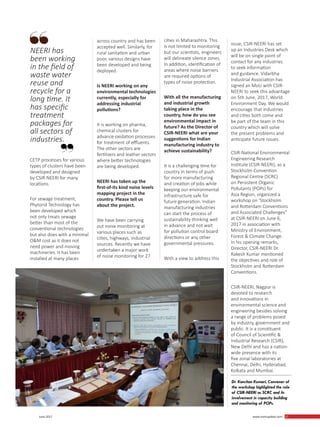
Dr. Kanchan Kumari, Convener of
the workshop highlighted the role
of CSIR-NEERI as SCRC and its
involvement in capacity building
and monitoring of POPs.
28 www.martupdate.com 28 June 2017
Corporate houses sometimes tread beyond the trodden ways to participate in
CSR in innovative ways. In the following article instances have been given where
a multinational automotive company supports training programme for growth
of a primary sector of economy, while a famous chain of hotels runs activities
to touch lives of underprivileged children and ensure environmental protection
through innovative methods.
Manoj Kabre
manoj.k@indo-mim.com
Corporate social responsibility (CSR) promotes a vision of
business accountability to a wide range of stakeholders,
besides shareholders and investors. Key areas of concern in
this article, are environmental protection and the wellbeing of
employees, the community and civil society in general, both
now and in the future.
Yale and Columbia University in its recently published 2016
Environmental Performance Index (EPI) has ranked India at
144th place among 180 countries with over all score of 53.58.
One bright side of 2016 ranking of India is 20% improvement
in various parameters in last 10 years specially in sanitation
and waste water treatment but the deteriorated air quality
due to emission from power plants, industries, fossil fuel
burning etc. which has placed India at almost bottom (178th
place) is quite deploring and call for urgent and concentrated
efforts to improve it. The Corporates need to expand their
ongoing endeavors in these directions.
Following are some of the Environmental benefits that are
aimed at being accomplished through various initiatives :
• Greater material recyclability;
• Better product durability and functionality;
• Greater use of renewable resources;
• Integration of environmental management tools into
business plans, including life-cycle assessment and costing,
environmental management standards, and eco-labeling.
We have CSR activities from the following organisations in this
issue:
1. Bajaj Auto
2. Shangri-La’s - Eros Hotel, New Delhi
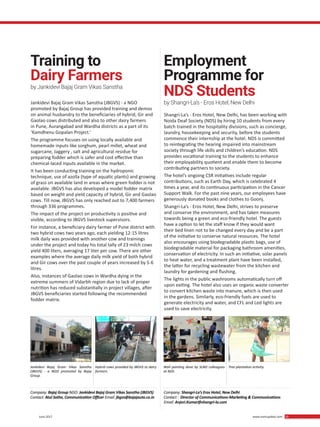
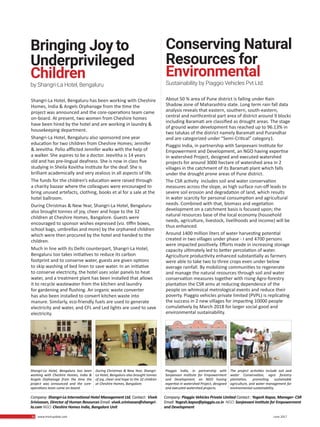
3. Shangri-La Hotel, Bengaluru
4. Piaggio Vehicles Private Limited
Manoj Kabre, Vice President of Indo-MIM Pvt Ltd, has directed
and headed the sales & marketing function for Asia and
parts of Europe, spoke at various forums across the world for
propagating the MIM technology. His laudable work includes,
Chairing – CSR Committee of RBWC, Founding of CaN Trust
(NGO), working for needy children. He is also on advisory
committee of ‘Your Philanthropy Story’ (YPS) which captures
stories through interviews of heroes and the cause they are
associated with.
Innovative
WaysofCSR
#CSR
29 June 2017 www.martupdate.com 29
Jankidevi Bajaj Gram Vikas Sanstha (JBGVS) - a NGO
promoted by Bajaj Group has provided training and demos
on animal husbandry to the beneficiaries of hybrid, Gir and
Gaolao cows distributed and also to other dairy farmers
in Pune, Aurangabad and Wardha districts as a part of its
‘Kamdhenu Gopalan Project.’
The programme focuses on using locally available and
homemade inputs like sorghum, pearl millet, wheat and
sugarcane, Jaggery , salt and agricultural residue for
preparing fodder which is safer and cost effective than
chemical-laced inputs available in the market.
It has been conducting training on the hydroponic
technique, use of azolla (type of aquatic plants) and growing
of grass on available land in areas where green fodder is not
available. JBGVS has also developed a model fodder matrix
based on weight and yield capacity of hybrid, Gir and Gaolao
cows. Till now, JBGVS has only reached out to 7,400 farmers
through 336 programmes.
The impact of the project on productivity is positive and
visible, according to JBGVS livestock supervisors.
For instance, a beneficiary dairy farmer of Pune district with
two hybrid cows two years ago, each yielding 12-15 litres
milk daily was provided with another cow and trainings
under the project and today his total tally of 23 milch cows
yield 400 liters, averaging 17 liter per cow. There are other
examples where the average daily milk yield of both hybrid
and Gir cows over the past couple of years increased by 5-6
litres.
Also, instances of Gaolao cows in Wardha dying in the
extreme summers of Vidarbh region due to lack of proper
nutrition has reduced substantially in project villages, after
JBGVS beneficiaries started following the recommended
fodder matrix.
Training to
Dairy Farmers
by Jankidevi Bajaj Gram Vikas Sanstha
Jankidevi Bajaj Gram Vikas Sanstha
(JBGVS) - a NGO promoted by Bajaj
Group.
Wall painting done by SLND colleagues
at NDS.
Hybrid cows provided by JBGVS to dairy
farmers.
Tree plantation activity.
Shangri-La’s - Eros Hotel, New Delhi, has been working with
Noida Deaf Society (NDS) by hiring 10 students from every
batch trained in the hospitality divisions, such as concierge,
laundry, housekeeping and security, before the students
commence their internship at the hotel. NDS is committed
to reintegrating the hearing impaired into mainstream
society through life skills and children’s education. NDS
provides vocational training to the students to enhance
their employability quotient and enable them to become
contributing partners to society.
The hotel’s ongoing CSR initiatives include regular
contributions, such as Earth Day, which is celebrated 4
times a year, and its continuous participation in the Cancer
Support Walk. For the past nine years, our employees have
generously donated books and clothes to Goonj.
Shangri-La’s - Eros Hotel, New Delhi, strives to preserve
and conserve the environment, and has taken measures
towards being a green and eco-friendly hotel. The guests
have a option to let the staff know if they would want
their bed linen not to be changed every day and be a part
of the initiative to conserve natural resources. The hotel
also encourages using biodegradable plastic bags, use of
biodegradable material for packaging bathroom amenities,
conservation of electricity. In such an initiative, solar panels
to heat water, and a treatment plant have been installed,
the latter for recycling wastewater from the kitchen and
laundry for gardening and flushing.
The lights in the public washrooms automatically turn off
upon exiting. The hotel also uses an organic waste converter
to convert kitchen waste into manure, which is then used
in the gardens. Similarly, eco-friendly fuels are used to
generate electricity and water, and CFL and Led lights are
used to save electricity.
Employment
Programme for
NDS Students
by Shangri-La’s - Eros Hotel, New Delhi
Company: Bajaj Group NGO: Jankidevi Bajaj Gram Vikas Sanstha (JBGVS)
Contact: Atul Sathe, Communication Officer Email: jbgvs@bajajauto.co.in
Company: Shangri-La’s Eros Hotel, New Delhi
Contact : Director of Communications-Marketing & Communications
Email: Anjori.Kumar@shangri-la.com
30 www.martupdate.com 30 June 2017
Shangri-La Hotel, Bengaluru has been working with Cheshire
Homes, India & Angels Orphanage from the time the
project was announced and the core-operations team came
on-board. At present, two women from Cheshire homes
have been hired by the hotel and are working in laundry &
housekeeping department.
Shangri-La Hotel, Bengaluru also sponsored one year
education for two children from Cheshire Homes; Jennifer
& Jeevitha. Polio afflicted Jennifer walks with the help of
a walker. She aspires to be a doctor. Jeevitha is 14 years
old and has pre-lingual deafness. She is now in class five
studying in Sheila Kovitha Institute for the deaf. She is
brilliant academically and very zealous in all aspects of life.
The funds for the children’s education were raised through
a charity bazaar where the colleagues were encouraged to
bring unused artefacts, clothing, books et al for a sale at the
hotel ballroom.
During Christmas & New Year, Shangri-La Hotel, Bengaluru
also brought tonnes of joy, cheer and hope to the 32
children at Cheshire Homes, Bangalore. Guests were
encouraged to sponsor wishes expressed (viz. tiffin boxes,
school bags, umbrellas and more) by the orphaned children
which were then procured by the hotel and handed to the
children.
Much in line with its Delhi counterpart, Shangri-La Hotel,
Bengaluru too takes initiatives to reduce its carbon
footprint and to conserve water, guests are given options
to skip washing of bed linen to save water. In an initiative
to conserve electricity, the hotel uses solar panels to heat
water, and a treatment plant has been installed that allows
it to recycle wastewater from the kitchen and laundry
for gardening and flushing. An organic waste converter
has also been installed to convert kitchen waste into
manure. Similarly, eco-friendly fuels are used to generate
electricity and water, and CFL and Led lights are used to save
electricity.
About 50 % area of Pune district is falling under Rain
Shadow zone of Maharashtra state. Long term rain fall data
analysis reveals that eastern, southern, south-eastern,
central and northcentral part area of district around 9 blocks
including Baramati are classified as drought areas. The stage
of ground water development has reached up to 96.13% in
two talukas of the district namely Baramati and Purandhar
and are categorized under “Semi-Critical” category1.
Piaggio India, in partnership with Sanjeevani Institute for
Empowerment and Development, an NGO having expertise
in watershed Project, designed and executed watershed
projects for around 3000 hectare of watershed area in 2
villages in the catchment of its Baramati plant which falls
under the drought prone areas of Pune district.
The CSR activity includes soil and water conservation
measures across the slope, as high surface run-off leads to
severe soil erosion and degradation of land, which results
in water scarcity for personal consumption and agricultural
needs. Combined with that, biomass and vegetation
development on a catchment basis is focused upon; the
natural resources base of the local economy (household
needs, agriculture, livestock, livelihoods and income) will be
thus enhanced.
Around 1400 million liters of water harvesting potential
created in two villages under phase - I and 4700 persons
were impacted positively. Efforts made in increasing storage
capacity ultimately led to better percolation of water.
Agriculture productivity enhanced substantially as farmers
were able to take two to three crops even under below
average rainfall. By mobilizing communities to regenerate
and manage the natural resources through soil and water
conservation measures together with rising Agro-forestry
plantation the CSR aims at reducing dependence of the
people on whimsical metrological events and reduce their
poverty. Piaggio vehicles private limited (PVPL) is replicating
the success in 2 new villages for impacting 10000 people
cumulatively by March 2018 for larger social good and
environmental sustainability.
Shangri-La Hotel, Bengaluru has been
working with Cheshire Homes, India &
Angels Orphanage from the time the
project was announced and the core-
operations team came on-board.
Piaggio India, in partnership with
Sanjeevani Institute for Empowerment
and Development, an NGO having
expertise in watershed Project, designed
and executed watershed projects.
During Christmas & New Year, Shangri-
La Hotel, Bengaluru also brought tonnes
of joy, cheer and hope to the 32 children
at Cheshire Homes, Bangalore.
The project activities include soil and
water Conservation, agro forestry
plantation, promoting sustainable
agriculture, and water management for
environmental sustainability.
Company: Shangri-La International Hotel Management Ltd. Contact: Vivek
Srinivasan, Director of Human Resources Email: vivek.srinivasan@shangri-
la.com NGO: Cheshire Homes India, Bangalore Unit
Company: Piaggio Vehicles Private Limited Contact : Yogesh Kapse, Manager- CSR
Email: Yogesh.kapse@piaggio.co.in NGO: Sanjeevani Institute for Empowerment
and Development
Bringing Joy to
Underprivileged
Children
by Shangri-La Hotel, Bengaluru
Conserving Natural
Resources for
Environmental
Sustainability by Piaggio Vehicles Pvt Ltd.
31 June 2017 www.martupdate.com 31
We are interested to subscribe “Industrial Business MART” as per the selected option:
One Year (12 issues) at 1800
Three Year (36 issue) at 4500, you save 900
Five Year (60 issues) at 6000, you save 3000
Name............................................................................................
Company....................................................................................................................................................
Address......................................................................................................................................................
City .............................................................
Mob ................................................. Email ..........................................................................................
Send your subscription to: The Circulation Manager
MART Infomedia Private Limited
Second Floor, Ariana, Bhumkar Chowk Marunji Road Near New Poona Bakery,
Wakad, Pune - 411057 India Tel: +91 70 3093 2700/ 3093/ 2696
Email: mart@martinfotech.in Web: www.martupdate.com
dated ......................................
.............................................................................................. Bank favoring “Mart Infomedia Pvt Ltd”
Pin ............................. Tel ..............................................
Designation.........................................
(Signature of the Subscriber)
Enclosed please find Cheque ................................... of ..........................
Industrial Business MART is one of the fastest growing engineering manufactur-
ing journals focusing on best manufacturing practices and happening in India
and abroad. We promise the readers to provide knowledge through cutting edge
article contributed by industry experts. MART aims to encourage manufacturing
as well as bridge the gap between industry and academia.
Subscription to MART will be a step towards polishing your knowledge of the manufacturing world.
32 www.martupdate.com 32 June 2017
Artificial Intelligence is the science concerned with the
creation of machine intelligence which is able to perform
tasks, only performed by people. Much of this machine
intelligence is symbolic and heuristic. Artificial intelligence
(AI) is intelligence exhibited by machines. In computer
science, an ideal “intelligent” machine is a flexible rational
agent that perceives its environment and takes actions that
maximize its chance of success at some goal. Colloquially,
the term “artificial intelligence” is applied when a machine
mimics “cognitive” functions that humans associate with
other human minds, such as “learning” and “problem solving.
AI research is divided into subfields that focus on specific
problems or on specific approaches or on the use of a
particular tool or towards satisfying particular applications.
The central problems (or goals) of AI research include
reasoning, knowledge, planning, learning, natural language
processing (communication), perception and the ability
to move and manipulate objects. Approaches include
statistical methods, computational intelligence, soft
computing (e.g. machine learning), and traditional symbolic
AI. Many tools are used in AI, including versions of search
and mathematical optimization, logic, methods based on
probability and economics. The AI field draws upon computer
science, mathematics, psychology, linguistics, philosophy,
neuroscience and artificial psychology.
Globalization of the world economy and growth of
competition on the market impose increasingly greater
demands on modern entrepreneurs. Currently, management
and control of production enterprises is impossible without
an application of appropriate tools supporting decision
making at each stage of a company’s functioning from
designing through to product exploitation. CIM (Computer
Integrated Manufacturing) Systems are an example of
such available tools that enable composite automatization
of technological and organizational preparation for
manufacture, current supervision, technological process
control, organization and management. The development of
CIM Systems has, in recent years, been directed at applying
the methods of artificialintelligence to support decision
processes and production control as well as monitoring,
simulation andtechnological process diagnosis.
Intelligent Manufacturing is:
“A set of methods, procedures and tools (e.g. CAD, CAP, CAM)
equipped with artificial intelligence tools and supporting
designing, planning and manufacturing.”
The following, among others, are the basic constituent
elements of Intelligent Manufacturing Systems mentioned as
Artificial intelligence’s ability to
function as a safety measure and
provide another set of eyes, so to
speak, can be extremely beneficial
to worker safety in
manufacturing.
Intelligent
Manufacturing Rajesh Angadi
rajeshangadi2013@gmail.com
Artificial Intelligence will transform the manufacturing into intelligent
manufacturing where AI will not only guide numerically controlled
machines and robots, but will play key role in their management system.
Though such Computer Integrated Manufacturing System created by AI
poses challenge to human workforce, it will in a way eradicate the need for
human beings to engage in repetitive and poorly paying tasks.
#AI
33 June 2017 www.martupdate.com 33
follows:
• Intelligent machines and tools, i.e. numerically controlled
machines and robots,
• Intelligent manufacturing systems, and
• Intelligent management systems.
The concept of intelligent manufacturing combines the ability
of decision-making support systems in generative systems
to obtain knowledge, to learn and to adapt to a changing
environment and to the actual arrangement of system
components. The nature of intelligent manufacturing is
system’s possibility to learn and its self-development as well
as the possibility to generate information necessary to control
the integrated productionsystem.
Designing Intelligent Manufacturing System
Intelligent Manufacturing System of a production enterprise
denotes a manufacturing systems integrated with information
system which provides necessary information, enables its
analysis and use of analytical and simulation- based decision
making models in order to assist decision making at each
stage of decision process, as well as it is capable of learning
and adapting to the dynamically changing environment
and the current arrangement of system components. In
other words, it is a decision supporting system based on the
applied methods and tools of artificial intelligence able to
solve complex decision problems, semi structured or non-
structured, requiring the processing of incomplete,unreliable,
contradictory, or difficult to formalize knowledge.
The demands towards Intelligent Management Systems in a
production enterprise are as follows:
• A possibility of collecting and processing different types of
information from all sources, both internal and external in
order to acquire and model knowledge necessary to make
decisions at all levels of decision process in an enterprise.
At the same time, a possibility of modeling knowledge and
processes, based on human thinking, is required.
• In a decision process, at decision selecting, the decision
maker’s subjective evaluation based on hisexperience and
intuition should be taken into account in IMS.
• There should be a possibility of preliminary information
handling and analysis with analytical methods as well as
modern artificial intelligence technologies.
• A possibility of detecting emergency and critical situations
and of prompt reaction to them. There must be a possibility
of situational data analysis in real time, necessary in
an emergency inside the production system or in its
surroundings.
• A possibility to allow for complexity and comprehensiveness
of decision-making issues in strategic management support.
• Taking into account the lack of stability and change
dynamics, both in the surroundings and inside the enterprise,
the IMSs under design should have the capability for learning
from experience and adapting the experience to intensive
alteration of working conditions.
In intelligent manufacturing systems, the following selected
contemporary methods and techniques of knowledge and
decision process modeling should be integrated:
• Artificial neural networks – the most fascinating tool of
artificial intelligence, capable of modeling extremely complex
functions and, to some extent, copying the learning activity in
the human brain.
• Fuzzy logic – technologies and methods of natural language
In intelligent manufacturing systems, the
following selected contemporary methods
and techniques of knowledge and decision
process modeling should be integrated.
Input
Ouput
→
→
Fuzzify
Inputs
Aggregate
Outputs Defuzzify
Apply
Rules
Artificial intelligence’s ability to
function as a safety measure and
provide another set of eyes, so to
speak, can be extremely beneficial
to worker safety in
manufacturing.
34 www.martupdate.com 34 June 2017
formalization, linguistic and quality knowledge processing and
fuzzification.
• Genetic algorithms and methods of evolutionary modeling
– learning algorithms based on theoreticalachievements of
the theory of evolution, enriching the artificial intelligence
techniques.
The combination of these tools, in which knowledge is
represented symbolically, with the traditional expert system
will make it possible to create complex programmatic tools
for solving difficult decision-making problems at eachstage of
enterprise functioning.
Artificial Intelligence and Control Engineering
Artificial intelligence (AI) relates to control engineering when
embedded software helps with situational awareness. The
software algorithm looks at feedback from a situation, then
actuates the decision (closed-loop control) without human
consultation, or the software recommends a course of
action with human consultation (open-loop control). Control
engineering or control systems engineering is the engineering
discipline that applies control theory to design systems with
desired behaviors.
The practice uses sensors to measure the output
performance of the device being controlled and those
measurements can be used to give feedback to the input
actuators that can make corrections toward desired
performance. Control engineering is the engineering
discipline that focuses on the modeling of a diverse range of
dynamic systems (e.g. mechanical systems) and the design
of controllers that will cause these systems to behave in
the desired manner. Although such controllers need not be
electrical many are and hence control engineering is often
viewed as a subfield of electrical engineering.
There are two major divisions in control theory, namely,
classical and modern, which have direct implications over
the control engineering applications. The scope of classical
control theory is limited to single-input and single-output
(SISO) system design, except when analyzing for disturbance
rejection using a second input. The system analysis is carried
out in the time domain using differential equations, in the
complex-s domain with the Laplace transform while modern
control theory is carried out in the state space, and can deal
with multiple-input and multiple-output (MIMO) systems.
This overcomes the limitations of classical control theory in
more sophisticated design problems. Control engineering
was all about continuous systems. Development of computer
control tools posed a requirement of discrete control system
engineering because the communications between the
computer-based digital controller and the physical system are
governed by a computer clock.
The equivalent to Laplace transform in the discrete domain
is the Z-transform. Today, many of the control systems are
computer controlled and they consist of both digital and
analog components.Therefore, at the design stage either
digital components are mapped into the continuous domain
and the design is carried out in the continuous domain, or
analog components are mapped into discrete domain and
design is carried out there.
In manufacturing, a machine running a web-based process
may have similar situational awareness. There may be a
perfectly good reason to leave the machine running when
the last material runs through the rollers and an operator is
standing in a certain location. If the machine is unattended
at that particular moment, embedded code may begin an
orderly shutdown as the best response. Control Engineering
relates to the next big thing (TNBT) which is the second
generation of smartphones, which have the software
capacity to provide situational awareness. TNBT devices will
Replacing human with robot in
manufacturing is a trend that we can’t
stop or avoid.
Artificial intelligence’s ability to
function as a safety measure and
provide another set of eyes, so to
speak, can be extremely beneficial to
worker safety in manufacturing.
35 June 2017
be able to recognize what is going on inside your area or
site and determine when something is out of normal but
not yet in alarm. Information for this awareness may come
from traditional fixed sensors or even by listening for sound
patterns such as hisses, whistles, clangs, and bangs. TNBT
devices will become true operator assistants; always watching
and always listening for out-of-normal conditions or for
events that require manual intervention.
Seven Artificial Intelligence (AI) tools have proved to be useful
with sensor systems: Knowledge-based systems, fuzzy logic,
automatic knowledge acquisition, neural networks, genetic
algorithms, case-based reasoning, and ambient-intelligence.
Applications of these tools within sensor systems have
become more widespread due to the power and affordability
of present-day computers. The appropriate deployment
of the new AI tools will contribute to the creation of more
competitive sensor systems and applications.
Artificial Intelligence (AI) helps computing in four ways:
1. Natural language understanding to improve
communication.
2. Machine reasoning to provide inference, theorem-proving,
cooperation, and relevant solutions.
3. Knowledge representation for perception, path planning,
modeling, and problem solving.
4. Knowledge acquisition using sensors to learn automatically
for navigation and problem solving.
Artificial intelligence’s ability to function as a safety measure
and provide another set of eyes, so to speak, can be
extremely beneficial to worker safety in manufacturing. It
can also enhance our ability to understand what’s happening
around us and offer solutions that might not be readily
available. As artificial intelligence becomes more prevalent
across industries, from defence to aerospace, experts in the
field will focus on making AI as safe and useful as possible.
Using artificial intelligence in a situation where human lives
depend on success could prove catastrophic. Manufacturing
is going through a revolution from a labor intensive, blue-
collar industry to a white-collar, Silicon Valley industry.
This use of AI to assist managers to efficiently run their
operations is part of the transition from manufacturing being
a labor intensive business to being highly automated at the
operations management level as well as on the production
floor.Artificial intelligence will eventually touch nearly every
industry on the planet, but self-driving cars are among the
most sought-after developments for this technology.
Will artificial intelligence (AI) take control of human race
for Intelligent Manufacturing?
The answer to this question seems to be positive. Several
experts of AI have similar comment as “everything that
humans can do machines can do”. Stephen Hawking
also warned us during an interview with BBC that “The
development of full artificial intelligence could spell the
end of the human race.” Ex Machina, a recent enthralling
science-fiction film presents the possibility of a robot that
has cognitive capability to think, feel and even manipulate
human beings. Self-driving cars, Siri on your iPhone, weather
forecasts, face recognition on your Facebook photos, etc are
all examples. A Japanese company with Deep Knowledge
found out an Artificial Intelligence (AI) as one of the directors
due to its ability to predict market trend that is “not
immediately obvious to humans”. Replacing human with
robot in manufacturing is a trend that we can’t stop or avoid.
Many experts fear that robots will cause a massive job loss
which would result in severe social problems. But it’s not that
simple, a country’s implementation of robots has no proven
relationship to the percentage of manufacturing jobs lot.
Rather they will restructure the labor market, accomplishing
poorly-paying tasks and at the same time creating job
opportunities which require high qualifications. As technology
advances, the low cost, high-accuracy and efficiency of robot
is going to benefit the human society as a whole on a broader
level. The future holds a generated era in which artificial
intelligence comes up with its own designs, its own ideas, its
own products instead of all our tools being passive, us telling
them what to do and them doing it. In real life, however,
artificial intelligence is far more benign, and may provide the
most critical catalyst for the future of manufacturing.
Rajesh Angadi completed his BE, MBA, PMP and is Hadoop
Certified. With 22 years of Information Technology
experience he worked on projects for Unisys, Intel, Satyam,
Microsoft, Ford, Hartford, Compaq, and Princeton.
Will artificial intelligence (AI) take
control of human race for Intelligent
Manufacturing?
36 www.martupdate.com 36 June 2017
In the last issue, we discussed on the inventory control cycle
and various methods of classification of inventory for better
control. In this article, we will discuss further options for
control of Inventory.
A. Bin systems
Here inventory is monitored and controlled using fixed size
of bins. Depending on the number of bins used, it is further
classified as one bin, two bins or three bins replenishment
system
a. One-bin replenishment system:
Here single bin is used for the item. The bin is periodically
checked. Order quantity will be enough to refill the bin. The
size of the bin can be suited to match EOQ (economic order
quantity) or MOQ (minimum order quantity)
b. Two-bins replenishment system:
Here two bins are used. When one bin becomes empty,
that would be a trigger point for the reorder. The size of
bin is dependent on the lead time of replenishment and
consumption during procurement. The advantage is that
triggering of reordering is visual and reorder level (ROL) can
be seen. Not suited when too many varieties are there in
stock. While reordering, fixed quantity is ordered. With bar
coding or RFID, the movement and position of the bin can be
tracked.
c. Three-bins replenishment system:
Here it is like two-bin system except that one extra bin is kept
as a safety stock to take care of fluctuation of lead time of
replenishment and demand during lead time.
B. Accurate forecasting
Inventory can be controlled by accurate forecasting. But
this is not an easy task and a lot of efforts are required.
Depending on the type of product, forecast is made from
data on the past sales, by judgement of persons in the field,
by survey (through mail, phone or physical meeting) and
using various forecasting models.
C. Accurate stock records
Here discipline plays a role. Every issue, receipt and balance is
recorded to manage replenishment. Reconciliation of physical
stock is done regularly to account for any loss. Typical usage
is in super markets. Systems like ERP (Enterprise Resource
Planning) helps. Discrepancy between electronic inventory
and physical inventory makes it difficult to control inventory.
Erratic orders will hamper affecting the inventory level. The
error is attributed wrong entries, thefts, lack of discipline,
improper storage, no proper system and missing training. To
check the error, cycle counting is done where each type of
items is checked for accuracy between physical and electronic
data in turn in a year.
D. Fixed time orders
Used for the low value items. Maximum level of stock based
on average demand and safety stock is set. Orders are placed
at fixed intervals. While ordering the difference between
maximum level and current level is considered.
E. Post-phoned product customization
By delaying customization to later stage of supply chain,
level of inventory can be controlled. The Dell computer uses
such concept where customization is done in last stage after
receipt of order from customer
P S Satish
gotopssatish@gmail.com
Optimize
Inventorieswith Right
ControlMethods
Successful control of inventory takes into account the right method
or the combinations of methods. And selection of these methods
is based on the type of product, size of inventory, customer service
level needed, size of the industry, customer demands, distance
between customer and supplier.
#MANUFACTURINGEXCELLENCE
37 June 2017
Depending on the type of product, accurate
forecast for inventory is made from data on
the past sales, by judgement of persons in the
field, by survey (through mail, phone or physical
meeting) and using various forecasting models.
F. Standardization
By standardizing items in the product at the design and
development stage, inventory can be reduced. This could
be part of concept of value engineering or design for
manufacture. Toyota has used extensively when models are
changed.
G. Continuous Communication
By continuous flow of information among supply chain
partners on stock levels, the bull whip effect can be reduced
which in turn helps to control inventory. If supply chain
partners are connected by a system to get real time data,
the control will still be better. Information has direct link with
Inventory.
H. Vendor Managed Inventory (VMI)
As the name suggests, here inventory is managed by the
vendor/supplier. The responsibility of the supplier includes
setting up inventory levels in agreement with the Customer,
monitoring closely the level for re-ordering and replenishing.
The vendor may do this by physically being present at the
Customer site or remotely. The ownership of inventory
should be agreed between customer and vendor. The
benefits include better visibility of inventory, better service
level to customers, better planning by vendor, reduction of
customer ordering errors and reduction of inventory cost
and its management. Care should be taken at the setting up
of VMI, to ensure proper agreement between customer and
vendor with regard to ownership, safety and insurance of
inventory, inventory levels, situations when inventory does
not move for a long time, payments, of situations of stock-
outs etc.
I. Just in time (JIT)
Here the focus is on perfect quality, elimination of waste and
low inventory. For this to be successful, high level of discipline
is required at all levels. There should be a collaborative
approach between customer and supplier with constant
exchange of information. The concept is to supply items
by supplier in right quantity and quality when customer
pulls in shortest time in case of Minimum or no stock at
Customer end. This will imply frequent supplies by Supplier
in small lot sizes. For JIT to be successful, there should be
long term contract with the Transporter, small size carriers,
electronic linkages for information flow, usage of returnable
containers, flexibility of production system at supplier end,
Total productive maintenance and perfect quality at supplier
end, efficient material handling and minimizing wastages in
packing.
J. Other opportunities to control inventory
• Better visibility of the inventory in the store. Example,
non-moving items are kept separately and is made visible. It
triggers quick action
• Imports with higher lead time, adds to inventory and
difficult to control. Import substitution helps to control
inventory.
• By proper housekeeping (5S), redundant items will come to
surface and brings in orderliness in store. This helps to some
extent on inventory control
• By proper codification, accumulation of stocks can be
avoided. Chances of duplications especially in spare items,
can be reduced. Special items are kept separately from
common items.
• Close monitoring of usage rate, lead time and safety stock
• Reduction of safety stock by reducing lead time and
improving supplier reliability
• By performing periodic inventory review to check
movements
• By having inventory visualization board
• By regular review of measurement of inventory like ITR
(Inventory turnover ratio), number of days of inventory,
customer service level, number of stock out situation &
loss, inventory carrying cost, ageing of inventory, inventory
accuracy and other Data to trigger actions
As a conclusion of inventory control methods, we need to
understand that no single control method will work for all
types of industries. The type of control or combinations
to be selected based on type of product, size of inventory,
customer service level needed, size of the industry, customer
demands, distance between customer and supplier and so
on. With this, we will conclude series of articles on inventory
management.
The author, P S Satish heads Saraswati Industrial Service. He
has acquired B.E, M.Tech (IIT) and with 30 years of Industrial
experience is serving engineering Industries in the area
of capability development (purchase, quality & soft skills),
consulting and mentoring. Focus is on overall improvement
of company for 3C - Competitiveness, Core-competency and
Customer satisfaction.
38 www.martupdate.com 38 June 2017
When output of a system is plateauing to a level it means
some thing is holding it there. This ‘some thing’ is called the
constraint of the system that is obstructing the output to
grow. By definition when the constraint is identified and is
opened, output must grow immediately.
The constraint could be production capacity, supplier, market,
resource, policy, mindset, conflict, measurement or any other
thing in the business. It is important to identify it because
improvement at any other place would be futile in terms
of output. This is one reason of stalling many improvement
strategies that suggest improving everywhere to be the
right way. Improvement at non-constraint could be wasteful
or even counter productive if it starts interfering with the
performance of constraint.
During my career at P&G where I first learnt of Theory of
Constraints in the 90’s, we used to quote an example of a
supplier that became constraint in supplying a chemical
additive whose demand suddenly rose because of the success
of one of our laundry products called ‘Tide with Bleach’. A
careful look at the operations of this supplier revealed that
their performance measurement system was not built around
maximizing the output from department with least capacity
in the production process. Suitable changes in policy on
measurements resulted in 42% increase in production with in
30 days of the intervention.
Another case of fast improvement is at one of my clients in
China who are in apparel retailing business. They bought
popular clothes from wholesale market and showcased
them at their retail outlets. A team of 5 to 6 store employees
managed the typical store outlet. The sales had plateaued
and preferred way to increase sales was to open new outlets
in another area. When we examined their bonus system for
paying the store employees we found that the employee
responsible for highest sales in a month received highest
bonus. This not only placed employees to compete with one
The constraint could be
production capacity, supplier,
market, resource, policy,
mindset, conflict, measurement
or any other thing in the
business. It is important to
identify it because improvement
at any other place would be
futile in terms of output.
Immediate
Improvement
by Applying
TOC
Pradeep Kumar
pradeep.toc@gmail.com
Identifying the constraints and taking measures can help output
grow immediately while improvement in any other areas, except in
constraint, renders no effect in output. Examples show that often
constraint operation adds no value to the production process in
terms of timeliness of deliverable.
#toc
39 June 2017 www.martupdate.com 39
another, but also distracted them from doing important jobs
like cashier, or stock management or calling out for discount
etc. because these jobs did not result in sales that could be
credited to the employee. The bonus policy was identified
as constraint and changed to make it based on team
performance on total sales of the outlet. The result was 15%
jump in sales because collaboration replaced the competitive
efforts amongst the employees.
If a production system is unable to deliver in time it shows
it has been over loaded. There would be material waiting
in queue and if it is not managed correctly the system goes
out of control leading to continuous fire fighting with hot
priorities. Sensible thing to do in such a case is to identify
the constraint operation that has least capacity and feed the
system at the rate no more than that can be processed by
the least capacity operation. This would reduce the work in
process stock and improve the flow. In any case the system
cannot produce more than what can be processed through
the least capacity operation but the delivery date becomes
more predictable immediately.
Multi tasking is the biggest drag in project process when
resources are expected to be productive for their time. When
every one is seeking to stay busy they are taking more than
one tasks in their hand and switch amongst them based on
the priority call given by the system. This multitasking culture
increases the lead-time of each task individually and that
is what gets captured in the estimates. This is reflected in
the picture below. When task A, B, and C are done without
interruption or multitasking with other tasks, the lead time
for all of them is 1 day. But when A and B are switched half
way the lead-time goes up to 1.5 days. Multitasking over
three tasks increases the lead-time to two and one third day.
Multitasking culture is a constraint in projects and new
product development process. This can be addressed by
policy change and managing the project for completing in
time as a whole instead of by each task. This can reduce
project lead-time by 30 to 40% as is evident from hundreds
of success stories around the world. Measurements are
mostly responsible for causing parts of a system to become
constraints. TOC way of management seeks to define
measurements for global good as prime measurements.
Other measurements are subordinated to this prime
measurement. This strategy is sufficient to produce results in
very short time.
Pradeep Kumar is Mentor, Coach and Consultant for CEOs
and Business owners. He is MD of China Subsidiary of Arete
Business Consultants and is a partner with HBC consulting in
China. He uses Theory of Constraints (TOC) thinking to enable
clients visualize the immense possibilities for themselves and
their businesses.
Pradeep has been in current role of mentoring and coaching
since 2006. Previously he was group COO of Singapore
multinational TCL for 4 years. And prior to that his 12-year
stint with P&G as Associate Director included experience in
Japan for 9 years. Currently Pradeep lives in Shanghai and
is an active Rotarian and Golfer. He received the top Rotary
recognition of “Service Above Self” from Rotary International
President in 2013.
Measurements are mostly
responsible for causing
parts of a system to become
constraints. TOC way of
management seeks to define
measurements for global good
as prime measurements.
A = 1 day
1/2 day
1/3
day
1/3
day
1/3
day
1/3
day
1/3
day
1/3
day
1/3
day
1/3
day
1/3
day
1/2 day 1/2 day 1/2 day
B = 1 day C = 1 day
Multitasking 2 tasks-both tasks lead time is 1 one and half days
Multitasking 3 tasks-Task lead time increases to Two and 1/3 days
>
>>
>
Multitasking over N tasks will
Increase each Task Time to
[(n-1)+1/n] days. It is typical for
pepole do multitasking half a dozen
tasks. That means the average time
in their expirence would take 5 times
the necessary time(if there were no
mutitasking) Pepole mutitasking to
meet the local efficency mesurment
for staying productive but this hurts
the overall productivity!!!
40 www.martupdate.com 40 June 2017
In memory of Rosemary Kennedy Shriver
and an attempt to make the world a
safer place for the mentally ill, John F.
Kennedy in his presidential years passed
several legislative bills on Mental Health
awareness, funded conducive researches
and vocational training for the disabled.
Eunice Kennedy Shriver on the other
hand funded several researches from
the Kennedy Foundation and founded
the ‘Shriver Camp’: A Retreat Centre for
disabled children and went on to found
the Special Olympics.
“Things do not happen. Things are made
to happen” – John F. Kennedy
What comes to you when I say the
colour ‘Green’? Yes, I just began this
article with a question, perhaps an all
too important one. Did you know that
it is possible to define your personality
based on your associations with
different colours? So, take a few minutes
and write down the things you would
associate with the colour Green. If
you’re wondering why this unorthodox
opening, it’s because of the theme
for this month, “Green Manufacturing
/‘GREEn’gineering”.
Green is a synonym of Clean, Nature
and Human friendly, Fresh, Serene,
Harmless, and Life. Don’t kill yourself
if you didn’t get it right, rather ponder
upon what came to you instead,
because in a way your answer defines
you. In this issue you must have read
quite a lot about Green Manufacturing,
hence my focus is not going to be on
GREEngineering, but, on GREEngineers.
I’m not sure what you’re expecting to
read or learn, and I’m not sure if this
article will meet your expectation, but
I’m confident that what you are about to
read will change your perspective about
who you are and what you can be. May
be now, may be later.
Prelude
You don’t have to be an American to
Anthony Aravind
anthony88ctyf@gmail.com
TheRosemary
Kennedy
Rosemary Kennedy, a lesser known member of famous Kennedy clan of
America, regained her rightful life courtesy her brother John F. Kennedy
after being discarded from the family for her mental illness by her father Joe
Kennedy in the name of unethical and prolonged treatment. John F. Kennedy
showed the right attitude and a ‘green’ heart driven by love and care, and
unmisted by darkness of pride, prejudice and social influence of his father.
Likewise, Green Manufacturing needs Green Engineers with ‘Green’ or
healthy mindset who can restore Green Ecosystem.
Incident
know the Kennedys, especially John F.
Kennedy, commonly addressed by his
initials JFK. John F. Kennedy hailed from
arguably the most famous and influential
family in the history of The United States
of America. As much as the Kennedys
are known for being world leaders and
pioneers at various forums, they are
also known for their tragic death. In this
article I’m going to discuss the life of
the less famous (hidden in the shadows)
Rosemary Kennedy.
The Life of Rosemary Kennedy
Rosemary Kennedy was the third child
of Joe and Rose Kennedy. She was
the immediate younger sibling of JFK.
Rosemary Kennedy was destined to see
the light of the world during World War
II, but the war required all the physicians
to be at various war camps tending
and reviving the wounded soldiers. The
delayed arrival of the physician from
the war camp to deliver Rosemary
Kenney forced the nurse (who was fully
#learningcurve
41 June 2017
John F. Kennedy and Eunice Kennedy realised the pain
of many with mental illness like their sister Rosemary
Kennedy. While JFK passed several legislative bills
on mental health awareness and funded researches
vocational training for the disabled, Eunice Kennedy
Shriver funded researches for disabled and founded
‘Shriver Camp’: A Retreat Centre for disabled children
and went on to found the Special Olympics from the
funded Kennedy Foundation.
capable of delivering a child) to push
Rosemary Kennedy back inside the birth
canal and hold her there for 2 hours.
The insensitive decision of the nurse
permanently slowed down Rosemary’s
mental ability. Living in an era which
considered mental illness and dark skin
as untouchables, Mr. Joe Kennedy feared
for her daughter, hence raised her in
complete isolation.
Mr. Joe Kennedy’s pride, prestige and
prejudice, was fuelled by his son Joe
Kennedy Jr.’s ideology, that people
with mental illness are an ignominy
to humanity, which was Adolf Hitler’s
propaganda during that period. Parallel
to his befouled ideology of people with
mental illness, Mr. Joe Kennedy was
introduced to Prefrontal Lobotomy:
An experimental corrective surgery
which was developed for people with
mental illness, high sexual desires, and
criminals, which had no or absolutely
minimal success rate. Having understood
the risk factors involved in such a newly
developed experimental corrective
surgery Mr. Joe Kennedy signed-in
his daughter Rosemary Kennedy for
Prefrontal Lobotomy without any
reservations and the consent of the
members of his family. Unsurprisingly
the surgery was unsuccessful with a
tragic outcome. Rosemary Kennedy
regressedto the state of a 2-year-old
girl. The result of the surgery forced
Mr. Joe Kennedy to place Rosemary in
a rehabilitation centre, away from the
reach of his family members, friends and
known associates. Rosemary Kennedy
was hidden in the shadows by her own
father.
20 years later, John F. Kennedy, after
being elected as the 35th President
of The United States of America,
used his influence to find his sister
Rosemary Kennedy and brought her
back home. The Kennedy family couldn’t
believe what Mr. Joe Kennedy had
done to his own daughter at the cost
of his prestige, pride and ego. The
most affected siblings were John F.
Kennedy and Eunice Kennedy Shriver,
as they were her immediate siblings.
In memory of Rosemary Kennedy
and an attempt to make the world a
safer place for the mentally ill, John
F. Kennedy in his presidential years
passed several legislative bills on Mental
Health awareness, funded conducive
researchesand vocational training for the
disabled. Eunice Kennedy Shriver on the
other hand funded several researches
from the Kennedy Foundation and
founded the ‘Shriver Camp’: A Retreat
Centre for disabled children and went on
to found the Special Olympics.
A classic example of the effects of both
Non-Green and Green humanity.
Here and Now
Can you call Rosemary Kennedy’s life
a Green life? Given the context of this
month’s issue. No, and neither was her
father Joe Kennedy’s life. Rosemary
Kennedy’s life was a tragedy because of
her father’s foolishness and resistance to
let go of his pride and societal influence,
which is an emotional and mental
instability by itself.
Now for the ultimate question – Are
you a GREEngineer? You can define
greengineer with the help of the
synonyms of the colour Green I
mentioned at the beginning of this
article. The world is toiling for a ‘Greener
Ecosystem’, but who polluted it in the
first place? It was us the non-green
people. Unfortunately no one seem
to care for a ‘Greener Human Race’, a
human race that is perhaps mentally
clean, human and nature friendly, with
fresh/open perspective, serene amidst
storm, harmless to self and others, and
overflowing with the goodness of life. I
believe in the motto: ‘A Green Human
Race leads to a Green Ecosystem’, which
can be translated as ‘A GREEngineer
leads to GREEngineering’ and to become
a GREEngineer, your mental health/
wellbeing is most important. So, how do
you become a GREEngineer?
1. Pasture: The pasture isn’t green on
the other side of the shore, the pasture
is green where you water it. If the
pasture you are looking at is greener, it
simply means the person on the other
side of the shore has watered and
nurtured it well. Stop looking at other
people, looking leads to comparing,
comparing leads to competing, and
competing leads to destruction, because
you’ll never stop at one. Stop looking
and start watering and nurturing
your pasture which is your potential,
gifts, skillset, knowledge, experience,
relationships, family and most
importantly your emotional and mental
wellbeing. Pasture is where you’re at and
what you possess, so guard it.
2. Prune: Pruning is more important
than you think it is. Ask a gardener, what
happens to a plant if it isn’t pruned?
The plant will begin to look ugly,
blossom shabby flowers and bear bitter
fruits, because pruning is the process
of snipping away all the unnecessary
growth that threatens the very purpose
of a plant. Do yourself a favour and
become a gardener to yourself and
identify the unnecessary emotional
fluctuations, wrong attitude, unhealthy
behaviour, unstable relationships, social
pressure, and demanding lifestyle. If
you found them, prune them, because
they are harming you. If you haven’t
found them, you’re still living a plant,
because only a gardener can know what
is unnecessary for the plant.
3. Provide: Being Green doesn’t stop at
you, if it did there’s no purpose in being
Green. What is the purpose of Green
Engineering? Green Ecosystem? I’m sure
you know the answer, now, apply that
answer to yourself, and you would have
discovered the purpose of a Green you.
Marvellous isn’t it?
The author Anthony Aravind A is a
Counselling Psychologist and a Content
Writer based in Bangalore, and
specialized in Organizational Behaviour,
Marriage and Family Therapy.
He is passionate about people, their
thought process and their behaviour. He
collaborates and brings in his creativity
as a professional Musician, knowledge
and discernment as a Counselling
Psychologist, and radical world view as
a Photographer in all his articles.
42 www.martupdate.com 42 June 2017
Every rational human being today is
well aware that Earth has plunged into
deep pits of environmental degradation
that has exposed its inhabitants to
several hazards. Most of this damage
is irreversible and hence today nations
all across the globe have prioritised the
need to conserve the gifts of nature.The
three incredible projects carried out by
talented researchers from across the
globe (One being an Indian) focuses on
ways to produce renewable energy that
Ramya Ramakrishnan
editor@martinfotech.in
Carbon-dioxide to support the production of renewable fuel.
The Soletair demo plant that produces
renewable fuel is established in
Lappeenranta and coupled to LUT’s
solar power plant in Lappeenranta. The
model gives us an insight of the entire
process chain ranging from solar power
generation to hydrocarbon production
all at the same place. The plant would
open up gateways to electrify the
chemical industries in future without the
use of fossil fuels.
The demo plant can be divided for our
understanding into four units- a solar
power plant; equipment for separating
carbon dioxide and water from the air; a
section that uses electrolysis to produce
hydrogen; and synthesis equipment for
producing a crude-oil substitute from
carbon dioxide and hydrogen.
The point scale plants are designed
to support a distributed small scale
production which can be increased
by adding extra units if required. The
Soletair demo plant will be tested by
VTT and LUT after which the synthesis
unit will be utilized in number of EU
projects in the future, further providing
a platform for conducting research
with multinational and international
companies.
VTT Technical Research Centre of Finland and
Lappeenranta University of Technology (LUT)
have developed a project that demonstrates
the production of 200 liter of fuels and other
hydrocarbons using carbon- dioxide.
can replace the existing binge use of
fossil fuels. We stand at a junction where
immediate steps and measures to help
such budding ideas need to be fuelled
and encouraged for a better and safer
future.
TheGreen
Era
The rapid increase in use of green technology in many
international companies has given an impetuous to scientists and
researchers to dive deeper into innovations that support the noble
cause of saving our planet. Mart has also decided to contribute it’s
part towards this step and enlighten few innovations that matters.
#Cuttingedge
43 June 2017 www.martupdate.com 43
A paper published in the Nature
Communications, written by Researchers at The
City College of New York-based CUNY Energy
Institute, has shed light on the noble way of
producing rechargeable high energy density
electrical battery that makes the widespread use
of solar and wind power possible in the future.
New batteries to help boost usage of clean energy.
The researches claim to have derived
the map of the future existence of such
batteries by using solar and wind energy.
These batteries are based on manganese
dioxide (MnO2), an abundant, safe
and non-toxic material. The unique
features of this battery include scope of
achieving both high cycle life and high
areal capacity. The high areal capacity
is essential to pack huge quantities of
battery electrodes into a single battery
case at a lower cost of production and
is an effective alternative to toxic filled
method of manufacturing ion batteries.
The simple theory behind this innovation
is the use of intercalating copper (Cu)
into bismuth-modified δ-MnO2, which
is called birnessite, which was initially
discovered by Ford Motor Company
in 1980 but could not find the way to
utilize it at high areal capacity.
This research team was led by Sanjoy
Banerjee, Distinguished Professor and
director of the Institute.
The true essence of this research was
to build the real practical battery which
could only be achieved by high areal
capacity. In the past researchers were
able to either manufacture high life cycle
battery or a high areal capacity battery,
but never have they bought together
both the elements. Such batteries can
be utilized to power up Solar panels and
Wind turbines, thus promoting the use
of clean energy.
The programmers questioned the ability
of converting whether silicon dioxide in
waste beverage bottles into high purity
silicon nanoparticles for lithium-ion
batteries. The silicon anodes have the
capacity to store upto 10% more energy
than the conventional graphite anodes
however the instability caused due to
expansion and shrinkage of material
during discharge of this energy makes it
unstable.
The solution to reduce this obstacle is
to downsize silicon to the nanoscale by
combining an abundant relatively pure
form of silicon dioxide and a low-cost
chemical reaction, doing so they have
created lithium-ion half-cell batteries
that store almost four times more
energy than conventional graphite
anodes.
The anodes have been created by
crushing and grinding the glass bottles
into fine white powder, transforming
the silicon dioxide into nanostructured
silicon using magnesiothermic
reduction and finally coating the silicon
nanoparticles with carbon to help them
improve energy storage capacity and
stability.
Changling Li, a graduate student and the
lead author of the research stated that
one glass bottle can provide nanosilicons
that will suffice hundreds of coin cell
batteries and three to five pouch cell
batteries. The coin cell batteries made
out of glass bottle based silicon anodes
surpassed the performance of traditional
batteries in multiple laboratory tests,
demonstrating excellent electrochemical
performance with a capacity of ~1420
mAh/g at C/2 rate after 400 cycles.
Cengiz Ozkan, professor of mechanical
engineering, and Mihri Ozkan, professor
of electrical engineering, led the project.
These batteries can be used to power
electrical cars, laptops, cell phones etc.
Finding alternatives to beat the traditional
system of converting solar energy into
electricity research team from Kobe University
have designed a new solar cell that can raise
the efficiency of energy conversion to 50%
by simply retaining the spectral components
of longer wavelengths that are usually lost
during transmission of cell.
Waste Glass Bottles soon to be the source of power.
44 www.martupdate.com
#SUCCESSSTORY
Can you tell us more
about launch of A7 MIG
Welder?
The program, recently held in Pune,
was specifically designed to showcase
development of Kempi’s robotic auto-
mation acrylic outsource. The main target
for this presentation was on introduction
of A7 MIG welder for automation and robotic
welding. The focus was on usability and function-
ality of the machines for the operators to make it
easier, simpler and faster to set up the whole system
on site for the customers. So, user friendly usability is
crossing nowadays in the automation world. Offering the
customers easier interface to set up the parameters will help
them to save lot of time.
When was A7 MIG Welder 450 launched globally?
We started to launch this product last year autumn, roughly
six to nine months ago. We started at the headquarters to
make the timing faster and then we went wider and wider.
Basically, very first integration was in Finland that has many
small facilities on Robot. Then we went to UK and next inte-
gration was in Portugal which is is basically our biggest inte-
grator in the world. So, it’s using around 200 sets per year. so
this is our core integrators as we started and introduced and
starting up our whole system.
Could you through some light on the benefits of the new
product?
The new welder has many benefits for its user which are:
WELDING WONDER
Kemppi India pvt ltd, the renowned manufacturer and global supplier of welding equipments announced the launch of their inte-
grator for welding robot for Indian market in its robot integrators meet held at JW Marriot, Pune on 9th may 2017. Ulrich hoepfel,
business area manager for automation, Kemppi Germany unveiled a detailed presentation of the innovative a7 mig welder 450,
which roused interest among participants. In conversation with MART, Mr. Hoepfel throws light on the new a7 mig welder 450.
SILVER PARTICIPANTS AWARDS BYORGANIZED BY CO-ORGANISER
SUPPORTED BY GOVT. OF INDIA SUPPORTED BY
Govt. Of India
Ministry of New and Renewable Energy
Government of India
Ministry of Heavy Industries & Public Enterprises
P E w+91 98795 66567 rajesh@imtos.com www.kdclglobal.com
DIAMOND PARTICIPANT
Pioneer in Spring Machinery Since 2001
GOLD PARTICIPANTS
CNC Machine Tools
Welcome to the World of Machine Tools, Multifarious Opportunities & Magnificence
ASIAN NATIONAL
Lifting Equipments
CNC Automation
Concord
CONCORD UNITED PRODUCTS
A Enterprise
Kawasaki
Kawasaki Robotics CNC Machine Tools
Pioneer in Spring Machinery Since 2001
Angel India Cad Cam Pvt. Ltd.
• Quick and easy integration with any robot brand with mod-
ern fieldbus hardware modules.
• Access to the power source from an external computer
via ethernet with a regular web browser. No extra programs
needed. It enables radical savings in setup time, as well as
quick and easy parameter configuration, system manage-
ment, and monitoring throughout the equipment’s life cycle.
• Increased productivity and a short payback period with its
Wise software and a wide range of available functions. Wise
processes are fine-tuned and pre-set to optimize productivity
with welding speeds typically used in automated welding. The
same equipment can be used for a wide variety of welding
tasks and applications.
• A comprehensive, completely balanced package from one
supplier results in significant savings in time and effort when
integrating the arc-welding package with the robot applica-
tion.
• Suitable for any industry using robotic welding for thin and
thick mild steel, stainless steel, and aluminum components.
• Enhanced arc ignition functionality (Touch Sense Ignition)
delivers minimum spatter and stabilizes the arc immediately
after ignition.
• The robust wire feeding casing with integrated wire feeder
controller electronics enables faster and more accurate con-
trol with better resistance to external interference.
• An integrated gas-flow sensor in the wire feeder enables
the shielding gas flow to be monitored closer to the arc by
default – no need for additional sensors.
• Search voltage level for the system can be set up freely
from web browser interface
What are your plans for Indian market?
In India, we started only in Pune. This was the official launch
to the integrators in Pune. We have a plan and acceptance
from the Kempi management board that they will establish
the application centre for automation and robotic in Pune
after the summer.
Can we use this product- A7 MIG Welder in Robots manu-
factured by different manufacturers?
Every robot manufacturer uses different communication
module with several different protocols available and most
probably every robot manufacturer uses their own proto-
col. Therefore, this machine has to work according to this
protocol and then the robots have to be implemented in
our software for working and functioning together. This is a
demanding and challenging phase that our interface works
with the outside world.
We have an internal communication and then we have
outside communication world. So, any kind of robot or any
communication module can control this kind of machine. As
with robots, the machine can also work equally efficiently
with mechanization units like PLC.
How was the response from the manufacturers as well as
from the users at the programme?
Before we made the first official launch, we contacted certain
robot manufacturers for e.g. Fanuc, Kawasaki, ABB and intro-
duced and tested this system. The feedback from all robot
manufacturers was very positive. We have had a very clever
idea which has responsive interfaces that no one else provide
as such at an efficient rate with the user interfaces. There
are certain responsive interfaces available but not so deeply
developed, and the usability is very easy and very comfort-
able- that was the feedback we received from the robot
manufacturer. We also introduced the Kempi machine to the
users and received positive response.
What are your expectations from the Indian market? Do
you think India is still in very nascent stage, when it comes
to the automation?
We know the statistics and we know the market but we want
to be present. Through our application centre we want to
be present from the beginning in India. We are here for last
20 years – with presence in energy industry, boiler industry,
railway industry and also we provided our product in various
products. This is our beginning and we will definitely increase
our range in terms of products. India is not at this moment
like China in terms of arc welding products sold but in future
it will definitely increase.
We have an internal
communication and
then we have outside
communication world. So,
any kind of robot or any
communication module
can control this kind of
machine.
June 201746 www.martupdate.com
47 June 2017 www.martupdate.com 47
48 www.martupdate.com 48 June 2017
Hypertherm introduced XPR 300 Plasma System at an event organized recently in Singapore. XPR 300 is equipped with
X-Definition plasma, developed by Hypertherm and the most developed plasma cutting till date for the industry. For its
faster cut speed, cut quality, intuitive features, automatic system monitoring and also for lower investment associated,
this is the right choice for customers.
High precision mechanized plasma
cutting reached a new level with the
introduction Hypertherm’s XPR 300.
Hypertherm recently launched
X-Definition, an entirely new range of
plasma and the most advanced till date,
at Hanover exhibition. New XPR 300
plasma system is the first product to the
industry that comes with this X-Definition
plasma.
Hypertherm, a U.S. based manufacturer
of plasma, laser, and waterjet cutting
systems, organized ‘Meet the New
Plasma’ at Hotel Jen Tanglin, Singapore
on 16th May 2017 to introduce this
integrated cutting system through
various programmes.
Mr. Phil Parker, Marketing Manager,
Hypertherm Mechanized Automated
Systems and Mr. Nathan Pascarella,
Marketing Manager, Hypertherm
Automation Automated Systems
analyzed the value propositions of the
new product in two sessions XPR 300
– Definitive Value Proposition (DVP)
part 1 and XPR 300 – Definitive Value
Proposition (DVP) part 2 respectively.
“The combination of faster cut speeds,
unparalleled cut quality, intuitive
features, and automatic system
monitoring make it our most advanced
and productive plasma yet. It really
opens up a wide range of opportunities
for companies by providing cut quality
and consistency that may make it
suitable for applications which have
previously been associated with
laser, but with the much lower initial
investment costs associated with
plasma,” said Mr. Paker during his
presentation.
Hypertherm XPR 300
EnthrallsParticipantsat
‘MeettheNewPlasma’
#Posteventreport
49 June 2017 www.martupdate.com 49
After the technical presentation, the
participants had an opportunity to visit
the Hypertherm Cutting Technology
Center.
A live demonstration was presented
with the new XPR 300 Plasma which was
followed by though provoking question-
answer session and interaction with
Hyperterm management.
The most advanced plasma cutting
system notwithstanding, Hypertherm
XPR 300 is an easy to use system
equipped with sensors for better
system monitoring information and
optimization. It is easy to fit and use
system, cutting down the set up time
for the customer. Another new design
feature is a quick change torch that
enables an operator to rapidly change
torches with just one hand.
All consoles feature advanced auto gas
capability allowing operators to select
and implement cutting jobs directly
from the CNC, along with Wi-Fi in the
power supply to enable system, or even
multiple system, monitoring remotely.
Hypertherm, a U.S. based manufacturer of plasma, laser, and waterjet cutting systems, organized
Meet the New Plasma’ at Hotel Jen Tanglin, Singapore on 16th May 2017 to introduce this integrated
cutting system through various programmes.
High precision mechanized plasma cutting reached a new level with the introduction Hypertherm’s XPR
300.
A live demonstration was presented with the new XPR 300 Plasma.
Key benefits
Superior Performance
• Industry leading cut quality for stain-
less and aluminum
• Mild steel cut quality is exceptional
over longer duration than the competi-
tion• 15% increase in cut speeds
Efficiency and Ease of Use
• Increased efficiency and easier to use
over other plasma systems
• Reduced console connections, Ether-
CAT connectivity, easy connect fitting
and mobile device connectivity
Innovation and Convenience
• Remote system monitoring from any
device no matter where you are
Reliability and Reduced Costs
• Ramp down error protection and auto-
matic torch protection¬ deliver optimal
consumable life and prevent catastroph-
ic torch failure
• Greatly extended consumable life and
torch protection¬ reduces operating
costs and downtime
50 www.martupdate.com 50 June 2017
#INNOVATIONS
At Hannover Messe 2017, igus showed the improved version of iglidur G, the world’s most successful
material for plastic bearings. igus has improved its best-seller, the all-round bearing material iglidur G, and
presented this at Hannover Messe 2017.
When it comes to the minimization
of friction and wear without the need
for any lubrication or maintenance,
customers can now choose from a
catalogue that contains a wide range
of bearings made of 53 Tribo plastics
with special material properties. In the
igus product range, customers can find
plastics especially suited for construction
and agricultural machines as well as for
use in the food or chemicals industry.
The most frequently used iglidur bearing,
however, is iglidur G. Presented for the
first time in 1983, it can now be supplied
worldwide from stock in 650 metric
catalogue dimensions with diameters
ranging from 1.5 to 195 millimeters.
It combines a favorable price with
many attractive technical properties: a
long service life across the entire load
spectrum on a wide variety of rotating
or pivoting shafts, even in very different
ambient conditions, for example when
applications are exposed to dirt, dust or
impacts. At Hannover Messe 2017, igus
presented an upgraded version of this
successful universalist: iglidur G1.
“The new G”: service life doubled
The new all-rounder achieves the stated
goals for these igus products, namely
enhancement of technical performance
and reduction of costs, and does so in an
exemplary manner. This is because the
material of “the new G” has considerably
improved properties at almost the same
price. The igus developers have reduced
the wear rates at low loads (up to to
5 MPa) down to levels up to a quarter
of what they were before. The service
life under heavy loads has almost been
doubled, depending on the application
parameters. At the same time, the all-
rounder can now be used continuously
at temperatures up to 180°C (iglidur G:
130°C).
In addition, the temperature above
which an additional means of axially
securing the bearing apart from
the press fit is recommended has
been increased by half to 120 °C In
conjunction with the more than 50 per
cent reduction of moisture absorption,
this means that the material is suitable
for an even wider range of ambient
conditions. “The new material is
an improved alternative in moving
applications where metal solutions
have been used up to now”, says
René Achnitz, Head of Business Unit
iglidur bearings at igus. “With this new
material, customers can reduce costs
by around 40 per cent, increase the
service life of bearings and, at the same
time, profit from the special material
properties of iglidur such as the absence
of a need for lubrication, lower weight
and corrosion resistance. “Initially,
iglidur G1 will be made available in 113
standard dimensions in the form of
cylindrical bearings and flange bearings.
Moreover, the range of dimensions
will now be expanded continually in
response to customer enquiries. Thanks
to extensive tests in the 2,750 square-
meter laboratory, it will soon be possible
to calculate and configure iglidur G1
online like all the materials contained in
the igus catalogue.
For more details write to Santhosh Jacob
Product Manager, iglidur®,igubal®,xiros®
Cell : +91-9535200466
Email: santhosh@igus.in
Web: www.igus.in
The plastic arts: At Hannover Messe, igus will be presenting
iglidur G1, the new lubrication and maintenance-free
plastic bearing. Compared to iglidur G, the new all-rounder
offers double the service life for almost the same price.
Similar price,
doubletheperformance:
Newplainbearingall-rounderfromigus
AEROSPACE
& DEFENCE
ENGINEERING
ENERGY &
ENVIRONMENT
AUTOMATION
& ROBOTICS
AUTO &
COMPONENTS
INDUSTRIAL
ENGINEERING
METALLURGY
& MINING
www.indiamanufacturingshow.com
Expected Participation
250EXHIBITORS
10000BUSINESS VISITORS
400DELEGATES
20COUNTRIES
For Conference:
IMS FOUNDATION
Telefax: +91-80-2665 1234 / 4171 6085
Email: info@imsfoundation.in
For Exhibition:
TAFCON PROJECTS (INDIA) PVT. LTD.
Tel: +91-11-4985 7777 (50 Lines)
Email: ims2017@tafcon.com
CONTACTORGANISERS
EXPO
ORGANISER
SUPPORTED BY
Ministries of
Commerce & Industry; Coal, Mines
Skill Development & Entrepreneurship
New and Renewable Energy
Defence Production, DRDO, Steel
Micro, Small & Medium Enterprises
GOVERNMENT OF INDIA
Indian Space Research
Organisation
Industry Partners
Federation of Indian Micro and
Small & Medium Enterprises
Indian Foundry
Organisation
Federation of Karnataka
Chambers of
Commerce and Industry
India China Economic
and Cultural Council
All India Association
of Industries
BRICS Chamber of
Commerce & Industry
India China Chamber of
Commerce & Industry
Solar Energy
Society of India
SME Chamber of IndiaBangalore Chamber of
Industry and Commerce
Official
Media Partner Media Partners
4th EDITION
INDIA MANUFACTURING SHOW
It’s time for ‘Make in India’
2017
30 October - 1 November, 2017
BIEC, Bengaluru, India
(Concurrent with 3 days Conference)
Society of Indian Aerospace
Technologies and Industries
52 www.martupdate.com 52 June 2017
#INNOVATIONS
TRIBOS Polygonal Clamping Technology developed by Schunk is a major innovation in the field of metal
cutting. To add more precision, they are now offering these special micro cutting technologies as a sealed
version of direct clamping.
For many years, the TRIBOS polygonal
clamping technology, developed and
patented by SCHUNK, are setting
benchmarks in the field of metal cutting.
Its high absolute accuracy, dy-namics
and excellent rigidity and damping
value allow best surface qualities and
long tool lives. In order to open up the
potentials of modern HSC cutting edges
and spindles more comprehensively,
the competence leader for gripping
systems and clamping technology offers
the standard series TRIBOS-RM, TRIBOS-
Mini, and TRIBOS-Mini SVL as a sealed
version for direct clamping of micro tools
with internal coolant supply, too. In the
case of deep bore holes and for milling
grooves, the internal coolant supply
ensures that chips will be re-moved and
taken away from the cutting edge for
best cutting actions and that optimum
cooling of the cutting edge is possible.
Both in combination, allows longer
service life of the high-quality tools and
excellent finish results at the workpiece.
In addition, the sealed de-sign prevents
chips or dust from penetrating into the
mounting or spindle. In the first step,
SCHUNK offers the dust-proof and
coolant-proof version (up to 80 bar) for
the precision mountings TRIBOS-RM
HSK-E 40 and HSK-E 32 with ø 3 mm, 6
mm, and 12 mm, TRIBOS-Mini HSK-E 40
and HSK-E 32 with ø 3 mm and 6 mm, as
well as tool extensions TRIBOS-Mini SVL
with ø 3 mm and 6 mm.
Mechanically insensitive and highly
precise
The standard version proves itself with
a run-out and repeat accuracy of <
0,003 mm at an unclamped length of
2,5 x D and a balancing grade of G 2.5
at 25.000 rpm or ultra-fine bal-anced
at a balancing grade of G 0.3 at 60.000
rpm. They meet all the standards in
terms of size accuracy and surface
quality and therefore even demanding
requirements can be reached. They
are suitable for every tool shank in h6
quality, and depending on the type, they
are tested up to 205,000 rpm. Since the
tools are operating without moveable
parts, they are mechanically insensitive
and guarantee low maintenance and
wear-free clamping. Even after several
thousand clamping cycles no material
fatigue occurs. With a hydraulic clamping
device tool change is done process
reliable within a few seconds.
For more details write to Satish
Sadasivan, Managing Director, SCHUNK
Intec India Pvt Ltd , Tel: 080-40538999
Email: info@in.schunk.com
Web: www.in.schunk.com
The SCHUNK TRIBOS-Mini and TRIBOS-RM precision
toolholders are very popular in the medical technology,
optical industry, mi-cro mold fabrication, aviation industry,
and watch and jewelry industry, and achieve high precision
results on the first go.
Specialists for
microcutting
nowinsealeddesignavailable
53 June 2017
54 www.martupdate.com 54 June 2017
#announcement
For years electrical switching
devices for hazardous areas have
been a focus for Pepperl+Fuchs.
For Hannover Fair the portfolio
for electrical explosion
protection has been significantly
expanded and updated.
Certified switches for panel
mounting - many functions
selectable: Pepperl+Fuchs
delivers a large variety of
products with many different
types of protection and housing
variants for machine control and
electrical networks in hazardous
areas.
Switches and push buttons for
panel mounting: Of particular
interest is the comprehensive
line of switches, illuminated
push buttons and emergency
stop buttons. They are all
characterized by their low
mounting depth. The bayonet
catch enables fast and secure
installation in any switch panel.
www.pepperl-fuchs.com
“KUSAM-MECO” has
introduced the all new versatile
Temperature Monitor and
Controller Models No. TCM
- 3 and TCM- 4 for Power
Transformers. The special
features of these models are
that it can display temp from
0°C to 250°C via PT-100 Sensor.
It has a three phase coil which
measures average and maximum
temperature with over-temp
alarm facility inbuilt.
You can set time for Fan to
operate automatically and
manually also. It can drive 2
industrial fans directly. It has
a Built - in high decibel buzzer
facility. These are operated by
RS – 485 Modbus - RTU mode.
The models are with one more
additional analog output of 4 -
20 mA and one more additional
input controlled independently
by relay.
Visit: www.kusamelectrical.com
“Kusam-Meco”
Temperature
Monitor and
Controller
Model - TMC-3
TMC-4
mayr® power transmission
provides a wide spectrum
of backlash-free, high
performance servo couplings
and is permanently expanding
its standard modular system.
Furthermore, new, modern
production processes ensure
favorable prices and short
delivery times. In addition, the
company also stands for diverse,
future-orientated solutions
for safety brakes and overload
clutches. For customers, this
means high-quality power
transmission from a single
source.
Shaft couplings in servo axes are
subjected to completely different
requirements depending on
the application. For this reason,
mayr® power transmission
provides an extremely wide
and mature product portfolio,
featuring various steel bellows,
elastomer and disk pack
couplings in their product range.
Visit: www.mayr.com
HARTING M12 PCB angled
D coded with PushPull, a
complicated sounding name
used for a clever connection.
The M12 for direct transmission
from the cable to the printed
circuit board is now immediately
available for the fast M12
PushPull system. The M12 PCB
connection is now also equipped
with the fast, time-saving
PushPull system.
Ethernet is transferred from
the cable to the circuit board,
this is the goal of the new M12
PushPull PCB connection. The
direct connection to the PCB
comes in an angled D-coded
female variant and thus provides
space-saving switches with Fast
Ethernet up to 100Mbit/s. The
direct M12 PushPull connection
to the PCB saves additional
wiring, assembly space and thus
space as well in a generation
of devices that are becoming
smaller and smaller.
Visit: www.HARTING.com
PushPull
connection to
PCB saves on
assembly time
Perfect
diversity-
Backlash free
reliable servo
couplings
New products
for switching
and control in
hazardous
55 June 2017 www.martupdate.com 55
56 June 201756 www.martupdate.com
NI Showcases Smart Platforms and Tools for the Indian
Aerospace & Defence Industry
Tata Steel Bags Award for Environment Protection from
Jharkhand State Pollution Control Board
NI (Nasdaq: NATI), the provider of
systems that enable engineers and
scientists to solve the world’s greatest
engineering challenges, hosted the India
Defence and Aerospace Symposium
2017 in association with Society of
Indian Aerospace Technologies and
Industries (SIATI). The symposium which
witnessed a footfall of 500, was attended
by engineers, scientists, managers and
professionals in the aviation, space
and defence industries and focused on
navigation, RADAR, Electronics Warfare,
Military Communications, Satellites as
well as test rig construction and HIL.
At the event, NI showcased how the
design, development and test challenges
of the Indian Aerospace & Defence
Tata Steel has won two prizes on World
Environment Day for commendable
efforts in the area of environment
protection, improvement and awareness.
The awards were given by Jharkhand
State Pollution Control Board (JSPCB) in
the presence of Shri Raghubar Das, Chief
Minister of Jharkhand, India.
The company won the first prize in the
‘Large Industry’ category with respect to
environment management and creating
environment awareness in the society.
In the ‘Mining’ category, Tata Steel West
Bokaro colliery won the second prize.
(A&D) Industry can be integrated by
smart platforms & tools powered by
ready-made technology. The diverse
set of industry experts present, shared
their ideas on revolution in simulation
and test solutions, challenges of RADAR
design & test, advanced techniques for
phase aligned RF signal generation &
acquisition and data acquisition systems
for A&D applications.
Commenting on the importance of
system design for the Aerospace
and Defence industry, Tarun Gupta,
Business Development Manager,
National Instruments India, said, “India
is an established technology hub for
engineering services and product
development for the global defence
Tata Steel has received awards in various
categories from JSPCB for the fourth
consecutive year.
The awards were presented during a
function held on the occasion of World
Environment Day with the theme
‘Connecting People with Nature’. It was
organized by JSPCB and Department of
Forest, Environment & Climate Change.
Shri Raghubar Das, Chief Minister of
Jharkhand, India was the Chief Guest
for the function. Shri Raghubar Das
presented the award to Mr B K Das, Vice
President, Iron Making, Tata Steel for
winning the first prize.
market. At National Instruments, it
is our endeavor to provide the best-
in-class testing solutions for enabling
this industry rapidly develop and
deploy systems. The India Defence and
Aerospace Symposium 2017 gives us
a platform to showcase the advanced
technologies that can help build modern
& reliable automated test systems for
the aerospace & defence segments.”
At the event, NI showcased:
• Smarter approach to system design in
Aerospace & Defence
• Prototyping & Testing modern
Electronic Warfare (EW) Systems and
RADARs
• Gigahertz Record & Playback Systems
& Using Software Defined Radios (SDRs)
for prototyping communications systems
for A&D industry
• Validating and Testing of Avionic
Systems & Advanced Techniques for
Phase Aligned signal generation and
acquisition
• Architecting Flexible HIL Test Systems
for Embedded Controllers & Data
Acquisition Systems for A&D Industry
The annual National Instruments
Defence & Aerospace event aims to
bring together and share domain
knowledge and best practices from
partners in the Indian Aerospace and
Defence industry.
#MARTUPDATE
57 June 2017
ExxonMobil Completes New Grease and Synthetic
Lubricants Facilities in Singapore
Tata Power Solar Posts Rs. 2262 Crore Revenue in FY17
ExxonMobil completed its expansion
project in Jurong to increase production
of grease and synthetic lubricants,
including Mobil 1TM, the company’s
flagship synthetic engine oil. The
milestone was recognized at an opening
ceremony attended by Singapore
Economic Development Board managing
director Yeoh Keat Chuan.
The expansion of the Jurong lubricant
plant further strengthens the company’s
manufacturing capabilities and its ability
to meet the growing demand for grease
and synthetic lubricants products in the
Asia Pacific region.
“These new grease and synthetic
lubricants production facilities are
Tata Power Solar, India’s largest
integrated solar company, has ramped
up the scale of business substantially
by focusing on building state of
art technology, engineering and
strengthening on customer & employee
satisfaction. Tata Power Solar increased
its revenue by more than two and a half
times in just two years to reach Rs. 2262
crore.
The focus on efficiency and quality
coupled with leveraging technology and
innovation has helped the company to
implement several challenging projects.
strategically located close to key Asia
Pacific markets, ensuring the reliable
supply of these premium products to
our customers,” said Teoh Song Ping,
Asia Pacific lubricant sales director at
ExxonMobil. “Our advanced lubricating
oils and greases contribute to society’s
broader sustainability objectives by
helping to increase equipment operating
efficiency and engine fuel economy,
which contribute to reduced energy
and resource use, as well as lower
emissions.”
The grease plant started production in
January 2017, and the synthetics plant,
which was completed in March, started
production in April following a successful
commissioning.
The company, with a view of long-
term objective, significantly increased
focus on EPC, where it had built strong
competencies Tata Power Solar has also
been the biggest rooftop player for 3
years in a row.
Tata Power Solar, in its effort to
encourage domestic manufacturing,
made significant expansion and
modernization of its cell and module
facility in Bengaluru. The second
expansion within 2 years doubled the
company’s module capacity to 400MW,
and increased its cell manufacturing
capacity by 65 per cent to 300MW. The
efficiency level of the cells and modules
coming out of these lines are among the
best in the world.
Commenting on the achievement, Mr
Anil Sardana, CEO & MD, Tata Power
said, “We are happy to see our team
responding to Government of India’s
call of ‘Make in India’. Considering the
fact that solar EPC is extremely low
margin and the pressures faced by the
domestic manufacturing sector, the
company has turned profitable within
a short span, which is a remarkable
achievement. Renewables will continue
to be our key focus whether it is
generation or manufacturing business. It
is encouraging to see all our businesses
coming together to achieve the ultimate
objective of being the largest integrated
player”.
“The journey has just begun for India’s
solar sector and opportunities as well as
challenges are galore. While there are
some bottlenecks like decreasing unit
cost driven by reverse bidding and influx
of cheap and subsided imported panels,
solar sector continues to be a key
sunrise sector with a potential to make a
significant and tangible socio-economic
and environmental impact”, says Ashish
Khanna, ED & CEO, Tata Power Solar.
www.martupdate.com 57
58 www.martupdate.com 58 June 2017
Dürr Ecoclean uses virtual reality on an industrial level
- Service training and instruction in virtual space
As one of the first manufacturers of
industrial part cleaning equipment,
Dürr Ecoclean uses Virtual Reality in
training its global service staff to carry
out maintenance support on its complex
manipulators.
Virtual Reality (VR) is a term currently
associated mainly with computer
games. However, the rendering and
simultaneous perception of reality – and
its physical properties – in a real-
time computer generated, interactive
virtual environment also offers plenty
of opportunities in industry. Dürr
Ecoclean, as a producer of forward
looking machinery, systems and
services for industrial part cleaning and
surface treatment in the automotive
manufacturing and supplier industries
in addition to a host of other industrial
market sectors, relies on virtual space
in training its service technicians all
around the globe. More specifically,
this first VR application was developed
by Tema Technology Marketing AG to
conduct maintenance training on the
Scara manipulator developed by Dürr
Ecoclean Monschau for its EcoCFlex 3
flexible cleaning cell. In this scenario,
the instructor and the trainee may be
located thousands of kilometers apart.
For a realistic rendering of all
maintenance operations and workflows,
a VR model of the manipulator was
created from CAD data. This model can
be moved in all directions of freedom via
slider bars. Every bolt can be slackened
and re-tightened in this manner, yet the
individual jobs are logically structured
and interdependent. For instance, in
performing an oil change in the virtual
system, the transmission cover can
only be re-closed after oil has actually
been added. This approach ensures
that the various steps will be trained
in their correct and full sequence,
thus becoming “ingrained”. In order to
achieve this, each service operative can
move freely on a defined surface area
in virtual space, e.g., by walking around
the manipulator. “This development
is an important step in ensuring that
our global service technicians will be
perfectly familiar with their tasks and
can provide excellent support to our
customers in minimum time”, comments
Michael Förster, Chief Executive Officer
at Dürr Ecoclean, in explaining his
company’s decision in favour of the use
of VR.
#MARTUPDATE
SKF India registers sales of INR 28047 million in 2016-17
SKF India Limited, India’s leading
technology and solutions provider of
bearings, seals, lubrication systems,
mechatronics and services, has posted
a sales figure of INR 28047.2 million in
the fiscal year 2016-17. The company
earned a net profit of INR 2438.9
million in the fiscal year.
Among major development the
Company had changed its accounting
year from calendar year to fiscal year in
2015-16. The current accounting period
of the Company covered 12 months
starting from 1 April 2016 to 31 March
2017 as compared to 15 months period
of Jan 2015 to March 2016.
Commenting on the company’s
performance, Mr. Shishir Joshipura,
Managing Director and Country
Head, SKF India said, “The prevailing
economic environment during
the financial year called for a
differentiated approach to meet the
unique challenges posed. Our results
reflect the continued acceptance
of our innovative approach by our
customers enabling us to consolidate
our leadership position. We expect
economic environment to improve
further, while overcoming the transition
challenges under the new GST regime
and other economic reforms underway.”
59 June 2017 www.martupdate.com 59
Auto Components.
Automation & Robotics.
Bearings.
Castings & Forgings.
Chemical Process Machinery.
Die & Mould.
Electrical & Electronics.
Factory Interiors.
Hand Tools.
Hydraulics & Pneumatics.
Industrial Maintenance Product.
Industrial Safety Equipments.
Instrumentations.
IT Products & Services.
Infrastructures.
Logistics.
Machine Tools & Accessories.
Material Handling.
Metal & Steel.
Packaging Machinery & Equipments.
Pipes, Tube & Fittings.
Plastics Machinery & Equipments.
Power / Energy.
Process Plant Machinery & Equipt.
Safety & Security.
Special Purpose Machine.
Storage Systems.
Testing & Castors.
Wire & Cable
Exhibitor”s Profile :
ENGINEERING
EXPO
Globe Tech
C O N C U R R E N T S H O W
MACHINE TOOLS
AUTOMATION & ROBOTICS
INSTRUMENTATION & CONTROLS
AUTO CLUSTER EXHIBITION
CENTRE, CHINCHWAD, PUNE
STALL BOOKINGS OPENa
Globe Tech
MEDIA SOLUTIONS
An Event by
ENGINEERING & MANUFACTURING
E X H I B I T I O N
Supporting PartnerAssociation Partner Online Partner Stall Design Partner Entrepreneur Dev. Partner Digital Media Partner
29 30 01Sep. Oct. 2017
InspireDesign9665182611
9823012162satish.mandole@enggexpo.in info@enggexpo.in www.enggexpo.in
Media Partner :
60 www.martupdate.com 60 June 2017
www.martupdate.com100 June 2016
KEMPPI INDIA PRIVATE LIMITEDKEMPPI INDIA PRIVATE LIMITED
Lakshmi Towers, 2/770, Kazura Garden, !st Street, Neelankarai, Chennai- 600041
Phone: 044-45671200 Email: sales.india@kemppi.com

MART June 2017 Issue

  • 1.
    Is Traditional Environmentalism Fading? e mp o w e r i n g e n g i n e e r i n g e x c e l l e n c e Volume 13 | Issue 12 | June 2017 | `150 Industry Environment Face-off Is Traditional Environmentalism Fading? Green Manufacturing A Way towards Sustainability RakeshKumar Director,CSIR-NationalEnvironmental EngineeringResearchInstitute ProactiveIndustry SustainableIndustrialGrowth GREEN MANUFACTURING
  • 3.
    3 June 2017www.martupdate.com 3
  • 4.
    4 www.martupdate.com 4June 2017 +91 79 40305602 | +91 9328899503 | bjhala@imtos.com | www.kdclglobal.com Organized By Supported By Gold Participant
  • 5.
    www.martupdate.com 5 Publisher &Managing Editor Hari Shanker hari@martinfotech.in CEO & Associate Editor Hiya Chakrabarti hiya@martnifotech.in Executive Director Siji Nair siji@martinfotech.in General Manager Sales Bishnu Priya Kundu priya@martinfotech.in Correspondent Arnab Mondal arnab@martinfotech.in Digital Marketing Akshay Shinde akshay@martinfotech.in Sales V. Subramaniam chennai@martinfotech.in Hr & Admin Neha Hedawoo info@martinfotech.in Creative Assistant Trupti Rakshe martcreative@gmail.com MART Editorial Advisory Board MART Editorial Council Manoj Kabre Vice President Indo MIM Pvt Ltd Saravjit Singh Quality Consultant & Trainer P S Satish Consultant & Trainer, SIS Harish Pant Managing Director Hampson Aerospace Dr. U Chandrasekhar Pro Vice Chancellor Vel Tech University Venkitachalam V Director EFENP Automation 4A S Shetty, Chief Executive, Sedvik Industries 4Laxmikant Bhakre, Director, Deven Infotech 4S M Dangi, Marketing Consultant 4Surendra Kumar, Chief Executive, Pitech Services 4J R Mahajan, Industry Consultant 4Rajesh Angadi, IT & IETS News Portal: www.martupdate.com Email: www.martonline.in Volume 13 4Issue 12 4June 2017 Annual Subscription `1800 4Member INS MART INFOMEDIA PRIVATE LIMITED Second Floor, Ariana, Bhumkar Chowk Marunji Road, Near New Poona Bakery, Wakad, Pune - 411057 India Email: info@martinfotech.in Editorial +91 70 3093 2700 Circulation +91 70 3093 2697 Advertisement +91 70 3093 2699 Accounts & HR +91 70 3093 2698 ‘GREENMANUFACTURING’ MANUFACTURING, AS ONE OF THE MAJOR INDUSTRIES WORLD OVER, HAS A SIZEABLE SHARE IN THE DEGRADATION OF ENVIRONMENT. THE SECTOR HAS TO REALIZE ITS SHARE OF RESPONSIBILITY TOO. Grow with Green Industry and environment cannot go hand in hand, or so, at least, do we tend to believe. It is, indeed, when one grows at the cost of other. Immediate and incremental benefits reaped out of the rapid industrial growth have been too strong that overlooking the degradation of environment was too obvious. Only when the environmental degradation reached a precarious stage, we the beneficiaries of industrial growth started noticing it. Soon ‘Sustainability’ and ‘Sustainable Development’ became words of prominence for us. It is with this view that the MART spoke to an eminent exponent of environmental science and technologies, Dr. Rakesh Kumar, Director, CSIR-NEERI. In his enlightening interview, Dr. Kumar opines that environment has always been at the bottom of industry’s priority list as compared to other performance areas, suggests how industry and competent government bodies can work in tandem to curb environmental impact, and how NEERI is making efforts in this direction. The cover story on industry environment face-off cites how environmental rules have been tweaked or violated to maximize economic benefits of industry over the years. The article on traditional environmentalism seeks to delve into the depths of old religious practices and their scientific reasons which were in sync with balance of nature. Today, these have lost their actual meanings and importance or are simply discarded in face of technological advancements. Alternative 2017, a debutante event with a noble aim of creating awareness about the depletion of conventional energy resources and need for alternative energy, has been covered in the event section of our June issue. Green manufacturing is not just limited to adopting a few technologies for reducing emission. Rather it requires a holistic approach and changes at multiple levels to actually become environment friendly manufacturing business. Venkitachalam V in his article has discussed these as much as he has discussed the notion of Indian companies act from pressures and not voluntarily to follow environmental norms. Green practices for environment protection, are equally important for brand image and long term benefits for a company in the eyes of its employees and customers. In his article, Sanjeev Himachai analyses how employees in an organization can be encouraged to follow environmental rules and regulations and contribute to nature. Besides, the June issue has regular columns on other areas of manufacturing along with a special feature Theory of Constraints by Praddep Kumar. We hope you’ll enjoy and encourage our effort.
  • 6.
    6 www.martupdate.com 6June 2017 08 28 Innovative ways of CSR 24 Proactive Industry Sustainable Industrial Growth 32 Intelligent Manufacturing 50 Similar price double the performance: New plain bearing all-rounder from igus 52 Specialists for micro cutting now in sealed design available 38 Immediate Improvement by applying TOC 40 The Rosemary Kenned Incident 42 The Green Era 44 Welding Wonder36 Optimize Invetories with right control methods 12 Is Traditional Environmentalism Fading? 14 Think Nature, Think Alternative! 16 Green Manufacturing A way to Wards Sustainability 20 Environment Training and Green Programmes for Employees in Manufacturing 22 Save Water, Save Lives, Save Future!g 08 Industry Environment Face-off #INNOVATIONS #COLUMN #ONFACE #TOC #leArningcurve #Cuttingedge #SUCCESSSTORY CONTENTS 44 #COVERSTORY 24 48 Hypertherm XPR 300 Enthralls Participants at Meet the new plasma #posteventreport 54 Announcement 56 Mart Update #FAIRMART
  • 7.
    7 June 2017www.martupdate.com 7www.martupdate.com 7 A kit to save costs ...drylin® W igus® dry-tech® ... lubrication-free bearings made easy Lubrication-free linear technology from the biggest tool kit. drylin® W: linear bearings for quiet and easy running, insensitive to dust and dirt. Configured and installed quickly and easily. For line, flat and room gantries. Developed individually as a custom-made solution or delivered as single components and complete system in a minimum of 24h. www.lineartoolkit.in igus® (India) Pvt. Ltd. 36/1, Sy. No. 17/3, Euro School Road, Dodda Nekkundi Industrial Area - 2nd Stage Mahadevapura Post Bangalore - 560048 Phone +91-80-45127800 Fax +91-80-45127802 info@igus.in plastics for longer life® IN-1094-drylinW Baukasten 210x297.indd 1 27.10.16 16:03
  • 8.
    8 www.martupdate.com 8June 2017 An UPA-era crisis wouldn’t be improper to begin with: a Ministry of Environment and Forests (MoEF) committee on the Posco project in Odisha recorded “serious lapses and illegalities” as per the Environment Impact Assessment Notification, 2006 and the majority of members recommended revocation of clearance granted in 2007 for a minor port and steel plant. The Ministry had to subsequently ignore the report and conditionally clear the project. Mr. Jairam Ramesh, then Minister of MoEF planned to strike the right balance between GDP growth and conservation, reduce carbon emissions without sacrificing growth — and vitally, to steer the MoEF away from the path of rubber- stamped environmental clearances. But the sheer pressure on the Ministry, including from other Ministries, proved so hard that it had to show causes why it was implementing fundamental laws such as the Forest (Conservation) Act. Environment and industry take such polar positions that often involve clashes of interests of the presiding ministries. Globally, this clash of interest has often taken proportion of debate over the existence of such a clash at all. Despite scientific evidences showing anthropogenic role on climate change, which includes industrial development among other, industry still casts aside climate change as a hoax. If they admit climate change, they deny role of humans for climate change. Even as the argument is proved wrong, the next of denial comes by playing down the climate as a serious problem at all. Industry Environment Face-off Regimes change but instances of tweaking rules and regulations remain constant. More so, when it comes to one of the persistent issue – environment vs. industry. While role and need of industrialization cannot be denied, growth of it in an unmindful and rapid manner makes it hazardous to environment. Those who should bring in a concerted effort to find solutions prefer to walk their comfort ways. And sustainable industrialization, remains far cry. Arnab Mondal arnab@martinfotech.in #greenmanufacturing
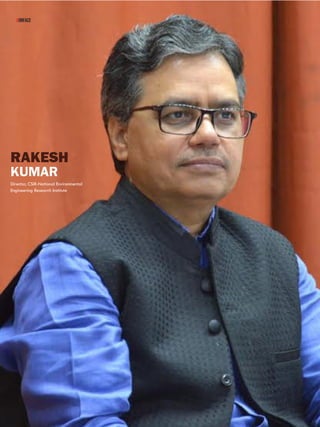
  • 9.
    9 June 2017www.martupdate.com 9 Scientists, in the United Nation’s International Panel on Climate Change (IPCC), reported with “extreme confidence,” or 95 per cent certainty, that humans are the dominant cause of global warming. The report projected a global average temperature rise of 0.3 to 4.8 degrees Celsius by the end of the century, and a seal level rise of 10 to 32 inches. Pro Industry Approach Advancement of the society is undeniable with the technological advancements due to industrialization. In this regard, many argue that it is important to take care of the millions of people who are starving instead of spending resources on saving the natural resources. The developing nations of the world cannot be expected to share the green concerns of the developed nations particularly while these countries have to face dire poverty and are engaged in a battle for survival. The emphasis of the industrialized world on green issues holds the developing countries back. The reason is that it is considered as interference in the internal affairs of these countries and at the same time it also increases the divide that exists between the first and third world countries. There are many who believe that the emphasis on environment is only an attempt to prevent the possible economic competitors. In this regard, an example is given of the high tariffs imposed by the US and the European Union on the products that are made cheaply in the developing countries and can be sold in Europe or America. By restricting the development of profitable but polluting industries, these countries are forcing developing countries to remain economically undeveloped. In this regard it can also be argued that industrialization economic development is necessary for fulfilling the basic requirements of the increasing population of the developing countries. Another ironical situation of industrialization is that although it appears that the world will become a better place if all the countries of the world follow the strict environmental rules however the reality is that a number of these rules are not in the interests of some of the countries of the world. For example, the iron and steel works in China, which is a major source of pollution, also provides a large scale employment to the people. Therefore the equal application of such strict environmental laws may result in creating barriers in the economic progress of some countries and may also result in causing political instability. Besides, it is not necessary in all cases that rapid industrialization places more pressure on the environment. Due to the latest scientific developments, the industries have become much less polluting and energy efficient as compared to the past. Similarly the developing countries can also learn lessons from the environmental mistakes that have been made by the developed countries of the world after Industrial Revolution as well as the industrial disasters that took place in Russia and China. For example, due to the recent scientific developments, much less water, power and raw material is being used by the new steelworks and as a result, much less pollution is being treated as compared to the traditional industries. Similarly, nuclear power plants can provide much more energy as compared to the thermal power plants and at the same time, the nuclear plants contribute much less in global warming. In the same way, the alternative sources of energy like solar power, wind and hydropower are also being explored for rapid industrialization. It is not correct for the rich and developed countries to require that the poorer nations of the world should also make the conservation of environment their priority. Now, when these countries have become richer, they have become more concerned regarding the environment as now they can afford to do somethi ng regarding this issue. On the other hand, the conservation of environment can wait till the developing countries also become rich. Balancing Act At the same time, there are many who prefer the protection of the environment as against industrialization. These people believe that huge natural resources have already been destroyed and wasted. These people claim that environmental damage is also related to poverty. The advocates of environmental protection are not against economic development that has the potential to make the life of a lot of people better. However they insist on achieving sustainable development that is able to combine environmental protection with economic growth and social justice. For example, the companies in the developed countries are already paying the higher costs of production as a result of the environment protection rules enforced in these countries. It will be unfair for these companies if they have to complete with the codes that have been produced in developing countries at a lesser cost but by damaging the environment. Due to pollution, countries are losing more than they are gaining as a result of industrialization. A perfect example in this regard can be given of China. Serious air and water pollution has been caused the country after two decades of unrestricted economic development. As a result, health problems have increased and the farmers also have to face losses worth billions of dollars every year. In this way, unrestricted economic development is not only harmful for the environment, it is not economically The developing nations of the world cannot be expected to share the green concerns of the developed nations particularly while these countries have to face dire poverty and are engaged in a battle for survival.
  • 10.
    10 www.martupdate.com 10June 2017 beneficial also. Situation Upfront The question how India is going to strike a balance between industrialization and environment – going by the eagerness of the Narendra Modi government to promote industrialization and ensure high economic growth – is gaining traction. India, being one of the world’s largest greenhouse gas emitter – though beset by a high population growth rate – has one of the lowest per capita rates of greenhouse gas emissions, about roughly 1/20th of the US and Australia. Millions of people in small islands, least-developed countries, landlocked countries as well as vulnerable communities in Brazil, India and China, and all around the world – are suffering from the effects of a problem to which they did not contribute. The argument for industrial development for countries such as Brazil and India are thus compelling. The one-third of the world’s population lives in the most heavily industrialized and developed nations accounting for 85 percent of the global personal income and a like fraction of the annual use of global resources. The people living in the less industrialized or developing nations must apportion the remaining 15 per cent of global income and resource use among two-thirds of the world’s population. The result is an unconscionable prosperity for the majority of people in the developed countries and crushing poverty for the majority in the developing or third world countries. The prosperity of the developed countries has been built on exploitation of the richest soils, the most accessible fossil fuels, and the most concentrated mineral deposits of the entire earth. As they now struggle to maintain and even expand their massive consumption from a resource base of declining quality, the developing countries, as they try to follow the same path to economic development, they remain laced with barriers as rapid industrialization based on the expensive resources that remain, is probably foredoomed by enormous if not insurmountable economic and environmental obstacles. Therefore, however much developing countries clamour for the natural right to seek industrial development with greater rapacity to catch up with the industrialized west; odds are heavily stacked against the environment. Thus, if all the people in India and China seek to own passenger cars at the rate of the US or own as much air conditioners, that would be an environmental disaster. Is there no middle path between the industrial growth and environmental activism? The answer lies probably in sustainable development of industry and protection of environment in the process. A whole range of environmental protection legislation including the Environment Protection Act, the Wildlife Protection Act, the Forest Conservation Act, and the Water and Air Pollution Act has come under fire possibly in the plea that they are major irritants in the path of India’s industrial growth. Take the instance how the ruling NDA steered clear of the direction in September 2013 by the UPA’s environment ministry to the Central Pollution Control Board to reassess the Comprehensive Environmental Pollution Index, an important criterion for project clearance, while keeping intact the moratorium on new industries in critically-polluted areas. The ministry has lifted the moratorium in eight critically polluted areas – Ghaziabad, Indore, Jharsuguda, Ludhiana, Panipat, Patancheru-Bollaram, Singrauli and Vapi. The report of the high-powered committee to review six top environmental laws of the country, headed by former cabinet secretary TSR Subramanian, prepared in just three months, justified the hyper-ventilation of the NDA ministry, on the grounds of “doing business easier in the country”. India cannot be denied its right to industrial growth but that should not happen at the cost of our environment in view of the larger and the more entrenched costs it might impose on the economy. United Nations’ Panel on Climate Change projected a global average temperature rise of 0.3 to 4.8 degrees Celsius by the end of the century, and a seal level rise of 10 to 32 inches.
  • 11.
    11 June 2017www.martupdate.com 11
  • 12.
    12 www.martupdate.com 12June 2017 Amajor part of the phenomenon of traditional environmentalism is formed by Traditional Ecological Knowledge (TEK). According to the Secretariat of the Convention on Biological Diversity (CBD Secretariat) Traditional Ecological Knowledge is “Knowledge, innovations and practices of indigenous and local communities around the world. Developed from experience gained over the centuries and adapted to the local culture and environment, traditional knowledge is transmitted orally from generation to generation. It tends to be collectively owned and takes the form of stories, songs, folklore, proverbs, cultural values, beliefs, rituals, community laws, local language, and agricultural practices, including the development of plant species and animal breeds. Traditional knowledge is mainly of a practical nature, particularly in such fields as agriculture, fisheries, health, horticulture, and forestry.” Traditional Environmentalism is following and making use of this traditional ecological knowledge with the motive of conservation and preservation of the environment. In Indian culture, they are translated into customs and traditions in some form or another. While most of these started with a scientific concept and a logical reason behind them; in current times they have taken the face of practices which are considered merely orthodox or boring. By taking a closer look into the nuances of a few practices, we can decipher the scientific thought behind them. In Vedic culture nature is considered to be an integral part of Is Traditional Environmentalism Fading? Do you go away from your culture when you gather more knowledge, or you lose knowledge when you go away from your culture? As complex as it may seem, this question lies at the roots of all the advancements and all the catastrophes that human being has created for himself. Environment degradation is one such catastrophe that mankind is continuously facing, and certain environmentalists claim that it can be tackled by following the age old traditional practices given to us by the Indian culture; i.e. by the path of traditional environmentalism. But is it so? Nishanshi Shukla martupdate@gmail.com #greenmanufacturing
  • 13.
    13 June 2017www.martupdate.com 13 human life. According to Isvarakṛṣṇa’s Sankhya-Karika, an old Hindu philosophy of metaphysical dualism, the world exists because of two elements, namely Purusa (pluralistic person) and Prakriti (singularistic nature); a balance in both is what enables the creation and smooth functioning of this entire world. Probably, in order to imbibe this philosophy and generate a culture inclined towards the preservation of cosmic balance between Purusa and Prakriti, Purusa was said to be the manifestation of Shiva and Prakriti was said to be the manifestation of his wife Shakti (Parvati). But today, while Shiva and Parvati are worshipped, the hidden meaning behind them is overlooked. The same phenomenon is seen in various other natural elements. While the river Ganga is called Ganga mata (mother Ganges) and worshipped by words like Har Har Gange (Hail Ganga); it is polluted, dirtied and ruined, but scarcely preserved. While Peepal tree (Ficus Religiosa) is worshipped by being considered as the abode of Lord Vishnu, the hidden message of importance of oxygen given by trees and thus established necessity of tree plantation and preservation is comfortably ignored. While Surya Deva (Sun God), Vayu Deva (Air God), Varun Deva (Water God), Bhoo Devi (Earth Goddess) etc. are still devotedly prayed, they are not devotedly preserved. Instead these natural elements are exploited by continuous and incremental pollution. During the festival of Diwali, while the original practice was that of lighting diyas (earthen lamps), and the thought behind it was to purify the air and keep away the mosquitoes and insects roaming in the atmosphere after monsoons; the practice has now taken a toll by excessive bursting of crackers, contaminating air more than purifying it. In the ten day long festival of celebrating Lord Ganesha, the last day is that of Ganesh Visarjan wherein after days of worship, the idol is immersed in water. Originally these idols were made of clay dug out from ponds/lakes, in order to make more place for rain water conservation. These clay idols were then worshipped with natural herbs, which when immersed in river/sea water would help the marine life, as their bearer clay would dissolve easily. Also, this festival symbolized the importance of worshipping natural elements like soil, and giving back to other natural beings. But today, the idols are made from harmful materials like plaster of paris, which not only harm natural water, but also cause damage to the marine life. Similar story is with the practice of havans (holy pyres), where the smoke from the offerings made to the pyre purify the air, and the mantras (hymns) create positive vibes and optimistic atmosphere; the practice is now majorly looked upon as overtly religious, boring, and outdated. Aforementioned practices, along with innumerable others under traditional environmentalism were developed owing to years of knowledge and research by the Indian sages (scholars); but its face is changing. Major reasons of the traditional environmental practices becoming boring or seemingly uninteresting to humans can be attributed to factors like changes in lifestyles and food habitats owing to modernization, occupational shifts from farming and agriculture to modern hi-tech jobs, hype around the western cultures, non-communication of reasons behind the faith in cultural practices and resulting ignorance towards blind faith, erosion of reading of ancient texts and writing in vernacular languages, migration of young generations away from their roots, forest degradation, and others. It can also be attributed to the modern human psychology of avoiding things which don’t guarantee immediate profit or fun. The need of today is to translate the meanings behind the traditional practices as promotional tool of the custom, instead of the custom itself. This cultural knowledge should also be incorporated in the formal educational system. The solution to the problem of environmental degradation was formulated around 2000 years ago in ancient scriptural text, the Isopanishad, which says, “This universe is the creation of the Supreme Power meant for the benefit of all his creation. Each individual life-form must, therefore, learn to enjoy its benefits by forming a part of the system in close relation with other species. Let not anyone species encroach upon the other’s rights.” Is it wise not to follow it? When the culture has the knowledge, the need is of awakening instead of ignoring. Today, the Ganesha idols are made from harmful materials like plaster of paris, which not only harm natural water, but also cause damage to the marine life.
  • 14.
    14 www.martupdate.com 14June 2017 Alternative energy sources - solar and wind and such – are no longer an option, they have become necessity in the face of depleting conventional natural resources and consequent carbon footprint. It is with a view to create this awareness among the people ‘ALTERNATIVE 2017’ was organized. The one-day event organized on 2 June in at New Horizon Engineering College in Bengaluru by UV Green Energy, green energy start-up, in the lead up to the World Environment Day 2017. The event proved to be a highly successful in its first edition with large participation of citizens, environmentalists, NGOs, CSR teams from corporate houses etc. among its target group. “Through this initiative, we wanted to create more awareness about the environment among the citizens of Bengaluru, and encourage them to choose alternatives. Instead of using natural resources, people need to bring in change in their lifestyle, and should opt for sustainable forms of energy like wind, solar and such,” Vinay Shinde, head of UV Green Energy and organizer of the event said.Luminaries and experts discussed environmental issues and enlightened with innovative ideas in the course of this day-long conference. The event covered various aspects of the environment including tackling garbage disposal, water management, protecting the green cover and more. Among the participants were Rajendra Singh, who is well-known as the ‘Waterman of India’, and Varadaraj Rangarajan, who is called the ‘Plastic Man of India’. Varadaraj, who is also the brains behind roads made of plastic, urged people to ‘use plastic for the roads and not on the road.’ ThinkNature, ThinkAlternative Alternative 2017 was a highly successful environmental event with innovative ways and illuminating ideas, creating awareness among people about their reasonability to save the nature. Along with other awareness programmes, ‘Alternative 2017’ also witnessed a special musical performance by Grammy winner Ricky Kej and sand art by Raghavendra Hegde. On this occasion 400 saplings were distributed among participants. Arnab Mondal arnab@martinfotech.in #greenmanufacturing
  • 15.
    15 June 2017www.martupdate.com 15 What was the driving motto behind ‘Alternative 17’? UV Green Energy is start-up green initiative firm, primarily focusing on CSR framework and competency development to the corporate world in the field of environmental solar projects and solutions. An initiative of ALTERNATIVE 17 is the education program of campaign and awareness to the corporate world, NGOs, institutions by way of environmental music consciousness, green talks from contributors to sustainability, nature art and few niche product exhibitions. We feel every social entrepreneur should have larger objective of social need of the development. This is the 1st initiative of 2 year old start-up firm UV Green Energy, connecting people to the nature by celebrating World Environment Day with own funding and taking the collaborative approach from various partners. What were the target groups of the event? And how spontaneous was their participation? Targeted intended group was corporate employees, CSR & sustainability team, NGOs, institutions & community. The event witnessed good participation from corporate and institutions. Did the event focus on the role of industry which is the biggest consumer of conventional energy and contributor to carbon footprint? The focus is more with bringing awareness to every citizen of the country to GO WITH ALTERNATIVES to protect the planet and our mother earth with the concept of greener together. Our focus is more towards highlighting alternative options to bring the change in every part of our life cycle including the organic food to water, waste plastic and alternative energy. Could you share with us some of the innovative and alternative ideas for protection of nature that were discussed or unveiled at the event? As for Green Talk Series the various topics for the discussion were... • ‘River Rejuvenation, Making Drought free Karnataka’ by Dr. Rajendra Singh- Water man of India, • ‘Innovative Bio Gas Production’ by Mr. Sanjay Kumar Patel, CEO, SP Ecofuel • ‘Biotech Solution for Global warming’ by Mr. Sampath Kumar, CEO, Nualgi • ‘Plastic Waste Management’ by Dr. R. Vasudevan- Plastic Man of India • ‘Widening the way of Organic Farming’ by Mr. H. R. Jayaram, CEO, The Greenpath • ‘Corporate Responsibility for sustainable development of villages’ by Dr. Ashok Das, CEO, Sunmoksha • ‘Urban Lakes Rejuvenation for water security’ by Dr. T. V. Ramachandra, IISc • ‘Citizen Role to Greener Bengaluru’ by Mr.Clement Jayakumar, Whitefield Rising • ‘Future of Electric Mobility’ by Mr.Kartik Gopal, Head-strategy & Business Planning, Mahindra Electric • ‘Save water Save Bengaluru’ by Mr. A. R. Shivkumar, Principal Scientific officer, IISc Do you plan to emulate the strategies adopted for Bengaluru in other Indian cities as well which are equally or even more in the perils of environmental degradation? After the successful event, we received feedbacks from industrialist & corporate as part of their sustainability program that ALTERNATIVE concept should reach to every major Indian city to connect the people to nature by ways of ALTERNATIVE. This awareness was largely needed to the corporate world CSR teams, so that corporate social responsibility team should brainstorm and come forward for protecting the nature and alternative source to reach social need way of CSR funding. Inaugral ALTERNATIVE 17 – Lighting the lamp by WATER MAN OF India ( Jal Purush) –Mr Rajendra Singh & Namma Bengaluro Foundation CEO –Mr Sridhar Pebbishetty & Vinay Shindhe ( CEO –UV Green Energy) Grammy Winner Ricky Kej & Team Performed ALTERNATIVE 17 on the occasion WED. Vinay Shindhe ( CEO UV Green Energy ) & Mahesh Babu ( Mahendra Electric CEO “We feel every social entrepreneur should have larger objective of social need of the development.” -Vinay Shindhe CEO-UV Green Energy Alternative 17 is the stratagem of Mr. Vinay Shindhe, CEO-UV Green Energy. Excerpts from the conversation:
  • 16.
    16 www.martupdate.com 16June 2017 G reen Manufacturing (GM) is also known by different names viz. clean manufacturing, environmentally conscious manufacturing, environmentally benign manufacturing, environmentally responsible manufacturing, and sustainable manufacturing. GM is about the techniques, policies, and procedures a firm uses to create manufactured products, that use process that minimize negative environmental impacts, conserve energy and natural resources, are safe to employees, communities and consumers and are economically sound. GM focuses around minimising environmental impact by reducing toxics, waste, pollution, optimising use of raw material, and energy. The society’s rising concern for Green can be grouped into three broad categories – (a) Rising emissions and associated Green Manufacturing AWaytowards Sustainability Green Manufacturing includes a holistic approach towards adopting green initiatives throughout the business from green energy use, green product development and green process chain. It offers benefits in terms of enhanced brand value, customer loyalty, better tax traction etc. while also fulfilling the environmental commitment for a company. In India, companies are still primarily driven by ‘RoI’ and ‘regulations’ while adopting green initiatives. Venkitachalam V abijitindia@yahoo.co.in climate change, (b) Fast depletion of scarce natural resources and (c) Growing waste generation and pollution. Being a green manufacturer means being efficient with the ways you manufacture, saving energies, recycling, and being environmentally aware of your footprint. When a business makes the decision to become a green, or environmentally friendly, manufacturer, it consciously decides to promote certain values. Ever since Industrialization, manufacturing of various goods exploited our natural resources, depleted them without thinking of future implications and polluted environment in various forms. GM is a manufacturing mode with full consideration of resource consumption and environmental impact which focuses at minimizing the environmental impact #greenmanufacturing
  • 17.
    17 June 2017www.martupdate.com 17 and maximizing resource utilization during the whole product life cycle design, manufacturing, packaging, use and subsequent disposal or recycling along with making enterprises harmonize the economic benefits with that of environmental benefits. Apart from efficient use of inputs and reducing wastes, GM also creates higher environmental awareness among the customers and at the same time shows the company as a propagator of green initiatives improving its brand image among the customers. Many of us think that green production simply entails instituting pollution controls or recycling programs while manufacturing goods. The reality, however, is that Green production focuses upon three fundamental goals: 1) minimize emissions, effluents, and accidents; 2) minimize the use of virgin materials and non-renewable forms of energy; and 3) minimize the life-cycle cost (cradle to grave) of products or services seek to minimize the impact of the manufacturing process on the environment at every stage. Growing concerns over depletion of forests and other natural resources, and environmental degradation created by mining and fossil fuel production. Reliance on recyclable or renewable materials, new energy and material conservation initiatives, and “replenishment” programs (such as forest replanting programs) have all been touted as effective tools in establishing processes that do not unduly harm the environment focuses on profitability through environmentally friendly operating processes Manufacturing companies can address these concerns by focussing on three areas: 1. Green energy- Green energy involves production and use of cleaner energy. This is the first and most obvious step given the dependence of industry on energy. Green energy includes both deploying renewable energy sources like CNG, wind, solar and biomass, and achieving higher energy efficiency in operations. 2. Green products- Developing greener products is the second step in this transformation. ‘Recycled’, ‘Low carbon footprint’, ‘Organic’ and ‘Natural’ are becoming popular buzz–words which are associated with Green products. Developing Green products can often mean higher costs. However, by developing Green products that are sought by consumers, and effectively marketing them, companies can derive additional volumes and price premiums, which can offset their cost of development. 3. Green processes in business operations- The third area is implementing Green processes in operations. This entails efficient use of key resources, reducing waste generation through lean operations, bringing down the carbon foot–print and conserving water. Employing Green processes improves operational efficiency and lowers costs. A number of companies have started adopting Green initiatives as an integral part of their operations. These initiatives are driven by five factors (i) Rising energy and input costs. (ii) Growing consumer pull for Green products. (iii) Increasing regulatory pressures as policy makers introduce new and stricter environmental and waste management laws. (iv) Technological advances which open up new attractive business opportunities. (v) The need to enhance competitive differentiation, particularly for first movers or those who are able © 2016 Fluke Process Instruments. Ad 09/2016 Raytek, Ircon and Datapaq – Together we are Fluke Process Instruments www.flukeprocessinstruments.com ■ Ratio and fibre-optic pyrometers ■ Wide temperature range: 550 to 3200°C ■ Superior optical resolution to 150:1 ■ Multiple sighting options: Laser, LED, Video – manual variable focus ■ Innovative intuitive user interface ■ Ethernet interface with PoE, using TCP/IP, HTTP and HTML protocols ■ Best-in-class 4 year warranty Endurance Series New High Temperature Pyrometers for Harsh Industrial Environments GM is about the techniques, policies, and procedures a firm uses to create manufactured products.
  • 18.
    18 www.martupdate.com 18June 2017 to break the compromise between short–term higher costs and numerous benefits (eg: brand premium, new customer segments). Green manufacturing involves transformation of industrial operations in three ways: (1) using Green energy, (2) developing and selling Green products and (3) employing Green processes in business operations. Even in tough market conditions, the business case for Green remains compelling. There is greater recognition of the imperatives of becoming Green and understanding that Green has to address all three areas – Green energy, Green products and Green processes. However, companies face challenges on various fronts, most critically in providing leadership for such an effort. Balancing People, Planet, and Profit is the Challenge of Green Manufacturing. Manufacturing companies that adopt Green practices benefit not only through long–term cost savings, but equally importantly, from brand enhancement with customers, better regulatory traction, greater ability to attract talent and higher investor interest. However, these benefits require a long term commitment and making tradeoffs against short term objectives, as the economics of Green manufacturing is still evolving and not well understood as yet. Some of the benefits of embracing sustainability and Green Manufacturing are – (i) Reduce energy-related costs – for eg. use of Solar and wind energy, switching to energy-efficient lighting (ii) Attract new customers and increase sales- Consumers are more conscious of the environment, and making improvements will strengthen your reputation (iii) Tax Incentives from Government (iv) Boost workforce morale and innovations (v) Societal impact by implementing changes, you will have a smaller carbon footprint and reduce the number of toxins released into the atmosphere. Future generations ultimately benefit from improved air and water quality, fewer landfills and more renewable energy sources. 4Rs (reduce, reuse, recycle, remanufacture) is slowly being accepted and adopted as the model of growth and sustainability the world over. Green manufacturing in India is at the take–off stage. While there has been significant policy development and adoption by the manufacturing industry in the area of Green energy, there is substantial scope on both the policy front and its adoption in the areas of Green products and Green processes. Successful transformation into Green manufacturing will bring tremendous benefits, both tangible and intangible, for the nation and the business community. The manufacturing sector has been one of the largest single contributors to environmental pollution. Over the last decade, there has been an increase in the adoption of green technologies; however, it is still largely driven by ‘return on investment’ and ‘regulatory requirements’ as the key evaluation criteria. India Green Manufacturing Challenge (IGMC) is an awarding platform that is designed to recognize manufacturing firms that have shown consistent progress in improving sustainability factors associated to a manufacturing facility. List of few Indian companies who adopted green manufacturing practices and is deploying sustainability- VE Commercial Vehicle (VECV). Pithampur, Larsen & Toubro Rubber Processing Machinery in Kanchipuram, USV, a pharmaceutical company at Baddi, Himachal Pradesh, Bharat Petroleum Corporation Ltd. (BPCL) Mumbai refinery and JK Tyre Industries Ltd. Chennai tyre plant. Companies that wait in adopting Green manufacturing until they are forced to change often find themselves in an expensive, last-minute scramble to meet the requirements. As a result, they end up throwing more money at the problem for a less effective solution than their more proactive counterparts. Green manufacturing is not an option, but a necessity for our well-being and survival. “When a business makes the decision to become a green, or environmentally friendly, manufacturer, it consciously decides to promote certain values.” “Many of us think that green production simply entails instituting pollution controls or recycling programs while manufacturing goods.” Manufacturing companies that adopt Green practices benefit not only through long–term cost savings, but equally importantly. Companies that wait in adopting Green manufacturing until they are forced to change often find themselves in an expensive, last- minute scramble to meet the requirements.
  • 19.
    19 June 2017www.martupdate.com 19
  • 20.
    20 www.martupdate.com 20June 2017 I n our science textbook of 9th grade (CBSE Syllabus) we had a chapter on Environment Pollution. It was the last chapter of the book. Our teacher told us to do self-study without investing too much time on it as only one question of two marks was expected to come in the exam from that chapter. Now, it’s been close to three decades since then and, guess what? Environment pollution is still the least important chapter in our lives. It is given least weightage. With the dawn of the industrial revolution, a global economy has emerged, and our population has grown exponentially. With coming of the Industrial Revolution, humans could advance further into the 21st century. Technology developed rapidly, advanced science crept in giving wide way to manufacturing. The changing phase brought yet another effect in the form of Industrial Pollution. Factory pollution Sanjeev Himachali sanjeev.himachali@gmail.com Environment Training andGreen Programmes forEmployeesinManufacturing People were blinded by the glitter of development with Industrial Revolution, so much so, that impacts of unbridled industrial growth on environment remained unnoticed, until environment reached a precarious stage. For people in an industrial organisation, creating awareness about environmental laws and regulations, and following some basic rules, guided by HR professionals, can be a good ploy to the ultimate goal of environmental protection. is often assumed to be smokestack emissions, but it pollutes water and land as well. Once pollutants enter the atmosphere or the water system, they can spread far and wide beyond the factory. Factories contribute to water and land pollution by acidifying rain, chemical spills and disposal of toxic waste. It is estimated that about 50% of pollution is due to industrial and manufacturing activities. Hence, understanding our external physical, biological and chemical environment, and how it affects individuals and man- made systems, has become an essential part of maintaining a healthy human population. While as an individual, I can contribute in different ways to protect or save the environment, either individually or through groups or NGO’s; as a Human Resource Professional, working for a profit-making organization, my role #greenmanufacturing
  • 21.
    21 June 2017www.martupdate.com 21 gift them a plant. We plant a tree on their behalf with a nameplate of their name, either in our factory or in nearest forests through NGO’s we are associated with. 8. Environment Pollution Awareness Training Program – Every quarter we conduct awareness training programs and workshops for villagers living in the vicinity of our factory as well as schools within 10 KMS of the radius of our factory. In total, 3,000 to 5,000 people participate in our programs. Till now, there are about 17 industries which are declared to be most polluting. These include the caustic soda, cement, dis¬tillery, dyes and dye intermediaries, fertilizers, iron and steel, oil refineries, paper and pulp, pesticides and pharmaceuticals, sugar, textiles, thermal power plants, tanneries and so on. Pollution caused by these industries has a direct impact on human life. As an HR Leader, I ensure that every member of my team and every manager of the organization are well versed with Environment Protect Act, 1986 and standards of ISO 14001(EMS - Environment Management System) and ISO 18001 (OSHA- Occupational Health and Safety Assessment Series). The basic principles of ISO 14001 and ISO 18001 based on PDCA – Plan, Do, Check and Act. Standards of EMS exists to help organizations (a) minimize how their operations (processes, etc.) negatively affect the environment (i.e., cause adverse changes to air, water, or land); (b) comply with applicable laws, regulations, and other environmentally oriented requirements; and (c) continually improve in the above. As far as environment pollution is concerned, we are in a very dangerous situation and it’s a time to take tough decisions and actions. One person might not be able to do everything to save and protect our environment but together we all can do something to give a better environment to our future generation. Let’s not pass on our accountability to Government and Business Houses. Sanjeev Himachali is a Talent Management and Development professional with over a decade and a half years of experience in various facets of Human Resource Management across various industries, cultures, and geographies. He helps start-ups, small- sized and mid-sized organisations in identifying and developing potential and competencies of their employees. gets restricted to creating awareness, conducting training programs and complying with the relevant law. Let me share with you some of the initiatives I took and what environment- friendly organizations in manufacturing industry do, to protect the environment 1. Paperless Offices – We maintain employee files digitally. Every communication with an employee, leave approval, issuance of promotion, transfer letter, etc. is done electronically. Communication with Government bodies, wherever possible, such as PF Office, is done electronically. 2. Open space Cubicles v/s Closed Cabins – Recently, I visited a factory and I was a bit surprised to see over 25 cabins of the size of 150x150 sq. ft., each equipped with air-conditioners. Instead, I often recommend having cubicles and use fans or air coolers (a set-up we follow in my organization). 3. Carpooling or Company Transport – In our office, employees are advised not to bring their vehicles to the factory; instead, they use office vehicle. Wherever it is not possible for the company transport to reach, we recommend carpooling. 4. Stick to the schedule (No Overtime) – Working for longer hours also means a use of more electricity and other resources. Hence, we strictly follow office working hours. Staying late is highly discouraged. 5. Rain Harvesting and Sewage Water Recycling/Treatment – We use rainwater harvesting instead of bore well. We also have a sewage water treatment plant. The water is then used for irrigating the garden, and plants maintained in the office premises. 6. Solar Energy – We use solar energy for lighting streets, pathways, and garden in our factory. Not only does this help in resource optimization but also in cost saving. 7. Gift a Plant- Whenever premium guests, foreign delegates, a key client, customer or vendor visit our office, we Environmental protection is a concern as well as responsibility for all and sundry, independent of actions by government or organisations. We plant a tree on their behalf with a nameplate of their name, either in our factory or in nearest forests through NGO’s we are associated with.
  • 22.
    22 www.martupdate.com 22June 2017 For the rapidly growing human population, the availability of so called abundant natural resources is shrinking; and the case of water is no different! Pune Techtrol Pvt. Ltd., the leading manufacturer of level measurement and control instruments, has always recognized the importance of preserving the environment and has believed in contributing to this noble cause. Human beings can use and consume only fresh water. While three-fourth of the Earth’s surface is covered in water, only three percent of it is fresh; and seventy percent of this three percent is locked up in the ice caps of Antarctic and Arctic regions. What remains, is to be used by the entire human population of seven billion for their ever increasing needs, and habitual wastage. Also, around ninety percent of fresh water that is consumed, goes down the drains as waste water. Industries, which are increasing continuously in numbers, create lots of harmful pollutants that get mixed with water. The rate at which human beings are bidding farewell to water in the form of waste is indeed alarming. Thus, arises the dire need of waste water management. Waste water treatment is the process of removing contaminants from waste water and making it reusable for all purposes. Processing of waste water is important with regards to the need of environment preservation in the current times. Waste water, if allowed to flow untreated, can play havoc not only with humans, but also with crops, forests and wild life as well. Hence, the treatment of waste water or effluent is SaveWater, SaveLives, SaveFuture! SaveWater, SaveLives, SaveFuture! The level measurement and control instruments manufactured and supplied by Pune Techtrol Pvt. Ltd. are widely used in the processes of waste water treatment. ‘Techtrol’ is recognized as most reliable & trusted brand, delivering quality products unsurpassed in terms of accuracy, workmanship, performance, safety & ease of installation, providing long uninterrupted service in wide & varied industrial applications. C N Shukla Training & Development Consultant, Pune Techtrol Pvt. Ltd #greenmanufacturing
  • 23.
    23 June 2017 increasinglybecoming vital for survival of human race and the environment. All waste water treatment processes require level monitoring and control. Level instruments are installed in almost all parts of water treatment and effluent treatment plants. The level measurement and control instruments manufactured and supplied by Pune Techtrol Pvt. Ltd. are widely used in the processes of waste water treatment. A very useful feature of “Techtrol” instruments is that there is wide choice of Material Of Construction (MOC) for all the instruments to suit specific requirements of the medium or liquid whose level is to be measured, detected or monitored. These level instruments are mainly classified into level gauges, level switches and level transmitters. These “Techtrol” level instruments are specifically designed for this particular application, and hence increase the efficiency and reliability of the process. The application of each of these level instruments for waste water management is explored further: Using Level Gauges for Waste Water Management: Pune Techtrol’s wide range of level gauges useful for in the application of waste water management are as follows: • Tubular Level Gauge (TTG) and Reflex Flat Glass Gauge (RFG) are glass gauges used to indicate liquid levels of chemical tanks & other storage /process tanks. • Magnetic Level Gauge (MLG) is used to indicate levels of storage tanks of acid & alkali. It can also be improvised with alarm switches and transmitter for remote indication and control. • Float and Dial Gauge (FDG) is useful for indication of liquid level in under-ground tanks. It is particularly suitable for applications involving limited head-space above the tank. It can also be improvised with alarm switches and transmitter for remote indication and control. • Float & Board Gauge (FBG) is the simplest but very reliable instrument used for indication of liquid level in large storage tanks of effluent / treated water. It can also be improvised with alarm switches. Using Level Switches for Waste Water Management: Pune Techtrol’s wide range of level switches useful for in the application of waste water management are as follows: • Float Guided Switch (FGS) is single or multipoint level switch used for in clarifier and aeration tank. These switching contacts can be used for alarm indication or pump control. • Displacer Switch (DS) is more suited for application in clear effluent and potable water. Switching points rated for 5A, 250VAC and can be adjusted at site as required. • Cable Suspended Switch (FTS) is a simplest type switch and easy to install. These switching contacts are rated for 5A, 250VAC and can be used for alarm indication or pump control and are ideally suitable for application in settling tanks. • Conductivity Type Switch (CNS) is used only for conductive liquids. It can be used for treated & potable water. More suitable in applications where the depth of tank is large. • Float Pivoted Switch (FPS) is side mounted, single point switch rated for 5A, 250VAC. It is suitable for over ground tanks. • Miniature Float Switch (MFPS/MFGS) is used for level detection in small / medium tanks. Using Level Transmitter for Waste Water Management: Pune Techtrol’s level transmitter useful for in the application of waste water management is as follows: • The Techtrol Ultrasonic Transmitter (TUS) is a non-contact type level transmitter, generally used for measurement of flow in open channel or level monitoring in tanks. It is compact, non-contact, and easy to install, integral type transmitter for continuous level measurement of non-corrosive liquids and slurries. It is programmable through Keys. Owing to its aforementioned characteristics, it proves highly useful in waste water management plants. It is used for various processes in storage tanks, filter beds, flotation cells, water / waste water/effluent treatment (WTP, ETP), etc. Since its inception, Pune Techtrol Pvt. Ltd. has time and again innovated and added on to the list of level measurement and control instruments which can be used for applications like waste water management. It takes pride in being not only a company of products, but a company of value too! For further information please mail us at ho@punetechtrol.com or visit www.punetechtrol.com Level Gauges Level Switches Level Transmitters
  • 24.
    24 www.martupdate.com 24June 2017 RAKESH KUMAR Director, CSIR-National Environmental Engineering Research Institute #onface
  • 25.
    25 June 2017www.martupdate.com 25 Proactive Industry SustainableIndustrial Environment has not been given due importance in industries’ priority list and “understaffed” pollution control boards have been too meek at times. No wonder environmental impact of industries has grown unbridled. It is time industries do proactive thinking about the sustainability factor and take measures in compliance with environmental norms and regulations to reduce delays in projects and help environment protection. Pollution control boards jointly with research and academic institutions can provide right directions guidance to industries. Dr. Rakesh Kumar, Director, CSIR- National Environmental Engineering Research Institute (CSIR-NEERI), shares his views on this enigmatic industry-environment relationship while also giving glimpses NEERI’s effort in this. Growth Scrapping and delay of industrial projects due to environmental norms and clearances is common in India. Though industrial growth is essential for economy, environmental protection is inevitable and priority. Where are the industries in India lagging behind global counterparts in achieving ‘sustainability’? The delays in environmental clearances have been very often touted as the main reason of slow industrial development. Some of these can be attributed to lack of preventive environmental planning by the industries. Till date mostly, if not all, the industries have addressed environment and sustainability issues as an external to their normal operation. These are addressed after all the other aspects of industries’ setting up are planned. Proactive thinking about what is needed for the India specific rules and other norms would prevent delays. Talking about the pollution control boards in India, do you think the bodies should play more active role in monitoring and guiding about the environmental aspects of industry rather than the current inspection and certification method? SPCBs (State Pollution Control Boards) have a big role to play in guiding the The delays in environmental clearances have been very often touted as the main reason of slow industrial development.
  • 26.
    26 www.martupdate.com 26June 2017 industries in terms of what kind of proactive measures industries can take and advise them in advance. Also since SPCBs are understaffed in most states, the preventive planning and planning can be done through research and academic institutions which will be long lasting and sustainability principles can be ingrained. NEERI has been closely monitoring and guiding projects for several Indian rivers which are severely affected, among many other reasons, by industrial effluents and discharges. Do you consider this situation a lack of awareness, lack of options or lack of intention on the part of industries? Indian rivers are affected due to multiple reasons of which major factors are untreated sewage ingress, industrial pockets discharging effluents and poor summer flows. Industrial discharges by major industries are mainly due to commitment to safeguard environment and river, whereas small scale industries need more awareness and finances to deal with their discharges. Common collection and treatment could be a possibility, however, proper design system and basic well maintained primary system by industries will be major pre-requisite criteria for success. Is there any integrated solution available for the industries to assess environmental impacts of their industrial processes, rectify it and also use generated data for their Environment Management System in future? Integrated solution for industries is available. Sustainability analysis can provide the inputs to their environment footprint of process and products. This kind of analysis can be used to improve their operation and also anticipate any future requirement. Regular credible monitoring and analysis can be the first step towards analyzing areas of improvement and management system. You have made notable contributions in developing technologies for reuse and recycle of domestic and industrial waste water. Please throw some light on such technologies. NEERI has been working in the field of waste water reuse and recycle for a long time. It has specific treatment packages for all sectors of industries. It is a challenging time for country in terms of push for more manufacturing and creation of jobs while keeping our environmental infrastructure safe for future generation. Dr. Rakesh Kumar is the Director of the CSIR-National Environmental Engineering Research Institute (CSIR-NEERI). Prior to this role, Dr. Kumar was Chief Scientist and Head of Mumbai Zonal Laboratory, CSIR-NEERI. He obtained M. Tech. in Environmental Science and Engineering from IIT-Bombay and Ph.D. in Environmental Engineering from RTM Nagpur University. A visionary for sustainable development, Dr. Kumar has made a notable contribution in developing technologies for recycle and reuse of domestic and industrial wastewater which brought a paradigm shift in the country. He has received 9 awards for his outstanding contributions in Environmental Science & Engineering, among which the notable ones are Commonwealth Commission Award, UK in 1994; “Environmental Leadership Award” by US Asia Environmental Partnership and US- AID for the year 2005 for outstanding contribution in improving quality of life for the population of Asia. He has been given an award for largest number of technology transfer for low cost waste water treatment- PHYTORID in the year 2012. He has been given VASVIK award for 2012 for his exemplary work for urban environment improvement and sustainable technology “Phytorid” for sewage treatment for better environment. He has been recently awarded “Hiyoshi Think of Ecology Award” in September 2015 for his work on use of ecology in solving environmental engineering problems.
  • 27.
    27 June 2017www.martupdate.com 27 CETP processes for various types of clusters have been developed and designed by CSIR-NEERI for many locations. For sewage treatment, Phytorid Technology has been developed which not only treats sewage better than most of the conventional technologies but also does with a minimal O&M cost as it does not need power and moving machineries. It has been installed at many places across country and has been accepted well. Similarly, for rural sanitation and urban poor, various designs have been developed and being deployed. Is NEERI working on any environmental technologies currently, especially for addressing industrial pollutions? It is working on pharma, chemical clusters for advance oxidation processes for treatment of effluents. The other sectors are fertilizers and leather sectors where better technologies are being developed. NEERI has taken up the first-of-its kind noise levels mapping project in the country. Please tell us about the project. We have been carrying out noise monitoring at various places such as cities, highways, industrial sources. Recently we have undertaken a major work of noise monitoring for 27 cities in Maharashtra. This is not limited to monitoring but our scientists, engineers will delineate silence zones. In addition, identification of areas where noise barriers are required options of types of noise protection. With all the manufacturing and industrial growth taking place in the country, how do you see environmental impact in future? As the Director of CSIR-NEERI what are your suggestions for Indian manufacturing industry to achieve sustainability? It is a challenging time for country in terms of push for more manufacturing and creation of jobs while keeping our environmental infrastructure safe for future generation. Indian manufacturing industries can start the process of sustainability thinking well in advance and not wait for pollution control board directions or any other governmental pressures. With a view to address this issue, CSIR-NEERI has set up an Industries Desk which will be on single point of contact for any industries to seek information and guidance. Vidarbha Industrial Association has signed an MoU with CSIR- NEERI to seek this advantage on 5th June, 2017, World Environment Day. We would encourage that industries and cities both come and be part of the team in this country which will solve the present problems and anticipate future issues. CSIR-National Environmental Engineering Research Institute (CSIR-NEERI), as a Stockholm Convention Regional Centre (SCRC) on Persistent Organic Pollutants (POPs) for Asia Region, organized a workshop on ‘Stockholm and Rotterdam Conventions and Associated Challenges” at CSIR-NEERI on June 6, 2017 in association with Ministry of Environment, Forest & Climate Change. In his opening remarks, Director, CSIR-NEERI Dr. Rakesh Kumar mentioned the objectives and role of Stockholm and Rotterdam Conventions. CSIR-NEERI, Nagpur is devoted to research and innovations in environmental science and engineering besides solving a range of problems posed by industry, government and public. It is a constituent of Council of Scientific & Industrial Research (CSIR), New Delhi and has a nation- wide presence with its five zonal laboratories at Chennai, Delhi, Hyderabad, Kolkata and Mumbai. NEERI has been working in the field of waste water reuse and recycle for a long time. It has specific treatment packages for all sectors of industries. Dr. Kanchan Kumari, Convener of the workshop highlighted the role of CSIR-NEERI as SCRC and its involvement in capacity building and monitoring of POPs.
  • 28.
    28 www.martupdate.com 28June 2017 Corporate houses sometimes tread beyond the trodden ways to participate in CSR in innovative ways. In the following article instances have been given where a multinational automotive company supports training programme for growth of a primary sector of economy, while a famous chain of hotels runs activities to touch lives of underprivileged children and ensure environmental protection through innovative methods. Manoj Kabre manoj.k@indo-mim.com Corporate social responsibility (CSR) promotes a vision of business accountability to a wide range of stakeholders, besides shareholders and investors. Key areas of concern in this article, are environmental protection and the wellbeing of employees, the community and civil society in general, both now and in the future. Yale and Columbia University in its recently published 2016 Environmental Performance Index (EPI) has ranked India at 144th place among 180 countries with over all score of 53.58. One bright side of 2016 ranking of India is 20% improvement in various parameters in last 10 years specially in sanitation and waste water treatment but the deteriorated air quality due to emission from power plants, industries, fossil fuel burning etc. which has placed India at almost bottom (178th place) is quite deploring and call for urgent and concentrated efforts to improve it. The Corporates need to expand their ongoing endeavors in these directions. Following are some of the Environmental benefits that are aimed at being accomplished through various initiatives : • Greater material recyclability; • Better product durability and functionality; • Greater use of renewable resources; • Integration of environmental management tools into business plans, including life-cycle assessment and costing, environmental management standards, and eco-labeling. We have CSR activities from the following organisations in this issue: 1. Bajaj Auto 2. Shangri-La’s - Eros Hotel, New Delhi 3. Shangri-La Hotel, Bengaluru 4. Piaggio Vehicles Private Limited Manoj Kabre, Vice President of Indo-MIM Pvt Ltd, has directed and headed the sales & marketing function for Asia and parts of Europe, spoke at various forums across the world for propagating the MIM technology. His laudable work includes, Chairing – CSR Committee of RBWC, Founding of CaN Trust (NGO), working for needy children. He is also on advisory committee of ‘Your Philanthropy Story’ (YPS) which captures stories through interviews of heroes and the cause they are associated with. Innovative WaysofCSR #CSR
  • 29.
    29 June 2017www.martupdate.com 29 Jankidevi Bajaj Gram Vikas Sanstha (JBGVS) - a NGO promoted by Bajaj Group has provided training and demos on animal husbandry to the beneficiaries of hybrid, Gir and Gaolao cows distributed and also to other dairy farmers in Pune, Aurangabad and Wardha districts as a part of its ‘Kamdhenu Gopalan Project.’ The programme focuses on using locally available and homemade inputs like sorghum, pearl millet, wheat and sugarcane, Jaggery , salt and agricultural residue for preparing fodder which is safer and cost effective than chemical-laced inputs available in the market. It has been conducting training on the hydroponic technique, use of azolla (type of aquatic plants) and growing of grass on available land in areas where green fodder is not available. JBGVS has also developed a model fodder matrix based on weight and yield capacity of hybrid, Gir and Gaolao cows. Till now, JBGVS has only reached out to 7,400 farmers through 336 programmes. The impact of the project on productivity is positive and visible, according to JBGVS livestock supervisors. For instance, a beneficiary dairy farmer of Pune district with two hybrid cows two years ago, each yielding 12-15 litres milk daily was provided with another cow and trainings under the project and today his total tally of 23 milch cows yield 400 liters, averaging 17 liter per cow. There are other examples where the average daily milk yield of both hybrid and Gir cows over the past couple of years increased by 5-6 litres. Also, instances of Gaolao cows in Wardha dying in the extreme summers of Vidarbh region due to lack of proper nutrition has reduced substantially in project villages, after JBGVS beneficiaries started following the recommended fodder matrix. Training to Dairy Farmers by Jankidevi Bajaj Gram Vikas Sanstha Jankidevi Bajaj Gram Vikas Sanstha (JBGVS) - a NGO promoted by Bajaj Group. Wall painting done by SLND colleagues at NDS. Hybrid cows provided by JBGVS to dairy farmers. Tree plantation activity. Shangri-La’s - Eros Hotel, New Delhi, has been working with Noida Deaf Society (NDS) by hiring 10 students from every batch trained in the hospitality divisions, such as concierge, laundry, housekeeping and security, before the students commence their internship at the hotel. NDS is committed to reintegrating the hearing impaired into mainstream society through life skills and children’s education. NDS provides vocational training to the students to enhance their employability quotient and enable them to become contributing partners to society. The hotel’s ongoing CSR initiatives include regular contributions, such as Earth Day, which is celebrated 4 times a year, and its continuous participation in the Cancer Support Walk. For the past nine years, our employees have generously donated books and clothes to Goonj. Shangri-La’s - Eros Hotel, New Delhi, strives to preserve and conserve the environment, and has taken measures towards being a green and eco-friendly hotel. The guests have a option to let the staff know if they would want their bed linen not to be changed every day and be a part of the initiative to conserve natural resources. The hotel also encourages using biodegradable plastic bags, use of biodegradable material for packaging bathroom amenities, conservation of electricity. In such an initiative, solar panels to heat water, and a treatment plant have been installed, the latter for recycling wastewater from the kitchen and laundry for gardening and flushing. The lights in the public washrooms automatically turn off upon exiting. The hotel also uses an organic waste converter to convert kitchen waste into manure, which is then used in the gardens. Similarly, eco-friendly fuels are used to generate electricity and water, and CFL and Led lights are used to save electricity. Employment Programme for NDS Students by Shangri-La’s - Eros Hotel, New Delhi Company: Bajaj Group NGO: Jankidevi Bajaj Gram Vikas Sanstha (JBGVS) Contact: Atul Sathe, Communication Officer Email: jbgvs@bajajauto.co.in Company: Shangri-La’s Eros Hotel, New Delhi Contact : Director of Communications-Marketing & Communications Email: Anjori.Kumar@shangri-la.com
  • 30.
    30 www.martupdate.com 30June 2017 Shangri-La Hotel, Bengaluru has been working with Cheshire Homes, India & Angels Orphanage from the time the project was announced and the core-operations team came on-board. At present, two women from Cheshire homes have been hired by the hotel and are working in laundry & housekeeping department. Shangri-La Hotel, Bengaluru also sponsored one year education for two children from Cheshire Homes; Jennifer & Jeevitha. Polio afflicted Jennifer walks with the help of a walker. She aspires to be a doctor. Jeevitha is 14 years old and has pre-lingual deafness. She is now in class five studying in Sheila Kovitha Institute for the deaf. She is brilliant academically and very zealous in all aspects of life. The funds for the children’s education were raised through a charity bazaar where the colleagues were encouraged to bring unused artefacts, clothing, books et al for a sale at the hotel ballroom. During Christmas & New Year, Shangri-La Hotel, Bengaluru also brought tonnes of joy, cheer and hope to the 32 children at Cheshire Homes, Bangalore. Guests were encouraged to sponsor wishes expressed (viz. tiffin boxes, school bags, umbrellas and more) by the orphaned children which were then procured by the hotel and handed to the children. Much in line with its Delhi counterpart, Shangri-La Hotel, Bengaluru too takes initiatives to reduce its carbon footprint and to conserve water, guests are given options to skip washing of bed linen to save water. In an initiative to conserve electricity, the hotel uses solar panels to heat water, and a treatment plant has been installed that allows it to recycle wastewater from the kitchen and laundry for gardening and flushing. An organic waste converter has also been installed to convert kitchen waste into manure. Similarly, eco-friendly fuels are used to generate electricity and water, and CFL and Led lights are used to save electricity. About 50 % area of Pune district is falling under Rain Shadow zone of Maharashtra state. Long term rain fall data analysis reveals that eastern, southern, south-eastern, central and northcentral part area of district around 9 blocks including Baramati are classified as drought areas. The stage of ground water development has reached up to 96.13% in two talukas of the district namely Baramati and Purandhar and are categorized under “Semi-Critical” category1. Piaggio India, in partnership with Sanjeevani Institute for Empowerment and Development, an NGO having expertise in watershed Project, designed and executed watershed projects for around 3000 hectare of watershed area in 2 villages in the catchment of its Baramati plant which falls under the drought prone areas of Pune district. The CSR activity includes soil and water conservation measures across the slope, as high surface run-off leads to severe soil erosion and degradation of land, which results in water scarcity for personal consumption and agricultural needs. Combined with that, biomass and vegetation development on a catchment basis is focused upon; the natural resources base of the local economy (household needs, agriculture, livestock, livelihoods and income) will be thus enhanced. Around 1400 million liters of water harvesting potential created in two villages under phase - I and 4700 persons were impacted positively. Efforts made in increasing storage capacity ultimately led to better percolation of water. Agriculture productivity enhanced substantially as farmers were able to take two to three crops even under below average rainfall. By mobilizing communities to regenerate and manage the natural resources through soil and water conservation measures together with rising Agro-forestry plantation the CSR aims at reducing dependence of the people on whimsical metrological events and reduce their poverty. Piaggio vehicles private limited (PVPL) is replicating the success in 2 new villages for impacting 10000 people cumulatively by March 2018 for larger social good and environmental sustainability. Shangri-La Hotel, Bengaluru has been working with Cheshire Homes, India & Angels Orphanage from the time the project was announced and the core- operations team came on-board. Piaggio India, in partnership with Sanjeevani Institute for Empowerment and Development, an NGO having expertise in watershed Project, designed and executed watershed projects. During Christmas & New Year, Shangri- La Hotel, Bengaluru also brought tonnes of joy, cheer and hope to the 32 children at Cheshire Homes, Bangalore. The project activities include soil and water Conservation, agro forestry plantation, promoting sustainable agriculture, and water management for environmental sustainability. Company: Shangri-La International Hotel Management Ltd. Contact: Vivek Srinivasan, Director of Human Resources Email: vivek.srinivasan@shangri- la.com NGO: Cheshire Homes India, Bangalore Unit Company: Piaggio Vehicles Private Limited Contact : Yogesh Kapse, Manager- CSR Email: Yogesh.kapse@piaggio.co.in NGO: Sanjeevani Institute for Empowerment and Development Bringing Joy to Underprivileged Children by Shangri-La Hotel, Bengaluru Conserving Natural Resources for Environmental Sustainability by Piaggio Vehicles Pvt Ltd.
  • 31.
    31 June 2017www.martupdate.com 31 We are interested to subscribe “Industrial Business MART” as per the selected option: One Year (12 issues) at 1800 Three Year (36 issue) at 4500, you save 900 Five Year (60 issues) at 6000, you save 3000 Name............................................................................................ Company.................................................................................................................................................... Address...................................................................................................................................................... City ............................................................. Mob ................................................. Email .......................................................................................... Send your subscription to: The Circulation Manager MART Infomedia Private Limited Second Floor, Ariana, Bhumkar Chowk Marunji Road Near New Poona Bakery, Wakad, Pune - 411057 India Tel: +91 70 3093 2700/ 3093/ 2696 Email: mart@martinfotech.in Web: www.martupdate.com dated ...................................... .............................................................................................. Bank favoring “Mart Infomedia Pvt Ltd” Pin ............................. Tel .............................................. Designation......................................... (Signature of the Subscriber) Enclosed please find Cheque ................................... of .......................... Industrial Business MART is one of the fastest growing engineering manufactur- ing journals focusing on best manufacturing practices and happening in India and abroad. We promise the readers to provide knowledge through cutting edge article contributed by industry experts. MART aims to encourage manufacturing as well as bridge the gap between industry and academia. Subscription to MART will be a step towards polishing your knowledge of the manufacturing world.
  • 32.
    32 www.martupdate.com 32June 2017 Artificial Intelligence is the science concerned with the creation of machine intelligence which is able to perform tasks, only performed by people. Much of this machine intelligence is symbolic and heuristic. Artificial intelligence (AI) is intelligence exhibited by machines. In computer science, an ideal “intelligent” machine is a flexible rational agent that perceives its environment and takes actions that maximize its chance of success at some goal. Colloquially, the term “artificial intelligence” is applied when a machine mimics “cognitive” functions that humans associate with other human minds, such as “learning” and “problem solving. AI research is divided into subfields that focus on specific problems or on specific approaches or on the use of a particular tool or towards satisfying particular applications. The central problems (or goals) of AI research include reasoning, knowledge, planning, learning, natural language processing (communication), perception and the ability to move and manipulate objects. Approaches include statistical methods, computational intelligence, soft computing (e.g. machine learning), and traditional symbolic AI. Many tools are used in AI, including versions of search and mathematical optimization, logic, methods based on probability and economics. The AI field draws upon computer science, mathematics, psychology, linguistics, philosophy, neuroscience and artificial psychology. Globalization of the world economy and growth of competition on the market impose increasingly greater demands on modern entrepreneurs. Currently, management and control of production enterprises is impossible without an application of appropriate tools supporting decision making at each stage of a company’s functioning from designing through to product exploitation. CIM (Computer Integrated Manufacturing) Systems are an example of such available tools that enable composite automatization of technological and organizational preparation for manufacture, current supervision, technological process control, organization and management. The development of CIM Systems has, in recent years, been directed at applying the methods of artificialintelligence to support decision processes and production control as well as monitoring, simulation andtechnological process diagnosis. Intelligent Manufacturing is: “A set of methods, procedures and tools (e.g. CAD, CAP, CAM) equipped with artificial intelligence tools and supporting designing, planning and manufacturing.” The following, among others, are the basic constituent elements of Intelligent Manufacturing Systems mentioned as Artificial intelligence’s ability to function as a safety measure and provide another set of eyes, so to speak, can be extremely beneficial to worker safety in manufacturing. Intelligent Manufacturing Rajesh Angadi rajeshangadi2013@gmail.com Artificial Intelligence will transform the manufacturing into intelligent manufacturing where AI will not only guide numerically controlled machines and robots, but will play key role in their management system. Though such Computer Integrated Manufacturing System created by AI poses challenge to human workforce, it will in a way eradicate the need for human beings to engage in repetitive and poorly paying tasks. #AI
  • 33.
    33 June 2017www.martupdate.com 33 follows: • Intelligent machines and tools, i.e. numerically controlled machines and robots, • Intelligent manufacturing systems, and • Intelligent management systems. The concept of intelligent manufacturing combines the ability of decision-making support systems in generative systems to obtain knowledge, to learn and to adapt to a changing environment and to the actual arrangement of system components. The nature of intelligent manufacturing is system’s possibility to learn and its self-development as well as the possibility to generate information necessary to control the integrated productionsystem. Designing Intelligent Manufacturing System Intelligent Manufacturing System of a production enterprise denotes a manufacturing systems integrated with information system which provides necessary information, enables its analysis and use of analytical and simulation- based decision making models in order to assist decision making at each stage of decision process, as well as it is capable of learning and adapting to the dynamically changing environment and the current arrangement of system components. In other words, it is a decision supporting system based on the applied methods and tools of artificial intelligence able to solve complex decision problems, semi structured or non- structured, requiring the processing of incomplete,unreliable, contradictory, or difficult to formalize knowledge. The demands towards Intelligent Management Systems in a production enterprise are as follows: • A possibility of collecting and processing different types of information from all sources, both internal and external in order to acquire and model knowledge necessary to make decisions at all levels of decision process in an enterprise. At the same time, a possibility of modeling knowledge and processes, based on human thinking, is required. • In a decision process, at decision selecting, the decision maker’s subjective evaluation based on hisexperience and intuition should be taken into account in IMS. • There should be a possibility of preliminary information handling and analysis with analytical methods as well as modern artificial intelligence technologies. • A possibility of detecting emergency and critical situations and of prompt reaction to them. There must be a possibility of situational data analysis in real time, necessary in an emergency inside the production system or in its surroundings. • A possibility to allow for complexity and comprehensiveness of decision-making issues in strategic management support. • Taking into account the lack of stability and change dynamics, both in the surroundings and inside the enterprise, the IMSs under design should have the capability for learning from experience and adapting the experience to intensive alteration of working conditions. In intelligent manufacturing systems, the following selected contemporary methods and techniques of knowledge and decision process modeling should be integrated: • Artificial neural networks – the most fascinating tool of artificial intelligence, capable of modeling extremely complex functions and, to some extent, copying the learning activity in the human brain. • Fuzzy logic – technologies and methods of natural language In intelligent manufacturing systems, the following selected contemporary methods and techniques of knowledge and decision process modeling should be integrated. Input Ouput → → Fuzzify Inputs Aggregate Outputs Defuzzify Apply Rules Artificial intelligence’s ability to function as a safety measure and provide another set of eyes, so to speak, can be extremely beneficial to worker safety in manufacturing.
  • 34.
    34 www.martupdate.com 34June 2017 formalization, linguistic and quality knowledge processing and fuzzification. • Genetic algorithms and methods of evolutionary modeling – learning algorithms based on theoreticalachievements of the theory of evolution, enriching the artificial intelligence techniques. The combination of these tools, in which knowledge is represented symbolically, with the traditional expert system will make it possible to create complex programmatic tools for solving difficult decision-making problems at eachstage of enterprise functioning. Artificial Intelligence and Control Engineering Artificial intelligence (AI) relates to control engineering when embedded software helps with situational awareness. The software algorithm looks at feedback from a situation, then actuates the decision (closed-loop control) without human consultation, or the software recommends a course of action with human consultation (open-loop control). Control engineering or control systems engineering is the engineering discipline that applies control theory to design systems with desired behaviors. The practice uses sensors to measure the output performance of the device being controlled and those measurements can be used to give feedback to the input actuators that can make corrections toward desired performance. Control engineering is the engineering discipline that focuses on the modeling of a diverse range of dynamic systems (e.g. mechanical systems) and the design of controllers that will cause these systems to behave in the desired manner. Although such controllers need not be electrical many are and hence control engineering is often viewed as a subfield of electrical engineering. There are two major divisions in control theory, namely, classical and modern, which have direct implications over the control engineering applications. The scope of classical control theory is limited to single-input and single-output (SISO) system design, except when analyzing for disturbance rejection using a second input. The system analysis is carried out in the time domain using differential equations, in the complex-s domain with the Laplace transform while modern control theory is carried out in the state space, and can deal with multiple-input and multiple-output (MIMO) systems. This overcomes the limitations of classical control theory in more sophisticated design problems. Control engineering was all about continuous systems. Development of computer control tools posed a requirement of discrete control system engineering because the communications between the computer-based digital controller and the physical system are governed by a computer clock. The equivalent to Laplace transform in the discrete domain is the Z-transform. Today, many of the control systems are computer controlled and they consist of both digital and analog components.Therefore, at the design stage either digital components are mapped into the continuous domain and the design is carried out in the continuous domain, or analog components are mapped into discrete domain and design is carried out there. In manufacturing, a machine running a web-based process may have similar situational awareness. There may be a perfectly good reason to leave the machine running when the last material runs through the rollers and an operator is standing in a certain location. If the machine is unattended at that particular moment, embedded code may begin an orderly shutdown as the best response. Control Engineering relates to the next big thing (TNBT) which is the second generation of smartphones, which have the software capacity to provide situational awareness. TNBT devices will Replacing human with robot in manufacturing is a trend that we can’t stop or avoid. Artificial intelligence’s ability to function as a safety measure and provide another set of eyes, so to speak, can be extremely beneficial to worker safety in manufacturing.
  • 35.
    35 June 2017 beable to recognize what is going on inside your area or site and determine when something is out of normal but not yet in alarm. Information for this awareness may come from traditional fixed sensors or even by listening for sound patterns such as hisses, whistles, clangs, and bangs. TNBT devices will become true operator assistants; always watching and always listening for out-of-normal conditions or for events that require manual intervention. Seven Artificial Intelligence (AI) tools have proved to be useful with sensor systems: Knowledge-based systems, fuzzy logic, automatic knowledge acquisition, neural networks, genetic algorithms, case-based reasoning, and ambient-intelligence. Applications of these tools within sensor systems have become more widespread due to the power and affordability of present-day computers. The appropriate deployment of the new AI tools will contribute to the creation of more competitive sensor systems and applications. Artificial Intelligence (AI) helps computing in four ways: 1. Natural language understanding to improve communication. 2. Machine reasoning to provide inference, theorem-proving, cooperation, and relevant solutions. 3. Knowledge representation for perception, path planning, modeling, and problem solving. 4. Knowledge acquisition using sensors to learn automatically for navigation and problem solving. Artificial intelligence’s ability to function as a safety measure and provide another set of eyes, so to speak, can be extremely beneficial to worker safety in manufacturing. It can also enhance our ability to understand what’s happening around us and offer solutions that might not be readily available. As artificial intelligence becomes more prevalent across industries, from defence to aerospace, experts in the field will focus on making AI as safe and useful as possible. Using artificial intelligence in a situation where human lives depend on success could prove catastrophic. Manufacturing is going through a revolution from a labor intensive, blue- collar industry to a white-collar, Silicon Valley industry. This use of AI to assist managers to efficiently run their operations is part of the transition from manufacturing being a labor intensive business to being highly automated at the operations management level as well as on the production floor.Artificial intelligence will eventually touch nearly every industry on the planet, but self-driving cars are among the most sought-after developments for this technology. Will artificial intelligence (AI) take control of human race for Intelligent Manufacturing? The answer to this question seems to be positive. Several experts of AI have similar comment as “everything that humans can do machines can do”. Stephen Hawking also warned us during an interview with BBC that “The development of full artificial intelligence could spell the end of the human race.” Ex Machina, a recent enthralling science-fiction film presents the possibility of a robot that has cognitive capability to think, feel and even manipulate human beings. Self-driving cars, Siri on your iPhone, weather forecasts, face recognition on your Facebook photos, etc are all examples. A Japanese company with Deep Knowledge found out an Artificial Intelligence (AI) as one of the directors due to its ability to predict market trend that is “not immediately obvious to humans”. Replacing human with robot in manufacturing is a trend that we can’t stop or avoid. Many experts fear that robots will cause a massive job loss which would result in severe social problems. But it’s not that simple, a country’s implementation of robots has no proven relationship to the percentage of manufacturing jobs lot. Rather they will restructure the labor market, accomplishing poorly-paying tasks and at the same time creating job opportunities which require high qualifications. As technology advances, the low cost, high-accuracy and efficiency of robot is going to benefit the human society as a whole on a broader level. The future holds a generated era in which artificial intelligence comes up with its own designs, its own ideas, its own products instead of all our tools being passive, us telling them what to do and them doing it. In real life, however, artificial intelligence is far more benign, and may provide the most critical catalyst for the future of manufacturing. Rajesh Angadi completed his BE, MBA, PMP and is Hadoop Certified. With 22 years of Information Technology experience he worked on projects for Unisys, Intel, Satyam, Microsoft, Ford, Hartford, Compaq, and Princeton. Will artificial intelligence (AI) take control of human race for Intelligent Manufacturing?
  • 36.
    36 www.martupdate.com 36June 2017 In the last issue, we discussed on the inventory control cycle and various methods of classification of inventory for better control. In this article, we will discuss further options for control of Inventory. A. Bin systems Here inventory is monitored and controlled using fixed size of bins. Depending on the number of bins used, it is further classified as one bin, two bins or three bins replenishment system a. One-bin replenishment system: Here single bin is used for the item. The bin is periodically checked. Order quantity will be enough to refill the bin. The size of the bin can be suited to match EOQ (economic order quantity) or MOQ (minimum order quantity) b. Two-bins replenishment system: Here two bins are used. When one bin becomes empty, that would be a trigger point for the reorder. The size of bin is dependent on the lead time of replenishment and consumption during procurement. The advantage is that triggering of reordering is visual and reorder level (ROL) can be seen. Not suited when too many varieties are there in stock. While reordering, fixed quantity is ordered. With bar coding or RFID, the movement and position of the bin can be tracked. c. Three-bins replenishment system: Here it is like two-bin system except that one extra bin is kept as a safety stock to take care of fluctuation of lead time of replenishment and demand during lead time. B. Accurate forecasting Inventory can be controlled by accurate forecasting. But this is not an easy task and a lot of efforts are required. Depending on the type of product, forecast is made from data on the past sales, by judgement of persons in the field, by survey (through mail, phone or physical meeting) and using various forecasting models. C. Accurate stock records Here discipline plays a role. Every issue, receipt and balance is recorded to manage replenishment. Reconciliation of physical stock is done regularly to account for any loss. Typical usage is in super markets. Systems like ERP (Enterprise Resource Planning) helps. Discrepancy between electronic inventory and physical inventory makes it difficult to control inventory. Erratic orders will hamper affecting the inventory level. The error is attributed wrong entries, thefts, lack of discipline, improper storage, no proper system and missing training. To check the error, cycle counting is done where each type of items is checked for accuracy between physical and electronic data in turn in a year. D. Fixed time orders Used for the low value items. Maximum level of stock based on average demand and safety stock is set. Orders are placed at fixed intervals. While ordering the difference between maximum level and current level is considered. E. Post-phoned product customization By delaying customization to later stage of supply chain, level of inventory can be controlled. The Dell computer uses such concept where customization is done in last stage after receipt of order from customer P S Satish gotopssatish@gmail.com Optimize Inventorieswith Right ControlMethods Successful control of inventory takes into account the right method or the combinations of methods. And selection of these methods is based on the type of product, size of inventory, customer service level needed, size of the industry, customer demands, distance between customer and supplier. #MANUFACTURINGEXCELLENCE
  • 37.
    37 June 2017 Dependingon the type of product, accurate forecast for inventory is made from data on the past sales, by judgement of persons in the field, by survey (through mail, phone or physical meeting) and using various forecasting models. F. Standardization By standardizing items in the product at the design and development stage, inventory can be reduced. This could be part of concept of value engineering or design for manufacture. Toyota has used extensively when models are changed. G. Continuous Communication By continuous flow of information among supply chain partners on stock levels, the bull whip effect can be reduced which in turn helps to control inventory. If supply chain partners are connected by a system to get real time data, the control will still be better. Information has direct link with Inventory. H. Vendor Managed Inventory (VMI) As the name suggests, here inventory is managed by the vendor/supplier. The responsibility of the supplier includes setting up inventory levels in agreement with the Customer, monitoring closely the level for re-ordering and replenishing. The vendor may do this by physically being present at the Customer site or remotely. The ownership of inventory should be agreed between customer and vendor. The benefits include better visibility of inventory, better service level to customers, better planning by vendor, reduction of customer ordering errors and reduction of inventory cost and its management. Care should be taken at the setting up of VMI, to ensure proper agreement between customer and vendor with regard to ownership, safety and insurance of inventory, inventory levels, situations when inventory does not move for a long time, payments, of situations of stock- outs etc. I. Just in time (JIT) Here the focus is on perfect quality, elimination of waste and low inventory. For this to be successful, high level of discipline is required at all levels. There should be a collaborative approach between customer and supplier with constant exchange of information. The concept is to supply items by supplier in right quantity and quality when customer pulls in shortest time in case of Minimum or no stock at Customer end. This will imply frequent supplies by Supplier in small lot sizes. For JIT to be successful, there should be long term contract with the Transporter, small size carriers, electronic linkages for information flow, usage of returnable containers, flexibility of production system at supplier end, Total productive maintenance and perfect quality at supplier end, efficient material handling and minimizing wastages in packing. J. Other opportunities to control inventory • Better visibility of the inventory in the store. Example, non-moving items are kept separately and is made visible. It triggers quick action • Imports with higher lead time, adds to inventory and difficult to control. Import substitution helps to control inventory. • By proper housekeeping (5S), redundant items will come to surface and brings in orderliness in store. This helps to some extent on inventory control • By proper codification, accumulation of stocks can be avoided. Chances of duplications especially in spare items, can be reduced. Special items are kept separately from common items. • Close monitoring of usage rate, lead time and safety stock • Reduction of safety stock by reducing lead time and improving supplier reliability • By performing periodic inventory review to check movements • By having inventory visualization board • By regular review of measurement of inventory like ITR (Inventory turnover ratio), number of days of inventory, customer service level, number of stock out situation & loss, inventory carrying cost, ageing of inventory, inventory accuracy and other Data to trigger actions As a conclusion of inventory control methods, we need to understand that no single control method will work for all types of industries. The type of control or combinations to be selected based on type of product, size of inventory, customer service level needed, size of the industry, customer demands, distance between customer and supplier and so on. With this, we will conclude series of articles on inventory management. The author, P S Satish heads Saraswati Industrial Service. He has acquired B.E, M.Tech (IIT) and with 30 years of Industrial experience is serving engineering Industries in the area of capability development (purchase, quality & soft skills), consulting and mentoring. Focus is on overall improvement of company for 3C - Competitiveness, Core-competency and Customer satisfaction.
  • 38.
    38 www.martupdate.com 38June 2017 When output of a system is plateauing to a level it means some thing is holding it there. This ‘some thing’ is called the constraint of the system that is obstructing the output to grow. By definition when the constraint is identified and is opened, output must grow immediately. The constraint could be production capacity, supplier, market, resource, policy, mindset, conflict, measurement or any other thing in the business. It is important to identify it because improvement at any other place would be futile in terms of output. This is one reason of stalling many improvement strategies that suggest improving everywhere to be the right way. Improvement at non-constraint could be wasteful or even counter productive if it starts interfering with the performance of constraint. During my career at P&G where I first learnt of Theory of Constraints in the 90’s, we used to quote an example of a supplier that became constraint in supplying a chemical additive whose demand suddenly rose because of the success of one of our laundry products called ‘Tide with Bleach’. A careful look at the operations of this supplier revealed that their performance measurement system was not built around maximizing the output from department with least capacity in the production process. Suitable changes in policy on measurements resulted in 42% increase in production with in 30 days of the intervention. Another case of fast improvement is at one of my clients in China who are in apparel retailing business. They bought popular clothes from wholesale market and showcased them at their retail outlets. A team of 5 to 6 store employees managed the typical store outlet. The sales had plateaued and preferred way to increase sales was to open new outlets in another area. When we examined their bonus system for paying the store employees we found that the employee responsible for highest sales in a month received highest bonus. This not only placed employees to compete with one The constraint could be production capacity, supplier, market, resource, policy, mindset, conflict, measurement or any other thing in the business. It is important to identify it because improvement at any other place would be futile in terms of output. Immediate Improvement by Applying TOC Pradeep Kumar pradeep.toc@gmail.com Identifying the constraints and taking measures can help output grow immediately while improvement in any other areas, except in constraint, renders no effect in output. Examples show that often constraint operation adds no value to the production process in terms of timeliness of deliverable. #toc
  • 39.
    39 June 2017www.martupdate.com 39 another, but also distracted them from doing important jobs like cashier, or stock management or calling out for discount etc. because these jobs did not result in sales that could be credited to the employee. The bonus policy was identified as constraint and changed to make it based on team performance on total sales of the outlet. The result was 15% jump in sales because collaboration replaced the competitive efforts amongst the employees. If a production system is unable to deliver in time it shows it has been over loaded. There would be material waiting in queue and if it is not managed correctly the system goes out of control leading to continuous fire fighting with hot priorities. Sensible thing to do in such a case is to identify the constraint operation that has least capacity and feed the system at the rate no more than that can be processed by the least capacity operation. This would reduce the work in process stock and improve the flow. In any case the system cannot produce more than what can be processed through the least capacity operation but the delivery date becomes more predictable immediately. Multi tasking is the biggest drag in project process when resources are expected to be productive for their time. When every one is seeking to stay busy they are taking more than one tasks in their hand and switch amongst them based on the priority call given by the system. This multitasking culture increases the lead-time of each task individually and that is what gets captured in the estimates. This is reflected in the picture below. When task A, B, and C are done without interruption or multitasking with other tasks, the lead time for all of them is 1 day. But when A and B are switched half way the lead-time goes up to 1.5 days. Multitasking over three tasks increases the lead-time to two and one third day. Multitasking culture is a constraint in projects and new product development process. This can be addressed by policy change and managing the project for completing in time as a whole instead of by each task. This can reduce project lead-time by 30 to 40% as is evident from hundreds of success stories around the world. Measurements are mostly responsible for causing parts of a system to become constraints. TOC way of management seeks to define measurements for global good as prime measurements. Other measurements are subordinated to this prime measurement. This strategy is sufficient to produce results in very short time. Pradeep Kumar is Mentor, Coach and Consultant for CEOs and Business owners. He is MD of China Subsidiary of Arete Business Consultants and is a partner with HBC consulting in China. He uses Theory of Constraints (TOC) thinking to enable clients visualize the immense possibilities for themselves and their businesses. Pradeep has been in current role of mentoring and coaching since 2006. Previously he was group COO of Singapore multinational TCL for 4 years. And prior to that his 12-year stint with P&G as Associate Director included experience in Japan for 9 years. Currently Pradeep lives in Shanghai and is an active Rotarian and Golfer. He received the top Rotary recognition of “Service Above Self” from Rotary International President in 2013. Measurements are mostly responsible for causing parts of a system to become constraints. TOC way of management seeks to define measurements for global good as prime measurements. A = 1 day 1/2 day 1/3 day 1/3 day 1/3 day 1/3 day 1/3 day 1/3 day 1/3 day 1/3 day 1/3 day 1/2 day 1/2 day 1/2 day B = 1 day C = 1 day Multitasking 2 tasks-both tasks lead time is 1 one and half days Multitasking 3 tasks-Task lead time increases to Two and 1/3 days > >> > Multitasking over N tasks will Increase each Task Time to [(n-1)+1/n] days. It is typical for pepole do multitasking half a dozen tasks. That means the average time in their expirence would take 5 times the necessary time(if there were no mutitasking) Pepole mutitasking to meet the local efficency mesurment for staying productive but this hurts the overall productivity!!!
  • 40.
    40 www.martupdate.com 40June 2017 In memory of Rosemary Kennedy Shriver and an attempt to make the world a safer place for the mentally ill, John F. Kennedy in his presidential years passed several legislative bills on Mental Health awareness, funded conducive researches and vocational training for the disabled. Eunice Kennedy Shriver on the other hand funded several researches from the Kennedy Foundation and founded the ‘Shriver Camp’: A Retreat Centre for disabled children and went on to found the Special Olympics. “Things do not happen. Things are made to happen” – John F. Kennedy What comes to you when I say the colour ‘Green’? Yes, I just began this article with a question, perhaps an all too important one. Did you know that it is possible to define your personality based on your associations with different colours? So, take a few minutes and write down the things you would associate with the colour Green. If you’re wondering why this unorthodox opening, it’s because of the theme for this month, “Green Manufacturing /‘GREEn’gineering”. Green is a synonym of Clean, Nature and Human friendly, Fresh, Serene, Harmless, and Life. Don’t kill yourself if you didn’t get it right, rather ponder upon what came to you instead, because in a way your answer defines you. In this issue you must have read quite a lot about Green Manufacturing, hence my focus is not going to be on GREEngineering, but, on GREEngineers. I’m not sure what you’re expecting to read or learn, and I’m not sure if this article will meet your expectation, but I’m confident that what you are about to read will change your perspective about who you are and what you can be. May be now, may be later. Prelude You don’t have to be an American to Anthony Aravind anthony88ctyf@gmail.com TheRosemary Kennedy Rosemary Kennedy, a lesser known member of famous Kennedy clan of America, regained her rightful life courtesy her brother John F. Kennedy after being discarded from the family for her mental illness by her father Joe Kennedy in the name of unethical and prolonged treatment. John F. Kennedy showed the right attitude and a ‘green’ heart driven by love and care, and unmisted by darkness of pride, prejudice and social influence of his father. Likewise, Green Manufacturing needs Green Engineers with ‘Green’ or healthy mindset who can restore Green Ecosystem. Incident know the Kennedys, especially John F. Kennedy, commonly addressed by his initials JFK. John F. Kennedy hailed from arguably the most famous and influential family in the history of The United States of America. As much as the Kennedys are known for being world leaders and pioneers at various forums, they are also known for their tragic death. In this article I’m going to discuss the life of the less famous (hidden in the shadows) Rosemary Kennedy. The Life of Rosemary Kennedy Rosemary Kennedy was the third child of Joe and Rose Kennedy. She was the immediate younger sibling of JFK. Rosemary Kennedy was destined to see the light of the world during World War II, but the war required all the physicians to be at various war camps tending and reviving the wounded soldiers. The delayed arrival of the physician from the war camp to deliver Rosemary Kenney forced the nurse (who was fully #learningcurve
  • 41.
    41 June 2017 JohnF. Kennedy and Eunice Kennedy realised the pain of many with mental illness like their sister Rosemary Kennedy. While JFK passed several legislative bills on mental health awareness and funded researches vocational training for the disabled, Eunice Kennedy Shriver funded researches for disabled and founded ‘Shriver Camp’: A Retreat Centre for disabled children and went on to found the Special Olympics from the funded Kennedy Foundation. capable of delivering a child) to push Rosemary Kennedy back inside the birth canal and hold her there for 2 hours. The insensitive decision of the nurse permanently slowed down Rosemary’s mental ability. Living in an era which considered mental illness and dark skin as untouchables, Mr. Joe Kennedy feared for her daughter, hence raised her in complete isolation. Mr. Joe Kennedy’s pride, prestige and prejudice, was fuelled by his son Joe Kennedy Jr.’s ideology, that people with mental illness are an ignominy to humanity, which was Adolf Hitler’s propaganda during that period. Parallel to his befouled ideology of people with mental illness, Mr. Joe Kennedy was introduced to Prefrontal Lobotomy: An experimental corrective surgery which was developed for people with mental illness, high sexual desires, and criminals, which had no or absolutely minimal success rate. Having understood the risk factors involved in such a newly developed experimental corrective surgery Mr. Joe Kennedy signed-in his daughter Rosemary Kennedy for Prefrontal Lobotomy without any reservations and the consent of the members of his family. Unsurprisingly the surgery was unsuccessful with a tragic outcome. Rosemary Kennedy regressedto the state of a 2-year-old girl. The result of the surgery forced Mr. Joe Kennedy to place Rosemary in a rehabilitation centre, away from the reach of his family members, friends and known associates. Rosemary Kennedy was hidden in the shadows by her own father. 20 years later, John F. Kennedy, after being elected as the 35th President of The United States of America, used his influence to find his sister Rosemary Kennedy and brought her back home. The Kennedy family couldn’t believe what Mr. Joe Kennedy had done to his own daughter at the cost of his prestige, pride and ego. The most affected siblings were John F. Kennedy and Eunice Kennedy Shriver, as they were her immediate siblings. In memory of Rosemary Kennedy and an attempt to make the world a safer place for the mentally ill, John F. Kennedy in his presidential years passed several legislative bills on Mental Health awareness, funded conducive researchesand vocational training for the disabled. Eunice Kennedy Shriver on the other hand funded several researches from the Kennedy Foundation and founded the ‘Shriver Camp’: A Retreat Centre for disabled children and went on to found the Special Olympics. A classic example of the effects of both Non-Green and Green humanity. Here and Now Can you call Rosemary Kennedy’s life a Green life? Given the context of this month’s issue. No, and neither was her father Joe Kennedy’s life. Rosemary Kennedy’s life was a tragedy because of her father’s foolishness and resistance to let go of his pride and societal influence, which is an emotional and mental instability by itself. Now for the ultimate question – Are you a GREEngineer? You can define greengineer with the help of the synonyms of the colour Green I mentioned at the beginning of this article. The world is toiling for a ‘Greener Ecosystem’, but who polluted it in the first place? It was us the non-green people. Unfortunately no one seem to care for a ‘Greener Human Race’, a human race that is perhaps mentally clean, human and nature friendly, with fresh/open perspective, serene amidst storm, harmless to self and others, and overflowing with the goodness of life. I believe in the motto: ‘A Green Human Race leads to a Green Ecosystem’, which can be translated as ‘A GREEngineer leads to GREEngineering’ and to become a GREEngineer, your mental health/ wellbeing is most important. So, how do you become a GREEngineer? 1. Pasture: The pasture isn’t green on the other side of the shore, the pasture is green where you water it. If the pasture you are looking at is greener, it simply means the person on the other side of the shore has watered and nurtured it well. Stop looking at other people, looking leads to comparing, comparing leads to competing, and competing leads to destruction, because you’ll never stop at one. Stop looking and start watering and nurturing your pasture which is your potential, gifts, skillset, knowledge, experience, relationships, family and most importantly your emotional and mental wellbeing. Pasture is where you’re at and what you possess, so guard it. 2. Prune: Pruning is more important than you think it is. Ask a gardener, what happens to a plant if it isn’t pruned? The plant will begin to look ugly, blossom shabby flowers and bear bitter fruits, because pruning is the process of snipping away all the unnecessary growth that threatens the very purpose of a plant. Do yourself a favour and become a gardener to yourself and identify the unnecessary emotional fluctuations, wrong attitude, unhealthy behaviour, unstable relationships, social pressure, and demanding lifestyle. If you found them, prune them, because they are harming you. If you haven’t found them, you’re still living a plant, because only a gardener can know what is unnecessary for the plant. 3. Provide: Being Green doesn’t stop at you, if it did there’s no purpose in being Green. What is the purpose of Green Engineering? Green Ecosystem? I’m sure you know the answer, now, apply that answer to yourself, and you would have discovered the purpose of a Green you. Marvellous isn’t it? The author Anthony Aravind A is a Counselling Psychologist and a Content Writer based in Bangalore, and specialized in Organizational Behaviour, Marriage and Family Therapy. He is passionate about people, their thought process and their behaviour. He collaborates and brings in his creativity as a professional Musician, knowledge and discernment as a Counselling Psychologist, and radical world view as a Photographer in all his articles.
  • 42.
    42 www.martupdate.com 42June 2017 Every rational human being today is well aware that Earth has plunged into deep pits of environmental degradation that has exposed its inhabitants to several hazards. Most of this damage is irreversible and hence today nations all across the globe have prioritised the need to conserve the gifts of nature.The three incredible projects carried out by talented researchers from across the globe (One being an Indian) focuses on ways to produce renewable energy that Ramya Ramakrishnan editor@martinfotech.in Carbon-dioxide to support the production of renewable fuel. The Soletair demo plant that produces renewable fuel is established in Lappeenranta and coupled to LUT’s solar power plant in Lappeenranta. The model gives us an insight of the entire process chain ranging from solar power generation to hydrocarbon production all at the same place. The plant would open up gateways to electrify the chemical industries in future without the use of fossil fuels. The demo plant can be divided for our understanding into four units- a solar power plant; equipment for separating carbon dioxide and water from the air; a section that uses electrolysis to produce hydrogen; and synthesis equipment for producing a crude-oil substitute from carbon dioxide and hydrogen. The point scale plants are designed to support a distributed small scale production which can be increased by adding extra units if required. The Soletair demo plant will be tested by VTT and LUT after which the synthesis unit will be utilized in number of EU projects in the future, further providing a platform for conducting research with multinational and international companies. VTT Technical Research Centre of Finland and Lappeenranta University of Technology (LUT) have developed a project that demonstrates the production of 200 liter of fuels and other hydrocarbons using carbon- dioxide. can replace the existing binge use of fossil fuels. We stand at a junction where immediate steps and measures to help such budding ideas need to be fuelled and encouraged for a better and safer future. TheGreen Era The rapid increase in use of green technology in many international companies has given an impetuous to scientists and researchers to dive deeper into innovations that support the noble cause of saving our planet. Mart has also decided to contribute it’s part towards this step and enlighten few innovations that matters. #Cuttingedge
  • 43.
    43 June 2017www.martupdate.com 43 A paper published in the Nature Communications, written by Researchers at The City College of New York-based CUNY Energy Institute, has shed light on the noble way of producing rechargeable high energy density electrical battery that makes the widespread use of solar and wind power possible in the future. New batteries to help boost usage of clean energy. The researches claim to have derived the map of the future existence of such batteries by using solar and wind energy. These batteries are based on manganese dioxide (MnO2), an abundant, safe and non-toxic material. The unique features of this battery include scope of achieving both high cycle life and high areal capacity. The high areal capacity is essential to pack huge quantities of battery electrodes into a single battery case at a lower cost of production and is an effective alternative to toxic filled method of manufacturing ion batteries. The simple theory behind this innovation is the use of intercalating copper (Cu) into bismuth-modified δ-MnO2, which is called birnessite, which was initially discovered by Ford Motor Company in 1980 but could not find the way to utilize it at high areal capacity. This research team was led by Sanjoy Banerjee, Distinguished Professor and director of the Institute. The true essence of this research was to build the real practical battery which could only be achieved by high areal capacity. In the past researchers were able to either manufacture high life cycle battery or a high areal capacity battery, but never have they bought together both the elements. Such batteries can be utilized to power up Solar panels and Wind turbines, thus promoting the use of clean energy. The programmers questioned the ability of converting whether silicon dioxide in waste beverage bottles into high purity silicon nanoparticles for lithium-ion batteries. The silicon anodes have the capacity to store upto 10% more energy than the conventional graphite anodes however the instability caused due to expansion and shrinkage of material during discharge of this energy makes it unstable. The solution to reduce this obstacle is to downsize silicon to the nanoscale by combining an abundant relatively pure form of silicon dioxide and a low-cost chemical reaction, doing so they have created lithium-ion half-cell batteries that store almost four times more energy than conventional graphite anodes. The anodes have been created by crushing and grinding the glass bottles into fine white powder, transforming the silicon dioxide into nanostructured silicon using magnesiothermic reduction and finally coating the silicon nanoparticles with carbon to help them improve energy storage capacity and stability. Changling Li, a graduate student and the lead author of the research stated that one glass bottle can provide nanosilicons that will suffice hundreds of coin cell batteries and three to five pouch cell batteries. The coin cell batteries made out of glass bottle based silicon anodes surpassed the performance of traditional batteries in multiple laboratory tests, demonstrating excellent electrochemical performance with a capacity of ~1420 mAh/g at C/2 rate after 400 cycles. Cengiz Ozkan, professor of mechanical engineering, and Mihri Ozkan, professor of electrical engineering, led the project. These batteries can be used to power electrical cars, laptops, cell phones etc. Finding alternatives to beat the traditional system of converting solar energy into electricity research team from Kobe University have designed a new solar cell that can raise the efficiency of energy conversion to 50% by simply retaining the spectral components of longer wavelengths that are usually lost during transmission of cell. Waste Glass Bottles soon to be the source of power.
  • 44.
    44 www.martupdate.com #SUCCESSSTORY Can youtell us more about launch of A7 MIG Welder? The program, recently held in Pune, was specifically designed to showcase development of Kempi’s robotic auto- mation acrylic outsource. The main target for this presentation was on introduction of A7 MIG welder for automation and robotic welding. The focus was on usability and function- ality of the machines for the operators to make it easier, simpler and faster to set up the whole system on site for the customers. So, user friendly usability is crossing nowadays in the automation world. Offering the customers easier interface to set up the parameters will help them to save lot of time. When was A7 MIG Welder 450 launched globally? We started to launch this product last year autumn, roughly six to nine months ago. We started at the headquarters to make the timing faster and then we went wider and wider. Basically, very first integration was in Finland that has many small facilities on Robot. Then we went to UK and next inte- gration was in Portugal which is is basically our biggest inte- grator in the world. So, it’s using around 200 sets per year. so this is our core integrators as we started and introduced and starting up our whole system. Could you through some light on the benefits of the new product? The new welder has many benefits for its user which are: WELDING WONDER Kemppi India pvt ltd, the renowned manufacturer and global supplier of welding equipments announced the launch of their inte- grator for welding robot for Indian market in its robot integrators meet held at JW Marriot, Pune on 9th may 2017. Ulrich hoepfel, business area manager for automation, Kemppi Germany unveiled a detailed presentation of the innovative a7 mig welder 450, which roused interest among participants. In conversation with MART, Mr. Hoepfel throws light on the new a7 mig welder 450.
  • 45.
    SILVER PARTICIPANTS AWARDSBYORGANIZED BY CO-ORGANISER SUPPORTED BY GOVT. OF INDIA SUPPORTED BY Govt. Of India Ministry of New and Renewable Energy Government of India Ministry of Heavy Industries & Public Enterprises P E w+91 98795 66567 rajesh@imtos.com www.kdclglobal.com DIAMOND PARTICIPANT Pioneer in Spring Machinery Since 2001 GOLD PARTICIPANTS CNC Machine Tools Welcome to the World of Machine Tools, Multifarious Opportunities & Magnificence ASIAN NATIONAL Lifting Equipments CNC Automation Concord CONCORD UNITED PRODUCTS A Enterprise Kawasaki Kawasaki Robotics CNC Machine Tools Pioneer in Spring Machinery Since 2001 Angel India Cad Cam Pvt. Ltd.
  • 46.
    • Quick andeasy integration with any robot brand with mod- ern fieldbus hardware modules. • Access to the power source from an external computer via ethernet with a regular web browser. No extra programs needed. It enables radical savings in setup time, as well as quick and easy parameter configuration, system manage- ment, and monitoring throughout the equipment’s life cycle. • Increased productivity and a short payback period with its Wise software and a wide range of available functions. Wise processes are fine-tuned and pre-set to optimize productivity with welding speeds typically used in automated welding. The same equipment can be used for a wide variety of welding tasks and applications. • A comprehensive, completely balanced package from one supplier results in significant savings in time and effort when integrating the arc-welding package with the robot applica- tion. • Suitable for any industry using robotic welding for thin and thick mild steel, stainless steel, and aluminum components. • Enhanced arc ignition functionality (Touch Sense Ignition) delivers minimum spatter and stabilizes the arc immediately after ignition. • The robust wire feeding casing with integrated wire feeder controller electronics enables faster and more accurate con- trol with better resistance to external interference. • An integrated gas-flow sensor in the wire feeder enables the shielding gas flow to be monitored closer to the arc by default – no need for additional sensors. • Search voltage level for the system can be set up freely from web browser interface What are your plans for Indian market? In India, we started only in Pune. This was the official launch to the integrators in Pune. We have a plan and acceptance from the Kempi management board that they will establish the application centre for automation and robotic in Pune after the summer. Can we use this product- A7 MIG Welder in Robots manu- factured by different manufacturers? Every robot manufacturer uses different communication module with several different protocols available and most probably every robot manufacturer uses their own proto- col. Therefore, this machine has to work according to this protocol and then the robots have to be implemented in our software for working and functioning together. This is a demanding and challenging phase that our interface works with the outside world. We have an internal communication and then we have outside communication world. So, any kind of robot or any communication module can control this kind of machine. As with robots, the machine can also work equally efficiently with mechanization units like PLC. How was the response from the manufacturers as well as from the users at the programme? Before we made the first official launch, we contacted certain robot manufacturers for e.g. Fanuc, Kawasaki, ABB and intro- duced and tested this system. The feedback from all robot manufacturers was very positive. We have had a very clever idea which has responsive interfaces that no one else provide as such at an efficient rate with the user interfaces. There are certain responsive interfaces available but not so deeply developed, and the usability is very easy and very comfort- able- that was the feedback we received from the robot manufacturer. We also introduced the Kempi machine to the users and received positive response. What are your expectations from the Indian market? Do you think India is still in very nascent stage, when it comes to the automation? We know the statistics and we know the market but we want to be present. Through our application centre we want to be present from the beginning in India. We are here for last 20 years – with presence in energy industry, boiler industry, railway industry and also we provided our product in various products. This is our beginning and we will definitely increase our range in terms of products. India is not at this moment like China in terms of arc welding products sold but in future it will definitely increase. We have an internal communication and then we have outside communication world. So, any kind of robot or any communication module can control this kind of machine. June 201746 www.martupdate.com
  • 47.
    47 June 2017www.martupdate.com 47
  • 48.
    48 www.martupdate.com 48June 2017 Hypertherm introduced XPR 300 Plasma System at an event organized recently in Singapore. XPR 300 is equipped with X-Definition plasma, developed by Hypertherm and the most developed plasma cutting till date for the industry. For its faster cut speed, cut quality, intuitive features, automatic system monitoring and also for lower investment associated, this is the right choice for customers. High precision mechanized plasma cutting reached a new level with the introduction Hypertherm’s XPR 300. Hypertherm recently launched X-Definition, an entirely new range of plasma and the most advanced till date, at Hanover exhibition. New XPR 300 plasma system is the first product to the industry that comes with this X-Definition plasma. Hypertherm, a U.S. based manufacturer of plasma, laser, and waterjet cutting systems, organized ‘Meet the New Plasma’ at Hotel Jen Tanglin, Singapore on 16th May 2017 to introduce this integrated cutting system through various programmes. Mr. Phil Parker, Marketing Manager, Hypertherm Mechanized Automated Systems and Mr. Nathan Pascarella, Marketing Manager, Hypertherm Automation Automated Systems analyzed the value propositions of the new product in two sessions XPR 300 – Definitive Value Proposition (DVP) part 1 and XPR 300 – Definitive Value Proposition (DVP) part 2 respectively. “The combination of faster cut speeds, unparalleled cut quality, intuitive features, and automatic system monitoring make it our most advanced and productive plasma yet. It really opens up a wide range of opportunities for companies by providing cut quality and consistency that may make it suitable for applications which have previously been associated with laser, but with the much lower initial investment costs associated with plasma,” said Mr. Paker during his presentation. Hypertherm XPR 300 EnthrallsParticipantsat ‘MeettheNewPlasma’ #Posteventreport
  • 49.
    49 June 2017www.martupdate.com 49 After the technical presentation, the participants had an opportunity to visit the Hypertherm Cutting Technology Center. A live demonstration was presented with the new XPR 300 Plasma which was followed by though provoking question- answer session and interaction with Hyperterm management. The most advanced plasma cutting system notwithstanding, Hypertherm XPR 300 is an easy to use system equipped with sensors for better system monitoring information and optimization. It is easy to fit and use system, cutting down the set up time for the customer. Another new design feature is a quick change torch that enables an operator to rapidly change torches with just one hand. All consoles feature advanced auto gas capability allowing operators to select and implement cutting jobs directly from the CNC, along with Wi-Fi in the power supply to enable system, or even multiple system, monitoring remotely. Hypertherm, a U.S. based manufacturer of plasma, laser, and waterjet cutting systems, organized Meet the New Plasma’ at Hotel Jen Tanglin, Singapore on 16th May 2017 to introduce this integrated cutting system through various programmes. High precision mechanized plasma cutting reached a new level with the introduction Hypertherm’s XPR 300. A live demonstration was presented with the new XPR 300 Plasma. Key benefits Superior Performance • Industry leading cut quality for stain- less and aluminum • Mild steel cut quality is exceptional over longer duration than the competi- tion• 15% increase in cut speeds Efficiency and Ease of Use • Increased efficiency and easier to use over other plasma systems • Reduced console connections, Ether- CAT connectivity, easy connect fitting and mobile device connectivity Innovation and Convenience • Remote system monitoring from any device no matter where you are Reliability and Reduced Costs • Ramp down error protection and auto- matic torch protection¬ deliver optimal consumable life and prevent catastroph- ic torch failure • Greatly extended consumable life and torch protection¬ reduces operating costs and downtime
  • 50.
    50 www.martupdate.com 50June 2017 #INNOVATIONS At Hannover Messe 2017, igus showed the improved version of iglidur G, the world’s most successful material for plastic bearings. igus has improved its best-seller, the all-round bearing material iglidur G, and presented this at Hannover Messe 2017. When it comes to the minimization of friction and wear without the need for any lubrication or maintenance, customers can now choose from a catalogue that contains a wide range of bearings made of 53 Tribo plastics with special material properties. In the igus product range, customers can find plastics especially suited for construction and agricultural machines as well as for use in the food or chemicals industry. The most frequently used iglidur bearing, however, is iglidur G. Presented for the first time in 1983, it can now be supplied worldwide from stock in 650 metric catalogue dimensions with diameters ranging from 1.5 to 195 millimeters. It combines a favorable price with many attractive technical properties: a long service life across the entire load spectrum on a wide variety of rotating or pivoting shafts, even in very different ambient conditions, for example when applications are exposed to dirt, dust or impacts. At Hannover Messe 2017, igus presented an upgraded version of this successful universalist: iglidur G1. “The new G”: service life doubled The new all-rounder achieves the stated goals for these igus products, namely enhancement of technical performance and reduction of costs, and does so in an exemplary manner. This is because the material of “the new G” has considerably improved properties at almost the same price. The igus developers have reduced the wear rates at low loads (up to to 5 MPa) down to levels up to a quarter of what they were before. The service life under heavy loads has almost been doubled, depending on the application parameters. At the same time, the all- rounder can now be used continuously at temperatures up to 180°C (iglidur G: 130°C). In addition, the temperature above which an additional means of axially securing the bearing apart from the press fit is recommended has been increased by half to 120 °C In conjunction with the more than 50 per cent reduction of moisture absorption, this means that the material is suitable for an even wider range of ambient conditions. “The new material is an improved alternative in moving applications where metal solutions have been used up to now”, says René Achnitz, Head of Business Unit iglidur bearings at igus. “With this new material, customers can reduce costs by around 40 per cent, increase the service life of bearings and, at the same time, profit from the special material properties of iglidur such as the absence of a need for lubrication, lower weight and corrosion resistance. “Initially, iglidur G1 will be made available in 113 standard dimensions in the form of cylindrical bearings and flange bearings. Moreover, the range of dimensions will now be expanded continually in response to customer enquiries. Thanks to extensive tests in the 2,750 square- meter laboratory, it will soon be possible to calculate and configure iglidur G1 online like all the materials contained in the igus catalogue. For more details write to Santhosh Jacob Product Manager, iglidur®,igubal®,xiros® Cell : +91-9535200466 Email: santhosh@igus.in Web: www.igus.in The plastic arts: At Hannover Messe, igus will be presenting iglidur G1, the new lubrication and maintenance-free plastic bearing. Compared to iglidur G, the new all-rounder offers double the service life for almost the same price. Similar price, doubletheperformance: Newplainbearingall-rounderfromigus
  • 51.
    AEROSPACE & DEFENCE ENGINEERING ENERGY & ENVIRONMENT AUTOMATION &ROBOTICS AUTO & COMPONENTS INDUSTRIAL ENGINEERING METALLURGY & MINING www.indiamanufacturingshow.com Expected Participation 250EXHIBITORS 10000BUSINESS VISITORS 400DELEGATES 20COUNTRIES For Conference: IMS FOUNDATION Telefax: +91-80-2665 1234 / 4171 6085 Email: info@imsfoundation.in For Exhibition: TAFCON PROJECTS (INDIA) PVT. LTD. Tel: +91-11-4985 7777 (50 Lines) Email: ims2017@tafcon.com CONTACTORGANISERS EXPO ORGANISER SUPPORTED BY Ministries of Commerce & Industry; Coal, Mines Skill Development & Entrepreneurship New and Renewable Energy Defence Production, DRDO, Steel Micro, Small & Medium Enterprises GOVERNMENT OF INDIA Indian Space Research Organisation Industry Partners Federation of Indian Micro and Small & Medium Enterprises Indian Foundry Organisation Federation of Karnataka Chambers of Commerce and Industry India China Economic and Cultural Council All India Association of Industries BRICS Chamber of Commerce & Industry India China Chamber of Commerce & Industry Solar Energy Society of India SME Chamber of IndiaBangalore Chamber of Industry and Commerce Official Media Partner Media Partners 4th EDITION INDIA MANUFACTURING SHOW It’s time for ‘Make in India’ 2017 30 October - 1 November, 2017 BIEC, Bengaluru, India (Concurrent with 3 days Conference) Society of Indian Aerospace Technologies and Industries
  • 52.
    52 www.martupdate.com 52June 2017 #INNOVATIONS TRIBOS Polygonal Clamping Technology developed by Schunk is a major innovation in the field of metal cutting. To add more precision, they are now offering these special micro cutting technologies as a sealed version of direct clamping. For many years, the TRIBOS polygonal clamping technology, developed and patented by SCHUNK, are setting benchmarks in the field of metal cutting. Its high absolute accuracy, dy-namics and excellent rigidity and damping value allow best surface qualities and long tool lives. In order to open up the potentials of modern HSC cutting edges and spindles more comprehensively, the competence leader for gripping systems and clamping technology offers the standard series TRIBOS-RM, TRIBOS- Mini, and TRIBOS-Mini SVL as a sealed version for direct clamping of micro tools with internal coolant supply, too. In the case of deep bore holes and for milling grooves, the internal coolant supply ensures that chips will be re-moved and taken away from the cutting edge for best cutting actions and that optimum cooling of the cutting edge is possible. Both in combination, allows longer service life of the high-quality tools and excellent finish results at the workpiece. In addition, the sealed de-sign prevents chips or dust from penetrating into the mounting or spindle. In the first step, SCHUNK offers the dust-proof and coolant-proof version (up to 80 bar) for the precision mountings TRIBOS-RM HSK-E 40 and HSK-E 32 with ø 3 mm, 6 mm, and 12 mm, TRIBOS-Mini HSK-E 40 and HSK-E 32 with ø 3 mm and 6 mm, as well as tool extensions TRIBOS-Mini SVL with ø 3 mm and 6 mm. Mechanically insensitive and highly precise The standard version proves itself with a run-out and repeat accuracy of < 0,003 mm at an unclamped length of 2,5 x D and a balancing grade of G 2.5 at 25.000 rpm or ultra-fine bal-anced at a balancing grade of G 0.3 at 60.000 rpm. They meet all the standards in terms of size accuracy and surface quality and therefore even demanding requirements can be reached. They are suitable for every tool shank in h6 quality, and depending on the type, they are tested up to 205,000 rpm. Since the tools are operating without moveable parts, they are mechanically insensitive and guarantee low maintenance and wear-free clamping. Even after several thousand clamping cycles no material fatigue occurs. With a hydraulic clamping device tool change is done process reliable within a few seconds. For more details write to Satish Sadasivan, Managing Director, SCHUNK Intec India Pvt Ltd , Tel: 080-40538999 Email: info@in.schunk.com Web: www.in.schunk.com The SCHUNK TRIBOS-Mini and TRIBOS-RM precision toolholders are very popular in the medical technology, optical industry, mi-cro mold fabrication, aviation industry, and watch and jewelry industry, and achieve high precision results on the first go. Specialists for microcutting nowinsealeddesignavailable
  • 53.
  • 54.
    54 www.martupdate.com 54June 2017 #announcement For years electrical switching devices for hazardous areas have been a focus for Pepperl+Fuchs. For Hannover Fair the portfolio for electrical explosion protection has been significantly expanded and updated. Certified switches for panel mounting - many functions selectable: Pepperl+Fuchs delivers a large variety of products with many different types of protection and housing variants for machine control and electrical networks in hazardous areas. Switches and push buttons for panel mounting: Of particular interest is the comprehensive line of switches, illuminated push buttons and emergency stop buttons. They are all characterized by their low mounting depth. The bayonet catch enables fast and secure installation in any switch panel. www.pepperl-fuchs.com “KUSAM-MECO” has introduced the all new versatile Temperature Monitor and Controller Models No. TCM - 3 and TCM- 4 for Power Transformers. The special features of these models are that it can display temp from 0°C to 250°C via PT-100 Sensor. It has a three phase coil which measures average and maximum temperature with over-temp alarm facility inbuilt. You can set time for Fan to operate automatically and manually also. It can drive 2 industrial fans directly. It has a Built - in high decibel buzzer facility. These are operated by RS – 485 Modbus - RTU mode. The models are with one more additional analog output of 4 - 20 mA and one more additional input controlled independently by relay. Visit: www.kusamelectrical.com “Kusam-Meco” Temperature Monitor and Controller Model - TMC-3 TMC-4 mayr® power transmission provides a wide spectrum of backlash-free, high performance servo couplings and is permanently expanding its standard modular system. Furthermore, new, modern production processes ensure favorable prices and short delivery times. In addition, the company also stands for diverse, future-orientated solutions for safety brakes and overload clutches. For customers, this means high-quality power transmission from a single source. Shaft couplings in servo axes are subjected to completely different requirements depending on the application. For this reason, mayr® power transmission provides an extremely wide and mature product portfolio, featuring various steel bellows, elastomer and disk pack couplings in their product range. Visit: www.mayr.com HARTING M12 PCB angled D coded with PushPull, a complicated sounding name used for a clever connection. The M12 for direct transmission from the cable to the printed circuit board is now immediately available for the fast M12 PushPull system. The M12 PCB connection is now also equipped with the fast, time-saving PushPull system. Ethernet is transferred from the cable to the circuit board, this is the goal of the new M12 PushPull PCB connection. The direct connection to the PCB comes in an angled D-coded female variant and thus provides space-saving switches with Fast Ethernet up to 100Mbit/s. The direct M12 PushPull connection to the PCB saves additional wiring, assembly space and thus space as well in a generation of devices that are becoming smaller and smaller. Visit: www.HARTING.com PushPull connection to PCB saves on assembly time Perfect diversity- Backlash free reliable servo couplings New products for switching and control in hazardous
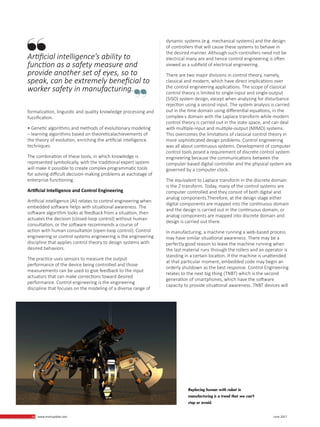
  • 55.
    55 June 2017www.martupdate.com 55
  • 56.
    56 June 201756www.martupdate.com NI Showcases Smart Platforms and Tools for the Indian Aerospace & Defence Industry Tata Steel Bags Award for Environment Protection from Jharkhand State Pollution Control Board NI (Nasdaq: NATI), the provider of systems that enable engineers and scientists to solve the world’s greatest engineering challenges, hosted the India Defence and Aerospace Symposium 2017 in association with Society of Indian Aerospace Technologies and Industries (SIATI). The symposium which witnessed a footfall of 500, was attended by engineers, scientists, managers and professionals in the aviation, space and defence industries and focused on navigation, RADAR, Electronics Warfare, Military Communications, Satellites as well as test rig construction and HIL. At the event, NI showcased how the design, development and test challenges of the Indian Aerospace & Defence Tata Steel has won two prizes on World Environment Day for commendable efforts in the area of environment protection, improvement and awareness. The awards were given by Jharkhand State Pollution Control Board (JSPCB) in the presence of Shri Raghubar Das, Chief Minister of Jharkhand, India. The company won the first prize in the ‘Large Industry’ category with respect to environment management and creating environment awareness in the society. In the ‘Mining’ category, Tata Steel West Bokaro colliery won the second prize. (A&D) Industry can be integrated by smart platforms & tools powered by ready-made technology. The diverse set of industry experts present, shared their ideas on revolution in simulation and test solutions, challenges of RADAR design & test, advanced techniques for phase aligned RF signal generation & acquisition and data acquisition systems for A&D applications. Commenting on the importance of system design for the Aerospace and Defence industry, Tarun Gupta, Business Development Manager, National Instruments India, said, “India is an established technology hub for engineering services and product development for the global defence Tata Steel has received awards in various categories from JSPCB for the fourth consecutive year. The awards were presented during a function held on the occasion of World Environment Day with the theme ‘Connecting People with Nature’. It was organized by JSPCB and Department of Forest, Environment & Climate Change. Shri Raghubar Das, Chief Minister of Jharkhand, India was the Chief Guest for the function. Shri Raghubar Das presented the award to Mr B K Das, Vice President, Iron Making, Tata Steel for winning the first prize. market. At National Instruments, it is our endeavor to provide the best- in-class testing solutions for enabling this industry rapidly develop and deploy systems. The India Defence and Aerospace Symposium 2017 gives us a platform to showcase the advanced technologies that can help build modern & reliable automated test systems for the aerospace & defence segments.” At the event, NI showcased: • Smarter approach to system design in Aerospace & Defence • Prototyping & Testing modern Electronic Warfare (EW) Systems and RADARs • Gigahertz Record & Playback Systems & Using Software Defined Radios (SDRs) for prototyping communications systems for A&D industry • Validating and Testing of Avionic Systems & Advanced Techniques for Phase Aligned signal generation and acquisition • Architecting Flexible HIL Test Systems for Embedded Controllers & Data Acquisition Systems for A&D Industry The annual National Instruments Defence & Aerospace event aims to bring together and share domain knowledge and best practices from partners in the Indian Aerospace and Defence industry. #MARTUPDATE
  • 57.
    57 June 2017 ExxonMobilCompletes New Grease and Synthetic Lubricants Facilities in Singapore Tata Power Solar Posts Rs. 2262 Crore Revenue in FY17 ExxonMobil completed its expansion project in Jurong to increase production of grease and synthetic lubricants, including Mobil 1TM, the company’s flagship synthetic engine oil. The milestone was recognized at an opening ceremony attended by Singapore Economic Development Board managing director Yeoh Keat Chuan. The expansion of the Jurong lubricant plant further strengthens the company’s manufacturing capabilities and its ability to meet the growing demand for grease and synthetic lubricants products in the Asia Pacific region. “These new grease and synthetic lubricants production facilities are Tata Power Solar, India’s largest integrated solar company, has ramped up the scale of business substantially by focusing on building state of art technology, engineering and strengthening on customer & employee satisfaction. Tata Power Solar increased its revenue by more than two and a half times in just two years to reach Rs. 2262 crore. The focus on efficiency and quality coupled with leveraging technology and innovation has helped the company to implement several challenging projects. strategically located close to key Asia Pacific markets, ensuring the reliable supply of these premium products to our customers,” said Teoh Song Ping, Asia Pacific lubricant sales director at ExxonMobil. “Our advanced lubricating oils and greases contribute to society’s broader sustainability objectives by helping to increase equipment operating efficiency and engine fuel economy, which contribute to reduced energy and resource use, as well as lower emissions.” The grease plant started production in January 2017, and the synthetics plant, which was completed in March, started production in April following a successful commissioning. The company, with a view of long- term objective, significantly increased focus on EPC, where it had built strong competencies Tata Power Solar has also been the biggest rooftop player for 3 years in a row. Tata Power Solar, in its effort to encourage domestic manufacturing, made significant expansion and modernization of its cell and module facility in Bengaluru. The second expansion within 2 years doubled the company’s module capacity to 400MW, and increased its cell manufacturing capacity by 65 per cent to 300MW. The efficiency level of the cells and modules coming out of these lines are among the best in the world. Commenting on the achievement, Mr Anil Sardana, CEO & MD, Tata Power said, “We are happy to see our team responding to Government of India’s call of ‘Make in India’. Considering the fact that solar EPC is extremely low margin and the pressures faced by the domestic manufacturing sector, the company has turned profitable within a short span, which is a remarkable achievement. Renewables will continue to be our key focus whether it is generation or manufacturing business. It is encouraging to see all our businesses coming together to achieve the ultimate objective of being the largest integrated player”. “The journey has just begun for India’s solar sector and opportunities as well as challenges are galore. While there are some bottlenecks like decreasing unit cost driven by reverse bidding and influx of cheap and subsided imported panels, solar sector continues to be a key sunrise sector with a potential to make a significant and tangible socio-economic and environmental impact”, says Ashish Khanna, ED & CEO, Tata Power Solar. www.martupdate.com 57
  • 58.
    58 www.martupdate.com 58June 2017 Dürr Ecoclean uses virtual reality on an industrial level - Service training and instruction in virtual space As one of the first manufacturers of industrial part cleaning equipment, Dürr Ecoclean uses Virtual Reality in training its global service staff to carry out maintenance support on its complex manipulators. Virtual Reality (VR) is a term currently associated mainly with computer games. However, the rendering and simultaneous perception of reality – and its physical properties – in a real- time computer generated, interactive virtual environment also offers plenty of opportunities in industry. Dürr Ecoclean, as a producer of forward looking machinery, systems and services for industrial part cleaning and surface treatment in the automotive manufacturing and supplier industries in addition to a host of other industrial market sectors, relies on virtual space in training its service technicians all around the globe. More specifically, this first VR application was developed by Tema Technology Marketing AG to conduct maintenance training on the Scara manipulator developed by Dürr Ecoclean Monschau for its EcoCFlex 3 flexible cleaning cell. In this scenario, the instructor and the trainee may be located thousands of kilometers apart. For a realistic rendering of all maintenance operations and workflows, a VR model of the manipulator was created from CAD data. This model can be moved in all directions of freedom via slider bars. Every bolt can be slackened and re-tightened in this manner, yet the individual jobs are logically structured and interdependent. For instance, in performing an oil change in the virtual system, the transmission cover can only be re-closed after oil has actually been added. This approach ensures that the various steps will be trained in their correct and full sequence, thus becoming “ingrained”. In order to achieve this, each service operative can move freely on a defined surface area in virtual space, e.g., by walking around the manipulator. “This development is an important step in ensuring that our global service technicians will be perfectly familiar with their tasks and can provide excellent support to our customers in minimum time”, comments Michael Förster, Chief Executive Officer at Dürr Ecoclean, in explaining his company’s decision in favour of the use of VR. #MARTUPDATE SKF India registers sales of INR 28047 million in 2016-17 SKF India Limited, India’s leading technology and solutions provider of bearings, seals, lubrication systems, mechatronics and services, has posted a sales figure of INR 28047.2 million in the fiscal year 2016-17. The company earned a net profit of INR 2438.9 million in the fiscal year. Among major development the Company had changed its accounting year from calendar year to fiscal year in 2015-16. The current accounting period of the Company covered 12 months starting from 1 April 2016 to 31 March 2017 as compared to 15 months period of Jan 2015 to March 2016. Commenting on the company’s performance, Mr. Shishir Joshipura, Managing Director and Country Head, SKF India said, “The prevailing economic environment during the financial year called for a differentiated approach to meet the unique challenges posed. Our results reflect the continued acceptance of our innovative approach by our customers enabling us to consolidate our leadership position. We expect economic environment to improve further, while overcoming the transition challenges under the new GST regime and other economic reforms underway.”
  • 59.
    59 June 2017www.martupdate.com 59 Auto Components. Automation & Robotics. Bearings. Castings & Forgings. Chemical Process Machinery. Die & Mould. Electrical & Electronics. Factory Interiors. Hand Tools. Hydraulics & Pneumatics. Industrial Maintenance Product. Industrial Safety Equipments. Instrumentations. IT Products & Services. Infrastructures. Logistics. Machine Tools & Accessories. Material Handling. Metal & Steel. Packaging Machinery & Equipments. Pipes, Tube & Fittings. Plastics Machinery & Equipments. Power / Energy. Process Plant Machinery & Equipt. Safety & Security. Special Purpose Machine. Storage Systems. Testing & Castors. Wire & Cable Exhibitor”s Profile : ENGINEERING EXPO Globe Tech C O N C U R R E N T S H O W MACHINE TOOLS AUTOMATION & ROBOTICS INSTRUMENTATION & CONTROLS AUTO CLUSTER EXHIBITION CENTRE, CHINCHWAD, PUNE STALL BOOKINGS OPENa Globe Tech MEDIA SOLUTIONS An Event by ENGINEERING & MANUFACTURING E X H I B I T I O N Supporting PartnerAssociation Partner Online Partner Stall Design Partner Entrepreneur Dev. Partner Digital Media Partner 29 30 01Sep. Oct. 2017 InspireDesign9665182611 9823012162satish.mandole@enggexpo.in info@enggexpo.in www.enggexpo.in Media Partner :
  • 60.
    60 www.martupdate.com 60June 2017 www.martupdate.com100 June 2016 KEMPPI INDIA PRIVATE LIMITEDKEMPPI INDIA PRIVATE LIMITED Lakshmi Towers, 2/770, Kazura Garden, !st Street, Neelankarai, Chennai- 600041 Phone: 044-45671200 Email: sales.india@kemppi.com