Predictive Analysis
Izmir Vodinaj
MKMR 310
Fall 2015
Project Summary
Goal
Determine the effects of the advertising methods on sales of men and women’s clothing and jewelry.
Data Used (All variables of interest)
1989 -1999 number of catalogs and their pages, phone lines, and men’s and women’s clothing sales.
SPSS Procedures Used
Frequencies, Regression, Select Files, Split File and Graph.
Potential Insights
Determination of continuation of catalog mailing and segmented target content.
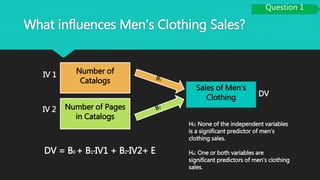
What influences Men’s Clothing Sales?
Number of
Catalogs
Number of Pages
in Catalogs
Sales of Men’s
Clothing
IV 1
IV 2
DV
DV = B0 + B1*IV1 + B2*IV2+ E
H0: None of the independent variables
is a significant predictor of men’s
clothing sales.
Ha: One or both variables are
significant predictors of men’s clothing
sales.
Question 1
Regression Assumptions: Number of Mailed
Catalogs and Catalog Pages
Continuous Variables
Normal Distribution
Linear Relationships
No Multicolinearity
No influential cases
Data Frequencies
Question 1
Interpretation
Looking at the skewnesses of these
variables all being less than 3 and
the kurtoses being less than 8, we
are able to determine that the
variables under study are normally
distributed. Furthermore, looking at
the individual variables we also see
that they are continuous.
Continuous Variables
Normal Distribution
Linear Relationships
No Multicolinearity
No influential cases
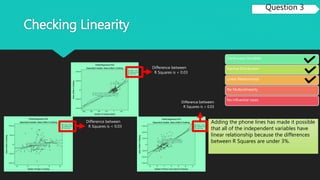
Checking Linearity
Difference between
R Squares is > 0.03 Difference between
R Squares is < 0.03
While number of pages in a catalog
and the Men’s clothing sales have
a linear relationship, the number of
catalogs mailed and men’s clothing
sales do not have a linear
relationship. This could potentially
be a sign that the linear model may
not be the best model for this project.
Continuous Variables
Normal Distribution
Linear Relationships Partially
No Multicolinearity
No influential cases
Question 2
Checking Multicolinearity
Tolerance > 0.2
VIF < 5
Continuous Variables
Normal Distribution
Linear Relationships Partially
No Multicolinearity
No influential cases
Due to our tolerance greater
Than 0.2 and the variance
Inflation factor smaller than 5,
We determine that there is no
Multicolinearity.
Question 2
Checking for Influential Cases
Before the Influential Case has been deleted:
I
II
After the Influential Case has been deleted:
Continuous Variables
Normal Distribution
Linear Relationships Partially
No Multicolinearity
No influential cases One Deleted
One influential case was found, and it
was deleted. After its deletion, the R
Square and the Adjusted R Square
resulted higher while remaining
significant. Beta Coefficients on the
other hand changed in different
directions. The coef. For number of
catalogs increased while the coef. For
the number of pages in a catalog
decreased.
Question 2
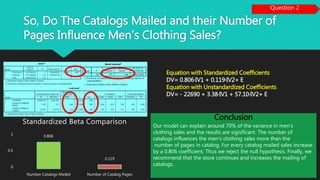
So, Do The Catalogs Mailed and their Number of
Pages Influence Men’s Clothing Sales?
Question 2
Equation with Standardized Coefficients
DV= 0.806*IV1 + 0.119*IV2+ E
Equation with Unstandardized Coefficients
DV= - 22690 + 3.38*IV1 + 57.10*IV2+ E
Conclusion
Our model can explain around 70% of the variance in men’s
clothing sales and the results are significant. The number of
catalogs influences the men’s clothing sales more than the
number of pages in catalog. For every catalog mailed sales increase
by a 0.806 coefficient. Thus we reject the null hypothesis. Finally, we
recommend that the store continues and increases the mailing of
catalogs.
0.806
0.119
0
0.5
1
Number Catalogs Mailed Number of Catalog Pages
Standardized Beta Comparison
What influences Men’s Clothing Sales?
Number of
Catalogs
Number of Pages
in Catalogs Sales of Men’s
Clothing
B2
IV 1
IV 2
DV
DV = B0 + B1*IV1 + B2*IV2+ B3*IV3 + E
H0: Adding open phone lines as an
independent variable does no
change the explanation of
variance of men’s clothing sales.
Ha: Adding open phone lines as an
independent variable does change
the explanation of variance of
men’s clothing sales.
Question 3
Number of Pages
in Catalogs
IV 3
Regression Assumptions: Phone Lines Added
Continuous Variables
Normal Distribution
Linear Relationships
No Multicolinearity
No influential cases
Question 3
Data Frequencies
Question 3
Interpretation
Looking at the skewnesses of these
variables all being less than 3 and
the kurtoses being less than 8, we
are able to determine that the
variables under study are normally
distributed. Furthermore, looking at
the individual variables we also see
that they are continuous.
Continuous Variables
Normal Distribution
Linear Relationships
No Multicolinearity
No influential cases
Checking Linearity
Difference between
R Squares is < 0.03
Difference between
R Squares is < 0.03
Adding the phone lines has made it possible
that all of the independent variables have
linear relationship because the differences
between R Squares are under 3%.
Continuous Variables
Normal Distribution
Linear Relationships
No Multicolinearity
No influential cases
Question 3
Difference between
R Squares is < 0.03
Checking Multicolinearity
Tolerance > 0.2
VIF < 5
Continuous Variables
Normal Distribution
Linear Relationships
No Multicolinearity
No influential cases
Due to our tolerance greater
than 0.2 and the variance
inflation factors smaller than 5,
we determine that there is no
multicolinearity.
Question 3
Checking for Influential Cases
Before the potential Influential Case has been deleted:
I
II
After the potential Influential Case has been deleted:
Continuous Variables
Normal Distribution
Linear Relationships Partially
No Multicolinearity
No influential cases
No influential cases were found. After
suspecting for one influential case
and deleting it, the R Square and the
Adjusted R Square resulted lower
while remaining significant. Beta
Coefficients also decreased with the
removal of the suspected influential
case.
Question 3
So, does the addition of open phone lines change
the results?
Question 3
Equation with Standardized Coefficients
DV= 0.523*IV1 + 0.110*IV2 + 0.431*IV3 + E
Equation with Unstandardized Coefficients
DV= - 19041 + 1.95*IV1 + 53.5*IV2+ 322.3*IV3 + E
Conclusion
Our model can explain around 78% of the variance in men’s
clothing sales, and the results are significant. Adding the phone lines
increased the explanation by more than 7%. The number of catalogs
still have the highest influence on men’s clothing sales, yet open
phone lines have a huge significance as well. For every catalog
mailed sales increase by a 0.523 coefficient while for every open
phone line sales increase by a 0.431 coefficient. Thus we reject the
null hypothesis. Finally, we recommend that the store continues and
increases the mailing of catalogs and open new phone lines.
0.523
0.11
0.431
0
0.2
0.4
0.6
Number Catalogs
Mailed
Number of Catalog
Pages
Phone Lines Open
Standardized Beta Comparison
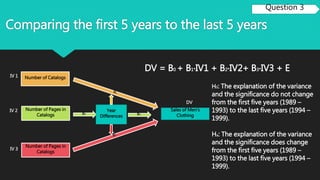
Comparing the first 5 years to the last 5 years
Number of Catalogs
Number of Pages in
Catalogs
Sales of Men’s
ClothingB2
IV 1
IV 2
DV
DV = B0 + B1*IV1 + B2*IV2+ B3*IV3 + E
H0: The explanation of the variance
and the significance do not change
from the first five years (1989 –
1993) to the last five years (1994 –
1999).
Ha: The explanation of the variance
and the significance does change
from the first five years (1989 –
1993) to the last five years (1994 –
1999).
Question 3
Number of Pages in
Catalogs
IV 3
Year
Differences
B2
Question 3
0.735
0.752
1989 - 1993 1994 - 1999
Adjusted R Square
1989 - 1993 1994 - 1999
1989 – 1993: St DV= 0.596*IV1 + 0.005*IV2 + 0.407*IV3
Unstandardized DV= - 20423 + 2.6*IV1 + 1.8*IV2+ 321.2*IV3 + E
1994 – 1999: St DV= 0.525*IV1 + 0.162*IV2 + 0.470*IV3 + E
Unstandardized DV= - 26740 + 1.98*IV1 + 80.5*IV2+ 435.4*IV3 + E
Do the first 5 years differ the last 5 years?
Conclusion
The variance of explanation differs between the years of 1989 – 1993
and 1994 - 1999 with a slightly higher variance of explanation.
Number of catalog pages has no significance during the first five years
and its beta coefficient increases during the second five years. The
open phone lines have a higher beta coefficient during the second five
years also, yet the number of catalogs beta coefficient decreased during
the second five years. According to these results, we reject our null
hypothesis. Finally, it recommended that the managers of the store
should increase the number of catalogs but pay close attention at the
future trends as its value has been decreasing. In regards to the number
of pages and open phone lines, their data suggests increase in value,
therefore investing in them moderately would be helpful.
What Influences the Sales of Women’s
Clothing the Most?
Number
Catalogs…
Number of
Catalog…
Phone
Lines Open
Customer
Service…
Adverstisin
g
Standardized Beta Comparison 0.47 0.184 -0.1 0.29 0.26
0.47
0.184
-0.1
0.29 0.26
-0.5
0
0.5
StandardizedBeta.
Standardized Beta Comparison
Interpretation
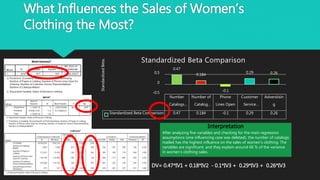
After analyzing five variables and checking for the main regression
assumptions (one influencing case was deleted), the number of catalogs
mailed has the highest influence on the sales of women’s clothing. The
variables are significant, and they explain around 66 % of the variance
in women’s clothing sales.
DV= 0.47*IV1 + 0.18*IV2 - 0.1*IV3 + 0.29*IV3 + 0.26*IV3

Marketing Analytics: Predictive analysis

  • 1.
  • 2.
    Project Summary Goal Determine theeffects of the advertising methods on sales of men and women’s clothing and jewelry. Data Used (All variables of interest) 1989 -1999 number of catalogs and their pages, phone lines, and men’s and women’s clothing sales. SPSS Procedures Used Frequencies, Regression, Select Files, Split File and Graph. Potential Insights Determination of continuation of catalog mailing and segmented target content.
  • 3.
    What influences Men’sClothing Sales? Number of Catalogs Number of Pages in Catalogs Sales of Men’s Clothing IV 1 IV 2 DV DV = B0 + B1*IV1 + B2*IV2+ E H0: None of the independent variables is a significant predictor of men’s clothing sales. Ha: One or both variables are significant predictors of men’s clothing sales. Question 1
  • 4.
    Regression Assumptions: Numberof Mailed Catalogs and Catalog Pages Continuous Variables Normal Distribution Linear Relationships No Multicolinearity No influential cases
  • 5.
    Data Frequencies Question 1 Interpretation Lookingat the skewnesses of these variables all being less than 3 and the kurtoses being less than 8, we are able to determine that the variables under study are normally distributed. Furthermore, looking at the individual variables we also see that they are continuous. Continuous Variables Normal Distribution Linear Relationships No Multicolinearity No influential cases
  • 6.
    Checking Linearity Difference between RSquares is > 0.03 Difference between R Squares is < 0.03 While number of pages in a catalog and the Men’s clothing sales have a linear relationship, the number of catalogs mailed and men’s clothing sales do not have a linear relationship. This could potentially be a sign that the linear model may not be the best model for this project. Continuous Variables Normal Distribution Linear Relationships Partially No Multicolinearity No influential cases Question 2
  • 7.
    Checking Multicolinearity Tolerance >0.2 VIF < 5 Continuous Variables Normal Distribution Linear Relationships Partially No Multicolinearity No influential cases Due to our tolerance greater Than 0.2 and the variance Inflation factor smaller than 5, We determine that there is no Multicolinearity. Question 2
  • 8.
    Checking for InfluentialCases Before the Influential Case has been deleted: I II After the Influential Case has been deleted: Continuous Variables Normal Distribution Linear Relationships Partially No Multicolinearity No influential cases One Deleted One influential case was found, and it was deleted. After its deletion, the R Square and the Adjusted R Square resulted higher while remaining significant. Beta Coefficients on the other hand changed in different directions. The coef. For number of catalogs increased while the coef. For the number of pages in a catalog decreased. Question 2
  • 9.
    So, Do TheCatalogs Mailed and their Number of Pages Influence Men’s Clothing Sales? Question 2 Equation with Standardized Coefficients DV= 0.806*IV1 + 0.119*IV2+ E Equation with Unstandardized Coefficients DV= - 22690 + 3.38*IV1 + 57.10*IV2+ E Conclusion Our model can explain around 70% of the variance in men’s clothing sales and the results are significant. The number of catalogs influences the men’s clothing sales more than the number of pages in catalog. For every catalog mailed sales increase by a 0.806 coefficient. Thus we reject the null hypothesis. Finally, we recommend that the store continues and increases the mailing of catalogs. 0.806 0.119 0 0.5 1 Number Catalogs Mailed Number of Catalog Pages Standardized Beta Comparison
  • 10.
    What influences Men’sClothing Sales? Number of Catalogs Number of Pages in Catalogs Sales of Men’s Clothing B2 IV 1 IV 2 DV DV = B0 + B1*IV1 + B2*IV2+ B3*IV3 + E H0: Adding open phone lines as an independent variable does no change the explanation of variance of men’s clothing sales. Ha: Adding open phone lines as an independent variable does change the explanation of variance of men’s clothing sales. Question 3 Number of Pages in Catalogs IV 3
  • 11.
    Regression Assumptions: PhoneLines Added Continuous Variables Normal Distribution Linear Relationships No Multicolinearity No influential cases Question 3
  • 12.
    Data Frequencies Question 3 Interpretation Lookingat the skewnesses of these variables all being less than 3 and the kurtoses being less than 8, we are able to determine that the variables under study are normally distributed. Furthermore, looking at the individual variables we also see that they are continuous. Continuous Variables Normal Distribution Linear Relationships No Multicolinearity No influential cases
  • 13.
    Checking Linearity Difference between RSquares is < 0.03 Difference between R Squares is < 0.03 Adding the phone lines has made it possible that all of the independent variables have linear relationship because the differences between R Squares are under 3%. Continuous Variables Normal Distribution Linear Relationships No Multicolinearity No influential cases Question 3 Difference between R Squares is < 0.03
  • 14.
    Checking Multicolinearity Tolerance >0.2 VIF < 5 Continuous Variables Normal Distribution Linear Relationships No Multicolinearity No influential cases Due to our tolerance greater than 0.2 and the variance inflation factors smaller than 5, we determine that there is no multicolinearity. Question 3
  • 15.
    Checking for InfluentialCases Before the potential Influential Case has been deleted: I II After the potential Influential Case has been deleted: Continuous Variables Normal Distribution Linear Relationships Partially No Multicolinearity No influential cases No influential cases were found. After suspecting for one influential case and deleting it, the R Square and the Adjusted R Square resulted lower while remaining significant. Beta Coefficients also decreased with the removal of the suspected influential case. Question 3
  • 16.
    So, does theaddition of open phone lines change the results? Question 3 Equation with Standardized Coefficients DV= 0.523*IV1 + 0.110*IV2 + 0.431*IV3 + E Equation with Unstandardized Coefficients DV= - 19041 + 1.95*IV1 + 53.5*IV2+ 322.3*IV3 + E Conclusion Our model can explain around 78% of the variance in men’s clothing sales, and the results are significant. Adding the phone lines increased the explanation by more than 7%. The number of catalogs still have the highest influence on men’s clothing sales, yet open phone lines have a huge significance as well. For every catalog mailed sales increase by a 0.523 coefficient while for every open phone line sales increase by a 0.431 coefficient. Thus we reject the null hypothesis. Finally, we recommend that the store continues and increases the mailing of catalogs and open new phone lines. 0.523 0.11 0.431 0 0.2 0.4 0.6 Number Catalogs Mailed Number of Catalog Pages Phone Lines Open Standardized Beta Comparison
  • 17.
    Comparing the first5 years to the last 5 years Number of Catalogs Number of Pages in Catalogs Sales of Men’s ClothingB2 IV 1 IV 2 DV DV = B0 + B1*IV1 + B2*IV2+ B3*IV3 + E H0: The explanation of the variance and the significance do not change from the first five years (1989 – 1993) to the last five years (1994 – 1999). Ha: The explanation of the variance and the significance does change from the first five years (1989 – 1993) to the last five years (1994 – 1999). Question 3 Number of Pages in Catalogs IV 3 Year Differences B2
  • 18.
    Question 3 0.735 0.752 1989 -1993 1994 - 1999 Adjusted R Square 1989 - 1993 1994 - 1999 1989 – 1993: St DV= 0.596*IV1 + 0.005*IV2 + 0.407*IV3 Unstandardized DV= - 20423 + 2.6*IV1 + 1.8*IV2+ 321.2*IV3 + E 1994 – 1999: St DV= 0.525*IV1 + 0.162*IV2 + 0.470*IV3 + E Unstandardized DV= - 26740 + 1.98*IV1 + 80.5*IV2+ 435.4*IV3 + E Do the first 5 years differ the last 5 years? Conclusion The variance of explanation differs between the years of 1989 – 1993 and 1994 - 1999 with a slightly higher variance of explanation. Number of catalog pages has no significance during the first five years and its beta coefficient increases during the second five years. The open phone lines have a higher beta coefficient during the second five years also, yet the number of catalogs beta coefficient decreased during the second five years. According to these results, we reject our null hypothesis. Finally, it recommended that the managers of the store should increase the number of catalogs but pay close attention at the future trends as its value has been decreasing. In regards to the number of pages and open phone lines, their data suggests increase in value, therefore investing in them moderately would be helpful.
  • 19.
    What Influences theSales of Women’s Clothing the Most? Number Catalogs… Number of Catalog… Phone Lines Open Customer Service… Adverstisin g Standardized Beta Comparison 0.47 0.184 -0.1 0.29 0.26 0.47 0.184 -0.1 0.29 0.26 -0.5 0 0.5 StandardizedBeta. Standardized Beta Comparison Interpretation After analyzing five variables and checking for the main regression assumptions (one influencing case was deleted), the number of catalogs mailed has the highest influence on the sales of women’s clothing. The variables are significant, and they explain around 66 % of the variance in women’s clothing sales. DV= 0.47*IV1 + 0.18*IV2 - 0.1*IV3 + 0.29*IV3 + 0.26*IV3

Editor's Notes

  • #6 FREQUENCIES VARIABLES=men mail page phone women /STATISTICS=STDDEV MINIMUM MAXIMUM MEAN SKEWNESS SESKEW KURTOSIS SEKURT /ORDER=ANALYSIS.
  • #7  DATASET ACTIVATE DataSet1. REGRESSION /MISSING LISTWISE /STATISTICS COEFF OUTS R ANOVA COLLIN TOL ZPP /CRITERIA=PIN(.05) POUT(.10) /NOORIGIN /DEPENDENT men /METHOD=ENTER mail page /PARTIALPLOT ALL /SAVE COOK SDRESID.
  • #8 REGRESSION /MISSING LISTWISE /STATISTICS COEFF OUTS R ANOVA COLLIN TOL ZPP /CRITERIA=PIN(.05) POUT(.10) /NOORIGIN /DEPENDENT men /METHOD=ENTER mail page /PARTIALPLOT ALL /SAVE COOK SDRESID.
  • #9 GRAPH /SCATTERPLOT(BIVAR)=COO_1 WITH SDR_1 /MISSING=LISTWISE.
  • #13 FREQUENCIES VARIABLES=men mail page phone women /STATISTICS=STDDEV MINIMUM MAXIMUM MEAN SKEWNESS SESKEW KURTOSIS SEKURT /ORDER=ANALYSIS.
  • #14 REGRESSION /MISSING LISTWISE /STATISTICS COEFF OUTS R ANOVA COLLIN TOL ZPP /CRITERIA=PIN(.05) POUT(.10) /NOORIGIN /DEPENDENT men /METHOD=ENTER mail page phone /PARTIALPLOT ALL /SAVE COOK SDRESID.
  • #15 REGRESSION /MISSING LISTWISE /STATISTICS COEFF OUTS R ANOVA COLLIN TOL ZPP /CRITERIA=PIN(.05) POUT(.10) /NOORIGIN /DEPENDENT men /METHOD=ENTER mail page /PARTIALPLOT ALL /SAVE COOK SDRESID.
  • #16 GRAPH /SCATTERPLOT(BIVAR)=COO_1 WITH SDR_1 /MISSING=LISTWISE.
  • #17 REGRESSION /MISSING LISTWISE /STATISTICS COEFF OUTS R ANOVA COLLIN TOL ZPP /CRITERIA=PIN(.05) POUT(.10) /NOORIGIN /DEPENDENT men /METHOD=ENTER mail page phone /PARTIALPLOT ALL /SAVE COOK SDRESID.
  • #18 SORT CASES BY New. SPLIT FILE LAYERED BY New. REGRESSION /MISSING LISTWISE /STATISTICS COEFF OUTS R ANOVA COLLIN TOL ZPP /CRITERIA=PIN(.05) POUT(.10) /NOORIGIN /DEPENDENT men /METHOD=ENTER mail page phone /PARTIALPLOT ALL /SAVE COOK SDRESID.
  • #20 REGRESSION /MISSING LISTWISE /STATISTICS COEFF OUTS R ANOVA COLLIN TOL ZPP /CRITERIA=PIN(.05) POUT(.10) /NOORIGIN /DEPENDENT women /METHOD=ENTER mail page phone service print /PARTIALPLOT ALL /SAVE COOK SDRESID.