A COMPREHENSIVE DATABASE ON
DRUG ASSEMENTS AND HTAs IN
SPAIN
MARKET ACCESS AND ITS IMPACT ON
DECISION MAKING

1

BCN HEALTH
Travessera de Gracia 62, 5-6
08006 Barcelona
Spain
enquiries@bcnhealth.com
Tel: +34 932 091 865
www.bcnhealth.com
OVERVIEW
o
o
o
o
o
o
o
o

Background
Objectives
Market Access
Drug assessments
Health Technology Assessment
Conclusions
Services
Contact details
2
BACKGROUND
Spain has a decentralized healthcare system. Each of the 17
Autonomous Communities have a similar but slightly different
healthcare system with its own responsibility for resource allocation
and budget planning, as well as drug assessments and HTA.
Spanish Healthcare System
o
Spain has a public National Health Service, providing universal, comprehensive care
and full access to health services as general practitioner (GP) services, hospital services
and emergency treatment free at the point of delivery. In the public sector, the only
time a patient may have to make a co-payment for care is when a prescription
medication is dispensed at a retail pharmacy.
o
The Spanish healthcare system is a highly decentralized one, although the inclusion of
health care services are arranged at a national level. The country is divided into 17
Autonomous Communities (CCAAs) each with similar but slightly different healthcare
systems.
o
Each CCAA can set additional requirements for including healthcare services as
pharmaceuticals, medical devices, diagnostics and other new technologies in their
region. For example, they can set lower drug prices or limit the use of expensive services
by introducing a visa for specific treatments. The most important CCAAs are Andalucia,
Catalonia, Madrid, Basque country and Valencia, because of their population and/or
economic interests.

3
OBJECTIVES
1)

To provide a comprehensive overview on HTA and its increasing
impact on market access of these new drugs and technologies in
Primary Healthcare Centers (PHCs) and hospital.

2)

To offer an effective tool to identify new and current assessments
published in Spain on your product and competitors focused
on the outcome measures used for its recommendations in its
specific area; PHCs or hospitals.

3)

To assess the real impact of a recommendation on prescription
patterns in daily practice.
4
MARKET ACCESS
The main objective of Market Access is to facilitate the successful and
rapid uptake of a new drug or technology at an optimal reimbursed
price. The role of the payer in determining treatment paradigms for
patients is crucial. At the hospital level the real decision-makers for the
introduction of a new drug or technology are medical personnel.
Considerations for market access
o

Payers are gaining increasing influence over the access to drugs and new technologies
(e.g. cost-containment measures, prior authorisation, reference pricing etc).

o

Payers who are managing healthcare budgets are under increasing pressure to balance
their budgets on the short as well as on the long term.

o

o

o

To make decisions payers are now increasingly demanding more information on new
drugs and technologies including data on economic parameters like costs, budget impact
and cost-effectiveness of drugs and new technologies .
As healthcare is regionally organised in Spain CCAAs can add additional requirements on
data for market access of new drugs or new technologies in their PHCs.
On a hospital level, the real decision makers for the introduction for a new drug or
technology are medical personnel. Apart from clinical evidence that need to convince
physicians to use the drug, the hospital budget is another constraint as the new drug or 5
technology will have to compete with standard treatments for the same budget.
ACTUAL SITUATION ON DRUG AND NEW

TECHNOLOGY ASSESSMENTS

The number and funding of assessments on drugs and other new
technologies is rising. Economic parameters included in these
assessments are increasing due to the initiatives of CmEVM and
GENESIS.
Description of the actual situation
o

o

o

o

o

o

In Spain numerous departments of regional health services assess new drugs and
there exist several agencies that are specialized in performing Health Technology
Assessments (HTAs)
The amount of assessments on drugs and new technologies is increasing. More
projects are started-up at the a region level (CCAA) as well as at a national level by
the Instituto Carlos III.
The increased funding of new projects at regional and national level also explains
the increase in the number of projects.
Some agencies have been included in Biomedical Research Network Centres and
Cooperative Networks on Research topics which raises additional funding for new
projects.
More drug unit departments of regional health services are starting to include
economic parameters in their assessments.
Initiatives on regional level and hospital level are taken to create working groups or
platforms to coordinate and cooperate on drug reviews and HTAs.

6
DRUG ASSESSMENT AGENCIES
Protocols and guidelines on how to perform drug assessments are
published at different levels ranging from drug unit departments
at CCAAs to coordinated working groups like CmEVM or
GENESIS.
Drug assessment performing entities
o

Drug Assessments are performed by all regional healthcare services in every CCAA.

o

Drug reviews are performed for drugs administered in Primary Healthcare Centres
(PHCs) and Hospitals.

o

Reviews for drugs in PHCs at an organised level are performed by Comité Mixto de
Evaluación de Nuevos Medicamentos (CmEVM).

o

Reviews for drugs at hospital level are done by individual hospitals or in cooperation
by Grupo de Evaluación de Novedades, Estandarización e Investigación en Selección
de Medicamentos (GENESIS) of the Spanish association of hospital pharmacy.
7
DRUG ASSESSMENTS IN PHCS
The CmENM publishes drug reviews that provide recommendations to
professionals on its respective use. Publications are written according to
a shared protocol and frequency depends on the availability of new drugs
in the market.
Considerations for drug asessment in PHCs
o

o

Members of CmENM are the Committees for the Evaluation of New Medicines (CENM) of
Andalucia, the Basque Country, Catalonia, Aragon and Navarra.
Their objective is to analyze and assess the added therapeutic value of new drugs
according to scientific evidence and provide recommendations to professionals for the
respective use of new drugs.

o

Each CCAA has a CENM who is in charge of the assessments, which will be shared with
other CCAAs as well as to validate those reports published by experts of other CCAAs.

o

Assessments include parameters as efficiency, safety, benefit / risk ratio , drug cost and its
place in therapeutic line.

o

Frequency of new assessments depend on the number of new active ingredients marketed or
new indications for an active ingredients available.

o

Full reports are published only in electronic format with some reports available in English.
8
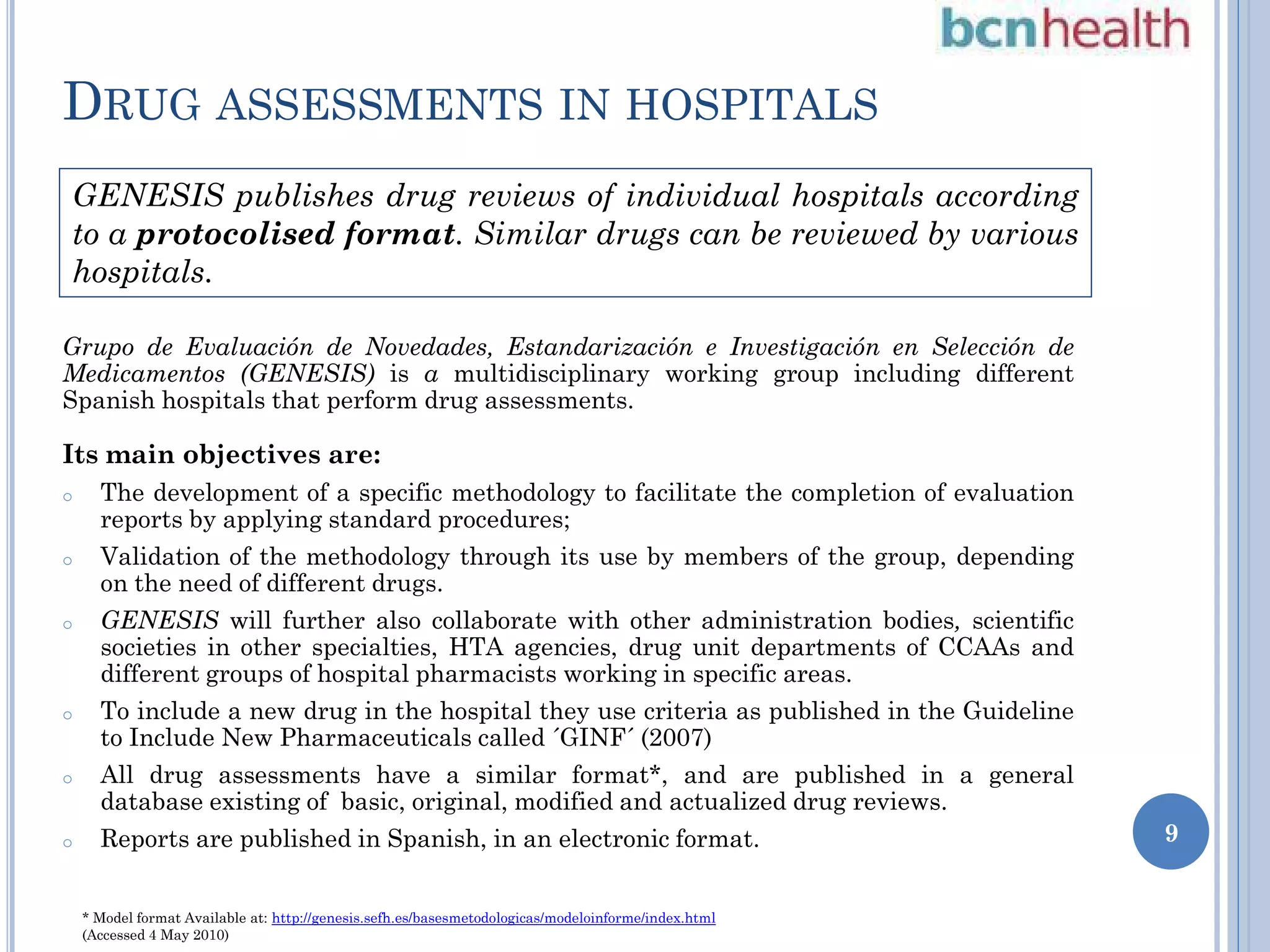
DRUG ASSESSMENTS IN HOSPITALS
GENESIS publishes drug reviews of individual hospitals according
to a protocolised format. Similar drugs can be reviewed by various
hospitals.
Grupo de Evaluación de Novedades, Estandarización e Investigación en Selección de
Medicamentos (GENESIS) is a multidisciplinary working group including different
Spanish hospitals that perform drug assessments.

Its main objectives are:
o

o

o

o

o

o

The development of a specific methodology to facilitate the completion of evaluation
reports by applying standard procedures;
Validation of the methodology through its use by members of the group, depending
on the need of different drugs.

GENESIS will further also collaborate with other administration bodies, scientific
societies in other specialties, HTA agencies, drug unit departments of CCAAs and
different groups of hospital pharmacists working in specific areas.

To include a new drug in the hospital they use criteria as published in the Guideline
to Include New Pharmaceuticals called ´GINF´ (2007)
All drug assessments have a similar format*, and are published in a general
database existing of basic, original, modified and actualized drug reviews.
Reports are published in Spanish, in an electronic format.

* Model format Available at: http://genesis.sefh.es/basesmetodologicas/modeloinforme/index.html
(Accessed 4 May 2010)

9
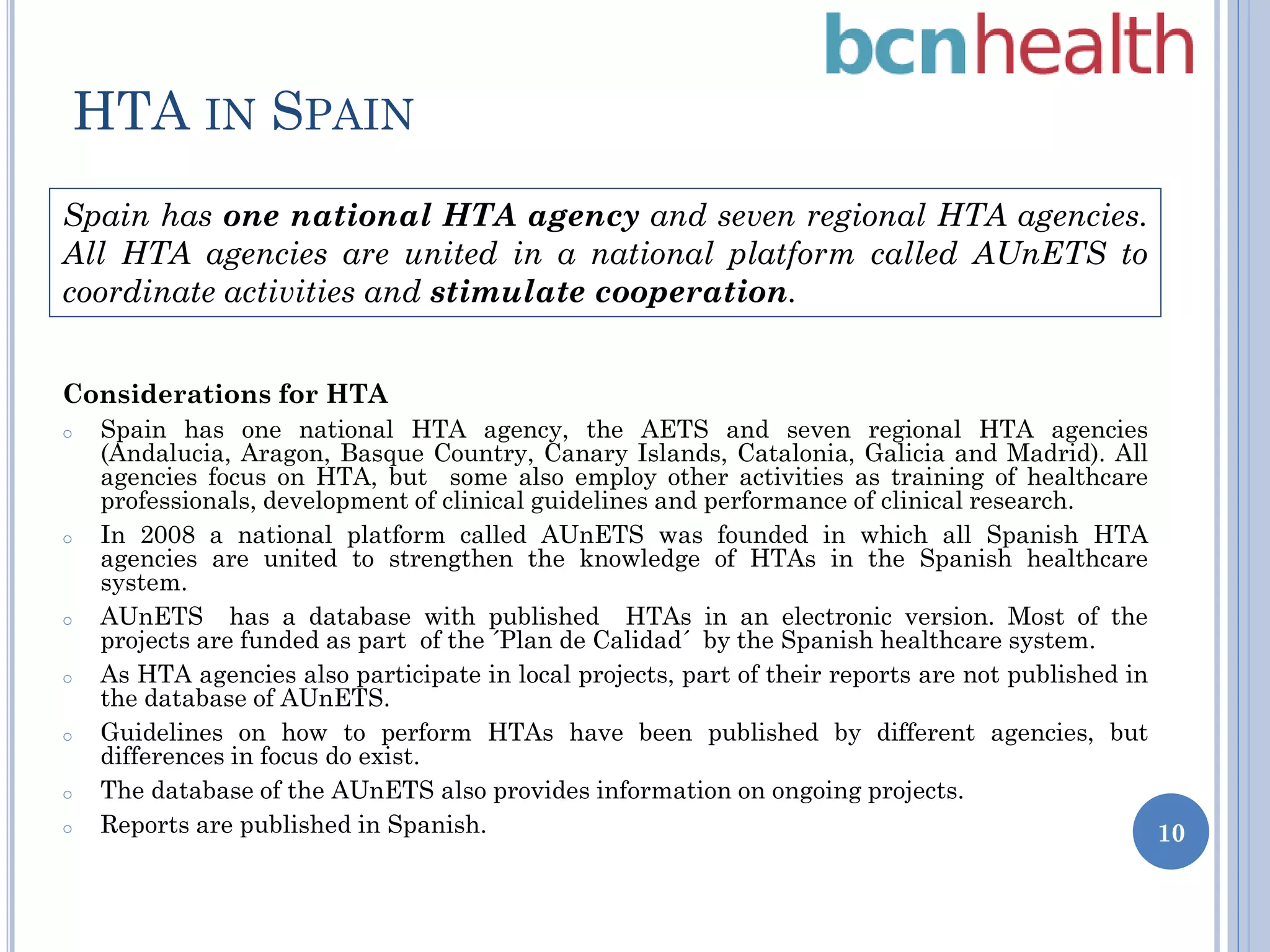
HTA IN SPAIN
Spain has one national HTA agency and seven regional HTA agencies.
All HTA agencies are united in a national platform called AUnETS to
coordinate activities and stimulate cooperation.
Considerations for HTA
o

o

o

o

o

o
o

Spain has one national HTA agency, the AETS and seven regional HTA agencies
(Andalucia, Aragon, Basque Country, Canary Islands, Catalonia, Galicia and Madrid). All
agencies focus on HTA, but some also employ other activities as training of healthcare
professionals, development of clinical guidelines and performance of clinical research.
In 2008 a national platform called AUnETS was founded in which all Spanish HTA
agencies are united to strengthen the knowledge of HTAs in the Spanish healthcare
system.
AUnETS has a database with published HTAs in an electronic version. Most of the
projects are funded as part of the ´Plan de Calidad´ by the Spanish healthcare system.
As HTA agencies also participate in local projects, part of their reports are not published in
the database of AUnETS.
Guidelines on how to perform HTAs have been published by different agencies, but
differences in focus do exist.
The database of the AUnETS also provides information on ongoing projects.
Reports are published in Spanish.
10
CONCLUSIONS
o

o

o

o

o

o

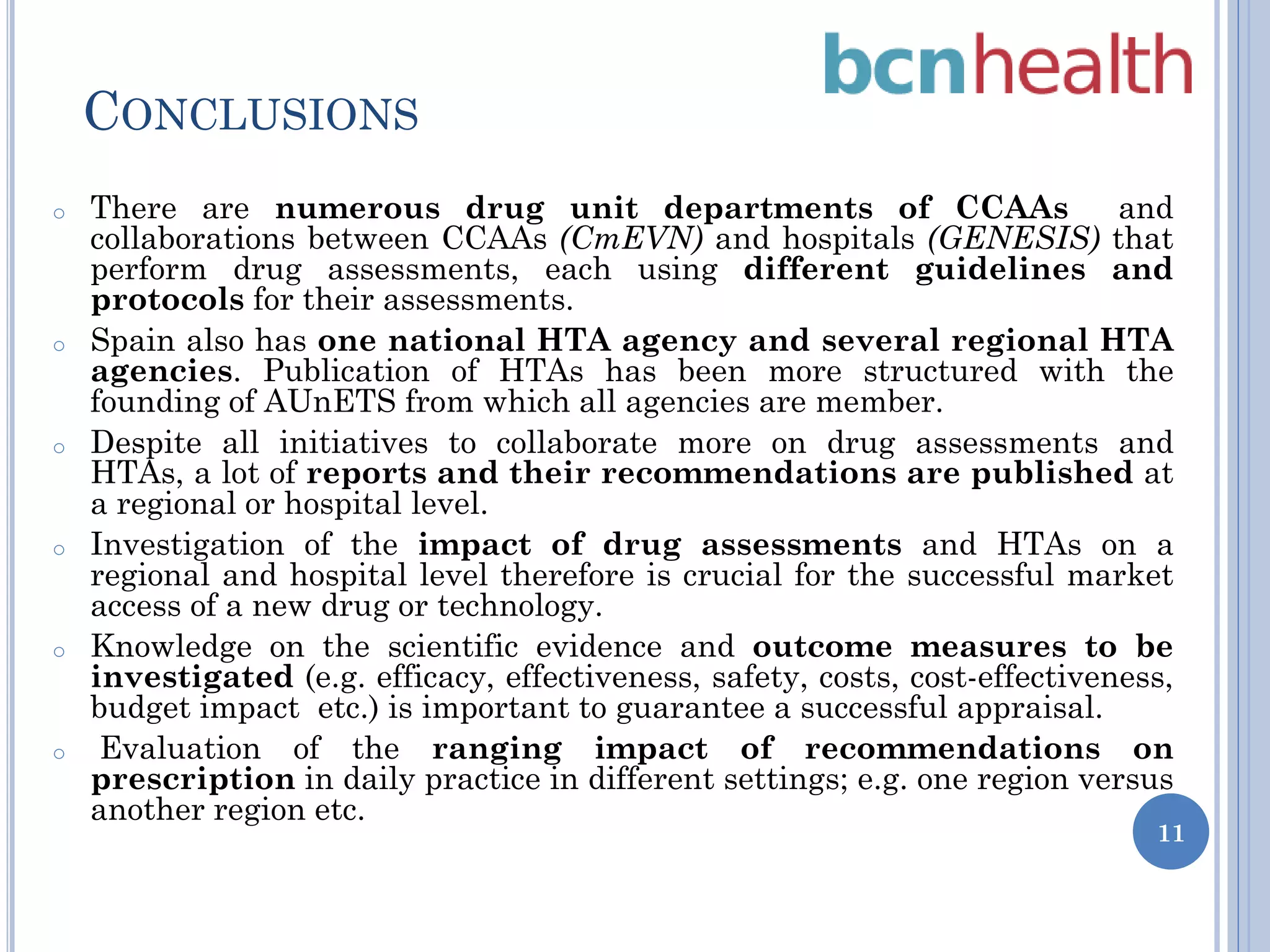
There are numerous drug unit departments of CCAAs
and
collaborations between CCAAs (CmEVN) and hospitals (GENESIS) that
perform drug assessments, each using different guidelines and
protocols for their assessments.
Spain also has one national HTA agency and several regional HTA
agencies. Publication of HTAs has been more structured with the
founding of AUnETS from which all agencies are member.
Despite all initiatives to collaborate more on drug assessments and
HTAs, a lot of reports and their recommendations are published at
a regional or hospital level.
Investigation of the impact of drug assessments and HTAs on a
regional and hospital level therefore is crucial for the successful market
access of a new drug or technology.
Knowledge on the scientific evidence and outcome measures to be
investigated (e.g. efficacy, effectiveness, safety, costs, cost-effectiveness,
budget impact etc.) is important to guarantee a successful appraisal.
Evaluation of the ranging impact of recommendations on
prescription in daily practice in different settings; e.g. one region versus
another region etc.

11
SERVICES
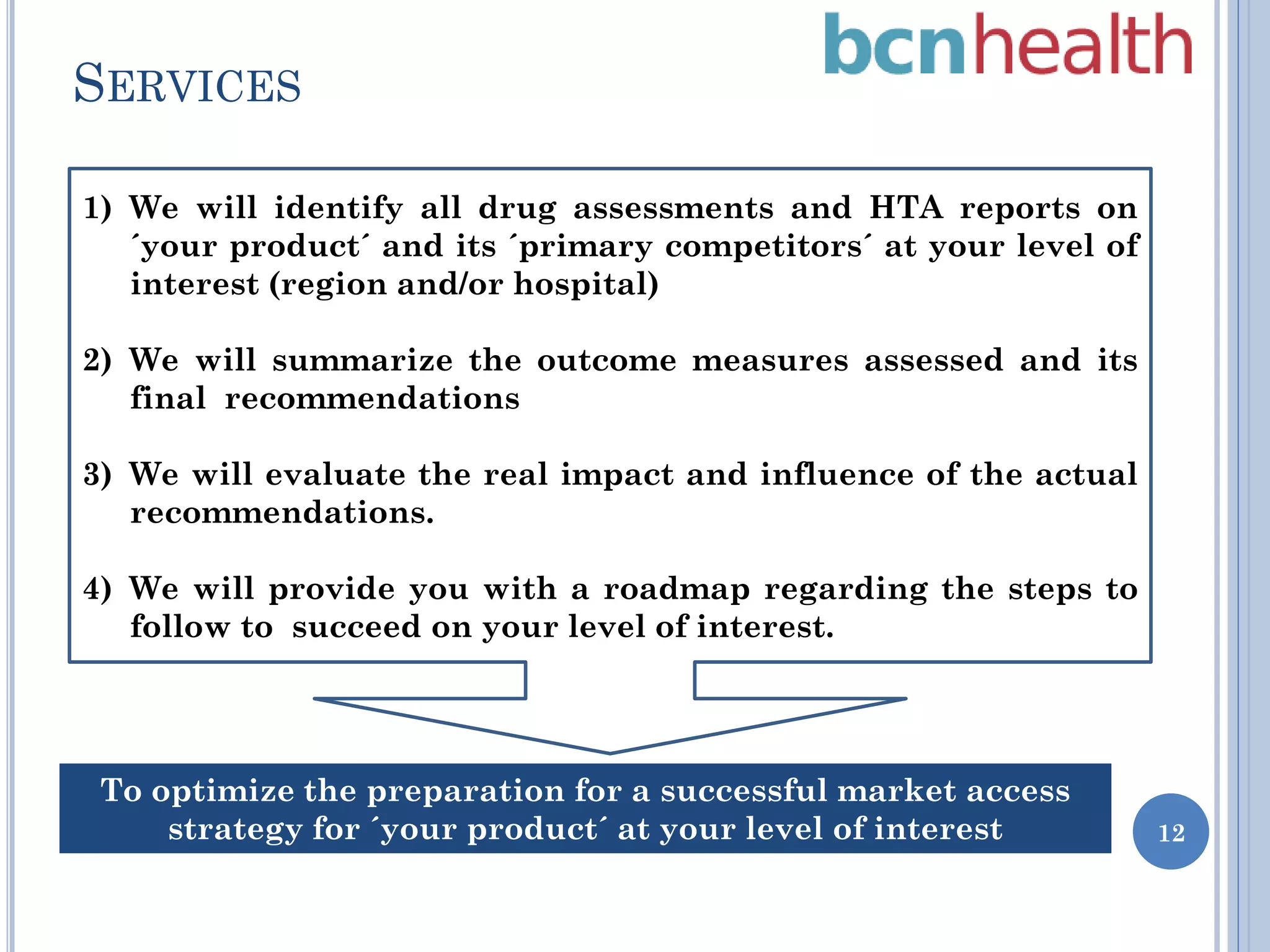
1) We will identify all drug assessments and HTA reports on
´your product´ and its ´primary competitors´ at your level of
interest (region and/or hospital)
2) We will summarize the outcome measures assessed and its
final recommendations
3) We will evaluate the real impact and influence of the actual
recommendations.
4) We will provide you with a roadmap regarding the steps to
follow to succeed on your level of interest.

To optimize the preparation for a successful market access
strategy for ´your product´ at your level of interest

12
C0NTAC INFORMATION
Pricing & Market Access Services

Travessera de Gracia 62, 5-6

08006 Barcelona - Spain

enquiries@bcnhealth.com
Tel: +34 932 091 865

Tel: +34 659 860 948

www.bcnhealth.com

13

Market Access Database Spain 2013

  • 1.
    A COMPREHENSIVE DATABASEON DRUG ASSEMENTS AND HTAs IN SPAIN MARKET ACCESS AND ITS IMPACT ON DECISION MAKING 1 BCN HEALTH Travessera de Gracia 62, 5-6 08006 Barcelona Spain enquiries@bcnhealth.com Tel: +34 932 091 865 www.bcnhealth.com
  • 2.
    OVERVIEW o o o o o o o o Background Objectives Market Access Drug assessments HealthTechnology Assessment Conclusions Services Contact details 2
  • 3.
    BACKGROUND Spain has adecentralized healthcare system. Each of the 17 Autonomous Communities have a similar but slightly different healthcare system with its own responsibility for resource allocation and budget planning, as well as drug assessments and HTA. Spanish Healthcare System o Spain has a public National Health Service, providing universal, comprehensive care and full access to health services as general practitioner (GP) services, hospital services and emergency treatment free at the point of delivery. In the public sector, the only time a patient may have to make a co-payment for care is when a prescription medication is dispensed at a retail pharmacy. o The Spanish healthcare system is a highly decentralized one, although the inclusion of health care services are arranged at a national level. The country is divided into 17 Autonomous Communities (CCAAs) each with similar but slightly different healthcare systems. o Each CCAA can set additional requirements for including healthcare services as pharmaceuticals, medical devices, diagnostics and other new technologies in their region. For example, they can set lower drug prices or limit the use of expensive services by introducing a visa for specific treatments. The most important CCAAs are Andalucia, Catalonia, Madrid, Basque country and Valencia, because of their population and/or economic interests. 3
  • 4.
    OBJECTIVES 1) To provide acomprehensive overview on HTA and its increasing impact on market access of these new drugs and technologies in Primary Healthcare Centers (PHCs) and hospital. 2) To offer an effective tool to identify new and current assessments published in Spain on your product and competitors focused on the outcome measures used for its recommendations in its specific area; PHCs or hospitals. 3) To assess the real impact of a recommendation on prescription patterns in daily practice. 4
  • 5.
    MARKET ACCESS The mainobjective of Market Access is to facilitate the successful and rapid uptake of a new drug or technology at an optimal reimbursed price. The role of the payer in determining treatment paradigms for patients is crucial. At the hospital level the real decision-makers for the introduction of a new drug or technology are medical personnel. Considerations for market access o Payers are gaining increasing influence over the access to drugs and new technologies (e.g. cost-containment measures, prior authorisation, reference pricing etc). o Payers who are managing healthcare budgets are under increasing pressure to balance their budgets on the short as well as on the long term. o o o To make decisions payers are now increasingly demanding more information on new drugs and technologies including data on economic parameters like costs, budget impact and cost-effectiveness of drugs and new technologies . As healthcare is regionally organised in Spain CCAAs can add additional requirements on data for market access of new drugs or new technologies in their PHCs. On a hospital level, the real decision makers for the introduction for a new drug or technology are medical personnel. Apart from clinical evidence that need to convince physicians to use the drug, the hospital budget is another constraint as the new drug or 5 technology will have to compete with standard treatments for the same budget.
  • 6.
    ACTUAL SITUATION ONDRUG AND NEW TECHNOLOGY ASSESSMENTS The number and funding of assessments on drugs and other new technologies is rising. Economic parameters included in these assessments are increasing due to the initiatives of CmEVM and GENESIS. Description of the actual situation o o o o o o In Spain numerous departments of regional health services assess new drugs and there exist several agencies that are specialized in performing Health Technology Assessments (HTAs) The amount of assessments on drugs and new technologies is increasing. More projects are started-up at the a region level (CCAA) as well as at a national level by the Instituto Carlos III. The increased funding of new projects at regional and national level also explains the increase in the number of projects. Some agencies have been included in Biomedical Research Network Centres and Cooperative Networks on Research topics which raises additional funding for new projects. More drug unit departments of regional health services are starting to include economic parameters in their assessments. Initiatives on regional level and hospital level are taken to create working groups or platforms to coordinate and cooperate on drug reviews and HTAs. 6
  • 7.
    DRUG ASSESSMENT AGENCIES Protocolsand guidelines on how to perform drug assessments are published at different levels ranging from drug unit departments at CCAAs to coordinated working groups like CmEVM or GENESIS. Drug assessment performing entities o Drug Assessments are performed by all regional healthcare services in every CCAA. o Drug reviews are performed for drugs administered in Primary Healthcare Centres (PHCs) and Hospitals. o Reviews for drugs in PHCs at an organised level are performed by Comité Mixto de Evaluación de Nuevos Medicamentos (CmEVM). o Reviews for drugs at hospital level are done by individual hospitals or in cooperation by Grupo de Evaluación de Novedades, Estandarización e Investigación en Selección de Medicamentos (GENESIS) of the Spanish association of hospital pharmacy. 7
  • 8.
    DRUG ASSESSMENTS INPHCS The CmENM publishes drug reviews that provide recommendations to professionals on its respective use. Publications are written according to a shared protocol and frequency depends on the availability of new drugs in the market. Considerations for drug asessment in PHCs o o Members of CmENM are the Committees for the Evaluation of New Medicines (CENM) of Andalucia, the Basque Country, Catalonia, Aragon and Navarra. Their objective is to analyze and assess the added therapeutic value of new drugs according to scientific evidence and provide recommendations to professionals for the respective use of new drugs. o Each CCAA has a CENM who is in charge of the assessments, which will be shared with other CCAAs as well as to validate those reports published by experts of other CCAAs. o Assessments include parameters as efficiency, safety, benefit / risk ratio , drug cost and its place in therapeutic line. o Frequency of new assessments depend on the number of new active ingredients marketed or new indications for an active ingredients available. o Full reports are published only in electronic format with some reports available in English. 8
  • 9.
    DRUG ASSESSMENTS INHOSPITALS GENESIS publishes drug reviews of individual hospitals according to a protocolised format. Similar drugs can be reviewed by various hospitals. Grupo de Evaluación de Novedades, Estandarización e Investigación en Selección de Medicamentos (GENESIS) is a multidisciplinary working group including different Spanish hospitals that perform drug assessments. Its main objectives are: o o o o o o The development of a specific methodology to facilitate the completion of evaluation reports by applying standard procedures; Validation of the methodology through its use by members of the group, depending on the need of different drugs. GENESIS will further also collaborate with other administration bodies, scientific societies in other specialties, HTA agencies, drug unit departments of CCAAs and different groups of hospital pharmacists working in specific areas. To include a new drug in the hospital they use criteria as published in the Guideline to Include New Pharmaceuticals called ´GINF´ (2007) All drug assessments have a similar format*, and are published in a general database existing of basic, original, modified and actualized drug reviews. Reports are published in Spanish, in an electronic format. * Model format Available at: http://genesis.sefh.es/basesmetodologicas/modeloinforme/index.html (Accessed 4 May 2010) 9
  • 10.
    HTA IN SPAIN Spainhas one national HTA agency and seven regional HTA agencies. All HTA agencies are united in a national platform called AUnETS to coordinate activities and stimulate cooperation. Considerations for HTA o o o o o o o Spain has one national HTA agency, the AETS and seven regional HTA agencies (Andalucia, Aragon, Basque Country, Canary Islands, Catalonia, Galicia and Madrid). All agencies focus on HTA, but some also employ other activities as training of healthcare professionals, development of clinical guidelines and performance of clinical research. In 2008 a national platform called AUnETS was founded in which all Spanish HTA agencies are united to strengthen the knowledge of HTAs in the Spanish healthcare system. AUnETS has a database with published HTAs in an electronic version. Most of the projects are funded as part of the ´Plan de Calidad´ by the Spanish healthcare system. As HTA agencies also participate in local projects, part of their reports are not published in the database of AUnETS. Guidelines on how to perform HTAs have been published by different agencies, but differences in focus do exist. The database of the AUnETS also provides information on ongoing projects. Reports are published in Spanish. 10
  • 11.
    CONCLUSIONS o o o o o o There are numerousdrug unit departments of CCAAs and collaborations between CCAAs (CmEVN) and hospitals (GENESIS) that perform drug assessments, each using different guidelines and protocols for their assessments. Spain also has one national HTA agency and several regional HTA agencies. Publication of HTAs has been more structured with the founding of AUnETS from which all agencies are member. Despite all initiatives to collaborate more on drug assessments and HTAs, a lot of reports and their recommendations are published at a regional or hospital level. Investigation of the impact of drug assessments and HTAs on a regional and hospital level therefore is crucial for the successful market access of a new drug or technology. Knowledge on the scientific evidence and outcome measures to be investigated (e.g. efficacy, effectiveness, safety, costs, cost-effectiveness, budget impact etc.) is important to guarantee a successful appraisal. Evaluation of the ranging impact of recommendations on prescription in daily practice in different settings; e.g. one region versus another region etc. 11
  • 12.
    SERVICES 1) We willidentify all drug assessments and HTA reports on ´your product´ and its ´primary competitors´ at your level of interest (region and/or hospital) 2) We will summarize the outcome measures assessed and its final recommendations 3) We will evaluate the real impact and influence of the actual recommendations. 4) We will provide you with a roadmap regarding the steps to follow to succeed on your level of interest. To optimize the preparation for a successful market access strategy for ´your product´ at your level of interest 12
  • 13.
    C0NTAC INFORMATION Pricing &Market Access Services Travessera de Gracia 62, 5-6 08006 Barcelona - Spain enquiries@bcnhealth.com Tel: +34 932 091 865 Tel: +34 659 860 948 www.bcnhealth.com 13