IT’S GETTING CLOUDY 
IN 
IT SERVICE MANAGEMENT 
MARK O’LOUGHLIN 
Copyright © Mark O’Loughlin 2014
Copyright © Mark O’Loughlin 2014 
Profile 
Mark O’Loughlin 
• Service Management Principal 
• Consultant 
- Service Management 
- Service Architect / Designer 
• Author The Service Catalog 
• Author Professional Cloud Service Management 
• ITIL Master 
• ITIL Trainer 
• Director itSMF Ireland 
• Member of WG25CA (ISO/IEC 20000 workgroup)
Copyright © Mark O’Loughlin 2014 
Organizations
Copyright © Mark O’Loughlin 2014 
Promote the Message 
Twitter: @oloughlinmark 
Email: mark@redcirclestrategies.com 
mark.oloughlin@italliancegroup.com 
mark.oloughlin@auxilion.com 
Website: www.redcirclestrategies.com 
Blog: www.markoloughlin.org
Copyright © Mark O’Loughlin 2014 
Agenda 
• Cloud Computing 
• Benefits & Importance of Cloud 
• Cloud and ITSM Convergence 
• Scenarios 
• Recommendations 
• Helpful Resources
Cloud computing is seen as a 
new way of delivering 
computing resources 
Copyright © Mark O’Loughlin 2014 
What is Cloud 
Cloud computing is 
not new technology 
Cloud computing is the 
delivery of computing as a 
service, rather than a product, 
where shared resources are 
provided as a utility over a 
network (internet)
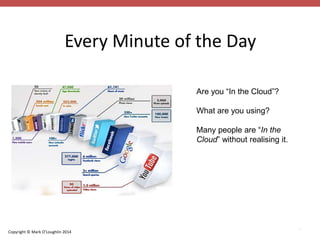
Every Minute of the Day 
Copyright © Mark O’Loughlin 2014 
7 
Are you “In the Cloud”? 
What are you using? 
Many people are “In the 
Cloud” without realising it.
Copyright © Mark O’Loughlin 2014 
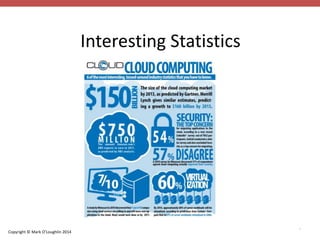
Interesting Statistics 
8
Examples of Cloud Services 
Copyright © Mark O’Loughlin 2014
Copyright © Mark O’Loughlin 2014 
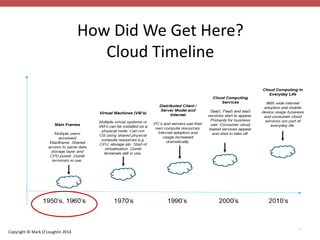
How Did We Get Here? 
Cloud Timeline 
10
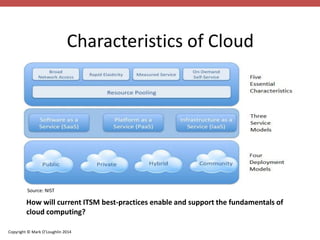
Characteristics of Cloud 
Source: NIST 
How will current ITSM best-practices enable and support the fundamentals of 
cloud computing? 
Copyright © Mark O’Loughlin 2014
Copyright © Mark O’Loughlin 2014 
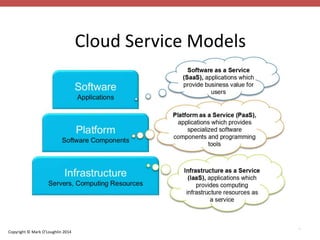
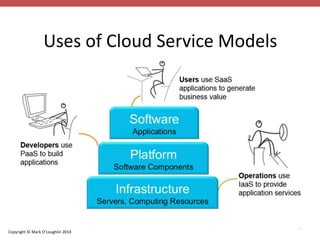
Cloud Service Models 
12
Uses of Cloud Service Models 
Copyright © Mark O’Loughlin 2014 
13
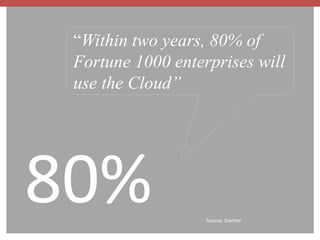
“Within two years, 80% of 
Fortune 1000 enterprises will 
use the Cloud” 
80% 
Source: Gartner 
Copyright © 2012 ITpreneurs. All rights reserved. www.ITpreneurs.com
Copyright © Mark O’Loughlin 2014 
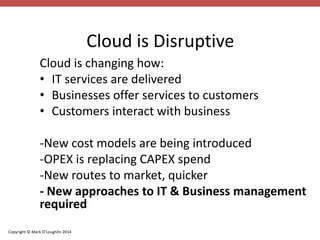
Cloud is Disruptive 
Cloud is changing how: 
• IT services are delivered 
• Businesses offer services to customers 
• Customers interact with business 
-New cost models are being introduced 
-OPEX is replacing CAPEX spend 
-New routes to market, quicker 
- New approaches to IT & Business management 
required
Copyright © Mark O’Loughlin 2014 
Cloud is Disruptive 
The business will expect faster, quicker, cheaper, 
better, agile. 
How will IT service providers adapt to the changes 
cloud is introducing? 
What can you deliver with cloud? 
How will you manage the development and 
operation of cloud based services?
Even though cloud is disruptive there are many benefits 
Copyright © Mark O’Loughlin 2014 
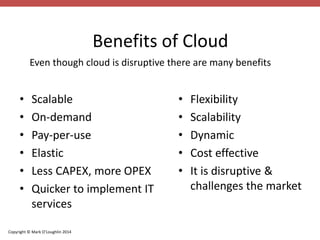
Benefits of Cloud 
• Scalable 
• On-demand 
• Pay-per-use 
• Elastic 
• Less CAPEX, more OPEX 
• Quicker to implement IT 
services 
• Flexibility 
• Scalability 
• Dynamic 
• Cost effective 
• It is disruptive & 
challenges the market
Copyright © Mark O’Loughlin 2014 
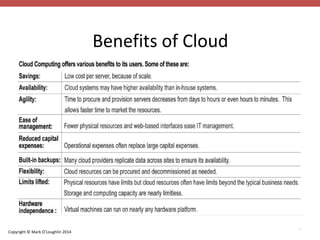
Benefits of Cloud 
18
Cloud and ITSM Convergence 
Updated IT & Business practices will be 
required to realise and manage the benefits 
Copyright © Mark O’Loughlin 2014 
from cloud computing
+ 
+ 
Copyright © Mark O’Loughlin 2014 
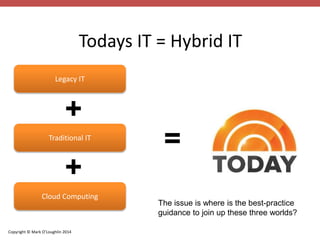
Todays IT = Hybrid IT 
Legacy IT 
Traditional IT 
Cloud Computing 
= 
The issue is where is the best-practice 
guidance to join up these three worlds?
Copyright © Mark O’Loughlin 2014 
Hybrid IT Examples 
-SaaS based ticketing systems 
-PaaS based systems for a test environment 
-IaaS for on-demand batch processing 
-ERP mainframe system 
-Desktop applications 
-Client / server environment
WHERE DOES ITSM GET CLOUDY? 
Copyright © Mark O’Loughlin 2014 
Copyright © Mark O’Loughlin 2014
Examples for Todays Webinar 
To realise the benefits of cloud computing you have 
to adapt what you do today 
Six basic examples where ITSM gets cloudy! 
1. Roles 
2. Service Levels 
3. Change Management 
4. Procuring Services 
5. Demand Management 
6. Financing IT & Business Services 
Copyright © Mark O’Loughlin 2014
Copyright © Mark O’Loughlin 2014 
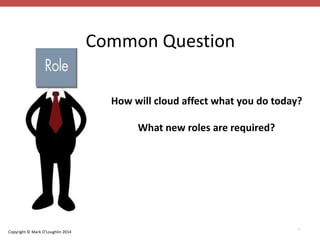
Common Question 
How will cloud affect what you do today? 
What new roles are required? 
24
Copyright © Mark O’Loughlin 2014 
Changing Roles 
Management of cloud computing and cloud-based 
services requires: 
• Roles from IT Service Management 
• Roles form the organization 
• Additional roles not defined in IT Service 
Management 
NIST defines these key roles 
• Cloud Consumer 
• Cloud Provider 
• Cloud Broker 
• Cloud Auditor 
• Cloud Carrier 
25
Copyright © Mark O’Loughlin 2014 
Common Questions 
How will cloud affect buying and selling 
services?
IT Becomes The Broker 
IT will buy cloud based services 
= New role for IT 
• Less in-house staff and operations to manage 
• More outsourcing taking place - higher spec roles 
• New skills needed - less technical, more business 
• Contract negotiation & supplier management 
• Increase OPEX offset by decrease CAPEX 
• Where is the best practice guidance for The 
Broker? 
Copyright © Mark O’Loughlin 2014
IT Becomes The Broker 
IT roles of the (not to distant) future 
• Strategy & CIO – aligned to business needs 
• Architecture 
• Development & design (primarily application) 
• Project management 
• Consultants including best practice in security & 
service management 
• Less of the traditional IT jobs done in-house 
In-house technical roles expected to phase out decrease 
as they will be provided by cloud service providers. 
Copyright © Mark O’Loughlin 2014
Copyright © Mark O’Loughlin 2014 
Common Questions 
How will cloud affect service levels?
Copyright © Mark O’Loughlin 2014 
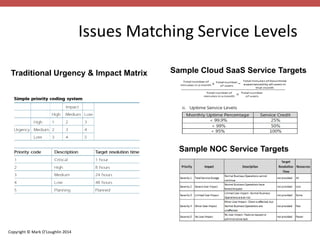
Issues Matching Service Levels 
Traditional Urgency & Impact Matrix Sample Cloud SaaS Service Targets 
Sample NOC Service Targets
Copyright © Mark O’Loughlin 2014 
Common Questions 
How will cloud affect change management?
Change Management Needs to Change 
Copyright © Mark O’Loughlin 2014 
32 
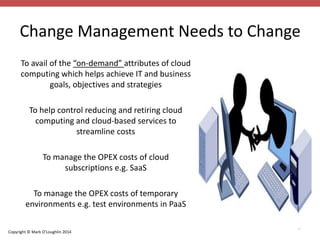
To avail of the “on-demand” attributes of cloud 
computing which helps achieve IT and business 
goals, objectives and strategies 
To help control reducing and retiring cloud 
computing and cloud-based services to 
streamline costs 
To manage the OPEX costs of cloud 
subscriptions e.g. SaaS 
To manage the OPEX costs of temporary 
environments e.g. test environments in PaaS
Copyright © Mark O’Loughlin 2014 
Change Management 
Is traditional change management capable of 
dealing with cloud based change? 
• Cloud is an on-demand service model 
• Changes happen on demand 
• Can traditional CAB’s cater for on-demand? 
• Actually – who owns the IT change now? 
• Who is accountable, responsible – who gets 
fired?
Copyright © Mark O’Loughlin 2014 
Change Management 
Is traditional change management capable 
of dealing with cloud based change? 
• Who’s change management system? 
• What changes do you need to know 
about? 
• Demand spikes need immediate change.
Copyright © Mark O’Loughlin 2014 
Common Questions 
How will cloud affect demand management for 
services?
Demand Management 
• The IT tap can be turned on or off in an 
instant 
Copyright © Mark O’Loughlin 2014 
- True for PaaS, IaaS e.g. more CPU compute power 
- Less true for BPaS, SRaaS i.e. redesign or readjust the service 
• Know in advance how cloud provider can 
react to your changing demands 
• Know the costs of using more compute / 
services 
• Will the business pay for their increased IT 
use that meets their demand?
Demand Management 
• Requires management of demand from 
both supplier and provider 
• Identify if SaaS subscriptions will increase 
costs e.g. if a SaaS applications is more heavily used than originally 
planned 
• Does your procurement team understand 
cloud services and how to buy them? 
• Have you enough OPEX to keep the tap 
running? 
Copyright © Mark O’Loughlin 2014
Copyright © Mark O’Loughlin 2014 
Common Questions 
How will cloud affect financing IT & business 
services?
Copyright © Mark O’Loughlin 2014 
CAPEX v’s OPEX 
39 
Many cloud services consumes OPEX e.g. 
• Office 365 subscriptions 
• ServiceNow incident management seats 
Considerations: 
• Current budgets not set up for increased OPEX spend 
• Who will pay for the extra OPEX spend? 
• Fixed price for IT services still required by procurement 
• CFO’s may want to spend CAPEX and *amortize it over a number of years 
• Some cloud services require set-up costs 
* How do you amortize subscription based charges?
Copyright © Mark O’Loughlin 2014 
Recommendations 
1. Understand the disruptive nature of cloud 
2. Identify where cloud can benefit the organization 
3. Realise that change to certain processes will be 
required 
4. Adapt current policies, processes and procedures 
where necessary 
5. Continue to capitalize on your ITSM investment 
6. Don’t reinvent the wheel – Use & adapt current 
practices for cloud 
7. Use ITIL and other best-practice to overcome 
challenges and explore new opportunities
Copyright © Mark O’Loughlin 2014 
Helpful Resources 
Cloud Service Manager (Mark O’Loughlin-Lead Author) 
https://www.itpreneurs.com/course/cloud-service-manager/ 
Cloud Service Architect 
https://www.itpreneurs.com/course/cloud-solutions-architect/ 
NIST 
http://www.nist.gov/itl/cloud/ 
Axelos White Paper on Cloud Computing 
http://www.axelos.com/gempdf/Best_Practice_In_The_Cloud_An_Introduction. 
pdf
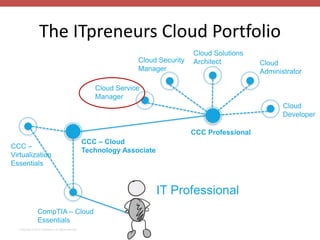
The ITpreneurs Cloud Portfolio 
Cloud Security 
Manager 
Cloud Service 
Manager 
Cloud Solutions 
Architect Cloud 
Administrator 
Cloud 
Developer 
CCC Professional 
CCC – Cloud 
Technology Associate 
CCC – 
Virtualization 
Essentials 
CompTIA – Cloud 
Essentials 
IT Professional 
Copyright © 2014 ITpreneurs. All rights reserved.
Cloud Service Manager 
Modules 
• Cloud Service Management Fundamentals 
• Cloud Service Management Roles 
• Cloud Service Strategy 
• Cloud Service Design, Deployment and On-Boarding 
• Cloud Service Management 
• Cloud Service Economics 
• Cloud Service Governance 
• Showing the Value of Cloud Services 
• Popular Service Management Frameworks 
Copyright © Mark O’Loughlin 2014
Copyright © Mark O’Loughlin 2014 
Review 
• Cloud Computing 
• Benefits & Importance of Cloud 
• Cloud and ITSM Convergence 
• Scenarios 
• Recommendations 
• Helpful Resources

It's Getting Cloudy In IT Service Management

  • 1.
    IT’S GETTING CLOUDY IN IT SERVICE MANAGEMENT MARK O’LOUGHLIN Copyright © Mark O’Loughlin 2014
  • 2.
    Copyright © MarkO’Loughlin 2014 Profile Mark O’Loughlin • Service Management Principal • Consultant - Service Management - Service Architect / Designer • Author The Service Catalog • Author Professional Cloud Service Management • ITIL Master • ITIL Trainer • Director itSMF Ireland • Member of WG25CA (ISO/IEC 20000 workgroup)
  • 3.
    Copyright © MarkO’Loughlin 2014 Organizations
  • 4.
    Copyright © MarkO’Loughlin 2014 Promote the Message Twitter: @oloughlinmark Email: mark@redcirclestrategies.com mark.oloughlin@italliancegroup.com mark.oloughlin@auxilion.com Website: www.redcirclestrategies.com Blog: www.markoloughlin.org
  • 5.
    Copyright © MarkO’Loughlin 2014 Agenda • Cloud Computing • Benefits & Importance of Cloud • Cloud and ITSM Convergence • Scenarios • Recommendations • Helpful Resources
  • 6.
    Cloud computing isseen as a new way of delivering computing resources Copyright © Mark O’Loughlin 2014 What is Cloud Cloud computing is not new technology Cloud computing is the delivery of computing as a service, rather than a product, where shared resources are provided as a utility over a network (internet)
  • 7.
    Every Minute ofthe Day Copyright © Mark O’Loughlin 2014 7 Are you “In the Cloud”? What are you using? Many people are “In the Cloud” without realising it.
  • 8.
    Copyright © MarkO’Loughlin 2014 Interesting Statistics 8
  • 9.
    Examples of CloudServices Copyright © Mark O’Loughlin 2014
  • 10.
    Copyright © MarkO’Loughlin 2014 How Did We Get Here? Cloud Timeline 10
  • 11.
    Characteristics of Cloud Source: NIST How will current ITSM best-practices enable and support the fundamentals of cloud computing? Copyright © Mark O’Loughlin 2014
  • 12.
    Copyright © MarkO’Loughlin 2014 Cloud Service Models 12
  • 13.
    Uses of CloudService Models Copyright © Mark O’Loughlin 2014 13
  • 14.
    “Within two years,80% of Fortune 1000 enterprises will use the Cloud” 80% Source: Gartner Copyright © 2012 ITpreneurs. All rights reserved. www.ITpreneurs.com
  • 15.
    Copyright © MarkO’Loughlin 2014 Cloud is Disruptive Cloud is changing how: • IT services are delivered • Businesses offer services to customers • Customers interact with business -New cost models are being introduced -OPEX is replacing CAPEX spend -New routes to market, quicker - New approaches to IT & Business management required
  • 16.
    Copyright © MarkO’Loughlin 2014 Cloud is Disruptive The business will expect faster, quicker, cheaper, better, agile. How will IT service providers adapt to the changes cloud is introducing? What can you deliver with cloud? How will you manage the development and operation of cloud based services?
  • 17.
    Even though cloudis disruptive there are many benefits Copyright © Mark O’Loughlin 2014 Benefits of Cloud • Scalable • On-demand • Pay-per-use • Elastic • Less CAPEX, more OPEX • Quicker to implement IT services • Flexibility • Scalability • Dynamic • Cost effective • It is disruptive & challenges the market
  • 18.
    Copyright © MarkO’Loughlin 2014 Benefits of Cloud 18
  • 19.
    Cloud and ITSMConvergence Updated IT & Business practices will be required to realise and manage the benefits Copyright © Mark O’Loughlin 2014 from cloud computing
  • 20.
    + + Copyright© Mark O’Loughlin 2014 Todays IT = Hybrid IT Legacy IT Traditional IT Cloud Computing = The issue is where is the best-practice guidance to join up these three worlds?
  • 21.
    Copyright © MarkO’Loughlin 2014 Hybrid IT Examples -SaaS based ticketing systems -PaaS based systems for a test environment -IaaS for on-demand batch processing -ERP mainframe system -Desktop applications -Client / server environment
  • 22.
    WHERE DOES ITSMGET CLOUDY? Copyright © Mark O’Loughlin 2014 Copyright © Mark O’Loughlin 2014
  • 23.
    Examples for TodaysWebinar To realise the benefits of cloud computing you have to adapt what you do today Six basic examples where ITSM gets cloudy! 1. Roles 2. Service Levels 3. Change Management 4. Procuring Services 5. Demand Management 6. Financing IT & Business Services Copyright © Mark O’Loughlin 2014
  • 24.
    Copyright © MarkO’Loughlin 2014 Common Question How will cloud affect what you do today? What new roles are required? 24
  • 25.
    Copyright © MarkO’Loughlin 2014 Changing Roles Management of cloud computing and cloud-based services requires: • Roles from IT Service Management • Roles form the organization • Additional roles not defined in IT Service Management NIST defines these key roles • Cloud Consumer • Cloud Provider • Cloud Broker • Cloud Auditor • Cloud Carrier 25
  • 26.
    Copyright © MarkO’Loughlin 2014 Common Questions How will cloud affect buying and selling services?
  • 27.
    IT Becomes TheBroker IT will buy cloud based services = New role for IT • Less in-house staff and operations to manage • More outsourcing taking place - higher spec roles • New skills needed - less technical, more business • Contract negotiation & supplier management • Increase OPEX offset by decrease CAPEX • Where is the best practice guidance for The Broker? Copyright © Mark O’Loughlin 2014
  • 28.
    IT Becomes TheBroker IT roles of the (not to distant) future • Strategy & CIO – aligned to business needs • Architecture • Development & design (primarily application) • Project management • Consultants including best practice in security & service management • Less of the traditional IT jobs done in-house In-house technical roles expected to phase out decrease as they will be provided by cloud service providers. Copyright © Mark O’Loughlin 2014
  • 29.
    Copyright © MarkO’Loughlin 2014 Common Questions How will cloud affect service levels?
  • 30.
    Copyright © MarkO’Loughlin 2014 Issues Matching Service Levels Traditional Urgency & Impact Matrix Sample Cloud SaaS Service Targets Sample NOC Service Targets
  • 31.
    Copyright © MarkO’Loughlin 2014 Common Questions How will cloud affect change management?
  • 32.
    Change Management Needsto Change Copyright © Mark O’Loughlin 2014 32 To avail of the “on-demand” attributes of cloud computing which helps achieve IT and business goals, objectives and strategies To help control reducing and retiring cloud computing and cloud-based services to streamline costs To manage the OPEX costs of cloud subscriptions e.g. SaaS To manage the OPEX costs of temporary environments e.g. test environments in PaaS
  • 33.
    Copyright © MarkO’Loughlin 2014 Change Management Is traditional change management capable of dealing with cloud based change? • Cloud is an on-demand service model • Changes happen on demand • Can traditional CAB’s cater for on-demand? • Actually – who owns the IT change now? • Who is accountable, responsible – who gets fired?
  • 34.
    Copyright © MarkO’Loughlin 2014 Change Management Is traditional change management capable of dealing with cloud based change? • Who’s change management system? • What changes do you need to know about? • Demand spikes need immediate change.
  • 35.
    Copyright © MarkO’Loughlin 2014 Common Questions How will cloud affect demand management for services?
  • 36.
    Demand Management •The IT tap can be turned on or off in an instant Copyright © Mark O’Loughlin 2014 - True for PaaS, IaaS e.g. more CPU compute power - Less true for BPaS, SRaaS i.e. redesign or readjust the service • Know in advance how cloud provider can react to your changing demands • Know the costs of using more compute / services • Will the business pay for their increased IT use that meets their demand?
  • 37.
    Demand Management •Requires management of demand from both supplier and provider • Identify if SaaS subscriptions will increase costs e.g. if a SaaS applications is more heavily used than originally planned • Does your procurement team understand cloud services and how to buy them? • Have you enough OPEX to keep the tap running? Copyright © Mark O’Loughlin 2014
  • 38.
    Copyright © MarkO’Loughlin 2014 Common Questions How will cloud affect financing IT & business services?
  • 39.
    Copyright © MarkO’Loughlin 2014 CAPEX v’s OPEX 39 Many cloud services consumes OPEX e.g. • Office 365 subscriptions • ServiceNow incident management seats Considerations: • Current budgets not set up for increased OPEX spend • Who will pay for the extra OPEX spend? • Fixed price for IT services still required by procurement • CFO’s may want to spend CAPEX and *amortize it over a number of years • Some cloud services require set-up costs * How do you amortize subscription based charges?
  • 40.
    Copyright © MarkO’Loughlin 2014 Recommendations 1. Understand the disruptive nature of cloud 2. Identify where cloud can benefit the organization 3. Realise that change to certain processes will be required 4. Adapt current policies, processes and procedures where necessary 5. Continue to capitalize on your ITSM investment 6. Don’t reinvent the wheel – Use & adapt current practices for cloud 7. Use ITIL and other best-practice to overcome challenges and explore new opportunities
  • 41.
    Copyright © MarkO’Loughlin 2014 Helpful Resources Cloud Service Manager (Mark O’Loughlin-Lead Author) https://www.itpreneurs.com/course/cloud-service-manager/ Cloud Service Architect https://www.itpreneurs.com/course/cloud-solutions-architect/ NIST http://www.nist.gov/itl/cloud/ Axelos White Paper on Cloud Computing http://www.axelos.com/gempdf/Best_Practice_In_The_Cloud_An_Introduction. pdf
  • 42.
    The ITpreneurs CloudPortfolio Cloud Security Manager Cloud Service Manager Cloud Solutions Architect Cloud Administrator Cloud Developer CCC Professional CCC – Cloud Technology Associate CCC – Virtualization Essentials CompTIA – Cloud Essentials IT Professional Copyright © 2014 ITpreneurs. All rights reserved.
  • 43.
    Cloud Service Manager Modules • Cloud Service Management Fundamentals • Cloud Service Management Roles • Cloud Service Strategy • Cloud Service Design, Deployment and On-Boarding • Cloud Service Management • Cloud Service Economics • Cloud Service Governance • Showing the Value of Cloud Services • Popular Service Management Frameworks Copyright © Mark O’Loughlin 2014
  • 44.
    Copyright © MarkO’Loughlin 2014 Review • Cloud Computing • Benefits & Importance of Cloud • Cloud and ITSM Convergence • Scenarios • Recommendations • Helpful Resources