Date www.local.gov.uk
Digital Delivery of Frontline Services –
Care and Health Integration
Mark Golledge
Local Government Association
Better Connected Live
@informaticsman
Outline
In threes….
1. What must we look at differently?
2. What is the role for digital?
3. What is the LGA doing?
But first…..what does integration mean?
What does integration mean….
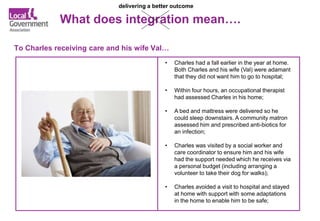
To Charles receiving care and his wife Val…
delivering a better outcome
• Charles had a fall earlier in the year at home.
Both Charles and his wife (Val) were adamant
that they did not want him to go to hospital;
• Within four hours, an occupational therapist
had assessed Charles in his home;
• A bed and mattress were delivered so he
could sleep downstairs. A community matron
assessed him and prescribed anti-biotics for
an infection;
• Charles was visited by a social worker and
care coordinator to ensure him and his wife
had the support needed which he receives via
a personal budget (including arranging a
volunteer to take their dog for walks);
• Charles avoided a visit to hospital and stayed
at home with support with some adaptations
in the home to enable him to be safe;
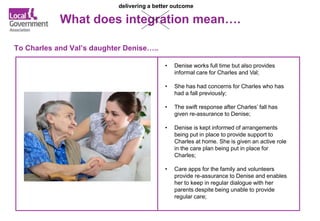
• Denise works full time but also provides
informal care for Charles and Val;
• She has had concerns for Charles who has
had a fall previously;
• The swift response after Charles’ fall has
given re-assurance to Denise;
• Denise is kept informed of arrangements
being put in place to provide support to
Charles at home. She is given an active role
in the care plan being put in place for
Charles;
• Care apps for the family and volunteers
provide re-assurance to Denise and enables
her to keep in regular dialogue with her
parents despite being unable to provide
regular care;
What does integration mean….
To Charles and Val’s daughter Denise…..
delivering a better outcome
What does integration mean….
To the organisations providing a range of care to Charles and Val….
delivering a better outcome
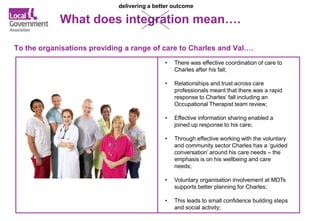
• There was effective coordination of care to
Charles after his fall;
• Relationships and trust across care
professionals meant that there was a rapid
response to Charles’ fall including an
Occupational Therapist team review;
• Effective information sharing enabled a
joined up response to his care;
• Through effective working with the voluntary
and community sector Charles has a ‘guided
conversation’ around his care needs – the
emphasis is on his wellbeing and care
needs;
• Voluntary organisation involvement at MDTs
supports better planning for Charles;
• This leads to small confidence building steps
and social activity;
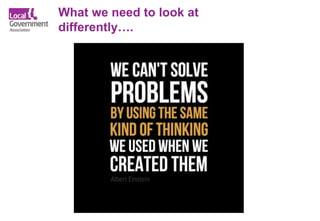
What we need to look at
differently….
How can digital assist?
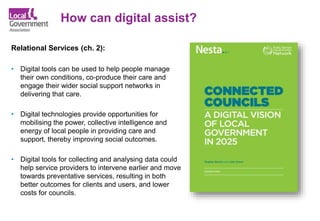
Relational Services (ch. 2):
• Digital tools can be used to help people manage
their own conditions, co-produce their care and
engage their wider social support networks in
delivering that care.
• Digital technologies provide opportunities for
mobilising the power, collective intelligence and
energy of local people in providing care and
support, thereby improving social outcomes.
• Digital tools for collecting and analysing data could
help service providers to intervene earlier and move
towards preventative services, resulting in both
better outcomes for clients and users, and lower
costs for councils.
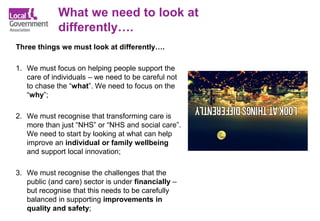
Three things we must look at differently….
1. We must focus on helping people support the
care of individuals – we need to be careful not
to chase the “what”. We need to focus on the
“why”;
2. We must recognise that transforming care is
more than just “NHS” or “NHS and social care”.
We need to start by looking at what can help
improve an individual or family wellbeing
and support local innovation;
3. We must recognise the challenges that the
public (and care) sector is under financially –
but recognise that this needs to be carefully
balanced in supporting improvements in
quality and safety;
What we need to look at
differently….
What does this mean for digital….
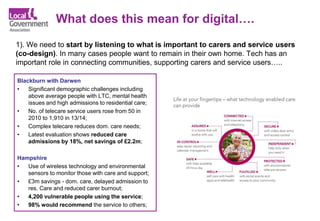
1). We need to start by listening to what is important to carers and service users
(co-design). In many cases people want to remain in their own home. Tech has an
important role in connecting communities, supporting carers and service users…..
Blackburn with Darwen
• Significant demographic challenges including
above average people with LTC, mental health
issues and high admissions to residential care;
• No. of telecare service users rose from 50 in
2010 to 1,910 in 13/14;
• Complex telecare reduces dom. care needs;
• Latest evaluation shows reduced care
admissions by 18%, net savings of £2.2m;
Hampshire
• Use of wireless technology and environmental
sensors to monitor those with care and support;
• £3m savings - dom. care, delayed admission to
res. Care and reduced carer burnout;
• 4,200 vulnerable people using the service;
• 98% would recommend the service to others;
What does this mean for digital….
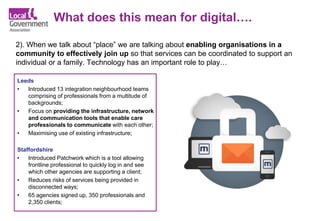
2). When we talk about “place” we are talking about enabling organisations in a
community to effectively join up so that services can be coordinated to support an
individual or a family. Technology has an important role to play…
Leeds
• Introduced 13 integration neighbourhood teams
comprising of professionals from a multitude of
backgrounds;
• Focus on providing the infrastructure, network
and communication tools that enable care
professionals to communicate with each other;
• Maximising use of existing infrastructure;
Staffordshire
• Introduced Patchwork which is a tool allowing
frontline professional to quickly log in and see
which other agencies are supporting a client;
• Reduces risks of services being provided in
disconnected ways;
• 65 agencies signed up, 350 professionals and
2,350 clients;
What does this mean for digital….
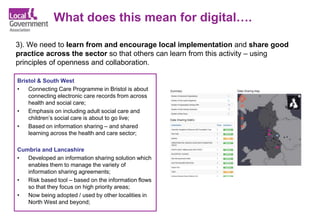
3). We need to learn from and encourage local implementation and share good
practice across the sector so that others can learn from this activity – using
principles of openness and collaboration.
Bristol & South West
• Connecting Care Programme in Bristol is about
connecting electronic care records from across
health and social care;
• Emphasis on including adult social care and
children’s social care is about to go live;
• Based on information sharing – and shared
learning across the health and care sector;
Cumbria and Lancashire
• Developed an information sharing solution which
enables them to manage the variety of
information sharing agreements;
• Risk based tool – based on the information flows
so that they focus on high priority areas;
• Now being adopted / used by other localities in
North West and beyond;
What is LGA and ADASS IN doing?
1. Funding innovation in local areas…
• 20 winning schemes (out of 111) benefitting from £560,000
for innovation including multi-Local Authority or multi-
partner activity;
• Includes Thurrock (integrating health and care information),
Blackpool (financial assessment app); Lewisham (app to
provide access to information); Leeds & Calderdale (open
social care standards);
2. Supporting the sharing of innovation…
• Promoting use of apps through Care Apps showcase –
using technology to support wellbeing and independence;
• Producing material and guidance which supports good
practice including ‘Citizen Online’ briefings which support
Local Authorities to transform services;
3. Pushing for the removal of barriers…
• LGA wants to see greater synergy across Government –
recognising the importance not just of health and social
care but of supporting individuals in communities.
www.local.gov.uk
Contact:
Mark Golledge
Programme Manager – Health and Care Informatics, LGA
Mark.golledge@local.gov.uk
Contact

MARK GOLLEDGE: Better Connected Live 2016

  • 1.
    Date www.local.gov.uk Digital Deliveryof Frontline Services – Care and Health Integration Mark Golledge Local Government Association Better Connected Live @informaticsman
  • 2.
    Outline In threes…. 1. Whatmust we look at differently? 2. What is the role for digital? 3. What is the LGA doing? But first…..what does integration mean?
  • 3.
    What does integrationmean…. To Charles receiving care and his wife Val… delivering a better outcome • Charles had a fall earlier in the year at home. Both Charles and his wife (Val) were adamant that they did not want him to go to hospital; • Within four hours, an occupational therapist had assessed Charles in his home; • A bed and mattress were delivered so he could sleep downstairs. A community matron assessed him and prescribed anti-biotics for an infection; • Charles was visited by a social worker and care coordinator to ensure him and his wife had the support needed which he receives via a personal budget (including arranging a volunteer to take their dog for walks); • Charles avoided a visit to hospital and stayed at home with support with some adaptations in the home to enable him to be safe;
  • 4.
    • Denise worksfull time but also provides informal care for Charles and Val; • She has had concerns for Charles who has had a fall previously; • The swift response after Charles’ fall has given re-assurance to Denise; • Denise is kept informed of arrangements being put in place to provide support to Charles at home. She is given an active role in the care plan being put in place for Charles; • Care apps for the family and volunteers provide re-assurance to Denise and enables her to keep in regular dialogue with her parents despite being unable to provide regular care; What does integration mean…. To Charles and Val’s daughter Denise….. delivering a better outcome
  • 5.
    What does integrationmean…. To the organisations providing a range of care to Charles and Val…. delivering a better outcome • There was effective coordination of care to Charles after his fall; • Relationships and trust across care professionals meant that there was a rapid response to Charles’ fall including an Occupational Therapist team review; • Effective information sharing enabled a joined up response to his care; • Through effective working with the voluntary and community sector Charles has a ‘guided conversation’ around his care needs – the emphasis is on his wellbeing and care needs; • Voluntary organisation involvement at MDTs supports better planning for Charles; • This leads to small confidence building steps and social activity;
  • 6.
    What we needto look at differently….
  • 7.
    How can digitalassist? Relational Services (ch. 2): • Digital tools can be used to help people manage their own conditions, co-produce their care and engage their wider social support networks in delivering that care. • Digital technologies provide opportunities for mobilising the power, collective intelligence and energy of local people in providing care and support, thereby improving social outcomes. • Digital tools for collecting and analysing data could help service providers to intervene earlier and move towards preventative services, resulting in both better outcomes for clients and users, and lower costs for councils.
  • 8.
    Three things wemust look at differently…. 1. We must focus on helping people support the care of individuals – we need to be careful not to chase the “what”. We need to focus on the “why”; 2. We must recognise that transforming care is more than just “NHS” or “NHS and social care”. We need to start by looking at what can help improve an individual or family wellbeing and support local innovation; 3. We must recognise the challenges that the public (and care) sector is under financially – but recognise that this needs to be carefully balanced in supporting improvements in quality and safety; What we need to look at differently….
  • 9.
    What does thismean for digital…. 1). We need to start by listening to what is important to carers and service users (co-design). In many cases people want to remain in their own home. Tech has an important role in connecting communities, supporting carers and service users….. Blackburn with Darwen • Significant demographic challenges including above average people with LTC, mental health issues and high admissions to residential care; • No. of telecare service users rose from 50 in 2010 to 1,910 in 13/14; • Complex telecare reduces dom. care needs; • Latest evaluation shows reduced care admissions by 18%, net savings of £2.2m; Hampshire • Use of wireless technology and environmental sensors to monitor those with care and support; • £3m savings - dom. care, delayed admission to res. Care and reduced carer burnout; • 4,200 vulnerable people using the service; • 98% would recommend the service to others;
  • 10.
    What does thismean for digital…. 2). When we talk about “place” we are talking about enabling organisations in a community to effectively join up so that services can be coordinated to support an individual or a family. Technology has an important role to play… Leeds • Introduced 13 integration neighbourhood teams comprising of professionals from a multitude of backgrounds; • Focus on providing the infrastructure, network and communication tools that enable care professionals to communicate with each other; • Maximising use of existing infrastructure; Staffordshire • Introduced Patchwork which is a tool allowing frontline professional to quickly log in and see which other agencies are supporting a client; • Reduces risks of services being provided in disconnected ways; • 65 agencies signed up, 350 professionals and 2,350 clients;
  • 11.
    What does thismean for digital…. 3). We need to learn from and encourage local implementation and share good practice across the sector so that others can learn from this activity – using principles of openness and collaboration. Bristol & South West • Connecting Care Programme in Bristol is about connecting electronic care records from across health and social care; • Emphasis on including adult social care and children’s social care is about to go live; • Based on information sharing – and shared learning across the health and care sector; Cumbria and Lancashire • Developed an information sharing solution which enables them to manage the variety of information sharing agreements; • Risk based tool – based on the information flows so that they focus on high priority areas; • Now being adopted / used by other localities in North West and beyond;
  • 12.
    What is LGAand ADASS IN doing? 1. Funding innovation in local areas… • 20 winning schemes (out of 111) benefitting from £560,000 for innovation including multi-Local Authority or multi- partner activity; • Includes Thurrock (integrating health and care information), Blackpool (financial assessment app); Lewisham (app to provide access to information); Leeds & Calderdale (open social care standards); 2. Supporting the sharing of innovation… • Promoting use of apps through Care Apps showcase – using technology to support wellbeing and independence; • Producing material and guidance which supports good practice including ‘Citizen Online’ briefings which support Local Authorities to transform services; 3. Pushing for the removal of barriers… • LGA wants to see greater synergy across Government – recognising the importance not just of health and social care but of supporting individuals in communities.
  • 13.
    www.local.gov.uk Contact: Mark Golledge Programme Manager– Health and Care Informatics, LGA Mark.golledge@local.gov.uk Contact