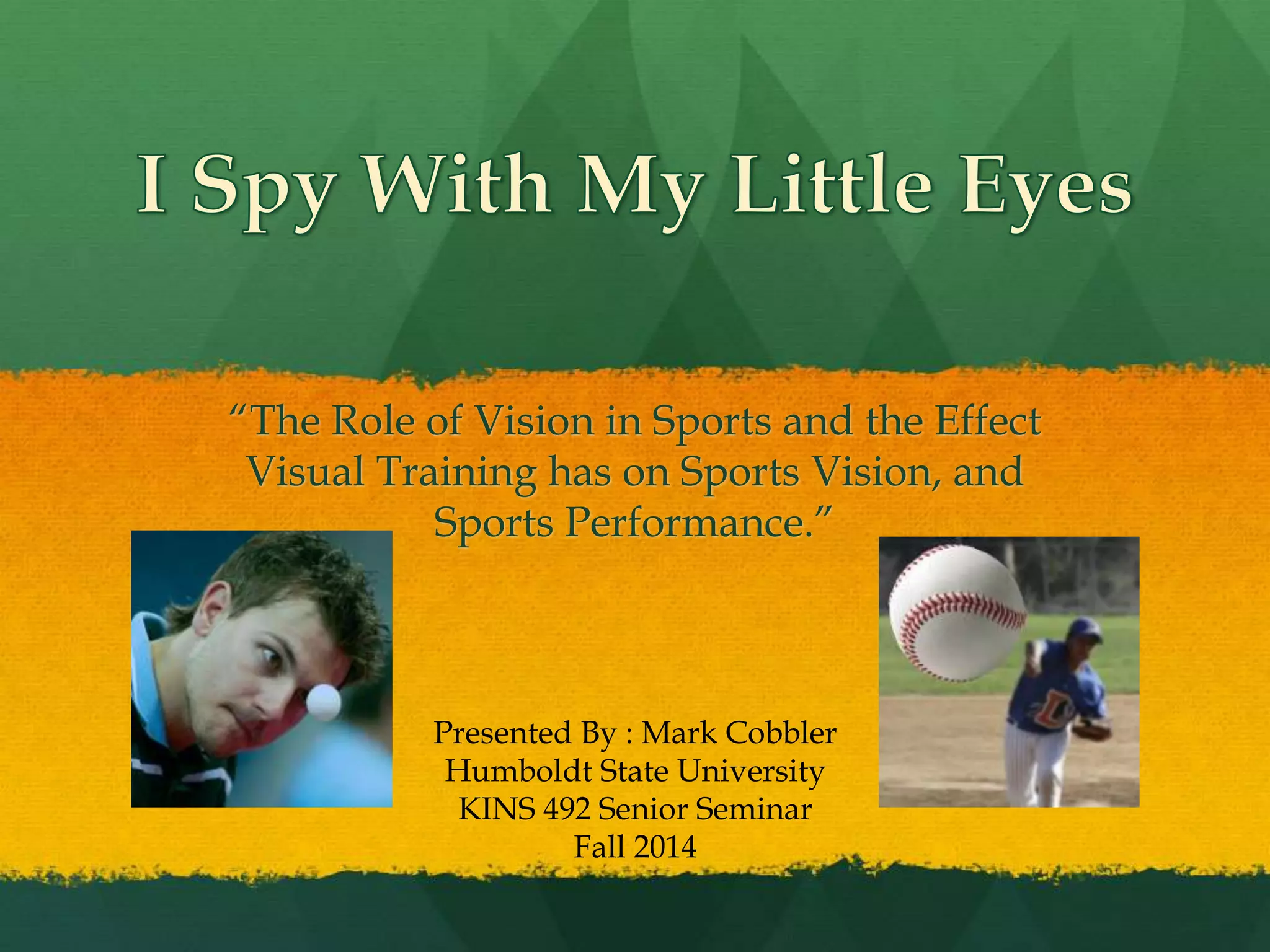
“The Role of Vision in Sports and the Effect
Visual Training has on Sports Vision, and
Sports Performance.”
Presented By : Mark Cobbler
Humboldt State University
KINS 492 Senior Seminar
Fall 2014
 “The Role Of Sports Vision In Eye Care Today”
-David G. Kirschen & Daniel L. Laby
 “Visual Acuity and Contrast Sensitivity Testing for Sports Vision
“
-Aaron B. Zimmerman , Kimberly L. Lust, Mark A. Bullimore
 “The Relationship of Vision and Skilled Movement “
-Pierre Elmurr
 “From Vision to Decision: The Role of Visual Attention in Elite
Sports Performance “
-Brian T. Miller & Welsey C. Clapp
 To provide a review on current literature about sports
vision, the various aspects related to vision and how they
relate to athletic performance.
 History
 The Sports Vision Pyramid
 Hardware
 Testing, Correction
 Software
 Sport Specific Variables
 Perception – Action Cycle
 Performance Vision Testing
 Vision Training
 “The Quiet Eye”
 Training Equipment/Enhancement
 Secondary Purpose:
 To identify gaps in literature and bridge the gap
between disciplines to form a new area of study in
kinesiology with emphasis on vision and
performance.
 Bring to fruition the potential economic benefits of
vision training in sports.
 Initial focus was protection, has steadily evolved over recent
years to focus on visual function to elite performance.
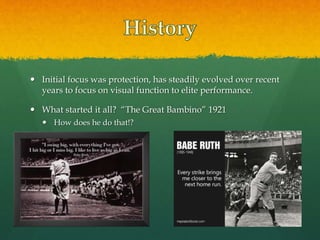
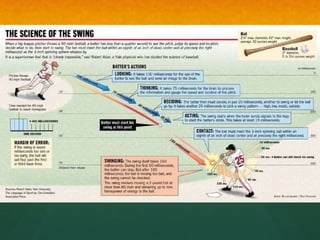
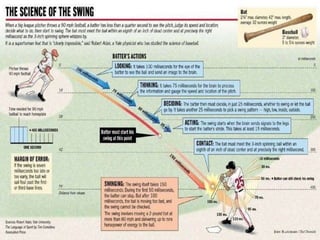
 What started it all? “The Great Bambino” 1921
 How does he do that!?
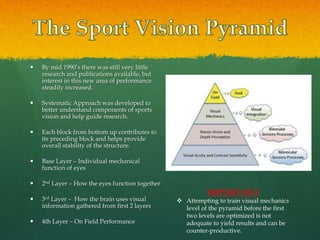
 By mid 1990’s there was still very little
research and publications available, but
interest in this new area of performance
steadily increased.
 Systematic Approach was developed to
better understand components of sports
vision and help guide research.
 Each block from bottom up contributes to
its preceding block and helps provide
overall stability of the structure.
 Base Layer – Individual mechanical
function of eyes
 2nd Layer – How the eyes function together
 3rd Layer – How the brain uses visual
information gathered from first 2 layers
 4th Layer – On Field Performance
IMPORTANT
 Attempting to train visual mechanics
level of the pyramid before the first
two levels are optimized is not
adequate to yield results and can be
counter-productive.
 The first type of vision information processing goes
through the “hardware” of the eye, the mechanical
functionality.
 Two major components of interested for hardware
related to sports vision(base of sport vision pyramid)
fundamentals of visual performance; Contrast
Sensitivity & Visual Acuity.
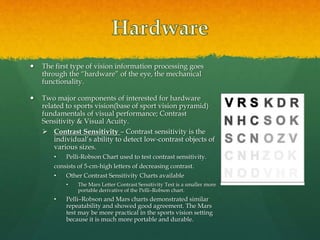
 Contrast Sensitivity – Contrast sensitivity is the
individual’s ability to detect low-contrast objects of
various sizes.
• Pelli-Robson Chart used to test contrast sensitivity.
consists of 5-cm-high letters of decreasing contrast.
• Other Contrast Sensitivity Charts available
• The Mars Letter Contrast Sensitivity Test is a smaller more
portable derivative of the Pelli–Robson chart.
• Pelli–Robson and Mars charts demonstrated similar
repeatability and showed good agreement. The Mars
test may be more practical in the sports vision setting
because it is much more portable and durable.
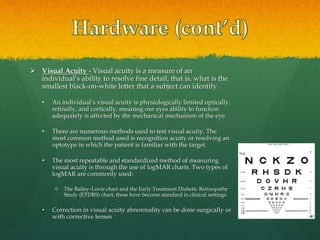
 Visual Acuity - Visual acuity is a measure of an
individual’s ability to resolve fine detail, that is, what is the
smallest black-on-white letter that a subject can identify.
• An individual’s visual acuity is physiologically limited optically,
retinally, and cortically; meaning our eyes ability to function
adequately is affected by the mechanical mechanism of the eye.
• There are numerous methods used to test visual acuity. The
most common method used is recognition acuity or resolving an
optotype in which the patient is familiar with the target.
• The most repeatable and standardized method of measuring
visual acuity is through the use of logMAR charts. Two types of
logMAR are commonly used:
 The Bailey–Lovie chart and the Early Treatment Diabetic Retinopathy
Study (ETDRS) chart, these have become standard in clinical settings.
• Correction in visual acuity abnormality can be done surgically or
with corrective lenses
 The second type of visual information processing involves the perception of visual
information that is influenced by the strategies an athlete develops through
experience, which results in processing the incoming information more efficiently.
(3rd level of sports vision pyramid)
 Software aspects of sports vision includes information processing strategies,
encoding and retrieving perceptual information from memory, extracting relevant
information from both advance cues and ball flight cues, and the use of
anticipatory skills.
 There are numerous ‘‘software’’ skills that differentiate an expert from a novice,
which includes, pattern recognition, interceptive timing, fixation, and visual
attention.
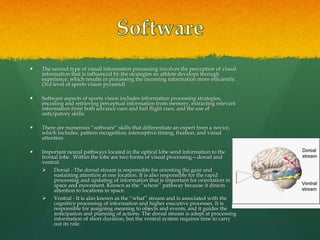
 Important neural pathways located in the optical lobe send information to the
frontal lobe . Within the lobe are two forms of visual processing—dorsal and
ventral.
 Dorsal - The dorsal stream is responsible for orienting the gaze and
sustaining attention at one location. It is also responsible for the rapid
processing and updating of information that is important for orientation in
space and movement. Known as the ‘‘where’’ pathway because it directs
attention to locations in space.
 Ventral - It is also known as the ‘‘what’’ stream and is associated with the
cognitive processing of information and higher executive processes. It is
responsible for assigning meaning to objects and events, and it guides the
anticipation and planning of actions. The dorsal stream is adept at processing
information of short duration, but the ventral system requires time to carry
out its role.
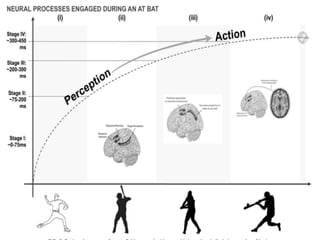
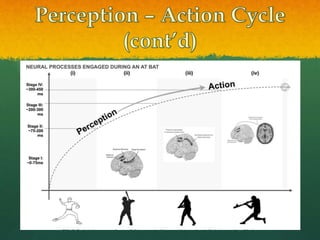
 The perception–action cycle is a theoretical construct encompassing the
multilevel chain of neural operations that are required to effectively guide
action based on one’s multimodal sensory experiences.
 The brain is a dynamic and predictive organ that buys critical milliseconds by
increasing the efficiency and fidelity of visual processing in a proactive, as
opposed to reflexive, manner. This boost in efficiency contributes to a wide
range of on-field situations.
 Elite athletes face intense visuomotor demands requiring millisecond-
level decision making to convert vision into action. In fact, elite athletics
falls into a small class of human behaviors in which the perception–action
cycle is required to function under intense temporal demands but with an
incredibly high level of decision-making accuracy and action execution.
(i.e. split moment life or death decisions)
 Athletes can demonstrate different principles of visual attention
and visuomotor integration at play during game time situations.
 At any given moment on the field, an athlete is bombarded with a
barrage of visual information about rapidly changing situations on
the field. The visual system, however, has inherent capacity
limitations. Visual inputs reflecting the location of the ball in space,
positions of teammates, threats posed by defenders along with
extraneous information (e.g., the crowd) all compete for these
limited resources of the visual system.
 Amid this continuous influx of visual signals, only a small subset
of inputs are particularly relevant for the athlete’s ongoing action
selection. A fundamental challenge for goal-directed behavior
generally, and on-field sports performance in particular, is the
brain’s need to manage the capacity limitations of vision by
favoring the neural representation of those inputs that are most
relevant for current action.
 By limiting neural resources to those incoming inputs that are most
critical for current action, the brain ensures that the athlete has the
most sensitive representation of the most important features in his
or her environment to guide decision making.
 To increase the efficiency of the perception–action cycle and to
manage extreme situations such as on-field athletics, the brain
evolved a set of mechanisms that speed up perception by
leveraging two different knowledge sources to guide
predictions:
 Knowledge from past experience
 Knowledge about current goals and means to those goals
 The impact of bringing in this extra information is that
humans are better and faster at recognizing objects in the
visual world when they know something in advance about the
features or potential location of the relevant target.
 Baseball batter attempting to hit a fastball Vs. Quarterback
dropping back for a pass
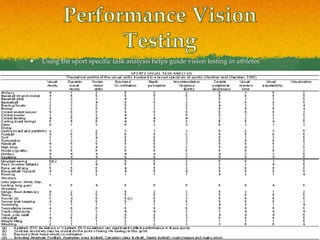
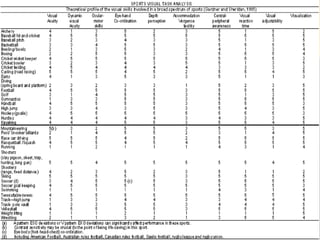
 Using the sport specific task analysis helps guide vision testing in athletes.
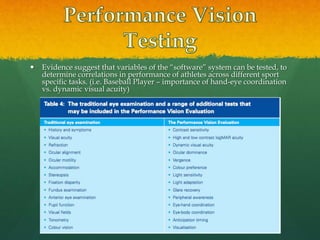
 Evidence suggest that variables of the “software” system can be tested, to
determine correlations in performance of athletes across different sport
specific tasks. (i.e. Baseball Player – importance of hand-eye coordination
vs. dynamic visual acuity)
 There is a belief within the sports science research community that the
‘‘hardware’’ system has limiting factors in relation to visual–perceptual
training.
 ‘‘Software’’ training is a relatively new form of visual– perceptual training.
Two areas of interest are as follows:
 Decision training (off the field). Which can be further divided into:
• Postural cue training - which is video-based temporal occlusion training. A video is
presented of a performer executing a particular action from the player’s perspective,
with this section of the video it is then edited at a point just before the occurrence of a
particular cue. Participants are asked to respond by predicting the outcome of the full
play sequence P
• Pattern recognition training - which is concerned with teaching players how to
recognize, and subsequently anticipate, the outcome of familiar patterns of play as they
evolve.
 Gaze behavior—using the ‘‘quiet eye’’ research it teaches athletes fixation behavior
cues in relation to motor control in specific tasks such as the basketball-free throw.
 Gaze can be defined as ‘‘the absolute position of the eyes in space and depends on both
eye position in the orbit and head position in space.’’ (i.e. fixations, pursuit tracking,
saccades, blinks) Gaze control is defined as the process of directing gaze to objects
within a scene in real time.
 The overall response from the
‘‘hardware’’ and ‘‘software’’
systems produces visuomotor
control; this is the process whereby
visual (gaze) information is used to
direct and control movements.
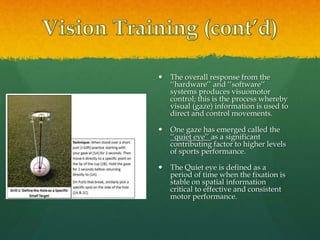
 One gaze has emerged called the
‘‘quiet eye’’ as a significant
contributing factor to higher levels
of sports performance.
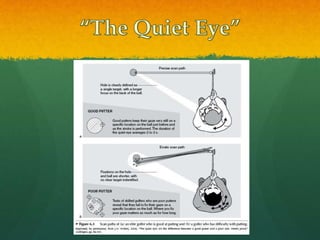
 The Quiet eye is defined as a
period of time when the fixation is
stable on spatial information
critical to effective and consistent
motor performance.
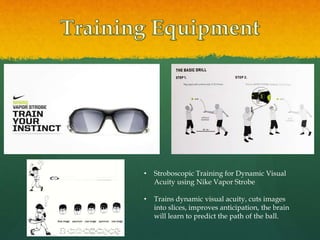
• Stroboscopic Training for Dynamic Visual
Acuity using Nike Vapor Strobe
• Trains dynamic visual acuity, cuts images
into slices, improves anticipation, the brain
will learn to predict the path of the ball.
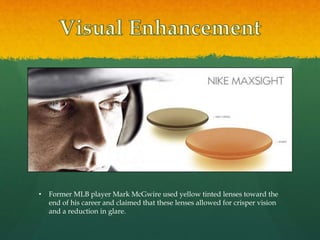
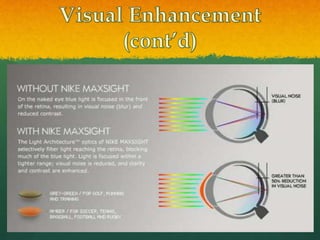
• Former MLB player Mark McGwire used yellow tinted lenses toward the
end of his career and claimed that these lenses allowed for crisper vision
and a reduction in glare.
 The birth of a new discipline within Kinesiology.
 Sports vision contains multiple professionals with different scientific
backgrounds such as physicians, optometrist, neuroscientist,
psychologist, coaches, athletic trainers, performance coaches etc.. All
which contribute to the mutual goal of appropriate diagnosis in sports
vision. Many different discipline's research various aspects related to
sports vision, but there is still a divide, this gap has yet to be bridged.
 As of 2010 sporting goods equipment sales amounted to over
18$ Billion.
 Sports apparel = over 20$ Billion in sales
 Not included in these numbers are number of dollars per year
spent on gym memberships and athletic trainers.
 Recent estimates suggest that parents spend roughly $2,000-
$10,000 per year on their child’s sporting activities.
 Parents should be educated on the fact that vision is a pre-
requisite to their child’s success in sports and that appropriate
vision correction should be a standard part of a child’s
“equipment”
• Economics surrounding sports vision is promising.
 Still a void in this area of research
 Individual research on various aspects of eyes and
functions, not related to sports. The connection of
research has yet to be made.
 Scattered research across multiple specialties mostly
unknown to most sports vision practitioners.
 Research is still in its infancy, very little compared to
other aspects of sports performance.
 Testing is hard to provide real on-field situations in
order to gain accurate baseline of performance, most eye
test/training done in a lab or under controlled
environment.
 The sports vision pyramid is a good model describing the
hierarchy of the visual components necessary for superior sports
vision.
 Training the higher levels of the pyramid is predicated on having
the best possible corrected visual acuity and contrast sensitivity.
 “Hardware” less adaptable to training
 “Software” highly trainable
 Perception –Action Cycle- Dictates athletes ability to perform at
elite levels under intense stimulus
 Lots of testing available/new products, methods used to train
eyes becoming more available
• Sports vision concepts apply to everyone, even the fans. Don’t make
this same mistake. TRAIN YOUR VISION!
 Zimmerman, A., Lust, K., & Bullimore, M. (2011). Visual
Acuity and Contrast Sensitivity Testing for Sports Vision.
Eye & Contact Lens: Science & Clinical Practice, 37(3),
153-159.
 Kirschen, D., & Laby, D. (2011). The Role of Sports Vision in
Eye Care Today. Eye & Contact Lens: Science & Clinical
Practice, 37(3), 127-130.
 Elmurr, P. (2011). The Relationship of Vision and Skilled
Movement—A General Review Using Cricket Batting.
Eye & Contact Lens: Science & Clinical Practice, 37(3),
164-166.
 Miller, B., & Clapp, W. (2011). From Vision to Decision: The
Role of Visual Attention in Elite Sports Performance. Eye
& Contact Lens: Science & Clinical Practice, 37(3), 131-139.
 http://www.caddypsych.com/wp-content/uploads/2014/02/QE-
training-drill-1.jpg
 http://www.pc.rhul.ac.uk/staff/J.Zanker/teach/PS2080/L5/PS208
0_5_files/Image254.gif
 http://www.humankinetics.com/AcuCustom/Sitename/DAM/023
/figure6-31_artX.jpg
 http://brickellvision.com/wp-content/uploads/2014/06/sports-
vision-eye-doctor-miami-brickell-optometrist.png
 http://www.usasportsvision.com/s/cc_images/cache_529980504.jp
g?t=1359511839
 http://www.steinoptometriccenter.com/images/sports-vision-
eyewear-performance-safety-goggles-impact-resistant.jpg
 http://quotelifes.com/wp-content/uploads/2014/09/babe-ruth-
quotesbabe-ruth-swing-big-quote-sports-poster-print-prints-at-allposters-
nvxe9vuh.jpg
 http://s3-
ec.buzzfed.com/static/enhanced/terminal05/2012/4/19/10/enhanced-
buzz-wide-24914-1334845266-6.jpg
 http://www.reviewofophthalmology.com/CMSImagesContent/2006/12/1
_13142_0.jpg
 https://c1.staticflickr.com/9/8142/7371293166_6e85933599_z.jpg
 http://www.bettermovement.org/wp-content/uploads/2011/05/ball-eye-
031511.jpg
 http://storeqv.com/wp-content/uploads/2013/02/lesdoit-nike-sparq-
vapor-strobe-21.jpg
 http://theawesomer.com/photos/2011/06/062111_nike_vapor_strobe_glas
Mark Cobbler Lit Review Powerpoint

Mark Cobbler Lit Review Powerpoint

  • 1.
    “The Role ofVision in Sports and the Effect Visual Training has on Sports Vision, and Sports Performance.” Presented By : Mark Cobbler Humboldt State University KINS 492 Senior Seminar Fall 2014
  • 2.
     “The RoleOf Sports Vision In Eye Care Today” -David G. Kirschen & Daniel L. Laby  “Visual Acuity and Contrast Sensitivity Testing for Sports Vision “ -Aaron B. Zimmerman , Kimberly L. Lust, Mark A. Bullimore  “The Relationship of Vision and Skilled Movement “ -Pierre Elmurr  “From Vision to Decision: The Role of Visual Attention in Elite Sports Performance “ -Brian T. Miller & Welsey C. Clapp
  • 3.
     To providea review on current literature about sports vision, the various aspects related to vision and how they relate to athletic performance.  History  The Sports Vision Pyramid  Hardware  Testing, Correction  Software  Sport Specific Variables  Perception – Action Cycle  Performance Vision Testing  Vision Training  “The Quiet Eye”  Training Equipment/Enhancement
  • 4.
     Secondary Purpose: To identify gaps in literature and bridge the gap between disciplines to form a new area of study in kinesiology with emphasis on vision and performance.  Bring to fruition the potential economic benefits of vision training in sports.
  • 5.
     Initial focuswas protection, has steadily evolved over recent years to focus on visual function to elite performance.  What started it all? “The Great Bambino” 1921  How does he do that!?
  • 7.
     By mid1990’s there was still very little research and publications available, but interest in this new area of performance steadily increased.  Systematic Approach was developed to better understand components of sports vision and help guide research.  Each block from bottom up contributes to its preceding block and helps provide overall stability of the structure.  Base Layer – Individual mechanical function of eyes  2nd Layer – How the eyes function together  3rd Layer – How the brain uses visual information gathered from first 2 layers  4th Layer – On Field Performance IMPORTANT  Attempting to train visual mechanics level of the pyramid before the first two levels are optimized is not adequate to yield results and can be counter-productive.
  • 8.
     The firsttype of vision information processing goes through the “hardware” of the eye, the mechanical functionality.  Two major components of interested for hardware related to sports vision(base of sport vision pyramid) fundamentals of visual performance; Contrast Sensitivity & Visual Acuity.  Contrast Sensitivity – Contrast sensitivity is the individual’s ability to detect low-contrast objects of various sizes. • Pelli-Robson Chart used to test contrast sensitivity. consists of 5-cm-high letters of decreasing contrast. • Other Contrast Sensitivity Charts available • The Mars Letter Contrast Sensitivity Test is a smaller more portable derivative of the Pelli–Robson chart. • Pelli–Robson and Mars charts demonstrated similar repeatability and showed good agreement. The Mars test may be more practical in the sports vision setting because it is much more portable and durable.
  • 9.
     Visual Acuity- Visual acuity is a measure of an individual’s ability to resolve fine detail, that is, what is the smallest black-on-white letter that a subject can identify. • An individual’s visual acuity is physiologically limited optically, retinally, and cortically; meaning our eyes ability to function adequately is affected by the mechanical mechanism of the eye. • There are numerous methods used to test visual acuity. The most common method used is recognition acuity or resolving an optotype in which the patient is familiar with the target. • The most repeatable and standardized method of measuring visual acuity is through the use of logMAR charts. Two types of logMAR are commonly used:  The Bailey–Lovie chart and the Early Treatment Diabetic Retinopathy Study (ETDRS) chart, these have become standard in clinical settings. • Correction in visual acuity abnormality can be done surgically or with corrective lenses
  • 10.
     The secondtype of visual information processing involves the perception of visual information that is influenced by the strategies an athlete develops through experience, which results in processing the incoming information more efficiently. (3rd level of sports vision pyramid)  Software aspects of sports vision includes information processing strategies, encoding and retrieving perceptual information from memory, extracting relevant information from both advance cues and ball flight cues, and the use of anticipatory skills.  There are numerous ‘‘software’’ skills that differentiate an expert from a novice, which includes, pattern recognition, interceptive timing, fixation, and visual attention.  Important neural pathways located in the optical lobe send information to the frontal lobe . Within the lobe are two forms of visual processing—dorsal and ventral.  Dorsal - The dorsal stream is responsible for orienting the gaze and sustaining attention at one location. It is also responsible for the rapid processing and updating of information that is important for orientation in space and movement. Known as the ‘‘where’’ pathway because it directs attention to locations in space.  Ventral - It is also known as the ‘‘what’’ stream and is associated with the cognitive processing of information and higher executive processes. It is responsible for assigning meaning to objects and events, and it guides the anticipation and planning of actions. The dorsal stream is adept at processing information of short duration, but the ventral system requires time to carry out its role.
  • 11.
     The perception–actioncycle is a theoretical construct encompassing the multilevel chain of neural operations that are required to effectively guide action based on one’s multimodal sensory experiences.  The brain is a dynamic and predictive organ that buys critical milliseconds by increasing the efficiency and fidelity of visual processing in a proactive, as opposed to reflexive, manner. This boost in efficiency contributes to a wide range of on-field situations.  Elite athletes face intense visuomotor demands requiring millisecond- level decision making to convert vision into action. In fact, elite athletics falls into a small class of human behaviors in which the perception–action cycle is required to function under intense temporal demands but with an incredibly high level of decision-making accuracy and action execution. (i.e. split moment life or death decisions)
  • 13.
     Athletes candemonstrate different principles of visual attention and visuomotor integration at play during game time situations.  At any given moment on the field, an athlete is bombarded with a barrage of visual information about rapidly changing situations on the field. The visual system, however, has inherent capacity limitations. Visual inputs reflecting the location of the ball in space, positions of teammates, threats posed by defenders along with extraneous information (e.g., the crowd) all compete for these limited resources of the visual system.  Amid this continuous influx of visual signals, only a small subset of inputs are particularly relevant for the athlete’s ongoing action selection. A fundamental challenge for goal-directed behavior generally, and on-field sports performance in particular, is the brain’s need to manage the capacity limitations of vision by favoring the neural representation of those inputs that are most relevant for current action.  By limiting neural resources to those incoming inputs that are most critical for current action, the brain ensures that the athlete has the most sensitive representation of the most important features in his or her environment to guide decision making.
  • 14.
     To increasethe efficiency of the perception–action cycle and to manage extreme situations such as on-field athletics, the brain evolved a set of mechanisms that speed up perception by leveraging two different knowledge sources to guide predictions:  Knowledge from past experience  Knowledge about current goals and means to those goals  The impact of bringing in this extra information is that humans are better and faster at recognizing objects in the visual world when they know something in advance about the features or potential location of the relevant target.  Baseball batter attempting to hit a fastball Vs. Quarterback dropping back for a pass
  • 15.
     Using thesport specific task analysis helps guide vision testing in athletes.
  • 16.
     Evidence suggestthat variables of the “software” system can be tested, to determine correlations in performance of athletes across different sport specific tasks. (i.e. Baseball Player – importance of hand-eye coordination vs. dynamic visual acuity)
  • 17.
     There isa belief within the sports science research community that the ‘‘hardware’’ system has limiting factors in relation to visual–perceptual training.  ‘‘Software’’ training is a relatively new form of visual– perceptual training. Two areas of interest are as follows:  Decision training (off the field). Which can be further divided into: • Postural cue training - which is video-based temporal occlusion training. A video is presented of a performer executing a particular action from the player’s perspective, with this section of the video it is then edited at a point just before the occurrence of a particular cue. Participants are asked to respond by predicting the outcome of the full play sequence P • Pattern recognition training - which is concerned with teaching players how to recognize, and subsequently anticipate, the outcome of familiar patterns of play as they evolve.  Gaze behavior—using the ‘‘quiet eye’’ research it teaches athletes fixation behavior cues in relation to motor control in specific tasks such as the basketball-free throw.  Gaze can be defined as ‘‘the absolute position of the eyes in space and depends on both eye position in the orbit and head position in space.’’ (i.e. fixations, pursuit tracking, saccades, blinks) Gaze control is defined as the process of directing gaze to objects within a scene in real time.
  • 18.
     The overallresponse from the ‘‘hardware’’ and ‘‘software’’ systems produces visuomotor control; this is the process whereby visual (gaze) information is used to direct and control movements.  One gaze has emerged called the ‘‘quiet eye’’ as a significant contributing factor to higher levels of sports performance.  The Quiet eye is defined as a period of time when the fixation is stable on spatial information critical to effective and consistent motor performance.
  • 20.
    • Stroboscopic Trainingfor Dynamic Visual Acuity using Nike Vapor Strobe • Trains dynamic visual acuity, cuts images into slices, improves anticipation, the brain will learn to predict the path of the ball.
  • 21.
    • Former MLBplayer Mark McGwire used yellow tinted lenses toward the end of his career and claimed that these lenses allowed for crisper vision and a reduction in glare.
  • 23.
     The birthof a new discipline within Kinesiology.  Sports vision contains multiple professionals with different scientific backgrounds such as physicians, optometrist, neuroscientist, psychologist, coaches, athletic trainers, performance coaches etc.. All which contribute to the mutual goal of appropriate diagnosis in sports vision. Many different discipline's research various aspects related to sports vision, but there is still a divide, this gap has yet to be bridged.
  • 24.
     As of2010 sporting goods equipment sales amounted to over 18$ Billion.  Sports apparel = over 20$ Billion in sales  Not included in these numbers are number of dollars per year spent on gym memberships and athletic trainers.  Recent estimates suggest that parents spend roughly $2,000- $10,000 per year on their child’s sporting activities.  Parents should be educated on the fact that vision is a pre- requisite to their child’s success in sports and that appropriate vision correction should be a standard part of a child’s “equipment” • Economics surrounding sports vision is promising.
  • 25.
     Still avoid in this area of research  Individual research on various aspects of eyes and functions, not related to sports. The connection of research has yet to be made.  Scattered research across multiple specialties mostly unknown to most sports vision practitioners.  Research is still in its infancy, very little compared to other aspects of sports performance.  Testing is hard to provide real on-field situations in order to gain accurate baseline of performance, most eye test/training done in a lab or under controlled environment.

  • 26.
     The sportsvision pyramid is a good model describing the hierarchy of the visual components necessary for superior sports vision.  Training the higher levels of the pyramid is predicated on having the best possible corrected visual acuity and contrast sensitivity.  “Hardware” less adaptable to training  “Software” highly trainable  Perception –Action Cycle- Dictates athletes ability to perform at elite levels under intense stimulus  Lots of testing available/new products, methods used to train eyes becoming more available
  • 27.
    • Sports visionconcepts apply to everyone, even the fans. Don’t make this same mistake. TRAIN YOUR VISION!
  • 29.
     Zimmerman, A.,Lust, K., & Bullimore, M. (2011). Visual Acuity and Contrast Sensitivity Testing for Sports Vision. Eye & Contact Lens: Science & Clinical Practice, 37(3), 153-159.  Kirschen, D., & Laby, D. (2011). The Role of Sports Vision in Eye Care Today. Eye & Contact Lens: Science & Clinical Practice, 37(3), 127-130.  Elmurr, P. (2011). The Relationship of Vision and Skilled Movement—A General Review Using Cricket Batting. Eye & Contact Lens: Science & Clinical Practice, 37(3), 164-166.  Miller, B., & Clapp, W. (2011). From Vision to Decision: The Role of Visual Attention in Elite Sports Performance. Eye & Contact Lens: Science & Clinical Practice, 37(3), 131-139.
  • 30.
     http://www.caddypsych.com/wp-content/uploads/2014/02/QE- training-drill-1.jpg  http://www.pc.rhul.ac.uk/staff/J.Zanker/teach/PS2080/L5/PS208 0_5_files/Image254.gif http://www.humankinetics.com/AcuCustom/Sitename/DAM/023 /figure6-31_artX.jpg  http://brickellvision.com/wp-content/uploads/2014/06/sports- vision-eye-doctor-miami-brickell-optometrist.png  http://www.usasportsvision.com/s/cc_images/cache_529980504.jp g?t=1359511839  http://www.steinoptometriccenter.com/images/sports-vision- eyewear-performance-safety-goggles-impact-resistant.jpg
  • 31.
     http://quotelifes.com/wp-content/uploads/2014/09/babe-ruth- quotesbabe-ruth-swing-big-quote-sports-poster-print-prints-at-allposters- nvxe9vuh.jpg  http://s3- ec.buzzfed.com/static/enhanced/terminal05/2012/4/19/10/enhanced- buzz-wide-24914-1334845266-6.jpg http://www.reviewofophthalmology.com/CMSImagesContent/2006/12/1 _13142_0.jpg  https://c1.staticflickr.com/9/8142/7371293166_6e85933599_z.jpg  http://www.bettermovement.org/wp-content/uploads/2011/05/ball-eye- 031511.jpg  http://storeqv.com/wp-content/uploads/2013/02/lesdoit-nike-sparq- vapor-strobe-21.jpg  http://theawesomer.com/photos/2011/06/062111_nike_vapor_strobe_glas