Setting Up a
Sports Vision
Practice
Naman Shah
PHILOSOPHY OF SPORTS VISION
• The philosophy of sports vision is based on the idea that the eyes send
information to the brain, which then directs the body’s movements and
balance.
• If the eye message is inaccurate, incomplete, or not at the correct time,
performance may decline.
• Sports vision specialists may offer services from fitting contact lenses and
protective eyewear to conducting detailed vision tests and training.
• Regardless of the level of care, the goal is to help athletes enhance
performance.
• Specialists should understand each sport’s rules and regulations of the game.
• They should actively engage in sports and follow local teams.
• They must be prepared to provide care outside regular hours, including
replacing contact lenses and treating eye injuries on-site.
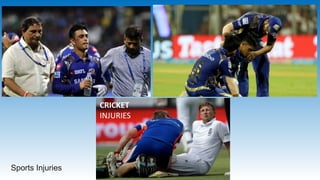
Sports Injuries
Market
The world is sports crazy, with millions involved in team or individual sports.
Many activities show significant growth, with participant numbers nearly doubling in
some areas. One-third were involved in at least five other sports.
Many are at an age where glasses are needed, can afford vision improvement, and may
have health insurance.
Sports enthusiasts spend a Good amount of money annually on equipment to
participate in activities and to improve performance.
In the United States, enthusiasts spent almost $30 billion in 1989 on various products
associated with their sports (Payne, 1991).
In the equipment market, large sums were spent in golf, hunting, fishing and camping.
In total, it was estimated that over $300 million was spent specifically on optical goods
alone related to these activities (Payne,1991)
History
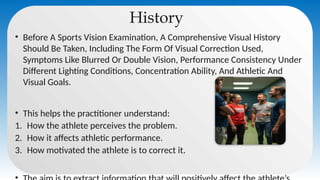
• Before A Sports Vision Examination, A Comprehensive Visual History
Should Be Taken, Including The Form Of Visual Correction Used,
Symptoms Like Blurred Or Double Vision, Performance Consistency Under
Different Lighting Conditions, Concentration Ability, And Athletic And
Visual Goals.
• This helps the practitioner understand:
1. How the athlete perceives the problem.
2. How it affects athletic performance.
3. How motivated the athlete is to correct it.
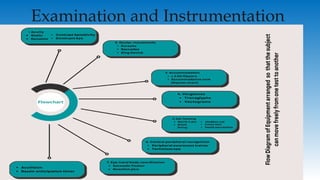
Examination and Instrumentation
• A Small Room Can Enough For Sports Vision Diagnostic Testing.
1.A Comprehensive Eye Examination Should Be Conducted First, Including
Refraction And Binocular Function Testing.
2.Any Pathology Should Be Noted, Including Retinal Photographs, Especially For
Combat Sports.
3.Visual Fields Must Be Documented To Detect Any Blind Areas.
• The Second Part Of The Exam Involves Free-space Tests For:
1.Peripheral Skills
2.Eye-hand-foot Coordination
3.Reflexes
4.Dynamic Visual Acuity
•After Evaluation, Training Programs Can Be Developed To Address
Deficiencies.
•Appropriate Tests For The Individual Athlete And Sport
•Effective Testing Should Occur In The Athlete’s Position (E.G.,
Hockey ) At The Nine Cardinal Positions Of Gaze.
•Optimum Training Includes All These Elements With Added Stress:
1.Prisms
2.Plus/Minus Lenses
3.Balance Boards
4.Background Noise
•The Sports Vision Guidebook (Carlson, 1991) Is An Excellent
Source, Covering:
1.Sport Overview
2.Important Visual Skills
3.Terminology
4.Specific Testing And Training Techniques
5.Common Ocular Injuries And First Aid
6.Protective Eye Wear
•A New Practice Management Tool : OPIS (Optometric Patient
Information System) :-Helps Generate Detailed Eye Care Reports.
•It Covers Contact Lenses, Vision Therapy, Low Vision, Eye Wear
Dispensing, And Sports Vision.
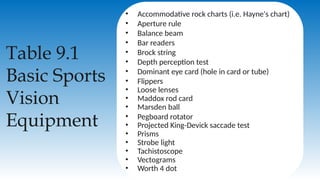
Table 9.1
Basic Sports
Vision
Equipment
• Accommodative rock charts (i.e. Hayne's chart)
• Aperture rule
• Balance beam
• Bar readers
• Brock string
• Depth perception test
• Dominant eye card (hole in card or tube)
• Flippers
• Loose lenses
• Maddox rod card
• Marsden ball
• Pegboard rotator
• Projected King-Devick saccade test
• Prisms
• Strobe light
• Tachistoscope
• Vectograms
• Worth 4 dot
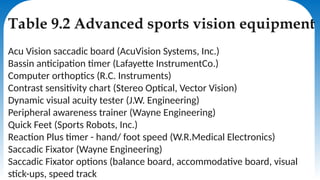
Table 9.2 Advanced sports vision equipment
Acu Vision saccadic board (AcuVision Systems, Inc.)
Bassin anticipation timer (Lafayette InstrumentCo.)
Computer orthoptics (R.C. Instruments)
Contrast sensitivity chart (Stereo Optical, Vector Vision)
Dynamic visual acuity tester (J.W. Engineering)
Peripheral awareness trainer (Wayne Engineering)
Quick Feet (Sports Robots, Inc.)
Reaction Plus timer - hand/ foot speed (W.R.Medical Electronics)
Saccadic Fixator (Wayne Engineering)
Saccadic Fixator options (balance board, accommodative board, visual
stick-ups, speed track
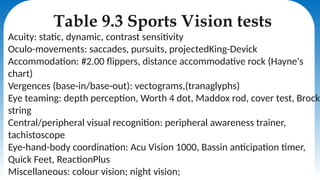
Table 9.3 Sports Vision tests
Acuity: static, dynamic, contrast sensitivity
Oculo-movements: saccades, pursuits, projectedKing-Devick
Accommodation: #2.00 flippers, distance accommodative rock (Hayne's
chart)
Vergences (base-in/base-out): vectograms,(tranaglyphs)
Eye teaming: depth perception, Worth 4 dot, Maddox rod, cover test, Brock
string
Central/peripheral visual recognition: peripheral awareness trainer,
tachistoscope
Eye-hand-body coordination: Acu Vision 1000, Bassin anticipation timer,
Quick Feet, ReactionPlus
Miscellaneous: colour vision; night vision;
Examination and Instrumentation
Staffing the Service
Staffing the service
Sports vision therapists must have a genuine interest in sports and have
flexible hours, including weekends and evenings. They must have a
thorough understanding of visual skills important to sport and their
relation to sports performance.
The therapist must be competent with each piece of equipment and
practice on the optometrist and staff members before working with the
athlete. The flow from optometrist to therapist can be discussed after
the general examination and sports vision work-up, with an introduction
arranged if the patient expresses interest in continuing therapy.
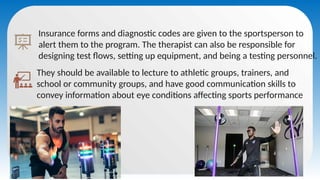
Insurance forms and diagnostic codes are given to the sportsperson to
alert them to the program. The therapist can also be responsible for
designing test flows, setting up equipment, and being a testing personnel.
They should be available to lecture to athletic groups, trainers, and
school or community groups, and have good communication skills to
convey information about eye conditions affecting sports performance
Establishing the practice
To establish a sports vision practice, it is essential to affiliate with a sports
vision organization like the International Academy of Sports Vision, the
American Optometric Association Sports Vision Section, or the European
Academy of Sports Vision.
Outside the United States, practitioners can access the European
Academy of Sports Vision, the Dutch/Belgian Council on Sports Vision, the
Australian and Canadian Optometric Association, and the Sports Vision
Association in the United Kingdom.
To make your services known in the community, contact the right
people, such as coaches, athletic directors, and trainers at high school,
collegiate, and professional players and teams. Once approved, conduct
a sports vision screening session to ensure the athlete's health.
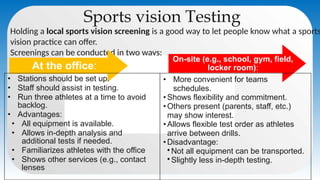
Sports vision Testing
Holding a local sports vision screening is a good way to let people know what a sports
vision practice can offer.
Screenings can be conducted in two ways:
At the office:
On-site (e.g., school, gym, field,
locker room):
• Stations should be set up.
• Staff should assist in testing.
• Run three athletes at a time to avoid
backlog.
• Advantages:
• All equipment is available.
• Allows in-depth analysis and
additional tests if needed.
• Familiarizes athletes with the office
• Shows other services (e.g., contact
lenses
• More convenient for teams
schedules.
• Shows flexibility and commitment.
• Others present (parents, staff, etc.)
may show interest.
• Allows flexible test order as athletes
arrive between drills.
• Disadvantage:
•Not all equipment can be transported.
•Slightly less in-depth testing.
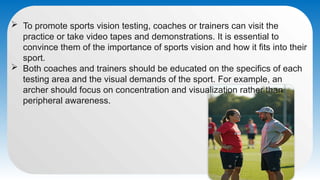
 To promote sports vision testing, coaches or trainers can visit the
practice or take video tapes and demonstrations. It is essential to
convince them of the importance of sports vision and how it fits into their
sport.
 Both coaches and trainers should be educated on the specifics of each
testing area and the visual demands of the sport. For example, an
archer should focus on concentration and visualization rather than
peripheral awareness.
Developing Links
1. As a sports vision specialist, it is crucial to work around the coach's schedule
and avoid interference with practice schedules. Test players between drills and
gradually incorporate them into pre-season activities. Focus on specifics first,
not presenting a complete list.
2. If a player has a visual problem that can be helped by training, it is best to
work with that player during the off season so as not to interfere with with
concentration. Athletes are very superstitious and y may unjustly blame you
for their poor performance if vision therapy is carried out during the season.
Present the problem as a minor issue, highlighting the potential improvement.
3. Report any visual weakness to the trainer, discuss contact lenses or glasses,
and send follow-up letters to the owner, club management, or employer.
4. Obtaining the confidence of the coach, trainer, and players is crucial for
03
Marketing Strategy
In the Practice
• To promote sports vision services in a practice, discuss sports during routine
exams and create a sports atmosphere in the office:-
1. Have pre-written sports vision pamphlets in the waiting room. They
are available from the American Optometric Association.
2. Have a protective eyewear display in the dispensary.
3. Include sports-related information in the waiting room, create a
brochure about your expertise, have general sports photos or
pictures around the office to create a sports theme.
4. Include articles about sports vision in the waiting area, write a
short article in your newsletter, and have a bulletin board with
news clippings of patients excelling in sports.
5. In your waiting room, have a bulletin board of news clippings of
In the Community
 Promoting sports vision in the community is crucial. Lecture to various
organizations, such as community civic groups, sports conferences, high
school coaches conferences, hospitals, and health clubs.
 Health clubs often have health lecture series, utilizing health professionals
in the local community.
 Clubs and medical health centres often have health programmes giving their
members a total body analysis using exercise physiologists, physical
therapists and nutritionists. Add Sports Vision in local health club about
being included in providing services to their members.
 When giving a presentation to an organization, use audio-visual aids. Slide
presentations and video tapes are available from the International Academy
of Sports Vision and American Optometric Association andadd personal
 Advertising should provide detailed information, but radio and television
are less effective. Newspaper or magazine feature articles are more
valuable than advertising. Active participation in local teams or leagues
can promote your name and logo.
 Arrange a fitness/health display at health forums or show a video tape of
someone undergoing testing, Show slides, hand out brochures and even
have some hands-on equipment to demonstrate.
 Hold seminars for local coaches, trainers, and physical education
instructors. The topics can be contact lenses, visual skills important to
sports or first aid for common eye injuries.
 Have an 'open house' function in your sports vision facility and invite the
general public as well as coaches, trainers and athletes.
Economics
of Sports
Vision
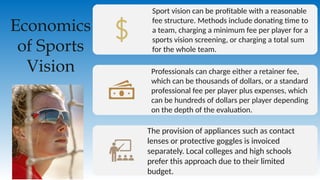
Sport vision can be profitable with a reasonable
fee structure. Methods include donating time to
a team, charging a minimum fee per player for a
sports vision screening, or charging a total sum
for the whole team.
Professionals can charge either a retainer fee,
which can be thousands of dollars, or a standard
professional fee per player plus expenses, which
can be hundreds of dollars per player depending
on the depth of the evaluation.
The provision of appliances such as contact
lenses or protective goggles is invoiced
separately. Local colleges and high schools
prefer this approach due to their limited
budget.
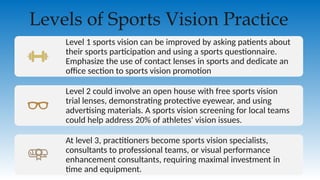
Level 1 sports vision can be improved by asking patients about
their sports participation and using a sports questionnaire.
Emphasize the use of contact lenses in sports and dedicate an
office section to sports vision promotion
Level 2 could involve an open house with free sports vision
trial lenses, demonstrating protective eyewear, and using
advertising materials. A sports vision screening for local teams
could help address 20% of athletes' vision issues.
At level 3, practitioners become sports vision specialists,
consultants to professional teams, or visual performance
enhancement consultants, requiring maximal investment in
time and equipment.
Levels of Sports Vision Practice
The Future
•More and more professional teams are realizing the importance of vision in
their sport and are incorporating sports vision into their programmes.
•Sports vision is now gaining credibility with research and data to support the
findings and claims.
•Optometry schools are currently providing more sports vision in their curricula.
•Sports vision is fun, offering a chance to travel, meet interesting people, players
and colleagues, and provide a service that is appreciated by everyone: coaches,
managers, but most importantly the players.
Setting Up a Sports Vision Practice.pptx

Setting Up a Sports Vision Practice.pptx

  • 1.
    Setting Up a SportsVision Practice Naman Shah
  • 2.
    PHILOSOPHY OF SPORTSVISION • The philosophy of sports vision is based on the idea that the eyes send information to the brain, which then directs the body’s movements and balance. • If the eye message is inaccurate, incomplete, or not at the correct time, performance may decline. • Sports vision specialists may offer services from fitting contact lenses and protective eyewear to conducting detailed vision tests and training. • Regardless of the level of care, the goal is to help athletes enhance performance. • Specialists should understand each sport’s rules and regulations of the game. • They should actively engage in sports and follow local teams. • They must be prepared to provide care outside regular hours, including replacing contact lenses and treating eye injuries on-site.
  • 3.
  • 4.
    Market The world issports crazy, with millions involved in team or individual sports. Many activities show significant growth, with participant numbers nearly doubling in some areas. One-third were involved in at least five other sports. Many are at an age where glasses are needed, can afford vision improvement, and may have health insurance. Sports enthusiasts spend a Good amount of money annually on equipment to participate in activities and to improve performance. In the United States, enthusiasts spent almost $30 billion in 1989 on various products associated with their sports (Payne, 1991). In the equipment market, large sums were spent in golf, hunting, fishing and camping. In total, it was estimated that over $300 million was spent specifically on optical goods alone related to these activities (Payne,1991)
  • 5.
    History • Before ASports Vision Examination, A Comprehensive Visual History Should Be Taken, Including The Form Of Visual Correction Used, Symptoms Like Blurred Or Double Vision, Performance Consistency Under Different Lighting Conditions, Concentration Ability, And Athletic And Visual Goals. • This helps the practitioner understand: 1. How the athlete perceives the problem. 2. How it affects athletic performance. 3. How motivated the athlete is to correct it.
  • 6.
    Examination and Instrumentation •A Small Room Can Enough For Sports Vision Diagnostic Testing. 1.A Comprehensive Eye Examination Should Be Conducted First, Including Refraction And Binocular Function Testing. 2.Any Pathology Should Be Noted, Including Retinal Photographs, Especially For Combat Sports. 3.Visual Fields Must Be Documented To Detect Any Blind Areas. • The Second Part Of The Exam Involves Free-space Tests For: 1.Peripheral Skills 2.Eye-hand-foot Coordination 3.Reflexes 4.Dynamic Visual Acuity
  • 7.
    •After Evaluation, TrainingPrograms Can Be Developed To Address Deficiencies. •Appropriate Tests For The Individual Athlete And Sport •Effective Testing Should Occur In The Athlete’s Position (E.G., Hockey ) At The Nine Cardinal Positions Of Gaze. •Optimum Training Includes All These Elements With Added Stress: 1.Prisms 2.Plus/Minus Lenses 3.Balance Boards 4.Background Noise
  • 8.
    •The Sports VisionGuidebook (Carlson, 1991) Is An Excellent Source, Covering: 1.Sport Overview 2.Important Visual Skills 3.Terminology 4.Specific Testing And Training Techniques 5.Common Ocular Injuries And First Aid 6.Protective Eye Wear •A New Practice Management Tool : OPIS (Optometric Patient Information System) :-Helps Generate Detailed Eye Care Reports. •It Covers Contact Lenses, Vision Therapy, Low Vision, Eye Wear Dispensing, And Sports Vision.
  • 9.
    Table 9.1 Basic Sports Vision Equipment •Accommodative rock charts (i.e. Hayne's chart) • Aperture rule • Balance beam • Bar readers • Brock string • Depth perception test • Dominant eye card (hole in card or tube) • Flippers • Loose lenses • Maddox rod card • Marsden ball • Pegboard rotator • Projected King-Devick saccade test • Prisms • Strobe light • Tachistoscope • Vectograms • Worth 4 dot
  • 10.
    Table 9.2 Advancedsports vision equipment Acu Vision saccadic board (AcuVision Systems, Inc.) Bassin anticipation timer (Lafayette InstrumentCo.) Computer orthoptics (R.C. Instruments) Contrast sensitivity chart (Stereo Optical, Vector Vision) Dynamic visual acuity tester (J.W. Engineering) Peripheral awareness trainer (Wayne Engineering) Quick Feet (Sports Robots, Inc.) Reaction Plus timer - hand/ foot speed (W.R.Medical Electronics) Saccadic Fixator (Wayne Engineering) Saccadic Fixator options (balance board, accommodative board, visual stick-ups, speed track
  • 11.
    Table 9.3 SportsVision tests Acuity: static, dynamic, contrast sensitivity Oculo-movements: saccades, pursuits, projectedKing-Devick Accommodation: #2.00 flippers, distance accommodative rock (Hayne's chart) Vergences (base-in/base-out): vectograms,(tranaglyphs) Eye teaming: depth perception, Worth 4 dot, Maddox rod, cover test, Brock string Central/peripheral visual recognition: peripheral awareness trainer, tachistoscope Eye-hand-body coordination: Acu Vision 1000, Bassin anticipation timer, Quick Feet, ReactionPlus Miscellaneous: colour vision; night vision;
  • 12.
  • 13.
  • 14.
    Staffing the service Sportsvision therapists must have a genuine interest in sports and have flexible hours, including weekends and evenings. They must have a thorough understanding of visual skills important to sport and their relation to sports performance. The therapist must be competent with each piece of equipment and practice on the optometrist and staff members before working with the athlete. The flow from optometrist to therapist can be discussed after the general examination and sports vision work-up, with an introduction arranged if the patient expresses interest in continuing therapy.
  • 15.
    Insurance forms anddiagnostic codes are given to the sportsperson to alert them to the program. The therapist can also be responsible for designing test flows, setting up equipment, and being a testing personnel. They should be available to lecture to athletic groups, trainers, and school or community groups, and have good communication skills to convey information about eye conditions affecting sports performance
  • 16.
    Establishing the practice Toestablish a sports vision practice, it is essential to affiliate with a sports vision organization like the International Academy of Sports Vision, the American Optometric Association Sports Vision Section, or the European Academy of Sports Vision. Outside the United States, practitioners can access the European Academy of Sports Vision, the Dutch/Belgian Council on Sports Vision, the Australian and Canadian Optometric Association, and the Sports Vision Association in the United Kingdom. To make your services known in the community, contact the right people, such as coaches, athletic directors, and trainers at high school, collegiate, and professional players and teams. Once approved, conduct a sports vision screening session to ensure the athlete's health.
  • 17.
    Sports vision Testing Holdinga local sports vision screening is a good way to let people know what a sports vision practice can offer. Screenings can be conducted in two ways: At the office: On-site (e.g., school, gym, field, locker room): • Stations should be set up. • Staff should assist in testing. • Run three athletes at a time to avoid backlog. • Advantages: • All equipment is available. • Allows in-depth analysis and additional tests if needed. • Familiarizes athletes with the office • Shows other services (e.g., contact lenses • More convenient for teams schedules. • Shows flexibility and commitment. • Others present (parents, staff, etc.) may show interest. • Allows flexible test order as athletes arrive between drills. • Disadvantage: •Not all equipment can be transported. •Slightly less in-depth testing.
  • 18.
     To promotesports vision testing, coaches or trainers can visit the practice or take video tapes and demonstrations. It is essential to convince them of the importance of sports vision and how it fits into their sport.  Both coaches and trainers should be educated on the specifics of each testing area and the visual demands of the sport. For example, an archer should focus on concentration and visualization rather than peripheral awareness.
  • 19.
    Developing Links 1. Asa sports vision specialist, it is crucial to work around the coach's schedule and avoid interference with practice schedules. Test players between drills and gradually incorporate them into pre-season activities. Focus on specifics first, not presenting a complete list. 2. If a player has a visual problem that can be helped by training, it is best to work with that player during the off season so as not to interfere with with concentration. Athletes are very superstitious and y may unjustly blame you for their poor performance if vision therapy is carried out during the season. Present the problem as a minor issue, highlighting the potential improvement. 3. Report any visual weakness to the trainer, discuss contact lenses or glasses, and send follow-up letters to the owner, club management, or employer. 4. Obtaining the confidence of the coach, trainer, and players is crucial for
  • 20.
  • 21.
    In the Practice •To promote sports vision services in a practice, discuss sports during routine exams and create a sports atmosphere in the office:- 1. Have pre-written sports vision pamphlets in the waiting room. They are available from the American Optometric Association. 2. Have a protective eyewear display in the dispensary. 3. Include sports-related information in the waiting room, create a brochure about your expertise, have general sports photos or pictures around the office to create a sports theme. 4. Include articles about sports vision in the waiting area, write a short article in your newsletter, and have a bulletin board with news clippings of patients excelling in sports. 5. In your waiting room, have a bulletin board of news clippings of
  • 22.
    In the Community Promoting sports vision in the community is crucial. Lecture to various organizations, such as community civic groups, sports conferences, high school coaches conferences, hospitals, and health clubs.  Health clubs often have health lecture series, utilizing health professionals in the local community.  Clubs and medical health centres often have health programmes giving their members a total body analysis using exercise physiologists, physical therapists and nutritionists. Add Sports Vision in local health club about being included in providing services to their members.  When giving a presentation to an organization, use audio-visual aids. Slide presentations and video tapes are available from the International Academy of Sports Vision and American Optometric Association andadd personal
  • 23.
     Advertising shouldprovide detailed information, but radio and television are less effective. Newspaper or magazine feature articles are more valuable than advertising. Active participation in local teams or leagues can promote your name and logo.  Arrange a fitness/health display at health forums or show a video tape of someone undergoing testing, Show slides, hand out brochures and even have some hands-on equipment to demonstrate.  Hold seminars for local coaches, trainers, and physical education instructors. The topics can be contact lenses, visual skills important to sports or first aid for common eye injuries.  Have an 'open house' function in your sports vision facility and invite the general public as well as coaches, trainers and athletes.
  • 24.
    Economics of Sports Vision Sport visioncan be profitable with a reasonable fee structure. Methods include donating time to a team, charging a minimum fee per player for a sports vision screening, or charging a total sum for the whole team. Professionals can charge either a retainer fee, which can be thousands of dollars, or a standard professional fee per player plus expenses, which can be hundreds of dollars per player depending on the depth of the evaluation. The provision of appliances such as contact lenses or protective goggles is invoiced separately. Local colleges and high schools prefer this approach due to their limited budget.
  • 25.
    Level 1 sportsvision can be improved by asking patients about their sports participation and using a sports questionnaire. Emphasize the use of contact lenses in sports and dedicate an office section to sports vision promotion Level 2 could involve an open house with free sports vision trial lenses, demonstrating protective eyewear, and using advertising materials. A sports vision screening for local teams could help address 20% of athletes' vision issues. At level 3, practitioners become sports vision specialists, consultants to professional teams, or visual performance enhancement consultants, requiring maximal investment in time and equipment. Levels of Sports Vision Practice
  • 27.
    The Future •More andmore professional teams are realizing the importance of vision in their sport and are incorporating sports vision into their programmes. •Sports vision is now gaining credibility with research and data to support the findings and claims. •Optometry schools are currently providing more sports vision in their curricula. •Sports vision is fun, offering a chance to travel, meet interesting people, players and colleagues, and provide a service that is appreciated by everyone: coaches, managers, but most importantly the players.