What does it mean to live,
learn, and teach in the
twenty-first century?
Marisa Seremet
What does it mean to live in the
twenty-first century?
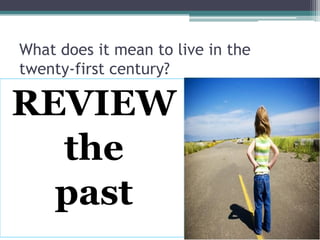
REVIEW
the
past
What does it mean to live in the
twenty-first century?
• In order to live in the twenty-first century as
“digital immigrants” Larry Cuban stated one
must “unlearn in order to learn.” “Digital
immigrants” must work with “digital natives” in
order to succeed and sustain for a better future.
Together we must review past technologies and
understand why and how we use technology
today in order to create a more equitable and
social society.
What does it mean to live in the
twenty-first century?
• According to Collins & Halverson, we are
currently living in the “Knowledge Revolution
that is driven by a new set of computer tools that
empower people’s minds rather than their
bodies” (p. 10). Technology has evolved over
time to make tasks easier and faster for people to
accomplish and share with others. “No one will
be able to solve complex problems or think
effectively in the coming world without using
digital technologies” (p.11).
What does it mean to live in the
twenty-first century?
• According to Facer, we take socio-technical
practices for granted. “These practices then
become part of wider socio-technical systems to
which we become accustomed and in time, come
to depend upon” (p.44). Living in the twenty-
first century allows people to augment or
enhance their being in order to sustain their role
in the socio-technological world.
What does it mean to learn in the
twenty-first century?
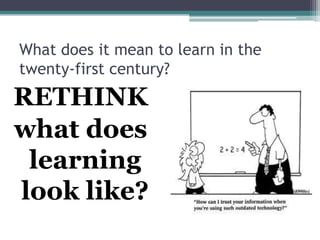
RETHINK
what does
learning
look like?
What does it mean to learn in the
twenty-first century?
• Facer states, “…we need to remember that the
future is not set in stone, that technology is not
some magical force driving us down one
inevitable path, and that education is also a force
to be reckoned with when it comes to shaping
progressive futures” (p.10). There are multiple
ways in which learning can happen besides
opening up a textbook at school.
What does it mean to learn in the
twenty-first century?
• We live in the age of “digital natives” and “digital
immigrants” where we need to rethink what it
means to learn in the twenty-first century and
beyond. Facer discusses the importance of
“intergenerational learning environments”
where learning is collaborative between
educators, parents, grandparents and children.
It is important that all generations work together
to have a better future than past generations.
What does it mean to learn in the
twenty-first century?
• Collins and Halverson goes along with Facer by
stating, “In general, as education becomes a
lifelong activity, there are likely to be more
situations where adults and children are
learning together” (p.102). They discuss a
mixed-age culture where learning does not just
happen in school but also with parents, other
adults, peers, mentors and within the media
environment. Learning does not just happen in
schooling years, but it is a lifelong journey.
What does it mean to learn in the
twenty-first century?
• I believe in the pedagogy of lifelong learning that
provides people with choices. Collins and
Halverson state, “When learners select programs
of study based on their interests, then the values
that guide learners interest become integrated
into the education experience” (p.96). If people
value what they are doing they will take
ownership over it. I believe lifelong learning will
allow people to take back their responsibility for
learning and only blame themselves if they do
not succeed.
What does it mean to learn in the
twenty-first century?
• Technology gives students
choice in their learning and
provides support in areas of
need. According to Collins and
Halverson, “So learning how to
learn and learning how to find
useful resources are becoming
the most important goals of
education” (p.95).
There are many ways to learn in the
21st Century:
▫ Just-in-time learning
▫ Customization
▫ Home Schooling
▫ Games and Simulations
▫ Multimedia
▫ MUSE
▫ Workplace Learning
▫ Distance Education
▫ Adult Education
▫ Learning Centers
▫ Educational Television and Videos
▫ Computer-Based Learning
Software
▫ Technical Certifications
▫ Internet Cafés
What does it mean to learn in the
twenty-first century?
• There are multiple ways to learn in the twenty-
first century to meet everyone’s learning style
and schedule. No matter how one chooses to
learn in the twenty-first century, Facer believes
that our students must develop and learn three
attributes: “discernment, multiliteracy and
responsibility” (p.70). By learning these three
attributes, “..it would to begin to equip our
students to participate in society’s conversation
about that future” (p.71).
What does it mean to teach in the
twenty-first century?
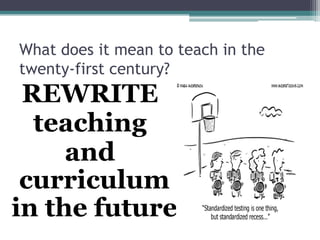
REWRITE
teaching
and
curriculum
in the future
What does it mean to teach in the
twenty-first century?
• Technology is the next natural solution to our
universal schooling today. As Collins and
Halverson stated, “Schools are expected to
prepare students for a different world and public
policies hold schools accountable for making
progress” (p.62). Since our goals are to meet the
needs of our 21st century lifelong learners and be
accountable for making progress, teachers must
implement technology to reach both goals.
What does it mean to teach in the
twenty-first century?
• Technology should be implemented into the
classroom on a daily basis. There should be a variety
of different “interactive learning environments”
used such as computer tutorial programs, just-in-
time learning activities, multimedia projects,
customization, learner control, interaction, games
and simulations, publications and reflection in order
to enhance student achievement. “Something about
education will have to change” (p.65). I think it is up
to us as teachers to make that change and when we
do those changes share it with other to make a
global change.
What does it mean to teach in the
twenty-first century?
• Larry Cuban discussed in his blog about student-
centered teaching using technology. In education we
need to shift from teacher-centered to student-centered
teaching. Cuban stated to me in his response, “The point
I would make is that the devices in of themselves do not
increase or decrease student-centered teaching. It is the
set of beliefs that are in teachers’ heads about students,
teaching, learning, and the school setting that shape
what approaches teachers take in their lessons. The
devices are a means toward the ends that teachers seek.”
So to teach in the twenty-first century is to meet the
needs of every student we teach using resources they are
accustom to in order to maximize their potential learning
growth.
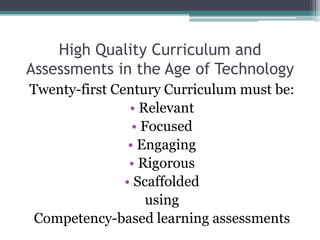
High Quality Curriculum and
Assessments in the Age of Technology
Twenty-first Century Curriculum must be:
• Relevant
• Focused
• Engaging
• Rigorous
• Scaffolded
using
Competency-based learning assessments
What does it mean to teach in the
twenty-first century?
• Facer states that we need to provide our students
with “educational encounters.” “In so doing,
educational encounters are oriented towards
understanding the actors and networks that are
already or potentially available as resources to draw
upon-the data the child has access to, the peers the
students regularly talks with, the experiences they
have had, the tools that are available, the specialist
communities they have been participating in” (p.
55). So if we add Differentiated Instruction created
by Carol Ann Tomlinson with Facer’s educational
encounters and resource mapping, we will be able to
meet the needs of every child individually.
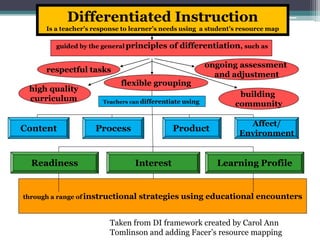
Differentiated Instruction
Is a teacher’s response to learner’s needs using a student’s resource map
guided by the general principles of differentiation, such as
flexible grouping
ongoing assessment
and adjustment
respectful tasks
Teachers can differentiate using
high quality
curriculum
building
community
Content Process Product
Readiness Interest Learning Profile
through a range of instructional strategies using educational encounters
Affect/
Environment
Taken from DI framework created by Carol Ann
Tomlinson and adding Facer’s resource mapping
In Conclusion…
• We must review living, rethink learning and
rewrite teaching in the twenty-first century in
order to create learning futures that will sustain
in a socio-technological world. We need to come
together as a community of learners in order for
“future schools” to exist.

Marisa's final project

  • 1.
    What does itmean to live, learn, and teach in the twenty-first century? Marisa Seremet
  • 2.
    What does itmean to live in the twenty-first century? REVIEW the past
  • 3.
    What does itmean to live in the twenty-first century? • In order to live in the twenty-first century as “digital immigrants” Larry Cuban stated one must “unlearn in order to learn.” “Digital immigrants” must work with “digital natives” in order to succeed and sustain for a better future. Together we must review past technologies and understand why and how we use technology today in order to create a more equitable and social society.
  • 4.
    What does itmean to live in the twenty-first century? • According to Collins & Halverson, we are currently living in the “Knowledge Revolution that is driven by a new set of computer tools that empower people’s minds rather than their bodies” (p. 10). Technology has evolved over time to make tasks easier and faster for people to accomplish and share with others. “No one will be able to solve complex problems or think effectively in the coming world without using digital technologies” (p.11).
  • 5.
    What does itmean to live in the twenty-first century? • According to Facer, we take socio-technical practices for granted. “These practices then become part of wider socio-technical systems to which we become accustomed and in time, come to depend upon” (p.44). Living in the twenty- first century allows people to augment or enhance their being in order to sustain their role in the socio-technological world.
  • 6.
    What does itmean to learn in the twenty-first century? RETHINK what does learning look like?
  • 7.
    What does itmean to learn in the twenty-first century? • Facer states, “…we need to remember that the future is not set in stone, that technology is not some magical force driving us down one inevitable path, and that education is also a force to be reckoned with when it comes to shaping progressive futures” (p.10). There are multiple ways in which learning can happen besides opening up a textbook at school.
  • 8.
    What does itmean to learn in the twenty-first century? • We live in the age of “digital natives” and “digital immigrants” where we need to rethink what it means to learn in the twenty-first century and beyond. Facer discusses the importance of “intergenerational learning environments” where learning is collaborative between educators, parents, grandparents and children. It is important that all generations work together to have a better future than past generations.
  • 9.
    What does itmean to learn in the twenty-first century? • Collins and Halverson goes along with Facer by stating, “In general, as education becomes a lifelong activity, there are likely to be more situations where adults and children are learning together” (p.102). They discuss a mixed-age culture where learning does not just happen in school but also with parents, other adults, peers, mentors and within the media environment. Learning does not just happen in schooling years, but it is a lifelong journey.
  • 10.
    What does itmean to learn in the twenty-first century? • I believe in the pedagogy of lifelong learning that provides people with choices. Collins and Halverson state, “When learners select programs of study based on their interests, then the values that guide learners interest become integrated into the education experience” (p.96). If people value what they are doing they will take ownership over it. I believe lifelong learning will allow people to take back their responsibility for learning and only blame themselves if they do not succeed.
  • 11.
    What does itmean to learn in the twenty-first century? • Technology gives students choice in their learning and provides support in areas of need. According to Collins and Halverson, “So learning how to learn and learning how to find useful resources are becoming the most important goals of education” (p.95). There are many ways to learn in the 21st Century: ▫ Just-in-time learning ▫ Customization ▫ Home Schooling ▫ Games and Simulations ▫ Multimedia ▫ MUSE ▫ Workplace Learning ▫ Distance Education ▫ Adult Education ▫ Learning Centers ▫ Educational Television and Videos ▫ Computer-Based Learning Software ▫ Technical Certifications ▫ Internet Cafés
  • 12.
    What does itmean to learn in the twenty-first century? • There are multiple ways to learn in the twenty- first century to meet everyone’s learning style and schedule. No matter how one chooses to learn in the twenty-first century, Facer believes that our students must develop and learn three attributes: “discernment, multiliteracy and responsibility” (p.70). By learning these three attributes, “..it would to begin to equip our students to participate in society’s conversation about that future” (p.71).
  • 13.
    What does itmean to teach in the twenty-first century? REWRITE teaching and curriculum in the future
  • 14.
    What does itmean to teach in the twenty-first century? • Technology is the next natural solution to our universal schooling today. As Collins and Halverson stated, “Schools are expected to prepare students for a different world and public policies hold schools accountable for making progress” (p.62). Since our goals are to meet the needs of our 21st century lifelong learners and be accountable for making progress, teachers must implement technology to reach both goals.
  • 15.
    What does itmean to teach in the twenty-first century? • Technology should be implemented into the classroom on a daily basis. There should be a variety of different “interactive learning environments” used such as computer tutorial programs, just-in- time learning activities, multimedia projects, customization, learner control, interaction, games and simulations, publications and reflection in order to enhance student achievement. “Something about education will have to change” (p.65). I think it is up to us as teachers to make that change and when we do those changes share it with other to make a global change.
  • 16.
    What does itmean to teach in the twenty-first century? • Larry Cuban discussed in his blog about student- centered teaching using technology. In education we need to shift from teacher-centered to student-centered teaching. Cuban stated to me in his response, “The point I would make is that the devices in of themselves do not increase or decrease student-centered teaching. It is the set of beliefs that are in teachers’ heads about students, teaching, learning, and the school setting that shape what approaches teachers take in their lessons. The devices are a means toward the ends that teachers seek.” So to teach in the twenty-first century is to meet the needs of every student we teach using resources they are accustom to in order to maximize their potential learning growth.
  • 17.
    High Quality Curriculumand Assessments in the Age of Technology Twenty-first Century Curriculum must be: • Relevant • Focused • Engaging • Rigorous • Scaffolded using Competency-based learning assessments
  • 18.
    What does itmean to teach in the twenty-first century? • Facer states that we need to provide our students with “educational encounters.” “In so doing, educational encounters are oriented towards understanding the actors and networks that are already or potentially available as resources to draw upon-the data the child has access to, the peers the students regularly talks with, the experiences they have had, the tools that are available, the specialist communities they have been participating in” (p. 55). So if we add Differentiated Instruction created by Carol Ann Tomlinson with Facer’s educational encounters and resource mapping, we will be able to meet the needs of every child individually.
  • 19.
    Differentiated Instruction Is ateacher’s response to learner’s needs using a student’s resource map guided by the general principles of differentiation, such as flexible grouping ongoing assessment and adjustment respectful tasks Teachers can differentiate using high quality curriculum building community Content Process Product Readiness Interest Learning Profile through a range of instructional strategies using educational encounters Affect/ Environment Taken from DI framework created by Carol Ann Tomlinson and adding Facer’s resource mapping
  • 20.
    In Conclusion… • Wemust review living, rethink learning and rewrite teaching in the twenty-first century in order to create learning futures that will sustain in a socio-technological world. We need to come together as a community of learners in order for “future schools” to exist.