Classifying water pollutants By: Denise Rollock-Phillip
What is Marine Pollution? Marine Pollution can be defined as the adding of toxins, and harmful chemicals ( Non-biodegradable waste)  into a body of water, such the ocean.  (Non-biodegradable, means that the material will  NOT  break down to become part of the earth, soil, or water).  Examples are plastics, metal and glass, grocery bags, Styrofoam (polystyrene), and other similar materials.  We call these “POLLUTANTS”. By: Denise Rollock-Phillip
Water pollutants can be classified  as: Industrial pollutants Municipal pollutants Agricultural pollutants By: Denise Rollock-Phillip
Industrial Pollutants By: Denise Rollock-Phillip
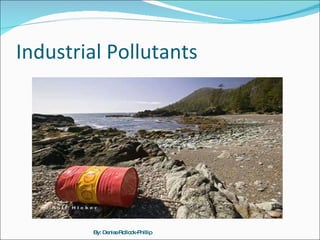
Industrial Pollutants This refer to the characteristics of the waste matter given off from factories. The impact of industrial discharges depends not only on their collective characteristics, such as biochemical oxygen demand and the amount of suspended solids, but also on the content of specific inorganic and organic substances. By: Denise Rollock-Phillip
Municipal Pollutants By: Denise Rollock-Phillip
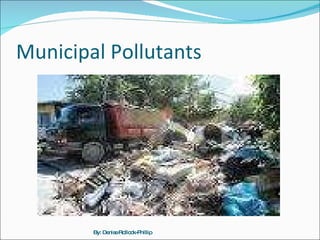
Municipal Pollutants Municipal water pollution consists of waste water and garbage from homes and commercial establishments.  The main goal of treating municipal wastewater was to reduce its content of suspended solids, oxygen-demanding materials, dissolved inorganic compounds, and harmful bacteria.  In recent years, however, more emphasis has been placed on improving means of disposal of the solid residues from the municipal treatment processes. By: Denise Rollock-Phillip
Agricultural Pollutants By: Denise Rollock-Phillip
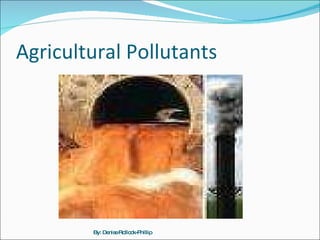
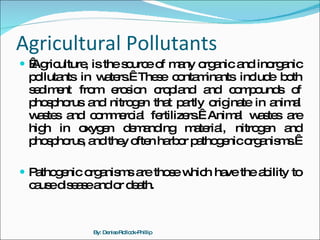
Agricultural Pollutants   Agriculture, is the source of many organic and inorganic pollutants in waters.  These contaminants include both sediment from erosion cropland and compounds of phosphorus and nitrogen that partly originate in animal wastes and commercial fertilizers.  Animal wastes are high in oxygen demanding material, nitrogen and phosphorus, and they often harbor pathogenic organisms.   Pathogenic organisms are those which have the ability to cause disease and or death. By: Denise Rollock-Phillip
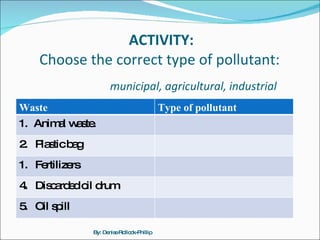
ACTIVITY: Choose the correct type of pollutant:  municipal, agricultural, industrial By: Denise Rollock-Phillip Waste Type of pollutant Animal waste. 2.  Plastic bag Fertilizers 4.  Discarded oil drum 5.  Oil spill
THE END By: Denise Rollock-Phillip

Marine Pollution Presentation For Week 2 Day 3

  • 1.
    Classifying water pollutantsBy: Denise Rollock-Phillip
  • 2.
    What is MarinePollution? Marine Pollution can be defined as the adding of toxins, and harmful chemicals ( Non-biodegradable waste) into a body of water, such the ocean. (Non-biodegradable, means that the material will NOT break down to become part of the earth, soil, or water). Examples are plastics, metal and glass, grocery bags, Styrofoam (polystyrene), and other similar materials. We call these “POLLUTANTS”. By: Denise Rollock-Phillip
  • 3.
    Water pollutants canbe classified as: Industrial pollutants Municipal pollutants Agricultural pollutants By: Denise Rollock-Phillip
  • 4.
    Industrial Pollutants By:Denise Rollock-Phillip
  • 5.
    Industrial Pollutants Thisrefer to the characteristics of the waste matter given off from factories. The impact of industrial discharges depends not only on their collective characteristics, such as biochemical oxygen demand and the amount of suspended solids, but also on the content of specific inorganic and organic substances. By: Denise Rollock-Phillip
  • 6.
    Municipal Pollutants By:Denise Rollock-Phillip
  • 7.
    Municipal Pollutants Municipalwater pollution consists of waste water and garbage from homes and commercial establishments.  The main goal of treating municipal wastewater was to reduce its content of suspended solids, oxygen-demanding materials, dissolved inorganic compounds, and harmful bacteria. In recent years, however, more emphasis has been placed on improving means of disposal of the solid residues from the municipal treatment processes. By: Denise Rollock-Phillip
  • 8.
    Agricultural Pollutants By:Denise Rollock-Phillip
  • 9.
    Agricultural Pollutants  Agriculture, is the source of many organic and inorganic pollutants in waters.  These contaminants include both sediment from erosion cropland and compounds of phosphorus and nitrogen that partly originate in animal wastes and commercial fertilizers.  Animal wastes are high in oxygen demanding material, nitrogen and phosphorus, and they often harbor pathogenic organisms.  Pathogenic organisms are those which have the ability to cause disease and or death. By: Denise Rollock-Phillip
  • 10.
    ACTIVITY: Choose thecorrect type of pollutant: municipal, agricultural, industrial By: Denise Rollock-Phillip Waste Type of pollutant Animal waste. 2. Plastic bag Fertilizers 4. Discarded oil drum 5. Oil spill
  • 11.
    THE END By:Denise Rollock-Phillip