









First International Consensus
Conference on the Mini-Bypass / One
        Anastomosis Bypass

     Paris 2012 October 18-19

       Email DrR@CLOS.Net
Marginal Ulcer &
 Gastric Bypass
SUCCESS CRITERIA
"IDEAL" WEIGHT LOSS SURGERY
1.  Low Risk
2. Major Weight Loss
3. Easily performed
4. Short operative times
5. Outpatient or short hospital stay
6. Minimal Blood Loss
7. No Need for ICU Stay
8. Minimal Pain
9. Very High Patient Satisfaction
10. A Good "Exit Strategy" 
SUCCESS CRITERIA
"IDEAL" WEIGHT LOSS SURGERY
11. Change Behavior & Preferences;  Marked Decrease in 
Hunger and Increased Satiety
12. Minimal Retching and Vomiting 
13. Few adhesions or hernias
14. Minimal impact on Heart and Lung Function
15. Low Failure Rate
16. Low Cost
17. Short Recovery Time
18. Rapid Return to Work
19. Low Risk of Pulmonary Embolus
20. Durable weight loss
SUCCESS CRITERIA
"IDEAL" WEIGHT LOSS SURGERY
21. Low Risk of Marginal Ulcer
22. Fat Malabsorption; low cholesterol & CV risk 
23. No Plastic Foreign Body 
24. Easily Verifiable Results; > 10 years of Results
25. Low Risk of Bowel Obstruction
26. Based upon sound surgical principles  
27. Independent confirmation of results
28. Healthy life after surgery
29. Supported by LEVEL I Evidence; RCT (Controlled 
Prospective Randomized Trial)
30. Block “Sweet Eater” Failures
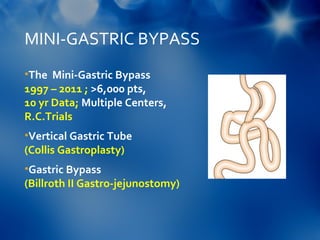
MINI-GASTRIC BYPASS
•The Mini-Gastric Bypass
1997 – 2011 ; >6,000 pts,
10 yr Data; Multiple Centers,
R.C.Trials
•Vertical Gastric Tube
(Collis Gastroplasty)
•Gastric Bypass
(Billroth II Gastro-jejunostomy)
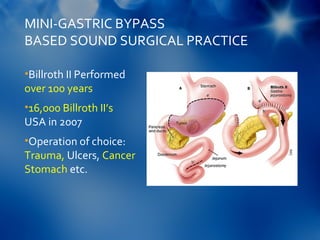
MINI-GASTRIC BYPASS
BASED SOUND SURGICAL PRACTICE 

•Billroth II Performed 
over 100 years
•16,000 Billroth II’s
USA in 2007
•Operation of choice: 
Trauma, Ulcers, Cancer 
Stomach etc.
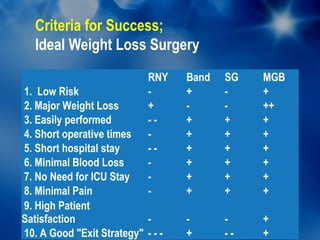
Criteria for Success;
   Ideal Weight Loss Surgery
                            RNY    Band   SG   MGB
1. Low Risk                 -      +      -    +
2. Major Weight Loss        +      -      -    ++
3. Easily performed         --     +      +    +
4. Short operative times    -      +      +    +
5. Short hospital stay      --     +      +    +
6. Minimal Blood Loss       -      +      +    +
7. No Need for ICU Stay     -      +      +    +
8. Minimal Pain             -      +      +    +
9. High Patient
Satisfaction               -       -      -    +
10. A Good "Exit Strategy" - - -   +      --   +
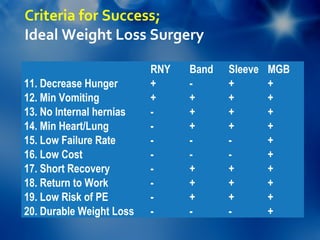
Criteria for Success;
Ideal Weight Loss Surgery

                          RNY   Band   Sleeve   MGB
11. Decrease Hunger       +     -      +        +
12. Min Vomiting          +     +      +        +
13. No Internal hernias   -     +      +        +
14. Min Heart/Lung        -     +      +        +
15. Low Failure Rate      -     -      -        +
16. Low Cost              -     -      -        +
17. Short Recovery        -     +      +        +
18. Return to Work        -     +      +        +
19. Low Risk of PE        -     +      +        +
20. Durable Weight Loss   -     -      -        +
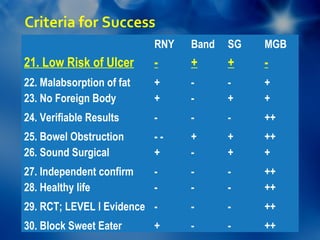
Criteria for Success
                           RNY   Band   SG   MGB
21. Low Risk of Ulcer      -     +      +    -
22. Malabsorption of fat   +     -      -    +
23. No Foreign Body        +     -      +    +
24. Verifiable Results     -     -      -    ++
25. Bowel Obstruction      --    +      +    ++
26. Sound Surgical         +     -      +    +
27. Independent confirm    -     -      -    ++
28. Healthy life           -     -      -    ++
29. RCT; LEVEL I Evidence -      -      -    ++
30. Block Sweet Eater      +     -      -    ++
Epidemiology: What do we know about
Marginal Ulcers?

Marginal ulcers represent one of the most problematic
postoperative complications following Roux-en-Y
A marginal ulcer, or stomal ulceration, refers to the
development of mucosal erosion at the gastrojejunal
anastomosis, typically on the jejunal side.
incidence of marginal ulcers is 0.6 to 16 %
The true incidence is very likely much higher
Marginal Ulcer has been known since the
beginning GI Surgery

MARGINAL, GASTROJEJUNAL OR PEPTIC ULCER
SUBSEQUENT TO GASTROENTEROSTOMY.

Erdmann JF.


Ann Surg. 1921 Apr;73(4):434-40. 
Marginal Ulcer has been known since the
beginning GI Surgery

THE ROENTGEN DIAGNOSIS AND LOCALIZATION
OF MARGINAL PEPTIC ULCER.

Carman RD.


Cal State J Med. 1920 Nov;18(11):377-82
Marginal Ulcer has been known since the
beginning GI Surgery

Re-evaluation of the role of the pyloric antrum in
marginal peptic ulcers.

SCHILLING JA, PEARSE HE.


Surg Gynecol Obstet. 1948 Aug;87(2):225-34
Marginal Ulcer has been known since the
beginning GI Surgery

Vagotomy as a treatment for marginal ulcer.


CRILE G Jr, BROWN GM Jr.


Gastroenterology. 1951 Jan;17(1):14-9
Marginal Ulcer has been known since the
beginning GI Surgery

Review Article: The present status of the management
of marginal ulcer.

BYRD BF Jr.


J Tn State Med Assoc. 1953 Feb;46(2):56-8.
Marginal Ulcer has been known since the
beginning GI Surgery

2,282 RYGB
122 (5%) Marginal ulcers
39 (32%) Surgery
Surg Obes Relat Dis. 2009 May-Jun;5(3):317-22. Revisional operations for marginal ulcer
after Roux-en-Y gastric bypass. Patel RA, Brolin RE, Department of Surgery, University
Medical Center at Princeton, Princeton, New Jersey 08536
Marginal Ulcer Very High After RNY Gastric
Bypass

  441 RYGB
  10 (12%) of RNY gastric bypass presented an "early"
  marginal ulcer
  Asymptomatic (28%)
  Obes Surg. 2009 Feb;19(2):135 Incidence of marginal ulcer 1 month and 1 to 2 years after
  gastric bypass: a prospective consecutive endoscopic evaluation of 442 patients with morbid
  obesity. Csendes A et al Department of Surgery, University Hospital, University of Chile,
  Santiago, Chile.
Marginal Ulcer Very High After RNY Gastric
Bypass
Associated with H. Pylori

  260 RYGB
  7% of RNY gastric bypass marginal ulcer
  H. pylori infection, (treated), was twice as common
  marginal ulceration (32%) as among those who did not
  (12%)
  Surg Endosc. 2007 Jul;21(7):1090-4. Marginal ulceration after laparoscopic gastric bypass:
  an analysis of predisposing factors in 260 patients. Rasmussen JJ, Department of Surgery,
  University of California, Davis, 2221 Stockton Boulevard, Sacramento, CA 95817, USA
Marginal Ulcer after Gastric Bypass;
Both RNY & MGB
Marginal Ulcers after Roux-en-Y Gastric Bypass:
Pain for the Patient…Pain for the Surgeon
by Camellia Racu,
January 2010
Bariatric Times.
2010;7(1):23–25
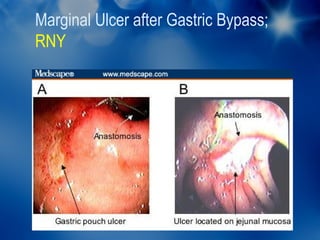
Marginal Ulcer after Gastric Bypass;
RNY
Marginal Ulcer after Gastric Bypass;
RNY & MGB
Marginal ulcers RNY ranging from 0.6 to 16%
True incidence is very likely much higher
Csendes prospective study
routine postoperative endoscopic evaluation
28% of marginal ulcers were asymptomatic
Gastric Bypass (RNY & MGB)
HIGH incidence of Marginal Ulcer
BILE MAKES NO DIFFERENCE!!!
Incidence of perforated gastrojejunal
anastomotic ulcers after RNY
April 2002 to April 2010, 1213 patients underwent
laparoscopic RYGB
Operative mortality was .15%
10 perforated GJA ulcers (.82%) at a mean of 13.5
(6-19) months
Morbidity and mortality rate was 30% and 10%
Perforated GJA ulcers can develop in 1 of 120 Roux
en Y Gastric Bypasses & DEADLY
Marginal Ulcers:
Achilles Heel of Gastric Bypass
Management
1. Warn Patients & Surgeon “Be Vigilant”
2. Aggressive anti-H. Pylori Rx
3. Aggressive use of Antacids
4. Strict Avoidance of Ulcerogenic Agents
(NSAIDS, Etoh, Smoking, Coffee, Soda, Nitrates)
5. Encourage: Probiotics, Yogurt, Fruits Vegetables
BILE MAKES NO DIFFERENCE!!!
CONCLUSIONS:
Best Choice: Mini-Gastric Bypass
•Choice of Obesity Surgery
•Objectives “Ideal” Weight Loss Surgery
•RNY, Band, Sleeve, MGB
•MGB Best meets all objectives/success criteria
•Beware of Marginal Ulcer in RNY & MGB
•Rational Decision Making:
Best Choice; Mini-Gastric Bypass
Rational Data Analysis vs.
Irrational FEAR Gastric Cancer
•1. Gastric Cancer Declining Rapidly
•2. GC Environmental Causes; Easily Prevented
•3. Some studies show Small Increased Risk 
Probably from Ulcers / H. Pylori
•4. Many large studies: NO increased risk
•5. Endoscopic Screening: Not Recommended
•6. General, Trauma & Oncologic Surgeons Use
Billroth II

Marginal Ulcer after Gastric Bypass;

  • 1.
    First International Consensus Conferenceon the Mini-Bypass / One Anastomosis Bypass Paris 2012 October 18-19 Email DrR@CLOS.Net
  • 2.
    Marginal Ulcer & Gastric Bypass
  • 3.
    SUCCESS CRITERIA "IDEAL" WEIGHTLOSS SURGERY 1.  Low Risk 2. Major Weight Loss 3. Easily performed 4. Short operative times 5. Outpatient or short hospital stay 6. Minimal Blood Loss 7. No Need for ICU Stay 8. Minimal Pain 9. Very High Patient Satisfaction 10. A Good "Exit Strategy" 
  • 4.
    SUCCESS CRITERIA "IDEAL" WEIGHTLOSS SURGERY 11. Change Behavior & Preferences;  Marked Decrease in  Hunger and Increased Satiety 12. Minimal Retching and Vomiting  13. Few adhesions or hernias 14. Minimal impact on Heart and Lung Function 15. Low Failure Rate 16. Low Cost 17. Short Recovery Time 18. Rapid Return to Work 19. Low Risk of Pulmonary Embolus 20. Durable weight loss
  • 5.
    SUCCESS CRITERIA "IDEAL" WEIGHTLOSS SURGERY 21. Low Risk of Marginal Ulcer 22. Fat Malabsorption; low cholesterol & CV risk  23. No Plastic Foreign Body  24. Easily Verifiable Results; > 10 years of Results 25. Low Risk of Bowel Obstruction 26. Based upon sound surgical principles   27. Independent confirmation of results 28. Healthy life after surgery 29. Supported by LEVEL I Evidence; RCT (Controlled  Prospective Randomized Trial) 30. Block “Sweet Eater” Failures
  • 6.
    MINI-GASTRIC BYPASS •The Mini-Gastric Bypass 1997– 2011 ; >6,000 pts, 10 yr Data; Multiple Centers, R.C.Trials •Vertical Gastric Tube (Collis Gastroplasty) •Gastric Bypass (Billroth II Gastro-jejunostomy)
  • 7.
  • 8.
    Criteria for Success; Ideal Weight Loss Surgery RNY Band SG MGB 1. Low Risk - + - + 2. Major Weight Loss + - - ++ 3. Easily performed -- + + + 4. Short operative times - + + + 5. Short hospital stay -- + + + 6. Minimal Blood Loss - + + + 7. No Need for ICU Stay - + + + 8. Minimal Pain - + + + 9. High Patient Satisfaction - - - + 10. A Good "Exit Strategy" - - - + -- +
  • 9.
    Criteria for Success; IdealWeight Loss Surgery RNY Band Sleeve MGB 11. Decrease Hunger + - + + 12. Min Vomiting + + + + 13. No Internal hernias - + + + 14. Min Heart/Lung - + + + 15. Low Failure Rate - - - + 16. Low Cost - - - + 17. Short Recovery - + + + 18. Return to Work - + + + 19. Low Risk of PE - + + + 20. Durable Weight Loss - - - +
  • 10.
    Criteria for Success RNY Band SG MGB 21. Low Risk of Ulcer - + + - 22. Malabsorption of fat + - - + 23. No Foreign Body + - + + 24. Verifiable Results - - - ++ 25. Bowel Obstruction -- + + ++ 26. Sound Surgical + - + + 27. Independent confirm - - - ++ 28. Healthy life - - - ++ 29. RCT; LEVEL I Evidence - - - ++ 30. Block Sweet Eater + - - ++
  • 11.
    Epidemiology: What dowe know about Marginal Ulcers? Marginal ulcers represent one of the most problematic postoperative complications following Roux-en-Y A marginal ulcer, or stomal ulceration, refers to the development of mucosal erosion at the gastrojejunal anastomosis, typically on the jejunal side. incidence of marginal ulcers is 0.6 to 16 % The true incidence is very likely much higher
  • 12.
    Marginal Ulcer hasbeen known since the beginning GI Surgery MARGINAL, GASTROJEJUNAL OR PEPTIC ULCER SUBSEQUENT TO GASTROENTEROSTOMY. Erdmann JF. Ann Surg. 1921 Apr;73(4):434-40. 
  • 13.
    Marginal Ulcer hasbeen known since the beginning GI Surgery THE ROENTGEN DIAGNOSIS AND LOCALIZATION OF MARGINAL PEPTIC ULCER. Carman RD. Cal State J Med. 1920 Nov;18(11):377-82
  • 14.
    Marginal Ulcer hasbeen known since the beginning GI Surgery Re-evaluation of the role of the pyloric antrum in marginal peptic ulcers. SCHILLING JA, PEARSE HE. Surg Gynecol Obstet. 1948 Aug;87(2):225-34
  • 15.
    Marginal Ulcer hasbeen known since the beginning GI Surgery Vagotomy as a treatment for marginal ulcer. CRILE G Jr, BROWN GM Jr. Gastroenterology. 1951 Jan;17(1):14-9
  • 16.
    Marginal Ulcer hasbeen known since the beginning GI Surgery Review Article: The present status of the management of marginal ulcer. BYRD BF Jr. J Tn State Med Assoc. 1953 Feb;46(2):56-8.
  • 17.
    Marginal Ulcer hasbeen known since the beginning GI Surgery 2,282 RYGB 122 (5%) Marginal ulcers 39 (32%) Surgery Surg Obes Relat Dis. 2009 May-Jun;5(3):317-22. Revisional operations for marginal ulcer after Roux-en-Y gastric bypass. Patel RA, Brolin RE, Department of Surgery, University Medical Center at Princeton, Princeton, New Jersey 08536
  • 18.
    Marginal Ulcer VeryHigh After RNY Gastric Bypass 441 RYGB 10 (12%) of RNY gastric bypass presented an "early" marginal ulcer Asymptomatic (28%) Obes Surg. 2009 Feb;19(2):135 Incidence of marginal ulcer 1 month and 1 to 2 years after gastric bypass: a prospective consecutive endoscopic evaluation of 442 patients with morbid obesity. Csendes A et al Department of Surgery, University Hospital, University of Chile, Santiago, Chile.
  • 19.
    Marginal Ulcer VeryHigh After RNY Gastric Bypass Associated with H. Pylori 260 RYGB 7% of RNY gastric bypass marginal ulcer H. pylori infection, (treated), was twice as common marginal ulceration (32%) as among those who did not (12%) Surg Endosc. 2007 Jul;21(7):1090-4. Marginal ulceration after laparoscopic gastric bypass: an analysis of predisposing factors in 260 patients. Rasmussen JJ, Department of Surgery, University of California, Davis, 2221 Stockton Boulevard, Sacramento, CA 95817, USA
  • 20.
    Marginal Ulcer afterGastric Bypass; Both RNY & MGB Marginal Ulcers after Roux-en-Y Gastric Bypass: Pain for the Patient…Pain for the Surgeon by Camellia Racu, January 2010 Bariatric Times. 2010;7(1):23–25
  • 21.
    Marginal Ulcer afterGastric Bypass; RNY
  • 22.
    Marginal Ulcer afterGastric Bypass; RNY & MGB Marginal ulcers RNY ranging from 0.6 to 16% True incidence is very likely much higher Csendes prospective study routine postoperative endoscopic evaluation 28% of marginal ulcers were asymptomatic Gastric Bypass (RNY & MGB) HIGH incidence of Marginal Ulcer BILE MAKES NO DIFFERENCE!!!
  • 23.
    Incidence of perforatedgastrojejunal anastomotic ulcers after RNY April 2002 to April 2010, 1213 patients underwent laparoscopic RYGB Operative mortality was .15% 10 perforated GJA ulcers (.82%) at a mean of 13.5 (6-19) months Morbidity and mortality rate was 30% and 10% Perforated GJA ulcers can develop in 1 of 120 Roux en Y Gastric Bypasses & DEADLY
  • 24.
    Marginal Ulcers: Achilles Heelof Gastric Bypass Management 1. Warn Patients & Surgeon “Be Vigilant” 2. Aggressive anti-H. Pylori Rx 3. Aggressive use of Antacids 4. Strict Avoidance of Ulcerogenic Agents (NSAIDS, Etoh, Smoking, Coffee, Soda, Nitrates) 5. Encourage: Probiotics, Yogurt, Fruits Vegetables BILE MAKES NO DIFFERENCE!!!
  • 25.
    CONCLUSIONS: Best Choice: Mini-GastricBypass •Choice of Obesity Surgery •Objectives “Ideal” Weight Loss Surgery •RNY, Band, Sleeve, MGB •MGB Best meets all objectives/success criteria •Beware of Marginal Ulcer in RNY & MGB •Rational Decision Making: Best Choice; Mini-Gastric Bypass
  • 26.
    Rational Data Analysis vs. Irrational FEAR Gastric Cancer •1. Gastric Cancer Declining Rapidly •2. GC Environmental Causes; EasilyPrevented •3. Some studies show Small Increased Risk  Probably from Ulcers / H. Pylori •4. Many large studies: NO increased risk •5. Endoscopic Screening: Not Recommended •6. General, Trauma & Oncologic Surgeons Use Billroth II