Health Reform & Language Access
Mara Youdelman
Managing Attorney, DC office
youdelman@healthlaw.org
NCIHC AMM – June 7, 2013
National Health Law Program
• NHeLP protects and advances the health rights
of low income and underserved individuals
• The oldest non-profit of its kind, NHeLP
advocates, educates and litigates at the federal
and state level
• Our language access work spans over 2
decades and focuses on improving policies &
funding for language access at the federal level
What is “health reform”?
• “Affordable Care Act”, “ACA” or “Obamacare”
– will provide health insurance to virtually
everyone in U.S. through public or private
insurance
• October 1, 2013 is the start of the first “open
enrollment” period to apply for insurance
• January 1, 2014 is when coverage starts
• Goal is to streamline applications and make
healthcare more affordable
What is an Exchange or
Marketplace?
• Individuals who do not have insurance can go
to an “exchange” or “marketplace” to buy
insurance
 If you have insurance through your employer,
Medicaid/CHIP, Medicare, you don’t have to go to
an Exchange
 One stop shopping to apply & pick a plan

• Help paying premiums and cost-sharing is
available for individuals under 400% FPL
LEP Enrollees
• 23% of expected Exchange applicants speak a
language other than English at home
• About 95% of uninsured LEP individuals are <
400% FPL and will be eligible for help paying for
insurance
• Exchanges must not discriminate against LEP
individuals to comply with Title VI and ACA’s sec.
1557
• Exchanges also have to comply with relevant
state laws
Nondiscrimination – ACA sec. 1557
• Extends federal civil rights laws prohibiting
discrimination on basis of race, color, national origin,
gender and disability to:
 any health program or activity receiving Federal financial
assistance – Exchanges, Medicaid/CHIP agencies, QHPs,
navigators, etc.
 any program or activity administered by a federal Executive
agency – FFE, Medicare
 any entity established under Title 1 of PPACA – Exchanges
 based on statutes in existence, inc. Title VI, Title IX, 504 of
Rehab Act

• HHS OCR to issue regulations, likely this year
Data Collection – ACA sec. 4302
• Applies to health care/public health
programs, activities, and surveys
 Collect race, ethnicity, primary language, sex,
disability status of all applicants, recipients or
participants
 Collect sufficient data for statistically reliable
estimates for subgroups
 Medicaid to use OMB standards for race & ethnicity
 CHIP to collect language data of enrollees &
parents/guardians
 Medicare to collect data
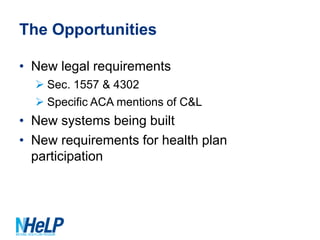
The Opportunities
• New legal requirements
 Sec. 1557 & 4302
 Specific ACA mentions of C&L

• New systems being built
• New requirements for health plan
participation
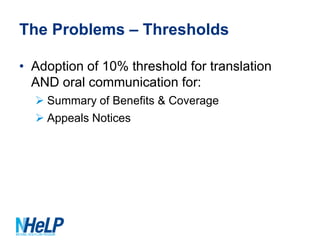
The Problems – Thresholds
• Adoption of 10% threshold for translation
AND oral communication for:
 Summary of Benefits & Coverage
 Appeals Notices
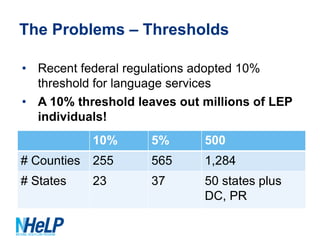
The Problems – Thresholds
• Recent federal regulations adopted 10%
threshold for language services
• A 10% threshold leaves out millions of LEP
individuals!
10%

5%

500

# Counties

255

565

1,284

# States

23

37

50 states plus
DC, PR
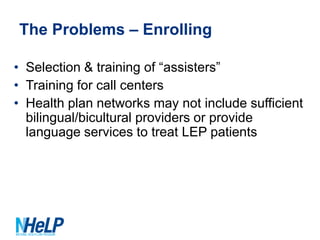
The Problems – Enrolling
• Selection & training of “assisters”
• Training for call centers
• Health plan networks may not include sufficient
bilingual/bicultural providers or provide
language services to treat LEP patients
The Problems – The Application
• Failure to collect language data from all
applicants, only household contact
• Failure to provide translated application into
any language other than Spanish
 CMS will develop a “tool” in 7 languages (Vietnamese,
French Creole, Chinese, Korean, Arabic, Portuguese &
Polish)
 CMS will support creation of similar tools in 17
languages
Now is the Time!
• Right now, decisions are being made at federal
and state level to implement health reform &
language services
• If we do not act quickly, it will be too late
because adding/changing systems later costs $
• If your state has a state-based Exchange, get
involved – send in your comments, talk at public
meetings, organize others to provide input
• If your state will use the “FFE”, get involved with
federal policymaking
Resources
• Language Access Checklist for Marketplace
Implementation
• Translation Glossaries: The Need for
Standardization of ACA-related Terms
• Short Paper 6: The ACA and Application of §
1557 and Title VI of the Civil Rights Act of 1964
to the Health Insurance Exchanges
• Short Paper 5: The ACA and Language Access
THANK YOU!
Washington DC Office

Los Angeles Office

North Carolina Office

1444 I Street NW, Suite 1105
Washington, DC 20005
ph: (202) 289-7661
fx: (202) 289-7724
nhelpdc@healthlaw.org

3701 Wilshire Blvd, Suite #750
Los Angeles, CA 90010
ph: (310) 204-6010
fx: (213) 368-0774
nhelp@healthlaw.org

101 East Weaver Street, Suite G-7
Carrboro, NC 27510
ph: (919) 968-6308
fx: (919) 968-8855
nhelpnc@healthlaw.org

www.healthlaw.org

Health Reform & Language Access

  • 1.
    Health Reform &Language Access Mara Youdelman Managing Attorney, DC office youdelman@healthlaw.org NCIHC AMM – June 7, 2013
  • 2.
    National Health LawProgram • NHeLP protects and advances the health rights of low income and underserved individuals • The oldest non-profit of its kind, NHeLP advocates, educates and litigates at the federal and state level • Our language access work spans over 2 decades and focuses on improving policies & funding for language access at the federal level
  • 3.
    What is “healthreform”? • “Affordable Care Act”, “ACA” or “Obamacare” – will provide health insurance to virtually everyone in U.S. through public or private insurance • October 1, 2013 is the start of the first “open enrollment” period to apply for insurance • January 1, 2014 is when coverage starts • Goal is to streamline applications and make healthcare more affordable
  • 4.
    What is anExchange or Marketplace? • Individuals who do not have insurance can go to an “exchange” or “marketplace” to buy insurance  If you have insurance through your employer, Medicaid/CHIP, Medicare, you don’t have to go to an Exchange  One stop shopping to apply & pick a plan • Help paying premiums and cost-sharing is available for individuals under 400% FPL
  • 5.
    LEP Enrollees • 23%of expected Exchange applicants speak a language other than English at home • About 95% of uninsured LEP individuals are < 400% FPL and will be eligible for help paying for insurance • Exchanges must not discriminate against LEP individuals to comply with Title VI and ACA’s sec. 1557 • Exchanges also have to comply with relevant state laws
  • 6.
    Nondiscrimination – ACAsec. 1557 • Extends federal civil rights laws prohibiting discrimination on basis of race, color, national origin, gender and disability to:  any health program or activity receiving Federal financial assistance – Exchanges, Medicaid/CHIP agencies, QHPs, navigators, etc.  any program or activity administered by a federal Executive agency – FFE, Medicare  any entity established under Title 1 of PPACA – Exchanges  based on statutes in existence, inc. Title VI, Title IX, 504 of Rehab Act • HHS OCR to issue regulations, likely this year
  • 7.
    Data Collection –ACA sec. 4302 • Applies to health care/public health programs, activities, and surveys  Collect race, ethnicity, primary language, sex, disability status of all applicants, recipients or participants  Collect sufficient data for statistically reliable estimates for subgroups  Medicaid to use OMB standards for race & ethnicity  CHIP to collect language data of enrollees & parents/guardians  Medicare to collect data
  • 8.
    The Opportunities • Newlegal requirements  Sec. 1557 & 4302  Specific ACA mentions of C&L • New systems being built • New requirements for health plan participation
  • 9.
    The Problems –Thresholds • Adoption of 10% threshold for translation AND oral communication for:  Summary of Benefits & Coverage  Appeals Notices
  • 10.
    The Problems –Thresholds • Recent federal regulations adopted 10% threshold for language services • A 10% threshold leaves out millions of LEP individuals! 10% 5% 500 # Counties 255 565 1,284 # States 23 37 50 states plus DC, PR
  • 11.
    The Problems –Enrolling • Selection & training of “assisters” • Training for call centers • Health plan networks may not include sufficient bilingual/bicultural providers or provide language services to treat LEP patients
  • 12.
    The Problems –The Application • Failure to collect language data from all applicants, only household contact • Failure to provide translated application into any language other than Spanish  CMS will develop a “tool” in 7 languages (Vietnamese, French Creole, Chinese, Korean, Arabic, Portuguese & Polish)  CMS will support creation of similar tools in 17 languages
  • 13.
    Now is theTime! • Right now, decisions are being made at federal and state level to implement health reform & language services • If we do not act quickly, it will be too late because adding/changing systems later costs $ • If your state has a state-based Exchange, get involved – send in your comments, talk at public meetings, organize others to provide input • If your state will use the “FFE”, get involved with federal policymaking
  • 14.
    Resources • Language AccessChecklist for Marketplace Implementation • Translation Glossaries: The Need for Standardization of ACA-related Terms • Short Paper 6: The ACA and Application of § 1557 and Title VI of the Civil Rights Act of 1964 to the Health Insurance Exchanges • Short Paper 5: The ACA and Language Access
  • 15.
    THANK YOU! Washington DCOffice Los Angeles Office North Carolina Office 1444 I Street NW, Suite 1105 Washington, DC 20005 ph: (202) 289-7661 fx: (202) 289-7724 nhelpdc@healthlaw.org 3701 Wilshire Blvd, Suite #750 Los Angeles, CA 90010 ph: (310) 204-6010 fx: (213) 368-0774 nhelp@healthlaw.org 101 East Weaver Street, Suite G-7 Carrboro, NC 27510 ph: (919) 968-6308 fx: (919) 968-8855 nhelpnc@healthlaw.org www.healthlaw.org