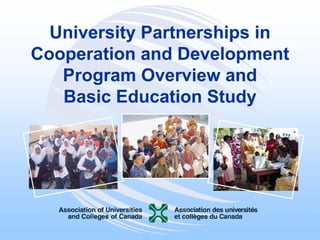
University Partnerships in
Cooperation and Development
   Program Overview and
   Basic Education Study
UPCD Program Overview

                  Overview
• Funded by CIDA’s
  Canadian Partnership
  Branch
• 3-5 million dollar Tier 1
  projects (33 to date)
• $750,000-1 million
  dollar Tier 2 projects
  (110 to date)

                              Chile/Université du Québec en Outaouais
January 2007
UPCD Program Overview

                   Purpose
• develop the human
  resources needed to
  address the Southern
  countries’ sustainable
  development needs
• responsive and
  Southern driven
• a small amount of
  CIDA funds for
  Canadian public
  engagement
                                   Uganda/UBC
January 2007
UPCD Program Overview

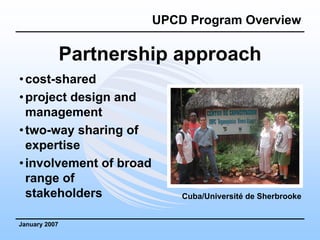
               Partnership approach
• cost-shared
• project design and
  management
• two-way sharing of
  expertise
• involvement of broad
  range of
  stakeholders               Cuba/Université de Sherbrooke


January 2007
UPCD Program Overview
        Universities double CIDA’s
               commitment
                       Commitments to Phase II
                        UPCD Tier 2 projects

                                          Overseas
                                          partners
                                           $22 M

                CIDA
               $68 M
                                           Canadian
                                          universities
                                            $39 M


January 2007
UPCD Program Overview

                    Leveraging
• 79% of projects leveraged additional funds,
  to extend project results
• 13% of projects shared resources with other
  initiatives to extend results
• 74% of projects surveyed created
  independently funded spin-offs


* from 43 operational Tier 2 projects surveyed in 2005-2006

January 2007
UPCD Program Overview

               Program results
•Education and
 training
•Research
•Community
 outreach


                     Mexico/First Nations University of Canada

January 2007
UPCD Program Overview

          Education and training
• 78% of initiatives were for short-term training
• 91% of initiatives were for Southern
  practitioners and professionals
• Estimated that over 60,000 people will be
  directly trained by the programs developed by
  the current Tier 2 projects by completion
• Multiplier effect by training trainers

* from 43 operational Tier 2 projects surveyed in 2005-2006


January 2007
UPCD Program Overview

                        Research
Action-oriented research:
• Use of indigenous
  knowledge
• Relevance and local
  ownership of the
  projects
• Sustainability of the
  results

* from 43 operational Tier 2
  projects surveyed in 2005-2006
                                     Mexico/First Nations University of Canada
January 2007
UPCD Program Overview

               Community outreach
  Universities act as a bridge


January 2007
UPCD Program Overview

               Community outreach
• 86% of projects
  strengthened Southern
  countries’ governance

• 93% of projects
  improved the Southern
  partners’ institutional
  governance

* from 43 operational Tier 2     The Gambia/Mount Saint Vincent University
  projects surveyed in 2005-2006

January 2007
UPCD Program Overview

        Vision for Next Program
• Build on past program and project
  successes
• Targeted and strategic interventions
• Build on strengths of universities in
  teaching, research and community outreach
• Design and deliver in consultation with
  stakeholders in North and South

January 2007
Basic Education Study

  Basic Education Desk Study
Purpose of study:
• Establish UPCD contribution to basic
  education
Method:
• Review 100 Tier 2 projects since 1994 (60
  completed/40 active)
• Annual, final and evaluation reports
• Validated by AUCC desk officers
January 2007
Basic Education Study

 Definition of Basic Education
• Dakar Framework for Action (UNESCO
  2000)
• Six overarching goals and 12 strategies
• Inclusive and broad definition of basic
  education
• All levels: primary, secondary and tertiary
• Various types of delivery: formal and non-
  formal
January 2007
Basic Education Study

          Key survey instrument
Solicit project results in general including:
• National education policy
• Sectoral capacity
• Organizational capacity
• Individual skills and competencies
• Cross-cutting issues (gender equality,
  access to BE for minority groups,
  research)
January 2007
Basic Education Study

               Types of Results (4)
• Education-specific results: direct result in education
  sector
• Cross-sectoral results: acquisition of basic learning skills
  in other sectors (health, agriculture, etc.)
• Indirect results: development of capacity of those
  interacting with communities targeted by development
  and whose work includes an education dimension (health
  workers, extension agents, etc.)
• No link to basic education


January 2007
Basic Education Study

               Findings
• Education-specific (12) and cross-sectoral
  (41) results
• Of Dakar Framework namely in terms of:
  - Goal 2 (universal primary education)
  - Goal 3 (youth and adult learning)
  - Goal 6 (quality)


January 2007
Basic Education Study

               Findings continued
Education-specific results (12 projects)
• National level: national policy on education (i.e. for distance
  education programs for teachers; creation of university to
  support education reform)
• Sectoral level: strengthening the education sector through the
  creation of networks, or other organizations
• Institutional level: support to schools
• Individual level: develop basic skills through involvement in
  projects: university professors, school teachers and school
  administrators


January 2007
Basic Education Study

               Findings continued
Cross-sectoral results (41 projects)
• Development of basic learning skills in sectors other than
  education: (i.e. agriculture, food security, environment, health,
  local development, etc.)
• Targeted community-based organizations, through two sub-
  groups, occupational groups and the general population
• Range of youth and adult participants via unions, local
  organizations, farmers’ association, etc.
• Skills: community-based planning, management, marketing,
  decision-making, analytical and critical skills


January 2007
Basic Education Study

               Findings continued
Indirect results (20 projects)
• Contribute to reaching those who might
  impact on the capabilities of the poor to
  develop basic skills (results can appear
  somewhat tenuous)
• Occupational groups: health workers,
  community development workers, university
  personnel, extension workers, etc.
• Other results: gender and targeting minority
  groups
January 2007
Basic Education Study
      Implications for future study
              and research
•   How to effectively harmonize and coordinate interventions
    - between the different levels of the education system; and
    - the levels of capacity development (individual, institutional,
       sectoral and national)
•   Basic skills needed to engage in community-based
    interventions
•   Better understanding of relationship between the various levels
    of the education and with the specific priority sector
•   Linking skills and improved livelihoods
•   Re-iterating the importance of gender results


January 2007

Maputo w1 béland

  • 1.
    University Partnerships in Cooperationand Development Program Overview and Basic Education Study
  • 2.
    UPCD Program Overview Overview • Funded by CIDA’s Canadian Partnership Branch • 3-5 million dollar Tier 1 projects (33 to date) • $750,000-1 million dollar Tier 2 projects (110 to date) Chile/Université du Québec en Outaouais January 2007
  • 3.
    UPCD Program Overview Purpose • develop the human resources needed to address the Southern countries’ sustainable development needs • responsive and Southern driven • a small amount of CIDA funds for Canadian public engagement Uganda/UBC January 2007
  • 4.
    UPCD Program Overview Partnership approach • cost-shared • project design and management • two-way sharing of expertise • involvement of broad range of stakeholders Cuba/Université de Sherbrooke January 2007
  • 5.
    UPCD Program Overview Universities double CIDA’s commitment Commitments to Phase II UPCD Tier 2 projects Overseas partners $22 M CIDA $68 M Canadian universities $39 M January 2007
  • 6.
    UPCD Program Overview Leveraging • 79% of projects leveraged additional funds, to extend project results • 13% of projects shared resources with other initiatives to extend results • 74% of projects surveyed created independently funded spin-offs * from 43 operational Tier 2 projects surveyed in 2005-2006 January 2007
  • 7.
    UPCD Program Overview Program results •Education and training •Research •Community outreach Mexico/First Nations University of Canada January 2007
  • 8.
    UPCD Program Overview Education and training • 78% of initiatives were for short-term training • 91% of initiatives were for Southern practitioners and professionals • Estimated that over 60,000 people will be directly trained by the programs developed by the current Tier 2 projects by completion • Multiplier effect by training trainers * from 43 operational Tier 2 projects surveyed in 2005-2006 January 2007
  • 9.
    UPCD Program Overview Research Action-oriented research: • Use of indigenous knowledge • Relevance and local ownership of the projects • Sustainability of the results * from 43 operational Tier 2 projects surveyed in 2005-2006 Mexico/First Nations University of Canada January 2007
  • 10.
    UPCD Program Overview Community outreach Universities act as a bridge January 2007
  • 11.
    UPCD Program Overview Community outreach • 86% of projects strengthened Southern countries’ governance • 93% of projects improved the Southern partners’ institutional governance * from 43 operational Tier 2 The Gambia/Mount Saint Vincent University projects surveyed in 2005-2006 January 2007
  • 12.
    UPCD Program Overview Vision for Next Program • Build on past program and project successes • Targeted and strategic interventions • Build on strengths of universities in teaching, research and community outreach • Design and deliver in consultation with stakeholders in North and South January 2007
  • 13.
    Basic Education Study Basic Education Desk Study Purpose of study: • Establish UPCD contribution to basic education Method: • Review 100 Tier 2 projects since 1994 (60 completed/40 active) • Annual, final and evaluation reports • Validated by AUCC desk officers January 2007
  • 14.
    Basic Education Study Definition of Basic Education • Dakar Framework for Action (UNESCO 2000) • Six overarching goals and 12 strategies • Inclusive and broad definition of basic education • All levels: primary, secondary and tertiary • Various types of delivery: formal and non- formal January 2007
  • 15.
    Basic Education Study Key survey instrument Solicit project results in general including: • National education policy • Sectoral capacity • Organizational capacity • Individual skills and competencies • Cross-cutting issues (gender equality, access to BE for minority groups, research) January 2007
  • 16.
    Basic Education Study Types of Results (4) • Education-specific results: direct result in education sector • Cross-sectoral results: acquisition of basic learning skills in other sectors (health, agriculture, etc.) • Indirect results: development of capacity of those interacting with communities targeted by development and whose work includes an education dimension (health workers, extension agents, etc.) • No link to basic education January 2007
  • 17.
    Basic Education Study Findings • Education-specific (12) and cross-sectoral (41) results • Of Dakar Framework namely in terms of: - Goal 2 (universal primary education) - Goal 3 (youth and adult learning) - Goal 6 (quality) January 2007
  • 18.
    Basic Education Study Findings continued Education-specific results (12 projects) • National level: national policy on education (i.e. for distance education programs for teachers; creation of university to support education reform) • Sectoral level: strengthening the education sector through the creation of networks, or other organizations • Institutional level: support to schools • Individual level: develop basic skills through involvement in projects: university professors, school teachers and school administrators January 2007
  • 19.
    Basic Education Study Findings continued Cross-sectoral results (41 projects) • Development of basic learning skills in sectors other than education: (i.e. agriculture, food security, environment, health, local development, etc.) • Targeted community-based organizations, through two sub- groups, occupational groups and the general population • Range of youth and adult participants via unions, local organizations, farmers’ association, etc. • Skills: community-based planning, management, marketing, decision-making, analytical and critical skills January 2007
  • 20.
    Basic Education Study Findings continued Indirect results (20 projects) • Contribute to reaching those who might impact on the capabilities of the poor to develop basic skills (results can appear somewhat tenuous) • Occupational groups: health workers, community development workers, university personnel, extension workers, etc. • Other results: gender and targeting minority groups January 2007
  • 21.
    Basic Education Study Implications for future study and research • How to effectively harmonize and coordinate interventions - between the different levels of the education system; and - the levels of capacity development (individual, institutional, sectoral and national) • Basic skills needed to engage in community-based interventions • Better understanding of relationship between the various levels of the education and with the specific priority sector • Linking skills and improved livelihoods • Re-iterating the importance of gender results January 2007