Maps and the Geospatial Revolution
Lesson 4 – Lecture 1
Anthony C. Robinson, Ph.D
Lead Faculty for Online Geospatial Education
JohnA. Dutton e-Education Institute
Assistant Director, GeoVISTA Center
Department of Geography
The Pennsylvania State University
This content is licensed under a Creative Commons Attribution-NonCommercial 3.0 Unported License
Doing Spatial Analysis
• Once you have spatial data, you should do
something with it
• Simply showing that you know something
exists in a place isn’t enough
• Geographic science uses a wide range of
analytical techniques to take measurements,
make comparisons, and detect anomalies
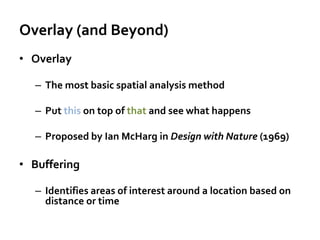
Overlay (and Beyond)
• Overlay
– The most basic spatial analysis method
– Put this on top of that and see what happens
– Proposed by Ian McHarg in Design with Nature (1969)
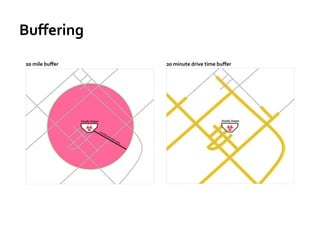
• Buffering
– Identifies areas of interest around a location based on
distance or time
Buffering
Surface Analysis
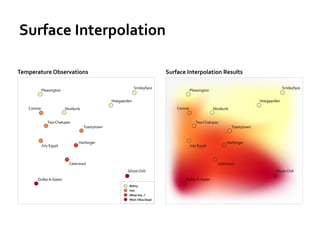
• Surface Analysis and Interpolation
– When you have lots of individual observations and you want
to make an overall map that shows trends
– Temperature readings from towns scattered across a state
– Interpolation is necessary to make estimates where you
have gaps in coverage
• These types of maps are frequently called “heat maps”
– They should be called density surface maps, but whatever
Surface Interpolation
Cluster Detection
• A cluster is a spatial pattern that appears
distinct from expected geographic variation
– 10 White Minivans at the supermarket = not
unexpected
– 10 White Minivans in the same driveway = possible
cluster
• Most famous example is John Snow’s map of a
Cholera outbreak in London
Maps and the Geospatial Revolution www.coursera.org/course/maps
Twitter @MapRevolution
Online Geospatial Education @ Penn State www.pennstategis.com
This content is licensed under a Creative Commons Attribution-NonCommercial 3.0 Unported License

Maps and the Geospatial Revolution: Lesson 4, Lecture 1

  • 1.
    Maps and theGeospatial Revolution Lesson 4 – Lecture 1 Anthony C. Robinson, Ph.D Lead Faculty for Online Geospatial Education JohnA. Dutton e-Education Institute Assistant Director, GeoVISTA Center Department of Geography The Pennsylvania State University This content is licensed under a Creative Commons Attribution-NonCommercial 3.0 Unported License
  • 2.
    Doing Spatial Analysis •Once you have spatial data, you should do something with it • Simply showing that you know something exists in a place isn’t enough • Geographic science uses a wide range of analytical techniques to take measurements, make comparisons, and detect anomalies
  • 3.
    Overlay (and Beyond) •Overlay – The most basic spatial analysis method – Put this on top of that and see what happens – Proposed by Ian McHarg in Design with Nature (1969) • Buffering – Identifies areas of interest around a location based on distance or time
  • 4.
  • 5.
    Surface Analysis • SurfaceAnalysis and Interpolation – When you have lots of individual observations and you want to make an overall map that shows trends – Temperature readings from towns scattered across a state – Interpolation is necessary to make estimates where you have gaps in coverage • These types of maps are frequently called “heat maps” – They should be called density surface maps, but whatever
  • 6.
  • 7.
    Cluster Detection • Acluster is a spatial pattern that appears distinct from expected geographic variation – 10 White Minivans at the supermarket = not unexpected – 10 White Minivans in the same driveway = possible cluster • Most famous example is John Snow’s map of a Cholera outbreak in London
  • 8.
    Maps and theGeospatial Revolution www.coursera.org/course/maps Twitter @MapRevolution Online Geospatial Education @ Penn State www.pennstategis.com This content is licensed under a Creative Commons Attribution-NonCommercial 3.0 Unported License