Understanding hate speech
 within a digital context
Defining the concept of hate
           speech
‘The term "hate speech" shall be understood as covering all
                  forms of expression which
spread, incite, promote or justify racial hatred, xenophobia,
                 anti‐Semitism or other forms
   of hatred based on intolerance, including: intolerance
                   expressed by aggressive
nationalism and ethnocentrism, discrimination and hostility
                 against minorities, migrants
              and people of immigrant origin.’


                                 Appendix to RECOMMENDATION No. R (97) 20 of the
                                 Committee of Ministers on “Hate
                                 Speech“.
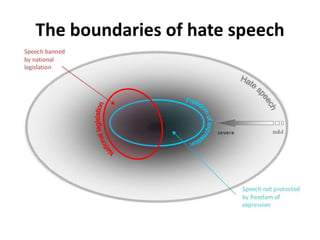
The boundaries of hate speech
Cyber hate
    “Cyber hate refers to any use of electronic communications
                         technology to spread
  anti‐Semitic, racist, bigoted, extremist or terrorist messages or
                          information. These
electronic communications technologies include the Internet (i.e.,
                           Web‐sites, social
networking sites, “Web 2.0” user‐generated content, dating sites,
                         blogs, on‐line games,
instant messages, and E‐mail) as well as other computer‐ and cell
                             phone‐based
   information technologies (such as text messages and mobile
                               phones).”


                             From Responding to Cyberhate, Toolkit for Action (ADL)4
Cyber bullying
“Cyber bullying is related to, but is different from, Cyber hate. In a school context,
  Cyber bullying means any electronic communication including, but not limited
                                           to, one
                shown to be motivated by a student's actual or perceived
                              race, colour, religion, national
 origin, ancestry or ethnicity, sexual orientation, physical, mental, emotional, or
                                          learning
     disability, gender, gender identity and expression, or other distinguishing
                                          personal
 characteristic, or based on association with any person identified above, when
                                             the
    written, verbal or physical act or electronic communication is intended to:
          (i) Physically harm a student or damage the student's property; or
      (ii) Substantially interfere with a student's educational opportunities; or
    (iii) Be so severe, persistent, or pervasive that it creates an intimidating or
                                        threatening
                               educational environment; or
              (iv) Substantially disrupt the orderly operation of the school.

                                        Responding to Cyberhate, Toolkit for Action (ADL)
Hate sites

    "An Internet hate site is a web site (or web page) maintained by an
                            organized hate group
   on which hatred is expressed, through any form of textual, visual, or
                                 audio‐based
rhetoric, for a person or persons, or which provides information about how
                                  individuals
               can support the group's ideological objectives."


                                   Untangling the Web of Hate, Brett Barnett (2007)
Cyber hate and freedom of
               expression
 a. Freedom of expression applies to the Internet, as it does to all means of
 communication. Restrictions on freedom of expression on the Internet are
                                      only
acceptable if they comply with established international standards, including
                                      that
   they are provided for by law, and that they are necessary to protect an
                                    interest
                which is recognized under international law …
     b. When assessing the proportionality of a restriction on freedom of
                                  expression
on the Internet, the impact of that restriction on the ability of the Internet to
deliver positive freedom of expression outcomes must be weighed against its
                benefits in terms of protecting other interests.

                            UN Special Rapporteur on Freedom of Opinion and Expression, OSCE
Confronting cyber hate:
        Key strategies
         1. Monitoring and research.
2. Receiving and investigating complaints.
      3. Working with ISPs and the law
   4. Education , training and awareness
                    raising
              5. Public campaigns
6. Victim support and community building
         7. International cooperation

Understanding hate speech within a digital context

  • 1.
    Understanding hate speech within a digital context
  • 2.
    Defining the conceptof hate speech ‘The term "hate speech" shall be understood as covering all forms of expression which spread, incite, promote or justify racial hatred, xenophobia, anti‐Semitism or other forms of hatred based on intolerance, including: intolerance expressed by aggressive nationalism and ethnocentrism, discrimination and hostility against minorities, migrants and people of immigrant origin.’ Appendix to RECOMMENDATION No. R (97) 20 of the Committee of Ministers on “Hate Speech“.
  • 3.
    The boundaries ofhate speech
  • 4.
    Cyber hate “Cyber hate refers to any use of electronic communications technology to spread anti‐Semitic, racist, bigoted, extremist or terrorist messages or information. These electronic communications technologies include the Internet (i.e., Web‐sites, social networking sites, “Web 2.0” user‐generated content, dating sites, blogs, on‐line games, instant messages, and E‐mail) as well as other computer‐ and cell phone‐based information technologies (such as text messages and mobile phones).” From Responding to Cyberhate, Toolkit for Action (ADL)4
  • 5.
    Cyber bullying “Cyber bullyingis related to, but is different from, Cyber hate. In a school context, Cyber bullying means any electronic communication including, but not limited to, one shown to be motivated by a student's actual or perceived race, colour, religion, national origin, ancestry or ethnicity, sexual orientation, physical, mental, emotional, or learning disability, gender, gender identity and expression, or other distinguishing personal characteristic, or based on association with any person identified above, when the written, verbal or physical act or electronic communication is intended to: (i) Physically harm a student or damage the student's property; or (ii) Substantially interfere with a student's educational opportunities; or (iii) Be so severe, persistent, or pervasive that it creates an intimidating or threatening educational environment; or (iv) Substantially disrupt the orderly operation of the school. Responding to Cyberhate, Toolkit for Action (ADL)
  • 6.
    Hate sites "An Internet hate site is a web site (or web page) maintained by an organized hate group on which hatred is expressed, through any form of textual, visual, or audio‐based rhetoric, for a person or persons, or which provides information about how individuals can support the group's ideological objectives." Untangling the Web of Hate, Brett Barnett (2007)
  • 7.
    Cyber hate andfreedom of expression a. Freedom of expression applies to the Internet, as it does to all means of communication. Restrictions on freedom of expression on the Internet are only acceptable if they comply with established international standards, including that they are provided for by law, and that they are necessary to protect an interest which is recognized under international law … b. When assessing the proportionality of a restriction on freedom of expression on the Internet, the impact of that restriction on the ability of the Internet to deliver positive freedom of expression outcomes must be weighed against its benefits in terms of protecting other interests. UN Special Rapporteur on Freedom of Opinion and Expression, OSCE
  • 8.
    Confronting cyber hate: Key strategies 1. Monitoring and research. 2. Receiving and investigating complaints. 3. Working with ISPs and the law 4. Education , training and awareness raising 5. Public campaigns 6. Victim support and community building 7. International cooperation

Editor's Notes

  • #3 A number of the concepts closely related to cyberhate are given different interpretations byorganisations working in the field – often depending on the region or country where the work isbased. Often the terms are not defined at all, and anything perceived by users to be anexpression of hate is recorded as an instance of hate speech. Although the definition lists a number of groups which are frequently seen to be the targetsof hate speech, it does not limit the possible targets to these groups alone. This is an ‘open‐ended’ definition, in accordance with the open‐ended understanding of discriminationadopted by the European Court of Human Rights.
  • #4 The boundaries of what is regarded as hate speech under this definition are likely to falloutside the boundaries of speech which is criminalised under national legislation. They arealso likely to fall outside the boundaries of speech which should not be restricted underfreedom of expression (see diagram). These are important points because the mostcommon strategy of organisations working in this area appears to be to campaign forgreater restrictions on content, or to campaign for content to be taken offline.
  • #5 The definition of cyberhate used by the Anti‐Defamation League (ADL) elaborates on the formsand mechanisms used by those who spread or promote hate online.
  • #6 Definition of cyber bullying.
  • #7 The technologies of Web 2.0, which allow for extensive user interaction have resulted in hatespreading outwards from what are more narrowly known as ‘hate sites’. This presentation addresseshate speech both on sites dedicated to particular hate groups, and elsewhere – such as in emailsor other personal messages, through gaming, comments on blogs and forums, music, videos –and so on.
  • #8 Even within the Council of Europe member states there is little common groundconcerning the need, or otherwise, for legislation to prohibit hate speech. Article 10 ofthe ECHR allows member states some margin of appreciation on this matter and thereare fairly significant differences in national legislation across Council of Europecountries. These may partly be led by cultural differences, partly by historical fact, butalso by the need – or perceived need – for greater or lesser protection for commonlytargeted groups in countries which do not face identical challenges.
  • #9 There are a number of national organisations and international networks which workexclusively on one or more of cyberhate, cybercrime, cyberbullying ‐ particularly wherethese involve young people ‐ or internet safety. Of these, by far the largest numberappear to be concerned with cyberbullying and crime: specifically, with protectingyoung people from pornographic sites and sexual exploitation. Where this is the focus ofan organisation, rather than the broader issue of extremist views online, there may stillbe a strand of work or a single project devoted to the problem of cyberhate. Theapproach taken will often sit on the back of the general advice or assistance given tointernet users about keeping safe online.For those organisations whose main orientation is cyberhate and the problem of racistor extremist views online, there are generally a broad range of initiatives undertaken –often including educational activities, receiving complaints or notification from thepublic, general monitoring of the problem, and guidance on safe use of the internet.Organisations will often follow up on complaints themselves and either engage incampaigns for better laws or a more rigorous approach by internet service providers(ISPs) towards removing such sites. A few such organisations pursue complaints in thecourts.A third group of organisations work on issues such as racism and xenophobia, children’srights or human rights generally ‐ and cyberhate will often be included as one aspect ofthis work. In general, such organisations tend to focus on activities which raiseawareness or promote a better understanding of the issues in question but they mayalso receive complaints through a hotline or contact form.