MASTER OF ARTS IN PHYSICAL EDUCA
TION
MAPE 202 - FOUNDATION
OFPHYSICAL
EDUCATION
ARIANNE MAE S. AREV
ALO, DSc. PE
Subject Professor
Introduction to Physical Education
and Sports
 Topics:
 Physical Education
 Scope and Significance of Physical
Education
Objectives:
 Define Physical Education.
Understand the scope and significance of PE
and sports.
Preliminaries:
 What is Physical Education for you?
Share your personal experience about
physical education or your personal
experience in teaching/doing physical
education.
Physical Education
Instruction in the development and care of the
body ranging from simple calisthenics exercises
to a course of study providing training in
hygiene, gymnastics, and the performance and
management of athletic games. - (Merriam
Dictionary)
Instruction in physical exercise and
games, especially in schools. - (Oxford
Dictionary)
Physical Education
 Is a structured educational discipline focused on the
development of physical fitness, motor skills, knowledge
of
body movement, and the promotion of lifelong healthy
habits
through physical activity. It integrates physical exercises,
sports, and health education to enhance students'
physical, mental, social, and emotional well-being.
 PE aims to equip individuals with the necessary skills,
knowledge, and attitudes to lead active, healthy lives,
fostering holistic development and encouraging
lifelong
participation in physical activities. (NASPE (2004).
Moving
into the Future: National Standards for Physical Education.
2nd edition. Reston, VA: National Association for Sport
Scope of Physical Education and
Sports
1. Physical Fitness Development
 Comprehensive Fitness: Physical
Education (PE) encompasses all aspects of
fitness, including cardiovascular
endurance, muscular strength, flexibility,
and body composition. It aims to develop
a balanced and healthy body capable of
handling various physical demands.
1. Physical Fitness Development
 Personalized Fitness Programs: PE
includes the creation of individualized
fitness programs tailored to meet specific
needs and goals, helping students
understand and manage their fitness
levels throughout life.
2. Motor Skills and Coordination
 Fundamental Skills: PE focuses on the
development of fundamental motor skills
such as running, jumping, throwing,
catching, and balancing. These skills are
the foundation for more complex
movements and sports activities.
2. Motor Skills and Coordination
 Advanced Coordination: Beyond basic
skills, PE helps in refining complex motor
skills necessary for advanced sports
performance, such as dribbling, striking,
and tactical movements.
3. Movement Education and Body
Mechanics
 Movement Literacy: Students learn the
principles of movement and body
mechanics, gaining an understanding of
how to move efficiently and safely. This
knowledge reduces the risk of injury and
enhances performance in various physical
activities.
3. Movement Education and Body
Mechanics
 Biomechanics: PE often includes the
study of biomechanics, helping students
understand the forces and motions
involved in human movement, which is
essential for optimizing performance and
preventing injuries.
4. Health and Wellness Education
 Comprehensive Health Education: PE
integrates health education, covering
topics such as nutrition, mental health,
substance abuse prevention, and personal
hygiene. This holistic approach ensures
that students understand the importance
of maintaining a healthy lifestyle.
4. Health and Wellness Education
 Lifestyle Diseases Prevention: PE plays
a critical role in preventing lifestyle-related
diseases like obesity, diabetes, and heart
disease by promoting regular physical
activity and healthy habits.
5. Social and Emotional Learning
 Teamwork and Collaboration: PE
provides opportunities for students to
engage in team sports and group activities,
fostering skills in teamwork, leadership,
communication, and collaboration.
5. Social and Emotional Learning
 Emotional Regulation: Through
physical activity, students learn to manage
stress, anxiety, and emotions. Sports offer
a platform for developing resilience,
patience, and the ability to cope with
success and failure.
6. Ethical and Moral Development
Sportsmanship: PE emphasizes the
importance of sportsmanship, teaching
students to respect opponents, follow rules,
and display integrity in both victory and defeat.
Ethical Decision-Making: The challenges
and situations encountered in sports require
ethical decision-making, which PE nurtures
through lessons on fairness, honesty, and
respect.
7. Cognitive Development and
Academic Performance
 Enhanced Cognitive Function: Regular
physical activity has been linked to improved
concentration, memory, and cognitive function.
PE
contributes to better academic performance by
boosting mental alertness and
reducing classroom-related stress.
 Problem-Solving and Strategy:
Sports and
physical activities often involve
strategic thinking,
problem-solving, and quick decision-
making, which translate into improved
8. Lifelong Physical Activity and
Recreation
 Lifelong Engagement: PE introduces
students to a variety of physical activities
and sports, encouraging them to adopt
habits that promote lifelong fitness and
health.
 Recreational Skills: Students learn
recreational skills that they can enjoy
throughout their lives, such as
swimming, cycling, hiking, and other
outdoor activities.
9. Career Preparation
 Diverse Career Opportunities: PE provides a
foundation for careers in sports, fitness,
coaching,
sports management, physical therapy, and
health
education. It also prepares students for
specialized fields such as kinesiology,
sports psychology, and athletic training.
 Vocational Skills: PE helps students
develop
skills that are valuable in various
professions,
including leadership, teamwork,
10. Cultural Awareness and Social
Inclusion
Cultural Appreciation: PE introduces students
to sports and physical activities from different
cultures, fostering cultural awareness and
respect for diversity.
Social Inclusion: PE promotes inclusivity by
encouraging participation from all students,
regardless of their physical abilities or
background. It helps reduce inequalities and

fosters a sense of belonging and community.
Significance of Physical
Education and Sports
1. Holistic Development
Physical and Mental Well-being: PE is integral
to the holistic development of individuals,
addressing physical, mental, emotional, and
social dimensions of health. It supports the
development of well- rounded, healthy
individuals who can contribute positively to
society.
Character Building: PE plays a crucial role in
character building, instilling values such as
discipline, perseverance, and respect. These
values are essential for personal and
professional success.
2. Health Promotion and Disease
Prevention
Combatting Lifestyle Diseases: PE is essential
in the fight against lifestyle-related diseases such
as obesity, diabetes, and cardiovascular
conditions. Regular physical activity, encouraged
through PE, is a key factor in maintaining a
healthy body and mind.
Mental Health Benefits: Physical activity is a
proven method for reducing stress, anxiety,
and depression. PE provides an outlet for
students to manage stress and improve their
mental health, leading to a balanced and
fulfilling life.
3. Improved Academic Performance
 Cognitive Benefits: Studies have shown that
regular
physical activity can lead to better academic
outcomes
by improving concentration, memory, and behavior
in
the classroom. PE helps students perform better
academically by enhancing brain function and
reducing stress.
 Enhanced Learning: Physical activity increases
blood flow to the brain, which can improve
cognitive
function and academic performance. PE
contributes to
4. Social Skills and Community
Building
Social Interaction: PE provides opportunities
for social interaction, helping students develop
social skills, make friends, and build
relationships. It fosters a sense of community
and belonging, both within schools and in the
wider society.
Leadership Development: PE and sports offer
opportunities for students to take on
leadership roles, such as team captains or
coaches. These experiences help develop
leadership skills that are valuable in all areas of
life.
5. Lifelong Healthy Habits
Foundation for a Healthy Lifestyle: PE instills
habits and attitudes that encourage lifelong
participation in physical activity, contributing to
long-term health and well-being. It teaches students
the importance of maintaining a healthy lifestyle
throughout their lives.
Active Lifestyles: PE encourages students to adopt
active lifestyles, reducing the risk of sedentary
behavior and associated health problems. It
promotes a positive attitude towards physical
activity, making it an enjoyable and regular part of
life.
6. Cultural Understanding and Global
Awareness
Diversity and Inclusion: PE and sports expose
students to different cultures and traditions,
fostering respect for diversity and enhancing global
awareness. It promotes understanding and
appreciation of different cultural practices and
values.
Global Competence: PE helps students develop
a global perspective by introducing them to
sports and activities from around the world. This
global competence is essential in today’s
interconnected world.
7. Stress Relief and Emotional
Balance
Stress Management: Physical activity is a
natural stress reliever. PE provides students with
the tools to manage stress and maintain
emotional balance, leading to better mental
health and overall well- being.
Emotional Resilience: Through participation in
sports and physical activities, students learn to
cope with challenges, setbacks, and pressure.
This emotional resilience is crucial for handling
the ups and downs of life.
8. Ethical and Moral Development
Ethical Principles: PE plays a vital role in
teaching ethical principles such as fairness,
integrity, and respect. These values are essential
for ethical decision-making and responsible
citizenship.
Moral Development: PE encourages the
development of moral character by promoting
values such as honesty, responsibility, and
respect for others. These values are important
for personal and professional success.
9. Career Preparation and
Opportunities
Foundation for Sports Careers: PE provides the
skills and knowledge necessary for careers in
sports, fitness, coaching, and health education.
It prepares students for a wide range of career
opportunities in the sports and fitness industry.
Skill Development: PE helps students develop
important skills such as teamwork,
communication, and leadership, which are
valuable in any career. It also promotes physical
literacy, which is essential for success in sports
and fitness careers.
10. National and Global Impact
National Health and Productivity: PE contributes
to the overall health and productivity of a nation by
promoting physical activity and healthy lifestyles. A
physically active population is more productive, less
prone to illness, and contributes to the economy.
Global Sports Participation: PE plays a crucial role
in promoting global sports participation, fostering
international understanding and cooperation
through sports. It helps build a sense of global
community and promotes peace through sports.
Generalization:
 Physical Education and sports are vital
components of
education that offer immense benefits to individuals
and
society as a whole. They contribute to the holistic
development of individuals, promote health and
well-
being, enhance academic performance, and foster
social skills, ethical values, and cultural
understanding.
 The scope of PE is broad, covering various aspects
of
physical, mental, and emotional development,
while its
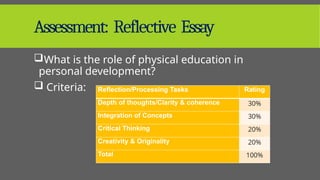
Assessment: Reflective Essay
What is the role of physical education in
personal development?
 Criteria: Reflection/Processing Tasks Rating
Depth of thoughts/Clarity & coherence 30%
Integration of Concepts 30%
Critical Thinking 20%
Creativity & Originality 20%
Total 100%
References:
 Wuest, D. A., & Fisette, J. L. (2012). Foundations of Physical Education, Exercise
Science, and Sport. McGraw-Hill Education.
 https://www.shapeamerica.org/
 https://us.humankinetics.com/
 https://www.acsm.org/
 https://www.pecentral.org/
 https://www.cdc.gov/physicalactivity/index.html
 https://www.tandfonline.com/toc/ujrd20/current
 https://journals.sagepub.com/home/pes
 https://eric.ed.gov/
 https://scholar.google.com/
 https://www.routledge.com/physical-education
Thank you very much for today! I hope
you learn something and enjoy the class.
See you next meeting!
Mam Arianne


MAPEeeeeeeeeeeeeeeeeeeeeeeeeeeeeeeeeee-W2.pptx

  • 1.
    MASTER OF ARTSIN PHYSICAL EDUCA TION MAPE 202 - FOUNDATION OFPHYSICAL EDUCATION ARIANNE MAE S. AREV ALO, DSc. PE Subject Professor
  • 2.
    Introduction to PhysicalEducation and Sports  Topics:  Physical Education  Scope and Significance of Physical Education
  • 3.
    Objectives:  Define PhysicalEducation. Understand the scope and significance of PE and sports.
  • 4.
    Preliminaries:  What isPhysical Education for you? Share your personal experience about physical education or your personal experience in teaching/doing physical education.
  • 5.
    Physical Education Instruction inthe development and care of the body ranging from simple calisthenics exercises to a course of study providing training in hygiene, gymnastics, and the performance and management of athletic games. - (Merriam Dictionary) Instruction in physical exercise and games, especially in schools. - (Oxford Dictionary)
  • 6.
    Physical Education  Isa structured educational discipline focused on the development of physical fitness, motor skills, knowledge of body movement, and the promotion of lifelong healthy habits through physical activity. It integrates physical exercises, sports, and health education to enhance students' physical, mental, social, and emotional well-being.  PE aims to equip individuals with the necessary skills, knowledge, and attitudes to lead active, healthy lives, fostering holistic development and encouraging lifelong participation in physical activities. (NASPE (2004). Moving into the Future: National Standards for Physical Education. 2nd edition. Reston, VA: National Association for Sport
  • 7.
    Scope of PhysicalEducation and Sports
  • 8.
    1. Physical FitnessDevelopment  Comprehensive Fitness: Physical Education (PE) encompasses all aspects of fitness, including cardiovascular endurance, muscular strength, flexibility, and body composition. It aims to develop a balanced and healthy body capable of handling various physical demands.
  • 9.
    1. Physical FitnessDevelopment  Personalized Fitness Programs: PE includes the creation of individualized fitness programs tailored to meet specific needs and goals, helping students understand and manage their fitness levels throughout life.
  • 10.
    2. Motor Skillsand Coordination  Fundamental Skills: PE focuses on the development of fundamental motor skills such as running, jumping, throwing, catching, and balancing. These skills are the foundation for more complex movements and sports activities.
  • 11.
    2. Motor Skillsand Coordination  Advanced Coordination: Beyond basic skills, PE helps in refining complex motor skills necessary for advanced sports performance, such as dribbling, striking, and tactical movements.
  • 12.
    3. Movement Educationand Body Mechanics  Movement Literacy: Students learn the principles of movement and body mechanics, gaining an understanding of how to move efficiently and safely. This knowledge reduces the risk of injury and enhances performance in various physical activities.
  • 13.
    3. Movement Educationand Body Mechanics  Biomechanics: PE often includes the study of biomechanics, helping students understand the forces and motions involved in human movement, which is essential for optimizing performance and preventing injuries.
  • 14.
    4. Health andWellness Education  Comprehensive Health Education: PE integrates health education, covering topics such as nutrition, mental health, substance abuse prevention, and personal hygiene. This holistic approach ensures that students understand the importance of maintaining a healthy lifestyle.
  • 15.
    4. Health andWellness Education  Lifestyle Diseases Prevention: PE plays a critical role in preventing lifestyle-related diseases like obesity, diabetes, and heart disease by promoting regular physical activity and healthy habits.
  • 16.
    5. Social andEmotional Learning  Teamwork and Collaboration: PE provides opportunities for students to engage in team sports and group activities, fostering skills in teamwork, leadership, communication, and collaboration.
  • 17.
    5. Social andEmotional Learning  Emotional Regulation: Through physical activity, students learn to manage stress, anxiety, and emotions. Sports offer a platform for developing resilience, patience, and the ability to cope with success and failure.
  • 18.
    6. Ethical andMoral Development Sportsmanship: PE emphasizes the importance of sportsmanship, teaching students to respect opponents, follow rules, and display integrity in both victory and defeat. Ethical Decision-Making: The challenges and situations encountered in sports require ethical decision-making, which PE nurtures through lessons on fairness, honesty, and respect.
  • 19.
    7. Cognitive Developmentand Academic Performance  Enhanced Cognitive Function: Regular physical activity has been linked to improved concentration, memory, and cognitive function. PE contributes to better academic performance by boosting mental alertness and reducing classroom-related stress.  Problem-Solving and Strategy: Sports and physical activities often involve strategic thinking, problem-solving, and quick decision- making, which translate into improved
  • 20.
    8. Lifelong PhysicalActivity and Recreation  Lifelong Engagement: PE introduces students to a variety of physical activities and sports, encouraging them to adopt habits that promote lifelong fitness and health.  Recreational Skills: Students learn recreational skills that they can enjoy throughout their lives, such as swimming, cycling, hiking, and other outdoor activities.
  • 21.
    9. Career Preparation Diverse Career Opportunities: PE provides a foundation for careers in sports, fitness, coaching, sports management, physical therapy, and health education. It also prepares students for specialized fields such as kinesiology, sports psychology, and athletic training.  Vocational Skills: PE helps students develop skills that are valuable in various professions, including leadership, teamwork,
  • 22.
    10. Cultural Awarenessand Social Inclusion Cultural Appreciation: PE introduces students to sports and physical activities from different cultures, fostering cultural awareness and respect for diversity. Social Inclusion: PE promotes inclusivity by encouraging participation from all students, regardless of their physical abilities or background. It helps reduce inequalities and fosters a sense of belonging and community.
  • 23.
  • 24.
    1. Holistic Development Physicaland Mental Well-being: PE is integral to the holistic development of individuals, addressing physical, mental, emotional, and social dimensions of health. It supports the development of well- rounded, healthy individuals who can contribute positively to society. Character Building: PE plays a crucial role in character building, instilling values such as discipline, perseverance, and respect. These values are essential for personal and professional success.
  • 25.
    2. Health Promotionand Disease Prevention Combatting Lifestyle Diseases: PE is essential in the fight against lifestyle-related diseases such as obesity, diabetes, and cardiovascular conditions. Regular physical activity, encouraged through PE, is a key factor in maintaining a healthy body and mind. Mental Health Benefits: Physical activity is a proven method for reducing stress, anxiety, and depression. PE provides an outlet for students to manage stress and improve their mental health, leading to a balanced and fulfilling life.
  • 26.
    3. Improved AcademicPerformance  Cognitive Benefits: Studies have shown that regular physical activity can lead to better academic outcomes by improving concentration, memory, and behavior in the classroom. PE helps students perform better academically by enhancing brain function and reducing stress.  Enhanced Learning: Physical activity increases blood flow to the brain, which can improve cognitive function and academic performance. PE contributes to
  • 27.
    4. Social Skillsand Community Building Social Interaction: PE provides opportunities for social interaction, helping students develop social skills, make friends, and build relationships. It fosters a sense of community and belonging, both within schools and in the wider society. Leadership Development: PE and sports offer opportunities for students to take on leadership roles, such as team captains or coaches. These experiences help develop leadership skills that are valuable in all areas of life.
  • 28.
    5. Lifelong HealthyHabits Foundation for a Healthy Lifestyle: PE instills habits and attitudes that encourage lifelong participation in physical activity, contributing to long-term health and well-being. It teaches students the importance of maintaining a healthy lifestyle throughout their lives. Active Lifestyles: PE encourages students to adopt active lifestyles, reducing the risk of sedentary behavior and associated health problems. It promotes a positive attitude towards physical activity, making it an enjoyable and regular part of life.
  • 29.
    6. Cultural Understandingand Global Awareness Diversity and Inclusion: PE and sports expose students to different cultures and traditions, fostering respect for diversity and enhancing global awareness. It promotes understanding and appreciation of different cultural practices and values. Global Competence: PE helps students develop a global perspective by introducing them to sports and activities from around the world. This global competence is essential in today’s interconnected world.
  • 30.
    7. Stress Reliefand Emotional Balance Stress Management: Physical activity is a natural stress reliever. PE provides students with the tools to manage stress and maintain emotional balance, leading to better mental health and overall well- being. Emotional Resilience: Through participation in sports and physical activities, students learn to cope with challenges, setbacks, and pressure. This emotional resilience is crucial for handling the ups and downs of life.
  • 31.
    8. Ethical andMoral Development Ethical Principles: PE plays a vital role in teaching ethical principles such as fairness, integrity, and respect. These values are essential for ethical decision-making and responsible citizenship. Moral Development: PE encourages the development of moral character by promoting values such as honesty, responsibility, and respect for others. These values are important for personal and professional success.
  • 32.
    9. Career Preparationand Opportunities Foundation for Sports Careers: PE provides the skills and knowledge necessary for careers in sports, fitness, coaching, and health education. It prepares students for a wide range of career opportunities in the sports and fitness industry. Skill Development: PE helps students develop important skills such as teamwork, communication, and leadership, which are valuable in any career. It also promotes physical literacy, which is essential for success in sports and fitness careers.
  • 33.
    10. National andGlobal Impact National Health and Productivity: PE contributes to the overall health and productivity of a nation by promoting physical activity and healthy lifestyles. A physically active population is more productive, less prone to illness, and contributes to the economy. Global Sports Participation: PE plays a crucial role in promoting global sports participation, fostering international understanding and cooperation through sports. It helps build a sense of global community and promotes peace through sports.
  • 34.
    Generalization:  Physical Educationand sports are vital components of education that offer immense benefits to individuals and society as a whole. They contribute to the holistic development of individuals, promote health and well- being, enhance academic performance, and foster social skills, ethical values, and cultural understanding.  The scope of PE is broad, covering various aspects of physical, mental, and emotional development, while its
  • 35.
    Assessment: Reflective Essay Whatis the role of physical education in personal development?  Criteria: Reflection/Processing Tasks Rating Depth of thoughts/Clarity & coherence 30% Integration of Concepts 30% Critical Thinking 20% Creativity & Originality 20% Total 100%
  • 36.
    References:  Wuest, D.A., & Fisette, J. L. (2012). Foundations of Physical Education, Exercise Science, and Sport. McGraw-Hill Education.  https://www.shapeamerica.org/  https://us.humankinetics.com/  https://www.acsm.org/  https://www.pecentral.org/  https://www.cdc.gov/physicalactivity/index.html  https://www.tandfonline.com/toc/ujrd20/current  https://journals.sagepub.com/home/pes  https://eric.ed.gov/  https://scholar.google.com/  https://www.routledge.com/physical-education
  • 37.
    Thank you verymuch for today! I hope you learn something and enjoy the class. See you next meeting! Mam Arianne 