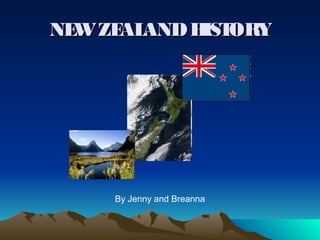
NEWZEALANDHISTORYNEWZEALANDHISTORY
By Jenny and Breanna
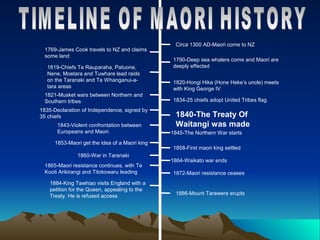
Circa 1300 AD-Maori come to NZ
1769-James Cook travels to NZ and claims
some land
1790-Deep sea whalers come and Maori are
deeply effected
1820-Hongi Hika (Hone Heke’s uncle) meets
with King George IV
1821-Musket wars between Northern and
Southern tribes 1834-25 chiefs adopt United Tribes flag
1835-Declaration of Independence, signed by
35 chiefs 1840-The Treaty Of
Waitangi was made1843-Violent confrontation between
Europeans and Maori. 1845-The Northern War starts
1864-Waikato war ends
1865-Maori resistance continues, with Te
Kooti Arikirangi and Titokowaru leading 1872-Maori resistance ceases
1884-King Tawhiao visits England with a
petition for the Queen, appealing to the
Treaty. He is refused access
1819-Chiefs Te Rauparaha, Patuone,
Nene, Moetara and Tuwhare lead raids
on the Taranaki and Te Whanganui-a-
tara areas
1853-Maori get the idea of a Maori king
1858-First maori king settled
1860-War in Taranaki
1886-Mount Tarawera erupts
How did Maori have to adapt to European
ways?
• No time, no order.
• Different lifestyles.
• Introduced things.
• Disrupted peace.
• Slightly changed cultures.
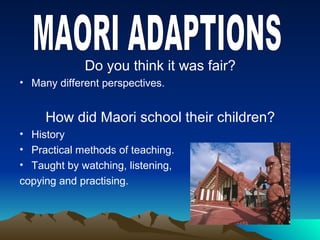
Do you think it was fair?
• Many different perspectives.
How did Maori school their children?
• History
• Practical methods of teaching.
• Taught by watching, listening,
copying and practising.
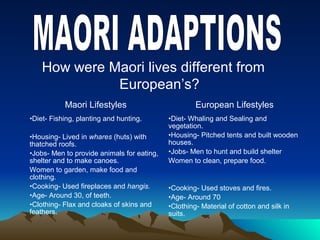
How were Maori lives different from
European’s?
Maori Lifestyles European Lifestyles
•Diet- Fishing, planting and hunting.
•Housing- Lived in whares (huts) with
thatched roofs.
•Jobs- Men to provide animals for eating,
shelter and to make canoes.
Women to garden, make food and
clothing.
•Cooking- Used fireplaces and hangis.
•Age- Around 30, of teeth.
•Clothing- Flax and cloaks of skins and
feathers.
•Diet- Whaling and Sealing and
vegetation.
•Housing- Pitched tents and built wooden
houses.
•Jobs- Men to hunt and build shelter
Women to clean, prepare food.
•Cooking- Used stoves and fires.
•Age- Around 70
•Clothing- Material of cotton and silk in
suits.
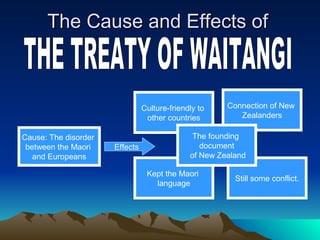
Cause: The disorder
between the Maori
and Europeans
The Cause and Effects ofThe Cause and Effects of
Culture-friendly to
other countries
Connection of New
Zealanders
Still some conflict.
Kept the Maori
language
The founding
document
of New Zealand
Effects
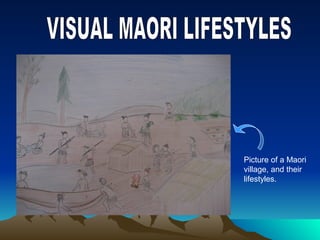
Picture of a Maori
village, and their
lifestyles.
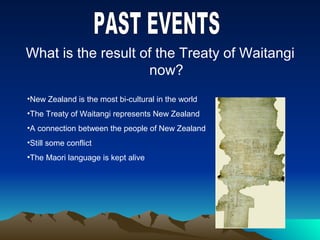
What is the result of the Treaty of Waitangi
now?
•New Zealand is the most bi-cultural in the world
•The Treaty of Waitangi represents New Zealand
•A connection between the people of New Zealand
•Still some conflict
•The Maori language is kept alive
-An A-Z of Kiwi Fact & Folklore,
Gordon Ell, 2003 New Holland
publishers (Auckland) Ltd
-The Maori, Pamela Odijk, 1991
Macmillian Australia
-History-nz.org/timeline.html
-En.wikipedia.org/wiki/Maori_Culture
-www.tepapa.govt.nz/education/
onlineresources/sgr/pages/
glasstreaty.asp
-en.wikipedia.org/wiki/list_of
_countries_by_life_expecancy
-Mrs Fletcher, 10th
November
2010, Teacher, Takapuna
Normal Intermediate School
Maori inquiry

Maori inquiry

  • 1.
  • 2.
    Circa 1300 AD-Maoricome to NZ 1769-James Cook travels to NZ and claims some land 1790-Deep sea whalers come and Maori are deeply effected 1820-Hongi Hika (Hone Heke’s uncle) meets with King George IV 1821-Musket wars between Northern and Southern tribes 1834-25 chiefs adopt United Tribes flag 1835-Declaration of Independence, signed by 35 chiefs 1840-The Treaty Of Waitangi was made1843-Violent confrontation between Europeans and Maori. 1845-The Northern War starts 1864-Waikato war ends 1865-Maori resistance continues, with Te Kooti Arikirangi and Titokowaru leading 1872-Maori resistance ceases 1884-King Tawhiao visits England with a petition for the Queen, appealing to the Treaty. He is refused access 1819-Chiefs Te Rauparaha, Patuone, Nene, Moetara and Tuwhare lead raids on the Taranaki and Te Whanganui-a- tara areas 1853-Maori get the idea of a Maori king 1858-First maori king settled 1860-War in Taranaki 1886-Mount Tarawera erupts
  • 3.
    How did Maorihave to adapt to European ways? • No time, no order. • Different lifestyles. • Introduced things. • Disrupted peace. • Slightly changed cultures.
  • 4.
    Do you thinkit was fair? • Many different perspectives. How did Maori school their children? • History • Practical methods of teaching. • Taught by watching, listening, copying and practising.
  • 5.
    How were Maorilives different from European’s? Maori Lifestyles European Lifestyles •Diet- Fishing, planting and hunting. •Housing- Lived in whares (huts) with thatched roofs. •Jobs- Men to provide animals for eating, shelter and to make canoes. Women to garden, make food and clothing. •Cooking- Used fireplaces and hangis. •Age- Around 30, of teeth. •Clothing- Flax and cloaks of skins and feathers. •Diet- Whaling and Sealing and vegetation. •Housing- Pitched tents and built wooden houses. •Jobs- Men to hunt and build shelter Women to clean, prepare food. •Cooking- Used stoves and fires. •Age- Around 70 •Clothing- Material of cotton and silk in suits.
  • 6.
    Cause: The disorder betweenthe Maori and Europeans The Cause and Effects ofThe Cause and Effects of Culture-friendly to other countries Connection of New Zealanders Still some conflict. Kept the Maori language The founding document of New Zealand Effects
  • 7.
    Picture of aMaori village, and their lifestyles.
  • 8.
    What is theresult of the Treaty of Waitangi now? •New Zealand is the most bi-cultural in the world •The Treaty of Waitangi represents New Zealand •A connection between the people of New Zealand •Still some conflict •The Maori language is kept alive
  • 9.
    -An A-Z ofKiwi Fact & Folklore, Gordon Ell, 2003 New Holland publishers (Auckland) Ltd -The Maori, Pamela Odijk, 1991 Macmillian Australia -History-nz.org/timeline.html -En.wikipedia.org/wiki/Maori_Culture -www.tepapa.govt.nz/education/ onlineresources/sgr/pages/ glasstreaty.asp -en.wikipedia.org/wiki/list_of _countries_by_life_expecancy -Mrs Fletcher, 10th November 2010, Teacher, Takapuna Normal Intermediate School