Many drones make light work
Centre for Defence Enterprise
themed competition
UK OFFICIAL© Crown copyright 2016 Dstl
September 2016
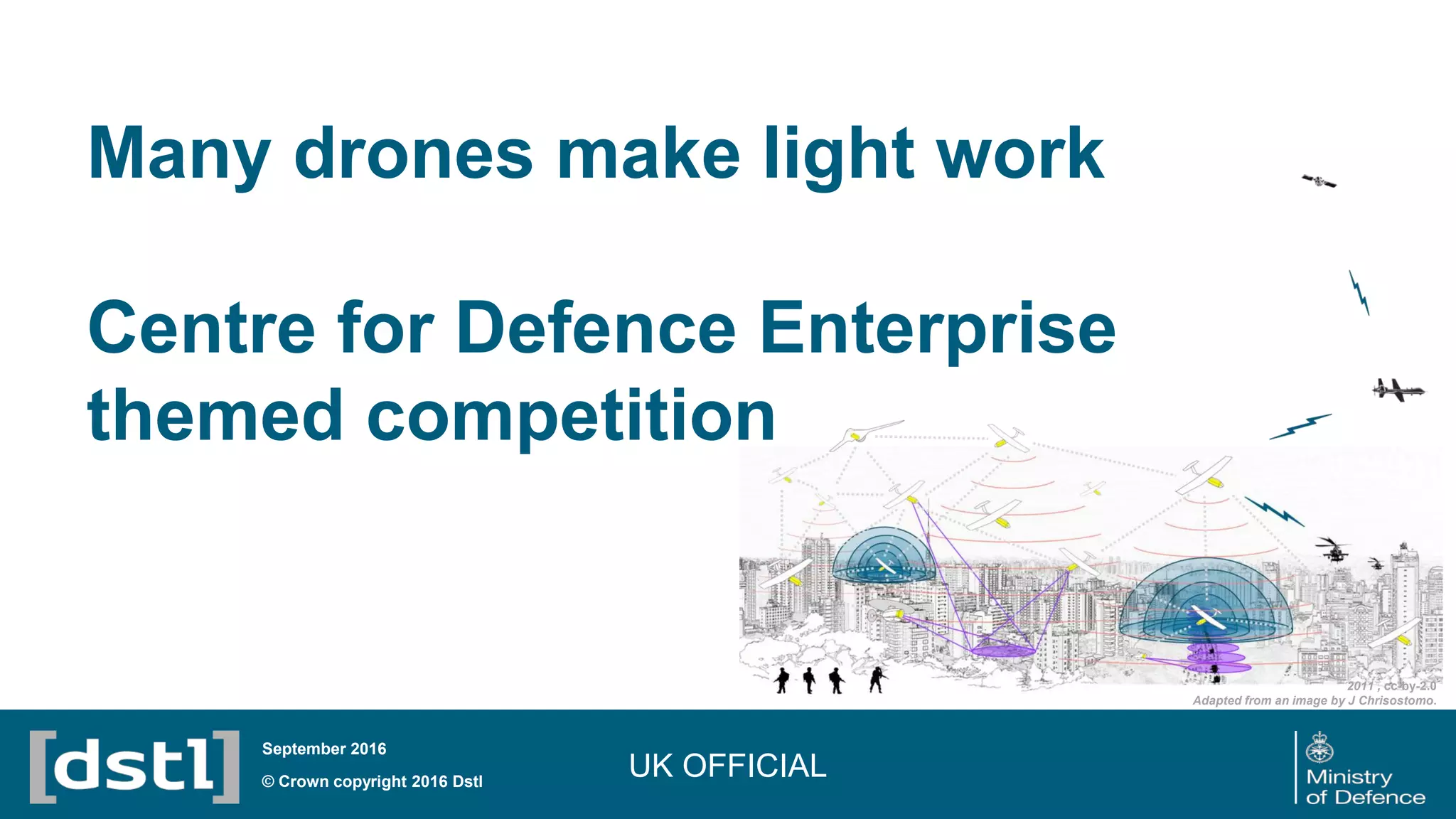
2011 , cc-by-2.0
Adapted from an image by J Chrisostomo.
Many drones make light work
UK OFFICIAL© Crown copyright 2016 Dstl
September 2016
Introduction
Military context
Technology challenges
Integration
Exploitation
Questions and answers
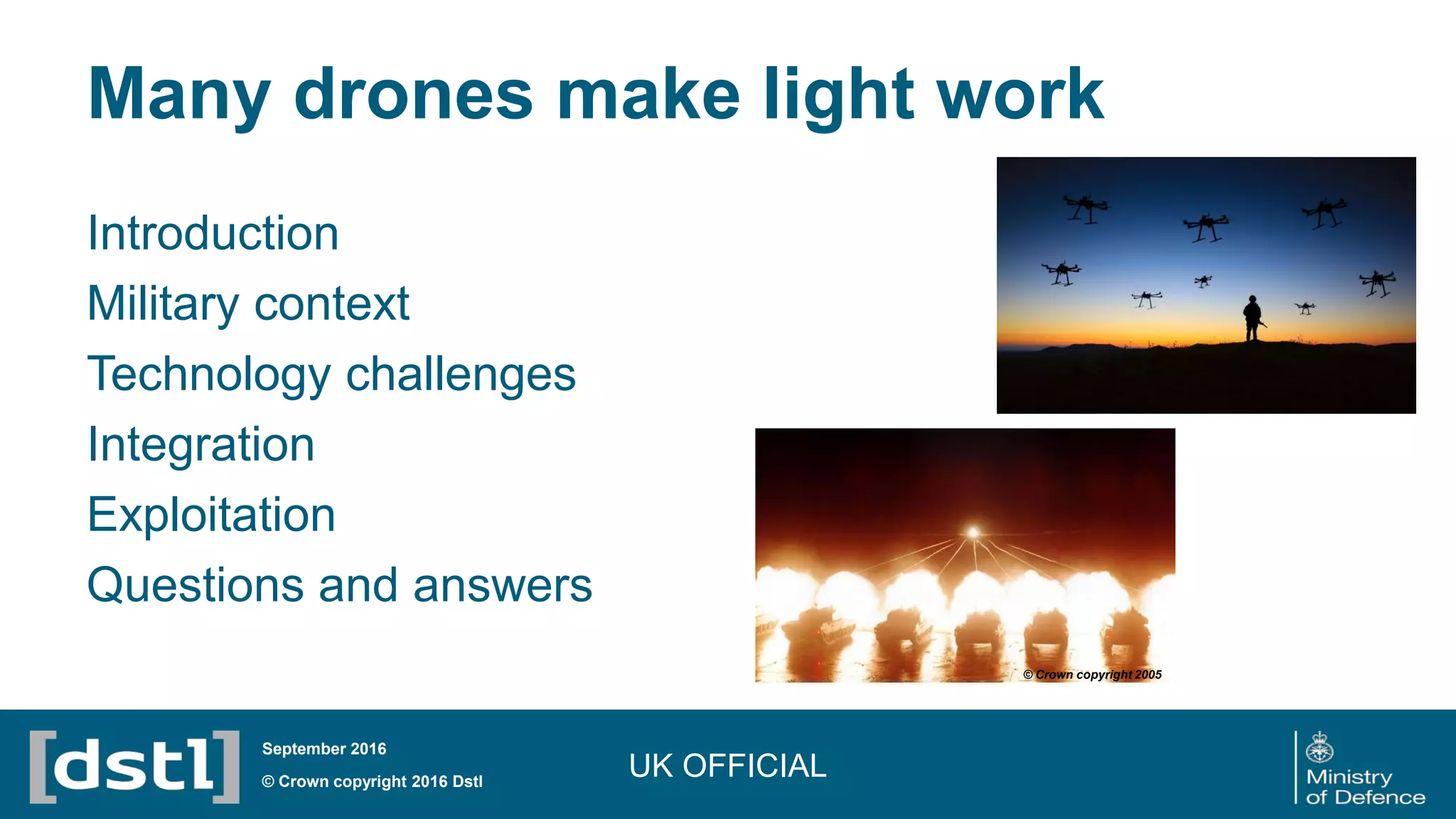
© Crown copyright 2005
Military context
UK OFFICIAL© Crown copyright 2016 Dstl
September 2016
Future operations
© Crown copyright 2016 Dstl
September 2016
• increasing urbanisation,
globalisation and interconnectivity
• baseline to encourage innovation
and adaptation
• describes UK and global context
UK OFFICIAL
Future Operating Environment 2035 [2014], DCDC. Available at
https://www.gov.uk/government/publications/future-operating-environment-2035
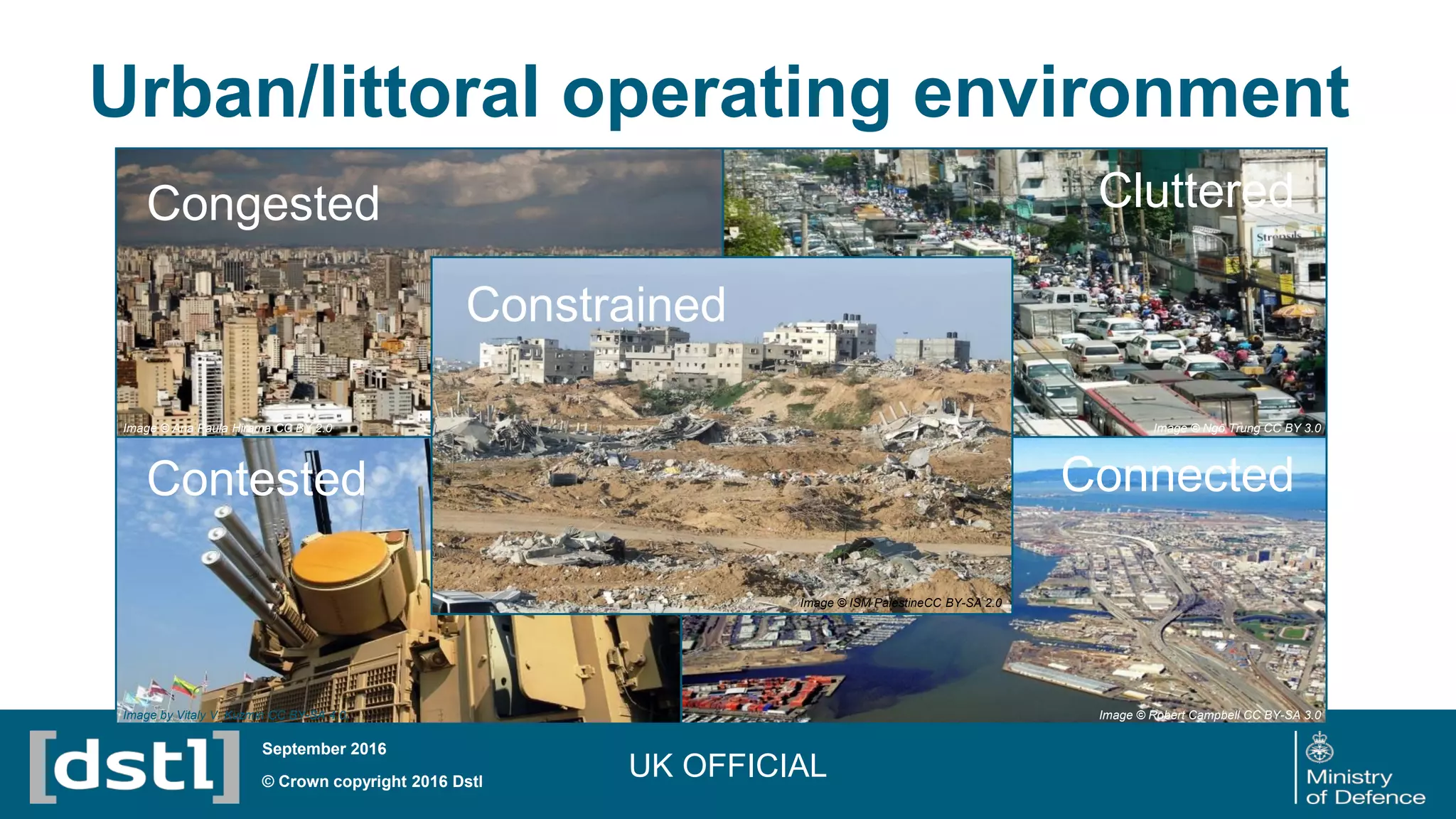
Urban/littoral operating environment
UK OFFICIAL© Crown copyright 2016 Dstl
September 2016
Image by Vitaly V. Kuzmin CC BY-SA 4.0, Image © Robert Campbell CC BY-SA 3.0
Image © Ngô Trung CC BY 3.0Image © Ana Paula Hirama CC BY 2.0
Image © ISM PalestineCC BY-SA 2.0
Congested
Connected
Constrained
Contested
Cluttered
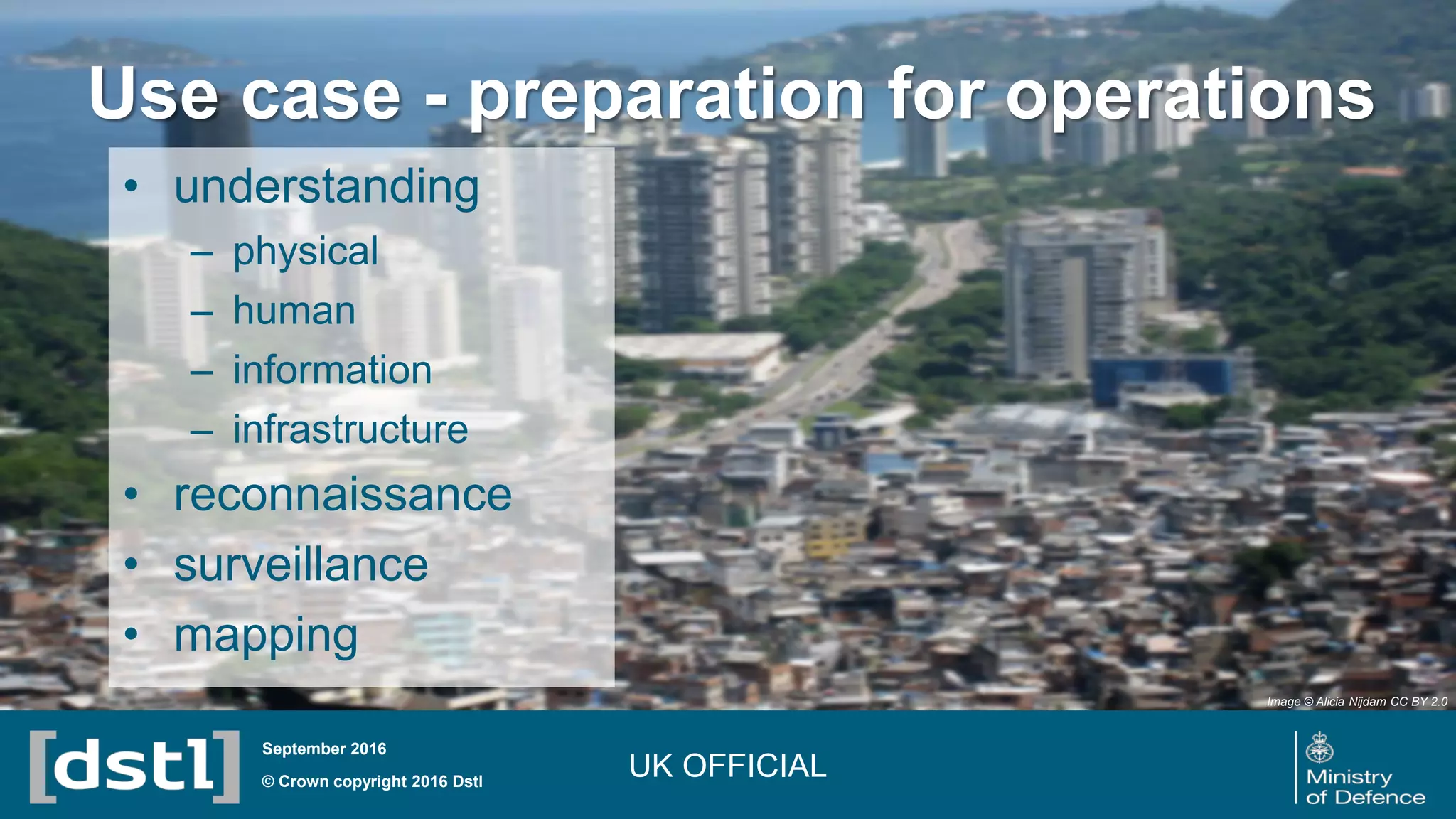
Use case - preparation for operations
UK OFFICIAL© Crown copyright 2016 Dstl
September 2016
• understanding
– physical
– human
– information
– infrastructure
• reconnaissance
• surveillance
• mapping
Image © Alicia Nijdam CC BY 2.0
Why swarming?
• multi-spectral mapping and understanding
• dispersed sensing opportunities
– multi-aspect mapping and imagery
• population continues normal pattern of life
UK OFFICIAL© Crown copyright 2016 Dstl
September 2016
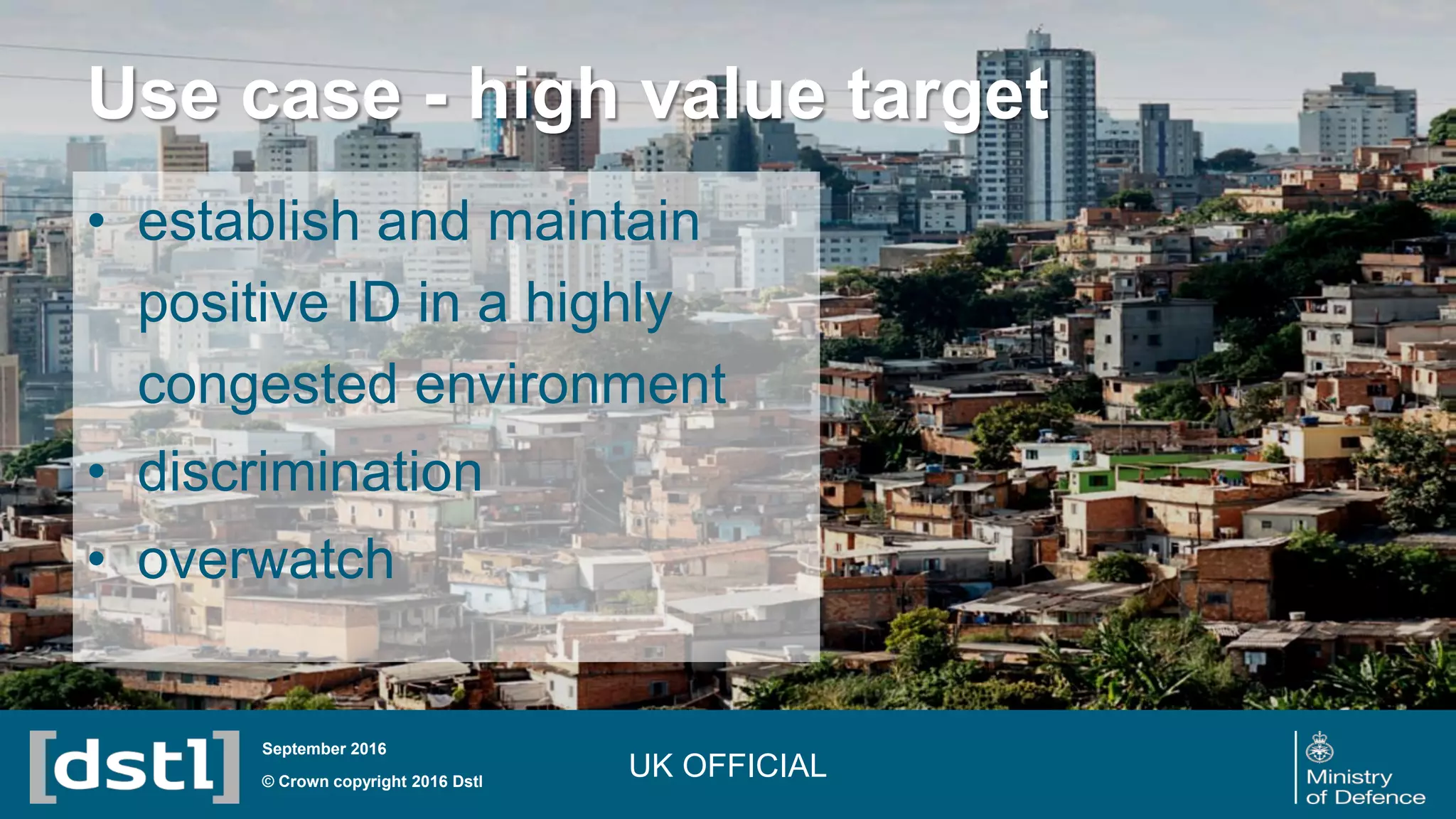
Use case - high value target
© Crown copyright 2016 Dstl
September 2016
• establish and maintain
positive ID in a highly
congested environment
• discrimination
• overwatch
UK OFFICIAL
Why swarming?
Flexibility
• multi-spectral surveillance
• multi-aspect imagery
• cooperation
Quantity
• redundancy
• saturation of defences
• splitting capability between a number of systems
UK OFFICIAL© Crown copyright 2016 Dstl
September 2016
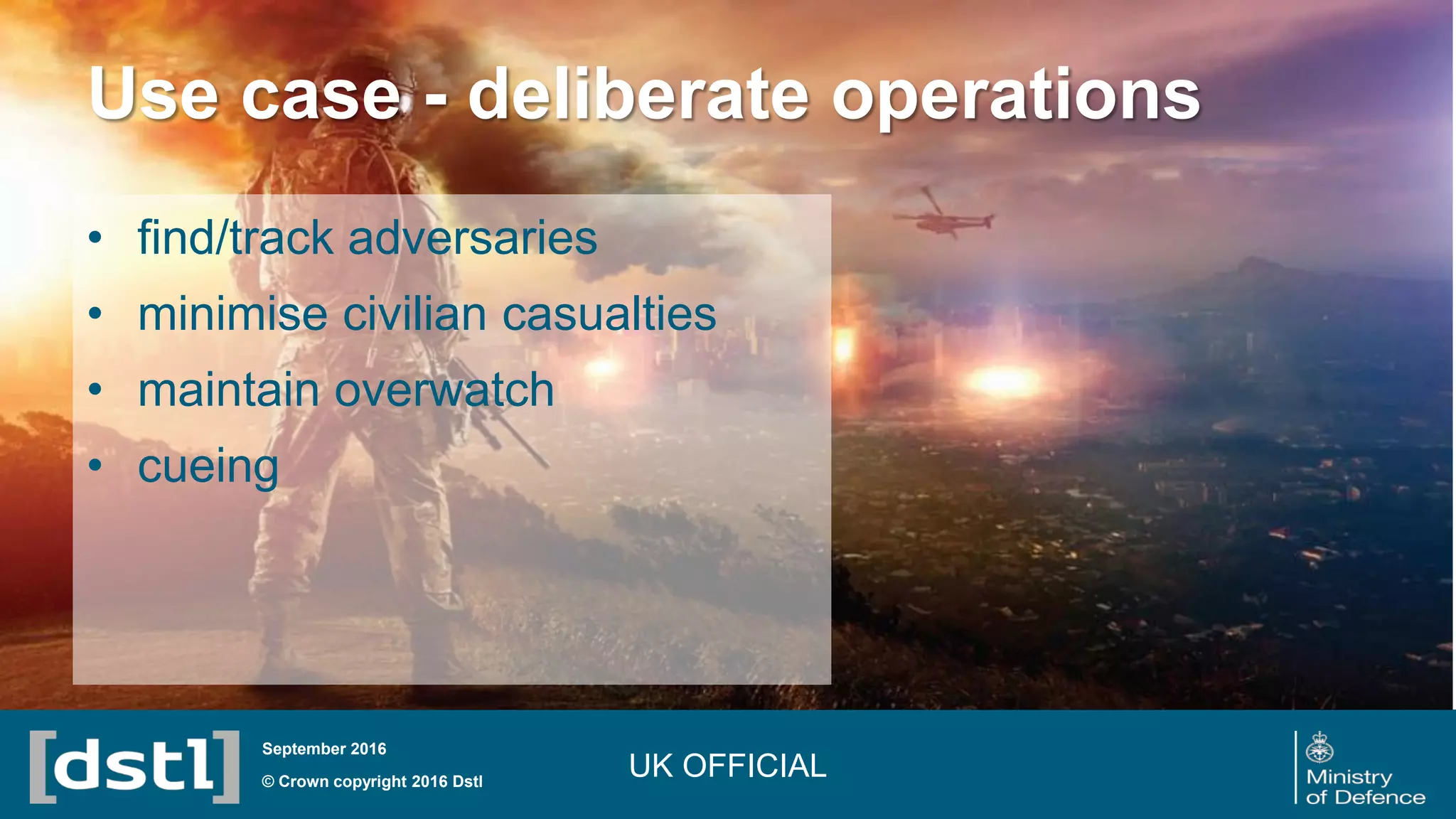
Use case - deliberate operations
© Crown copyright 2016 Dstl
September 2016
• find/track adversaries
• minimise civilian casualties
• maintain overwatch
• cueing
UK OFFICIAL
Why swarming?
Contested environment
Layered defence
• quantity presents targeting problem
• redundancy
• loss of any drone provides understanding
• responsive re-tasking
UK OFFICIAL© Crown copyright 2016 Dstl
September 2016
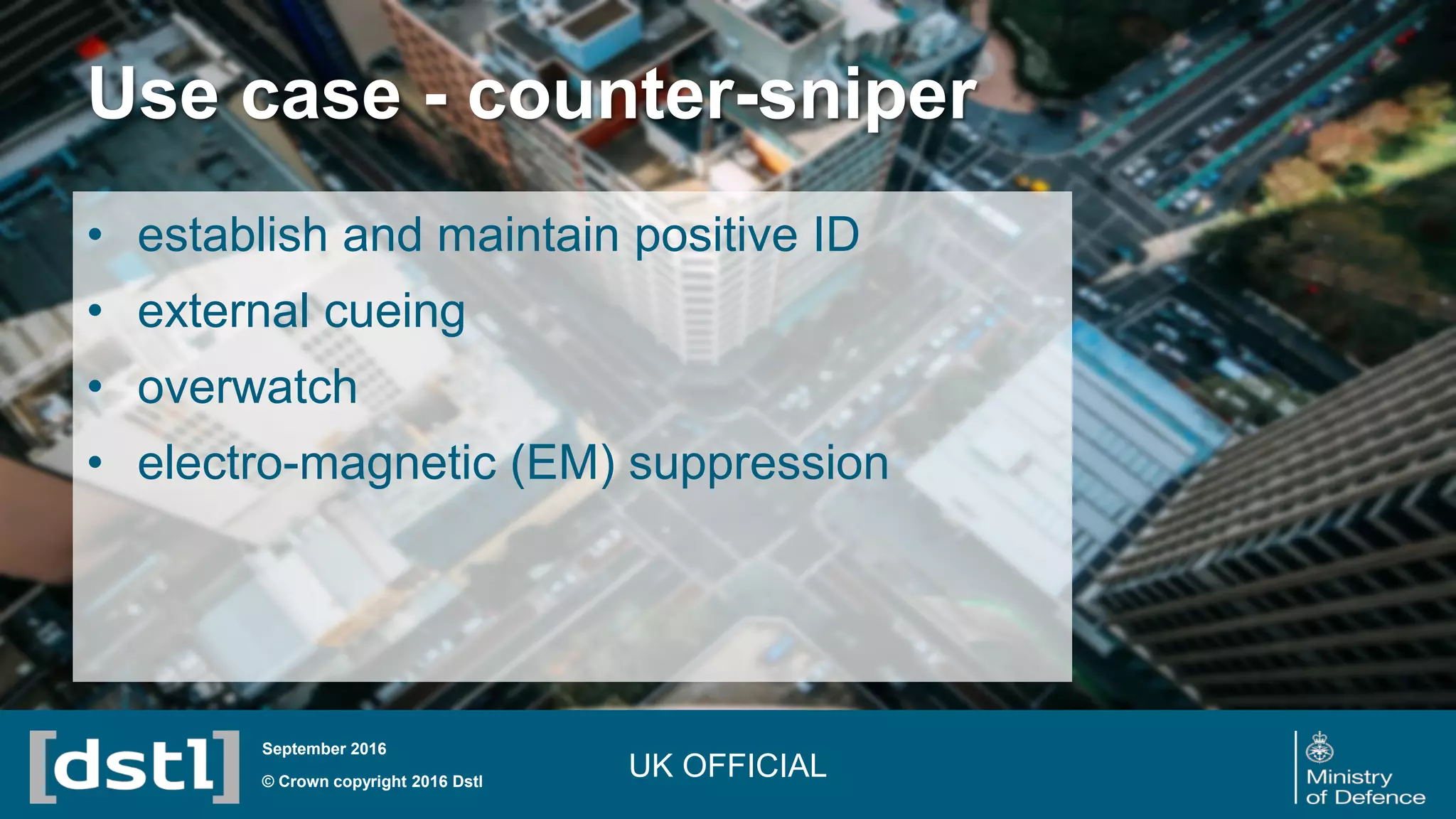
Use case - counter-sniper
© Crown copyright 2016 Dstl
September 2016
• establish and maintain positive ID
• external cueing
• overwatch
• electro-magnetic (EM) suppression
UK OFFICIAL
Why swarming?
• “see” inside the urban canyon
• multi-spectral sensor cueing
• intelligent swarm response
• multiple mission capability
UK OFFICIAL© Crown copyright 2016 Dstl
September 2016
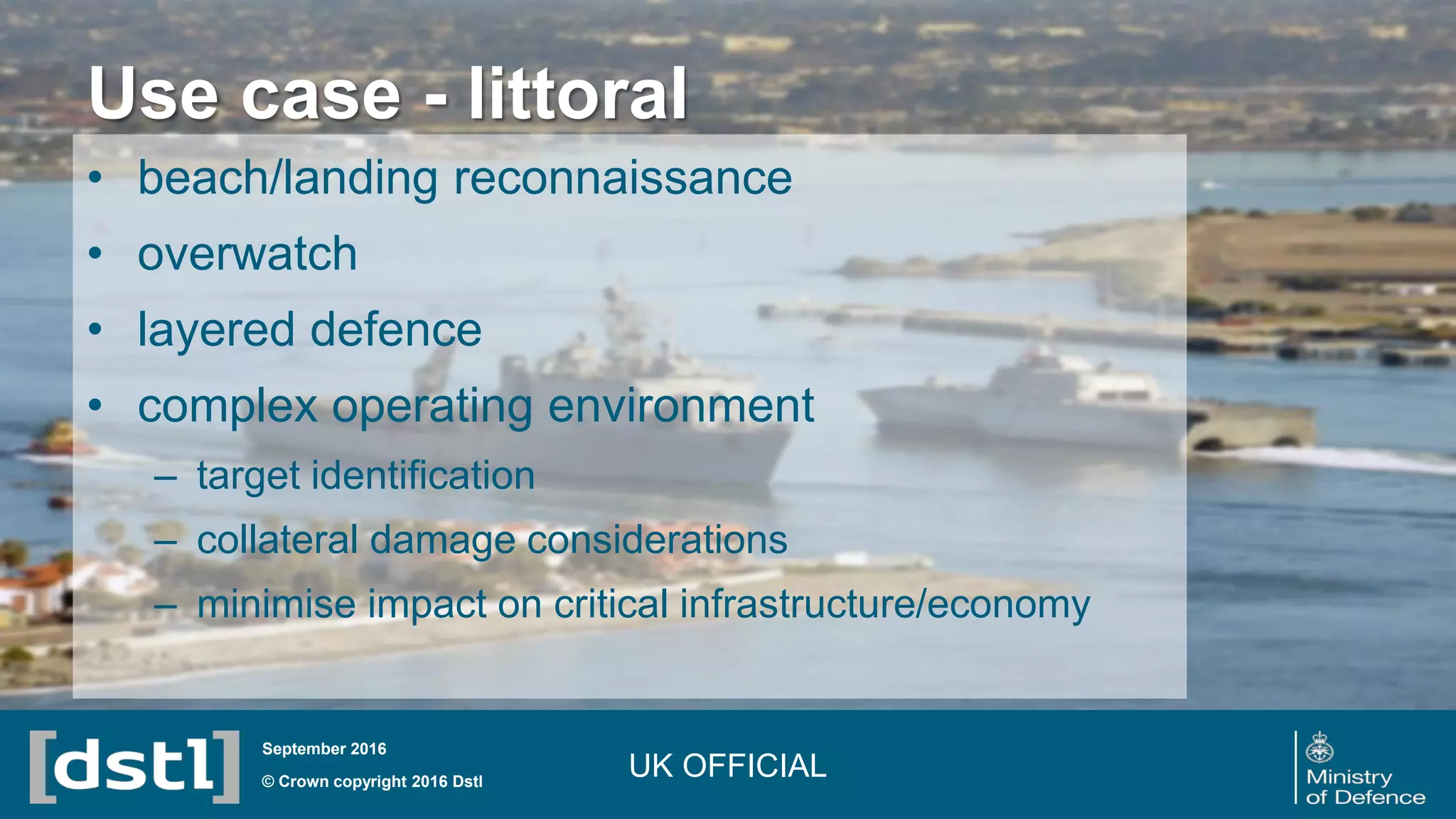
Use case - littoral
© Crown copyright 2016 Dstl
September 2016
• beach/landing reconnaissance
• overwatch
• layered defence
• complex operating environment
– target identification
– collateral damage considerations
– minimise impact on critical infrastructure/economy
UK OFFICIAL
Why Swarming?
Quantity
• redundancy
• multi-mission capability
• cooperation
• saturation of defences
Multi-sensor/multi-aspect
UK OFFICIAL© Crown copyright 2016 Dstl
September 2016
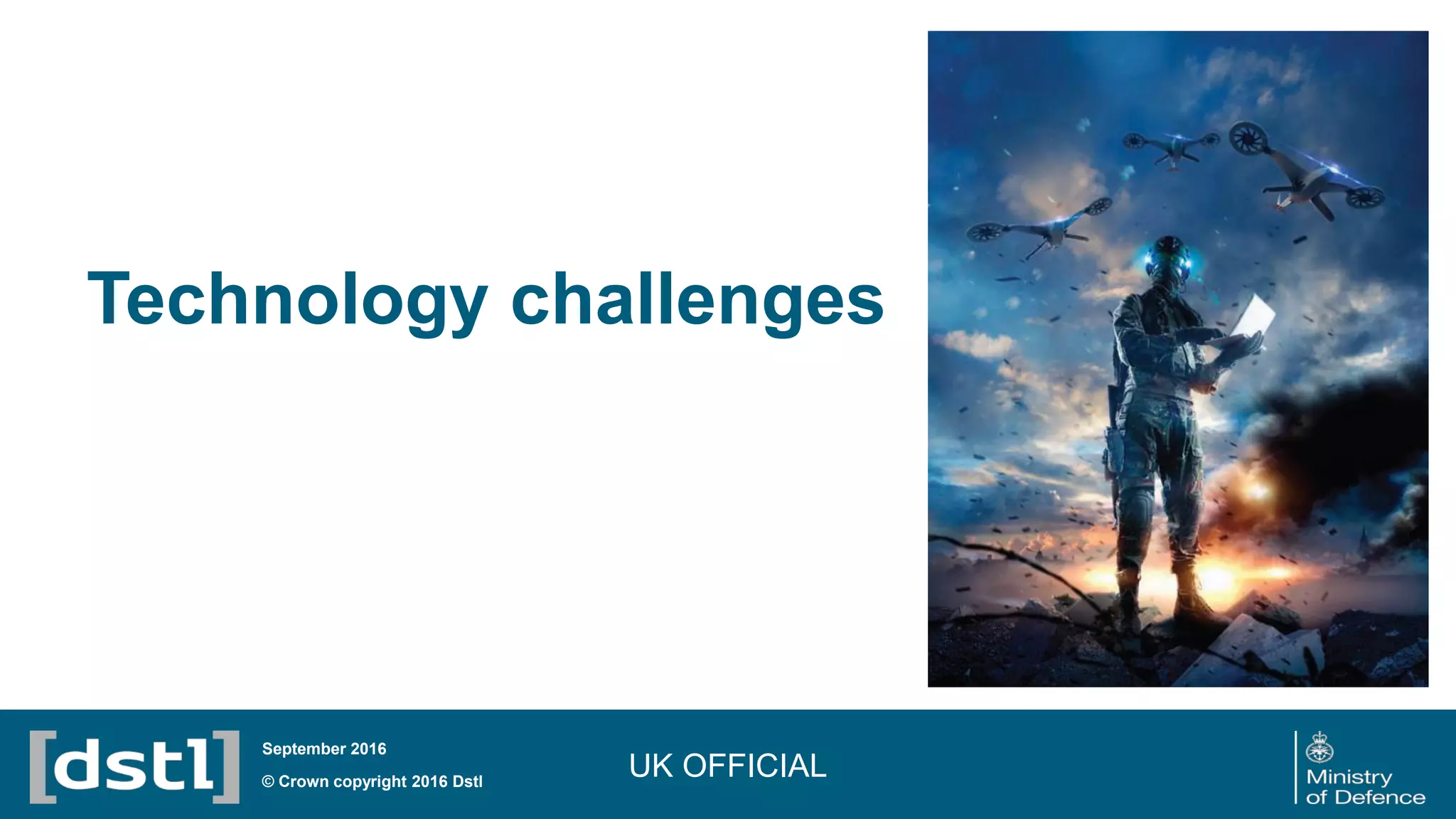
Technology challenges
UK OFFICIAL© Crown copyright 2016 Dstl
September 2016
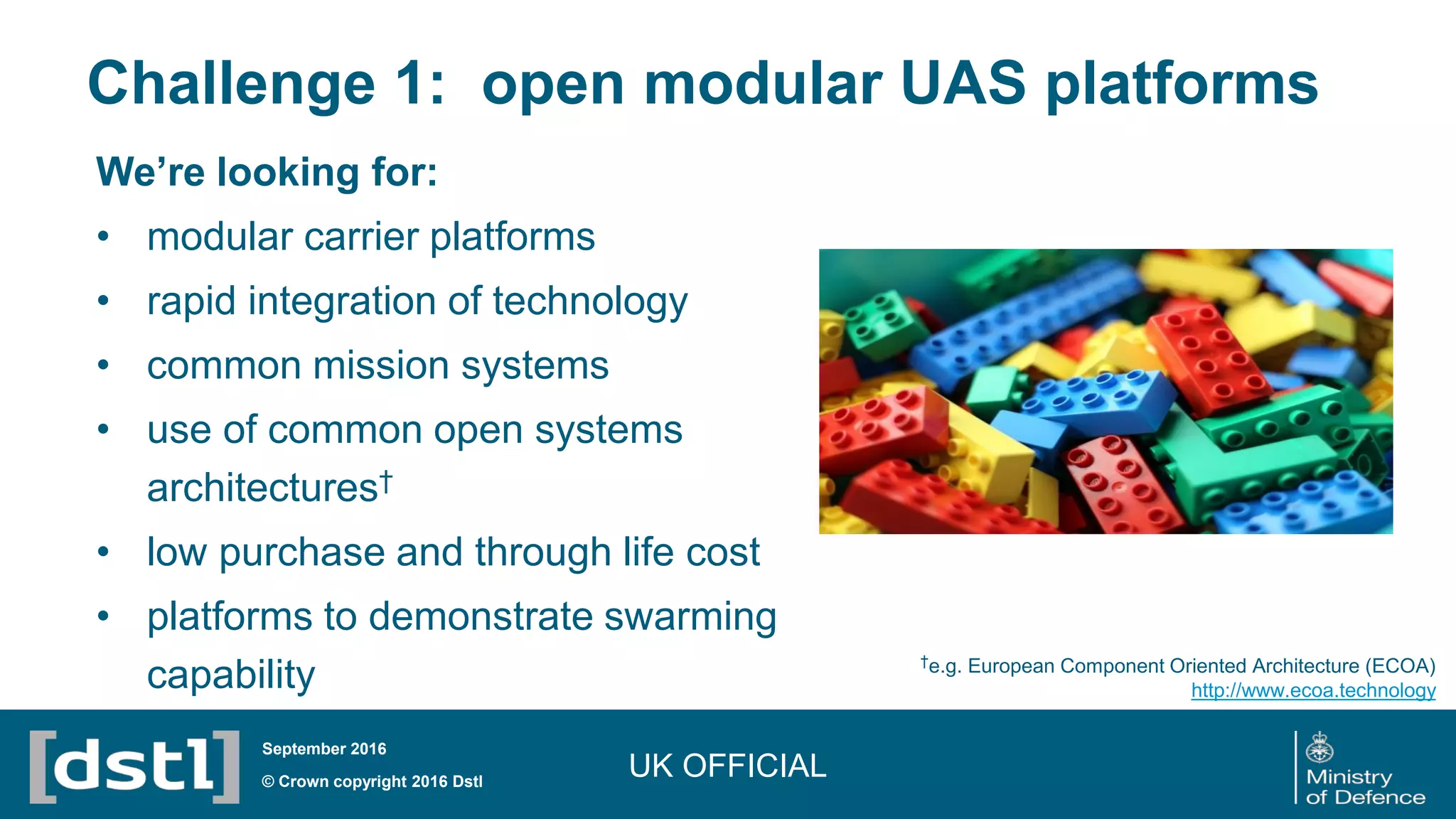
Challenge 1: open modular UAS platforms
UK OFFICIAL© Crown copyright 2016 Dstl
September 2016
We’re looking for:
• modular carrier platforms
• rapid integration of technology
• common mission systems
• use of common open systems
architectures†
• low purchase and through life cost
• platforms to demonstrate swarming
capability
†e.g. European Component Oriented Architecture (ECOA)
http://www.ecoa.technology
Challenge 1: open modular UAS platforms
UK OFFICIAL© Crown copyright 2016 Dstl
September 2016
We expect key outputs to be:
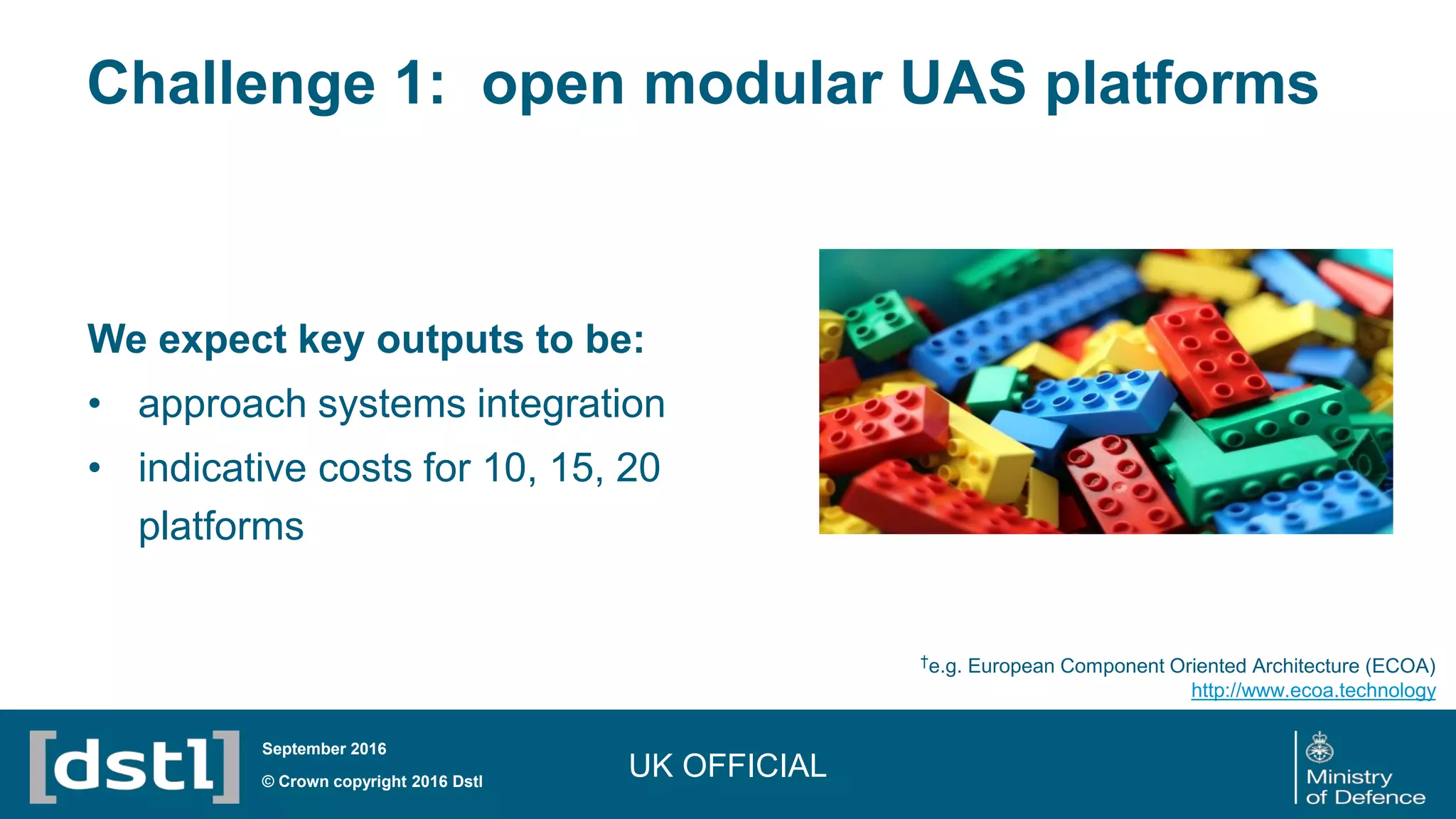
• approach systems integration
• indicative costs for 10, 15, 20
platforms
†e.g. European Component Oriented Architecture (ECOA)
http://www.ecoa.technology
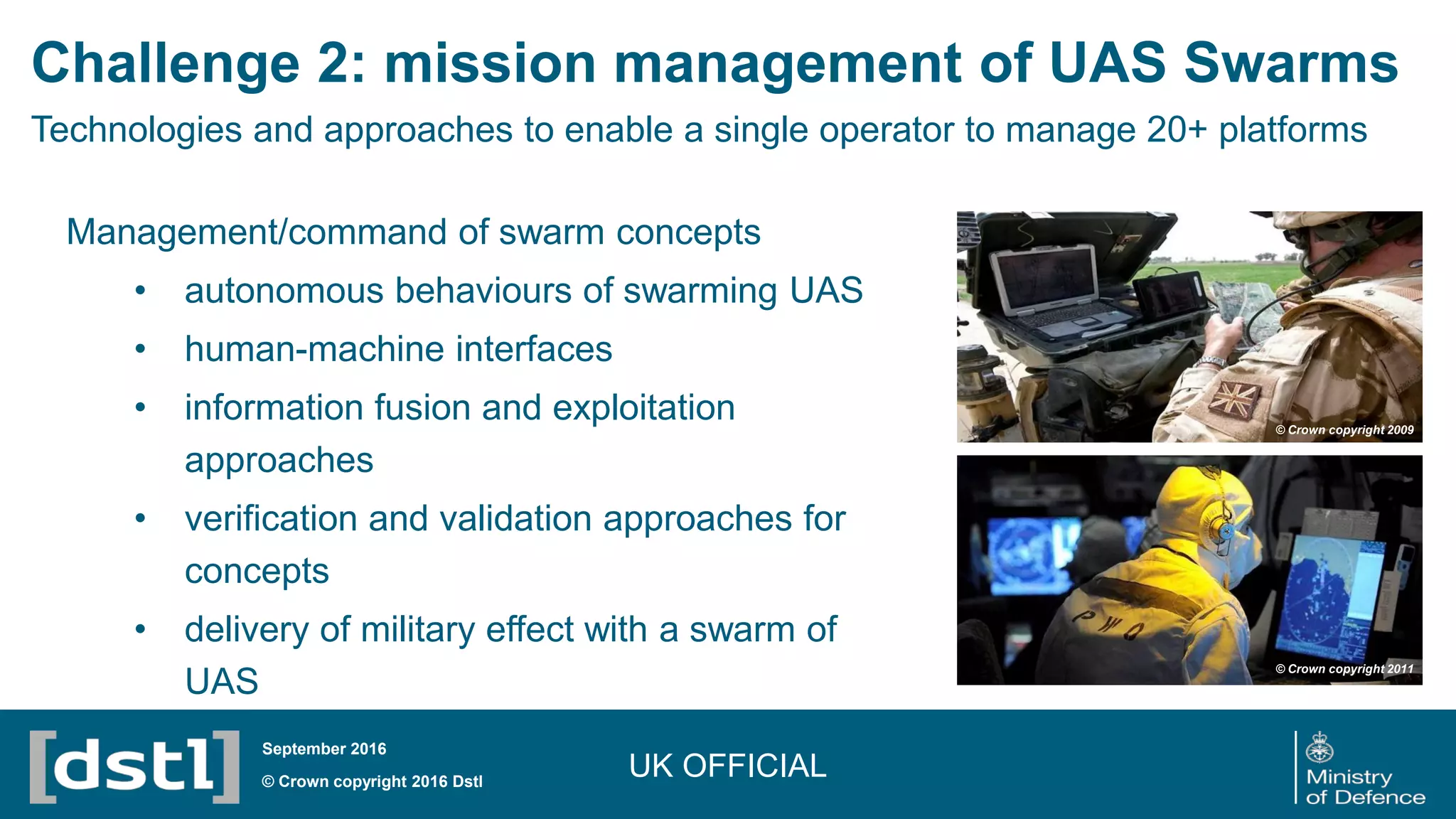
Management/command of swarm concepts
• autonomous behaviours of swarming UAS
• human-machine interfaces
• information fusion and exploitation
approaches
• verification and validation approaches for
concepts
• delivery of military effect with a swarm of
UAS
Challenge 2: mission management of UAS Swarms
Technologies and approaches to enable a single operator to manage 20+ platforms
UK OFFICIAL© Crown copyright 2016 Dstl
September 2016
© Crown copyright 2009
© Crown copyright 2011
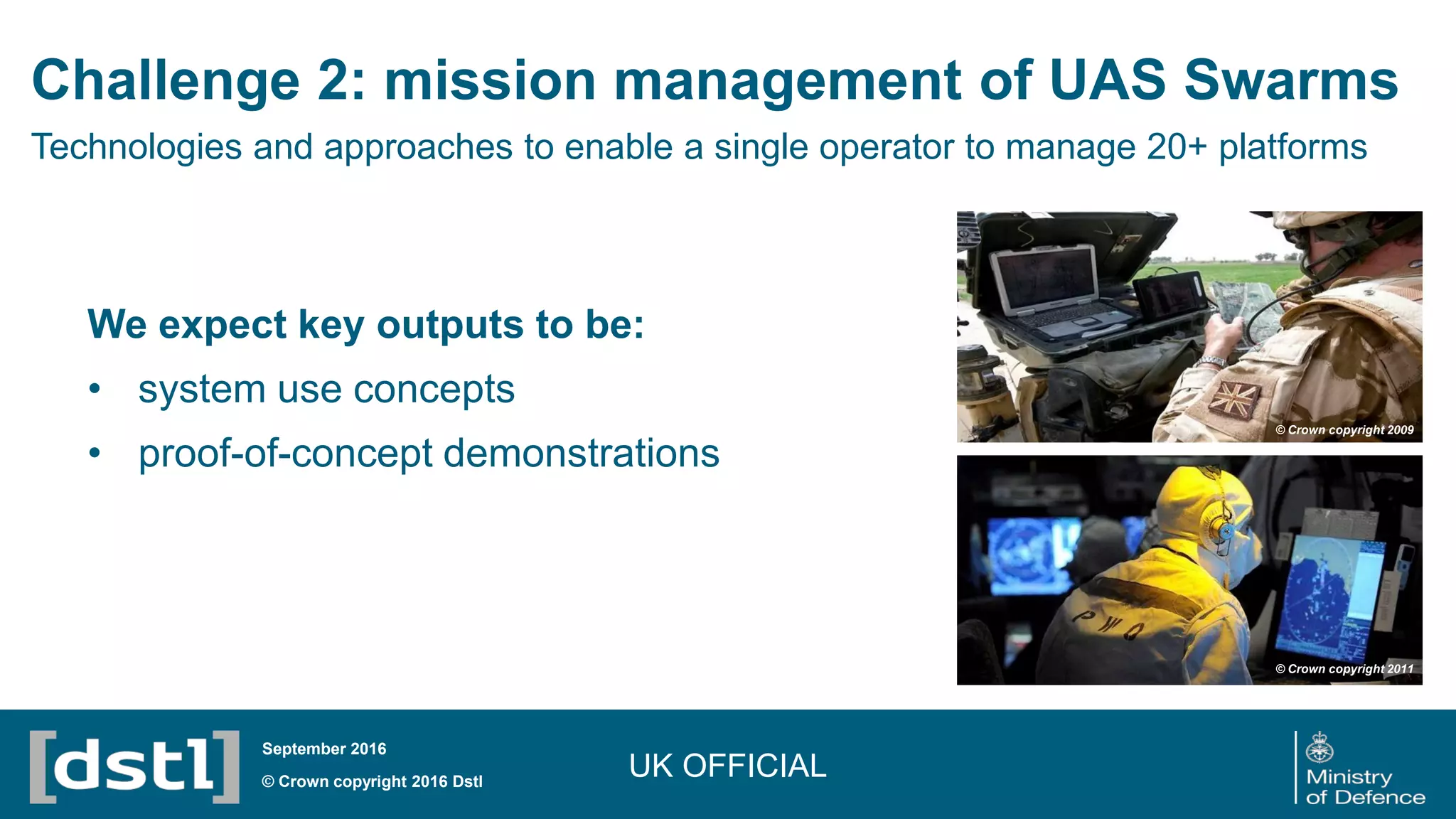
We expect key outputs to be:
• system use concepts
• proof-of-concept demonstrations
Challenge 2: mission management of UAS Swarms
Technologies and approaches to enable a single operator to manage 20+ platforms
UK OFFICIAL© Crown copyright 2016 Dstl
September 2016
© Crown copyright 2009
© Crown copyright 2011
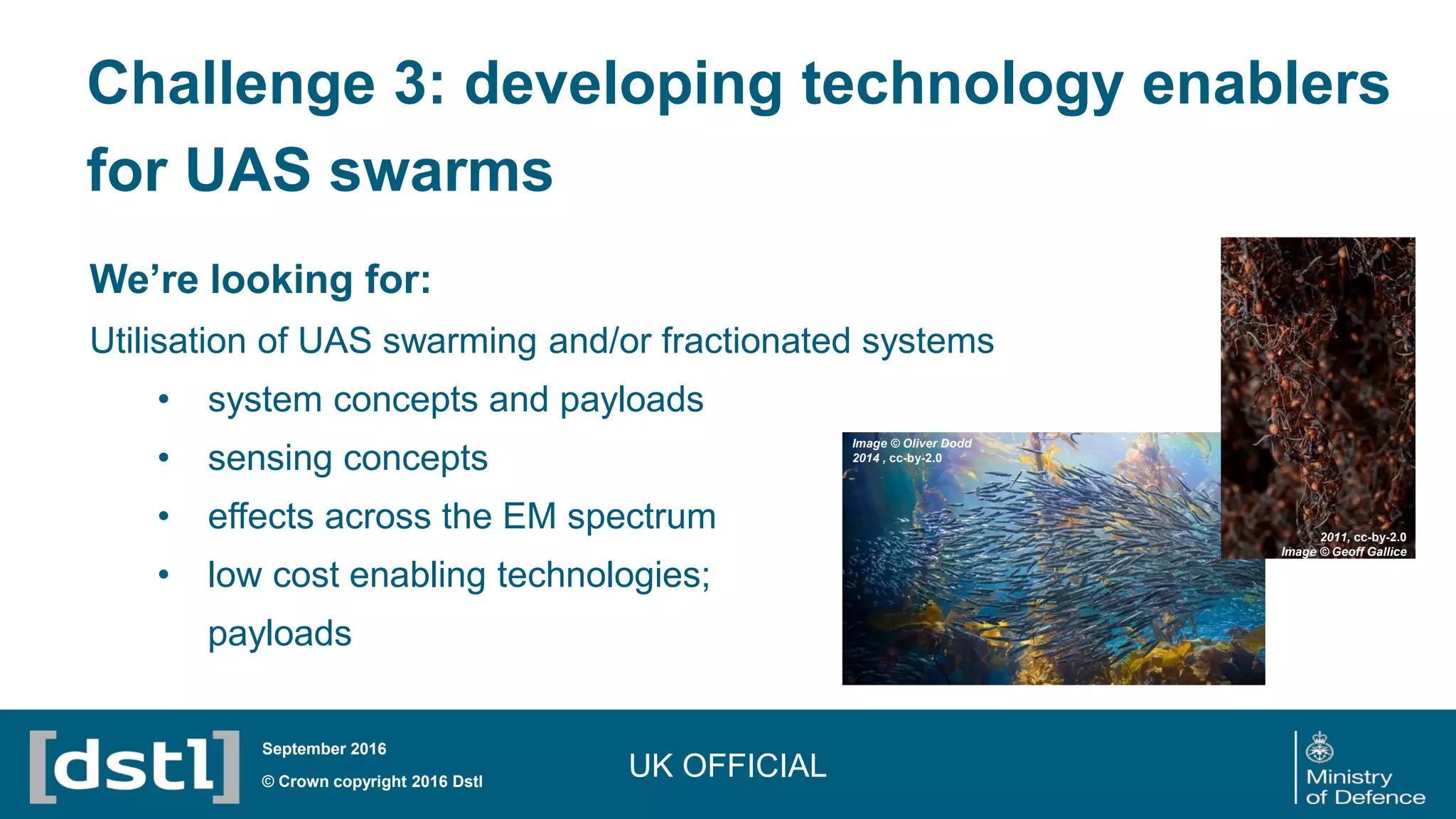
We’re looking for:
Utilisation of UAS swarming and/or fractionated systems
• system concepts and payloads
• sensing concepts
• effects across the EM spectrum
• low cost enabling technologies;
payloads
UK OFFICIAL© Crown copyright 2016 Dstl
September 2016
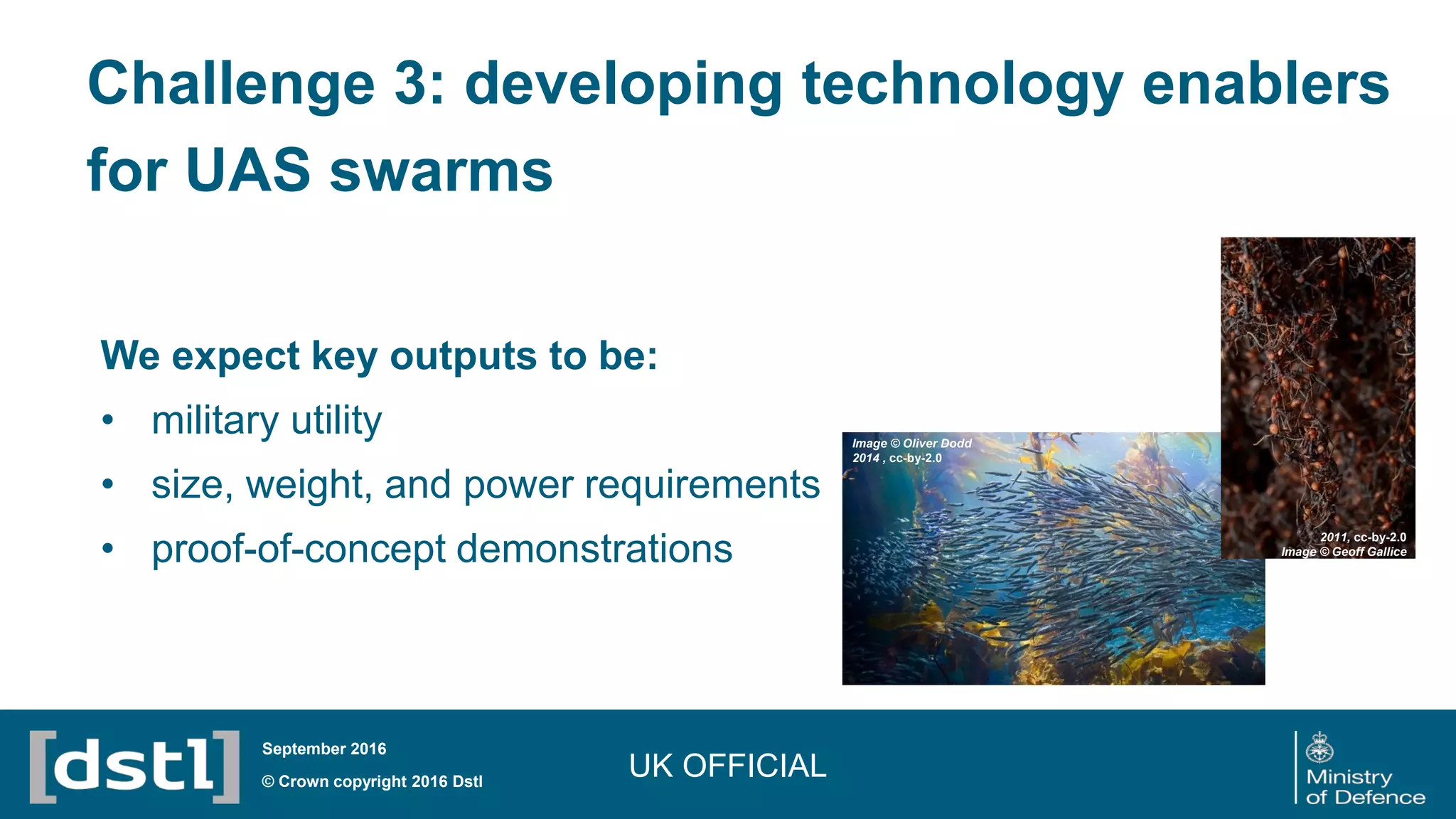
2011, cc-by-2.0
Image © Geoff Gallice
Image © Oliver Dodd
2014 , cc-by-2.0
Challenge 3: developing technology enablers
for UAS swarms
We expect key outputs to be:
• military utility
• size, weight, and power requirements
• proof-of-concept demonstrations
UK OFFICIAL© Crown copyright 2016 Dstl
September 2016
2011, cc-by-2.0
Image © Geoff Gallice
Image © Oliver Dodd
2014 , cc-by-2.0
Challenge 3: developing technology enablers
for UAS swarms
What we want
UK OFFICIAL© Crown copyright 2016 Dstl
September 2016
• willingness to collaborate with others
• projects that consider a system approach and integration requirements
• proposals that demonstrate understanding of cost implications
• proof-of-concept technology demonstration
• novel and innovative approaches
• solutions which can be exploited into integrated phase-2 demonstrations
• solutions which can easily be reconfigured, upgraded or updated
• consider ECOA – European Component Orientated Architecture
What we don’t want
• single solution from a single supplier
• projects that can’t demonstrate feasibility within the phase 1 timescale
• demonstrations of existing ‘off-the-shelf’ products
• solutions that don’t offer significant benefit to defence
• generic swarming models or algorithms
• marginal improvements in capability
• consultancy, paper-based studies or literature reviews
UK OFFICIAL© Crown copyright 2016 Dstl
September 2016
Integration
• aspiration to establish ad-hoc, virtual teams
• we think it’s unlikely that phase 1 projects will seamlessly fit together
and cover the solution space
– introduce other technology suppliers
– support to integration
• only phase-1 suppliers can be funded in phase 2 but can sub-
contract new technology suppliers
UK OFFICIAL© Crown copyright 2016 Dstl
September 2016
Exploitation
UK OFFICIAL© Crown copyright 2016 Dstl
September 2016
• networking events [Jan/Feb and May/June]
• stakeholder demonstration [July]
• phase 2 competition
• possible opportunity to participate in the TTCP ASC
Cardigan Bay trials in 2017 and 2018
• integration into research programme
© Crown copyright 2014
© Crown copyright 2010
TTCP: The Technical Cooperation Program
ASC: Autonomy Strategic Challenge
Important information
• total budget for phase 1 up to £1 million
• projects typically between £40,000 to £80,000
– we will not accept proposals over £100,000
• stakeholder event July 2017 for successful phase-1
projects to demonstrate their technology
• up to an additional £2 million available for phase-2
funding
UK OFFICIAL© Crown copyright 2016 Dstl
September 2016
Important dates
• webinar 12.30pm 3 October 2016
• competition closes at 5pm Thursday 3 November 2016
• proposals must be submitted using the CDE online
submission service
• contract placement initiated and feedback provided mid-
January 2017
• phase-1 projects to complete by 1 August 2017
UK OFFICIAL© Crown copyright 2016 Dstl
September 2016
Many drones make light work
UK OFFICIAL© Crown copyright 2016 Dstl
September 2016
Technical questions
swarming@dstl.gov.uk
General enquiries
cde@dstl.gov.uk
Proposals submitted via the CDE online submission
service – no later than 5pm Thursday 3 November 2016
© Crown copyright 2016 Dstl
September 2016
How will the competition work?
Innovation Network event
22 September 2016
Emma Howe
CDE Themed Competition Manager
Intellectual property
Online bid submission
Assessors
Technical partners
www.gov.uk/dstl/cde
Challenge 1
Open modular UAS platforms
Challenge 2
mission management of UAS swarms
Challenge 3
Developing technology enablers for UAS
swarms
Many drones make light work
What we want
Many drones make light work
What we don’t want
Phase 1
Up to £1 million
Typically £40 - 80,000
Research complete by August 2017
Proof-of-concept
Phase 2 proposal
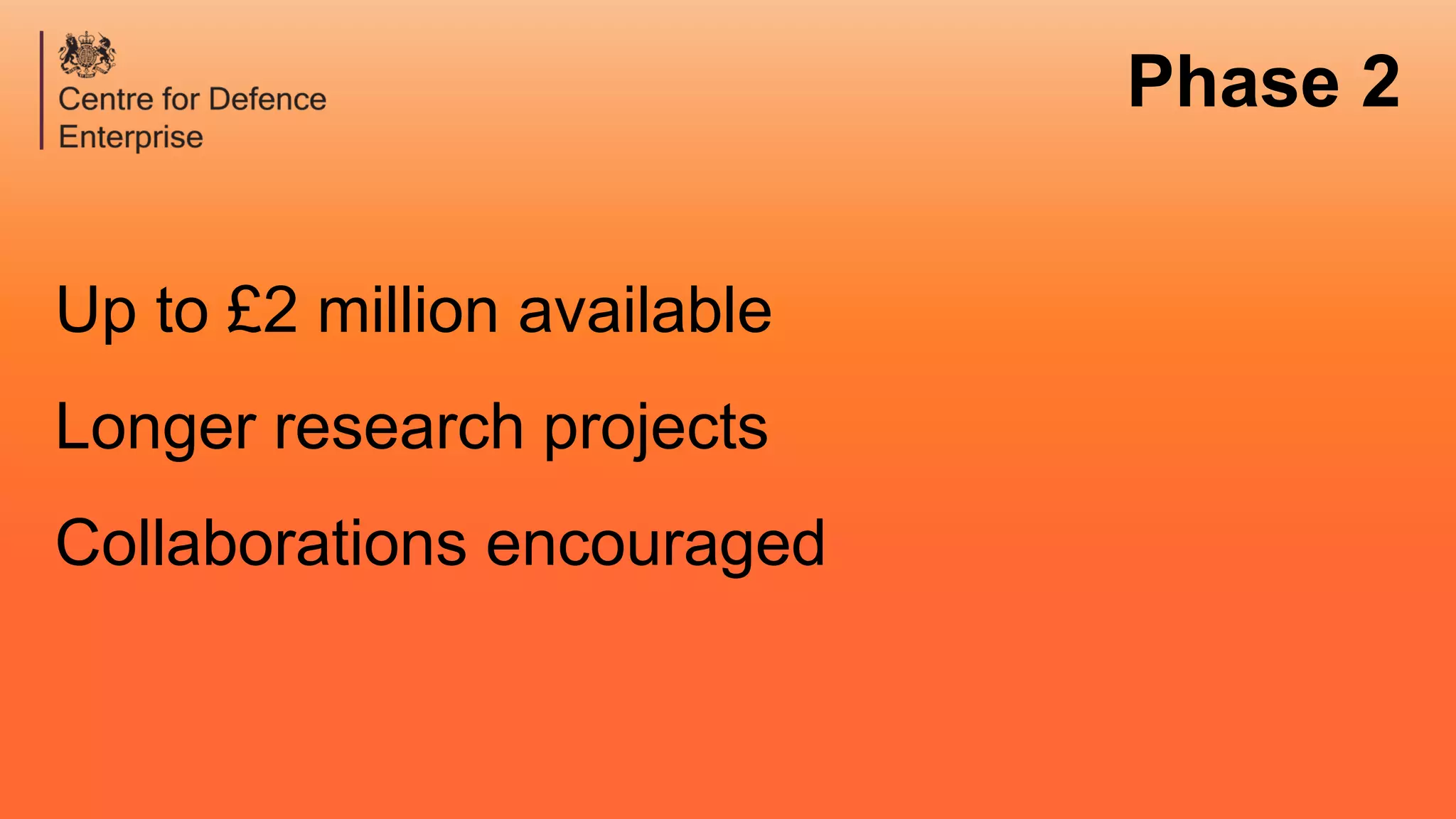
Phase 2
Up to £2 million available
Longer research projects
Collaborations encouraged
Competition dates
Webinar:
3 October 2016
Technical queries
swarming@dstl.gov.uk
November
Competition closes
3 November 2016 at 5pm
53
Questions

many drones make light work themed competition 22 September 2016

  • 1.
    Many drones makelight work Centre for Defence Enterprise themed competition UK OFFICIAL© Crown copyright 2016 Dstl September 2016 2011 , cc-by-2.0 Adapted from an image by J Chrisostomo.
  • 2.
    Many drones makelight work UK OFFICIAL© Crown copyright 2016 Dstl September 2016 Introduction Military context Technology challenges Integration Exploitation Questions and answers © Crown copyright 2005
  • 3.
    Military context UK OFFICIAL©Crown copyright 2016 Dstl September 2016
  • 4.
    Future operations © Crowncopyright 2016 Dstl September 2016 • increasing urbanisation, globalisation and interconnectivity • baseline to encourage innovation and adaptation • describes UK and global context UK OFFICIAL Future Operating Environment 2035 [2014], DCDC. Available at https://www.gov.uk/government/publications/future-operating-environment-2035
  • 5.
    Urban/littoral operating environment UKOFFICIAL© Crown copyright 2016 Dstl September 2016 Image by Vitaly V. Kuzmin CC BY-SA 4.0, Image © Robert Campbell CC BY-SA 3.0 Image © Ngô Trung CC BY 3.0Image © Ana Paula Hirama CC BY 2.0 Image © ISM PalestineCC BY-SA 2.0 Congested Connected Constrained Contested Cluttered
  • 6.
    Use case -preparation for operations UK OFFICIAL© Crown copyright 2016 Dstl September 2016 • understanding – physical – human – information – infrastructure • reconnaissance • surveillance • mapping Image © Alicia Nijdam CC BY 2.0
  • 7.
    Why swarming? • multi-spectralmapping and understanding • dispersed sensing opportunities – multi-aspect mapping and imagery • population continues normal pattern of life UK OFFICIAL© Crown copyright 2016 Dstl September 2016
  • 8.
    Use case -high value target © Crown copyright 2016 Dstl September 2016 • establish and maintain positive ID in a highly congested environment • discrimination • overwatch UK OFFICIAL
  • 9.
    Why swarming? Flexibility • multi-spectralsurveillance • multi-aspect imagery • cooperation Quantity • redundancy • saturation of defences • splitting capability between a number of systems UK OFFICIAL© Crown copyright 2016 Dstl September 2016
  • 10.
    Use case -deliberate operations © Crown copyright 2016 Dstl September 2016 • find/track adversaries • minimise civilian casualties • maintain overwatch • cueing UK OFFICIAL
  • 11.
    Why swarming? Contested environment Layereddefence • quantity presents targeting problem • redundancy • loss of any drone provides understanding • responsive re-tasking UK OFFICIAL© Crown copyright 2016 Dstl September 2016
  • 12.
    Use case -counter-sniper © Crown copyright 2016 Dstl September 2016 • establish and maintain positive ID • external cueing • overwatch • electro-magnetic (EM) suppression UK OFFICIAL
  • 13.
    Why swarming? • “see”inside the urban canyon • multi-spectral sensor cueing • intelligent swarm response • multiple mission capability UK OFFICIAL© Crown copyright 2016 Dstl September 2016
  • 14.
    Use case -littoral © Crown copyright 2016 Dstl September 2016 • beach/landing reconnaissance • overwatch • layered defence • complex operating environment – target identification – collateral damage considerations – minimise impact on critical infrastructure/economy UK OFFICIAL
  • 15.
    Why Swarming? Quantity • redundancy •multi-mission capability • cooperation • saturation of defences Multi-sensor/multi-aspect UK OFFICIAL© Crown copyright 2016 Dstl September 2016
  • 16.
    Technology challenges UK OFFICIAL©Crown copyright 2016 Dstl September 2016
  • 17.
    Challenge 1: openmodular UAS platforms UK OFFICIAL© Crown copyright 2016 Dstl September 2016 We’re looking for: • modular carrier platforms • rapid integration of technology • common mission systems • use of common open systems architectures† • low purchase and through life cost • platforms to demonstrate swarming capability †e.g. European Component Oriented Architecture (ECOA) http://www.ecoa.technology
  • 18.
    Challenge 1: openmodular UAS platforms UK OFFICIAL© Crown copyright 2016 Dstl September 2016 We expect key outputs to be: • approach systems integration • indicative costs for 10, 15, 20 platforms †e.g. European Component Oriented Architecture (ECOA) http://www.ecoa.technology
  • 19.
    Management/command of swarmconcepts • autonomous behaviours of swarming UAS • human-machine interfaces • information fusion and exploitation approaches • verification and validation approaches for concepts • delivery of military effect with a swarm of UAS Challenge 2: mission management of UAS Swarms Technologies and approaches to enable a single operator to manage 20+ platforms UK OFFICIAL© Crown copyright 2016 Dstl September 2016 © Crown copyright 2009 © Crown copyright 2011
  • 20.
    We expect keyoutputs to be: • system use concepts • proof-of-concept demonstrations Challenge 2: mission management of UAS Swarms Technologies and approaches to enable a single operator to manage 20+ platforms UK OFFICIAL© Crown copyright 2016 Dstl September 2016 © Crown copyright 2009 © Crown copyright 2011
  • 21.
    We’re looking for: Utilisationof UAS swarming and/or fractionated systems • system concepts and payloads • sensing concepts • effects across the EM spectrum • low cost enabling technologies; payloads UK OFFICIAL© Crown copyright 2016 Dstl September 2016 2011, cc-by-2.0 Image © Geoff Gallice Image © Oliver Dodd 2014 , cc-by-2.0 Challenge 3: developing technology enablers for UAS swarms
  • 22.
    We expect keyoutputs to be: • military utility • size, weight, and power requirements • proof-of-concept demonstrations UK OFFICIAL© Crown copyright 2016 Dstl September 2016 2011, cc-by-2.0 Image © Geoff Gallice Image © Oliver Dodd 2014 , cc-by-2.0 Challenge 3: developing technology enablers for UAS swarms
  • 23.
    What we want UKOFFICIAL© Crown copyright 2016 Dstl September 2016 • willingness to collaborate with others • projects that consider a system approach and integration requirements • proposals that demonstrate understanding of cost implications • proof-of-concept technology demonstration • novel and innovative approaches • solutions which can be exploited into integrated phase-2 demonstrations • solutions which can easily be reconfigured, upgraded or updated • consider ECOA – European Component Orientated Architecture
  • 24.
    What we don’twant • single solution from a single supplier • projects that can’t demonstrate feasibility within the phase 1 timescale • demonstrations of existing ‘off-the-shelf’ products • solutions that don’t offer significant benefit to defence • generic swarming models or algorithms • marginal improvements in capability • consultancy, paper-based studies or literature reviews UK OFFICIAL© Crown copyright 2016 Dstl September 2016
  • 25.
    Integration • aspiration toestablish ad-hoc, virtual teams • we think it’s unlikely that phase 1 projects will seamlessly fit together and cover the solution space – introduce other technology suppliers – support to integration • only phase-1 suppliers can be funded in phase 2 but can sub- contract new technology suppliers UK OFFICIAL© Crown copyright 2016 Dstl September 2016
  • 26.
    Exploitation UK OFFICIAL© Crowncopyright 2016 Dstl September 2016 • networking events [Jan/Feb and May/June] • stakeholder demonstration [July] • phase 2 competition • possible opportunity to participate in the TTCP ASC Cardigan Bay trials in 2017 and 2018 • integration into research programme © Crown copyright 2014 © Crown copyright 2010 TTCP: The Technical Cooperation Program ASC: Autonomy Strategic Challenge
  • 27.
    Important information • totalbudget for phase 1 up to £1 million • projects typically between £40,000 to £80,000 – we will not accept proposals over £100,000 • stakeholder event July 2017 for successful phase-1 projects to demonstrate their technology • up to an additional £2 million available for phase-2 funding UK OFFICIAL© Crown copyright 2016 Dstl September 2016
  • 28.
    Important dates • webinar12.30pm 3 October 2016 • competition closes at 5pm Thursday 3 November 2016 • proposals must be submitted using the CDE online submission service • contract placement initiated and feedback provided mid- January 2017 • phase-1 projects to complete by 1 August 2017 UK OFFICIAL© Crown copyright 2016 Dstl September 2016
  • 29.
    Many drones makelight work UK OFFICIAL© Crown copyright 2016 Dstl September 2016 Technical questions swarming@dstl.gov.uk General enquiries cde@dstl.gov.uk Proposals submitted via the CDE online submission service – no later than 5pm Thursday 3 November 2016
  • 30.
    © Crown copyright2016 Dstl September 2016
  • 31.
    How will thecompetition work? Innovation Network event 22 September 2016 Emma Howe CDE Themed Competition Manager
  • 32.
  • 33.
  • 34.
  • 35.
  • 36.
  • 37.
  • 38.
  • 39.
    Challenge 3 Developing technologyenablers for UAS swarms
  • 40.
    Many drones makelight work What we want
  • 41.
    Many drones makelight work What we don’t want
  • 42.
    Phase 1 Up to£1 million Typically £40 - 80,000 Research complete by August 2017 Proof-of-concept Phase 2 proposal
  • 43.
    Phase 2 Up to£2 million available Longer research projects Collaborations encouraged
  • 44.
  • 45.
  • 46.
  • 47.