MANDIBLE
DR. ABDUL RAUF MEMON
ANATOMY DEPARTMENT
LUMHS JAMSHORO
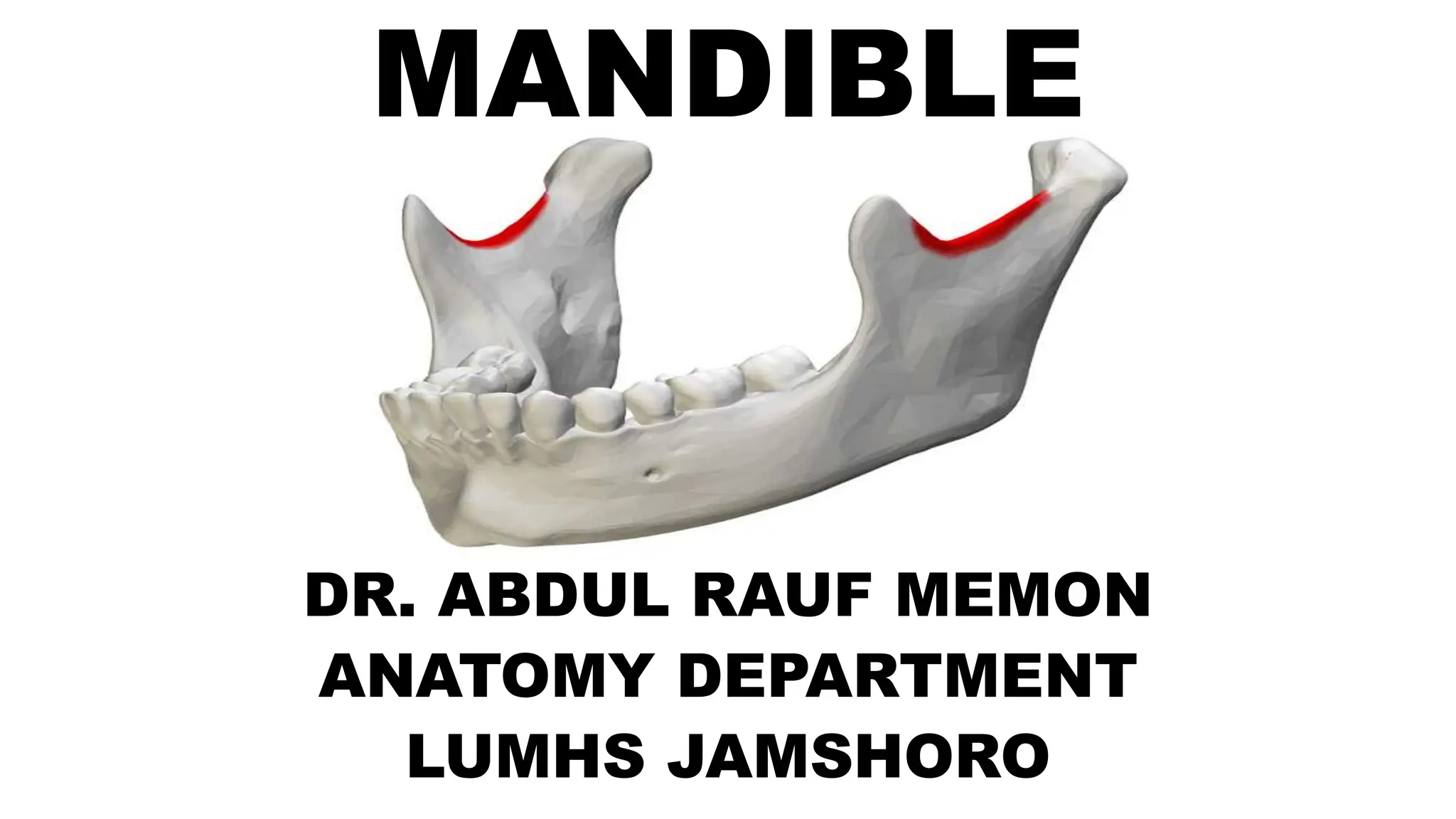
MANDIBLE
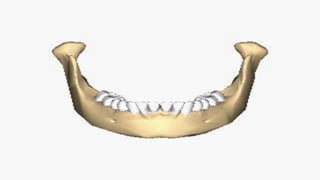
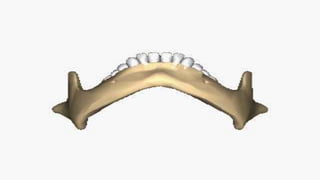
•Horseshoe shaped bone of
viscerocranium.
•Largest bone of viscerocranium.
•Besides the bones of the middle ear,
mandible is only mobile bone in the skull.
•Unlike other bones of the skull, the mandible
doesn’t articulate with the surrounding bones
via sutures,
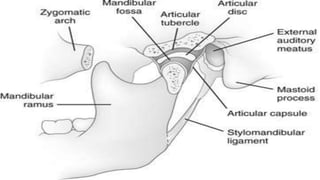
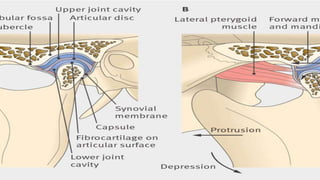
•It articulates rather by synovial joint called
the temporomandibular joint.
•Joint allows it to be attached to skull while at same
time produce various translatory and rotatory
movements.
•These movements allow complex actions like
chewing and speaking.
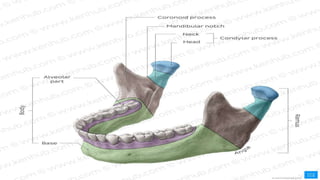
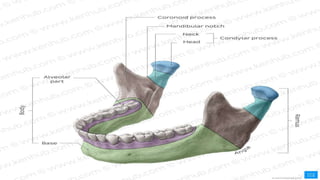
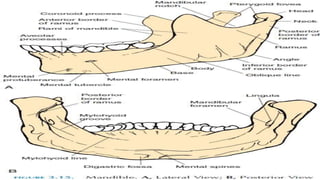
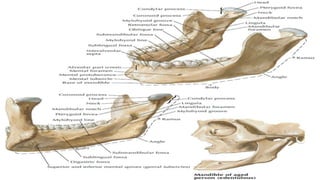
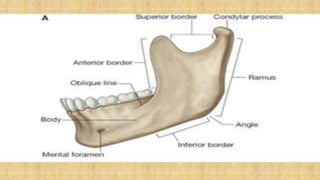
BODY
•Body is horizontal portion.
•It consists of two parts:
•Alveolar part
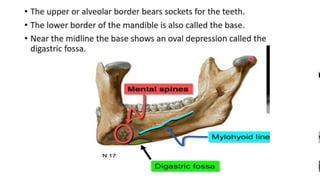
•Base of mandible
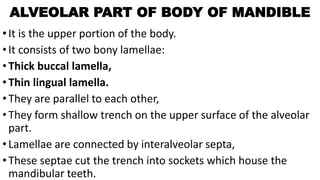
ALVEOLAR PART OF BODY OF MANDIBLE
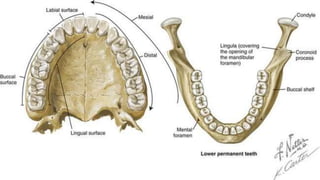
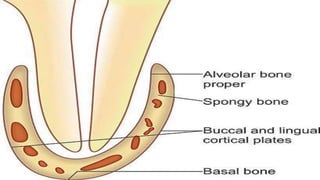
•It is the upper portion of the body.
•It consists of two bony lamellae:
•Thick buccal lamella,
•Thin lingual lamella.
•They are parallel to each other,
•They form shallow trench on the upper surface of the alveolar
part.
•Lamellae are connected by interalveolar septa,
•These septae cut the trench into sockets which house the
mandibular teeth.
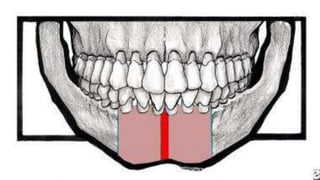
BASE OF BODY OF MANDIBLE
•It is inferior part of body
•It has several anatomical landmarks.
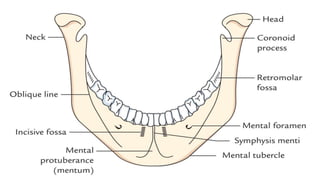
•Mandibular symphysis:
•Fibrous tissue in the midline,
•It ossifies by the first year of life.
•It unites the left and right halves of the mandible in
order to form a single, symmetrical bone.
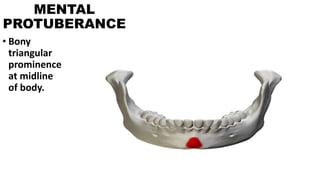
MENTAL
PROTUBERANCE
• Bony
triangular
prominence
at midline
of body.
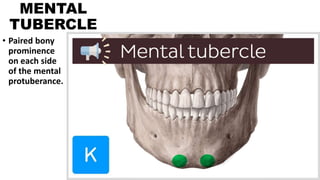
MENTAL
TUBERCLE
• Paired bony
prominence
on each side
of the mental
protuberance.
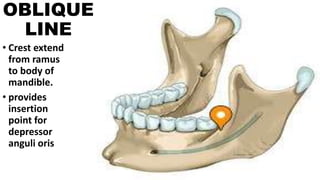
OBLIQUE
LINE
• Crest extend
from ramus
to body of
mandible.
• provides
insertion
point for
depressor
anguli oris
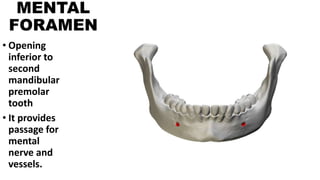
MENTAL
FORAMEN
• Opening
inferior to
second
mandibular
premolar
tooth
• It provides
passage for
mental
nerve and
vessels.
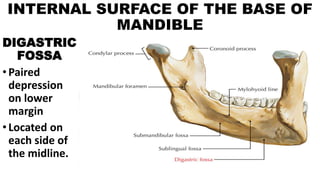
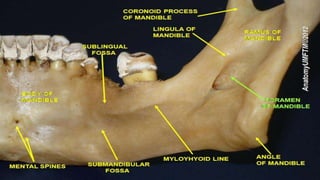
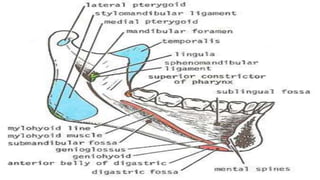
INTERNAL SURFACE OF THE BASE OF
MANDIBLE
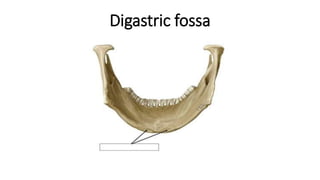
DIGASTRIC
FOSSA
•Paired
depression
on lower
margin
•Located on
each side of
the midline.
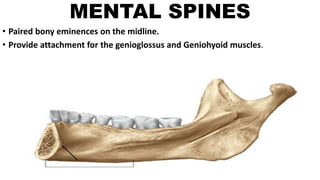
MENTAL SPINES
• Paired bony eminences on the midline.
• Provide attachment for the genioglossus and Geniohyoid muscles.
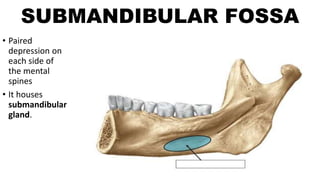
SUBMANDIBULAR FOSSA
• Paired
depression on
each side of
the mental
spines
• It houses
submandibular
gland.
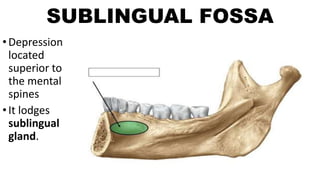
SUBLINGUAL FOSSA
•Depression
located
superior to
the mental
spines
•It lodges
sublingual
gland.
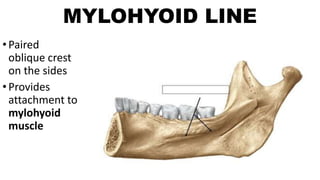
MYLOHYOID LINE
•Paired
oblique crest
on the sides
•Provides
attachment to
mylohyoid
muscle
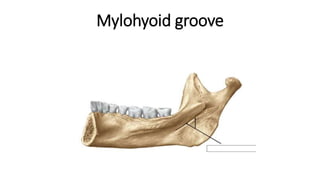
Mylohyoid groove
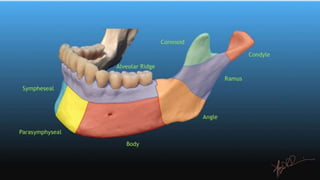
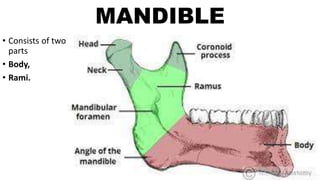
MANDIBLE
• Consists of two
parts
• Body,
• Rami.
Digastric fossa
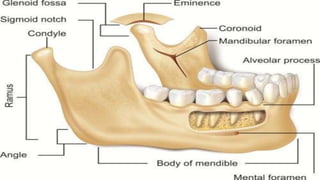
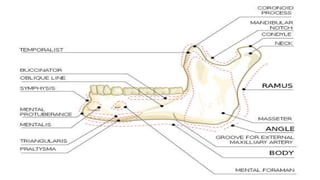
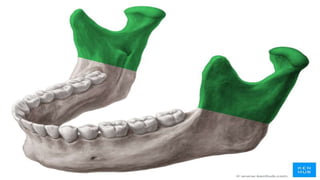
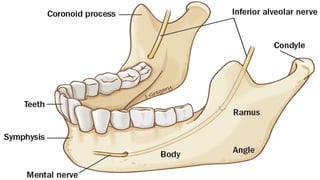
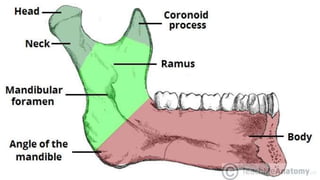
RAMUS
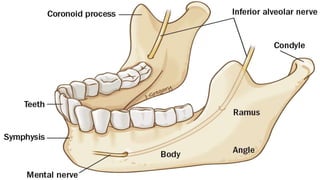
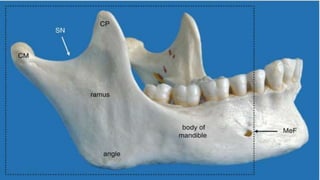
•It is vertical part of the mandible.
•It unites with the body at angle of mandible (i.e.
gonial angle).
•Angle can range from 110° to 130°
•Angle can vary depending on the age, sex and
ethnicity.
•Angulation is larger in men usually.
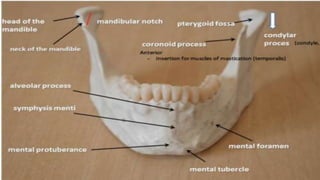
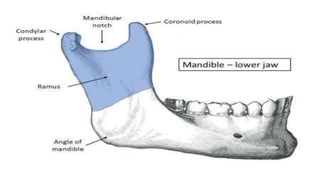
SUPERIOR PART OF THE RAMUS
•It consists of two processes:
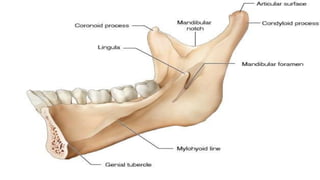
•Coronoid process (anterior process)
•Condylar process (posterior process).
•Incisure between them is called the mandibular
notch
•Notch crossed by the masseteric nerve and vessels.
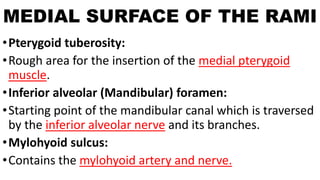
MEDIAL SURFACE OF THE RAMI
•Pterygoid tuberosity:
•Rough area for the insertion of the medial pterygoid
muscle.
•Inferior alveolar (Mandibular) foramen:
•Starting point of the mandibular canal which is traversed
by the inferior alveolar nerve and its branches.
•Mylohyoid sulcus:
•Contains the mylohyoid artery and nerve.
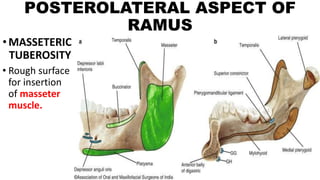
POSTEROLATERAL ASPECT OF
RAMUS
•MASSETERIC
TUBEROSITY
• Rough surface
for insertion
of masseter
muscle.
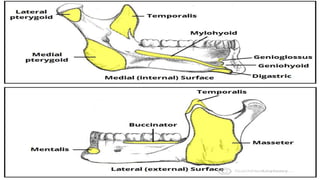
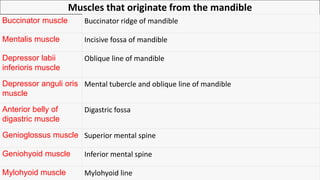
Muscles that originate from the mandible
Buccinator muscle Buccinator ridge of mandible
Mentalis muscle Incisive fossa of mandible
Depressor labii
inferioris muscle
Oblique line of mandible
Depressor anguli oris
muscle
Mental tubercle and oblique line of mandible
Anterior belly of
digastric muscle
Digastric fossa
Genioglossus muscle Superior mental spine
Geniohyoid muscle Inferior mental spine
Mylohyoid muscle Mylohyoid line
Muscles that insert to the mandible
Lateral pterygoid
muscle
Pterygoid fossa
Temporalis
muscle
Apex and medial surface of coronoid process of mandible
Medial pterygoid
muscle
Medial surface of ramus (pterygoid tuberosity) and angle of
mandible
Masseter muscle Lateral surface of ramus and angle of mandible
Platysma Lateral surface of ramus and angle of mandible
CLINICALS
•Alveolar bone resorption occurs when the
teeth are lost
•There is a lack of structures to support the
bone
•There is increased pressure upon the bone due
to chronic denture wearing.
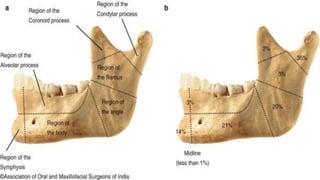
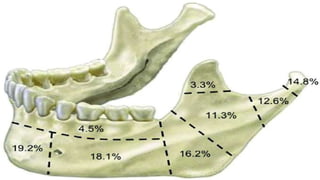
MANDIBULAR FRACTURES
• Intra- and extracapsular condylar fractures are the most
frequent mandibular fractures
• They usually result due to car accidents or indirect force due to
violence.
• Other mandibular fracture areas include
• Body,
• Angle,
• Symphysis,
• Ramus,
• Alveolus
• Coronoid process
• In decreasing order of frequency.
MANDIBULAR FRACTURES
•A mandibular fracture rarely occurs in isolation.
•Fracture on one side is frequently associated with a
fracture on the contralateral side.
•Therefore, if one fracture is observed, another
should be searched for.
•E.g.: Fractured neck of the mandible is often
observed in conjunction with a fracture of the
contralateral mandibular body.
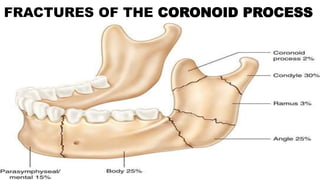
FRACTURES OF THE CORONOID PROCESS
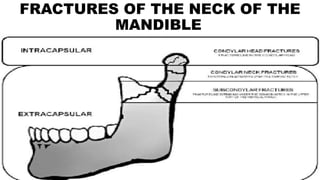
FRACTURES OF THE NECK OF THE
MANDIBLE
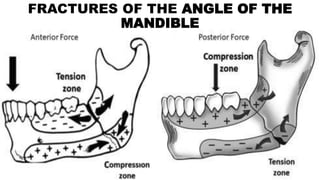
FRACTURES OF THE ANGLE OF THE
MANDIBLE
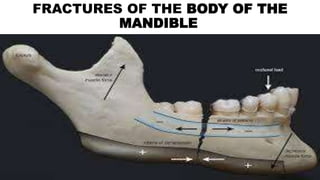
FRACTURES OF THE BODY OF THE
MANDIBLE
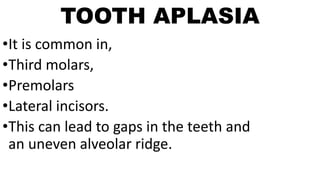
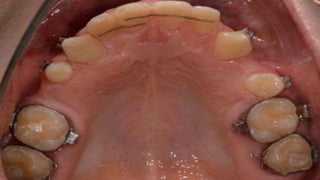
TOOTH APLASIA
•It is common in,
•Third molars,
•Premolars
•Lateral incisors.
•This can lead to gaps in the teeth and
an uneven alveolar ridge.
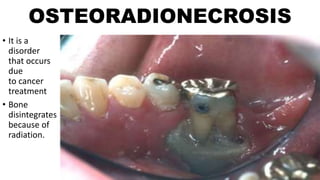
OSTEORADIONECROSIS
• It is a
disorder
that occurs
due
to cancer
treatment
• Bone
disintegrates
because of
radiation.
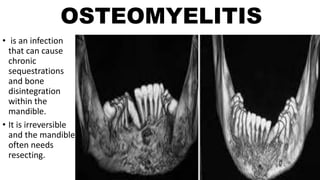
OSTEOMYELITIS
• is an infection
that can cause
chronic
sequestrations
and bone
disintegration
within the
mandible.
• It is irreversible
and the mandible
often needs
resecting.
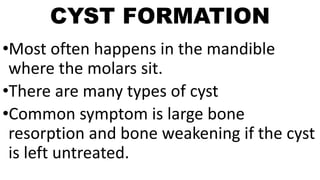
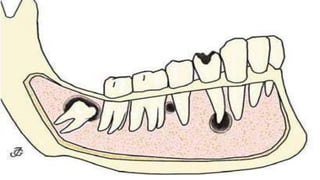
CYST FORMATION
•Most often happens in the mandible
where the molars sit.
•There are many types of cyst
•Common symptom is large bone
resorption and bone weakening if the cyst
is left untreated.
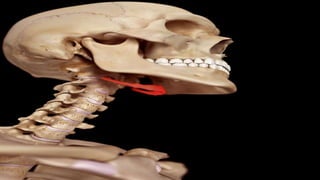
HYOID BONE
•It is a ‘U’ shaped bone
•Located in the anterior neck.
•It lies at the base of the mandible
(approximately at the level of C3),
•Here it acts as a site of attachment for the
anterior neck muscles.
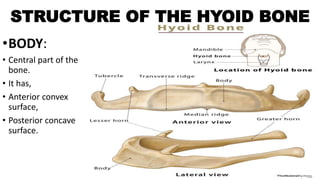
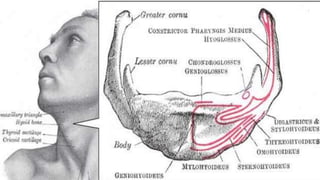
STRUCTURE OF THE HYOID BONE
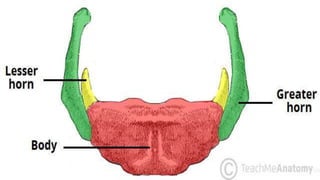
•BODY:
• Central part of the
bone.
• It has,
• Anterior convex
surface,
• Posterior concave
surface.
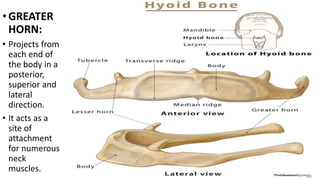
•GREATER
HORN:
• Projects from
each end of
the body in a
posterior,
superior and
lateral
direction.
• It acts as a
site of
attachment
for numerous
neck
muscles.
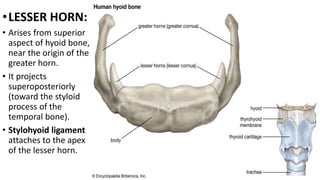
•LESSER HORN:
• Arises from superior
aspect of hyoid bone,
near the origin of the
greater horn.
• It projects
superoposteriorly
(toward the styloid
process of the
temporal bone).
• Stylohyoid ligament
attaches to the apex
of the lesser horn.
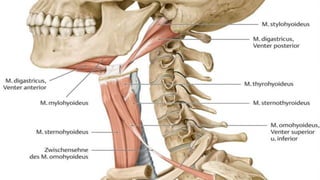
MUSCULAR ATTACHMENTS
•It is unique in the fact that,
•It does not articulate with any other bones,
•It is suspended in place by the muscles and
ligaments that attach to it.
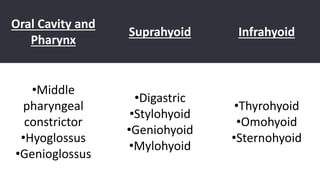
Oral Cavity and
Pharynx
Suprahyoid Infrahyoid
•Middle
pharyngeal
constrictor
•Hyoglossus
•Genioglossus
•Digastric
•Stylohyoid
•Geniohyoid
•Mylohyoid
•Thyrohyoid
•Omohyoid
•Sternohyoid
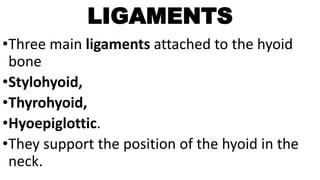
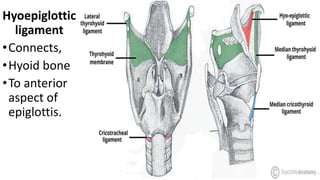
LIGAMENTS
•Three main ligaments attached to the hyoid
bone
•Stylohyoid,
•Thyrohyoid,
•Hyoepiglottic.
•They support the position of the hyoid in the
neck.
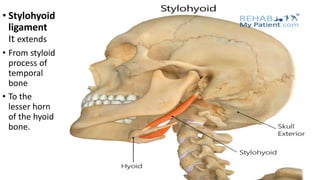
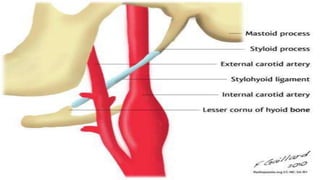
• Stylohyoid
ligament
It extends
• From styloid
process of
temporal
bone
• To the
lesser horn
of the hyoid
bone.
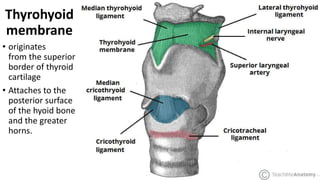
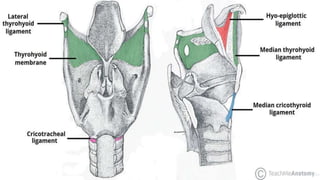
Thyrohyoid
membrane
• originates
from the superior
border of thyroid
cartilage
• Attaches to the
posterior surface
of the hyoid bone
and the greater
horns.
Hyoepiglottic
ligament
•Connects,
•Hyoid bone
•To anterior
aspect of
epiglottis.
FRACTURE OF THE HYOID BONE
•It is well protected by mandible and cervical spine,
•Due to it fractures are relatively rare.
•Hyoid bones fractures are characteristically associated
with strangulation
•It is found in 1/3 of all homicides by strangulation.
•It is therefore a significant post-mortem finding.
•It is also result of trauma, with clinical features of
•Pain on speaking,
•Odynophagia
•Dyspnoea.
Mandible and Hyoid Bones gross features.pptx

Mandible and Hyoid Bones gross features.pptx

  • 1.
    MANDIBLE DR. ABDUL RAUFMEMON ANATOMY DEPARTMENT LUMHS JAMSHORO
  • 2.
    MANDIBLE •Horseshoe shaped boneof viscerocranium. •Largest bone of viscerocranium. •Besides the bones of the middle ear, mandible is only mobile bone in the skull.
  • 7.
    •Unlike other bonesof the skull, the mandible doesn’t articulate with the surrounding bones via sutures, •It articulates rather by synovial joint called the temporomandibular joint. •Joint allows it to be attached to skull while at same time produce various translatory and rotatory movements. •These movements allow complex actions like chewing and speaking.
  • 11.
    BODY •Body is horizontalportion. •It consists of two parts: •Alveolar part •Base of mandible
  • 13.
    ALVEOLAR PART OFBODY OF MANDIBLE •It is the upper portion of the body. •It consists of two bony lamellae: •Thick buccal lamella, •Thin lingual lamella. •They are parallel to each other, •They form shallow trench on the upper surface of the alveolar part. •Lamellae are connected by interalveolar septa, •These septae cut the trench into sockets which house the mandibular teeth.
  • 19.
    BASE OF BODYOF MANDIBLE •It is inferior part of body •It has several anatomical landmarks. •Mandibular symphysis: •Fibrous tissue in the midline, •It ossifies by the first year of life. •It unites the left and right halves of the mandible in order to form a single, symmetrical bone.
  • 21.
  • 22.
    MENTAL TUBERCLE • Paired bony prominence oneach side of the mental protuberance.
  • 23.
    OBLIQUE LINE • Crest extend fromramus to body of mandible. • provides insertion point for depressor anguli oris
  • 24.
    MENTAL FORAMEN • Opening inferior to second mandibular premolar tooth •It provides passage for mental nerve and vessels.
  • 29.
    INTERNAL SURFACE OFTHE BASE OF MANDIBLE DIGASTRIC FOSSA •Paired depression on lower margin •Located on each side of the midline.
  • 31.
    MENTAL SPINES • Pairedbony eminences on the midline. • Provide attachment for the genioglossus and Geniohyoid muscles.
  • 32.
    SUBMANDIBULAR FOSSA • Paired depressionon each side of the mental spines • It houses submandibular gland.
  • 33.
    SUBLINGUAL FOSSA •Depression located superior to themental spines •It lodges sublingual gland.
  • 34.
    MYLOHYOID LINE •Paired oblique crest onthe sides •Provides attachment to mylohyoid muscle
  • 36.
  • 37.
    MANDIBLE • Consists oftwo parts • Body, • Rami.
  • 39.
  • 42.
    RAMUS •It is verticalpart of the mandible. •It unites with the body at angle of mandible (i.e. gonial angle). •Angle can range from 110° to 130° •Angle can vary depending on the age, sex and ethnicity. •Angulation is larger in men usually.
  • 46.
    SUPERIOR PART OFTHE RAMUS •It consists of two processes: •Coronoid process (anterior process) •Condylar process (posterior process). •Incisure between them is called the mandibular notch •Notch crossed by the masseteric nerve and vessels.
  • 48.
    MEDIAL SURFACE OFTHE RAMI •Pterygoid tuberosity: •Rough area for the insertion of the medial pterygoid muscle. •Inferior alveolar (Mandibular) foramen: •Starting point of the mandibular canal which is traversed by the inferior alveolar nerve and its branches. •Mylohyoid sulcus: •Contains the mylohyoid artery and nerve.
  • 49.
    POSTEROLATERAL ASPECT OF RAMUS •MASSETERIC TUBEROSITY •Rough surface for insertion of masseter muscle.
  • 51.
    Muscles that originatefrom the mandible Buccinator muscle Buccinator ridge of mandible Mentalis muscle Incisive fossa of mandible Depressor labii inferioris muscle Oblique line of mandible Depressor anguli oris muscle Mental tubercle and oblique line of mandible Anterior belly of digastric muscle Digastric fossa Genioglossus muscle Superior mental spine Geniohyoid muscle Inferior mental spine Mylohyoid muscle Mylohyoid line
  • 52.
    Muscles that insertto the mandible Lateral pterygoid muscle Pterygoid fossa Temporalis muscle Apex and medial surface of coronoid process of mandible Medial pterygoid muscle Medial surface of ramus (pterygoid tuberosity) and angle of mandible Masseter muscle Lateral surface of ramus and angle of mandible Platysma Lateral surface of ramus and angle of mandible
  • 53.
    CLINICALS •Alveolar bone resorptionoccurs when the teeth are lost •There is a lack of structures to support the bone •There is increased pressure upon the bone due to chronic denture wearing.
  • 54.
    MANDIBULAR FRACTURES • Intra-and extracapsular condylar fractures are the most frequent mandibular fractures • They usually result due to car accidents or indirect force due to violence. • Other mandibular fracture areas include • Body, • Angle, • Symphysis, • Ramus, • Alveolus • Coronoid process • In decreasing order of frequency.
  • 55.
    MANDIBULAR FRACTURES •A mandibularfracture rarely occurs in isolation. •Fracture on one side is frequently associated with a fracture on the contralateral side. •Therefore, if one fracture is observed, another should be searched for. •E.g.: Fractured neck of the mandible is often observed in conjunction with a fracture of the contralateral mandibular body.
  • 56.
    FRACTURES OF THECORONOID PROCESS
  • 57.
    FRACTURES OF THENECK OF THE MANDIBLE
  • 58.
    FRACTURES OF THEANGLE OF THE MANDIBLE
  • 59.
    FRACTURES OF THEBODY OF THE MANDIBLE
  • 60.
    TOOTH APLASIA •It iscommon in, •Third molars, •Premolars •Lateral incisors. •This can lead to gaps in the teeth and an uneven alveolar ridge.
  • 62.
    OSTEORADIONECROSIS • It isa disorder that occurs due to cancer treatment • Bone disintegrates because of radiation.
  • 63.
    OSTEOMYELITIS • is aninfection that can cause chronic sequestrations and bone disintegration within the mandible. • It is irreversible and the mandible often needs resecting.
  • 64.
    CYST FORMATION •Most oftenhappens in the mandible where the molars sit. •There are many types of cyst •Common symptom is large bone resorption and bone weakening if the cyst is left untreated.
  • 68.
    HYOID BONE •It isa ‘U’ shaped bone •Located in the anterior neck. •It lies at the base of the mandible (approximately at the level of C3), •Here it acts as a site of attachment for the anterior neck muscles.
  • 70.
    STRUCTURE OF THEHYOID BONE •BODY: • Central part of the bone. • It has, • Anterior convex surface, • Posterior concave surface.
  • 72.
    •GREATER HORN: • Projects from eachend of the body in a posterior, superior and lateral direction. • It acts as a site of attachment for numerous neck muscles.
  • 73.
    •LESSER HORN: • Arisesfrom superior aspect of hyoid bone, near the origin of the greater horn. • It projects superoposteriorly (toward the styloid process of the temporal bone). • Stylohyoid ligament attaches to the apex of the lesser horn.
  • 75.
    MUSCULAR ATTACHMENTS •It isunique in the fact that, •It does not articulate with any other bones, •It is suspended in place by the muscles and ligaments that attach to it.
  • 77.
    Oral Cavity and Pharynx SuprahyoidInfrahyoid •Middle pharyngeal constrictor •Hyoglossus •Genioglossus •Digastric •Stylohyoid •Geniohyoid •Mylohyoid •Thyrohyoid •Omohyoid •Sternohyoid
  • 79.
    LIGAMENTS •Three main ligamentsattached to the hyoid bone •Stylohyoid, •Thyrohyoid, •Hyoepiglottic. •They support the position of the hyoid in the neck.
  • 80.
    • Stylohyoid ligament It extends •From styloid process of temporal bone • To the lesser horn of the hyoid bone.
  • 82.
    Thyrohyoid membrane • originates from thesuperior border of thyroid cartilage • Attaches to the posterior surface of the hyoid bone and the greater horns.
  • 84.
  • 85.
    FRACTURE OF THEHYOID BONE •It is well protected by mandible and cervical spine, •Due to it fractures are relatively rare. •Hyoid bones fractures are characteristically associated with strangulation •It is found in 1/3 of all homicides by strangulation. •It is therefore a significant post-mortem finding. •It is also result of trauma, with clinical features of •Pain on speaking, •Odynophagia •Dyspnoea.