Welcome!
Please turn cell phones off or
on vibrate.

Thank You!


M

We are glad you have joined
us!

Mulcahy Law Firm, P.C.
Please join us in the Pledge of Allegiance


Secrets to Collection of
Delinquent Assessments
Enforcement of CC&Rs
Trustee Sales
&
Bankruptcy


Secrets to Collection of
Delinquent Assessments


1. Obtain Information On Owners Upfront
 Create a form to obtain the following information from
homeowners at the close of escrow:
Bank information
Place of employment
Mortgage company
Mailing address
 Update and retain an owner’s information:
Keeping copies of an owner’s checks
Noting place of employment
Information regarding potential renters


2. Accurate Bookkeeping
 Accounting records should be:
Accurate
Easily available
Reflect current charges and payments

At anytime, particularly in litigation, it is very important for
the association to be able to provide the homeowner or court
with the status of account(s).


3. Collection Policies
 Collection policies in place allow:
Quick notification regarding delinquency policy and
Intended course of action
Encourage prompt payment


4. Late Fees
 Late fees should:
Be uniformly and strictly imposed
Within the limits of the law
For planned communities, late fees cannot exceed $15 or 10% of
the assessment, whichever is greater.


5. Communication with Owners
The association should use open and continuous
communication with owners (i.e. newsletters and demand
letters) regarding the need for timely payment of
assessments and the procedures the association will follow
in the event of non-payment of assessments.


6. Timely Action
Timeliness is the key to successful collections!
 60-90 days past due record a notice of lien on the lot/unit
 Do Not Delay - provide the attorney
all pertinent and complete information on file:
name of owner, address, breakdown of charges
previous correspondence/owner and association
 After a file is forwarded to the attorney
forward all correspondence to the attorney to handle
consult the attorney for payoff amounts


7. Due Diligence / Credit Evaluations
 Prior to pursuing collection, run due diligence checks:
Ownership records
Trustee Sale search
Potential Bankruptcy filings
Recorded liens
Run an address search for new mailing addresses

 Make an informed decision:
The association’s attorney should run a credit check to
evaluate the value of and risks of collection.


8. Understand Available Legal Remedies
 Justice court action vs. foreclosure
 Utilizing the association’s legal remedies is often the most
successful tool for the association to collect delinquencies.


Personal Judgment Against the Owner
Justice Court
 Association attorney files a lawsuit against the owner and
obtains a judgment against the delinquent owner
personally
 With the judgment, the association can:
Garnish the owner’s wages, bank accounts or
Rent payments or
Levy and execute on other real or personal property


Disadvantages to
obtaining a personal
judgment in
Justice Court

Benefits to obtaining a
personal judgment in
Justice Court
 Fast - usually four to six
months to obtain a
judgment
 Cost efficient approximately $700 $1,000 in attorneys’ fees
and court costs

 The judgment may not be
collectible if the
individual has no assets.
 If bankruptcy filed:
debtor can be discharged
from the entire debt, and
the proceedings halted
due to the automatic stay
of the bankruptcy.


Foreclose an Assessment Lien on the Lot / Unit
Superior Court
 Requirements to Foreclose:
Assessments one year delinquent or
$1,200+ delinquent assessments (whichever occurs first)
 Under this option:
Association records a lien on the lot/unit and
The attorney files a lawsuit to foreclose the lien
Judgment obtained against the owner which orders a
sheriff’s sale of the lot and
A deficiency judgment against the owner


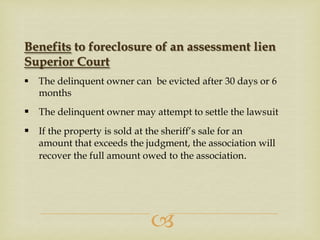
Benefits to foreclosure of an assessment lien
Superior Court


The delinquent owner can be evicted after 30 days or 6
months

 The delinquent owner may attempt to settle the lawsuit
 If the property is sold at the sheriff’s sale for an
amount that exceeds the judgment, the association will
recover the full amount owed to the association.


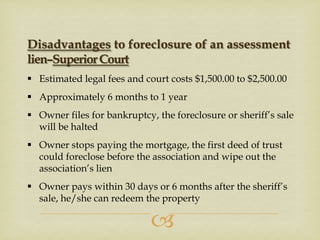
Disadvantages to foreclosure of an assessment
lien–Superior Court
 Estimated legal fees and court costs $1,500.00 to $2,500.00
 Approximately 6 months to 1 year
 Owner files for bankruptcy, the foreclosure or sheriff’s sale
will be halted

 Owner stops paying the mortgage, the first deed of trust
could foreclose before the association and wipe out the
association’s lien
 Owner pays within 30 days or 6 months after the sheriff’s
sale, he/she can redeem the property


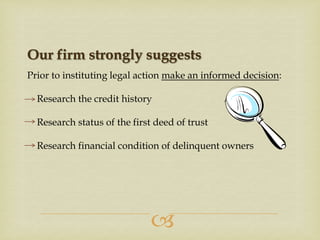
Our firm strongly suggests
Prior to instituting legal action make an informed decision:
Research the credit history
Research status of the first deed of trust
Research financial condition of delinquent owners


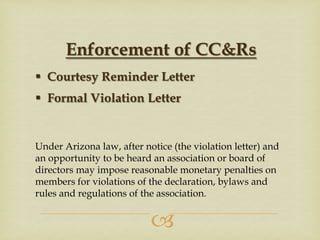
Enforcement of CC&Rs
 Courtesy Reminder Letter
 Formal Violation Letter

Under Arizona law, after notice (the violation letter) and
an opportunity to be heard an association or board of
directors may impose reasonable monetary penalties on
members for violations of the declaration, bylaws and
rules and regulations of the association.


 Enforce payment of fines:
1. Filing a lawsuit against the owner
2. Obtaining a judgment against the owner
3. Recording the judgment with the county
Recorder’s Office.

 “Self-help”

 Litigation


 Owner responds after notification:
• By certified mail to the association
• Within ten (10) business days after notice
• Association may not proceed with action to
enforce

Association responds in writing within 10 business
days with:
1. The provision violated;
2. Date of the violation or date was observed;
3. First and last name of the person(s) who observed
the violation; and
4. Process to contest the notice.
Association may proceed


 Deed Enforcement, Fine and Notification
Policies:
• Adopt a deed enforcement policy
• Notify residents
• Outline the steps the association will take to
address a violation
• Reminders to the owners


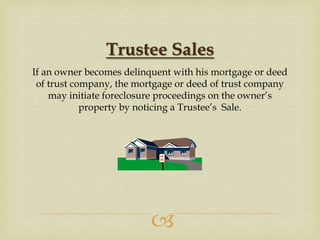
Trustee Sales
If an owner becomes delinquent with his mortgage or deed
of trust company, the mortgage or deed of trust company
may initiate foreclosure proceedings on the owner’s
property by noticing a Trustee’s Sale.


Secure the association’s interests
A lien places the Trustee on notice of the association’s
interests:
 Association will receive notice of the Trustee’s sale
 Association will receive notice of excess proceeds, if
any


Notice of Trustee’s Sale
A Notice of Trustee’s Sale is:
 Recorded with the county recorder’s office
 Posted at the property being sold
1. Notice, sale location, contact information
2. Description and address of the property
3. Name of the beneficiary - e.g. mortgage company or deed
of trust
4. The recording number of the mortgage or deed of trust
5. The principal balance owed
6. The Trust or - e.g. the owner of the lot
7. The date of the Trustee’s Sale.


The Trustee
 The mortgage or deed of trust company assigns a Trustee
to manage the affairs
 The Trustee may be contacted for updated information


Events that may occur regarding a Trustee’s
Sale
Postponement of a Trustee’s Sale
Cancellation
Revert back to the beneficiary

Sale


After the Trustee’s Sale
 New Owner
 Former Owner


Events that require close monitoring
Owners file for bankruptcy, transfer ownership (sale)
or intend to sell the property
If the property is sold at the Trustee’s Sale and excess
proceeds are generated
If the property is sold at the Trustee’s Sale and excess
proceeds are generated, but are deposited with the County
Treasurer’s Office


Bankruptcy
When a homeowner files a bankruptcy (and lists an
association as a creditor in the bankruptcy), there is an
automatic stay in place, which prohibits the association
from proceeding forward with collection against the owner
or face strict and costly penalties.
 Owner’s file should be clearly flagged as a bankruptcy
file, so that no actions are taken in violation of the stay.
 Two types of bankruptcies:
Chapter 7
Chapter 13


Chapter 7 Bankruptcy
 A Chapter 7 Bankruptcy is generally, but not always, a no
asset bankruptcy
 If owner owes delinquent assessments, association should
file Notice of Appearance
 Monitor status


Chapter 13 Bankruptcy
 Called a “wage earners” bankruptcy
 Association should file a Notice of Appearance and a
Proof of Claim
 Debtor files a proposed plan in which to pay creditors
back


Responsibility for Post-bankruptcy
Assessments
A homeowner is responsible for all assessments, late fees
and other charges, including bankruptcy related attorneys’
fees after the date of filing.

Lift of Stay
If the owner is not paying post-petition assessments and
not responding to post-petition demand letters, the
association has the opportunity to file a motion to the
Court requesting a relief of stay.


Date of Filing
The date that triggers the automatic stay

Date of Discharge Chapter 7
The date the Court grants the debtor a personal discharge of
all debt owed as of the date filed for bankruptcy protection.

Date of Discharge Chapter 13
The date the Court grants the debtor a discharge of all debt
owed and not paid pursuant to the Bankruptcy Plan, as of the
date filed for bankruptcy protection.


Date of Termination or Closing of Case
The date that the bankruptcy case has been closed or
terminated and the automatic stay is no longer in effect

Property Sold by Owner During Bankruptcy
Term
All amounts are due and owing! A payoff should include
pre-petition debt and post-petition debt due to the
association

Dismissal of Bankruptcy
When a case is dismissed, it’s as if it were never filed


Join us for our Next Lunch with Mulcahy
February 6, 2014

What are the Legal
Ramifications of Board Inaction?

M

We are glad you have joined
us!

Mulcahy Law Firm, P.C.


If you like what we do…
please fill out one of the
Testimonial Cards on your table,
and send a YELP review

Thank You!

M

We are glad you have joined
us!



Mulcahy Law Firm, P.C.
“Like Us” on Face Book
By Friday, January 10th at 11:59pm to

Receive a Movie
Ticket


Lunch with Mulcahy January 2014: Secrets to Collection of Delinquent Assessments; Enforcements of CC&R's; Trustee Sales & Bankruptcy

  • 1.
    Welcome! Please turn cellphones off or on vibrate. Thank You! 
  • 2.
    M We are gladyou have joined us! Mulcahy Law Firm, P.C.
  • 3.
    Please join usin the Pledge of Allegiance 
  • 4.
    Secrets to Collectionof Delinquent Assessments Enforcement of CC&Rs Trustee Sales & Bankruptcy 
  • 5.
    Secrets to Collectionof Delinquent Assessments 
  • 6.
    1. Obtain InformationOn Owners Upfront  Create a form to obtain the following information from homeowners at the close of escrow: Bank information Place of employment Mortgage company Mailing address  Update and retain an owner’s information: Keeping copies of an owner’s checks Noting place of employment Information regarding potential renters 
  • 7.
    2. Accurate Bookkeeping Accounting records should be: Accurate Easily available Reflect current charges and payments At anytime, particularly in litigation, it is very important for the association to be able to provide the homeowner or court with the status of account(s). 
  • 8.
    3. Collection Policies Collection policies in place allow: Quick notification regarding delinquency policy and Intended course of action Encourage prompt payment 
  • 9.
    4. Late Fees Late fees should: Be uniformly and strictly imposed Within the limits of the law For planned communities, late fees cannot exceed $15 or 10% of the assessment, whichever is greater. 
  • 10.
    5. Communication withOwners The association should use open and continuous communication with owners (i.e. newsletters and demand letters) regarding the need for timely payment of assessments and the procedures the association will follow in the event of non-payment of assessments. 
  • 11.
    6. Timely Action Timelinessis the key to successful collections!  60-90 days past due record a notice of lien on the lot/unit  Do Not Delay - provide the attorney all pertinent and complete information on file: name of owner, address, breakdown of charges previous correspondence/owner and association  After a file is forwarded to the attorney forward all correspondence to the attorney to handle consult the attorney for payoff amounts 
  • 12.
    7. Due Diligence/ Credit Evaluations  Prior to pursuing collection, run due diligence checks: Ownership records Trustee Sale search Potential Bankruptcy filings Recorded liens Run an address search for new mailing addresses  Make an informed decision: The association’s attorney should run a credit check to evaluate the value of and risks of collection. 
  • 13.
    8. Understand AvailableLegal Remedies  Justice court action vs. foreclosure  Utilizing the association’s legal remedies is often the most successful tool for the association to collect delinquencies. 
  • 14.
    Personal Judgment Againstthe Owner Justice Court  Association attorney files a lawsuit against the owner and obtains a judgment against the delinquent owner personally  With the judgment, the association can: Garnish the owner’s wages, bank accounts or Rent payments or Levy and execute on other real or personal property 
  • 15.
    Disadvantages to obtaining apersonal judgment in Justice Court Benefits to obtaining a personal judgment in Justice Court  Fast - usually four to six months to obtain a judgment  Cost efficient approximately $700 $1,000 in attorneys’ fees and court costs  The judgment may not be collectible if the individual has no assets.  If bankruptcy filed: debtor can be discharged from the entire debt, and the proceedings halted due to the automatic stay of the bankruptcy. 
  • 16.
    Foreclose an AssessmentLien on the Lot / Unit Superior Court  Requirements to Foreclose: Assessments one year delinquent or $1,200+ delinquent assessments (whichever occurs first)  Under this option: Association records a lien on the lot/unit and The attorney files a lawsuit to foreclose the lien Judgment obtained against the owner which orders a sheriff’s sale of the lot and A deficiency judgment against the owner 
  • 17.
    Benefits to foreclosureof an assessment lien Superior Court  The delinquent owner can be evicted after 30 days or 6 months  The delinquent owner may attempt to settle the lawsuit  If the property is sold at the sheriff’s sale for an amount that exceeds the judgment, the association will recover the full amount owed to the association. 
  • 18.
    Disadvantages to foreclosureof an assessment lien–Superior Court  Estimated legal fees and court costs $1,500.00 to $2,500.00  Approximately 6 months to 1 year  Owner files for bankruptcy, the foreclosure or sheriff’s sale will be halted  Owner stops paying the mortgage, the first deed of trust could foreclose before the association and wipe out the association’s lien  Owner pays within 30 days or 6 months after the sheriff’s sale, he/she can redeem the property 
  • 19.
    Our firm stronglysuggests Prior to instituting legal action make an informed decision: Research the credit history Research status of the first deed of trust Research financial condition of delinquent owners 
  • 20.
    Enforcement of CC&Rs Courtesy Reminder Letter  Formal Violation Letter Under Arizona law, after notice (the violation letter) and an opportunity to be heard an association or board of directors may impose reasonable monetary penalties on members for violations of the declaration, bylaws and rules and regulations of the association. 
  • 21.
     Enforce paymentof fines: 1. Filing a lawsuit against the owner 2. Obtaining a judgment against the owner 3. Recording the judgment with the county Recorder’s Office.  “Self-help”  Litigation 
  • 22.
     Owner respondsafter notification: • By certified mail to the association • Within ten (10) business days after notice • Association may not proceed with action to enforce Association responds in writing within 10 business days with: 1. The provision violated; 2. Date of the violation or date was observed; 3. First and last name of the person(s) who observed the violation; and 4. Process to contest the notice. Association may proceed 
  • 23.
     Deed Enforcement,Fine and Notification Policies: • Adopt a deed enforcement policy • Notify residents • Outline the steps the association will take to address a violation • Reminders to the owners 


  • 24.
    Trustee Sales If anowner becomes delinquent with his mortgage or deed of trust company, the mortgage or deed of trust company may initiate foreclosure proceedings on the owner’s property by noticing a Trustee’s Sale. 
  • 25.
    Secure the association’sinterests A lien places the Trustee on notice of the association’s interests:  Association will receive notice of the Trustee’s sale  Association will receive notice of excess proceeds, if any 
  • 26.
    Notice of Trustee’sSale A Notice of Trustee’s Sale is:  Recorded with the county recorder’s office  Posted at the property being sold 1. Notice, sale location, contact information 2. Description and address of the property 3. Name of the beneficiary - e.g. mortgage company or deed of trust 4. The recording number of the mortgage or deed of trust 5. The principal balance owed 6. The Trust or - e.g. the owner of the lot 7. The date of the Trustee’s Sale. 
  • 27.
    The Trustee  Themortgage or deed of trust company assigns a Trustee to manage the affairs  The Trustee may be contacted for updated information 
  • 28.
    Events that mayoccur regarding a Trustee’s Sale Postponement of a Trustee’s Sale Cancellation Revert back to the beneficiary Sale 
  • 29.
    After the Trustee’sSale  New Owner  Former Owner 
  • 30.
    Events that requireclose monitoring Owners file for bankruptcy, transfer ownership (sale) or intend to sell the property If the property is sold at the Trustee’s Sale and excess proceeds are generated If the property is sold at the Trustee’s Sale and excess proceeds are generated, but are deposited with the County Treasurer’s Office 
  • 31.
    Bankruptcy When a homeownerfiles a bankruptcy (and lists an association as a creditor in the bankruptcy), there is an automatic stay in place, which prohibits the association from proceeding forward with collection against the owner or face strict and costly penalties.  Owner’s file should be clearly flagged as a bankruptcy file, so that no actions are taken in violation of the stay.  Two types of bankruptcies: Chapter 7 Chapter 13 
  • 32.
    Chapter 7 Bankruptcy A Chapter 7 Bankruptcy is generally, but not always, a no asset bankruptcy  If owner owes delinquent assessments, association should file Notice of Appearance  Monitor status 
  • 33.
    Chapter 13 Bankruptcy Called a “wage earners” bankruptcy  Association should file a Notice of Appearance and a Proof of Claim  Debtor files a proposed plan in which to pay creditors back 
  • 34.
    Responsibility for Post-bankruptcy Assessments Ahomeowner is responsible for all assessments, late fees and other charges, including bankruptcy related attorneys’ fees after the date of filing. Lift of Stay If the owner is not paying post-petition assessments and not responding to post-petition demand letters, the association has the opportunity to file a motion to the Court requesting a relief of stay. 
  • 35.
    Date of Filing Thedate that triggers the automatic stay Date of Discharge Chapter 7 The date the Court grants the debtor a personal discharge of all debt owed as of the date filed for bankruptcy protection. Date of Discharge Chapter 13 The date the Court grants the debtor a discharge of all debt owed and not paid pursuant to the Bankruptcy Plan, as of the date filed for bankruptcy protection. 
  • 36.
    Date of Terminationor Closing of Case The date that the bankruptcy case has been closed or terminated and the automatic stay is no longer in effect Property Sold by Owner During Bankruptcy Term All amounts are due and owing! A payoff should include pre-petition debt and post-petition debt due to the association Dismissal of Bankruptcy When a case is dismissed, it’s as if it were never filed 
  • 37.
    Join us forour Next Lunch with Mulcahy February 6, 2014 What are the Legal Ramifications of Board Inaction? M We are glad you have joined us! Mulcahy Law Firm, P.C. 
  • 38.
    If you likewhat we do… please fill out one of the Testimonial Cards on your table, and send a YELP review Thank You! M We are glad you have joined us!  Mulcahy Law Firm, P.C.
  • 39.
    “Like Us” onFace Book By Friday, January 10th at 11:59pm to Receive a Movie Ticket 