MANAGING SYSTEM SECURITY
LEARNING OBJECTIVES Examine information systems’ vulnerability and the possible damage from malfunctions. Describe the major methods of defending information systems. Describe the security issues of the Web and electronic commerce. Describe security auditing
COMPUTER SYSTEMS MANAGEMENT Encompasses all activities related to the:  planning organizing, acquiring maintaining Securing controlling of IT resources.
CASE:  CYBER CRIME   On  Feb . 6,  2000  -  the biggest  EC  sites were  hit by cyber crime .  The attacker used a method called denial of service (DOS).  By hammering a Web site’s equipment with too many requests for information, an attacker can effectively clog a system.   The total damage worldwide was estimated at $5 -10 billion (U.S.). T he alleged attacker, from the Philippines, was not prosecuted because he did not break any law in the Philippines.
MORE EXAMPLES An American computer programmer planted a virus to be activated two days after his name was deleted from the payroll file. The virus eliminated 168,000 payroll records which resulted in a one-month delay in processing payroll cheques. Donald Burleston was found guilty of a third degree felony and fined $5,000 A fire disabled a Bell switching exchange in the U.S. The effect disabled the voice and data telecommunications for a period ranging from two days to three weeks. The business cost to the community was estimated at $300 million.
MORE EXAMPLES A group installed an ATM in a busy shopping center in Hartford, Connecticut. Customers using the m/c were shown the message “sorry, no transactions possible” after inserting their cards and entering the pin numbers. Using counterfeit cards made from the information given the group netted around $100,000. An teenager was arrested on suspicion of hacking into the Pentagon and over 700 other sensitive computer sites worldwide. The teenager became an instant folk hero and received many highly paid security assignments as a result.
MORE EXAMPLES The U.S. Social Security Service discovered an error in the program used to calculate retirement benefits. The error had been in the system for over 20 years. It had shortchanged 700,000 people of over $850 million and took more than three years to fix the problem.
LESSONS LEARNED FROM THE CASES Information resources that include computers, networks, programs, and data are vulnerable to unforeseen attacks. Many countries do not have sufficient laws to deal with computer criminals. Protection of networked systems can be a complex issue.
LESSONS LEARNED FROM THE CASES Attackers can zero on a single company, or can attack many companies, without discrimination. Attackers use different attack methods. Although variations of the attack methods are known, the defence against them is difficult and/or expensive.
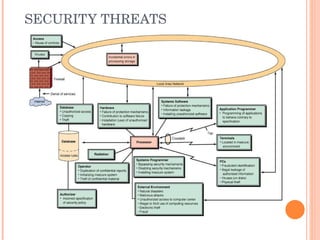
SECURITY THREATS
SECURITY PROBLEMS Defending information systems is not a simple or inexpensive task for the following reasons: IS physical resources, data, software, procedures and other resources may be  at   risk at any time Hundreds of  potential threats  exist Computing resources may be distributed  across many locations – Intranets, Extranets
SECURITY PROBLEMS Computer networks can be outside the organization and difficult to protect Many individuals control information assets Rapid technological changes make some controls obsolete as soon as they are installed Many computer crimes are undetected for a long period of time. People tend to violate security procedures because the y  are inconvenient
INFORMATION SYSTEM RISK Risks to the organisations information resources include the following: Human errors Environmental hazards Computer systems failures Intentional threats Cyber Crime
HUMAN ERRORS In the design of hardware and information systems Programming, testing, authorisation These errors contribute to the vast majority of control and security related problems.
ENVIRONMENTAL HAZARDS Earthquakes, hurricanes, floods, lightning strikes etc. Fire, defective air-conditioning, radio-active fallout, water-cooling systems failures. Smoke, heat and water damage resulting  from the other environmental hazards.
COMPUTER SYSTEMS FAILURES Poor design Use of defective material Lack of proper quality control Inadequate specification of hardware by the buyer
INTENTIONAL THREATS Theft of data, inappropriate use of data Theft of computer time, equipment and programs Deliberate manipulation of data and programs Strikes, riots, sabotage
INTENTIONAL THREATS Malicious damage including terrorist attacks Destruction from virus attacks Miscellaneous computer abuses and crimes Fraud and crimes related to the use of the internet
CYBER CRIME Crimes can be performed by  Hackers outsiders who penetrate a computer system or by  insiders who are authorised to use the computer system but are misusing their authorization.
CYBER CRIME According to the FBI an average white-collar crime involves  $23,000 ; but  an average computer crime involves about  $600,000
CYBER CRIME Two basic  methods of attack are  used in deliberate attacks on computer systems:  Data tampering False, fabricated or fraudulent data Changing or deleting data Examples –  Wages clerk and the extra employee Stock clerk and the damaged stock Shift supervisor and the extra overtime
CYBER CRIME 2. Programming fraud , e.g. Viruses Programming techniques used to modify a computer program Virus Worm Trojan Horse Spoofing
DEFENSE STRATEGIES The following are the major objectives of defence strategies: Prevention & deterrence Detection Limitation Recovery Correction
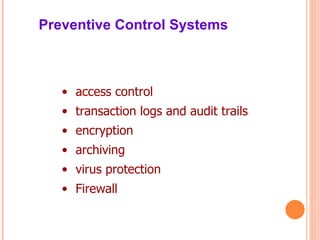
access control  transaction logs and audit trails  encryption  archiving  virus protection  Firewall Preventive Control Systems
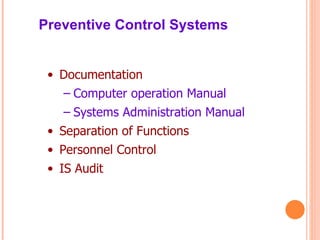
Documentation Computer operation Manual Systems Administration Manual Separation of Functions Personnel Control IS Audit Preventive Control Systems
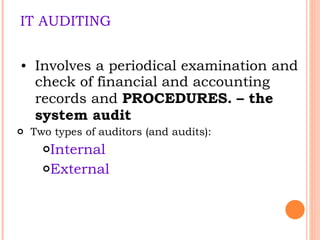
IT AUDITING Involves a periodical examination and check of financial and accounting records and  PROCEDURES.   – the system audit Two types of auditors (and audits):  Internal  External
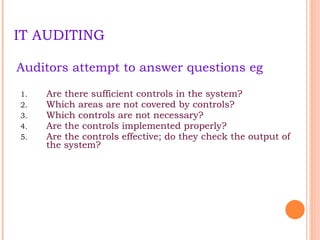
IT AUDITING Auditors attempt to answer questions eg Are there sufficient controls in the system? Which areas are not covered by controls? Which controls are not necessary ? Are the controls implemented properly? Are the controls effective; do they check the output of the system?
IT AUDITING Is there a clear separation of duties of employees? Are there procedures to ensure compliance with the controls? Are there procedures to ensure reporting and corrective actions in case of violations of controls?
HOW IS AUDITING EXECUTED? IT auditing procedures can be classified into three categories:  Auditing around the computer  - verifying processing by checking for known outputs using specific inputs.  Auditing through the computer  - inputs, outputs, and processing are checked.  Auditing with the computer  - using a combination of client data, auditor software, and client and auditor hardware.
IN SUMMARY Risk Threats  Defense strategies Controls IT Audit

Managing System Security

  • 1.
  • 2.
    LEARNING OBJECTIVES Examineinformation systems’ vulnerability and the possible damage from malfunctions. Describe the major methods of defending information systems. Describe the security issues of the Web and electronic commerce. Describe security auditing
  • 3.
    COMPUTER SYSTEMS MANAGEMENTEncompasses all activities related to the: planning organizing, acquiring maintaining Securing controlling of IT resources.
  • 4.
    CASE: CYBERCRIME On Feb . 6, 2000 - the biggest EC sites were hit by cyber crime . The attacker used a method called denial of service (DOS). By hammering a Web site’s equipment with too many requests for information, an attacker can effectively clog a system. The total damage worldwide was estimated at $5 -10 billion (U.S.). T he alleged attacker, from the Philippines, was not prosecuted because he did not break any law in the Philippines.
  • 5.
    MORE EXAMPLES AnAmerican computer programmer planted a virus to be activated two days after his name was deleted from the payroll file. The virus eliminated 168,000 payroll records which resulted in a one-month delay in processing payroll cheques. Donald Burleston was found guilty of a third degree felony and fined $5,000 A fire disabled a Bell switching exchange in the U.S. The effect disabled the voice and data telecommunications for a period ranging from two days to three weeks. The business cost to the community was estimated at $300 million.
  • 6.
    MORE EXAMPLES Agroup installed an ATM in a busy shopping center in Hartford, Connecticut. Customers using the m/c were shown the message “sorry, no transactions possible” after inserting their cards and entering the pin numbers. Using counterfeit cards made from the information given the group netted around $100,000. An teenager was arrested on suspicion of hacking into the Pentagon and over 700 other sensitive computer sites worldwide. The teenager became an instant folk hero and received many highly paid security assignments as a result.
  • 7.
    MORE EXAMPLES TheU.S. Social Security Service discovered an error in the program used to calculate retirement benefits. The error had been in the system for over 20 years. It had shortchanged 700,000 people of over $850 million and took more than three years to fix the problem.
  • 8.
    LESSONS LEARNED FROMTHE CASES Information resources that include computers, networks, programs, and data are vulnerable to unforeseen attacks. Many countries do not have sufficient laws to deal with computer criminals. Protection of networked systems can be a complex issue.
  • 9.
    LESSONS LEARNED FROMTHE CASES Attackers can zero on a single company, or can attack many companies, without discrimination. Attackers use different attack methods. Although variations of the attack methods are known, the defence against them is difficult and/or expensive.
  • 10.
  • 11.
    SECURITY PROBLEMS Defendinginformation systems is not a simple or inexpensive task for the following reasons: IS physical resources, data, software, procedures and other resources may be at risk at any time Hundreds of potential threats exist Computing resources may be distributed across many locations – Intranets, Extranets
  • 12.
    SECURITY PROBLEMS Computernetworks can be outside the organization and difficult to protect Many individuals control information assets Rapid technological changes make some controls obsolete as soon as they are installed Many computer crimes are undetected for a long period of time. People tend to violate security procedures because the y are inconvenient
  • 13.
    INFORMATION SYSTEM RISKRisks to the organisations information resources include the following: Human errors Environmental hazards Computer systems failures Intentional threats Cyber Crime
  • 14.
    HUMAN ERRORS Inthe design of hardware and information systems Programming, testing, authorisation These errors contribute to the vast majority of control and security related problems.
  • 15.
    ENVIRONMENTAL HAZARDS Earthquakes,hurricanes, floods, lightning strikes etc. Fire, defective air-conditioning, radio-active fallout, water-cooling systems failures. Smoke, heat and water damage resulting from the other environmental hazards.
  • 16.
    COMPUTER SYSTEMS FAILURESPoor design Use of defective material Lack of proper quality control Inadequate specification of hardware by the buyer
  • 17.
    INTENTIONAL THREATS Theftof data, inappropriate use of data Theft of computer time, equipment and programs Deliberate manipulation of data and programs Strikes, riots, sabotage
  • 18.
    INTENTIONAL THREATS Maliciousdamage including terrorist attacks Destruction from virus attacks Miscellaneous computer abuses and crimes Fraud and crimes related to the use of the internet
  • 19.
    CYBER CRIME Crimescan be performed by Hackers outsiders who penetrate a computer system or by insiders who are authorised to use the computer system but are misusing their authorization.
  • 20.
    CYBER CRIME Accordingto the FBI an average white-collar crime involves $23,000 ; but an average computer crime involves about $600,000
  • 21.
    CYBER CRIME Twobasic methods of attack are used in deliberate attacks on computer systems: Data tampering False, fabricated or fraudulent data Changing or deleting data Examples – Wages clerk and the extra employee Stock clerk and the damaged stock Shift supervisor and the extra overtime
  • 22.
    CYBER CRIME 2.Programming fraud , e.g. Viruses Programming techniques used to modify a computer program Virus Worm Trojan Horse Spoofing
  • 23.
    DEFENSE STRATEGIES Thefollowing are the major objectives of defence strategies: Prevention & deterrence Detection Limitation Recovery Correction
  • 24.
    access control transaction logs and audit trails encryption archiving virus protection Firewall Preventive Control Systems
  • 25.
    Documentation Computer operationManual Systems Administration Manual Separation of Functions Personnel Control IS Audit Preventive Control Systems
  • 26.
    IT AUDITING Involvesa periodical examination and check of financial and accounting records and PROCEDURES. – the system audit Two types of auditors (and audits): Internal External
  • 27.
    IT AUDITING Auditorsattempt to answer questions eg Are there sufficient controls in the system? Which areas are not covered by controls? Which controls are not necessary ? Are the controls implemented properly? Are the controls effective; do they check the output of the system?
  • 28.
    IT AUDITING Isthere a clear separation of duties of employees? Are there procedures to ensure compliance with the controls? Are there procedures to ensure reporting and corrective actions in case of violations of controls?
  • 29.
    HOW IS AUDITINGEXECUTED? IT auditing procedures can be classified into three categories: Auditing around the computer - verifying processing by checking for known outputs using specific inputs. Auditing through the computer - inputs, outputs, and processing are checked. Auditing with the computer - using a combination of client data, auditor software, and client and auditor hardware.
  • 30.
    IN SUMMARY RiskThreats Defense strategies Controls IT Audit

Editor's Notes

  • #5 If interested have an academic article on cyber crime that is used in CSM&A
  • #6 If interested have an academic article on cyber crime that is used in CSM&A
  • #7 If interested have an academic article on cyber crime that is used in CSM&A