Managing Software Debt

    Continued Delivery of High Value as Systems Age


                                                               Chris Sterling
                                                        Technology Consultant / Agile Coach /
                                                                      Certified Scrum Trainer
                                                                   Sterling Barton, LLC
                                                          Web: www.SterlingBarton.com
                                                         Email: chris@sterlingbarton.com
                                                            Blog: www.GettingAgile.com
                                                         Follow Me on Twitter: @csterwa
                                                      Hash Tag for Presentation: #swdebt
Thursday, March 4, 2010                                                                    1
Topics Being Covered

               Problems Found with Aging Software

               Software Debt Explained

                   Technical Debt

                   Quality Debt

                   Configuration Management Debt

                   Design Debt

                   Platform Experience Debt

               The Wrap Up

                   A Story of What is Possible


© 2009-2010,                                        2


Thursday, March 4, 2010                                 2
Problems Found with Aging Software

               Software gets difficult to add features to as it ages

               Business expectations do not lessen as software ages

               Software must remain maintainable and changeable to meet needs of
               business over time


© 2009-2010,                                                                       3


Thursday, March 4, 2010                                                                3
Lack of emphasis on software quality attributes
     contributes to decay


© 2009-2010,                                           4


Thursday, March 4, 2010                                    4
Like-to-Like Migrations

               “It will be easy since we worked on the original version” - although we
               understand the domain we will be fighting with new features, technology,
               tools, and processes

               “We don’t have any other options” - Refactoring and test automation are
               potential alternatives to like-to-like migrations.


© 2009-2010,                                                                             5


Thursday, March 4, 2010                                                                      5
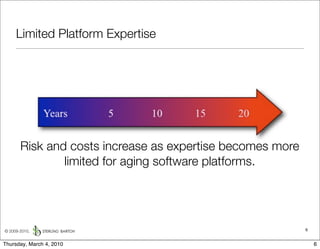
Limited Platform Expertise


       Risk and costs increase as expertise becomes more
               limited for aging software platforms.


© 2009-2010,                                               6


Thursday, March 4, 2010                                        6
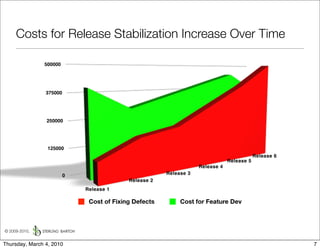
Costs for Release Stabilization Increase Over Time

               500000


                375000


                250000


                 125000
                                                                                           Release 6
                                                                               Release 5
                                                                   Release 4
                         0                             Release 3
                                           Release 2
                             Release 1

                              Cost of Fixing Defects        Cost for Feature Dev


© 2009-2010,


Thursday, March 4, 2010                                                                                7
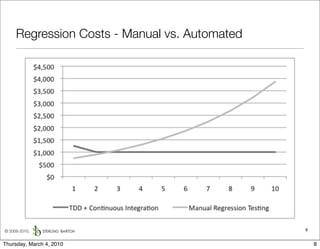
Regression Costs - Manual vs. Automated


© 2009-2010,                                   8


Thursday, March 4, 2010                            8
Extreme Specialization

               Knowledge and capability to maintain legacy software decays with time

               Costs to maintain rarely used software platforms are higher

               Leads to waiting for people in specialized roles to finish their tasks in
               support of development effort


© 2009-2010,                                                                              9


Thursday, March 4, 2010                                                                       9
Software Debt

    Creeps into software slowly and leaves organizations with liabilities


                                                                            10


Thursday, March 4, 2010                                                          10
Software Debt Creeps In


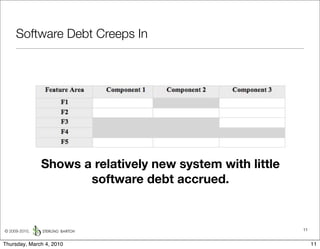
               Shows a relatively new system with little
                      software debt accrued.


© 2009-2010,                                               11


Thursday, March 4, 2010                                         11
Software Debt Creeps In


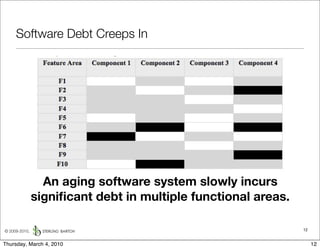
                 An aging software system slowly incurs
               significant debt in multiple functional areas.

© 2009-2010,                                                   12


Thursday, March 4, 2010                                             12
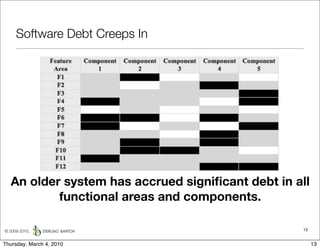
Software Debt Creeps In


  An older system has accrued significant debt in all
          functional areas and components.

© 2009-2010,                                      13


Thursday, March 4, 2010                                13
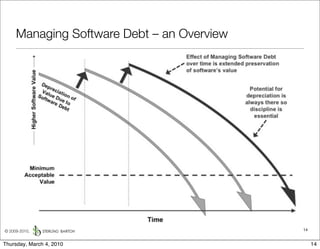
Managing Software Debt – an Overview


© 2009-2010,                                14


Thursday, March 4, 2010                          14
Managing Software Debt

               It is impossible to stop software debt from creeping into our software

               Managing debt in software is based on putting frequent feedback
               mechanisms in place for code, quality assurance, configuration
               management, design, and organization of people on project team

               Feedback mechanisms should be frequent, automated, and easy to use to
               support their continued use or modified to new needs


© 2009-2010,                                                                            15


Thursday, March 4, 2010                                                                      15
Types of Software Debt

               Technical Debt

               Quality Debt

               Configuration Management Debt

               Design Debt

               Platform Experience Debt


© 2009-2010,                                  16


Thursday, March 4, 2010                            16
Technical Debt

    Issues in software implementation that will impede future development if left
    unresolved


                                                                                    17


Thursday, March 4, 2010                                                                  17
* Ward Cunningham on “Technical Debt”

               Technical Debt includes those internal things that you choose not to do now,
               but which will impede future development if left undone. This includes
               deferred refactoring.

               Technical Debt doesn’t include deferred functionality, except possibly in
               edge cases where delivered functionality is “good enough” for the customer,
               but doesn’t satisfy some standard (e.g., a UI element that isn’t fully
               compliant with some UI standard).


                              * Ward Cunningham - “Technical Debt” - http://c2.com/cgi/wiki?TechnicalDebt

© 2009-2010,                                                                                                18


Thursday, March 4, 2010                                                                                          18
My Definition of “Technical Debt”

                   “Technical debt is the decay of
                  component and inter-component
                    behavior when the application
               functionality meets a minimum standard
                  of satisfaction for the customer.”


© 2009-2010,                                            19


Thursday, March 4, 2010                                      19
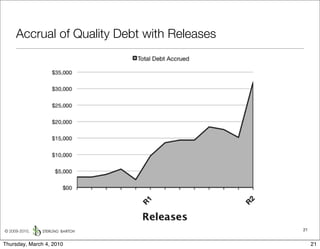
Quality Debt

    A lack of quality, either technical or functional, will lessen value per feature
    added over time


                                                                                       20


Thursday, March 4, 2010                                                                     20
Accrual of Quality Debt with Releases


© 2009-2010,                                 21


Thursday, March 4, 2010                           21
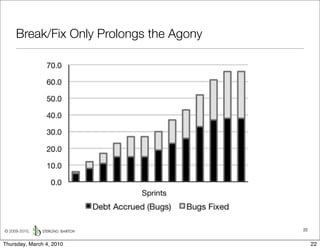
Break/Fix Only Prolongs the Agony


© 2009-2010,                             22


Thursday, March 4, 2010                       22
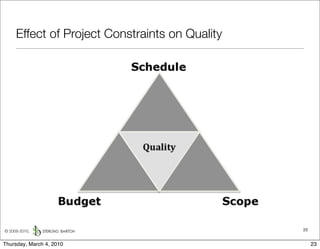
Effect of Project Constraints on Quality


© 2009-2010,                                    23


Thursday, March 4, 2010                              23
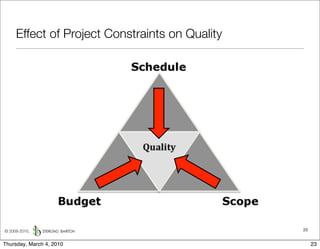
Effect of Project Constraints on Quality


© 2009-2010,                                    23


Thursday, March 4, 2010                              23
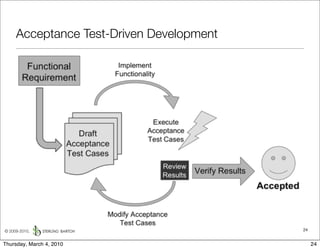
Acceptance Test-Driven Development


© 2009-2010,                              24


Thursday, March 4, 2010                        24
A Fit Case Study

    Cost reduction using Fit for test automation and data conversion


                                                                       25


Thursday, March 4, 2010                                                     25
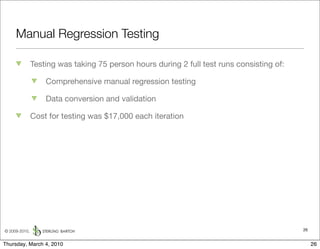
Manual Regression Testing

               Testing was taking 75 person hours during 2 full test runs consisting of:

                   Comprehensive manual regression testing

                   Data conversion and validation

               Cost for testing was $17,000 each iteration


© 2009-2010,                                                                               26


Thursday, March 4, 2010                                                                         26
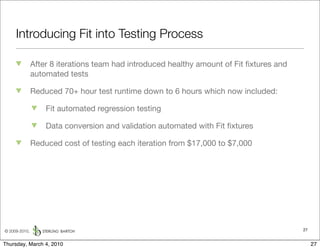
Introducing Fit into Testing Process

               After 8 iterations team had introduced healthy amount of Fit fixtures and
               automated tests

               Reduced 70+ hour test runtime down to 6 hours which now included:

                   Fit automated regression testing

                   Data conversion and validation automated with Fit fixtures

               Reduced cost of testing each iteration from $17,000 to $7,000


© 2009-2010,                                                                              27


Thursday, March 4, 2010                                                                        27
Configuration Management Debt

    Creating unpredictable and error-prone release management


                                                                28


Thursday, March 4, 2010                                              28
Traditional Source Control Management


© 2009-2010,                                 29


Thursday, March 4, 2010                           29
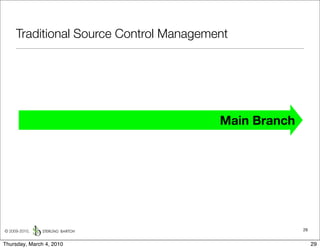
Traditional Source Control Management


                                        Main Branch


© 2009-2010,                                          29


Thursday, March 4, 2010                                    29
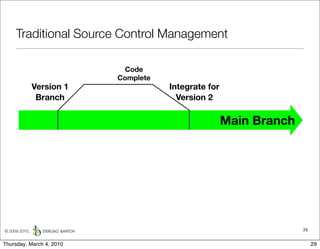
Traditional Source Control Management

                            Code
                           Complete
               Version 1              Integrate for
                Branch                  Version 2

                                                      Main Branch


© 2009-2010,                                                        29


Thursday, March 4, 2010                                                  29
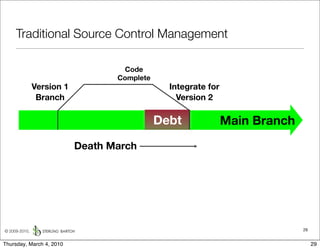
Traditional Source Control Management

                                   Code
                                  Complete
               Version 1                       Integrate for
                Branch                           Version 2

                                             Debt              Main Branch
                           Death March


© 2009-2010,                                                                 29


Thursday, March 4, 2010                                                           29
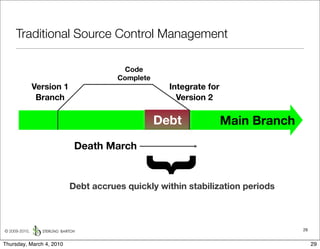
Traditional Source Control Management

                                       Code
                                      Complete
               Version 1                           Integrate for
                Branch                               Version 2

                                                 Debt              Main Branch
                            Death March


                                          {
                           Debt accrues quickly within stabilization periods


© 2009-2010,                                                                     29


Thursday, March 4, 2010                                                               29
Flexible Source Control Management


© 2009-2010,                              30


Thursday, March 4, 2010                        30
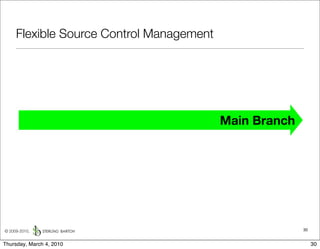
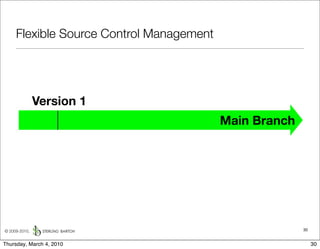
Flexible Source Control Management


                                          Main Branch


© 2009-2010,                                            30


Thursday, March 4, 2010                                      30
Flexible Source Control Management


               Version 1
                                          Main Branch


© 2009-2010,                                            30


Thursday, March 4, 2010                                      30
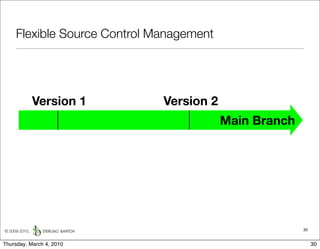
Flexible Source Control Management


               Version 1      Version 2
                                          Main Branch


© 2009-2010,                                            30


Thursday, March 4, 2010                                      30
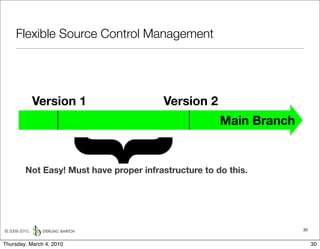
Flexible Source Control Management


               Version 1                  Version 2
                                                        Main Branch

                 {
          Not Easy! Must have proper infrastructure to do this.


© 2009-2010,                                                          30


Thursday, March 4, 2010                                                    30
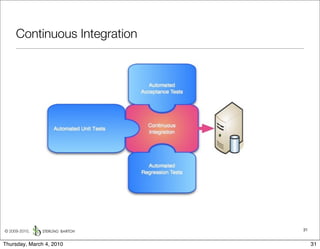
Continuous Integration


© 2009-2010,                  31


Thursday, March 4, 2010            31
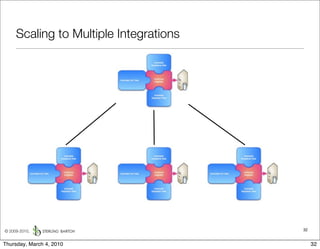
Scaling to Multiple Integrations


© 2009-2010,                            32


Thursday, March 4, 2010                      32
Design Debt

    Design decays when not attended to so design your software continually


                                                                             33


Thursday, March 4, 2010                                                           33
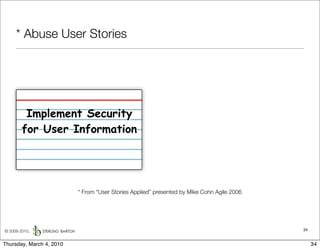
* Abuse User Stories


         Implement Security
        for User Information


                          * From “User Stories Applied” presented by Mike Cohn Agile 2006


© 2009-2010,                                                                                34


Thursday, March 4, 2010                                                                          34
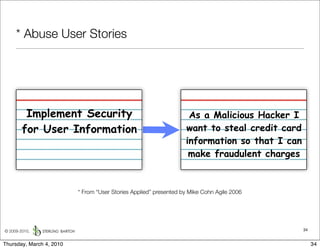
* Abuse User Stories


         Implement Security                                         As a Malicious Hacker I
        for User Information                                       want to steal credit card
                                                                   information so that I can
                                                                    make fraudulent charges


                          * From “User Stories Applied” presented by Mike Cohn Agile 2006


© 2009-2010,                                                                                   34


Thursday, March 4, 2010                                                                             34
Platform Experience Debt

    Silos of knowledge and increased specialization will increase cost of
    maintenance over time


                                                                            35


Thursday, March 4, 2010                                                          35
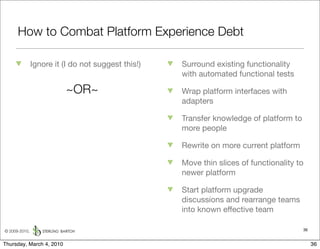
How to Combat Platform Experience Debt

               Ignore it (I do not suggest this!)   Surround existing functionality
                                                    with automated functional tests

                          ~OR~                      Wrap platform interfaces with
                                                    adapters

                                                    Transfer knowledge of platform to
                                                    more people

                                                    Rewrite on more current platform

                                                    Move thin slices of functionality to
                                                    newer platform

                                                    Start platform upgrade
                                                    discussions and rearrange teams
                                                    into known effective team

© 2009-2010,                                                                            36


Thursday, March 4, 2010                                                                      36
Team Configuration Patterns

               Virtual Architect Pattern

               Integration Team Pattern

               Component Shepherd Pattern

               Team Architect Pattern


© 2009-2010,                                37


Thursday, March 4, 2010                          37
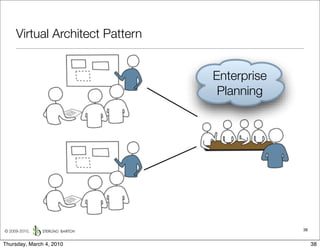
Virtual Architect Pattern


                                 Enterprise
                                  Planning


© 2009-2010,                                  38


Thursday, March 4, 2010                            38
Virtual Architect Pattern

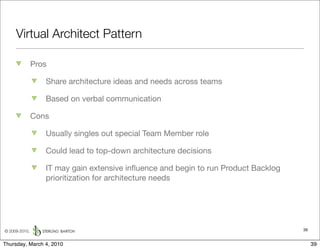
               Pros

                  Share architecture ideas and needs across teams

                  Based on verbal communication

               Cons

                  Usually singles out special Team Member role

                  Could lead to top-down architecture decisions

                  IT may gain extensive influence and begin to run Product Backlog
                  prioritization for architecture needs


© 2009-2010,                                                                        39


Thursday, March 4, 2010                                                                  39
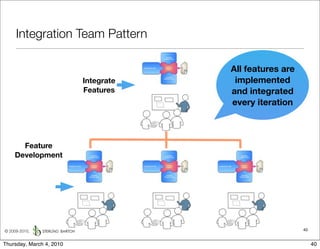
Integration Team Pattern

                                      All features are
                          Integrate    implemented
                          Features    and integrated
                                      every iteration


      Feature
    Development


© 2009-2010,                                             40


Thursday, March 4, 2010                                       40
Integration Team Pattern

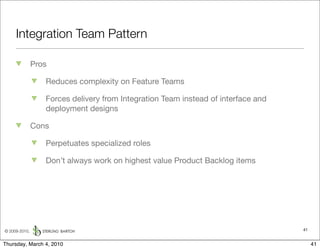
               Pros

                  Reduces complexity on Feature Teams

                  Forces delivery from Integration Team instead of interface and
                  deployment designs

               Cons

                  Perpetuates specialized roles

                  Don’t always work on highest value Product Backlog items


© 2009-2010,                                                                       41


Thursday, March 4, 2010                                                                 41
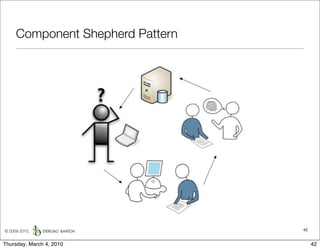
Component Shepherd Pattern


© 2009-2010,                      42


Thursday, March 4, 2010                42
Component Shepherd Pattern

               Pros

                  Share more knowledge within organization to minimize platform
                  experience debt

                  Work on highest value Product Backlog items

               Cons

                  Not always optimal as using individual knowledge

                  Difficult to learn multiple systems across Teams


© 2009-2010,                                                                      43


Thursday, March 4, 2010                                                                43
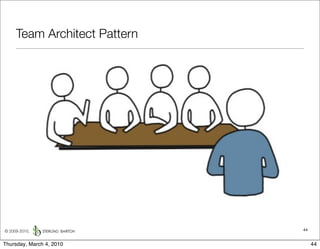
Team Architect Pattern


© 2009-2010,                  44


Thursday, March 4, 2010            44
Team Architect Pattern

               Pros

                  Team owns architecture decisions

                  Decisions are made close to implementation concerns

               Cons

                  May not have appropriate experience on Team

                  Team could get “stuck” on architecture decisions


© 2009-2010,                                                            45


Thursday, March 4, 2010                                                      45
What is possible?

    High quality can be attained and should enable accelerated feature delivery at
    same time.


                                                                                     46


Thursday, March 4, 2010                                                                   46
A Story: Field Support Application

               2000+ users access application each day
               Application supports multiple perspectives and workflows
               from Field Support Operations to Customer Service
               Team of 5 people delivering features on existing Cold Fusion
               platform implementation
               Migrating to Spring/Hibernate in slices while delivering
               valuable features
               36 2-week Sprints, 33 production releases, and only 1 defect
               found in production
               So, what was the defect you say? Let me tell you…

© 2009-2010,                                                                  47


Thursday, March 4, 2010                                                            47
Lets wrap this up...

    What should I take away from this?


                                         48


Thursday, March 4, 2010                       48
Principles for Managing Software Debt

               Maintain one list of work

               Emphasize quality

               Evolve tools and infrastructure continually

               Improve system design always

               Share knowledge across the organization

               And most importantly, get the right people to work on your software!


© 2009-2010,                                                                          49


Thursday, March 4, 2010                                                                    49
Thank you

    Questions and Answers


                            50


Thursday, March 4, 2010          50
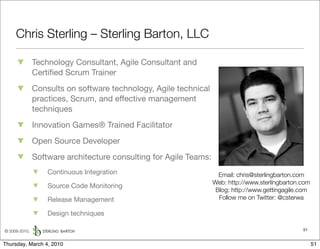
Chris Sterling – Sterling Barton, LLC

               Technology Consultant, Agile Consultant and
               Certified Scrum Trainer
               Consults on software technology, Agile technical
               practices, Scrum, and effective management
               techniques
               Innovation Games® Trained Facilitator
               Open Source Developer
               Software architecture consulting for Agile Teams:
                   Continuous Integration                            Email: chris@sterlingbarton.com
                                                                   Web: http://www.sterlingbarton.com
                   Source Code Monitoring
                                                                    Blog: http://www.gettingagile.com
                   Release Management                                Follow me on Twitter: @csterwa

                   Design techniques

© 2009-2010,                                                                                      51


Thursday, March 4, 2010                                                                                 51

Managing Software Debt Agile Bazaar

  • 1.
    Managing Software Debt Continued Delivery of High Value as Systems Age Chris Sterling Technology Consultant / Agile Coach / Certified Scrum Trainer Sterling Barton, LLC Web: www.SterlingBarton.com Email: chris@sterlingbarton.com Blog: www.GettingAgile.com Follow Me on Twitter: @csterwa Hash Tag for Presentation: #swdebt Thursday, March 4, 2010 1
  • 2.
    Topics Being Covered Problems Found with Aging Software Software Debt Explained Technical Debt Quality Debt Configuration Management Debt Design Debt Platform Experience Debt The Wrap Up A Story of What is Possible © 2009-2010, 2 Thursday, March 4, 2010 2
  • 3.
    Problems Found withAging Software Software gets difficult to add features to as it ages Business expectations do not lessen as software ages Software must remain maintainable and changeable to meet needs of business over time © 2009-2010, 3 Thursday, March 4, 2010 3
  • 4.
    Lack of emphasison software quality attributes contributes to decay © 2009-2010, 4 Thursday, March 4, 2010 4
  • 5.
    Like-to-Like Migrations “It will be easy since we worked on the original version” - although we understand the domain we will be fighting with new features, technology, tools, and processes “We don’t have any other options” - Refactoring and test automation are potential alternatives to like-to-like migrations. © 2009-2010, 5 Thursday, March 4, 2010 5
  • 6.
    Limited Platform Expertise Risk and costs increase as expertise becomes more limited for aging software platforms. © 2009-2010, 6 Thursday, March 4, 2010 6
  • 7.
    Costs for ReleaseStabilization Increase Over Time 500000 375000 250000 125000 Release 6 Release 5 Release 4 0 Release 3 Release 2 Release 1 Cost of Fixing Defects Cost for Feature Dev © 2009-2010, Thursday, March 4, 2010 7
  • 8.
    Regression Costs -Manual vs. Automated © 2009-2010, 8 Thursday, March 4, 2010 8
  • 9.
    Extreme Specialization Knowledge and capability to maintain legacy software decays with time Costs to maintain rarely used software platforms are higher Leads to waiting for people in specialized roles to finish their tasks in support of development effort © 2009-2010, 9 Thursday, March 4, 2010 9
  • 10.
    Software Debt Creeps into software slowly and leaves organizations with liabilities 10 Thursday, March 4, 2010 10
  • 11.
    Software Debt CreepsIn Shows a relatively new system with little software debt accrued. © 2009-2010, 11 Thursday, March 4, 2010 11
  • 12.
    Software Debt CreepsIn An aging software system slowly incurs significant debt in multiple functional areas. © 2009-2010, 12 Thursday, March 4, 2010 12
  • 13.
    Software Debt CreepsIn An older system has accrued significant debt in all functional areas and components. © 2009-2010, 13 Thursday, March 4, 2010 13
  • 14.
    Managing Software Debt– an Overview © 2009-2010, 14 Thursday, March 4, 2010 14
  • 15.
    Managing Software Debt It is impossible to stop software debt from creeping into our software Managing debt in software is based on putting frequent feedback mechanisms in place for code, quality assurance, configuration management, design, and organization of people on project team Feedback mechanisms should be frequent, automated, and easy to use to support their continued use or modified to new needs © 2009-2010, 15 Thursday, March 4, 2010 15
  • 16.
    Types of SoftwareDebt Technical Debt Quality Debt Configuration Management Debt Design Debt Platform Experience Debt © 2009-2010, 16 Thursday, March 4, 2010 16
  • 17.
    Technical Debt Issues in software implementation that will impede future development if left unresolved 17 Thursday, March 4, 2010 17
  • 18.
    * Ward Cunninghamon “Technical Debt” Technical Debt includes those internal things that you choose not to do now, but which will impede future development if left undone. This includes deferred refactoring. Technical Debt doesn’t include deferred functionality, except possibly in edge cases where delivered functionality is “good enough” for the customer, but doesn’t satisfy some standard (e.g., a UI element that isn’t fully compliant with some UI standard). * Ward Cunningham - “Technical Debt” - http://c2.com/cgi/wiki?TechnicalDebt © 2009-2010, 18 Thursday, March 4, 2010 18
  • 19.
    My Definition of“Technical Debt” “Technical debt is the decay of component and inter-component behavior when the application functionality meets a minimum standard of satisfaction for the customer.” © 2009-2010, 19 Thursday, March 4, 2010 19
  • 20.
    Quality Debt A lack of quality, either technical or functional, will lessen value per feature added over time 20 Thursday, March 4, 2010 20
  • 21.
    Accrual of QualityDebt with Releases © 2009-2010, 21 Thursday, March 4, 2010 21
  • 22.
    Break/Fix Only Prolongsthe Agony © 2009-2010, 22 Thursday, March 4, 2010 22
  • 23.
    Effect of ProjectConstraints on Quality © 2009-2010, 23 Thursday, March 4, 2010 23
  • 24.
    Effect of ProjectConstraints on Quality © 2009-2010, 23 Thursday, March 4, 2010 23
  • 25.
    Acceptance Test-Driven Development ©2009-2010, 24 Thursday, March 4, 2010 24
  • 26.
    A Fit CaseStudy Cost reduction using Fit for test automation and data conversion 25 Thursday, March 4, 2010 25
  • 27.
    Manual Regression Testing Testing was taking 75 person hours during 2 full test runs consisting of: Comprehensive manual regression testing Data conversion and validation Cost for testing was $17,000 each iteration © 2009-2010, 26 Thursday, March 4, 2010 26
  • 28.
    Introducing Fit intoTesting Process After 8 iterations team had introduced healthy amount of Fit fixtures and automated tests Reduced 70+ hour test runtime down to 6 hours which now included: Fit automated regression testing Data conversion and validation automated with Fit fixtures Reduced cost of testing each iteration from $17,000 to $7,000 © 2009-2010, 27 Thursday, March 4, 2010 27
  • 29.
    Configuration Management Debt Creating unpredictable and error-prone release management 28 Thursday, March 4, 2010 28
  • 30.
    Traditional Source ControlManagement © 2009-2010, 29 Thursday, March 4, 2010 29
  • 31.
    Traditional Source ControlManagement Main Branch © 2009-2010, 29 Thursday, March 4, 2010 29
  • 32.
    Traditional Source ControlManagement Code Complete Version 1 Integrate for Branch Version 2 Main Branch © 2009-2010, 29 Thursday, March 4, 2010 29
  • 33.
    Traditional Source ControlManagement Code Complete Version 1 Integrate for Branch Version 2 Debt Main Branch Death March © 2009-2010, 29 Thursday, March 4, 2010 29
  • 34.
    Traditional Source ControlManagement Code Complete Version 1 Integrate for Branch Version 2 Debt Main Branch Death March { Debt accrues quickly within stabilization periods © 2009-2010, 29 Thursday, March 4, 2010 29
  • 35.
    Flexible Source ControlManagement © 2009-2010, 30 Thursday, March 4, 2010 30
  • 36.
    Flexible Source ControlManagement Main Branch © 2009-2010, 30 Thursday, March 4, 2010 30
  • 37.
    Flexible Source ControlManagement Version 1 Main Branch © 2009-2010, 30 Thursday, March 4, 2010 30
  • 38.
    Flexible Source ControlManagement Version 1 Version 2 Main Branch © 2009-2010, 30 Thursday, March 4, 2010 30
  • 39.
    Flexible Source ControlManagement Version 1 Version 2 Main Branch { Not Easy! Must have proper infrastructure to do this. © 2009-2010, 30 Thursday, March 4, 2010 30
  • 40.
    Continuous Integration © 2009-2010, 31 Thursday, March 4, 2010 31
  • 41.
    Scaling to MultipleIntegrations © 2009-2010, 32 Thursday, March 4, 2010 32
  • 42.
    Design Debt Design decays when not attended to so design your software continually 33 Thursday, March 4, 2010 33
  • 43.
    * Abuse UserStories Implement Security for User Information * From “User Stories Applied” presented by Mike Cohn Agile 2006 © 2009-2010, 34 Thursday, March 4, 2010 34
  • 44.
    * Abuse UserStories Implement Security As a Malicious Hacker I for User Information want to steal credit card information so that I can make fraudulent charges * From “User Stories Applied” presented by Mike Cohn Agile 2006 © 2009-2010, 34 Thursday, March 4, 2010 34
  • 45.
    Platform Experience Debt Silos of knowledge and increased specialization will increase cost of maintenance over time 35 Thursday, March 4, 2010 35
  • 46.
    How to CombatPlatform Experience Debt Ignore it (I do not suggest this!) Surround existing functionality with automated functional tests ~OR~ Wrap platform interfaces with adapters Transfer knowledge of platform to more people Rewrite on more current platform Move thin slices of functionality to newer platform Start platform upgrade discussions and rearrange teams into known effective team © 2009-2010, 36 Thursday, March 4, 2010 36
  • 47.
    Team Configuration Patterns Virtual Architect Pattern Integration Team Pattern Component Shepherd Pattern Team Architect Pattern © 2009-2010, 37 Thursday, March 4, 2010 37
  • 48.
    Virtual Architect Pattern Enterprise Planning © 2009-2010, 38 Thursday, March 4, 2010 38
  • 49.
    Virtual Architect Pattern Pros Share architecture ideas and needs across teams Based on verbal communication Cons Usually singles out special Team Member role Could lead to top-down architecture decisions IT may gain extensive influence and begin to run Product Backlog prioritization for architecture needs © 2009-2010, 39 Thursday, March 4, 2010 39
  • 50.
    Integration Team Pattern All features are Integrate implemented Features and integrated every iteration Feature Development © 2009-2010, 40 Thursday, March 4, 2010 40
  • 51.
    Integration Team Pattern Pros Reduces complexity on Feature Teams Forces delivery from Integration Team instead of interface and deployment designs Cons Perpetuates specialized roles Don’t always work on highest value Product Backlog items © 2009-2010, 41 Thursday, March 4, 2010 41
  • 52.
    Component Shepherd Pattern ©2009-2010, 42 Thursday, March 4, 2010 42
  • 53.
    Component Shepherd Pattern Pros Share more knowledge within organization to minimize platform experience debt Work on highest value Product Backlog items Cons Not always optimal as using individual knowledge Difficult to learn multiple systems across Teams © 2009-2010, 43 Thursday, March 4, 2010 43
  • 54.
    Team Architect Pattern ©2009-2010, 44 Thursday, March 4, 2010 44
  • 55.
    Team Architect Pattern Pros Team owns architecture decisions Decisions are made close to implementation concerns Cons May not have appropriate experience on Team Team could get “stuck” on architecture decisions © 2009-2010, 45 Thursday, March 4, 2010 45
  • 56.
    What is possible? High quality can be attained and should enable accelerated feature delivery at same time. 46 Thursday, March 4, 2010 46
  • 57.
    A Story: FieldSupport Application 2000+ users access application each day Application supports multiple perspectives and workflows from Field Support Operations to Customer Service Team of 5 people delivering features on existing Cold Fusion platform implementation Migrating to Spring/Hibernate in slices while delivering valuable features 36 2-week Sprints, 33 production releases, and only 1 defect found in production So, what was the defect you say? Let me tell you… © 2009-2010, 47 Thursday, March 4, 2010 47
  • 58.
    Lets wrap thisup... What should I take away from this? 48 Thursday, March 4, 2010 48
  • 59.
    Principles for ManagingSoftware Debt Maintain one list of work Emphasize quality Evolve tools and infrastructure continually Improve system design always Share knowledge across the organization And most importantly, get the right people to work on your software! © 2009-2010, 49 Thursday, March 4, 2010 49
  • 60.
    Thank you Questions and Answers 50 Thursday, March 4, 2010 50
  • 61.
    Chris Sterling –Sterling Barton, LLC Technology Consultant, Agile Consultant and Certified Scrum Trainer Consults on software technology, Agile technical practices, Scrum, and effective management techniques Innovation Games® Trained Facilitator Open Source Developer Software architecture consulting for Agile Teams: Continuous Integration Email: chris@sterlingbarton.com Web: http://www.sterlingbarton.com Source Code Monitoring Blog: http://www.gettingagile.com Release Management Follow me on Twitter: @csterwa Design techniques © 2009-2010, 51 Thursday, March 4, 2010 51