Managing, Consulting,
               Implementing and
                    Support

             World Class Efficiency
              made in Germany

infoWAN Datenkommunikation GmbH
     infoWAN Asia Sdn. Bhd.


                              © infoWAN GmbH 2010
RoI Calculation Study
    LYNC Unified Communication

         *)based on Forrester Study

               Thomas Pött
MD and Senior Principal Consultant at infoWAN


                                           © infoWAN GmbH 2010
Content

  Summary                  TEI Framework
  Purpose                  COST
  Methodology              BENEFITS
  Approach                 RoI Summary
  Key Findings             Results
  Unified Communications
  Prologue


                                           © infoWAN GmbH 2010
Summary

  Business communications are increasingly complex and require workers to
  manage multiple devices, applications, and face-to-face interactions in an
  attempt to stay productively connected with one another.
  Workdays for many people are no longer 9 to 5;
  Workdays are now 24x7 and span geographic boundaries, making
  communication and decision-making even more difficult and much
  more time-sensitive.
  People typically list multiple phone numbers and email addresses — so rather
  than simplifying things, a business card actually makes connecting quite
  complicated. As a result, when a person wants to reach someone else, s/he
  typically leaves numerous messages at multiple addresses.
  Lync 2010 Brings Enterprise Voice, Better Collaboration Functionality,
  And Improved System Stability


                                                                    © infoWAN GmbH 2010
Purpose

  The purpose of this study is to provide decision makers
  with a framework to evaluate the potential financial
  impact of Microsoft‘s UC products on their
  organizations.
  Forrester‘s aim is to clearly show all calculations and
  assumptions used in the analysis.
  Decision maker can use this study to better understand
  and communicate a business case for investing in
  Microsoft‘s UC products


                                                 © infoWAN GmbH 2010
Methodology

   For this study, Forrester employed four fundamental
   elements of TEI in modeling the financial framework for
   Microsoft‘s unified communications products.

   1.    Costs
   2.    Benefits
   3.    Risk
   4.    Flexibility


Forrester Total Economic Impact™ (TEI) case study


                                                    © infoWAN GmbH 2010
Approach

  Forrester used a five-step approach for this study.
      Forrester gathered data from existing Forrester research relative to UC
      and the enterprise messaging and collaboration market in general.
      Forrester interviewed Microsoft UC strategy and product marketing
      personnel in order to fully understand the potential value proposition of
      UC products.
      Forrester conducted a series of in-depth interviews with 12 organizations
      currently using Microsoft UC products.
      Forrester constructed a financial model to represent the findings gathered
      in the interviews. This model can be found in the TEI Framework section
      below.
      Forrester created a composite organization based on the interviews and
      populated the framework using data from the interviews.


                                                                     © infoWAN GmbH 2010
Key Findings

    ROI. Based on the interviews with the 12 existing Microsoft UC customers

Benefits.
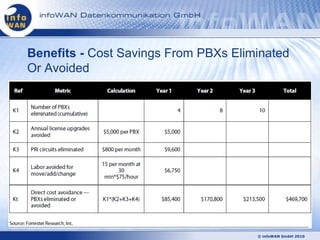
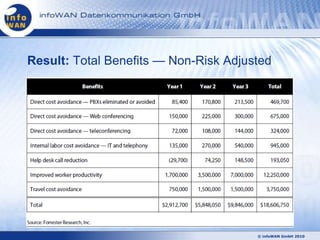
    Replacing private branch exchange (PBX) telephone systems, valued at
    nearly $500,000 over three years.
    Direct cost savings from Web- and teleconferencing, amounting to $1
    million over three years.
    Reduced IT and telephony labor cost, estimated at nearly $1 million.
    Fewer calls to the help desk, valued at a labor cost saving of more than
    $190,000.
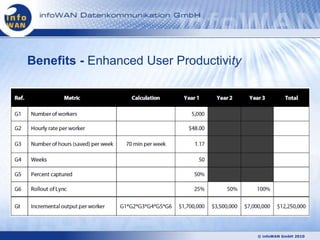
    Increased user productivity, conservatively assessed at more than $12
    million over three years.
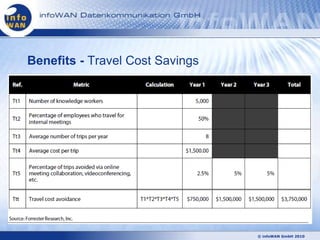
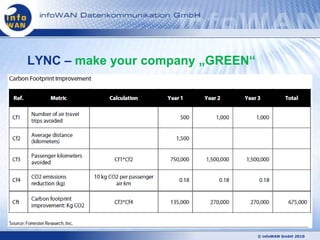
    Modest travel cost savings (and carbon footprint improvement), over
    and above the travel cost savings already gained from earlier UC investments,
    of $3.8 million.

                                                                       © infoWAN GmbH 2010
Key Findings

    ROI. Based on the interviews with the 12 existing Microsoft UC customers

Costs.
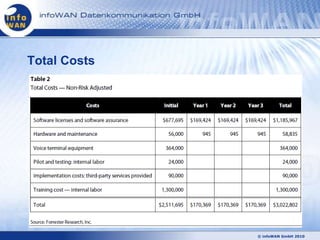
    Software licenses and software assurance costs: $1.2 million over three
    years.
    Server hardware: less than $60,000.
    Voice terminal equipment: approximately $364,000.
    Internal labor for pilot and testing: $24,000.
    Internal training labor opportunity cost: $1.3 million.


                                                                      © infoWAN GmbH 2010
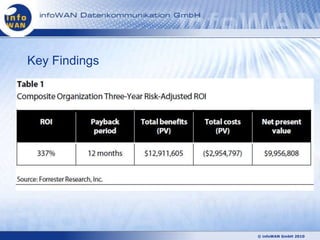
Key Findings


               © infoWAN GmbH 2010
Unified Communications Prologue

Presence Information
      Presence information provides user status information (e.g., online, away, busy, in a meeting/call,
      do not disturb).
Instant Messaging
      IM was introduced to the enterprise to provide the capability to send and receive text messages in
      real time over the corporate network.
Web And Videoconferencing
      Ad hoc Web and videoconferencing made some improvements in efficiency in real-time decision-
      making by providing links to presence management and point-and-click conference launches.
Voice Over Internet Protocol (VoIP)
      VoIP made it possible to communicate via telephone over an IP network using SIP protocol instead
     of over traditional time-division multiplexing (TDM) voice networks via PBX telephony infrastructure.
One-Click Communication
       Early UC adopter companies looked to the prospect of having all of the means of contacting
       individuals immediately available using only their name.
Mobility
       Although mobile email has been around for years, today, more mobile devices can run the mobile
      client for Lync 2010


                                                                                             © infoWAN GmbH 2010
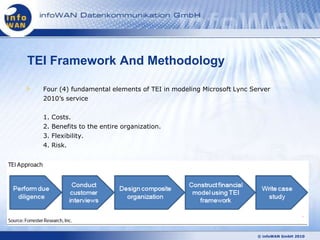
TEI Framework And Methodology

    Four (4) fundamental elements of TEI in modeling Microsoft Lync Server
    2010‘s service

    1.   Costs.
    2.   Benefits to the entire organization.
    3.   Flexibility.
    4.   Risk.

.


                                                                      © infoWAN GmbH 2010
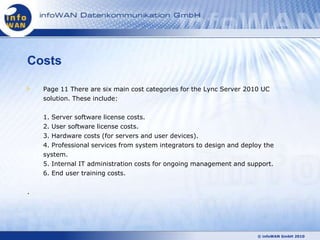
Costs

    Page 11 There are six main cost categories for the Lync Server 2010 UC
    solution. These include:

    1. Server software license costs.
    2. User software license costs.
    3. Hardware costs (for servers and user devices).
    4. Professional services from system integrators to design and deploy the
    system.
    5. Internal IT administration costs for ongoing management and support.
    6. End user training costs.

.


                                                                       © infoWAN GmbH 2010
Total Costs


              © infoWAN GmbH 2010
Benefits

     Lync is the next level of integration with Microsoft applications and
     back-end apps and SharePoint apps. . . . This is a cultural change
     not just technology


     Getting the right people in attendance, doing rework in real time,
     cutting time to project completion. It used to take three meeting[s]
     to get a decision; now we are down to one


     It’s so much more effective and motivating.


(Director, collaboration technology, global engineering conglomerate)

                                                                        © infoWAN GmbH 2010
Benefits - Cost Savings From PBXs Eliminated
Or Avoided


                                      © infoWAN GmbH 2010
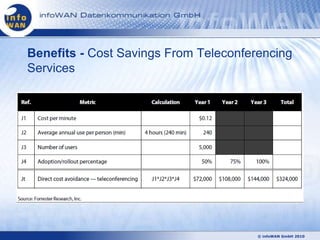
Benefits - Cost Savings From Teleconferencing
Services


                                       © infoWAN GmbH 2010
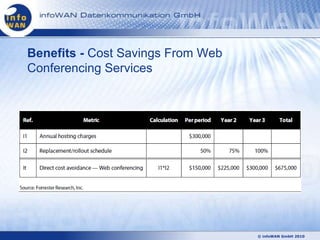
Benefits - Cost Savings From Web
Conferencing Services


                                   © infoWAN GmbH 2010
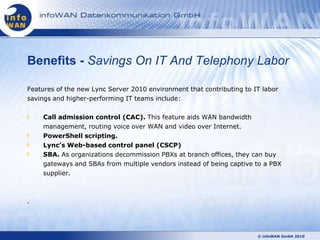
Benefits - Savings On IT And Telephony Labor

Features of the new Lync Server 2010 environment that contributing to IT labor
savings and higher-performing IT teams include:

    Call admission control (CAC). This feature aids WAN bandwidth
    management, routing voice over WAN and video over Internet.
    PowerShell scripting.
    Lync’s Web-based control panel (CSCP)
    SBA. As organizations decommission PBXs at branch offices, they can buy
    gateways and SBAs from multiple vendors instead of being captive to a PBX
    supplier.


.


                                                                       © infoWAN GmbH 2010
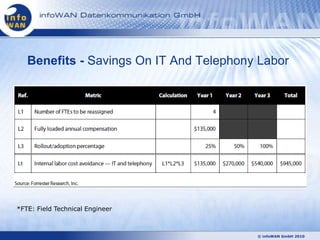
Benefits - Savings On IT And Telephony Labor


*FTE: Field Technical Engineer


                                         © infoWAN GmbH 2010
Benefits - Enhanced User Productivity


                                        © infoWAN GmbH 2010
Benefits - Travel Cost Savings


                                 © infoWAN GmbH 2010
LYNC – make your company „GREEN“


                                   © infoWAN GmbH 2010
Result: Total Benefits — Non-Risk Adjusted


                                       © infoWAN GmbH 2010
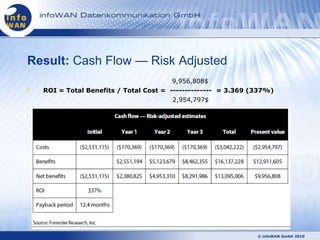
Result: Cash Flow — Risk Adjusted
                                       9,956,808$
  ROI = Total Benefits / Total Cost = -------------- = 3.369 (337%)
                                       2,954,797$


                                                              © infoWAN GmbH 2010
Important observations on the business value of
the Lync 2010 investment

  Higher work efficiency of employees

  Replacing PBX telephone systems with Lync Server 2010 software.

  Cost reductions for Web- and teleconferencing charges.

  IT and help desk labor cost savings.

  Enhanced individual and workgroup productivity.

  Travel cost savings. (positive ―green‖ impact)


                                                                    © infoWAN GmbH 2010
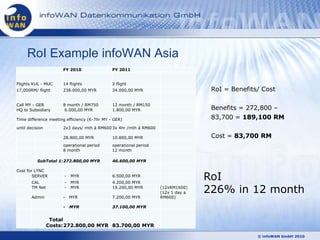
RoI Example infoWAN Asia
                      FY 2010                 FY 2011


Flights KUL - MUC     14 flights              2 flight
17,000RM/ flight      238.000,00 MYR          34.000,00 MYR                        RoI = Benefits/ Cost

Call MY - GER         8 month / RM750         12 month / RM150
HQ to Subsidiary       6.000,00 MYR           1.800,00 MYR                         Benefits = 272,800 –
Time difference meeting efficiency (6-7hr MY - GER)                                83,700 = 189,100 RM
until decision        2x3 days/ mth á RM600 3x 4hr /mth á RM600

                      28.800,00 MYR           10.800,00 MYR                        Cost = 83,700 RM
                      operational period      operational period
                      8 month                 12 month

           SubTotal 1:272.800,00 MYR          46.600,00 MYR

Cost for LYNC
        SERVER
       CAL
                       -
                       -
                           MYR
                           MYR
                                              6.500,00 MYR
                                              4.200,00 MYR
                                                                                  RoI
       TM Net          -   MYR                19.200,00 MYR        (12xRM1600)
                                                                   (12x 1 day a   226% in 12 month
       Admin          -    MYR                7.200,00 MYR         RM600)

                      -    MYR                37.100,00 MYR


                  Total
                 Costs:272.800,00 MYR 83.700,00 MYR

                                                                                                 © infoWAN GmbH 2010
Thank you for your attention


Please ask infoWAN for your company‗s
           RoI calculation !!


                                        © infoWAN GmbH 2010
Questions?

 Contact:
 info@infoWAN.de             info@infoWAN.asia
 www.infoWAN.asia

 Tel:     Germany: +49 (0)89 / 32 47 56 – 0
          Malaysia: +60 (0)3 / 83130 – 600
 Fax:     Germany: +49 (0)89 / 32 47 56 – 99
          Malaysia: +60 (0)3 / 83130 – 680


                                               © infoWAN GmbH 2010

Lync RoI Study

  • 1.
    Managing, Consulting, Implementing and Support World Class Efficiency made in Germany infoWAN Datenkommunikation GmbH infoWAN Asia Sdn. Bhd. © infoWAN GmbH 2010
  • 2.
    RoI Calculation Study LYNC Unified Communication *)based on Forrester Study Thomas Pött MD and Senior Principal Consultant at infoWAN © infoWAN GmbH 2010
  • 3.
    Content Summary TEI Framework Purpose COST Methodology BENEFITS Approach RoI Summary Key Findings Results Unified Communications Prologue © infoWAN GmbH 2010
  • 4.
    Summary Businesscommunications are increasingly complex and require workers to manage multiple devices, applications, and face-to-face interactions in an attempt to stay productively connected with one another. Workdays for many people are no longer 9 to 5; Workdays are now 24x7 and span geographic boundaries, making communication and decision-making even more difficult and much more time-sensitive. People typically list multiple phone numbers and email addresses — so rather than simplifying things, a business card actually makes connecting quite complicated. As a result, when a person wants to reach someone else, s/he typically leaves numerous messages at multiple addresses. Lync 2010 Brings Enterprise Voice, Better Collaboration Functionality, And Improved System Stability © infoWAN GmbH 2010
  • 5.
    Purpose Thepurpose of this study is to provide decision makers with a framework to evaluate the potential financial impact of Microsoft‘s UC products on their organizations. Forrester‘s aim is to clearly show all calculations and assumptions used in the analysis. Decision maker can use this study to better understand and communicate a business case for investing in Microsoft‘s UC products © infoWAN GmbH 2010
  • 6.
    Methodology For this study, Forrester employed four fundamental elements of TEI in modeling the financial framework for Microsoft‘s unified communications products. 1. Costs 2. Benefits 3. Risk 4. Flexibility Forrester Total Economic Impact™ (TEI) case study © infoWAN GmbH 2010
  • 7.
    Approach Forresterused a five-step approach for this study. Forrester gathered data from existing Forrester research relative to UC and the enterprise messaging and collaboration market in general. Forrester interviewed Microsoft UC strategy and product marketing personnel in order to fully understand the potential value proposition of UC products. Forrester conducted a series of in-depth interviews with 12 organizations currently using Microsoft UC products. Forrester constructed a financial model to represent the findings gathered in the interviews. This model can be found in the TEI Framework section below. Forrester created a composite organization based on the interviews and populated the framework using data from the interviews. © infoWAN GmbH 2010
  • 8.
    Key Findings ROI. Based on the interviews with the 12 existing Microsoft UC customers Benefits. Replacing private branch exchange (PBX) telephone systems, valued at nearly $500,000 over three years. Direct cost savings from Web- and teleconferencing, amounting to $1 million over three years. Reduced IT and telephony labor cost, estimated at nearly $1 million. Fewer calls to the help desk, valued at a labor cost saving of more than $190,000. Increased user productivity, conservatively assessed at more than $12 million over three years. Modest travel cost savings (and carbon footprint improvement), over and above the travel cost savings already gained from earlier UC investments, of $3.8 million. © infoWAN GmbH 2010
  • 9.
    Key Findings ROI. Based on the interviews with the 12 existing Microsoft UC customers Costs. Software licenses and software assurance costs: $1.2 million over three years. Server hardware: less than $60,000. Voice terminal equipment: approximately $364,000. Internal labor for pilot and testing: $24,000. Internal training labor opportunity cost: $1.3 million. © infoWAN GmbH 2010
  • 10.
    Key Findings © infoWAN GmbH 2010
  • 11.
    Unified Communications Prologue PresenceInformation Presence information provides user status information (e.g., online, away, busy, in a meeting/call, do not disturb). Instant Messaging IM was introduced to the enterprise to provide the capability to send and receive text messages in real time over the corporate network. Web And Videoconferencing Ad hoc Web and videoconferencing made some improvements in efficiency in real-time decision- making by providing links to presence management and point-and-click conference launches. Voice Over Internet Protocol (VoIP) VoIP made it possible to communicate via telephone over an IP network using SIP protocol instead of over traditional time-division multiplexing (TDM) voice networks via PBX telephony infrastructure. One-Click Communication Early UC adopter companies looked to the prospect of having all of the means of contacting individuals immediately available using only their name. Mobility Although mobile email has been around for years, today, more mobile devices can run the mobile client for Lync 2010 © infoWAN GmbH 2010
  • 12.
    TEI Framework AndMethodology Four (4) fundamental elements of TEI in modeling Microsoft Lync Server 2010‘s service 1. Costs. 2. Benefits to the entire organization. 3. Flexibility. 4. Risk. . © infoWAN GmbH 2010
  • 13.
    Costs Page 11 There are six main cost categories for the Lync Server 2010 UC solution. These include: 1. Server software license costs. 2. User software license costs. 3. Hardware costs (for servers and user devices). 4. Professional services from system integrators to design and deploy the system. 5. Internal IT administration costs for ongoing management and support. 6. End user training costs. . © infoWAN GmbH 2010
  • 14.
    Total Costs © infoWAN GmbH 2010
  • 15.
    Benefits Lync is the next level of integration with Microsoft applications and back-end apps and SharePoint apps. . . . This is a cultural change not just technology Getting the right people in attendance, doing rework in real time, cutting time to project completion. It used to take three meeting[s] to get a decision; now we are down to one It’s so much more effective and motivating. (Director, collaboration technology, global engineering conglomerate) © infoWAN GmbH 2010
  • 16.
    Benefits - CostSavings From PBXs Eliminated Or Avoided © infoWAN GmbH 2010
  • 17.
    Benefits - CostSavings From Teleconferencing Services © infoWAN GmbH 2010
  • 18.
    Benefits - CostSavings From Web Conferencing Services © infoWAN GmbH 2010
  • 19.
    Benefits - SavingsOn IT And Telephony Labor Features of the new Lync Server 2010 environment that contributing to IT labor savings and higher-performing IT teams include: Call admission control (CAC). This feature aids WAN bandwidth management, routing voice over WAN and video over Internet. PowerShell scripting. Lync’s Web-based control panel (CSCP) SBA. As organizations decommission PBXs at branch offices, they can buy gateways and SBAs from multiple vendors instead of being captive to a PBX supplier. . © infoWAN GmbH 2010
  • 20.
    Benefits - SavingsOn IT And Telephony Labor *FTE: Field Technical Engineer © infoWAN GmbH 2010
  • 21.
    Benefits - EnhancedUser Productivity © infoWAN GmbH 2010
  • 22.
    Benefits - TravelCost Savings © infoWAN GmbH 2010
  • 23.
    LYNC – makeyour company „GREEN“ © infoWAN GmbH 2010
  • 24.
    Result: Total Benefits— Non-Risk Adjusted © infoWAN GmbH 2010
  • 25.
    Result: Cash Flow— Risk Adjusted 9,956,808$ ROI = Total Benefits / Total Cost = -------------- = 3.369 (337%) 2,954,797$ © infoWAN GmbH 2010
  • 26.
    Important observations onthe business value of the Lync 2010 investment Higher work efficiency of employees Replacing PBX telephone systems with Lync Server 2010 software. Cost reductions for Web- and teleconferencing charges. IT and help desk labor cost savings. Enhanced individual and workgroup productivity. Travel cost savings. (positive ―green‖ impact) © infoWAN GmbH 2010
  • 27.
    RoI Example infoWANAsia FY 2010 FY 2011 Flights KUL - MUC 14 flights 2 flight 17,000RM/ flight 238.000,00 MYR 34.000,00 MYR RoI = Benefits/ Cost Call MY - GER 8 month / RM750 12 month / RM150 HQ to Subsidiary 6.000,00 MYR 1.800,00 MYR Benefits = 272,800 – Time difference meeting efficiency (6-7hr MY - GER) 83,700 = 189,100 RM until decision 2x3 days/ mth á RM600 3x 4hr /mth á RM600 28.800,00 MYR 10.800,00 MYR Cost = 83,700 RM operational period operational period 8 month 12 month SubTotal 1:272.800,00 MYR 46.600,00 MYR Cost for LYNC SERVER CAL - - MYR MYR 6.500,00 MYR 4.200,00 MYR RoI TM Net - MYR 19.200,00 MYR (12xRM1600) (12x 1 day a 226% in 12 month Admin - MYR 7.200,00 MYR RM600) - MYR 37.100,00 MYR Total Costs:272.800,00 MYR 83.700,00 MYR © infoWAN GmbH 2010
  • 28.
    Thank you foryour attention Please ask infoWAN for your company‗s RoI calculation !! © infoWAN GmbH 2010
  • 29.
    Questions? Contact: info@infoWAN.de info@infoWAN.asia www.infoWAN.asia Tel: Germany: +49 (0)89 / 32 47 56 – 0 Malaysia: +60 (0)3 / 83130 – 600 Fax: Germany: +49 (0)89 / 32 47 56 – 99 Malaysia: +60 (0)3 / 83130 – 680 © infoWAN GmbH 2010

Editor's Notes

  • #27 Net present value (NPV): The present or current value of (discounted) future net cash flows given an interest rate (the discount rate). A positive project NPV normally indicates that the investment should be made, unless other projects have higher NPVs. Present value (PV): The present or current value of (discounted) cost and benefit estimates given at an interest rate (the discount rate). The PV of costs and benefits feed into the total net present value of cash flows. Payback period: The breakeven point for an investment. The point in time at which net benefits (benefits minus costs) equal initial investment or cost. Return on investment (ROI): A measure of a project’s expected return in percentage terms. ROI is calculated by dividing net benefits (benefits minus costs) by costs.
  • #28 Net present value (NPV): The present or current value of (discounted) future net cash flows given an interest rate (the discount rate). A positive project NPV normally indicates that the investment should be made, unless other projects have higher NPVs. Present value (PV): The present or current value of (discounted) cost and benefit estimates given at an interest rate (the discount rate). The PV of costs and benefits feed into the total net present value of cash flows. Payback period: The breakeven point for an investment. The point in time at which net benefits (benefits minus costs) equal initial investment or cost. Return on investment (ROI): A measure of a project’s expected return in percentage terms. ROI is calculated by dividing net benefits (benefits minus costs) by costs.