UW Agile CP202 Class 3:
                 Managing Software Debt
                       Continued Delivery of High Value as Systems Age


                                                                         Chris Sterling
                                                                Technology Consultant / Agile Coach /
                                                                             Certified Scrum Trainer
                                                                           Sterling Barton, LLC
                                                                  Web: www.SterlingBarton.com
                                                                Email: chris@sterlingbarton.com
                                                                    Blog: www.GettingAgile.com
                                                                 Follow Me on Twitter: @csterwa
                                                               Hash Tag for Presentation: #swdebt
Monday, May 10, 2010                                                                               1
Topics Being Covered

           Problems Found with Aging Software

           Software Debt Explained

               Technical Debt

               Quality Debt

               Configuration Management Debt

               Design Debt

               Platform Experience Debt

           The Wrap Up

               A Story of What is Possible

Monday, May 10, 2010                            2
Problems Found with Aging Software


           Software gets difficult to add features to as it ages

           Business expectations do not lessen as software ages

           Software must remain maintainable and changeable to meet needs
           of business over time


Monday, May 10, 2010                                                        3
Lack of emphasis on software
         quality attributes contributes to
                       decay


Monday, May 10, 2010                         4
Like-to-Like Migrations


           “It will be easy since we worked on the original version” - although
           we understand the domain we will be fighting with new features,
           technology, tools, and processes

           “We don’t have any other options” - Refactoring and test
           automation are potential alternatives to like-to-like migrations.


Monday, May 10, 2010                                                              5
Limited Platform Expertise


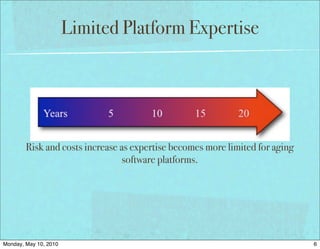
        Risk and costs increase as expertise becomes more limited for aging
                                 software platforms.


Monday, May 10, 2010                                                          6
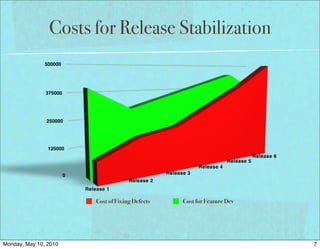
Costs for Release Stabilization
               500000


               375000


               250000


                125000
                                                                                             Release 6
                                                                                 Release 5
                                                                     Release 4
                        0                                Release 3
                                             Release 2
                            Release 1

                                Cost of Fixing Defects         Cost for Feature Dev


Monday, May 10, 2010                                                                                     7
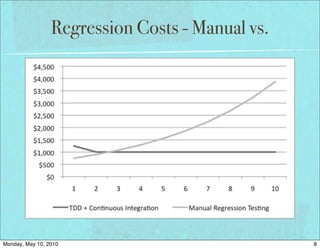
Regression Costs - Manual vs.


Monday, May 10, 2010                             8
Extreme Specialization


           Knowledge and capability to maintain legacy software decays with
           time

           Costs to maintain rarely used software platforms are higher

           Leads to waiting for people in specialized roles to finish their tasks
           in support of development effort


Monday, May 10, 2010                                                                9
Software Debt
        Creeps into software slowly and leaves organizations with liabilities


Monday, May 10, 2010                                                            10
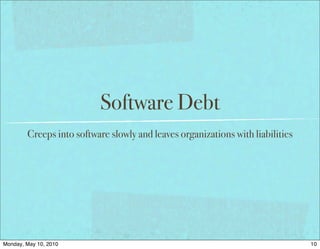
Software Debt Creeps In


                Shows a relatively new system with little software debt
                                      accrued.


Monday, May 10, 2010                                                      11
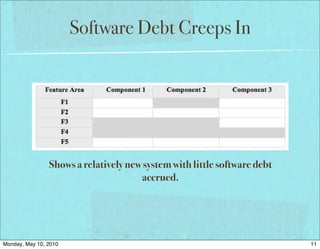
Software Debt Creeps In


      An aging software system slowly incurs significant debt in multiple
                              functional areas.


Monday, May 10, 2010                                                        12
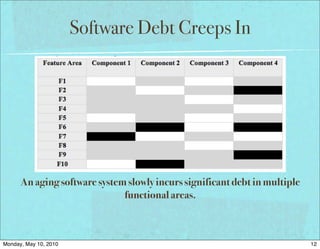
Software Debt Creeps In


   An older system has accrued significant debt in all functional areas and
                               components.


Monday, May 10, 2010                                                          13
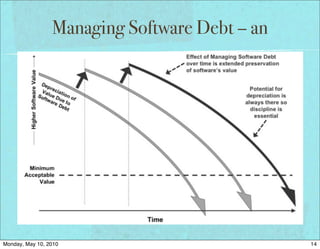
Managing Software Debt – an


Monday, May 10, 2010                           14
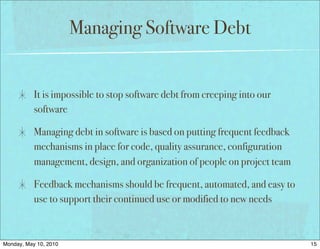
Managing Software Debt


           It is impossible to stop software debt from creeping into our
           software

           Managing debt in software is based on putting frequent feedback
           mechanisms in place for code, quality assurance, configuration
           management, design, and organization of people on project team

           Feedback mechanisms should be frequent, automated, and easy to
           use to support their continued use or modified to new needs


Monday, May 10, 2010                                                         15
Types of Software Debt


           Technical Debt

           Quality Debt

           Configuration Management Debt

           Design Debt

           Platform Experience Debt


Monday, May 10, 2010                            16
Technical Debt
      Issues in software implementation that will impede future development
                                if left unresolved


Monday, May 10, 2010                                                          17
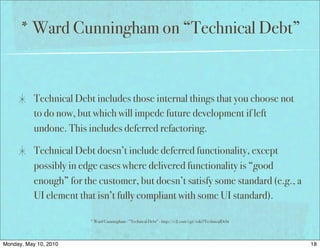
* Ward Cunningham on “Technical Debt”


           Technical Debt includes those internal things that you choose not
           to do now, but which will impede future development if left
           undone. This includes deferred refactoring.

           Technical Debt doesn’t include deferred functionality, except
           possibly in edge cases where delivered functionality is “good
           enough” for the customer, but doesn’t satisfy some standard (e.g., a
           UI element that isn’t fully compliant with some UI standard).

                         * Ward Cunningham - “Technical Debt” - http://c2.com/cgi/wiki?TechnicalDebt


Monday, May 10, 2010                                                                                   18
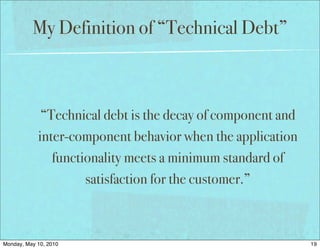
My Definition of “Technical Debt”


             “Technical debt is the decay of component and
            inter-component behavior when the application
               functionality meets a minimum standard of
                     satisfaction for the customer.”


Monday, May 10, 2010                                         19
Test-Driven Development

           Test-Driven Development (TDD)

               The “Flow”

               Integrating with Team

           Difficulties with TDD

           Example TDD Session

           Refactoring


Monday, May 10, 2010                             20
Questions for You...

           How many of you are practicing TDD?

           What issues are you having currently with TDD?


Monday, May 10, 2010                                        21
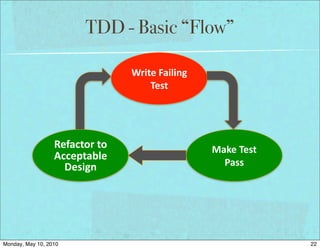
TDD - Basic “Flow”


Monday, May 10, 2010                        22
TDD - Basic “Flow”

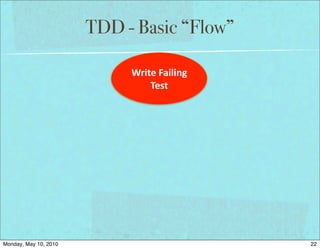
                            Write	
  Failing	
  
                                Test


Monday, May 10, 2010                               22
TDD - Basic “Flow”

                            Write	
  Failing	
  
                                Test


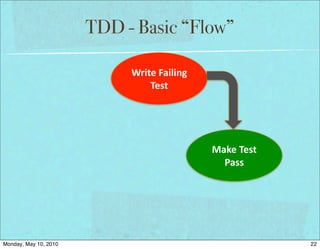
                                                   Make	
  Test	
  
                                                     Pass


Monday, May 10, 2010                                                  22
TDD - Basic “Flow”

                                       Write	
  Failing	
  
                                           Test


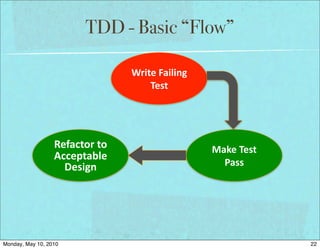
                  Refactor	
  to	
                            Make	
  Test	
  
                  Acceptable	
  
                    Design                                      Pass


Monday, May 10, 2010                                                             22
TDD - Basic “Flow”

                                       Write	
  Failing	
  
                                           Test


                  Refactor	
  to	
                            Make	
  Test	
  
                  Acceptable	
  
                    Design                                      Pass


Monday, May 10, 2010                                                             22
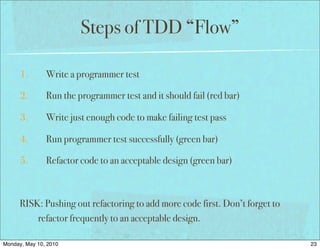
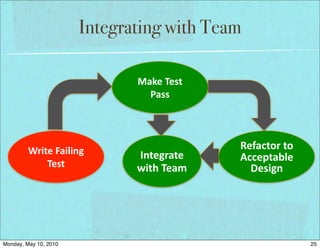
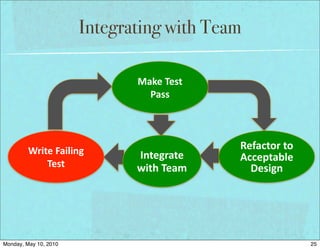
Steps of TDD “Flow”

      1.       Write a programmer test

      2.       Run the programmer test and it should fail (red bar)

      3.       Write just enough code to make failing test pass

      4.       Run programmer test successfully (green bar)

      5.       Refactor code to an acceptable design (green bar)


      RISK: Pushing out refactoring to add more code first. Don’t forget to
          refactor frequently to an acceptable design.

Monday, May 10, 2010                                                          23
Be a User --
     “What should the software do next
          This question helps you to decide what the next programmer test
                                   should model


Monday, May 10, 2010                                                        24
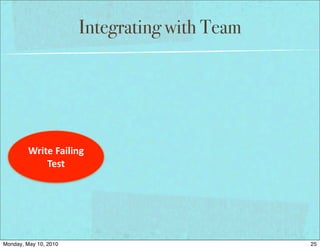
Integrating with Team


Monday, May 10, 2010                           25
Integrating with Team


         Write	
  Failing	
  
             Test


Monday, May 10, 2010                              25
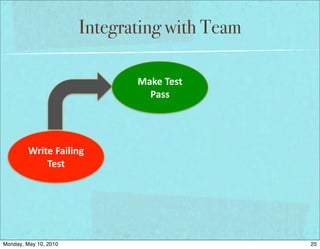
Integrating with Team

                                 Make	
  Test	
  
                                   Pass


         Write	
  Failing	
  
             Test


Monday, May 10, 2010                                25
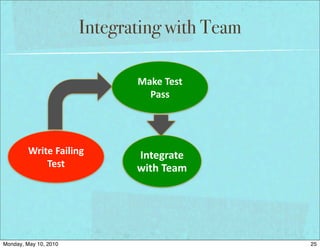
Integrating with Team

                                 Make	
  Test	
  
                                   Pass


         Write	
  Failing	
      Integrate	
  
             Test                with	
  Team


Monday, May 10, 2010                                25
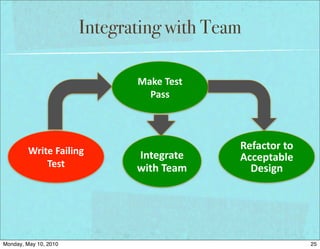
Integrating with Team

                                 Make	
  Test	
  
                                   Pass


         Write	
  Failing	
                         Refactor	
  to	
  
                                 Integrate	
        Acceptable	
  
             Test                with	
  Team         Design


Monday, May 10, 2010                                                     25
Integrating with Team

                                 Make	
  Test	
  
                                   Pass


         Write	
  Failing	
                         Refactor	
  to	
  
                                 Integrate	
        Acceptable	
  
             Test                with	
  Team         Design


Monday, May 10, 2010                                                     25
Integrating with Team

                                 Make	
  Test	
  
                                   Pass


         Write	
  Failing	
                         Refactor	
  to	
  
                                 Integrate	
        Acceptable	
  
             Test                with	
  Team         Design


Monday, May 10, 2010                                                     25
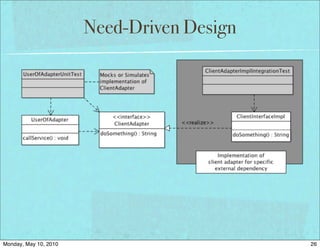
Need-Driven Design


Monday, May 10, 2010                        26
Test-Driven Development

               What Causes TDD to be so Difficult to Implement Well?


Monday, May 10, 2010                                                   27
Impediments to TDD

      This simple technique for developing software, when used in a
       disciplined manner, will enable individuals and teams to improve
       software quality. The discipline necessary to do TDD is not easily
       attainable. Following is a list of environmental issues that lowers
       chances of effectively implementing TDD approach.


Monday, May 10, 2010                                                         28
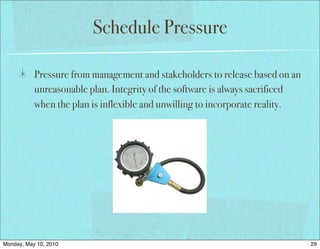
Schedule Pressure

           Pressure from management and stakeholders to release based on an
           unreasonable plan. Integrity of the software is always sacrificed
           when the plan is inflexible and unwilling to incorporate reality.


Monday, May 10, 2010                                                           29
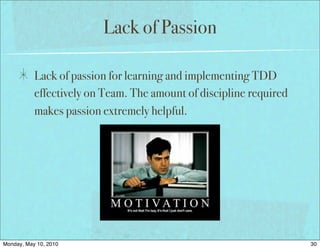
Lack of Passion

           Lack of passion for learning and implementing TDD
           effectively on Team. The amount of discipline required
           makes passion extremely helpful.


Monday, May 10, 2010                                                30
Insufficient Experience

           Insufficient team member ratio who have experience
           doing TDD well. When there is little experience on or
           coaching for the team success is minimal.


Monday, May 10, 2010                                               31
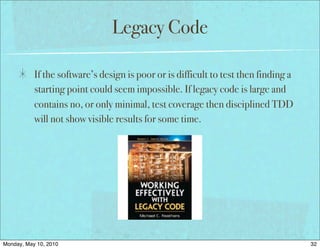
Legacy Code

           If the software’s design is poor or is difficult to test then finding a
           starting point could seem impossible. If legacy code is large and
           contains no, or only minimal, test coverage then disciplined TDD
           will not show visible results for some time.


Monday, May 10, 2010                                                                 32
Introducing TDD Approach

           To successfully adopt TDD, it is important to manage these
           environmental issues. This could include managing expectations,
           providing the Team support from a coach, and enabling sufficient
           learning of tools and techniques while working with an existing
           code base.


Monday, May 10, 2010                                                          33
Test-Driven Development

                         Quick Example


Monday, May 10, 2010                       34
Jitter – Example TDD Session
          Fake micro-blogging tool named “Jitter” is made by Seattle-based
          fictitious company that focuses on enabling coffee injected folks to
          write short messages and have common online messaging
          shorthand expanded for easy reading. The user story we are
          working on is:

              So it is easier to read their kid’s messages, Mothers want to
                    automatically expand common shorthand notation

          The acceptance criteria for this user story are:

               LOL, AFAIK, and TTYL are expandable

               Expand lower and upper case versions of shorthand
Monday, May 10, 2010                                                             35
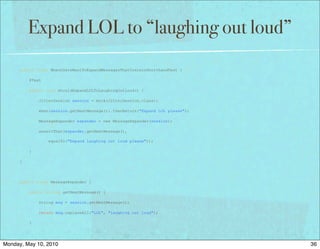
Expand LOL to “laughing out loud”
      public class WhenUsersWantToExpandMessagesThatContainShorthandTest {

          @Test

          public void shouldExpandLOLToLaughingOutLoud() {

              JitterSession session = mock(JitterSession.class);

              when(session.getNextMessage()).thenReturn("Expand LOL please");

              MessageExpander expander = new MessageExpander(session);

              assertThat(expander.getNextMessage(),

                  equalTo("Expand laughing out loud please"));

          }

      }


      public class MessageExpander {

          public String getNextMessage() {

              String msg = session.getNextMessage();

              return msg.replaceAll("LOL", "laughing out loud");

          }


Monday, May 10, 2010                                                            36
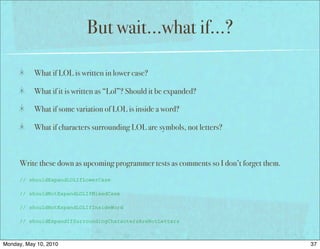
But wait…what if…?

           What if LOL is written in lower case?

           What if it is written as “Lol”? Should it be expanded?

           What if some variation of LOL is inside a word?

           What if characters surrounding LOL are symbols, not letters?


      Write these down as upcoming programmer tests as comments so I don’t forget them.
      // shouldExpandLOLIfLowerCase

      // shouldNotExpandLOLIfMixedCase

      // shouldNotExpandLOLIfInsideWord

      // shouldExpandIfSurroundingCharactersAreNotLetters


Monday, May 10, 2010                                                                      37
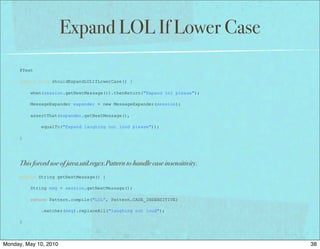
Expand LOL If Lower Case
      @Test

      public void shouldExpandLOLIfLowerCase() {

          when(session.getNextMessage()).thenReturn("Expand lol please");

          MessageExpander expander = new MessageExpander(session);

          assertThat(expander.getNextMessage(),

              equalTo("Expand laughing out loud please"));

      }


      This forced use of java.util.regex.Pattern to handle case insensitivity.
      public String getNextMessage() {

          String msg = session.getNextMessage();

          return Pattern.compile("LOL”, Pattern.CASE_INSENSITIVE)

              .matcher(msg).replaceAll("laughing out loud");

      }


Monday, May 10, 2010                                                             38
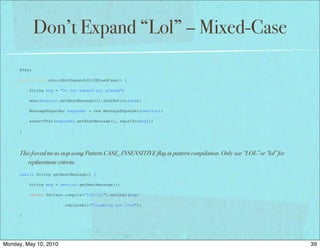
Don’t Expand “Lol” – Mixed-Case
      @Test

      public void shouldNotExpandLOLIfMixedCase() {

          String msg = "Do not expand Lol please";

          when(session.getNextMessage()).thenReturn(msg);

          MessageExpander expander = new MessageExpander(session);

          assertThat(expander.getNextMessage(), equalTo(msg));

      }


      This forced me to stop using Pattern.CASE_INSENSITIVE flag in pattern compilation. Only use “LOL” or “lol” for
         replacement criteria.
      public String getNextMessage() {

          String msg = session.getNextMessage();

          return Pattern.compile("LOL|lol").matcher(msg)
                        .replaceAll("laughing out loud");

      }


Monday, May 10, 2010                                                                                                   39
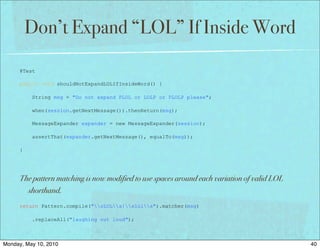
Don’t Expand “LOL” If Inside Word

      @Test

      public void shouldNotExpandLOLIfInsideWord() {
          String msg = "Do not expand PLOL or LOLP or PLOLP please";

          when(session.getNextMessage()).thenReturn(msg);

          MessageExpander expander = new MessageExpander(session);

          assertThat(expander.getNextMessage(), equalTo(msg));

      }


      The pattern matching is now modified to use spaces around each variation of valid LOL
        shorthand.
      return Pattern.compile("sLOLs|slols").matcher(msg)

          .replaceAll("laughing out loud");


Monday, May 10, 2010                                                                          40
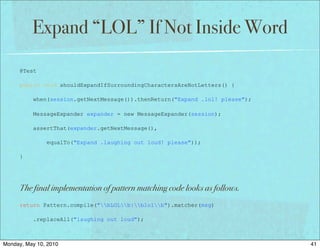
Expand “LOL” If Not Inside Word

      @Test

      public void shouldExpandIfSurroundingCharactersAreNotLetters() {

          when(session.getNextMessage()).thenReturn("Expand .lol! please");

          MessageExpander expander = new MessageExpander(session);

          assertThat(expander.getNextMessage(),

               equalTo("Expand .laughing out loud! please"));

      }


      The final implementation of pattern matching code looks as follows.
      return Pattern.compile("bLOLb|blolb").matcher(msg)

          .replaceAll("laughing out loud");


Monday, May 10, 2010                                                          41
Merciless Refactoring

           Refactoring: a disciplined technique for restructuring an existing
           body of code, altering its internal structure without changing its
           external behavior.*

           Merciless: having or showing no [mercy - showing great kindness
           toward the distressed]

           Relieve your distressed code through kindness and disciplined
           restructuring


                                * From http://www.refactoring.com/


Monday, May 10, 2010                                                            42
Where to Start Refactoring?
          Does this change directly affect feature I am working on?

          Would change add clarity for feature implementation?

          Will change add automated tests where there are none?

     If “yes” to any question above, ask following question to decide if you
        should work on it now:

          At first glance, does refactoring look like a large endeavor involving
          significant portions of the software’s components?


Monday, May 10, 2010                                                               43
When to Stop Refactoring?

           Am I refactoring code not directly affected by feature?

           Is other code directly affected by feature I am working on that has
           not been refactoring sufficiently?

           If refactoring is exploding feature estimate given to Customer then
           I should bring it up to Team to decide how we should progress

           If Team decides that refactoring can be absorbed into current
           iteration without affecting delivery on our commitments then
           continue refactor


Monday, May 10, 2010                                                             44
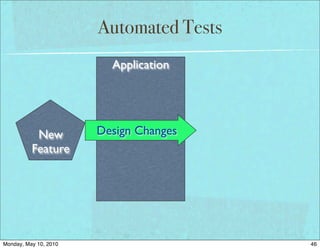
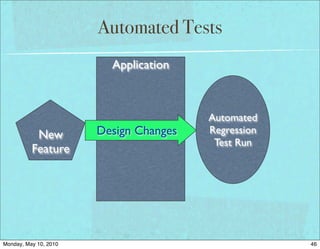
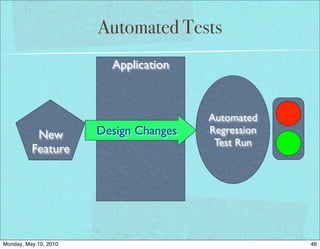
Automate Testing to Support

           Refactoring cannot be done effectively without automated tests
           surrounding code

           Start by creating automated test which fails

           If difficult to create at unit level look at automated acceptance tests
           from functional perspective

           Over time look for ways to create automated unit tests


Monday, May 10, 2010                                                                 45
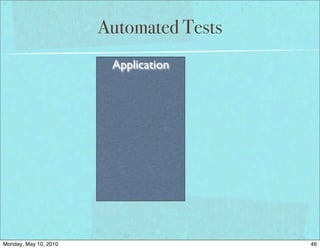
Automated Tests
                        Application


Monday, May 10, 2010                     46
Automated Tests
                        Application


           New
          Feature


Monday, May 10, 2010                     46
Automated Tests
                         Application


           New         Design Changes
          Feature


Monday, May 10, 2010                     46
Automated Tests
                         Application


                                        Automated
           New         Design Changes   Regression
                                         Test Run
          Feature


Monday, May 10, 2010                                 46
Automated Tests
                         Application


                                        Automated
           New         Design Changes   Regression
                                         Test Run
          Feature


Monday, May 10, 2010                                 46
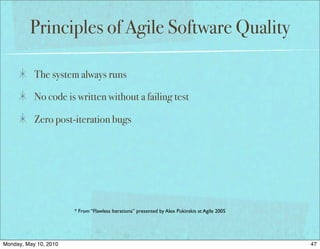
Principles of Agile Software Quality

           The system always runs

           No code is written without a failing test

           Zero post-iteration bugs


                       * From “Flawless Iterations” presented by Alex Pukinskis at Agile 2005


Monday, May 10, 2010                                                                            47
Quality Debt
        A lack of quality, either technical or functional, will lessen value per
                                feature added over time


Monday, May 10, 2010                                                               48
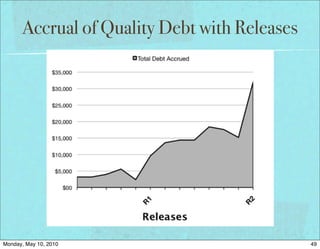
Accrual of Quality Debt with Releases


Monday, May 10, 2010                          49
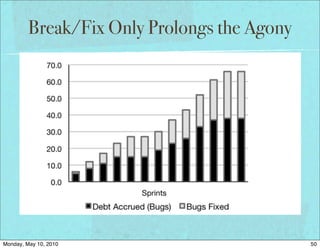
Break/Fix Only Prolongs the Agony


Monday, May 10, 2010                         50
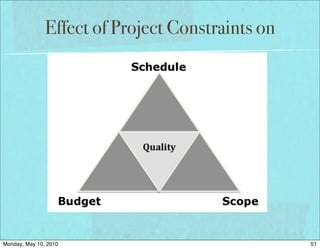
Effect of Project Constraints on


Monday, May 10, 2010                              51
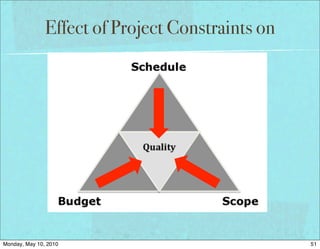
Effect of Project Constraints on


Monday, May 10, 2010                              51
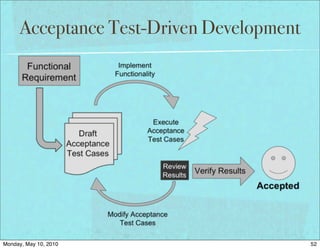
Acceptance Test-Driven Development


Monday, May 10, 2010                      52
A Fit Case Study
          Cost reduction using Fit for test automation and data conversion


Monday, May 10, 2010                                                         53
Manual Regression Testing


           Testing was taking 75 person hours during 2 full test runs
           consisting of:

               Comprehensive manual regression testing

               Data conversion and validation

           Cost for testing was $17,000 each iteration


Monday, May 10, 2010                                                    54
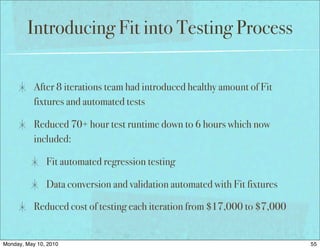
Introducing Fit into Testing Process

           After 8 iterations team had introduced healthy amount of Fit
           fixtures and automated tests

           Reduced 70+ hour test runtime down to 6 hours which now
           included:

               Fit automated regression testing

               Data conversion and validation automated with Fit fixtures

           Reduced cost of testing each iteration from $17,000 to $7,000


Monday, May 10, 2010                                                        55
Configuration Management Debt
             Creating unpredictable and error-prone release management


Monday, May 10, 2010                                                     56
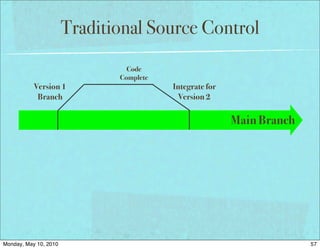
Traditional Source Control


Monday, May 10, 2010                                57
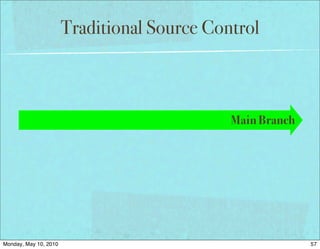
Traditional Source Control


                                             Main Branch


Monday, May 10, 2010                                       57
Traditional Source Control
                                Code
                              Complete
           Version 1                     Integrate for
            Branch                         Version 2

                                                         Main Branch


Monday, May 10, 2010                                                   57
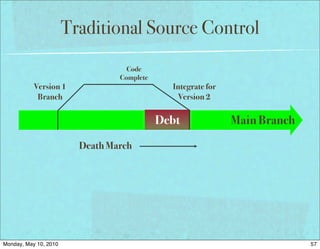
Traditional Source Control
                                   Code
                                 Complete
           Version 1                          Integrate for
            Branch                              Version 2

                                            Debt              Main Branch
                         Death March


Monday, May 10, 2010                                                        57
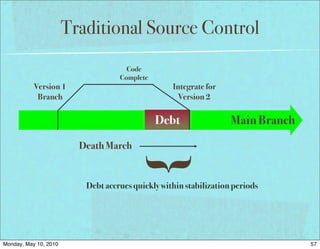
Traditional Source Control
                                     Code
                                   Complete
           Version 1                              Integrate for
            Branch                                  Version 2

                                              Debt                 Main Branch
                         Death March


                                       {
                          Debt accrues quickly within stabilization periods


Monday, May 10, 2010                                                             57
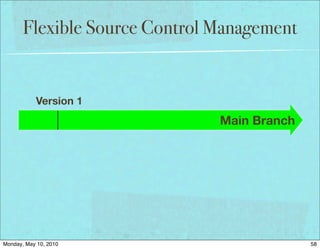
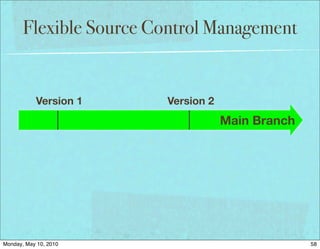
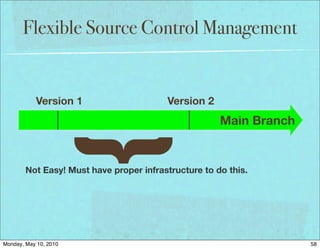
Flexible Source Control Management


Monday, May 10, 2010                        58
Flexible Source Control Management


                               Main Branch


Monday, May 10, 2010                         58
Flexible Source Control Management


           Version 1
                               Main Branch


Monday, May 10, 2010                         58
Flexible Source Control Management


           Version 1    Version 2
                                    Main Branch


Monday, May 10, 2010                              58
Flexible Source Control Management


           Version 1                     Version 2
                                                      Main Branch

                {
        Not Easy! Must have proper infrastructure to do this.


Monday, May 10, 2010                                                58
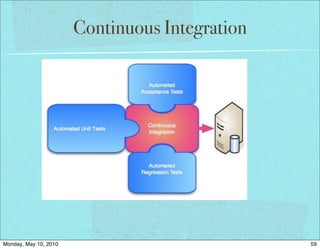
Continuous Integration


Monday, May 10, 2010                            59
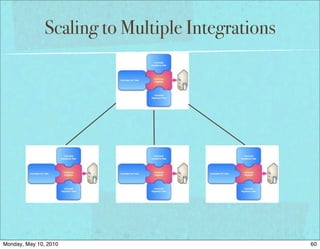
Scaling to Multiple Integrations


Monday, May 10, 2010                              60
Design Debt
             Design decays when not attended to so design your software
                                   continually


Monday, May 10, 2010                                                      61
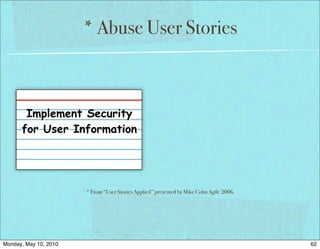
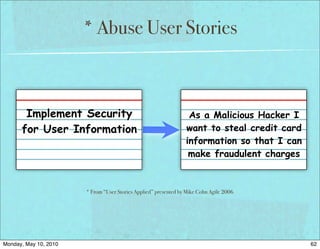
* Abuse User Stories


       Implement Security
      for User Information


                       * From “User Stories Applied” presented by Mike Cohn Agile 2006


Monday, May 10, 2010                                                                     62
* Abuse User Stories


       Implement Security                                         As a Malicious Hacker I
      for User Information                                       want to steal credit card
                                                                 information so that I can
                                                                  make fraudulent charges


                       * From “User Stories Applied” presented by Mike Cohn Agile 2006


Monday, May 10, 2010                                                                         62
Platform Experience Debt
        Silos of knowledge and increased specialization will increase cost of
                             maintenance over time


Monday, May 10, 2010                                                            63
Team Configuration Patterns


           Virtual Architect Pattern

           Integration Team Pattern

           Component Shepherd Pattern

           Team Architect Pattern


Monday, May 10, 2010                            64
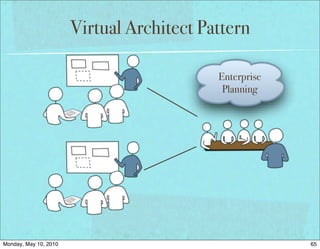
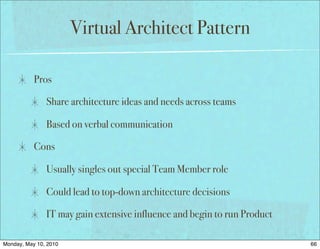
Virtual Architect Pattern

                                           Enterprise
                                            Planning


Monday, May 10, 2010                                    65
Virtual Architect Pattern

           Pros

               Share architecture ideas and needs across teams

               Based on verbal communication

           Cons

               Usually singles out special Team Member role

               Could lead to top-down architecture decisions

               IT may gain extensive influence and begin to run Product

Monday, May 10, 2010                                                      66
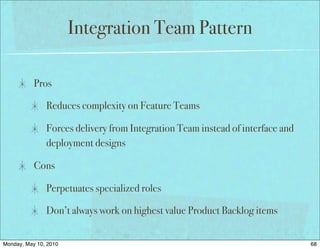
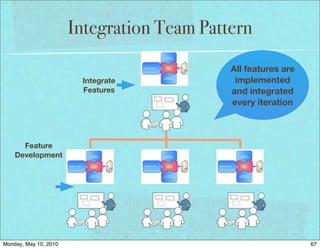
Integration Team Pattern
                                            All features are
                        Integrate            implemented
                        Features            and integrated
                                            every iteration


      Feature
    Development


Monday, May 10, 2010                                           67
Integration Team Pattern

           Pros

               Reduces complexity on Feature Teams

               Forces delivery from Integration Team instead of interface and
               deployment designs

           Cons

               Perpetuates specialized roles

               Don’t always work on highest value Product Backlog items


Monday, May 10, 2010                                                            68
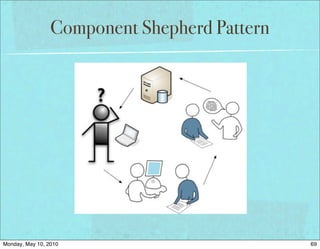
Component Shepherd Pattern


Monday, May 10, 2010                          69
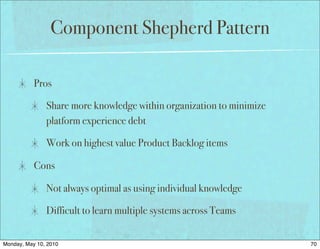
Component Shepherd Pattern

           Pros

               Share more knowledge within organization to minimize
               platform experience debt

               Work on highest value Product Backlog items

           Cons

               Not always optimal as using individual knowledge

               Difficult to learn multiple systems across Teams


Monday, May 10, 2010                                                  70
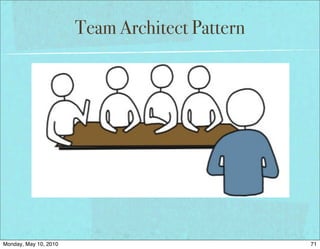
Team Architect Pattern


Monday, May 10, 2010                            71
Team Architect Pattern


           Pros

               Team owns architecture decisions

               Decisions are made close to implementation concerns

           Cons

               May not have appropriate experience on Team

               Team could get “stuck” on architecture decisions


Monday, May 10, 2010                                                 72
What is possible?
         High quality can be attained and should enable accelerated feature
                                delivery at same time.


Monday, May 10, 2010                                                          73
A Story: Field Support Application

           2000+ users access application each day

           Application supports multiple perspectives and workflows from Field
           Support Operations to Customer Service

           Team of 5 people delivering features on existing Cold Fusion platform
           implementation

           Migrating to Spring/Hibernate in slices while delivering valuable features

           36 2-week Sprints, 33 production releases, and only 1 defect found in
           production

           So, what was the defect you say? Let me tell you…

Monday, May 10, 2010                                                                    74
Lets wrap this up...
                        What should I take away from this?


Monday, May 10, 2010                                         75
Principles for Managing Software Debt

           Maintain one list of work

           Emphasize quality

           Evolve tools and infrastructure continually

           Improve system design always

           Share knowledge across the organization

           And most importantly, get the right people to work on your
           software!


Monday, May 10, 2010                                                    76

UW Agile CP202 Class 3 Managing Software Debt

  • 1.
    UW Agile CP202Class 3: Managing Software Debt Continued Delivery of High Value as Systems Age Chris Sterling Technology Consultant / Agile Coach / Certified Scrum Trainer Sterling Barton, LLC Web: www.SterlingBarton.com Email: chris@sterlingbarton.com Blog: www.GettingAgile.com Follow Me on Twitter: @csterwa Hash Tag for Presentation: #swdebt Monday, May 10, 2010 1
  • 2.
    Topics Being Covered Problems Found with Aging Software Software Debt Explained Technical Debt Quality Debt Configuration Management Debt Design Debt Platform Experience Debt The Wrap Up A Story of What is Possible Monday, May 10, 2010 2
  • 3.
    Problems Found withAging Software Software gets difficult to add features to as it ages Business expectations do not lessen as software ages Software must remain maintainable and changeable to meet needs of business over time Monday, May 10, 2010 3
  • 4.
    Lack of emphasison software quality attributes contributes to decay Monday, May 10, 2010 4
  • 5.
    Like-to-Like Migrations “It will be easy since we worked on the original version” - although we understand the domain we will be fighting with new features, technology, tools, and processes “We don’t have any other options” - Refactoring and test automation are potential alternatives to like-to-like migrations. Monday, May 10, 2010 5
  • 6.
    Limited Platform Expertise Risk and costs increase as expertise becomes more limited for aging software platforms. Monday, May 10, 2010 6
  • 7.
    Costs for ReleaseStabilization 500000 375000 250000 125000 Release 6 Release 5 Release 4 0 Release 3 Release 2 Release 1 Cost of Fixing Defects Cost for Feature Dev Monday, May 10, 2010 7
  • 8.
    Regression Costs -Manual vs. Monday, May 10, 2010 8
  • 9.
    Extreme Specialization Knowledge and capability to maintain legacy software decays with time Costs to maintain rarely used software platforms are higher Leads to waiting for people in specialized roles to finish their tasks in support of development effort Monday, May 10, 2010 9
  • 10.
    Software Debt Creeps into software slowly and leaves organizations with liabilities Monday, May 10, 2010 10
  • 11.
    Software Debt CreepsIn Shows a relatively new system with little software debt accrued. Monday, May 10, 2010 11
  • 12.
    Software Debt CreepsIn An aging software system slowly incurs significant debt in multiple functional areas. Monday, May 10, 2010 12
  • 13.
    Software Debt CreepsIn An older system has accrued significant debt in all functional areas and components. Monday, May 10, 2010 13
  • 14.
    Managing Software Debt– an Monday, May 10, 2010 14
  • 15.
    Managing Software Debt It is impossible to stop software debt from creeping into our software Managing debt in software is based on putting frequent feedback mechanisms in place for code, quality assurance, configuration management, design, and organization of people on project team Feedback mechanisms should be frequent, automated, and easy to use to support their continued use or modified to new needs Monday, May 10, 2010 15
  • 16.
    Types of SoftwareDebt Technical Debt Quality Debt Configuration Management Debt Design Debt Platform Experience Debt Monday, May 10, 2010 16
  • 17.
    Technical Debt Issues in software implementation that will impede future development if left unresolved Monday, May 10, 2010 17
  • 18.
    * Ward Cunninghamon “Technical Debt” Technical Debt includes those internal things that you choose not to do now, but which will impede future development if left undone. This includes deferred refactoring. Technical Debt doesn’t include deferred functionality, except possibly in edge cases where delivered functionality is “good enough” for the customer, but doesn’t satisfy some standard (e.g., a UI element that isn’t fully compliant with some UI standard). * Ward Cunningham - “Technical Debt” - http://c2.com/cgi/wiki?TechnicalDebt Monday, May 10, 2010 18
  • 19.
    My Definition of“Technical Debt” “Technical debt is the decay of component and inter-component behavior when the application functionality meets a minimum standard of satisfaction for the customer.” Monday, May 10, 2010 19
  • 20.
    Test-Driven Development Test-Driven Development (TDD) The “Flow” Integrating with Team Difficulties with TDD Example TDD Session Refactoring Monday, May 10, 2010 20
  • 21.
    Questions for You... How many of you are practicing TDD? What issues are you having currently with TDD? Monday, May 10, 2010 21
  • 22.
    TDD - Basic“Flow” Monday, May 10, 2010 22
  • 23.
    TDD - Basic“Flow” Write  Failing   Test Monday, May 10, 2010 22
  • 24.
    TDD - Basic“Flow” Write  Failing   Test Make  Test   Pass Monday, May 10, 2010 22
  • 25.
    TDD - Basic“Flow” Write  Failing   Test Refactor  to   Make  Test   Acceptable   Design Pass Monday, May 10, 2010 22
  • 26.
    TDD - Basic“Flow” Write  Failing   Test Refactor  to   Make  Test   Acceptable   Design Pass Monday, May 10, 2010 22
  • 27.
    Steps of TDD“Flow” 1. Write a programmer test 2. Run the programmer test and it should fail (red bar) 3. Write just enough code to make failing test pass 4. Run programmer test successfully (green bar) 5. Refactor code to an acceptable design (green bar) RISK: Pushing out refactoring to add more code first. Don’t forget to refactor frequently to an acceptable design. Monday, May 10, 2010 23
  • 28.
    Be a User-- “What should the software do next This question helps you to decide what the next programmer test should model Monday, May 10, 2010 24
  • 29.
  • 30.
    Integrating with Team Write  Failing   Test Monday, May 10, 2010 25
  • 31.
    Integrating with Team Make  Test   Pass Write  Failing   Test Monday, May 10, 2010 25
  • 32.
    Integrating with Team Make  Test   Pass Write  Failing   Integrate   Test with  Team Monday, May 10, 2010 25
  • 33.
    Integrating with Team Make  Test   Pass Write  Failing   Refactor  to   Integrate   Acceptable   Test with  Team Design Monday, May 10, 2010 25
  • 34.
    Integrating with Team Make  Test   Pass Write  Failing   Refactor  to   Integrate   Acceptable   Test with  Team Design Monday, May 10, 2010 25
  • 35.
    Integrating with Team Make  Test   Pass Write  Failing   Refactor  to   Integrate   Acceptable   Test with  Team Design Monday, May 10, 2010 25
  • 36.
  • 37.
    Test-Driven Development What Causes TDD to be so Difficult to Implement Well? Monday, May 10, 2010 27
  • 38.
    Impediments to TDD This simple technique for developing software, when used in a disciplined manner, will enable individuals and teams to improve software quality. The discipline necessary to do TDD is not easily attainable. Following is a list of environmental issues that lowers chances of effectively implementing TDD approach. Monday, May 10, 2010 28
  • 39.
    Schedule Pressure Pressure from management and stakeholders to release based on an unreasonable plan. Integrity of the software is always sacrificed when the plan is inflexible and unwilling to incorporate reality. Monday, May 10, 2010 29
  • 40.
    Lack of Passion Lack of passion for learning and implementing TDD effectively on Team. The amount of discipline required makes passion extremely helpful. Monday, May 10, 2010 30
  • 41.
    Insufficient Experience Insufficient team member ratio who have experience doing TDD well. When there is little experience on or coaching for the team success is minimal. Monday, May 10, 2010 31
  • 42.
    Legacy Code If the software’s design is poor or is difficult to test then finding a starting point could seem impossible. If legacy code is large and contains no, or only minimal, test coverage then disciplined TDD will not show visible results for some time. Monday, May 10, 2010 32
  • 43.
    Introducing TDD Approach To successfully adopt TDD, it is important to manage these environmental issues. This could include managing expectations, providing the Team support from a coach, and enabling sufficient learning of tools and techniques while working with an existing code base. Monday, May 10, 2010 33
  • 44.
    Test-Driven Development Quick Example Monday, May 10, 2010 34
  • 45.
    Jitter – ExampleTDD Session Fake micro-blogging tool named “Jitter” is made by Seattle-based fictitious company that focuses on enabling coffee injected folks to write short messages and have common online messaging shorthand expanded for easy reading. The user story we are working on is: So it is easier to read their kid’s messages, Mothers want to automatically expand common shorthand notation The acceptance criteria for this user story are: LOL, AFAIK, and TTYL are expandable Expand lower and upper case versions of shorthand Monday, May 10, 2010 35
  • 46.
    Expand LOL to“laughing out loud” public class WhenUsersWantToExpandMessagesThatContainShorthandTest { @Test public void shouldExpandLOLToLaughingOutLoud() { JitterSession session = mock(JitterSession.class); when(session.getNextMessage()).thenReturn("Expand LOL please"); MessageExpander expander = new MessageExpander(session); assertThat(expander.getNextMessage(), equalTo("Expand laughing out loud please")); } } public class MessageExpander { public String getNextMessage() { String msg = session.getNextMessage(); return msg.replaceAll("LOL", "laughing out loud"); } Monday, May 10, 2010 36
  • 47.
    But wait…what if…? What if LOL is written in lower case? What if it is written as “Lol”? Should it be expanded? What if some variation of LOL is inside a word? What if characters surrounding LOL are symbols, not letters? Write these down as upcoming programmer tests as comments so I don’t forget them. // shouldExpandLOLIfLowerCase // shouldNotExpandLOLIfMixedCase // shouldNotExpandLOLIfInsideWord // shouldExpandIfSurroundingCharactersAreNotLetters Monday, May 10, 2010 37
  • 48.
    Expand LOL IfLower Case @Test public void shouldExpandLOLIfLowerCase() { when(session.getNextMessage()).thenReturn("Expand lol please"); MessageExpander expander = new MessageExpander(session); assertThat(expander.getNextMessage(), equalTo("Expand laughing out loud please")); } This forced use of java.util.regex.Pattern to handle case insensitivity. public String getNextMessage() { String msg = session.getNextMessage(); return Pattern.compile("LOL”, Pattern.CASE_INSENSITIVE) .matcher(msg).replaceAll("laughing out loud"); } Monday, May 10, 2010 38
  • 49.
    Don’t Expand “Lol”– Mixed-Case @Test public void shouldNotExpandLOLIfMixedCase() { String msg = "Do not expand Lol please"; when(session.getNextMessage()).thenReturn(msg); MessageExpander expander = new MessageExpander(session); assertThat(expander.getNextMessage(), equalTo(msg)); } This forced me to stop using Pattern.CASE_INSENSITIVE flag in pattern compilation. Only use “LOL” or “lol” for replacement criteria. public String getNextMessage() { String msg = session.getNextMessage(); return Pattern.compile("LOL|lol").matcher(msg) .replaceAll("laughing out loud"); } Monday, May 10, 2010 39
  • 50.
    Don’t Expand “LOL”If Inside Word @Test public void shouldNotExpandLOLIfInsideWord() { String msg = "Do not expand PLOL or LOLP or PLOLP please"; when(session.getNextMessage()).thenReturn(msg); MessageExpander expander = new MessageExpander(session); assertThat(expander.getNextMessage(), equalTo(msg)); } The pattern matching is now modified to use spaces around each variation of valid LOL shorthand. return Pattern.compile("sLOLs|slols").matcher(msg) .replaceAll("laughing out loud"); Monday, May 10, 2010 40
  • 51.
    Expand “LOL” IfNot Inside Word @Test public void shouldExpandIfSurroundingCharactersAreNotLetters() { when(session.getNextMessage()).thenReturn("Expand .lol! please"); MessageExpander expander = new MessageExpander(session); assertThat(expander.getNextMessage(), equalTo("Expand .laughing out loud! please")); } The final implementation of pattern matching code looks as follows. return Pattern.compile("bLOLb|blolb").matcher(msg) .replaceAll("laughing out loud"); Monday, May 10, 2010 41
  • 52.
    Merciless Refactoring Refactoring: a disciplined technique for restructuring an existing body of code, altering its internal structure without changing its external behavior.* Merciless: having or showing no [mercy - showing great kindness toward the distressed] Relieve your distressed code through kindness and disciplined restructuring * From http://www.refactoring.com/ Monday, May 10, 2010 42
  • 53.
    Where to StartRefactoring? Does this change directly affect feature I am working on? Would change add clarity for feature implementation? Will change add automated tests where there are none? If “yes” to any question above, ask following question to decide if you should work on it now: At first glance, does refactoring look like a large endeavor involving significant portions of the software’s components? Monday, May 10, 2010 43
  • 54.
    When to StopRefactoring? Am I refactoring code not directly affected by feature? Is other code directly affected by feature I am working on that has not been refactoring sufficiently? If refactoring is exploding feature estimate given to Customer then I should bring it up to Team to decide how we should progress If Team decides that refactoring can be absorbed into current iteration without affecting delivery on our commitments then continue refactor Monday, May 10, 2010 44
  • 55.
    Automate Testing toSupport Refactoring cannot be done effectively without automated tests surrounding code Start by creating automated test which fails If difficult to create at unit level look at automated acceptance tests from functional perspective Over time look for ways to create automated unit tests Monday, May 10, 2010 45
  • 56.
    Automated Tests Application Monday, May 10, 2010 46
  • 57.
    Automated Tests Application New Feature Monday, May 10, 2010 46
  • 58.
    Automated Tests Application New Design Changes Feature Monday, May 10, 2010 46
  • 59.
    Automated Tests Application Automated New Design Changes Regression Test Run Feature Monday, May 10, 2010 46
  • 60.
    Automated Tests Application Automated New Design Changes Regression Test Run Feature Monday, May 10, 2010 46
  • 61.
    Principles of AgileSoftware Quality The system always runs No code is written without a failing test Zero post-iteration bugs * From “Flawless Iterations” presented by Alex Pukinskis at Agile 2005 Monday, May 10, 2010 47
  • 62.
    Quality Debt A lack of quality, either technical or functional, will lessen value per feature added over time Monday, May 10, 2010 48
  • 63.
    Accrual of QualityDebt with Releases Monday, May 10, 2010 49
  • 64.
    Break/Fix Only Prolongsthe Agony Monday, May 10, 2010 50
  • 65.
    Effect of ProjectConstraints on Monday, May 10, 2010 51
  • 66.
    Effect of ProjectConstraints on Monday, May 10, 2010 51
  • 67.
  • 68.
    A Fit CaseStudy Cost reduction using Fit for test automation and data conversion Monday, May 10, 2010 53
  • 69.
    Manual Regression Testing Testing was taking 75 person hours during 2 full test runs consisting of: Comprehensive manual regression testing Data conversion and validation Cost for testing was $17,000 each iteration Monday, May 10, 2010 54
  • 70.
    Introducing Fit intoTesting Process After 8 iterations team had introduced healthy amount of Fit fixtures and automated tests Reduced 70+ hour test runtime down to 6 hours which now included: Fit automated regression testing Data conversion and validation automated with Fit fixtures Reduced cost of testing each iteration from $17,000 to $7,000 Monday, May 10, 2010 55
  • 71.
    Configuration Management Debt Creating unpredictable and error-prone release management Monday, May 10, 2010 56
  • 72.
  • 73.
    Traditional Source Control Main Branch Monday, May 10, 2010 57
  • 74.
    Traditional Source Control Code Complete Version 1 Integrate for Branch Version 2 Main Branch Monday, May 10, 2010 57
  • 75.
    Traditional Source Control Code Complete Version 1 Integrate for Branch Version 2 Debt Main Branch Death March Monday, May 10, 2010 57
  • 76.
    Traditional Source Control Code Complete Version 1 Integrate for Branch Version 2 Debt Main Branch Death March { Debt accrues quickly within stabilization periods Monday, May 10, 2010 57
  • 77.
    Flexible Source ControlManagement Monday, May 10, 2010 58
  • 78.
    Flexible Source ControlManagement Main Branch Monday, May 10, 2010 58
  • 79.
    Flexible Source ControlManagement Version 1 Main Branch Monday, May 10, 2010 58
  • 80.
    Flexible Source ControlManagement Version 1 Version 2 Main Branch Monday, May 10, 2010 58
  • 81.
    Flexible Source ControlManagement Version 1 Version 2 Main Branch { Not Easy! Must have proper infrastructure to do this. Monday, May 10, 2010 58
  • 82.
  • 83.
    Scaling to MultipleIntegrations Monday, May 10, 2010 60
  • 84.
    Design Debt Design decays when not attended to so design your software continually Monday, May 10, 2010 61
  • 85.
    * Abuse UserStories Implement Security for User Information * From “User Stories Applied” presented by Mike Cohn Agile 2006 Monday, May 10, 2010 62
  • 86.
    * Abuse UserStories Implement Security As a Malicious Hacker I for User Information want to steal credit card information so that I can make fraudulent charges * From “User Stories Applied” presented by Mike Cohn Agile 2006 Monday, May 10, 2010 62
  • 87.
    Platform Experience Debt Silos of knowledge and increased specialization will increase cost of maintenance over time Monday, May 10, 2010 63
  • 88.
    Team Configuration Patterns Virtual Architect Pattern Integration Team Pattern Component Shepherd Pattern Team Architect Pattern Monday, May 10, 2010 64
  • 89.
    Virtual Architect Pattern Enterprise Planning Monday, May 10, 2010 65
  • 90.
    Virtual Architect Pattern Pros Share architecture ideas and needs across teams Based on verbal communication Cons Usually singles out special Team Member role Could lead to top-down architecture decisions IT may gain extensive influence and begin to run Product Monday, May 10, 2010 66
  • 91.
    Integration Team Pattern All features are Integrate implemented Features and integrated every iteration Feature Development Monday, May 10, 2010 67
  • 92.
    Integration Team Pattern Pros Reduces complexity on Feature Teams Forces delivery from Integration Team instead of interface and deployment designs Cons Perpetuates specialized roles Don’t always work on highest value Product Backlog items Monday, May 10, 2010 68
  • 93.
  • 94.
    Component Shepherd Pattern Pros Share more knowledge within organization to minimize platform experience debt Work on highest value Product Backlog items Cons Not always optimal as using individual knowledge Difficult to learn multiple systems across Teams Monday, May 10, 2010 70
  • 95.
  • 96.
    Team Architect Pattern Pros Team owns architecture decisions Decisions are made close to implementation concerns Cons May not have appropriate experience on Team Team could get “stuck” on architecture decisions Monday, May 10, 2010 72
  • 97.
    What is possible? High quality can be attained and should enable accelerated feature delivery at same time. Monday, May 10, 2010 73
  • 98.
    A Story: FieldSupport Application 2000+ users access application each day Application supports multiple perspectives and workflows from Field Support Operations to Customer Service Team of 5 people delivering features on existing Cold Fusion platform implementation Migrating to Spring/Hibernate in slices while delivering valuable features 36 2-week Sprints, 33 production releases, and only 1 defect found in production So, what was the defect you say? Let me tell you… Monday, May 10, 2010 74
  • 99.
    Lets wrap thisup... What should I take away from this? Monday, May 10, 2010 75
  • 100.
    Principles for ManagingSoftware Debt Maintain one list of work Emphasize quality Evolve tools and infrastructure continually Improve system design always Share knowledge across the organization And most importantly, get the right people to work on your software! Monday, May 10, 2010 76