









What is
DELEGATION?
Delegation
By Definition Is:
The assignment to another person
of formal authority (legitimate power)
and accountability for carrying out
specific activities
Distinctions That Make
A Difference
• Responsibility
 ownership
• Authority
 legitimacy
• Accountability
 obligation
What are the ADVANTAGES OF
DELEGATION?
 it increases the level of motivation of employees.
 allows for new and innovative ideas from the
employees.
 leads to development of employees' creative and
decision making skills.
 improved decision quality
 time saving - we can achieve 10 to 20 times more
through delegation than we can by doing all the
work by ourselves.
 Gain more time to do other things you've not had a
chance to complete.
 Learn how to manage people and can expand
employment.
What are the DISADVANTAGES OF
DELEGATION?
Business Risk
Burden on Employees
Tend to stop monitoring a person, and
that can cause trouble (honest mistakes,
embezzlement, etc.).
Lose control of a project or business
because it's grown in a way you can no
longer handle.
What are the GUIDELINES for effective
delegation ?
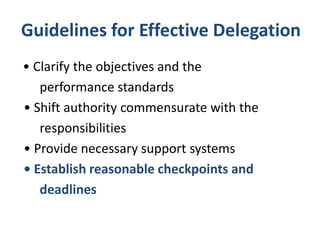
Guidelines for Effective Delegation
• Clarify the objectives and the
performance standards
Guidelines for Effective Delegation
• Clarify the objectives and the
performance standards
• Shift authority commensurate with the
responsibilities
Guidelines for Effective Delegation
• Clarify the objectives and the
performance standards
• Shift authority commensurate with the
responsibilities
• Provide necessary support systems
Guidelines for Effective Delegation
• Clarify the objectives and the
performance standards
• Shift authority commensurate with the
responsibilities
• Provide necessary support systems
• Establish reasonable checkpoints and
deadlines
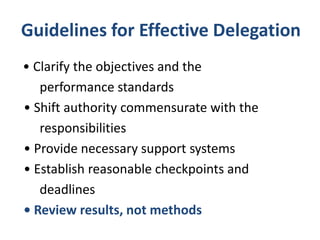
Guidelines for Effective Delegation
• Clarify the objectives and the
performance standards
• Shift authority commensurate with the
responsibilities
• Provide necessary support systems
• Establish reasonable checkpoints and
deadlines
• Review results, not methods
Task of effective delegation
1. Decide which task can be delegated.
2. Decide who should get the assignment.
3. Provide sufficient resources for carrying out
the delegated task.
4. Delegate the assignment.
5. Be prepared to run interference, if
necessary.
6. Establish a feedback system.
By: Chelloline B. Tebangin
THANK YOU!!!!!!!

what is DELEGATION?

  • 1.
  • 2.
    Delegation By Definition Is: Theassignment to another person of formal authority (legitimate power) and accountability for carrying out specific activities
  • 3.
    Distinctions That Make ADifference • Responsibility  ownership • Authority  legitimacy • Accountability  obligation
  • 4.
    What are theADVANTAGES OF DELEGATION?
  • 5.
     it increasesthe level of motivation of employees.  allows for new and innovative ideas from the employees.  leads to development of employees' creative and decision making skills.  improved decision quality  time saving - we can achieve 10 to 20 times more through delegation than we can by doing all the work by ourselves.  Gain more time to do other things you've not had a chance to complete.  Learn how to manage people and can expand employment.
  • 6.
    What are theDISADVANTAGES OF DELEGATION?
  • 7.
    Business Risk Burden onEmployees Tend to stop monitoring a person, and that can cause trouble (honest mistakes, embezzlement, etc.). Lose control of a project or business because it's grown in a way you can no longer handle.
  • 8.
    What are theGUIDELINES for effective delegation ?
  • 9.
    Guidelines for EffectiveDelegation • Clarify the objectives and the performance standards
  • 10.
    Guidelines for EffectiveDelegation • Clarify the objectives and the performance standards • Shift authority commensurate with the responsibilities
  • 11.
    Guidelines for EffectiveDelegation • Clarify the objectives and the performance standards • Shift authority commensurate with the responsibilities • Provide necessary support systems
  • 12.
    Guidelines for EffectiveDelegation • Clarify the objectives and the performance standards • Shift authority commensurate with the responsibilities • Provide necessary support systems • Establish reasonable checkpoints and deadlines
  • 13.
    Guidelines for EffectiveDelegation • Clarify the objectives and the performance standards • Shift authority commensurate with the responsibilities • Provide necessary support systems • Establish reasonable checkpoints and deadlines • Review results, not methods
  • 14.
  • 15.
    Task of effectivedelegation 1. Decide which task can be delegated. 2. Decide who should get the assignment. 3. Provide sufficient resources for carrying out the delegated task. 4. Delegate the assignment. 5. Be prepared to run interference, if necessary. 6. Establish a feedback system.
  • 16.
    By: Chelloline B.Tebangin THANK YOU!!!!!!!