APPLIED ANATOMY AETIOPATHOGENESIS CLINICAL
FEATURES INVESTIGATIONS & MANAGEMENT OF
MALIGNANT DISORDERS OF SKIN
(SU.18.2 & 18.3)
Dr Sanjeev R Navalyal
Asst. Prof. Dept. of General Surgery
KLE’S JGMMMC Hubballi
Source
Bailey & Love’s Short Practice of Surgery. 28th
.Edition. Chapter 45. Page 639 to 663
SRB Manual of Surgery. 7th
.Edition. Chapter 19. Page 314 to 335
Schwartz’s Principles of Surgery. 11th
. Edition. Chapter 16.Page 528 to 534
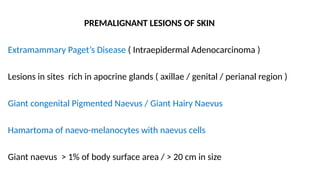
PREMALIGNANT LESIONS OF SKIN
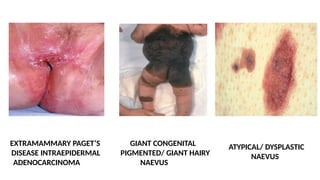
Extramammary Paget’s Disease ( Intraepidermal Adenocarcinoma )
Lesions in sites rich in apocrine glands ( axillae / genital / perianal region )
Giant congenital Pigmented Naevus / Giant Hairy Naevus
Hamartoma of naevo-melanocytes with naevus cells
Giant naevus > 1% of body surface area / > 20 cm in size
HIGH RISK SKIN CANCER LESIONS
BCC / SCC has higher risk to develop 2nd
. new skin cancers
> 2 cm in trunk & limbs
> 1cm in forehead & neck
> 6 mm in central face
Poorly defined margins
Recurrent type
Moderate / poor differentiation
Perineural / Vascular invasion
Presence of Immunosuppression
Previous Radio-therapy
ATYPICAL ( DYSPLASTIC ) NAEVUS
Three of the following characteristics
Variegated pigmentation
Ill-defined borders
Irregular surfaces
Size > 5 mm
Sporadic / Familial Atypical Multiple Mole–Melanoma ( FAMMM syndrome)
> 5 lesions confers a relative risk of melanoma
FAMMM syndrome confers 100% risk of malignant melanoma
EXTRAMAMMARY PAGET’S
DISEASE INTRAEPIDERMAL
ADENOCARCINOMA
GIANT CONGENITAL
PIGMENTED/ GIANT HAIRY
NAEVUS
ATYPICAL/ DYSPLASTIC
NAEVUS
CUTANEOUS SQUAMOUS CELL CARCINOMA / EPITHELIOMA / SCC
DEFINITION
Malignant tumour of keratinising cells of epidermis / its appendages arising from the
stratum basalis of epidermis
PREMALIGNANT CONDITIONS
Bowen’s disease
Paget’s disease
Leukoplakia
Chronic scars
Chemically induced chronic irritation
Radio-dermatitis
Senile keratosis
Cutaneous Squamous Cell Carcinoma Contd’
KANG CANCER
Seen in buttocks & heel of Tibetans due to sleeping over oven bed to avoid cold
CHIMNEY SWEEP CANCER
Observed in scrotum due to constant irritation by tar in chimney sweepers
KANGRI CANCER IN KASHMIR
Due to constant placing of hot charcoal pot ( kangri ) over abdominal wall to
avoid cold
Cutaneous Squamous Cell Carcinoma Contd’
EPIDEMIOLOGY
Second most common form of skin cancer
Sun exposure & damage in white-skinned living nearer equator
Common in men than women
Associated with chronic inflammation ( chronic sinus tracts / pre-existing scars
Osteomyelitis / burns / vaccination points ) & immunosuppression
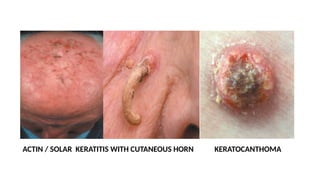
KERATOACANTHOMAS
Nodular tumours exhibiting symmetry around a central keratin-filled crater
Considered as self-healing SCCs
Twice common in men than women
Usually on face / limbs
Chronically seen in sun-damaged 50- to 70-year-old white-skinned individuals
May be caused by HPV infection in hair follicle
Associated with smoking & chemical carcinogen exposure
ACTIN / SOLAR KERATITIS WITH CUTANEOUS HORN KERATOCANTHOMA
BOWEN’S DISEASE
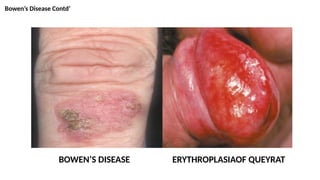
SCC in situ with dysplasia in hypertrophic AKs
Slowly enlarging erythematous scaly plaque on mucocutaneous surface
On the glans penis it is called Erythroplasia of Queyrat
Bowen’s Disease Contd’
BOWEN’S DISEASE ERYTHROPLASIAOF QUEYRAT
COMMON SITES OF SCC
Dorsum of hand
Limbs / Face & Oral cavity
Skin of abdominal wall
External genitalia
Mucocutaneous junction
Respiratory system
Oesophagus
Gall-bladder
Urinary bladder
CLINICAL FEATURES OF SCC
An Ulcerative / Ulceroproliferative / Proliferative lesion
Raised & everted edge
Indurated base & edge
Bloody discharge from lesion
Regional lymph nodes are hard / nodular / initially mobile
Fixed to underlying structures in late stages
Usually blood spread does not occur
VARIANTS OF SCC
MARJOLIN’S ULCER
SCC on chronic scar without lymph node spread
FERGUSON - SMITH SYNDROME
Self-healing SCC in face as a familial autosomal dominant ( Ch 9q ) disorder
SCC often associated with BCC
Variants Of SCC Contd’
VERRUCOUS CARCINOMA
SITES
Mucous membrane / mucocutaneous junction
FEATURES
Dry / Exophytic / Warty / Indurated growth
No lymph node spread
It has good prognosis
It is a curable malignancy
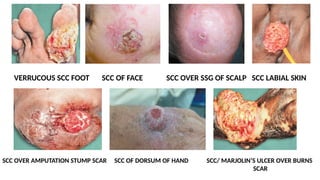
VERRUCOUS SCC FOOT SCC OF FACE SCC OVER SSG OF SCALP SCC LABIAL SKIN
SCC OVER AMPUTATION STUMP SCAR SCC OF DORSUM OF HAND SCC/ MARJOLIN’S ULCER OVER BURNS
SCAR
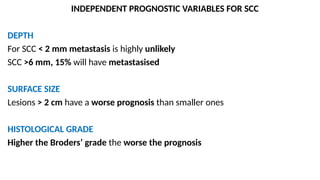
INDEPENDENT PROGNOSTIC VARIABLES FOR SCC
DEPTH
For SCC < 2 mm metastasis is highly unlikely
SCC >6 mm, 15% will have metastasised
SURFACE SIZE
Lesions > 2 cm have a worse prognosis than smaller ones
HISTOLOGICAL GRADE
Higher the Broders’ grade the worse the prognosis
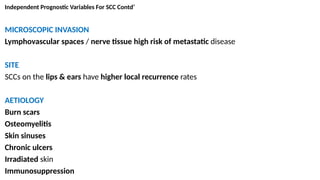
Independent Prognostic Variables For SCC Contd’
MICROSCOPIC INVASION
Lymphovascular spaces / nerve tissue high risk of metastatic disease
SITE
SCCs on the lips & ears have higher local recurrence rates
AETIOLOGY
Burn scars
Osteomyelitis
Skin sinuses
Chronic ulcers
Irradiated skin
Immunosuppression
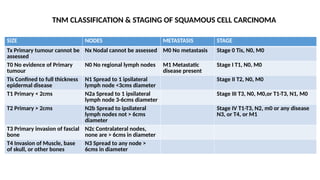
SIZE NODES METASTASIS STAGE
Tx Primary tumour cannot be
assessed
Nx Nodal cannot be assessed M0 No metastasis Stage 0 Tis, N0, M0
T0 No evidence of Primary
tumour
N0 No regional lymph nodes M1 Metastatic
disease present
Stage I T1, N0, M0
Tis Confined to full thickness
epidermal disease
N1 Spread to 1 ipsilateral
lymph node <3cms diameter
Stage II T2, N0, M0
T1 Primary < 2cms N2a Spread to 1 ipsilateral
lymph node 3-6cms diameter
Stage III T3, N0, M0,or T1-T3, N1, M0
T2 Primary > 2cms N2b Spread to ipsilateral
lymph nodes not > 6cms
diameter
Stage IV T1-T3, N2, m0 or any disease
N3, or T4, or M1
T3 Primary invasion of fascial
bone
N2c Contralateral nodes,
none are > 6cms in diameter
T4 Invasion of Muscle, base
of skull, or other bones
N3 Spread to any node >
6cms in diameter
TNM CLASSIFICATION & STAGING OF SQUAMOUS CELL CARCINOMA
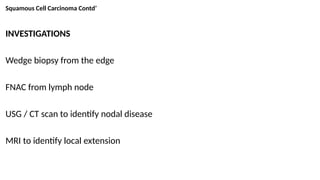
Squamous Cell Carcinoma Contd’
INVESTIGATIONS
Wedge biopsy from the edge
FNAC from lymph node
USG / CT scan to identify nodal disease
MRI to identify local extension
Squamous Cell Carcinoma Contd’
DIFFERENTIAL DIAGNOSIS
BCC
Melanoma
Keratoacanthoma
Skin adnexal tumours
Actinic keratosis
Pyogenic granuloma
Squamous Cell Carcinoma Contd’
TREATMENT
Wide excision 2 cm clearance
Tumour < 2 cm 4 mm clearance
Tumour > 2 cm 1 cm clearance
Clearance both at margin & depth
Reconstruction by primary split skin grafting (SSG / Thiersch) / Flaps
SCC Treatment Contd’
FOR LYMPH NODES
Block dissection
Curative Radiotherapy (RT)
Tumours not adherent to deeper planes / cartilage
Dose of 6000 cGy units over 6 weeks /200 units /day
SCC Treatment Contd’
ADVANCED CASES
Palliative external radiotherapy
CHEMOTHERAPY
Methotrexate
Vincristine
Bleomycin
MARJOLIN’S ULCER ( 1828)
DEFINITION
Well-differentiated Squamous Cell Carcinoma which occurs in chronic scars like
burn scar / scar of venous ulcer
FEATURES
No lymphatics in scar tissue ( not spread to lymph nodes )
Scar is relatively avascular it grows slowly
As scar does not contain nerves it is painless
It occurs in unstable scar of long duration
Marjolin’s Ulcer Contd’
CLINICAL FEATURES
History of pre-existing venous ulcer / burn scar
Indurated / painless / nontender / ulcer with raised & everted edges
Biopsy from the edge confirms the diagnosis
TREATMENT
Wide Excision
In case of large ulcer Amputation is required
Radiotherapy should not be given as it may turn into poorly differentiated SCC
It is a curable malignancy
BASAL CELL CARCINOMA / BCC ( RODENT ULCER )
DEFINITION
Slow-growing locally invasive malignant tumour of Pluripotential epithelial cells
arising from basal epidermis & hair follicles affecting the pilosebaceous skin
It does not arise from mucosa
EPIDEMIOLOGY
Strongest predisposing factor to BCC is UVR ( ultra violet rays )
Elderly / the middle-aged after excessive sun exposure
95% occurring between the ages of 40 & 80 years
Basal Cell Carcinoma Contd’
PREDISPOSING FACTORS
Exposure to arsenical compounds / coal tar / aromatic hydrocarbons
Genetic skin cancer syndromes
White-skinned people are exclusively affected
Common in men than in women
FEATURES
Commonest ( 70%) malignant skin tumour
Common site is face—above the line drawn between angle of mouth & ear
lobule (90%)—Onghren’s line
Called as Tear Cancer as it is seen in area where tears roll down
PATHOGENESIS OF BCC
No apparent precursor lesions
Development is proportional to the initial dose of the carcinogen
It is only locally malignant
Does not spread through lymphatics / blood
Erodes into local tissues causing extensive local destruction (“rodent ulcer”)
Pathology of BCC Contd’
MACROSCOPIC
Localised
Nodular
Nodulocystic
Cystic
Pigmented / Naevoid
Generalised
Pathology of BCC Contd’
SUPERFICIAL
Multifocal & superfcial spreading
INFILTRATIVE
Morphoeic ice pick & cicatrising
Geographical / Field fire / Forest fire BCC
Wide area of involvement with central scabbing & peripherally active
Pathogenesis of BCC Contd’
MICROSCOPY
Twenty-six histological subtypes have been described
Ovoid cells in nests with a single ‘palisading’ layer
Only the outer layer of cells that actively divide
Incompletely excised lesions are more aggressive
Basi - squamous—behaves like squamous cell carcinoma
Nodular & Nodulocystic variants account for 90% of BCCs
CLINICO-PATHOLOGICAL TYPES OF BCC
SUPERFICIAL TYPE
Small buds of tumour masses
MORPHEIC TYPE
Dense stroma with basal cells & type IV collagen
Spreads rapidly ( sclerosing BCC )
FIBROEPITHELIOMA TYPE
Elongated cords of basaloid cells with mesh work
BCC Contd’
CLINICAL FEATURES OF BCC
Ulcer on face in middle-aged man
Nontender / Dry / Slowly growing / Nonmobile / Raised & beaded edge
Central scab & depression / umbilication
No lymph node / blood spread
BCC Contd’
INVESTIGATIONS
Wedge biopsy
X-ray of the part
CT scan
DIFFERENTIAL DIAGNOSIS
1. Squamous cell carcinoma
2. Melanoma
3. Keratoacanthoma
4. Seborrhoeic keratosis
BCC Contd’
PROGNOSIS
HIGH-RISK BCCS
Tumours are large ( > 2 cm)
Sites where direct invasion gives access cranium ( near the eye /nose & ear )
Recurrent tumours in presence of immunosuppression
Micronodular / Infiltrating histological subtypes
TREATMENT OF BCC
RADIOTHERAPY( RT )
It is Radiosensitive
Lesion away from vital structure ( eyes ) curative radiotherapy can be given
Radiotherapy is not given if cartilage / bone invasion is present
RT is not given to BCC of ear & close to lacrimal canaliculi
INDICATIONS FOR SURGERY IN BCC
Rodent ulcer eroding into cartilage / bone
BCC close to the eye
Recurrent BCC
WIDE EXCISION
(1 cm clearance) with skin grafting / primary suturing / Z plasty
Rhomboid rotation flap is the procedure of choice
BCC Treatment Contd’
MOHS ( MICROSCOPICALLY ORIENTED HISTOGRAPHIC SURGERY )
( Federic E Mohs – American Surgeon )
INDICATIONS
Useful in BCC close to eyes / nose / ear to preserve more tissues
Done by Dermatological surgeon with a Histotechnician / Histologist
MOHS Contd’
PROCEDURE
Saucerised excision of primary tumour is done
Quadrants of specimen are mapped with different colours
Specimen is sectioned by Histotechnician from margin & depth
Studied by MOHS surgeon / Histologist
Residual tumour from relevant mapped area is excised
Procedure is repeated until clear margin & clear depth are achieved
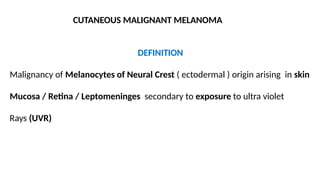
CUTANEOUS MALIGNANT MELANOMA
DEFINITION
Malignancy of Melanocytes of Neural Crest ( ectodermal ) origin arising in skin
Mucosa / Retina / Leptomeninges secondary to exposure to ultra violet
Rays (UVR)
Cutaneous Malignant Melanoma Contd’
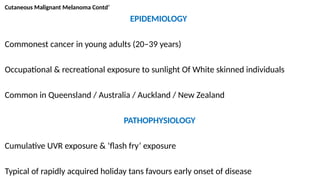
EPIDEMIOLOGY
Commonest cancer in young adults (20–39 years)
Occupational & recreational exposure to sunlight Of White skinned individuals
Common in Queensland / Australia / Auckland / New Zealand
PATHOPHYSIOLOGY
Cumulative UVR exposure & ‘flash fry’ exposure
Typical of rapidly acquired holiday tans favours early onset of disease
Cutaneous Malignant Melanoma Contd’
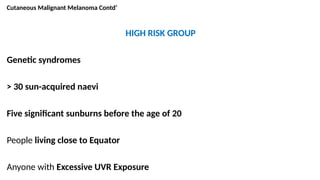
HIGH RISK GROUP
Genetic syndromes
> 30 sun-acquired naevi
Five significant sunburns before the age of 20
People living close to Equator
Anyone with Excessive UVR Exposure
Cutaneous Malignant Melanoma Contd’
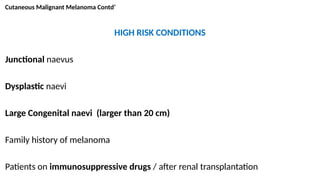
HIGH RISK CONDITIONS
Junctional naevus
Dysplastic naevi
Large Congenital naevi (larger than 20 cm)
Family history of melanoma
Patients on immunosuppressive drugs / after renal transplantation
SITES OF MALIGNANT MELANOMA
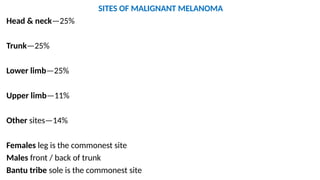
Head & neck—25%
Trunk—25%
Lower limb—25%
Upper limb—11%
Other sites—14%
Females leg is the commonest site
Males front / back of trunk
Bantu tribe sole is the commonest site
Sites of Malignant Melanoma Contd’
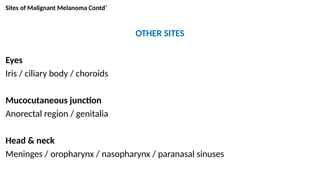
OTHER SITES
Eyes
Iris / ciliary body / choroids
Mucocutaneous junction
Anorectal region / genitalia
Head & neck
Meninges / oropharynx / nasopharynx / paranasal sinuses
CLASSIFICATIONS OF MALIGNANT MELANOMA
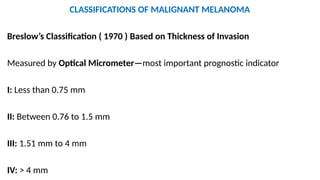
Breslow’s Classification ( 1970 ) Based on Thickness of Invasion
Measured by Optical Micrometer—most important prognostic indicator
I: Less than 0.75 mm
II: Between 0.76 to 1.5 mm
III: 1.51 mm to 4 mm
IV: > 4 mm
Malignant Melanoma Contd’
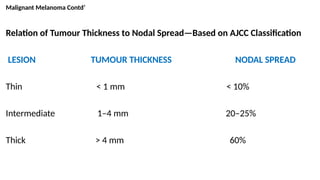
Relation of Tumour Thickness to Nodal Spread—Based on AJCC Classification
LESION TUMOUR THICKNESS NODAL SPREAD
Thin < 1 mm < 10%
Intermediate 1–4 mm 20–25%
Thick > 4 mm 60%
CLINICAL TYPES OF MELANOMA
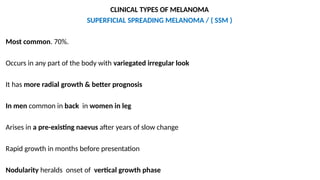
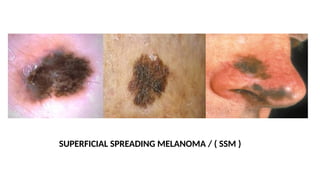
SUPERFICIAL SPREADING MELANOMA / ( SSM )
Most common. 70%.
Occurs in any part of the body with variegated irregular look
It has more radial growth & better prognosis
In men common in back in women in leg
Arises in a pre-existing naevus after years of slow change
Rapid growth in months before presentation
Nodularity heralds onset of vertical growth phase
SUPERFICIAL SPREADING MELANOMA / ( SSM )
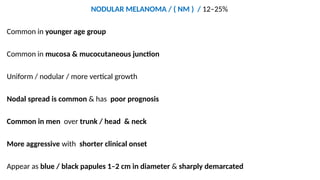
NODULAR MELANOMA / ( NM ) / 12–25%
Common in younger age group
Common in mucosa & mucocutaneous junction
Uniform / nodular / more vertical growth
Nodal spread is common & has poor prognosis
Common in men over trunk / head & neck
More aggressive with shorter clinical onset
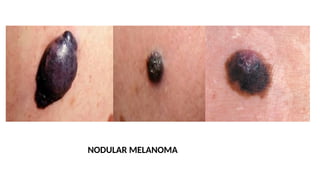
Appear as blue / black papules 1–2 cm in diameter & sharply demarcated
NODULAR MELANOMA
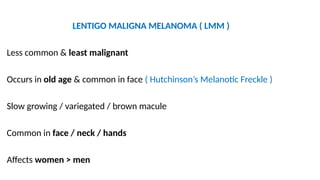
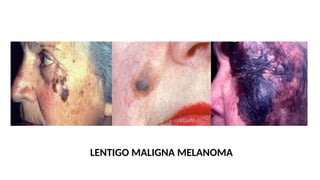
LENTIGO MALIGNA MELANOMA ( LMM )
Less common & least malignant
Occurs in old age & common in face ( Hutchinson’s Melanotic Freckle )
Slow growing / variegated / brown macule
Common in face / neck / hands
Affects women > men
LENTIGO MALIGNA MELANOMA
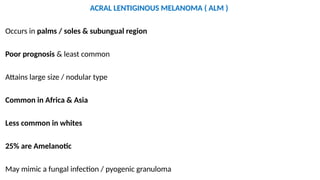
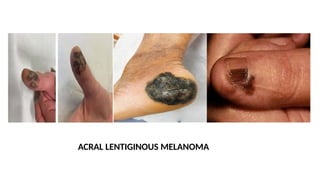
ACRAL LENTIGINOUS MELANOMA ( ALM )
Occurs in palms / soles & subungual region
Poor prognosis & least common
Attains large size / nodular type
Common in Africa & Asia
Less common in whites
25% are Amelanotic
May mimic a fungal infection / pyogenic granuloma
ACRAL LENTIGINOUS MELANOMA
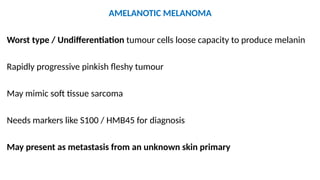
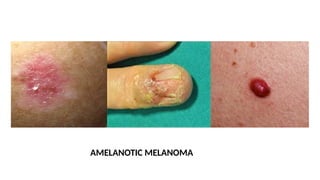
AMELANOTIC MELANOMA
Worst type / Undifferentiation tumour cells loose capacity to produce melanin
Rapidly progressive pinkish fleshy tumour
May mimic soft tissue sarcoma
Needs markers like S100 / HMB45 for diagnosis
May present as metastasis from an unknown skin primary
AMELANOTIC MELANOMA
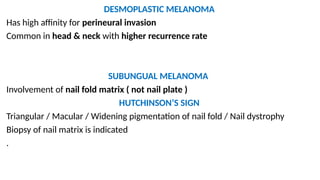
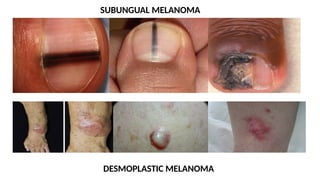
DESMOPLASTIC MELANOMA
Has high affinity for perineural invasion
Common in head & neck with higher recurrence rate
SUBUNGUAL MELANOMA
Involvement of nail fold matrix ( not nail plate )
HUTCHINSON’S SIGN
Triangular / Macular / Widening pigmentation of nail fold / Nail dystrophy
Biopsy of nail matrix is indicated
.
DESMOPLASTIC MELANOMA
SUBUNGUAL MELANOMA
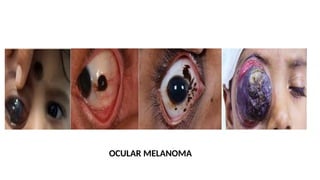
OCULAR MELANOMA
Commonest malignancy arising in eye
Arise from Retina / Iris / Ciliary body / Choroid
Rarely metastasize
Shows its distant spread to liver
Treated with Enucleation / Radiation / Photocoagulation
CLINICAL FEATURES
Induration is not seen
Ulceration / Bleeding / Itching / Change in colour
OCULAR MELANOMA
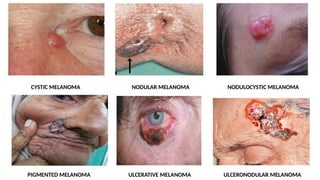
CYSTIC MELANOMA NODULAR MELANOMA NODULOCYSTIC MELANOMA
PIGMENTED MELANOMA ULCERATIVE MELANOMA ULCERONODULAR MELANOMA
When a mole turns malignant following changes should be observed
( GLASGOW CRITERIA )
MAJOR SIGNS
Change in size (diameter more than 6 mm) shape & colour
OTHER CHANGES
Inflammation / Crusting / Bleeding / Itching
Nodularity / Ulceration / Halo around a mole
Satellite lesions
Doppler positive pigmented lesions ( > 1 mm thick lesion )
FIVE MOST IMPORTANT FEATURES OF MELANOMA
Asymmetry
Border irregularity
Colour variation
Diameter > 6 mm
Elevation
SPREAD OF MELANOMA
LYMPHATICS
Regional lymph nodes either by permeation / by embolisation
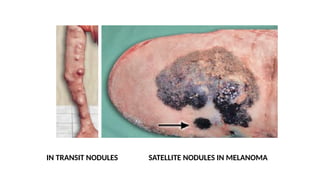
In-transit nodules / satellite nodules
Seen in the skin between the primary lesion & regional lymph node area
HAEMATOGENOUS
To lungs / liver (huge liver) / brain / skin / bones
Secondaries are typically black
IN TRANSIT NODULES SATELLITE NODULES IN MELANOMA
BLOOD SPREAD IN MELANOMA
Brain: convulsions / localising features / raised intracranial pressure
Lung: cannon ball secondaries / pleural effusion / haemoptysis / chest pain & cough
Liver: (massive liver) / ascites
Skin: cutaneous nodules often pigmented
Bones: bone pain / pathological fracture
Paraplegia / Neurological deficits in spine metastasis
Extensive visceral involvement causes Melanuria
INVESTIGATIONS IN MALIGNANT MELANOMA
No incision biopsy. It can cause early blood spread
Excision biopsy
Primary with 2 mm margin with deeper fatty tissue
Punch biopsy
In large primary tumour very close to pinna
FNAC of lymph node
USG abdomen
Liver secondaries
Chest X-ray / HRCT
Secondaries in lung (“cannon ball” appearance )
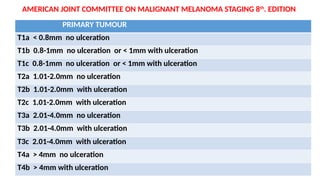
AMERICAN JOINT COMMITTEE ON MALIGNANT MELANOMA STAGING 8th
. EDITION
PRIMARY TUMOUR
T1a < 0.8mm no ulceration
T1b 0.8-1mm no ulceration or < 1mm with ulceration
T1c 0.8-1mm no ulceration or < 1mm with ulceration
T2a 1.01-2.0mm no ulceration
T2b 1.01-2.0mm with ulceration
T2c 1.01-2.0mm with ulceration
T3a 2.01-4.0mm no ulceration
T3b 2.01-4.0mm with ulceration
T3c 2.01-4.0mm with ulceration
T4a > 4mm no ulceration
T4b > 4mm with ulceration
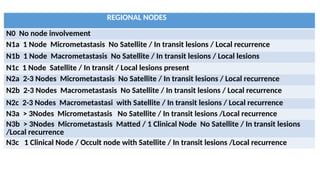
REGIONAL NODES
N0 No node involvement
N1a 1 Node Micrometastasis No Satellite / In transit lesions / Local recurrence
N1b 1 Node Macrometastasis No Satellite / In transit lesions / Local lesions
N1c 1 Node Satellite / In transit / Local lesions present
N2a 2-3 Nodes Micrometastasis No Satellite / In transit lesions / Local recurrence
N2b 2-3 Nodes Macrometastasis No Satellite / In transit lesions / Local recurrence
N2c 2-3 Nodes Macrometastasi with Satellite / In transit lesions / Local recurrence
N3a > 3Nodes Micrometastasis No Satellite / In transit lesions /Local recurrence
N3b > 3Nodes Micrometastasis Matted / 1 Clinical Node No Satellite / In transit lesions
/Local recurrence
N3c 1 Clinical Node / Occult node with Satellite / In transit lesions /Local recurrence
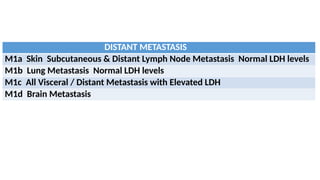
DISTANT METASTASIS
M1a Skin Subcutaneous & Distant Lymph Node Metastasis Normal LDH levels
M1b Lung Metastasis Normal LDH levels
M1c All Visceral / Distant Metastasis with Elevated LDH
M1d Brain Metastasis
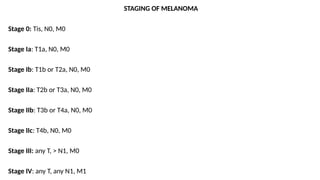
STAGING OF MELANOMA
Stage 0: Tis, N0, M0
Stage Ia: T1a, N0, M0
Stage Ib: T1b or T2a, N0, M0
Stage IIa: T2b or T3a, N0, M0
Stage IIb: T3b or T4a, N0, M0
Stage IIc: T4b, N0, M0
Stage III: any T, > N1, M0
Stage IV: any T, any N1, M1
TREATMENT OF MELANOMA
SURGERY IS THE MAIN TREATMENT
FOR PRIMARY
in situ melanoma needs 0.5 cm clearance
Melanoma < 1 mm thickness needs 1.0 cm clearance
Ance of 1–2 mm thickness needs 1–2 (1.5) cm clearance
Treatment of Melanoma Contd’
Wide & deep Primary then amputation with one joint above is done
Fingers & toes disarticulation is required
Melanoma in anal canal may require abdomino-perineal resection
Enucleation in case of melanoma in eye
MELANOMA IN PREGNANCY
Termination of pregnancy
Specific therapy for melanoma
Pregnancy should be postponed for 2 years
Treatment of Melanoma Contd’
FOR LYMPH NODE SECONDARIES
Clinically palpable lymph node FNAC of lymph node is done
CASE OF SPREAD
Regional block dissection ( ilioinguinal / axillary / neck )
FIXED LYMPH NODE
Chemotherapy is the treatment
MICROMETASTASIS
Regional block dissection is done
Treatment of Melanoma Contd’
SLNB is useful for melanoma with thickness more than 1 mm depth
Less than 1 mm thickness is considered as low-risk for metastases
1-4 mm thickness is considered as intermediate-risk for metastases
> 4 mm thickness will be considered as high-risk for metastases
Elective lymph node dissection is done when tumour thickness is 1 to 4mm.
Treatment of Melanoma Contd’
MANAGEMENT IN UNKNOWN PRIMARY
Nodal radical dissection at the region with adjuvant chemotherapy
FOR LOCO REGIONAL RECURRENT MELANOMA
Local recurrence ( within 5 cm radius of the primary tumour )
ISOLATED LIMB PERFUSION
Cytotoxic agents used
Melphalan
Interleukin 2
Tumour necrosis factor ( TNF )
LASER ABLATION
For multiple small cutaneous lesions
CHEMOTHERAPY FOR MELANOMA
INDICATIONS
Secondaries in lungs / liver / bones
After surgery for melanoma
DRUGS USED
DTIC: Diethyl Triamine Iminocarboxamide
Melphalan
Carboplatin
Vindesine
CVD REGIME— Cisplatin / Vinblastine / Dacarbazine
PROGNOSIS FOR MELANOMA
Poor since it is very aggressive tumour
Old age has worse prognosis
Females show better prognosis
Extremity melanoma has better prognosis than head & Neck
Higher the mitotic index the poorer the prognosis of primary tumour
Lymph node metastases most important prognostic index in melanoma
Number of nodes & extranodal extension are significant outcome predictors
If nodes are clinically involved 70–85% have occult distant metastases
THANK YOU

Malignant Skin Disorders dermat ppt.pptx

  • 1.
    APPLIED ANATOMY AETIOPATHOGENESISCLINICAL FEATURES INVESTIGATIONS & MANAGEMENT OF MALIGNANT DISORDERS OF SKIN (SU.18.2 & 18.3) Dr Sanjeev R Navalyal Asst. Prof. Dept. of General Surgery KLE’S JGMMMC Hubballi Source Bailey & Love’s Short Practice of Surgery. 28th .Edition. Chapter 45. Page 639 to 663 SRB Manual of Surgery. 7th .Edition. Chapter 19. Page 314 to 335 Schwartz’s Principles of Surgery. 11th . Edition. Chapter 16.Page 528 to 534
  • 2.
    PREMALIGNANT LESIONS OFSKIN Extramammary Paget’s Disease ( Intraepidermal Adenocarcinoma ) Lesions in sites rich in apocrine glands ( axillae / genital / perianal region ) Giant congenital Pigmented Naevus / Giant Hairy Naevus Hamartoma of naevo-melanocytes with naevus cells Giant naevus > 1% of body surface area / > 20 cm in size
  • 3.
    HIGH RISK SKINCANCER LESIONS BCC / SCC has higher risk to develop 2nd . new skin cancers > 2 cm in trunk & limbs > 1cm in forehead & neck > 6 mm in central face Poorly defined margins Recurrent type Moderate / poor differentiation Perineural / Vascular invasion Presence of Immunosuppression Previous Radio-therapy
  • 4.
    ATYPICAL ( DYSPLASTIC) NAEVUS Three of the following characteristics Variegated pigmentation Ill-defined borders Irregular surfaces Size > 5 mm Sporadic / Familial Atypical Multiple Mole–Melanoma ( FAMMM syndrome) > 5 lesions confers a relative risk of melanoma FAMMM syndrome confers 100% risk of malignant melanoma
  • 5.
    EXTRAMAMMARY PAGET’S DISEASE INTRAEPIDERMAL ADENOCARCINOMA GIANTCONGENITAL PIGMENTED/ GIANT HAIRY NAEVUS ATYPICAL/ DYSPLASTIC NAEVUS
  • 6.
    CUTANEOUS SQUAMOUS CELLCARCINOMA / EPITHELIOMA / SCC DEFINITION Malignant tumour of keratinising cells of epidermis / its appendages arising from the stratum basalis of epidermis PREMALIGNANT CONDITIONS Bowen’s disease Paget’s disease Leukoplakia Chronic scars Chemically induced chronic irritation Radio-dermatitis Senile keratosis
  • 7.
    Cutaneous Squamous CellCarcinoma Contd’ KANG CANCER Seen in buttocks & heel of Tibetans due to sleeping over oven bed to avoid cold CHIMNEY SWEEP CANCER Observed in scrotum due to constant irritation by tar in chimney sweepers KANGRI CANCER IN KASHMIR Due to constant placing of hot charcoal pot ( kangri ) over abdominal wall to avoid cold
  • 8.
    Cutaneous Squamous CellCarcinoma Contd’ EPIDEMIOLOGY Second most common form of skin cancer Sun exposure & damage in white-skinned living nearer equator Common in men than women Associated with chronic inflammation ( chronic sinus tracts / pre-existing scars Osteomyelitis / burns / vaccination points ) & immunosuppression
  • 9.
    KERATOACANTHOMAS Nodular tumours exhibitingsymmetry around a central keratin-filled crater Considered as self-healing SCCs Twice common in men than women Usually on face / limbs Chronically seen in sun-damaged 50- to 70-year-old white-skinned individuals May be caused by HPV infection in hair follicle Associated with smoking & chemical carcinogen exposure
  • 10.
    ACTIN / SOLARKERATITIS WITH CUTANEOUS HORN KERATOCANTHOMA
  • 11.
    BOWEN’S DISEASE SCC insitu with dysplasia in hypertrophic AKs Slowly enlarging erythematous scaly plaque on mucocutaneous surface On the glans penis it is called Erythroplasia of Queyrat
  • 12.
    Bowen’s Disease Contd’ BOWEN’SDISEASE ERYTHROPLASIAOF QUEYRAT
  • 13.
    COMMON SITES OFSCC Dorsum of hand Limbs / Face & Oral cavity Skin of abdominal wall External genitalia Mucocutaneous junction Respiratory system Oesophagus Gall-bladder Urinary bladder
  • 14.
    CLINICAL FEATURES OFSCC An Ulcerative / Ulceroproliferative / Proliferative lesion Raised & everted edge Indurated base & edge Bloody discharge from lesion Regional lymph nodes are hard / nodular / initially mobile Fixed to underlying structures in late stages Usually blood spread does not occur
  • 15.
    VARIANTS OF SCC MARJOLIN’SULCER SCC on chronic scar without lymph node spread FERGUSON - SMITH SYNDROME Self-healing SCC in face as a familial autosomal dominant ( Ch 9q ) disorder SCC often associated with BCC
  • 16.
    Variants Of SCCContd’ VERRUCOUS CARCINOMA SITES Mucous membrane / mucocutaneous junction FEATURES Dry / Exophytic / Warty / Indurated growth No lymph node spread It has good prognosis It is a curable malignancy
  • 17.
    VERRUCOUS SCC FOOTSCC OF FACE SCC OVER SSG OF SCALP SCC LABIAL SKIN SCC OVER AMPUTATION STUMP SCAR SCC OF DORSUM OF HAND SCC/ MARJOLIN’S ULCER OVER BURNS SCAR
  • 18.
    INDEPENDENT PROGNOSTIC VARIABLESFOR SCC DEPTH For SCC < 2 mm metastasis is highly unlikely SCC >6 mm, 15% will have metastasised SURFACE SIZE Lesions > 2 cm have a worse prognosis than smaller ones HISTOLOGICAL GRADE Higher the Broders’ grade the worse the prognosis
  • 19.
    Independent Prognostic VariablesFor SCC Contd’ MICROSCOPIC INVASION Lymphovascular spaces / nerve tissue high risk of metastatic disease SITE SCCs on the lips & ears have higher local recurrence rates AETIOLOGY Burn scars Osteomyelitis Skin sinuses Chronic ulcers Irradiated skin Immunosuppression
  • 20.
    SIZE NODES METASTASISSTAGE Tx Primary tumour cannot be assessed Nx Nodal cannot be assessed M0 No metastasis Stage 0 Tis, N0, M0 T0 No evidence of Primary tumour N0 No regional lymph nodes M1 Metastatic disease present Stage I T1, N0, M0 Tis Confined to full thickness epidermal disease N1 Spread to 1 ipsilateral lymph node <3cms diameter Stage II T2, N0, M0 T1 Primary < 2cms N2a Spread to 1 ipsilateral lymph node 3-6cms diameter Stage III T3, N0, M0,or T1-T3, N1, M0 T2 Primary > 2cms N2b Spread to ipsilateral lymph nodes not > 6cms diameter Stage IV T1-T3, N2, m0 or any disease N3, or T4, or M1 T3 Primary invasion of fascial bone N2c Contralateral nodes, none are > 6cms in diameter T4 Invasion of Muscle, base of skull, or other bones N3 Spread to any node > 6cms in diameter TNM CLASSIFICATION & STAGING OF SQUAMOUS CELL CARCINOMA
  • 21.
    Squamous Cell CarcinomaContd’ INVESTIGATIONS Wedge biopsy from the edge FNAC from lymph node USG / CT scan to identify nodal disease MRI to identify local extension
  • 22.
    Squamous Cell CarcinomaContd’ DIFFERENTIAL DIAGNOSIS BCC Melanoma Keratoacanthoma Skin adnexal tumours Actinic keratosis Pyogenic granuloma
  • 23.
    Squamous Cell CarcinomaContd’ TREATMENT Wide excision 2 cm clearance Tumour < 2 cm 4 mm clearance Tumour > 2 cm 1 cm clearance Clearance both at margin & depth Reconstruction by primary split skin grafting (SSG / Thiersch) / Flaps
  • 24.
    SCC Treatment Contd’ FORLYMPH NODES Block dissection Curative Radiotherapy (RT) Tumours not adherent to deeper planes / cartilage Dose of 6000 cGy units over 6 weeks /200 units /day
  • 25.
    SCC Treatment Contd’ ADVANCEDCASES Palliative external radiotherapy CHEMOTHERAPY Methotrexate Vincristine Bleomycin
  • 26.
    MARJOLIN’S ULCER (1828) DEFINITION Well-differentiated Squamous Cell Carcinoma which occurs in chronic scars like burn scar / scar of venous ulcer FEATURES No lymphatics in scar tissue ( not spread to lymph nodes ) Scar is relatively avascular it grows slowly As scar does not contain nerves it is painless It occurs in unstable scar of long duration
  • 27.
    Marjolin’s Ulcer Contd’ CLINICALFEATURES History of pre-existing venous ulcer / burn scar Indurated / painless / nontender / ulcer with raised & everted edges Biopsy from the edge confirms the diagnosis TREATMENT Wide Excision In case of large ulcer Amputation is required Radiotherapy should not be given as it may turn into poorly differentiated SCC It is a curable malignancy
  • 28.
    BASAL CELL CARCINOMA/ BCC ( RODENT ULCER ) DEFINITION Slow-growing locally invasive malignant tumour of Pluripotential epithelial cells arising from basal epidermis & hair follicles affecting the pilosebaceous skin It does not arise from mucosa EPIDEMIOLOGY Strongest predisposing factor to BCC is UVR ( ultra violet rays ) Elderly / the middle-aged after excessive sun exposure 95% occurring between the ages of 40 & 80 years
  • 29.
    Basal Cell CarcinomaContd’ PREDISPOSING FACTORS Exposure to arsenical compounds / coal tar / aromatic hydrocarbons Genetic skin cancer syndromes White-skinned people are exclusively affected Common in men than in women FEATURES Commonest ( 70%) malignant skin tumour Common site is face—above the line drawn between angle of mouth & ear lobule (90%)—Onghren’s line Called as Tear Cancer as it is seen in area where tears roll down
  • 30.
    PATHOGENESIS OF BCC Noapparent precursor lesions Development is proportional to the initial dose of the carcinogen It is only locally malignant Does not spread through lymphatics / blood Erodes into local tissues causing extensive local destruction (“rodent ulcer”)
  • 31.
    Pathology of BCCContd’ MACROSCOPIC Localised Nodular Nodulocystic Cystic Pigmented / Naevoid Generalised
  • 32.
    Pathology of BCCContd’ SUPERFICIAL Multifocal & superfcial spreading INFILTRATIVE Morphoeic ice pick & cicatrising Geographical / Field fire / Forest fire BCC Wide area of involvement with central scabbing & peripherally active
  • 33.
    Pathogenesis of BCCContd’ MICROSCOPY Twenty-six histological subtypes have been described Ovoid cells in nests with a single ‘palisading’ layer Only the outer layer of cells that actively divide Incompletely excised lesions are more aggressive Basi - squamous—behaves like squamous cell carcinoma Nodular & Nodulocystic variants account for 90% of BCCs
  • 34.
    CLINICO-PATHOLOGICAL TYPES OFBCC SUPERFICIAL TYPE Small buds of tumour masses MORPHEIC TYPE Dense stroma with basal cells & type IV collagen Spreads rapidly ( sclerosing BCC ) FIBROEPITHELIOMA TYPE Elongated cords of basaloid cells with mesh work
  • 35.
    BCC Contd’ CLINICAL FEATURESOF BCC Ulcer on face in middle-aged man Nontender / Dry / Slowly growing / Nonmobile / Raised & beaded edge Central scab & depression / umbilication No lymph node / blood spread
  • 36.
    BCC Contd’ INVESTIGATIONS Wedge biopsy X-rayof the part CT scan DIFFERENTIAL DIAGNOSIS 1. Squamous cell carcinoma 2. Melanoma 3. Keratoacanthoma 4. Seborrhoeic keratosis
  • 37.
    BCC Contd’ PROGNOSIS HIGH-RISK BCCS Tumoursare large ( > 2 cm) Sites where direct invasion gives access cranium ( near the eye /nose & ear ) Recurrent tumours in presence of immunosuppression Micronodular / Infiltrating histological subtypes
  • 38.
    TREATMENT OF BCC RADIOTHERAPY(RT ) It is Radiosensitive Lesion away from vital structure ( eyes ) curative radiotherapy can be given Radiotherapy is not given if cartilage / bone invasion is present RT is not given to BCC of ear & close to lacrimal canaliculi
  • 39.
    INDICATIONS FOR SURGERYIN BCC Rodent ulcer eroding into cartilage / bone BCC close to the eye Recurrent BCC WIDE EXCISION (1 cm clearance) with skin grafting / primary suturing / Z plasty Rhomboid rotation flap is the procedure of choice
  • 40.
    BCC Treatment Contd’ MOHS( MICROSCOPICALLY ORIENTED HISTOGRAPHIC SURGERY ) ( Federic E Mohs – American Surgeon ) INDICATIONS Useful in BCC close to eyes / nose / ear to preserve more tissues Done by Dermatological surgeon with a Histotechnician / Histologist
  • 41.
    MOHS Contd’ PROCEDURE Saucerised excisionof primary tumour is done Quadrants of specimen are mapped with different colours Specimen is sectioned by Histotechnician from margin & depth Studied by MOHS surgeon / Histologist Residual tumour from relevant mapped area is excised Procedure is repeated until clear margin & clear depth are achieved
  • 42.
    CUTANEOUS MALIGNANT MELANOMA DEFINITION Malignancyof Melanocytes of Neural Crest ( ectodermal ) origin arising in skin Mucosa / Retina / Leptomeninges secondary to exposure to ultra violet Rays (UVR)
  • 43.
    Cutaneous Malignant MelanomaContd’ EPIDEMIOLOGY Commonest cancer in young adults (20–39 years) Occupational & recreational exposure to sunlight Of White skinned individuals Common in Queensland / Australia / Auckland / New Zealand PATHOPHYSIOLOGY Cumulative UVR exposure & ‘flash fry’ exposure Typical of rapidly acquired holiday tans favours early onset of disease
  • 44.
    Cutaneous Malignant MelanomaContd’ HIGH RISK GROUP Genetic syndromes > 30 sun-acquired naevi Five significant sunburns before the age of 20 People living close to Equator Anyone with Excessive UVR Exposure
  • 45.
    Cutaneous Malignant MelanomaContd’ HIGH RISK CONDITIONS Junctional naevus Dysplastic naevi Large Congenital naevi (larger than 20 cm) Family history of melanoma Patients on immunosuppressive drugs / after renal transplantation
  • 46.
    SITES OF MALIGNANTMELANOMA Head & neck—25% Trunk—25% Lower limb—25% Upper limb—11% Other sites—14% Females leg is the commonest site Males front / back of trunk Bantu tribe sole is the commonest site
  • 47.
    Sites of MalignantMelanoma Contd’ OTHER SITES Eyes Iris / ciliary body / choroids Mucocutaneous junction Anorectal region / genitalia Head & neck Meninges / oropharynx / nasopharynx / paranasal sinuses
  • 48.
    CLASSIFICATIONS OF MALIGNANTMELANOMA Breslow’s Classification ( 1970 ) Based on Thickness of Invasion Measured by Optical Micrometer—most important prognostic indicator I: Less than 0.75 mm II: Between 0.76 to 1.5 mm III: 1.51 mm to 4 mm IV: > 4 mm
  • 49.
    Malignant Melanoma Contd’ Relationof Tumour Thickness to Nodal Spread—Based on AJCC Classification LESION TUMOUR THICKNESS NODAL SPREAD Thin < 1 mm < 10% Intermediate 1–4 mm 20–25% Thick > 4 mm 60%
  • 50.
    CLINICAL TYPES OFMELANOMA SUPERFICIAL SPREADING MELANOMA / ( SSM ) Most common. 70%. Occurs in any part of the body with variegated irregular look It has more radial growth & better prognosis In men common in back in women in leg Arises in a pre-existing naevus after years of slow change Rapid growth in months before presentation Nodularity heralds onset of vertical growth phase
  • 51.
  • 52.
    NODULAR MELANOMA /( NM ) / 12–25% Common in younger age group Common in mucosa & mucocutaneous junction Uniform / nodular / more vertical growth Nodal spread is common & has poor prognosis Common in men over trunk / head & neck More aggressive with shorter clinical onset Appear as blue / black papules 1–2 cm in diameter & sharply demarcated
  • 53.
  • 54.
    LENTIGO MALIGNA MELANOMA( LMM ) Less common & least malignant Occurs in old age & common in face ( Hutchinson’s Melanotic Freckle ) Slow growing / variegated / brown macule Common in face / neck / hands Affects women > men
  • 55.
  • 56.
    ACRAL LENTIGINOUS MELANOMA( ALM ) Occurs in palms / soles & subungual region Poor prognosis & least common Attains large size / nodular type Common in Africa & Asia Less common in whites 25% are Amelanotic May mimic a fungal infection / pyogenic granuloma
  • 57.
  • 58.
    AMELANOTIC MELANOMA Worst type/ Undifferentiation tumour cells loose capacity to produce melanin Rapidly progressive pinkish fleshy tumour May mimic soft tissue sarcoma Needs markers like S100 / HMB45 for diagnosis May present as metastasis from an unknown skin primary
  • 59.
  • 60.
    DESMOPLASTIC MELANOMA Has highaffinity for perineural invasion Common in head & neck with higher recurrence rate SUBUNGUAL MELANOMA Involvement of nail fold matrix ( not nail plate ) HUTCHINSON’S SIGN Triangular / Macular / Widening pigmentation of nail fold / Nail dystrophy Biopsy of nail matrix is indicated .
  • 61.
  • 62.
    OCULAR MELANOMA Commonest malignancyarising in eye Arise from Retina / Iris / Ciliary body / Choroid Rarely metastasize Shows its distant spread to liver Treated with Enucleation / Radiation / Photocoagulation CLINICAL FEATURES Induration is not seen Ulceration / Bleeding / Itching / Change in colour
  • 63.
  • 64.
    CYSTIC MELANOMA NODULARMELANOMA NODULOCYSTIC MELANOMA PIGMENTED MELANOMA ULCERATIVE MELANOMA ULCERONODULAR MELANOMA
  • 65.
    When a moleturns malignant following changes should be observed ( GLASGOW CRITERIA ) MAJOR SIGNS Change in size (diameter more than 6 mm) shape & colour OTHER CHANGES Inflammation / Crusting / Bleeding / Itching Nodularity / Ulceration / Halo around a mole Satellite lesions Doppler positive pigmented lesions ( > 1 mm thick lesion )
  • 66.
    FIVE MOST IMPORTANTFEATURES OF MELANOMA Asymmetry Border irregularity Colour variation Diameter > 6 mm Elevation
  • 67.
    SPREAD OF MELANOMA LYMPHATICS Regionallymph nodes either by permeation / by embolisation In-transit nodules / satellite nodules Seen in the skin between the primary lesion & regional lymph node area HAEMATOGENOUS To lungs / liver (huge liver) / brain / skin / bones Secondaries are typically black
  • 68.
    IN TRANSIT NODULESSATELLITE NODULES IN MELANOMA
  • 69.
    BLOOD SPREAD INMELANOMA Brain: convulsions / localising features / raised intracranial pressure Lung: cannon ball secondaries / pleural effusion / haemoptysis / chest pain & cough Liver: (massive liver) / ascites Skin: cutaneous nodules often pigmented Bones: bone pain / pathological fracture Paraplegia / Neurological deficits in spine metastasis Extensive visceral involvement causes Melanuria
  • 70.
    INVESTIGATIONS IN MALIGNANTMELANOMA No incision biopsy. It can cause early blood spread Excision biopsy Primary with 2 mm margin with deeper fatty tissue Punch biopsy In large primary tumour very close to pinna FNAC of lymph node USG abdomen Liver secondaries Chest X-ray / HRCT Secondaries in lung (“cannon ball” appearance )
  • 71.
    AMERICAN JOINT COMMITTEEON MALIGNANT MELANOMA STAGING 8th . EDITION PRIMARY TUMOUR T1a < 0.8mm no ulceration T1b 0.8-1mm no ulceration or < 1mm with ulceration T1c 0.8-1mm no ulceration or < 1mm with ulceration T2a 1.01-2.0mm no ulceration T2b 1.01-2.0mm with ulceration T2c 1.01-2.0mm with ulceration T3a 2.01-4.0mm no ulceration T3b 2.01-4.0mm with ulceration T3c 2.01-4.0mm with ulceration T4a > 4mm no ulceration T4b > 4mm with ulceration
  • 72.
    REGIONAL NODES N0 Nonode involvement N1a 1 Node Micrometastasis No Satellite / In transit lesions / Local recurrence N1b 1 Node Macrometastasis No Satellite / In transit lesions / Local lesions N1c 1 Node Satellite / In transit / Local lesions present N2a 2-3 Nodes Micrometastasis No Satellite / In transit lesions / Local recurrence N2b 2-3 Nodes Macrometastasis No Satellite / In transit lesions / Local recurrence N2c 2-3 Nodes Macrometastasi with Satellite / In transit lesions / Local recurrence N3a > 3Nodes Micrometastasis No Satellite / In transit lesions /Local recurrence N3b > 3Nodes Micrometastasis Matted / 1 Clinical Node No Satellite / In transit lesions /Local recurrence N3c 1 Clinical Node / Occult node with Satellite / In transit lesions /Local recurrence
  • 73.
    DISTANT METASTASIS M1a SkinSubcutaneous & Distant Lymph Node Metastasis Normal LDH levels M1b Lung Metastasis Normal LDH levels M1c All Visceral / Distant Metastasis with Elevated LDH M1d Brain Metastasis
  • 74.
    STAGING OF MELANOMA Stage0: Tis, N0, M0 Stage Ia: T1a, N0, M0 Stage Ib: T1b or T2a, N0, M0 Stage IIa: T2b or T3a, N0, M0 Stage IIb: T3b or T4a, N0, M0 Stage IIc: T4b, N0, M0 Stage III: any T, > N1, M0 Stage IV: any T, any N1, M1
  • 75.
    TREATMENT OF MELANOMA SURGERYIS THE MAIN TREATMENT FOR PRIMARY in situ melanoma needs 0.5 cm clearance Melanoma < 1 mm thickness needs 1.0 cm clearance Ance of 1–2 mm thickness needs 1–2 (1.5) cm clearance
  • 76.
    Treatment of MelanomaContd’ Wide & deep Primary then amputation with one joint above is done Fingers & toes disarticulation is required Melanoma in anal canal may require abdomino-perineal resection Enucleation in case of melanoma in eye MELANOMA IN PREGNANCY Termination of pregnancy Specific therapy for melanoma Pregnancy should be postponed for 2 years
  • 77.
    Treatment of MelanomaContd’ FOR LYMPH NODE SECONDARIES Clinically palpable lymph node FNAC of lymph node is done CASE OF SPREAD Regional block dissection ( ilioinguinal / axillary / neck ) FIXED LYMPH NODE Chemotherapy is the treatment MICROMETASTASIS Regional block dissection is done
  • 78.
    Treatment of MelanomaContd’ SLNB is useful for melanoma with thickness more than 1 mm depth Less than 1 mm thickness is considered as low-risk for metastases 1-4 mm thickness is considered as intermediate-risk for metastases > 4 mm thickness will be considered as high-risk for metastases Elective lymph node dissection is done when tumour thickness is 1 to 4mm.
  • 79.
    Treatment of MelanomaContd’ MANAGEMENT IN UNKNOWN PRIMARY Nodal radical dissection at the region with adjuvant chemotherapy FOR LOCO REGIONAL RECURRENT MELANOMA Local recurrence ( within 5 cm radius of the primary tumour ) ISOLATED LIMB PERFUSION Cytotoxic agents used Melphalan Interleukin 2 Tumour necrosis factor ( TNF ) LASER ABLATION For multiple small cutaneous lesions
  • 80.
    CHEMOTHERAPY FOR MELANOMA INDICATIONS Secondariesin lungs / liver / bones After surgery for melanoma DRUGS USED DTIC: Diethyl Triamine Iminocarboxamide Melphalan Carboplatin Vindesine CVD REGIME— Cisplatin / Vinblastine / Dacarbazine
  • 81.
    PROGNOSIS FOR MELANOMA Poorsince it is very aggressive tumour Old age has worse prognosis Females show better prognosis Extremity melanoma has better prognosis than head & Neck Higher the mitotic index the poorer the prognosis of primary tumour Lymph node metastases most important prognostic index in melanoma Number of nodes & extranodal extension are significant outcome predictors If nodes are clinically involved 70–85% have occult distant metastases
  • 82.