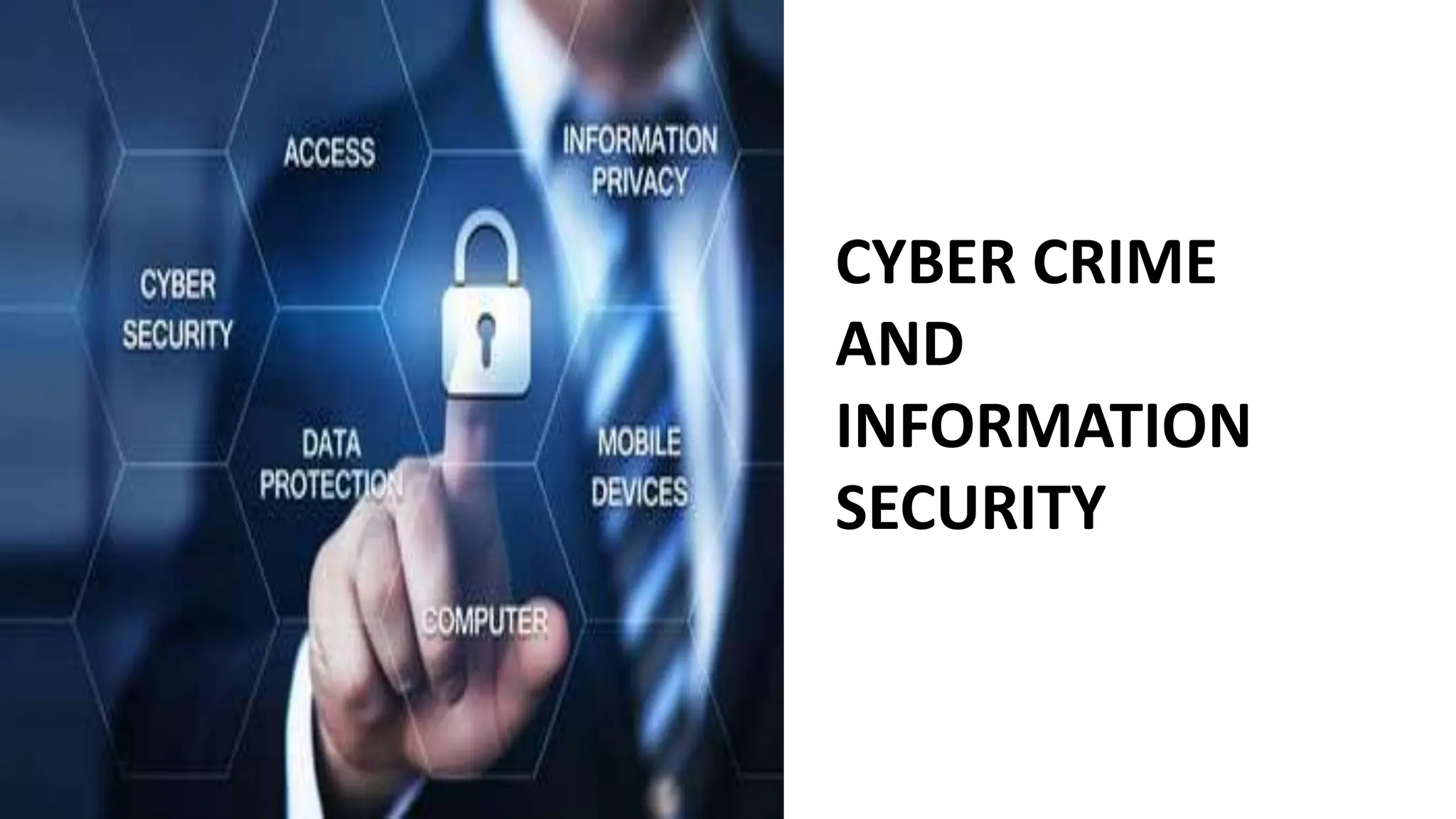
CYBER CRIME
AND
INFORMATION
SECURITY
INTRODUCTION TO
CYBER CRIME AND
INFORMATION SECURITY
Cybercrime and information security are critical issues in our digital age.
Malicious actors seek to exploit vulnerabilities to steal data, disrupt
systems, and cause harm. Understanding cyber threats and developing
robust security measures are essential to protect individuals,
organizations, and societies.
Cybercrime can be carried out by individuals or organizations. Some
cybercriminals are organized, use advanced techniques and are highly
technically skilled. Others are novice hackers.
a. Email and internet fraud.
b. Identity fraud (where personal information is stolen and used).
c. Theft of financial or card payment data.
d. Theft and sale of corporate data.
e. Cyber extortion (demanding money to prevent a threatened
attack).
f. Ransom ware attacks (a type of cyber extortion).
g. Crypto jacking (where hackers mine crypto currency using
resources they do not own).
h. Cyber espionage (where hackers access government or company
data).
i. Interfering with systems in a way that compromises a network.
j. Infringing copyright.
k. Illegal gambling.
l. Selling illegal items online.
TYPES OF CYBER CRIME
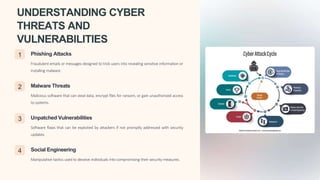
UNDERSTANDING CYBER
THREATS AND
VULNERABILITIES
1 Phishing Attacks
Fraudulent emails or messages designed to trick users into revealing sensitive information or
installing malware.
2 Malware Threats
Malicious software that can steal data, encrypt files for ransom, or gain unauthorized access
to systems.
3 Unpatched Vulnerabilities
Software flaws that can be exploited by attackers if not promptly addressed with security
updates.
4 Social Engineering
Manipulative tactics used to deceive individuals into compromising their security measures.
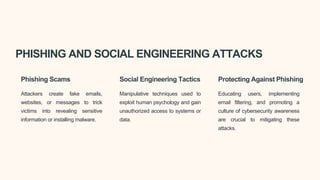
PHISHING AND SOCIAL ENGINEERING ATTACKS
Phishing Scams
Attackers create fake emails,
websites, or messages to trick
victims into revealing sensitive
information or installing malware.
Social Engineering Tactics
Manipulative techniques used to
exploit human psychology and gain
unauthorized access to systems or
data.
Protecting Against Phishing
Educating users, implementing
email filtering, and promoting a
culture of cybersecurity awareness
are crucial to mitigating these
attacks.
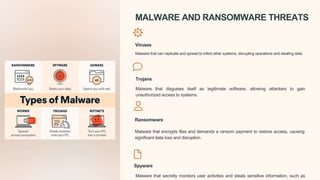
MALWARE AND RANSOMWARE THREATS
Viruses
Malware that can replicate and spread to infect other systems, disrupting operations and stealing data.
Trojans
Malware that disguises itself as legitimate software, allowing attackers to gain
unauthorized access to systems.
Ransomware
Malware that encrypts files and demands a ransom payment to restore access, causing
significant data loss and disruption.
Spyware
Malware that secretly monitors user activities and steals sensitive information, such as
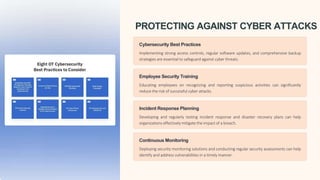
PROTECTING AGAINST CYBER ATTACKS
Cybersecurity Best Practices
Implementing strong access controls, regular software updates, and comprehensive backup
strategies are essential to safeguard against cyber threats.
Employee Security Training
Educating employees on recognizing and reporting suspicious activities can significantly
reduce the risk of successful cyber attacks.
Incident Response Planning
Developing and regularly testing incident response and disaster recovery plans can help
organizations effectively mitigate the impact of a breach.
Continuous Monitoring
Deploying security monitoring solutions and conducting regular security assessments can help
identify and address vulnerabilities in a timely manner.
IMPORTANCE OF CYBERSECURITY
MEASURES
1 Protect Data
Cybersecurity measures safeguard sensitive information, such as personal,
financial, and intellectual property data, from unauthorized access and misuse.
2 Ensure Business Continuity
Effective cybersecurity practices help organizations maintain operational
capabilities and minimize the impact of cyber incidents on their daily operations.
3 Build Trust and Reputation
A strong cybersecurity posture contributes to the trust and credibility of an
organization, which is crucial for maintaining customer and stakeholder
confidence.
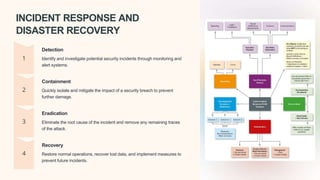
INCIDENT RESPONSE AND
DISASTER RECOVERY
Detection
Identify and investigate potential security incidents through monitoring and
alert systems.
Containment
Quickly isolate and mitigate the impact of a security breach to prevent
further damage.
Eradication
Eliminate the root cause of the incident and remove any remaining traces
of the attack.
Recovery
Restore normal operations, recover lost data, and implement measures to
prevent future incidents.
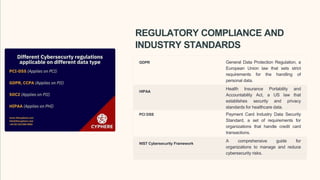
REGULATORY COMPLIANCE AND
INDUSTRY STANDARDS
GDPR General Data Protection Regulation, a
European Union law that sets strict
requirements for the handling of
personal data.
HIPAA
Health Insurance Portability and
Accountability Act, a US law that
establishes security and privacy
standards for healthcare data.
PCI DSS Payment Card Industry Data Security
Standard, a set of requirements for
organizations that handle credit card
transactions.
NIST Cybersecurity Framework
A comprehensive guide for
organizations to manage and reduce
cybersecurity risks.
EMERGING TRENDS IN CYBERSECURITY
Cloud Security
Securing data and applications in
cloud computing environments as
organizations increasingly migrate
to the cloud.
IoT Security
Addressing the unique security
challenges posed by the
proliferation of internet-connected
devices, such as smart home
appliances and industrial systems.
Artificial Intelligence and
Machine Learning
Leveraging advanced analytics and
automated decision-making to
enhance threat detection, incident
response, and security operations.
Information security is the practice of protecting information
by mitigating information risks. It involves protecting
information systems and the information processed, stored,
and transmitted by these systems from unauthorized access,
use, disclosure, disruption, modification, or destruction. This
includes the protection of personal information, financial
information, and sensitive or confidential information stored
in both digital and physical forms. Effective information
security requires a comprehensive and multi-disciplinary
approach, involving people, processes, and technology.
INFORMATION SECURITY
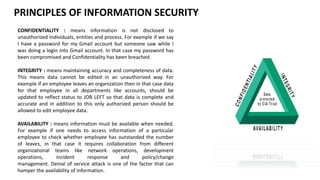
PRINCIPLES OF INFORMATION SECURITY
CONFIDENTIALITY : means information is not disclosed to
unauthorized individuals, entities and process. For example if we say
I have a password for my Gmail account but someone saw while I
was doing a login into Gmail account. In that case my password has
been compromised and Confidentiality has been breached.
INTEGRITY : means maintaining accuracy and completeness of data.
This means data cannot be edited in an unauthorized way. For
example if an employee leaves an organization then in that case data
for that employee in all departments like accounts, should be
updated to reflect status to JOB LEFT so that data is complete and
accurate and in addition to this only authorized person should be
allowed to edit employee data.
AVAILABILITY : means information must be available when needed.
For example if one needs to access information of a particular
employee to check whether employee has outstanded the number
of leaves, in that case it requires collaboration from different
organizational teams like network operations, development
operations, incident response and policy/change
management. Denial of service attack is one of the factor that can
hamper the availability of information.
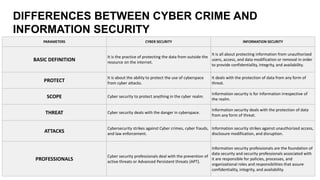
PARAMETERS CYBER SECURITY INFORMATION SECURITY
BASIC DEFINITION
It is the practice of protecting the data from outside the
resource on the internet.
It is all about protecting information from unauthorized
users, access, and data modification or removal in order
to provide confidentiality, integrity, and availability.
PROTECT
It is about the ability to protect the use of cyberspace
from cyber attacks.
It deals with the protection of data from any form of
threat.
SCOPE Cyber security to protect anything in the cyber realm.
Information security is for information irrespective of
the realm.
THREAT Cyber security deals with the danger in cyberspace.
Information security deals with the protection of data
from any form of threat.
ATTACKS
Cybersecurity strikes against Cyber crimes, cyber frauds,
and law enforcement.
Information security strikes against unauthorized access,
disclosure modification, and disruption.
PROFESSIONALS
Cyber security professionals deal with the prevention of
active threats or Advanced Persistent threats (APT).
Information security professionals are the foundation of
data security and security professionals associated with
it are responsible for policies, processes, and
organizational roles and responsibilities that assure
confidentiality, integrity, and availability.
DIFFERENCES BETWEEN CYBER CRIME AND
INFORMATION SECURITY
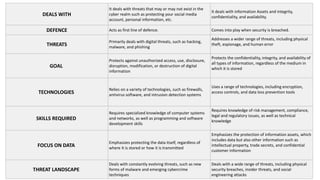
DEALS WITH
It deals with threats that may or may not exist in the
cyber realm such as protecting your social media
account, personal information, etc.
It deals with information Assets and integrity,
confidentiality, and availability.
DEFENCE Acts as first line of defence. Comes into play when security is breached.
THREATS
Primarily deals with digital threats, such as hacking,
malware, and phishing
Addresses a wider range of threats, including physical
theft, espionage, and human error
GOAL
Protects against unauthorized access, use, disclosure,
disruption, modification, or destruction of digital
information
Protects the confidentiality, integrity, and availability of
all types of information, regardless of the medium in
which it is stored
TECHNOLOGIES
Relies on a variety of technologies, such as firewalls,
antivirus software, and intrusion detection systems
Uses a range of technologies, including encryption,
access controls, and data loss prevention tools
SKILLS REQUIRED
Requires specialized knowledge of computer systems
and networks, as well as programming and software
development skills
Requires knowledge of risk management, compliance,
legal and regulatory issues, as well as technical
knowledge
FOCUS ON DATA
Emphasizes protecting the data itself, regardless of
where it is stored or how it is transmitted
Emphasizes the protection of information assets, which
includes data but also other information such as
intellectual property, trade secrets, and confidential
customer information
THREAT LANDSCAPE
Deals with constantly evolving threats, such as new
forms of malware and emerging cybercrime
techniques
Deals with a wide range of threats, including physical
security breaches, insider threats, and social
engineering attacks
Conclusion
Cybercrime and information security threats continue to evolve, making it crucial for individuals and organizations
to stay vigilant and proactive in their cybersecurity efforts. By understanding the latest threats, implementing robust
security measures, and staying informed on emerging trends, we can collectively work to create a safer and more
secure digital landscape.
Cyber crime and Information Security.pptx

Cyber crime and Information Security.pptx

  • 1.
  • 2.
    INTRODUCTION TO CYBER CRIMEAND INFORMATION SECURITY Cybercrime and information security are critical issues in our digital age. Malicious actors seek to exploit vulnerabilities to steal data, disrupt systems, and cause harm. Understanding cyber threats and developing robust security measures are essential to protect individuals, organizations, and societies. Cybercrime can be carried out by individuals or organizations. Some cybercriminals are organized, use advanced techniques and are highly technically skilled. Others are novice hackers.
  • 3.
    a. Email andinternet fraud. b. Identity fraud (where personal information is stolen and used). c. Theft of financial or card payment data. d. Theft and sale of corporate data. e. Cyber extortion (demanding money to prevent a threatened attack). f. Ransom ware attacks (a type of cyber extortion). g. Crypto jacking (where hackers mine crypto currency using resources they do not own). h. Cyber espionage (where hackers access government or company data). i. Interfering with systems in a way that compromises a network. j. Infringing copyright. k. Illegal gambling. l. Selling illegal items online. TYPES OF CYBER CRIME
  • 4.
    UNDERSTANDING CYBER THREATS AND VULNERABILITIES 1Phishing Attacks Fraudulent emails or messages designed to trick users into revealing sensitive information or installing malware. 2 Malware Threats Malicious software that can steal data, encrypt files for ransom, or gain unauthorized access to systems. 3 Unpatched Vulnerabilities Software flaws that can be exploited by attackers if not promptly addressed with security updates. 4 Social Engineering Manipulative tactics used to deceive individuals into compromising their security measures.
  • 5.
    PHISHING AND SOCIALENGINEERING ATTACKS Phishing Scams Attackers create fake emails, websites, or messages to trick victims into revealing sensitive information or installing malware. Social Engineering Tactics Manipulative techniques used to exploit human psychology and gain unauthorized access to systems or data. Protecting Against Phishing Educating users, implementing email filtering, and promoting a culture of cybersecurity awareness are crucial to mitigating these attacks.
  • 6.
    MALWARE AND RANSOMWARETHREATS Viruses Malware that can replicate and spread to infect other systems, disrupting operations and stealing data. Trojans Malware that disguises itself as legitimate software, allowing attackers to gain unauthorized access to systems. Ransomware Malware that encrypts files and demands a ransom payment to restore access, causing significant data loss and disruption. Spyware Malware that secretly monitors user activities and steals sensitive information, such as
  • 7.
    PROTECTING AGAINST CYBERATTACKS Cybersecurity Best Practices Implementing strong access controls, regular software updates, and comprehensive backup strategies are essential to safeguard against cyber threats. Employee Security Training Educating employees on recognizing and reporting suspicious activities can significantly reduce the risk of successful cyber attacks. Incident Response Planning Developing and regularly testing incident response and disaster recovery plans can help organizations effectively mitigate the impact of a breach. Continuous Monitoring Deploying security monitoring solutions and conducting regular security assessments can help identify and address vulnerabilities in a timely manner.
  • 8.
    IMPORTANCE OF CYBERSECURITY MEASURES 1Protect Data Cybersecurity measures safeguard sensitive information, such as personal, financial, and intellectual property data, from unauthorized access and misuse. 2 Ensure Business Continuity Effective cybersecurity practices help organizations maintain operational capabilities and minimize the impact of cyber incidents on their daily operations. 3 Build Trust and Reputation A strong cybersecurity posture contributes to the trust and credibility of an organization, which is crucial for maintaining customer and stakeholder confidence.
  • 9.
    INCIDENT RESPONSE AND DISASTERRECOVERY Detection Identify and investigate potential security incidents through monitoring and alert systems. Containment Quickly isolate and mitigate the impact of a security breach to prevent further damage. Eradication Eliminate the root cause of the incident and remove any remaining traces of the attack. Recovery Restore normal operations, recover lost data, and implement measures to prevent future incidents.
  • 10.
    REGULATORY COMPLIANCE AND INDUSTRYSTANDARDS GDPR General Data Protection Regulation, a European Union law that sets strict requirements for the handling of personal data. HIPAA Health Insurance Portability and Accountability Act, a US law that establishes security and privacy standards for healthcare data. PCI DSS Payment Card Industry Data Security Standard, a set of requirements for organizations that handle credit card transactions. NIST Cybersecurity Framework A comprehensive guide for organizations to manage and reduce cybersecurity risks.
  • 11.
    EMERGING TRENDS INCYBERSECURITY Cloud Security Securing data and applications in cloud computing environments as organizations increasingly migrate to the cloud. IoT Security Addressing the unique security challenges posed by the proliferation of internet-connected devices, such as smart home appliances and industrial systems. Artificial Intelligence and Machine Learning Leveraging advanced analytics and automated decision-making to enhance threat detection, incident response, and security operations.
  • 12.
    Information security isthe practice of protecting information by mitigating information risks. It involves protecting information systems and the information processed, stored, and transmitted by these systems from unauthorized access, use, disclosure, disruption, modification, or destruction. This includes the protection of personal information, financial information, and sensitive or confidential information stored in both digital and physical forms. Effective information security requires a comprehensive and multi-disciplinary approach, involving people, processes, and technology. INFORMATION SECURITY
  • 13.
    PRINCIPLES OF INFORMATIONSECURITY CONFIDENTIALITY : means information is not disclosed to unauthorized individuals, entities and process. For example if we say I have a password for my Gmail account but someone saw while I was doing a login into Gmail account. In that case my password has been compromised and Confidentiality has been breached. INTEGRITY : means maintaining accuracy and completeness of data. This means data cannot be edited in an unauthorized way. For example if an employee leaves an organization then in that case data for that employee in all departments like accounts, should be updated to reflect status to JOB LEFT so that data is complete and accurate and in addition to this only authorized person should be allowed to edit employee data. AVAILABILITY : means information must be available when needed. For example if one needs to access information of a particular employee to check whether employee has outstanded the number of leaves, in that case it requires collaboration from different organizational teams like network operations, development operations, incident response and policy/change management. Denial of service attack is one of the factor that can hamper the availability of information.
  • 14.
    PARAMETERS CYBER SECURITYINFORMATION SECURITY BASIC DEFINITION It is the practice of protecting the data from outside the resource on the internet. It is all about protecting information from unauthorized users, access, and data modification or removal in order to provide confidentiality, integrity, and availability. PROTECT It is about the ability to protect the use of cyberspace from cyber attacks. It deals with the protection of data from any form of threat. SCOPE Cyber security to protect anything in the cyber realm. Information security is for information irrespective of the realm. THREAT Cyber security deals with the danger in cyberspace. Information security deals with the protection of data from any form of threat. ATTACKS Cybersecurity strikes against Cyber crimes, cyber frauds, and law enforcement. Information security strikes against unauthorized access, disclosure modification, and disruption. PROFESSIONALS Cyber security professionals deal with the prevention of active threats or Advanced Persistent threats (APT). Information security professionals are the foundation of data security and security professionals associated with it are responsible for policies, processes, and organizational roles and responsibilities that assure confidentiality, integrity, and availability. DIFFERENCES BETWEEN CYBER CRIME AND INFORMATION SECURITY
  • 15.
    DEALS WITH It dealswith threats that may or may not exist in the cyber realm such as protecting your social media account, personal information, etc. It deals with information Assets and integrity, confidentiality, and availability. DEFENCE Acts as first line of defence. Comes into play when security is breached. THREATS Primarily deals with digital threats, such as hacking, malware, and phishing Addresses a wider range of threats, including physical theft, espionage, and human error GOAL Protects against unauthorized access, use, disclosure, disruption, modification, or destruction of digital information Protects the confidentiality, integrity, and availability of all types of information, regardless of the medium in which it is stored TECHNOLOGIES Relies on a variety of technologies, such as firewalls, antivirus software, and intrusion detection systems Uses a range of technologies, including encryption, access controls, and data loss prevention tools SKILLS REQUIRED Requires specialized knowledge of computer systems and networks, as well as programming and software development skills Requires knowledge of risk management, compliance, legal and regulatory issues, as well as technical knowledge FOCUS ON DATA Emphasizes protecting the data itself, regardless of where it is stored or how it is transmitted Emphasizes the protection of information assets, which includes data but also other information such as intellectual property, trade secrets, and confidential customer information THREAT LANDSCAPE Deals with constantly evolving threats, such as new forms of malware and emerging cybercrime techniques Deals with a wide range of threats, including physical security breaches, insider threats, and social engineering attacks
  • 16.
    Conclusion Cybercrime and informationsecurity threats continue to evolve, making it crucial for individuals and organizations to stay vigilant and proactive in their cybersecurity efforts. By understanding the latest threats, implementing robust security measures, and staying informed on emerging trends, we can collectively work to create a safer and more secure digital landscape.