Management Accounting


    A. F. M. Rubayat-Ul-Jannat
          ID: BBA080160714
Chapter 1
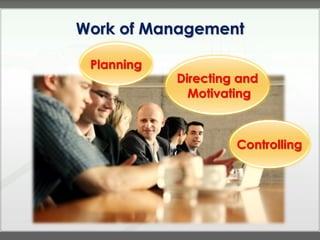
Work of Management

 Planning
            Directing and
              Motivating


                     Controlling
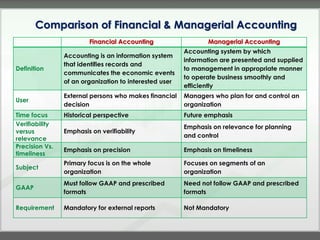
Comparison of Financial & Managerial Accounting
                        Financial Accounting                   Managerial Accounting
                                                        Accounting system by which
                Accounting is an information system
                                                        information are presented and supplied
                that identifies records and
Definition                                              to management in appropriate manner
                communicates the economic events
                                                        to operate business smoothly and
                of an organization to interested user
                                                        efficiently
                External persons who makes financial    Managers who plan for and control an
User
                decision                                organization
Time focus      Historical perspective                  Future emphasis
Verifiability                                           Emphasis on relevance for planning
versus          Emphasis on verifiability
                                                        and control
relevance
Precision Vs.
                Emphasis on precision                   Emphasis on timeliness
timeliness
                Primary focus is on the whole           Focuses on segments of an
Subject
                organization                            organization
                Must follow GAAP and prescribed         Need not follow GAAP and prescribed
GAAP
                formats                                 formats

Requirement     Mandatory for external reports          Not Mandatory
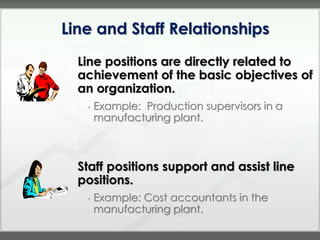
Line and Staff Relationships
  Line positions are directly related to
  achievement of the basic objectives of
  an organization.
   •   Example: Production supervisors in a
       manufacturing plant.


  Staff positions support and assist line
  positions.
   •   Example: Cost accountants in the
       manufacturing plant.
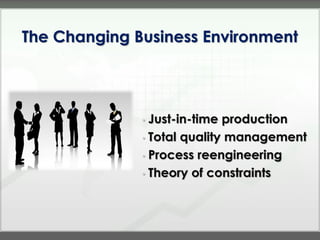
The Changing Business Environment


              • Just-in-time production
              • Total quality management

              • Process reengineering

              • Theory of constraints
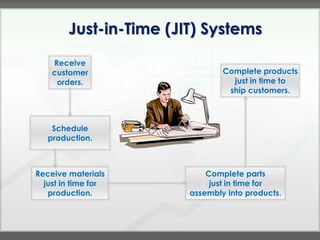
Just-in-Time (JIT) Systems
    Receive
    customer                    Complete products
     orders.                      just in time to
                                 ship customers.


    Schedule
   production.


Receive materials           Complete parts
  just in time for           just in time for
   production.          assembly into products.
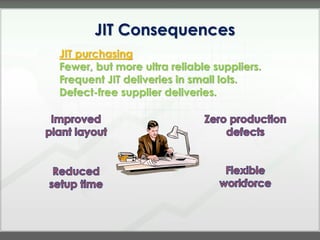
JIT Consequences
JIT purchasing
Fewer, but more ultra reliable suppliers.
Frequent JIT deliveries in small lots.
Defect-free supplier deliveries.
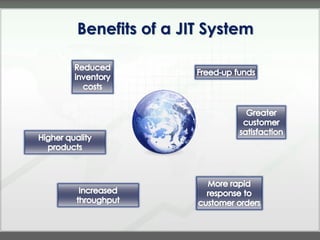
Benefits of a JIT System
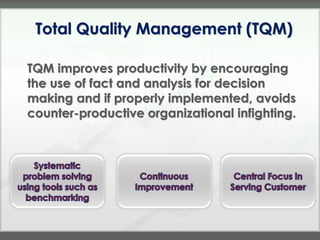
Total Quality Management (TQM)

TQM improves productivity by encouraging
the use of fact and analysis for decision
making and if properly implemented, avoids
counter-productive organizational infighting.
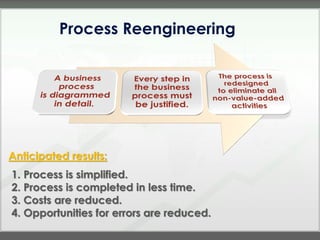
Process Reengineering


Anticipated results:
1. Process is simplified.
2. Process is completed in less time.
3. Costs are reduced.
4. Opportunities for errors are reduced.
Process Reengineering versus TQM


Process Reengineering          Total Quality
                               Management
1. Radically overhauls    1.Tweaks existing
   existing processes.      processes to realize
                            gradual improvements.
2. Likely to be imposed
   from above and to      2.Uses a team approach
   use outside              involving people who
   consultants.             work directly in the
                            process.
Theory of Constraints

A constraint (also called a bottleneck) is
anything that prevents you from getting more of
what you want.
Chapter 2
Manufacturing Cost

Manufacturing cost are those cost that
are used to manufacture goods directly.
There are three types of manufacturing
cost; which are:

1.   Direct Material
2.   Direct Labor
3.   Manufacturing overhead
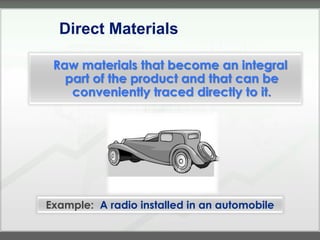
Direct Materials

 Raw materials that become an integral
   part of the product and that can be
    conveniently traced directly to it.


Example: A radio installed in an automobile
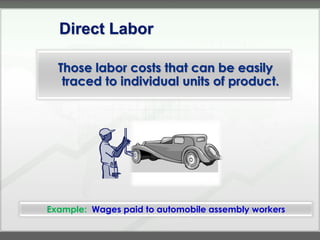
Direct Labor

  Those labor costs that can be easily
   traced to individual units of product.


Example: Wages paid to automobile assembly workers
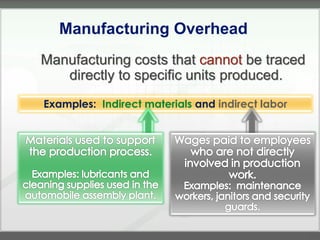
Manufacturing Overhead
Manufacturing costs that cannot be traced
   directly to specific units produced.
Examples: Indirect materials and indirect labor


                                                  2-18
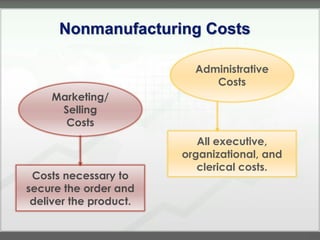
Nonmanufacturing Costs

                          Administrative
                             Costs
    Marketing/
     Selling
      Costs
                           All executive,
                        organizational, and
                           clerical costs.
 Costs necessary to
secure the order and
 deliver the product.


                                              2-19
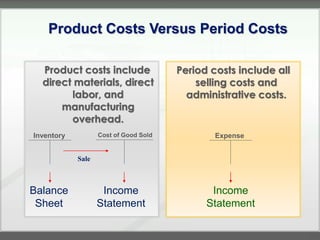
Product Costs Versus Period Costs

  Product costs include                Period costs include all
  direct materials, direct                 selling costs and
        labor, and                       administrative costs.
      manufacturing
        overhead.
Inventory          Cost of Good Sold           Expense


            Sale


Balance             Income                    Income
 Sheet             Statement                 Statement

                                                                  2-20
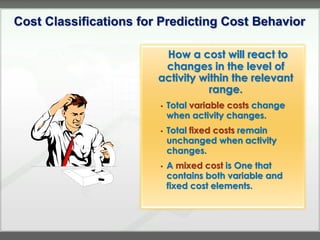
Cost Classifications for Predicting Cost Behavior

                         How a cost will react to
                         changes in the level of
                        activity within the relevant
                                   range.
                        •   Total variable costs change
                            when activity changes.
                        •   Total fixed costs remain
                            unchanged when activity
                            changes.
                        •   A mixed cost is One that
                            contains both variable and
                            fixed cost elements.
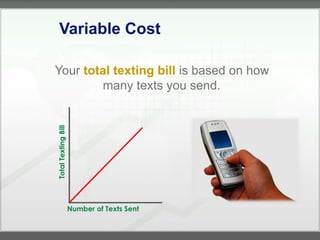
Variable Cost

Your total texting bill is based on how
        many texts you send.
Total Texting Bill


                     Number of Texts Sent
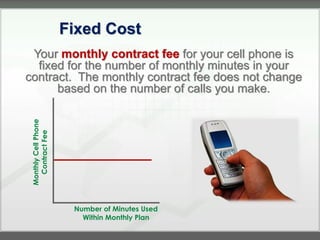
Fixed Cost
 Your monthly contract fee for your cell phone is
  fixed for the number of monthly minutes in your
contract. The monthly contract fee does not change
      based on the number of calls you make.
 Monthly Cell Phone
   Contract Fee


                       Number of Minutes Used
                         Within Monthly Plan
Mixed Cost


In case of a Telephone bill Line Rent is
fixed cost and Call Charge is variable
cost.
Management Accounting

Management Accounting

  • 1.
    Management Accounting A. F. M. Rubayat-Ul-Jannat ID: BBA080160714
  • 2.
  • 3.
    Work of Management Planning Directing and Motivating Controlling
  • 4.
    Comparison of Financial& Managerial Accounting Financial Accounting Managerial Accounting Accounting system by which Accounting is an information system information are presented and supplied that identifies records and Definition to management in appropriate manner communicates the economic events to operate business smoothly and of an organization to interested user efficiently External persons who makes financial Managers who plan for and control an User decision organization Time focus Historical perspective Future emphasis Verifiability Emphasis on relevance for planning versus Emphasis on verifiability and control relevance Precision Vs. Emphasis on precision Emphasis on timeliness timeliness Primary focus is on the whole Focuses on segments of an Subject organization organization Must follow GAAP and prescribed Need not follow GAAP and prescribed GAAP formats formats Requirement Mandatory for external reports Not Mandatory
  • 5.
    Line and StaffRelationships Line positions are directly related to achievement of the basic objectives of an organization. • Example: Production supervisors in a manufacturing plant. Staff positions support and assist line positions. • Example: Cost accountants in the manufacturing plant.
  • 6.
    The Changing BusinessEnvironment • Just-in-time production • Total quality management • Process reengineering • Theory of constraints
  • 7.
    Just-in-Time (JIT) Systems Receive customer Complete products orders. just in time to ship customers. Schedule production. Receive materials Complete parts just in time for just in time for production. assembly into products.
  • 8.
    JIT Consequences JIT purchasing Fewer,but more ultra reliable suppliers. Frequent JIT deliveries in small lots. Defect-free supplier deliveries.
  • 9.
    Benefits of aJIT System
  • 10.
    Total Quality Management(TQM) TQM improves productivity by encouraging the use of fact and analysis for decision making and if properly implemented, avoids counter-productive organizational infighting.
  • 11.
    Process Reengineering Anticipated results: 1.Process is simplified. 2. Process is completed in less time. 3. Costs are reduced. 4. Opportunities for errors are reduced.
  • 12.
    Process Reengineering versusTQM Process Reengineering Total Quality Management 1. Radically overhauls 1.Tweaks existing existing processes. processes to realize gradual improvements. 2. Likely to be imposed from above and to 2.Uses a team approach use outside involving people who consultants. work directly in the process.
  • 13.
    Theory of Constraints Aconstraint (also called a bottleneck) is anything that prevents you from getting more of what you want.
  • 14.
  • 15.
    Manufacturing Cost Manufacturing costare those cost that are used to manufacture goods directly. There are three types of manufacturing cost; which are: 1. Direct Material 2. Direct Labor 3. Manufacturing overhead
  • 16.
    Direct Materials Rawmaterials that become an integral part of the product and that can be conveniently traced directly to it. Example: A radio installed in an automobile
  • 17.
    Direct Labor Those labor costs that can be easily traced to individual units of product. Example: Wages paid to automobile assembly workers
  • 18.
    Manufacturing Overhead Manufacturing coststhat cannot be traced directly to specific units produced. Examples: Indirect materials and indirect labor 2-18
  • 19.
    Nonmanufacturing Costs Administrative Costs Marketing/ Selling Costs All executive, organizational, and clerical costs. Costs necessary to secure the order and deliver the product. 2-19
  • 20.
    Product Costs VersusPeriod Costs Product costs include Period costs include all direct materials, direct selling costs and labor, and administrative costs. manufacturing overhead. Inventory Cost of Good Sold Expense Sale Balance Income Income Sheet Statement Statement 2-20
  • 21.
    Cost Classifications forPredicting Cost Behavior How a cost will react to changes in the level of activity within the relevant range. • Total variable costs change when activity changes. • Total fixed costs remain unchanged when activity changes. • A mixed cost is One that contains both variable and fixed cost elements.
  • 22.
    Variable Cost Your totaltexting bill is based on how many texts you send. Total Texting Bill Number of Texts Sent
  • 23.
    Fixed Cost Yourmonthly contract fee for your cell phone is fixed for the number of monthly minutes in your contract. The monthly contract fee does not change based on the number of calls you make. Monthly Cell Phone Contract Fee Number of Minutes Used Within Monthly Plan
  • 24.
    Mixed Cost In caseof a Telephone bill Line Rent is fixed cost and Call Charge is variable cost.