Author of Redesign Your Life in Modern Age
Balvinder Kumar retd. IAS
& Explore Your Life Journey
YOUR THOUGHTS
LEARN TO MANAGE
YOUR THOUGHTS
LEARN TO MANAGE
KNOW YOUR LIFE [SERIES 3]
If you are able to master your thoughts, you can
manage any adversity in life
The world out there is a human
construct. We perceive and construct
images and models of reality inside our
mind. Our beliefs about the world
around us, the thoughts, feelings and
emotions and state of our mind all
contribute in creating the reality inside
the mind.
It's well said that we ourselves are the
sole creator of 'heaven' and 'hell' during
our lifetime itself. These are not the
imaginary 'places' beyond earth where
we take re-birth after death. We create
and experience such conditions in the
lifetime only. When our sufferings are
severe and continuous, we create 'hell'
and when our life is full of joy and
happiness, we make 'heaven' in our life.
It all depends on how well or bad we
manage our mind.
Introduction
Mind can be our best
master or the worst
servant, we can ever
imagine, depending on
the control we exercise
over it. Outer reality is
nothing but the reflection
of our own inner world.
If we are happy and contended then the
outer world is full of joy and happiness.
On the contrary, if mind is depressed,
sad or distressed then the world around
us becomes unfriendly and hostile. It's
just of matter of how we perceive the
world in our mind.
There is no objective or 'true' reality
outside us. For each one us we perceive
the world in our own unique way. There
is no 'true reality'. This is the reason; we
all think and perceive the world in
different ways. Hence, so much of
conflicts and contradictions in our
society.
We all live in our own self-
created 'world'. It rarely
comes in our mind that
others may have altogether
different version of reality in
their mind.
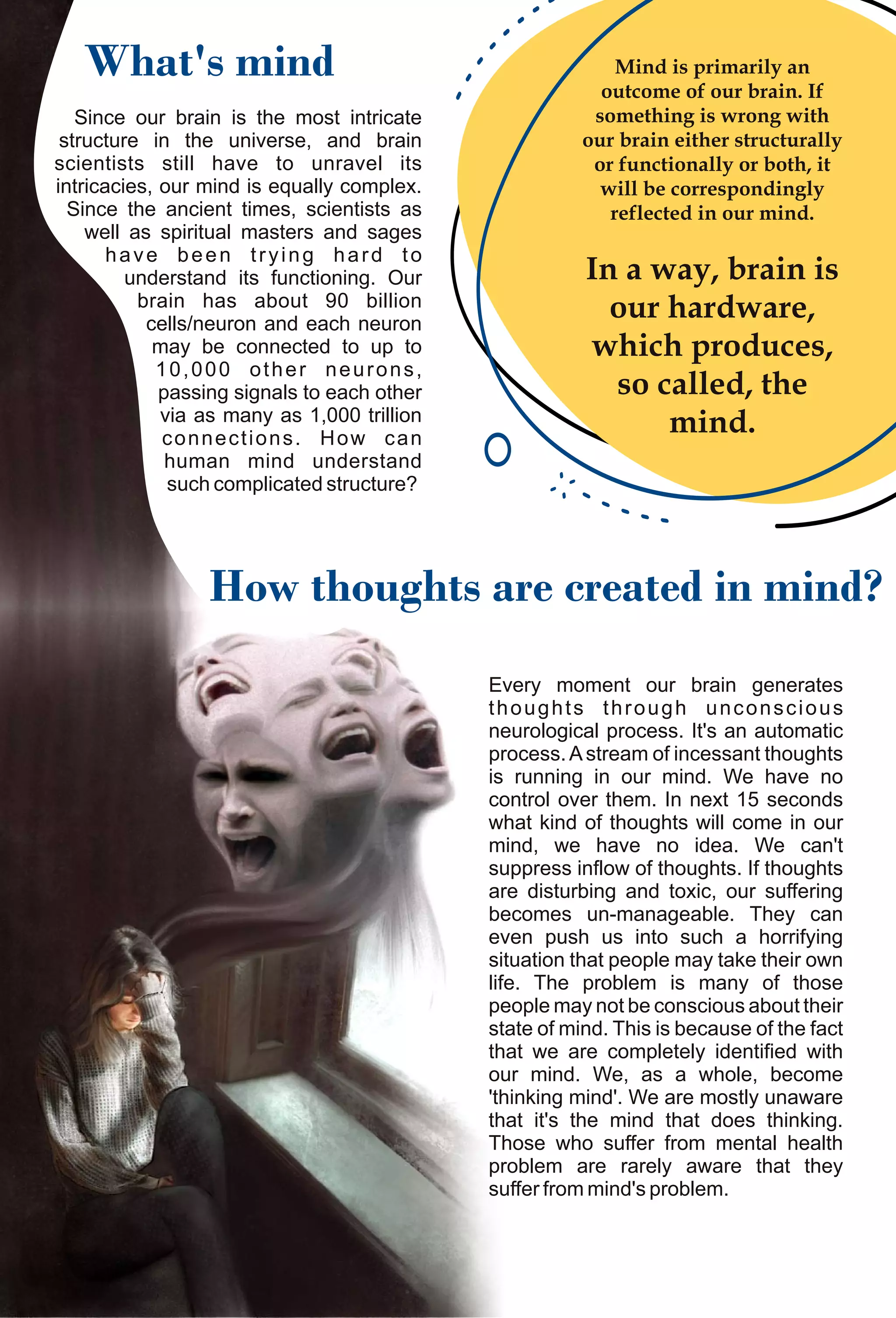
Every moment our brain generates
thoughts through unconscious
neurological process. It's an automatic
process.Astream of incessant thoughts
is running in our mind. We have no
control over them. In next 15 seconds
what kind of thoughts will come in our
mind, we have no idea. We can't
suppress inflow of thoughts. If thoughts
are disturbing and toxic, our suffering
becomes un-manageable. They can
even push us into such a horrifying
situation that people may take their own
life. The problem is many of those
people may not be conscious about their
state of mind. This is because of the fact
that we are completely identified with
our mind. We, as a whole, become
'thinking mind'. We are mostly unaware
that it's the mind that does thinking.
Those who suffer from mental health
problem are rarely aware that they
suffer from mind's problem.
What's mind
How thoughts are created in mind?
Since our brain is the most intricate
structure in the universe, and brain
scientists still have to unravel its
intricacies, our mind is equally complex.
Since the ancient times, scientists as
well as spiritual masters and sages
have been trying hard to
understand its functioning. Our
brain has about 90 billion
cells/neuron and each neuron
may be connected to up to
10,000 other neurons,
passing signals to each other
via as many as 1,000 trillion
connections. How can
human mind understand
such complicated structure?
In a way, brain is
our hardware,
which produces,
so called, the
mind.
Mind is primarily an
outcome of our brain. If
something is wrong with
our brain either structurally
or functionally or both, it
will be correspondingly
reflected in our mind.
Most of the contents of the unconscious mind
are repressed and may be unpleasant, such
as feelings of pain, anxiety, or conflict. We
are completely unaware of this part of mind.
All of our early childhood experiences
including traumatic incidents, if any, are
deeply imbedded here.
Then comes our subconscious mind. The
function of our subconscious mind is to
store and retrieve data from memory bank.
All automatic functions like eating,
breathing, driving and walking are
programmed here. It stores our previous
experiences, beliefs, memories, skills and
habits. Because of this part of our mind, we
work on automatic mode, without the
intervention of conscious mind. Another
very powerful part of our mind. During our
waking hours, more than 95% of our tasks
are carried out not by conscious mind but
by unconscious and subconscious mind.
So now we know, first of all, our
thoughts are generated automatically.
We have no control over them.
Second, the mind which works in the
present moment and for which we are
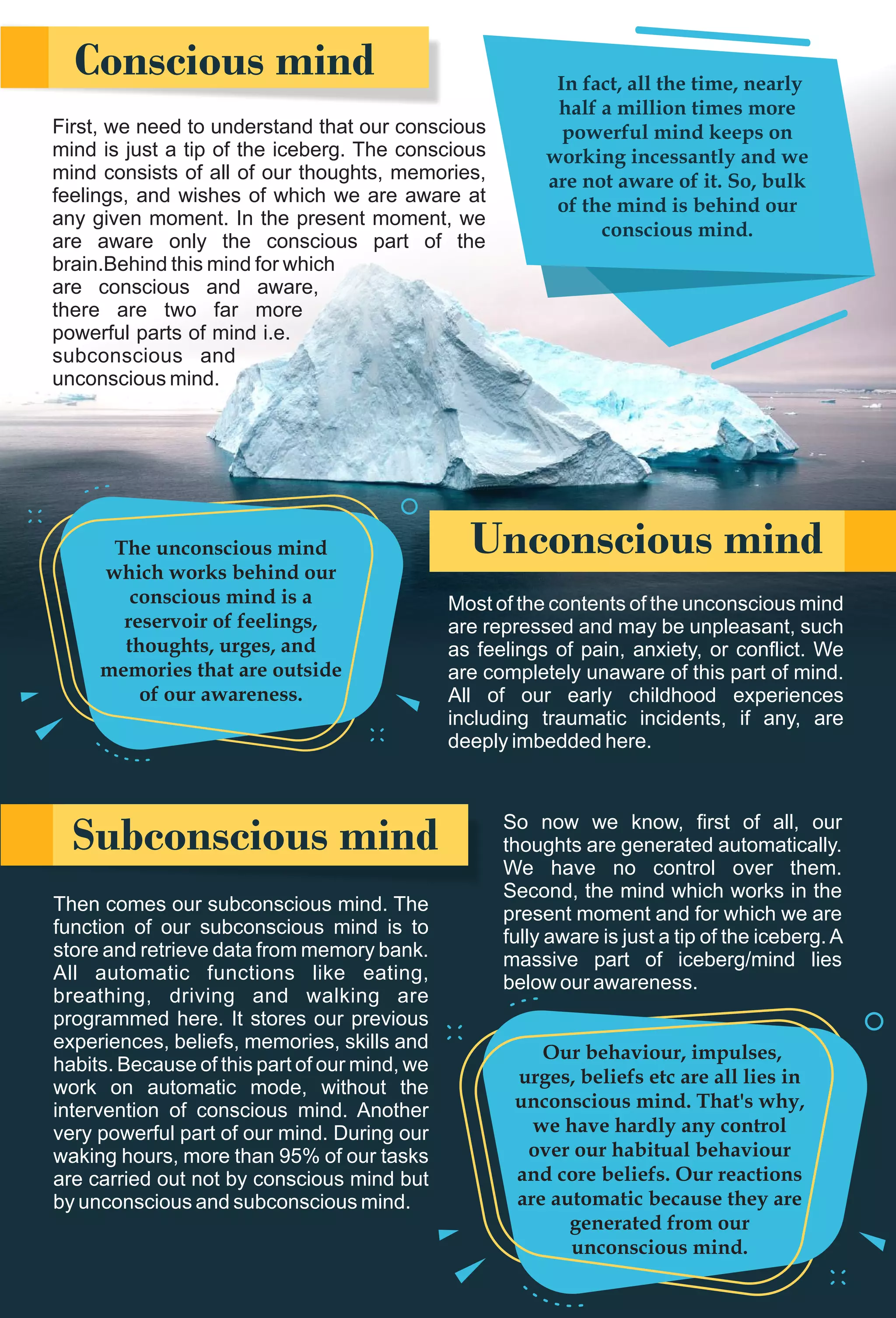
fully aware is just a tip of the iceberg.A
massive part of iceberg/mind lies
below our awareness.
Conscious mind
Unconscious mind
Subconscious mind
First, we need to understand that our conscious
mind is just a tip of the iceberg. The conscious
mind consists of all of our thoughts, memories,
feelings, and wishes of which we are aware at
any given moment. In the present moment, we
are aware only the conscious part of the
brain.Behind this mind for which
are conscious and aware,
there are two far more
powerful parts of mind i.e.
subconscious and
unconscious mind.
In fact, all the time, nearly
half a million times more
powerful mind keeps on
working incessantly and we
are not aware of it. So, bulk
of the mind is behind our
conscious mind.
The unconscious mind
which works behind our
conscious mind is a
reservoir of feelings,
thoughts, urges, and
memories that are outside
of our awareness.
Our behaviour, impulses,
urges, beliefs etc are all lies in
unconscious mind. That's why,
we have hardly any control
over our habitual behaviour
and core beliefs. Our reactions
are automatic because they are
generated from our
unconscious mind.
Inherent Nature of Mind
1
2
Second, our mind is biased
towards negativity. That's
the reason we are prone to
perceive negative news
instantly. As an evidence, see
any news channels or read daily
newspapers, how they highlight negative
news because they know that their
audience would love that content. Media
look desperately for sensational news to
broadcast, as public prefer to see that kind
of news. The reason lies in our past. When
we were hunter gatherers living in highly
dangerous and fearful situations, our mind
got adapted to receive alerts or signals,
negative in nature immediately from
surrounding environment. Same
sensitivity of negative news is presently
continuing. In the modern age, though
there is so such types of dangerous
circumstances as were prevalent during
those days, but our brain gets instantly
activated. That particular part of brain is the
legacy of that era and this very part makes
us fearful even with imaginary threats.
There are few other very
important characteristics of
mind, which we all must know to
understand our mind. The first is
mind's wandering. When we
are not focused or attentive, our mind
wanders in various possible directions.
Suppose we are in a 'boring' meeting or
watching a movie, we are mostly on
wandering mode. Further, mind's
wandering increases when we are
disturbed or unhappy. Frequency of
wandering of thoughts increases during
those distressing times. On the other
hand, when we are focused or fully
absorbed in certain activity, we are
comparatively happier. Mind's wandering
becomes uncontrollable if we are very
disturbed. On an average, nearly 53% of
our time, our mind is not focused, it's
somewhere else. When we are bored or
doing routine or any other uninteresting
work, mind's wandering is as high as 70%.
However, when we are engaged in mind-
absorbing or concentration-demanding
tasks, this percentage is low, as low as
10%.
Mind's Wandering
Our Mind is
biased towards
Negativity
3
Negative Thoughts
This is a Psychological
Phenomenon known as
“ironic process”
4
Third, the negative thoughts
don't easy leave our mind
once they intrude into our
thinking domain. They are very
'sticky', stick inside the mind,
and keep on repeating and expanding
inside the mind. One of the worst
characteristic features of negative
thoughts is their 'stickiness'. It's not an
easy task to remove 'stickiness' from
negative thoughts. Each one of us must
have experienced, once in a while, when
we are stuck with those types of disturbing
thoughts.
Fourth, I am sure you all must
have observed that when are
disturbed by negative
thoughts, and try to suppress
them by diverting our
attention to other things, then same very
thoughts resurface more frequently.
More we suppress those thought, more
forcefully they keep on coming in mind.
This is a psychological phenomenon
known as “ironic process” or the
“white bear problem,” wherein
deliberate attempts to suppress certain
thoughts make them more likely to
reappear. For instance, when someone
is trying hard not to think of a white bear,
the same bear is likely to appear more in
our mind. On those disturbing times,
when we try to focus on other activities
like talking to friends, to go for those
disturbing times, when we try to focus on
other activities like talking to friends, to
go for movie, play games or start reading,
we get only a temporary relief. Those
disturbing thoughts just don’t want to
quit! We become increasingly agitated
and disturbed, when those thoughts
keep on intruding in our mind.
This inherent nature of our
mind makes us vulnerable and
prone to negativity. Unless we
know how to deal with such
kinds of thoughts, it's not easy
for us to manage them.
First of all, we must understand that we
can never be perfectly happy. Even if
someone has huge wealth, big bungalow
to live, all the comforts and luxuries and
working on some top executive/govt. post,
he/she would still be not happy and
satisfied. That person may still be suffering
from mental stress or feeling of
'satisfactoriness' or may be experiencing
some emotional issues at workplace or
with relationships.
Our own critique in mind
We can never be
perfectly happy
and satisfied with
life
There is no harm in engaging our mind
with internal voice. However, when we are
disturbed for some reason, our own inner
voice/critique will keep on repeating 'self-
critical thoughts'. Suppose we commit some
grave mistake due to our own negligence,
then we become highly critical to ourselves.
Even to extent of abusing or criticising
severely to ourselves. Many of us must have
done sometime in the past. If we experience
self-critical voice once in a while there is
no problem but once it becomes
recurring, more like a habit then it's
very harmful for our mental
health.
We, without exception, very often
talk to ourselves. Unless and until we
are focused or be attentive on certain
task, we speak to our own self. This
is called inner voice.
It's an inherent
tendency to be restless
and not to be satisfied
with life's conditions.
Poor people suffer for want of money
and struggle for minimum required
level of livelihood. Rich people
suffer from boredom and feeling of
restlessness because they may still be
needing more pleasurable and
material goods.
Most of them feel they would be
happy with more wealth and with
more frequent and intense
pleasurable activities. The result is
majority of us are not fully satisfied
and happy with life.
To a certain extent, worrying is good for
us because it prompts us to take
precautionary measures or avoid risky
behaviour. However, worrying often
leads to distressing, negative and often
obsessive thoughts. Whenever there is a
perception of danger, real or imagined,
our mind keeps on deliberating and
analysing until it’s overburdened with
negative thoughts.
Worrying,
The Main Source of Mental Distress
There will always be some imaginary
or real perception of threat involved
in our everyday life. And the more
we focus on the issue giving us
worry, the more we attract the same
in one form or another. The mind
tends to create worst-case scenarios
based on any imaginary fear.
We all worry for one reason or another. Worrying is an inherent tendency of
our mind as well as a constant problem for us. Worry refers to the thoughts and
emotions of a negative nature, with fearful anticipation of poor outcome. Most of
us do have a number of concerns to worry about. As an emotion, it is experienced
as anxiety or concern about a real or imagined fear or threat,often on personal
matters such as health or workplace tensions. Most of us experiences short-lived
episodes of worry from time to time in our lives. Our brains are wired to worry first and
think rationally later. It often becomes an automatic response to any perception of threat.
Some of us will worry about virtually anything.
The problem is when we suffer or
experience some adversity, then the
thoughts relating to that particular
event or circumstances make us
mentally and psychologically
vulnerable. If we don't know how to deal
with the thoughts that are generated on
those moments, we suffer intensively.
It's well said that real test of life comes
under adversity. Not only we suffer
m e n t a l l y b e c a u s e o f t h o s e
circumstances but also make our mind
susceptible to mental health problems,
that may arise at later date.
Psychological turmoil is unavoidable
Nearly 15% people in India suffer from
different kinds of mental disorders. Many
of them don't seek professional help.
Because they are ignorant of the fact that
they need medical assistance for their
illness.
Depression, one of the most
prominent mental problem
prevalent worldwide pushes lakhs
of sufferers to end their lives. We
all are potentially vulnerable to
experience adversities that can
lead to emotional and
psychological turmoil in our life.
Worrying in itself is not bad as long as
it's controlled. It makes us to prepare
better for a possibly difficult event or
circumstance. But this is at the cost of
our happiness. Very often, when we
continue to worry intensively, we
experience difficulty in getting sleep,
In the long run, worrying leads to many
health-related issues. It even
weakens our immune system and
that's is the reason we get prone to
many other illnesses such as high
sugar level, blood pressure and heart
disease.
The problem with worrying is
that it becomes a cycle of self-
p e rp e tu a ti n g n e g a ti ve
thoughts. As we continue to
worry, there is a steady flow of
negative thoughts which we
keep on repeating, with
distressing variations, till it
becomes uncontrollable. Indeed,
a number of studies have shown
that worry not only puts strain on
our mental health, but also on our
physical health.
Life is like a roller coaster ride with
ups and down. It's a mix of pain,
suffering, boredom, joy and
happiness.
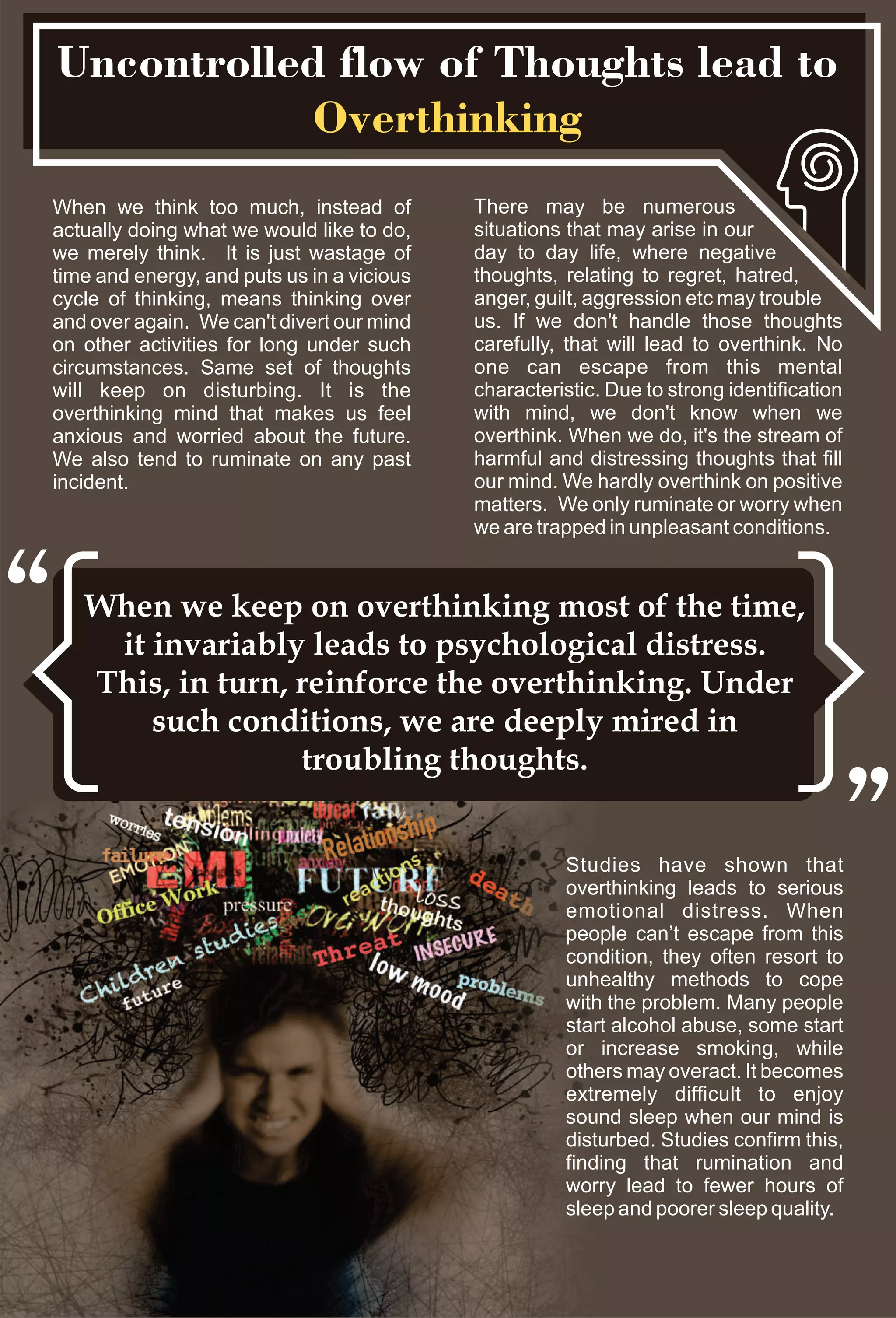
Studies have shown that
overthinking leads to serious
emotional distress. When
people can’t escape from this
condition, they often resort to
unhealthy methods to cope
with the problem. Many people
start alcohol abuse, some start
or increase smoking, while
others may overact. It becomes
extremely difficult to enjoy
sound sleep when our mind is
disturbed. Studies confirm this,
finding that rumination and
worry lead to fewer hours of
sleep and poorer sleep quality.
Uncontrolled flow of Thoughts lead to
Overthinking
When we think too much, instead of
actually doing what we would like to do,
we merely think. It is just wastage of
time and energy, and puts us in a vicious
cycle of thinking, means thinking over
and over again. We can't divert our mind
on other activities for long under such
circumstances. Same set of thoughts
will keep on disturbing. It is the
overthinking mind that makes us feel
anxious and worried about the future.
We also tend to ruminate on any past
incident.
There may be numerous
situations that may arise in our
day to day life, where negative
thoughts, relating to regret, hatred,
anger, guilt, aggression etc may trouble
us. If we don't handle those thoughts
carefully, that will lead to overthink. No
one can escape from this mental
characteristic. Due to strong identification
with mind, we don't know when we
overthink. When we do, it's the stream of
harmful and distressing thoughts that fill
our mind. We hardly overthink on positive
matters. We only ruminate or worry when
we are trapped in unpleasant conditions.
When we keep on overthinking most of the time,
it invariably leads to psychological distress.
This, in turn, reinforce the overthinking. Under
such conditions, we are deeply mired in
troubling thoughts.
How to manage negative thoughts?
First and the foremost thing,
which we must to understand
that we have no control over the
world around us. The people,
their behaviour and actions, the
pollical and social scenario in
the country, and likewise, there
is nothing we can control. Many
of us, unnecessarily and
wasteful, try to change others. If
it's so, then we should not bother
about these things in life.
Be Stoic
The Roman philosopher,
Epictetus, the founder of
Stoicism, had very correctly
remarked that, “For good or
for ill, life and nature are
governed by laws that we
can't change. The quicker
we accept this, the more
tranquilwecanbe”.
We must accept our limitations in controlling the external
surroundings. The things which are beyond are control
must not be the source of our
worrying. Similarly, we should
remember that “whatever has
happened, has happened, and
things would have happened in any
other way”. There is no point in
worrying on those matters. We
should accept those things
wholeheartedly. This simple
philosophy, first, focus on things
over which we have control like our
thoughts, behaviour and actions.
Second, accept the things where we
have no control or things have already
happened, why worry over them. If we adopt these two
components of philosophy, our life will become far simpler
and easier.
Most of our pain, and suffering
comes from resistance to things
happening in outer world. Life is
like that.
When we resist what life is, we suffer. On the contrary,
when we say yes to life, surrender to life, life moves
with ease. If an accident happens, it has happened.
Nothing will change now. Then why do we resist. Why
do we react. We must remember 3-word mantra: Learn,
Accept and Move. Life flows like a river. So, flow with
thewater, thetime andthelife.
We should respond appropriately
without preconceived beliefs.
However, we have complete
control over our inner world. Our
thoughts, actions, behaviour,
desires, impulses and urges are
totally under our control. We must
bother about our mind, from
where all these things arise.
.
Avoid Worrying and Overthinking
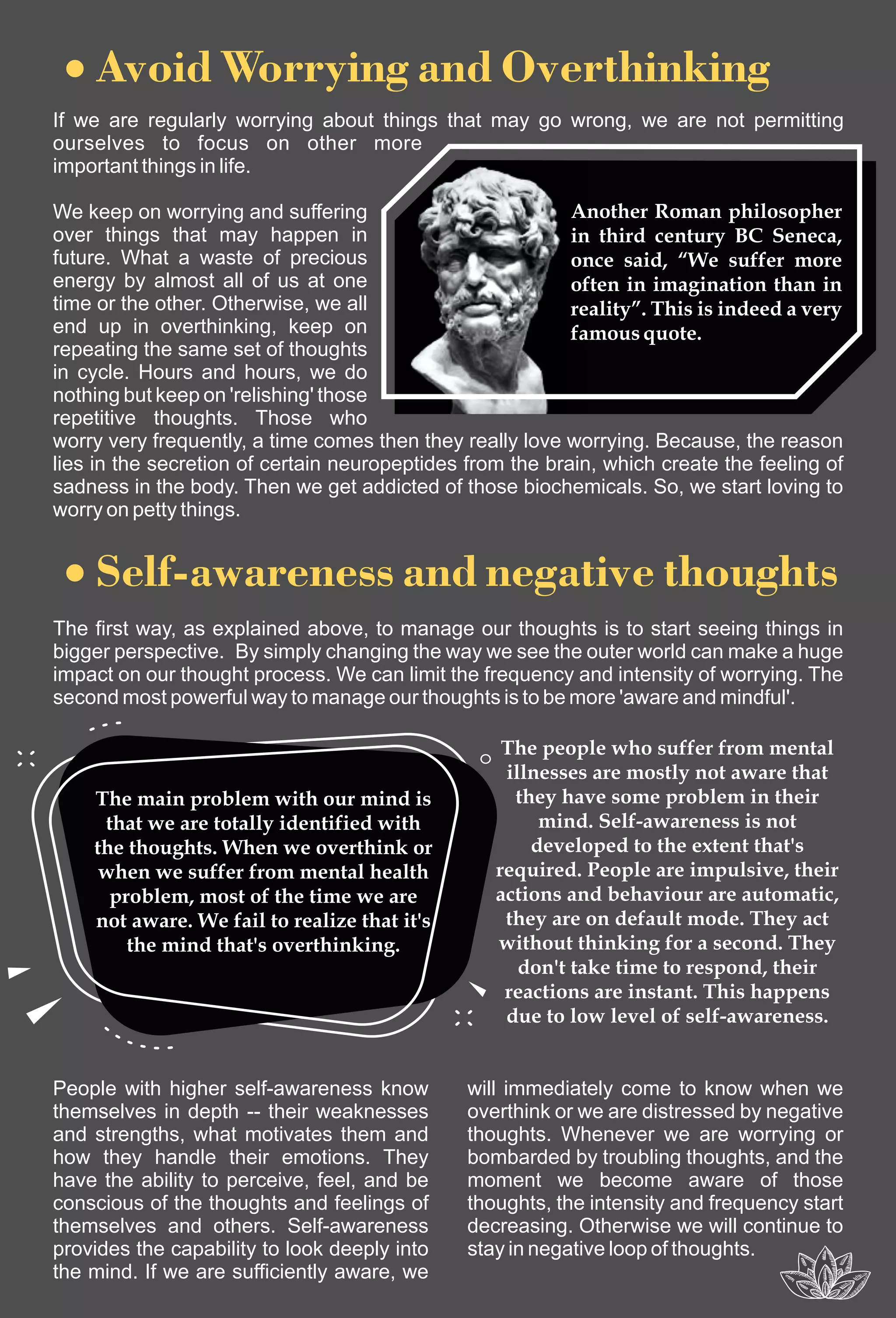
Another Roman philosopher
in third century BC Seneca,
once said, “We suffer more
often in imagination than in
reality”. This is indeed a very
famous quote.
If we are regularly worrying about things that may go wrong, we are not permitting
ourselves to focus on other more
important things in life.
We keep on worrying and suffering
over things that may happen in
future. What a waste of precious
energy by almost all of us at one
time or the other. Otherwise, we all
end up in overthinking, keep on
repeating the same set of thoughts
in cycle. Hours and hours, we do
nothing but keep on 'relishing' those
repetitive thoughts. Those who
worry very frequently, a time comes then they really love worrying. Because, the reason
lies in the secretion of certain neuropeptides from the brain, which create the feeling of
sadness in the body. Then we get addicted of those biochemicals. So, we start loving to
worry on petty things.
Self-awareness and negative thoughts
.
.
The first way, as explained above, to manage our thoughts is to start seeing things in
bigger perspective. By simply changing the way we see the outer world can make a huge
impact on our thought process. We can limit the frequency and intensity of worrying. The
second most powerful way to manage our thoughts is to be more 'aware and mindful'.
The main problem with our mind is
that we are totally identified with
the thoughts. When we overthink or
when we suffer from mental health
problem, most of the time we are
not aware. We fail to realize that it's
the mind that's overthinking.
The people who suffer from mental
illnesses are mostly not aware that
they have some problem in their
mind. Self-awareness is not
developed to the extent that's
required. People are impulsive, their
actions and behaviour are automatic,
they are on default mode. They act
without thinking for a second. They
don't take time to respond, their
reactions are instant. This happens
due to low level of self-awareness.
People with higher self-awareness know
themselves in depth -- their weaknesses
and strengths, what motivates them and
how they handle their emotions. They
have the ability to perceive, feel, and be
conscious of the thoughts and feelings of
themselves and others. Self-awareness
provides the capability to look deeply into
the mind. If we are sufficiently aware, we
will immediately come to know when we
overthink or we are distressed by negative
thoughts. Whenever we are worrying or
bombarded by troubling thoughts, and the
moment we become aware of those
thoughts, the intensity and frequency start
decreasing. Otherwise we will continue to
stay in negative loop of thoughts.
You may have noticed that people who are
generally aware and mindful about what's
happening in their surrounding
environment are happier, because their
behavior, emotions and actions are not
impulsive. They are not on 'autopilot
mode'. They are not impulsive. They will
Awareness of those
thoughts also leads to
release of their negative
energy. This is called as
'relaxed awareness'.
If we stay in the state of relaxed awareness for
some time and observe those negative
thoughts without reacting to them, then shortly
we see that negative thoughts are losing their
energy.
It's a big step indeed for handling negative
thoughts. At least half of the problem is taken
care of if we become fully aware and be
conscious of troubling thoughts. It makes a
difference. That's why self-awareness is
the foundation stone of mental health.
We need to cultivate it. Though
everyone says they have complete
self-awareness and are fully
conscious, but this is generally not
the case. Those who suffer more,
have low level of 'awareness'.
MINDFUL LIVING
More the
mind's
wandering, more
unhappy they are. It's a
simple formula of life. Those
who learn to live mindfully,
exercise more control over
their inner
world/mind.
If we really want to manage our mind and the thoughts,
we need to be aware, conscious and mindful. We need
to be 'present at the moment' to the extent possible.
People who are focused and be present, are
happier.
never react instantly if something
happens. They will respond to the situation
as per the demand of that particular
moment. They are 'mindful' and they
experience 'mindful living'.
Need to Meditate
Once we start living mindfully, we become increasingly aware of
what is going on around us. This is called meta-awareness, to be
aware of awareness. When we are stressed or emotionally
disturbed, we are able to regain equilibrium much faster if we live
mindfully. In other words, we recover
faster from virtually any disturbance.
When we suffer from anxiety, stress,
negative or depressing thoughts, the
amygdala, our brain's emotional centre, is very
active. When we practice meditation, the
amygdala, in those moments, resumes normal
function much faster.
MINDFULNESS
Mindfulness is nothing but be present on
the moment and observe whatever is
happening around us in non-judgmental
way. We shouldn't react but respond in
conscious way. It's not easy to become
'mindful' and conscious, it needs regular
mental exercises such as meditation and
practice of mindfulness. While eating,
walking, working, interacting with
others, we should be mindful. This is
nothing but mindfulness. To manage
thoughts, this is the best recipe. To know
further on mindfulness and meditation,
may like to read my earlier chapter on
“Conquerthe Mind”.
Mindfulness is the key to enhance self-awareness,
conscious behaviour and mindful action in our life.
For mindful living, we should try to live in present with higher level of self-
awareness. This is the best possible option to handle all kinds of harmful thoughts.
Therefore, the basic mantra which we all must
learn is to live mindfully i.e. be aware,
conscious and be present, as far as possible.
Off course, we can't eliminate mind's wandering all the time
but certainly we can, with the regular practice of
meditation, minimize it and we gradually become
more focused and attentive all the time.

Manage your mind & thoughts

  • 1.
    Author of RedesignYour Life in Modern Age Balvinder Kumar retd. IAS & Explore Your Life Journey YOUR THOUGHTS LEARN TO MANAGE YOUR THOUGHTS LEARN TO MANAGE KNOW YOUR LIFE [SERIES 3] If you are able to master your thoughts, you can manage any adversity in life
  • 2.
    The world outthere is a human construct. We perceive and construct images and models of reality inside our mind. Our beliefs about the world around us, the thoughts, feelings and emotions and state of our mind all contribute in creating the reality inside the mind. It's well said that we ourselves are the sole creator of 'heaven' and 'hell' during our lifetime itself. These are not the imaginary 'places' beyond earth where we take re-birth after death. We create and experience such conditions in the lifetime only. When our sufferings are severe and continuous, we create 'hell' and when our life is full of joy and happiness, we make 'heaven' in our life. It all depends on how well or bad we manage our mind. Introduction Mind can be our best master or the worst servant, we can ever imagine, depending on the control we exercise over it. Outer reality is nothing but the reflection of our own inner world. If we are happy and contended then the outer world is full of joy and happiness. On the contrary, if mind is depressed, sad or distressed then the world around us becomes unfriendly and hostile. It's just of matter of how we perceive the world in our mind. There is no objective or 'true' reality outside us. For each one us we perceive the world in our own unique way. There is no 'true reality'. This is the reason; we all think and perceive the world in different ways. Hence, so much of conflicts and contradictions in our society. We all live in our own self- created 'world'. It rarely comes in our mind that others may have altogether different version of reality in their mind.
  • 3.
    Every moment ourbrain generates thoughts through unconscious neurological process. It's an automatic process.Astream of incessant thoughts is running in our mind. We have no control over them. In next 15 seconds what kind of thoughts will come in our mind, we have no idea. We can't suppress inflow of thoughts. If thoughts are disturbing and toxic, our suffering becomes un-manageable. They can even push us into such a horrifying situation that people may take their own life. The problem is many of those people may not be conscious about their state of mind. This is because of the fact that we are completely identified with our mind. We, as a whole, become 'thinking mind'. We are mostly unaware that it's the mind that does thinking. Those who suffer from mental health problem are rarely aware that they suffer from mind's problem. What's mind How thoughts are created in mind? Since our brain is the most intricate structure in the universe, and brain scientists still have to unravel its intricacies, our mind is equally complex. Since the ancient times, scientists as well as spiritual masters and sages have been trying hard to understand its functioning. Our brain has about 90 billion cells/neuron and each neuron may be connected to up to 10,000 other neurons, passing signals to each other via as many as 1,000 trillion connections. How can human mind understand such complicated structure? In a way, brain is our hardware, which produces, so called, the mind. Mind is primarily an outcome of our brain. If something is wrong with our brain either structurally or functionally or both, it will be correspondingly reflected in our mind.
  • 4.
    Most of thecontents of the unconscious mind are repressed and may be unpleasant, such as feelings of pain, anxiety, or conflict. We are completely unaware of this part of mind. All of our early childhood experiences including traumatic incidents, if any, are deeply imbedded here. Then comes our subconscious mind. The function of our subconscious mind is to store and retrieve data from memory bank. All automatic functions like eating, breathing, driving and walking are programmed here. It stores our previous experiences, beliefs, memories, skills and habits. Because of this part of our mind, we work on automatic mode, without the intervention of conscious mind. Another very powerful part of our mind. During our waking hours, more than 95% of our tasks are carried out not by conscious mind but by unconscious and subconscious mind. So now we know, first of all, our thoughts are generated automatically. We have no control over them. Second, the mind which works in the present moment and for which we are fully aware is just a tip of the iceberg.A massive part of iceberg/mind lies below our awareness. Conscious mind Unconscious mind Subconscious mind First, we need to understand that our conscious mind is just a tip of the iceberg. The conscious mind consists of all of our thoughts, memories, feelings, and wishes of which we are aware at any given moment. In the present moment, we are aware only the conscious part of the brain.Behind this mind for which are conscious and aware, there are two far more powerful parts of mind i.e. subconscious and unconscious mind. In fact, all the time, nearly half a million times more powerful mind keeps on working incessantly and we are not aware of it. So, bulk of the mind is behind our conscious mind. The unconscious mind which works behind our conscious mind is a reservoir of feelings, thoughts, urges, and memories that are outside of our awareness. Our behaviour, impulses, urges, beliefs etc are all lies in unconscious mind. That's why, we have hardly any control over our habitual behaviour and core beliefs. Our reactions are automatic because they are generated from our unconscious mind.
  • 5.
    Inherent Nature ofMind 1 2 Second, our mind is biased towards negativity. That's the reason we are prone to perceive negative news instantly. As an evidence, see any news channels or read daily newspapers, how they highlight negative news because they know that their audience would love that content. Media look desperately for sensational news to broadcast, as public prefer to see that kind of news. The reason lies in our past. When we were hunter gatherers living in highly dangerous and fearful situations, our mind got adapted to receive alerts or signals, negative in nature immediately from surrounding environment. Same sensitivity of negative news is presently continuing. In the modern age, though there is so such types of dangerous circumstances as were prevalent during those days, but our brain gets instantly activated. That particular part of brain is the legacy of that era and this very part makes us fearful even with imaginary threats. There are few other very important characteristics of mind, which we all must know to understand our mind. The first is mind's wandering. When we are not focused or attentive, our mind wanders in various possible directions. Suppose we are in a 'boring' meeting or watching a movie, we are mostly on wandering mode. Further, mind's wandering increases when we are disturbed or unhappy. Frequency of wandering of thoughts increases during those distressing times. On the other hand, when we are focused or fully absorbed in certain activity, we are comparatively happier. Mind's wandering becomes uncontrollable if we are very disturbed. On an average, nearly 53% of our time, our mind is not focused, it's somewhere else. When we are bored or doing routine or any other uninteresting work, mind's wandering is as high as 70%. However, when we are engaged in mind- absorbing or concentration-demanding tasks, this percentage is low, as low as 10%. Mind's Wandering Our Mind is biased towards Negativity
  • 6.
    3 Negative Thoughts This isa Psychological Phenomenon known as “ironic process” 4 Third, the negative thoughts don't easy leave our mind once they intrude into our thinking domain. They are very 'sticky', stick inside the mind, and keep on repeating and expanding inside the mind. One of the worst characteristic features of negative thoughts is their 'stickiness'. It's not an easy task to remove 'stickiness' from negative thoughts. Each one of us must have experienced, once in a while, when we are stuck with those types of disturbing thoughts. Fourth, I am sure you all must have observed that when are disturbed by negative thoughts, and try to suppress them by diverting our attention to other things, then same very thoughts resurface more frequently. More we suppress those thought, more forcefully they keep on coming in mind. This is a psychological phenomenon known as “ironic process” or the “white bear problem,” wherein deliberate attempts to suppress certain thoughts make them more likely to reappear. For instance, when someone is trying hard not to think of a white bear, the same bear is likely to appear more in our mind. On those disturbing times, when we try to focus on other activities like talking to friends, to go for those disturbing times, when we try to focus on other activities like talking to friends, to go for movie, play games or start reading, we get only a temporary relief. Those disturbing thoughts just don’t want to quit! We become increasingly agitated and disturbed, when those thoughts keep on intruding in our mind. This inherent nature of our mind makes us vulnerable and prone to negativity. Unless we know how to deal with such kinds of thoughts, it's not easy for us to manage them.
  • 7.
    First of all,we must understand that we can never be perfectly happy. Even if someone has huge wealth, big bungalow to live, all the comforts and luxuries and working on some top executive/govt. post, he/she would still be not happy and satisfied. That person may still be suffering from mental stress or feeling of 'satisfactoriness' or may be experiencing some emotional issues at workplace or with relationships. Our own critique in mind We can never be perfectly happy and satisfied with life There is no harm in engaging our mind with internal voice. However, when we are disturbed for some reason, our own inner voice/critique will keep on repeating 'self- critical thoughts'. Suppose we commit some grave mistake due to our own negligence, then we become highly critical to ourselves. Even to extent of abusing or criticising severely to ourselves. Many of us must have done sometime in the past. If we experience self-critical voice once in a while there is no problem but once it becomes recurring, more like a habit then it's very harmful for our mental health. We, without exception, very often talk to ourselves. Unless and until we are focused or be attentive on certain task, we speak to our own self. This is called inner voice. It's an inherent tendency to be restless and not to be satisfied with life's conditions. Poor people suffer for want of money and struggle for minimum required level of livelihood. Rich people suffer from boredom and feeling of restlessness because they may still be needing more pleasurable and material goods. Most of them feel they would be happy with more wealth and with more frequent and intense pleasurable activities. The result is majority of us are not fully satisfied and happy with life.
  • 8.
    To a certainextent, worrying is good for us because it prompts us to take precautionary measures or avoid risky behaviour. However, worrying often leads to distressing, negative and often obsessive thoughts. Whenever there is a perception of danger, real or imagined, our mind keeps on deliberating and analysing until it’s overburdened with negative thoughts. Worrying, The Main Source of Mental Distress There will always be some imaginary or real perception of threat involved in our everyday life. And the more we focus on the issue giving us worry, the more we attract the same in one form or another. The mind tends to create worst-case scenarios based on any imaginary fear. We all worry for one reason or another. Worrying is an inherent tendency of our mind as well as a constant problem for us. Worry refers to the thoughts and emotions of a negative nature, with fearful anticipation of poor outcome. Most of us do have a number of concerns to worry about. As an emotion, it is experienced as anxiety or concern about a real or imagined fear or threat,often on personal matters such as health or workplace tensions. Most of us experiences short-lived episodes of worry from time to time in our lives. Our brains are wired to worry first and think rationally later. It often becomes an automatic response to any perception of threat. Some of us will worry about virtually anything.
  • 9.
    The problem iswhen we suffer or experience some adversity, then the thoughts relating to that particular event or circumstances make us mentally and psychologically vulnerable. If we don't know how to deal with the thoughts that are generated on those moments, we suffer intensively. It's well said that real test of life comes under adversity. Not only we suffer m e n t a l l y b e c a u s e o f t h o s e circumstances but also make our mind susceptible to mental health problems, that may arise at later date. Psychological turmoil is unavoidable Nearly 15% people in India suffer from different kinds of mental disorders. Many of them don't seek professional help. Because they are ignorant of the fact that they need medical assistance for their illness. Depression, one of the most prominent mental problem prevalent worldwide pushes lakhs of sufferers to end their lives. We all are potentially vulnerable to experience adversities that can lead to emotional and psychological turmoil in our life. Worrying in itself is not bad as long as it's controlled. It makes us to prepare better for a possibly difficult event or circumstance. But this is at the cost of our happiness. Very often, when we continue to worry intensively, we experience difficulty in getting sleep, In the long run, worrying leads to many health-related issues. It even weakens our immune system and that's is the reason we get prone to many other illnesses such as high sugar level, blood pressure and heart disease. The problem with worrying is that it becomes a cycle of self- p e rp e tu a ti n g n e g a ti ve thoughts. As we continue to worry, there is a steady flow of negative thoughts which we keep on repeating, with distressing variations, till it becomes uncontrollable. Indeed, a number of studies have shown that worry not only puts strain on our mental health, but also on our physical health. Life is like a roller coaster ride with ups and down. It's a mix of pain, suffering, boredom, joy and happiness.
  • 10.
    Studies have shownthat overthinking leads to serious emotional distress. When people can’t escape from this condition, they often resort to unhealthy methods to cope with the problem. Many people start alcohol abuse, some start or increase smoking, while others may overact. It becomes extremely difficult to enjoy sound sleep when our mind is disturbed. Studies confirm this, finding that rumination and worry lead to fewer hours of sleep and poorer sleep quality. Uncontrolled flow of Thoughts lead to Overthinking When we think too much, instead of actually doing what we would like to do, we merely think. It is just wastage of time and energy, and puts us in a vicious cycle of thinking, means thinking over and over again. We can't divert our mind on other activities for long under such circumstances. Same set of thoughts will keep on disturbing. It is the overthinking mind that makes us feel anxious and worried about the future. We also tend to ruminate on any past incident. There may be numerous situations that may arise in our day to day life, where negative thoughts, relating to regret, hatred, anger, guilt, aggression etc may trouble us. If we don't handle those thoughts carefully, that will lead to overthink. No one can escape from this mental characteristic. Due to strong identification with mind, we don't know when we overthink. When we do, it's the stream of harmful and distressing thoughts that fill our mind. We hardly overthink on positive matters. We only ruminate or worry when we are trapped in unpleasant conditions. When we keep on overthinking most of the time, it invariably leads to psychological distress. This, in turn, reinforce the overthinking. Under such conditions, we are deeply mired in troubling thoughts.
  • 11.
    How to managenegative thoughts? First and the foremost thing, which we must to understand that we have no control over the world around us. The people, their behaviour and actions, the pollical and social scenario in the country, and likewise, there is nothing we can control. Many of us, unnecessarily and wasteful, try to change others. If it's so, then we should not bother about these things in life. Be Stoic The Roman philosopher, Epictetus, the founder of Stoicism, had very correctly remarked that, “For good or for ill, life and nature are governed by laws that we can't change. The quicker we accept this, the more tranquilwecanbe”. We must accept our limitations in controlling the external surroundings. The things which are beyond are control must not be the source of our worrying. Similarly, we should remember that “whatever has happened, has happened, and things would have happened in any other way”. There is no point in worrying on those matters. We should accept those things wholeheartedly. This simple philosophy, first, focus on things over which we have control like our thoughts, behaviour and actions. Second, accept the things where we have no control or things have already happened, why worry over them. If we adopt these two components of philosophy, our life will become far simpler and easier. Most of our pain, and suffering comes from resistance to things happening in outer world. Life is like that. When we resist what life is, we suffer. On the contrary, when we say yes to life, surrender to life, life moves with ease. If an accident happens, it has happened. Nothing will change now. Then why do we resist. Why do we react. We must remember 3-word mantra: Learn, Accept and Move. Life flows like a river. So, flow with thewater, thetime andthelife. We should respond appropriately without preconceived beliefs. However, we have complete control over our inner world. Our thoughts, actions, behaviour, desires, impulses and urges are totally under our control. We must bother about our mind, from where all these things arise. .
  • 12.
    Avoid Worrying andOverthinking Another Roman philosopher in third century BC Seneca, once said, “We suffer more often in imagination than in reality”. This is indeed a very famous quote. If we are regularly worrying about things that may go wrong, we are not permitting ourselves to focus on other more important things in life. We keep on worrying and suffering over things that may happen in future. What a waste of precious energy by almost all of us at one time or the other. Otherwise, we all end up in overthinking, keep on repeating the same set of thoughts in cycle. Hours and hours, we do nothing but keep on 'relishing' those repetitive thoughts. Those who worry very frequently, a time comes then they really love worrying. Because, the reason lies in the secretion of certain neuropeptides from the brain, which create the feeling of sadness in the body. Then we get addicted of those biochemicals. So, we start loving to worry on petty things. Self-awareness and negative thoughts . . The first way, as explained above, to manage our thoughts is to start seeing things in bigger perspective. By simply changing the way we see the outer world can make a huge impact on our thought process. We can limit the frequency and intensity of worrying. The second most powerful way to manage our thoughts is to be more 'aware and mindful'. The main problem with our mind is that we are totally identified with the thoughts. When we overthink or when we suffer from mental health problem, most of the time we are not aware. We fail to realize that it's the mind that's overthinking. The people who suffer from mental illnesses are mostly not aware that they have some problem in their mind. Self-awareness is not developed to the extent that's required. People are impulsive, their actions and behaviour are automatic, they are on default mode. They act without thinking for a second. They don't take time to respond, their reactions are instant. This happens due to low level of self-awareness. People with higher self-awareness know themselves in depth -- their weaknesses and strengths, what motivates them and how they handle their emotions. They have the ability to perceive, feel, and be conscious of the thoughts and feelings of themselves and others. Self-awareness provides the capability to look deeply into the mind. If we are sufficiently aware, we will immediately come to know when we overthink or we are distressed by negative thoughts. Whenever we are worrying or bombarded by troubling thoughts, and the moment we become aware of those thoughts, the intensity and frequency start decreasing. Otherwise we will continue to stay in negative loop of thoughts.
  • 13.
    You may havenoticed that people who are generally aware and mindful about what's happening in their surrounding environment are happier, because their behavior, emotions and actions are not impulsive. They are not on 'autopilot mode'. They are not impulsive. They will Awareness of those thoughts also leads to release of their negative energy. This is called as 'relaxed awareness'. If we stay in the state of relaxed awareness for some time and observe those negative thoughts without reacting to them, then shortly we see that negative thoughts are losing their energy. It's a big step indeed for handling negative thoughts. At least half of the problem is taken care of if we become fully aware and be conscious of troubling thoughts. It makes a difference. That's why self-awareness is the foundation stone of mental health. We need to cultivate it. Though everyone says they have complete self-awareness and are fully conscious, but this is generally not the case. Those who suffer more, have low level of 'awareness'. MINDFUL LIVING More the mind's wandering, more unhappy they are. It's a simple formula of life. Those who learn to live mindfully, exercise more control over their inner world/mind. If we really want to manage our mind and the thoughts, we need to be aware, conscious and mindful. We need to be 'present at the moment' to the extent possible. People who are focused and be present, are happier. never react instantly if something happens. They will respond to the situation as per the demand of that particular moment. They are 'mindful' and they experience 'mindful living'. Need to Meditate Once we start living mindfully, we become increasingly aware of what is going on around us. This is called meta-awareness, to be aware of awareness. When we are stressed or emotionally disturbed, we are able to regain equilibrium much faster if we live mindfully. In other words, we recover faster from virtually any disturbance. When we suffer from anxiety, stress, negative or depressing thoughts, the amygdala, our brain's emotional centre, is very active. When we practice meditation, the amygdala, in those moments, resumes normal function much faster.
  • 14.
    MINDFULNESS Mindfulness is nothingbut be present on the moment and observe whatever is happening around us in non-judgmental way. We shouldn't react but respond in conscious way. It's not easy to become 'mindful' and conscious, it needs regular mental exercises such as meditation and practice of mindfulness. While eating, walking, working, interacting with others, we should be mindful. This is nothing but mindfulness. To manage thoughts, this is the best recipe. To know further on mindfulness and meditation, may like to read my earlier chapter on “Conquerthe Mind”. Mindfulness is the key to enhance self-awareness, conscious behaviour and mindful action in our life. For mindful living, we should try to live in present with higher level of self- awareness. This is the best possible option to handle all kinds of harmful thoughts. Therefore, the basic mantra which we all must learn is to live mindfully i.e. be aware, conscious and be present, as far as possible. Off course, we can't eliminate mind's wandering all the time but certainly we can, with the regular practice of meditation, minimize it and we gradually become more focused and attentive all the time.