Child Care from a Global Perspective
:
PHILIPPINES
Avelina
Junnifer
Nasima,
Annie
Salmee
PAA Toes
TUHODKnees
BALIKATShoulders
ULO Head
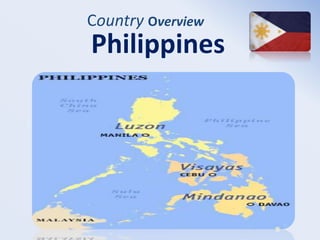
Philippines
Country Overview
• 1564-1882- PRE-SPANISH PERIOD
1890 -1900 -SPANISH ERA
1935-1948- AMERICAN ERA
• Day care programmes are carried out in public centres and
home-based setting
a. Home-based – Parents , guardians enhanced their
knowledge, skills and attitudes in parenting through
listening to air program –Philippine family on the air;
b. PublicDay Care Centres- largest provider of early child
care
• 3 to 4 hr sessions per age group, Monday till Friday
• Education aims to develop physical,social,emotional, and
cognitive in a less structured curriculum and mostly
through play.
Both Formal and Informal aim to develop children in all
aspects(physical,social, emotional,and cognitive )to
maximize children’s potential through a variety of
experiences considering their interests and capabilities.
July 26, 2005 -National Pre-School Education
Program was conceived and started
• To engage children in a
teacher-directed, structured
classroom tasks;
• Educators maintain the
children’s health and follow
safety policies, if they get sick
(I.e. cold, flu, running nose
or diarrhea).
• Encourage children’s growth
in all domains (physical,
social, emotional, language
and cognitive).
• Create enhancing programs
and curriculums
• High School Diploma
• The education must be a Bachelor
of Science degree with
specialization in Early Childhood
or Kindergarten education.
• Female between ages 18-45 (for
daycares)
• Male or female, between the age
of 21- 35 (for pre-school)
• Training experience and an
interest in working with young
children and certified physically
and emotionally fit.
Availability of Day Care Programs in
Canada
Different types of childcare
 Child care centers school age or under
 Preschool/nursery school 2.5-5 years
 Regulated family child care 0-12 years
 Early childhood intervention
 Kindergarten 5 years
Availability of Day Care Programs in
Philippines
Different types of childcare:
Day-care Centers 3-5years
NGOs/Community-based 3-5years
Public Pre-schools 5 years
Private Pre-schools 3-5years
OPENING HOURS
COMPARISON
Canada
Full-day or part-
day
Monday-Friday
Philippines
3-4 hours sessions
Morning or afternoon
shift
Monday and Friday
• Canada
$ 9600 a year
DIFFERENT COSTS IN
TWO COUNTRIES
• Philippines
2850pesos($66)
a year
the State of Day Care Programs
in Canada
 Child care and nursery school/preschool programs are
in short supply in most regions of the country
 Nursery schools, preschools and kindergarten
programs are not organized to support the needs of
parents.
 The subsidy system often does not cover the actual
costs.
the State of Day Care Programs
in Philippines
 There are more day-care centers in urban
areas than in rural area
 Day-care centers are insufficient for the
large number of children below six years
who live in severely congested urban areas
Reference
http://www.flickr.com/
http://unesdoc.unesco.org/images/0013/001378/137867e.pdf
Gestwicki, Barbara, and Jane Carol. Essentials of Early Childhood
Education. fourth. NELSON, 2012. Print.
References:
http://unesdoc.unesco.org/images/0013/001378/1378
67e.pdf
Gestwicki, Barbara, and Jane Carol. Essentials of Early
Childhood Education. fourth. NELSON, 2012. Print.
www.globalperspective-child’s care,philippines.Web.
Unesdoc.unesco.org/images/0013/001378/137867.pdf
Slideshare.net/philippinepresentation2.

Mamita2 (1)

  • 1.
    Child Care froma Global Perspective : PHILIPPINES Avelina Junnifer Nasima, Annie Salmee
  • 2.
  • 4.
  • 5.
    • 1564-1882- PRE-SPANISHPERIOD 1890 -1900 -SPANISH ERA 1935-1948- AMERICAN ERA
  • 7.
    • Day careprogrammes are carried out in public centres and home-based setting a. Home-based – Parents , guardians enhanced their knowledge, skills and attitudes in parenting through listening to air program –Philippine family on the air; b. PublicDay Care Centres- largest provider of early child care • 3 to 4 hr sessions per age group, Monday till Friday • Education aims to develop physical,social,emotional, and cognitive in a less structured curriculum and mostly through play. Both Formal and Informal aim to develop children in all aspects(physical,social, emotional,and cognitive )to maximize children’s potential through a variety of experiences considering their interests and capabilities.
  • 9.
    July 26, 2005-National Pre-School Education Program was conceived and started
  • 12.
    • To engagechildren in a teacher-directed, structured classroom tasks; • Educators maintain the children’s health and follow safety policies, if they get sick (I.e. cold, flu, running nose or diarrhea). • Encourage children’s growth in all domains (physical, social, emotional, language and cognitive). • Create enhancing programs and curriculums
  • 13.
    • High SchoolDiploma • The education must be a Bachelor of Science degree with specialization in Early Childhood or Kindergarten education. • Female between ages 18-45 (for daycares) • Male or female, between the age of 21- 35 (for pre-school) • Training experience and an interest in working with young children and certified physically and emotionally fit.
  • 14.
    Availability of DayCare Programs in Canada Different types of childcare  Child care centers school age or under  Preschool/nursery school 2.5-5 years  Regulated family child care 0-12 years  Early childhood intervention  Kindergarten 5 years
  • 15.
    Availability of DayCare Programs in Philippines Different types of childcare: Day-care Centers 3-5years NGOs/Community-based 3-5years Public Pre-schools 5 years Private Pre-schools 3-5years
  • 16.
    OPENING HOURS COMPARISON Canada Full-day orpart- day Monday-Friday Philippines 3-4 hours sessions Morning or afternoon shift Monday and Friday
  • 17.
    • Canada $ 9600a year DIFFERENT COSTS IN TWO COUNTRIES • Philippines 2850pesos($66) a year
  • 18.
    the State ofDay Care Programs in Canada  Child care and nursery school/preschool programs are in short supply in most regions of the country  Nursery schools, preschools and kindergarten programs are not organized to support the needs of parents.  The subsidy system often does not cover the actual costs.
  • 19.
    the State ofDay Care Programs in Philippines  There are more day-care centers in urban areas than in rural area  Day-care centers are insufficient for the large number of children below six years who live in severely congested urban areas
  • 20.
    Reference http://www.flickr.com/ http://unesdoc.unesco.org/images/0013/001378/137867e.pdf Gestwicki, Barbara, andJane Carol. Essentials of Early Childhood Education. fourth. NELSON, 2012. Print.
  • 21.
    References: http://unesdoc.unesco.org/images/0013/001378/1378 67e.pdf Gestwicki, Barbara, andJane Carol. Essentials of Early Childhood Education. fourth. NELSON, 2012. Print. www.globalperspective-child’s care,philippines.Web. Unesdoc.unesco.org/images/0013/001378/137867.pdf Slideshare.net/philippinepresentation2.