Global perspective Child Care
   Canada and United States
    Sofia Abubeker, Fareeda Hapy, Suwon Choi
        Huma Mir, Yuleisi Slina, Jenny Nguyen
Contents
   Formal/Informal

   History

   Underlying Philosophy

   Program Structure

   Roles of early childhood educators

   Training needed
Formal - US
   Working families with children, child care expenses
    can consume a large portion of the family budget


   Low-income families-the expenses can be significant


   Some of the parents who use paid care may place
    their children in care they consider unsatisfactory
    because other arrangements are unaffordable, with
    potential effects on a variety of child outcomes.
Informal - US
   Families use informal care in response to low-wage
    working conditions

   Sometimes informal care meets family’s needs but, in
    some cases the informal care met minimal standars of
    health and safety

   A surprising number of families find the subsidy system
    unhelpful

 Bureaucratic procedures and staff attitudes in agencies
  that manage subsidies often discourage parents who
  qualify from using this help
http://www.mdrc.org/publications/353/policybrief.html
History – US
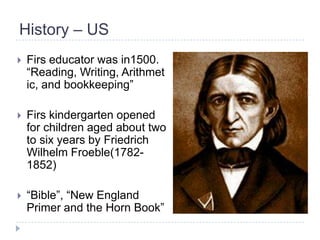
   Firs educator was in1500.
    ―Reading, Writing, Arithmet
    ic, and bookkeeping‖

   Firs kindergarten opened
    for children aged about two
    to six years by Friedrich
    Wilhelm Froeble(1782-
    1852)

   ―Bible‖, ―New England
    Primer and the Horn Book‖
Underlying Philosophy/Availability and
Accessibility - US
   Poorly distributed in both public and private
    providers

   Child care fees paid by parents equal, on average

   Only about 10% of eligible low-income parents get
    the subsidies

   Less available to those who live in rural areas
    compared to those who live in urban cities.

   Less professional training
Underlying Philosophy/Availability and
Accessibility – US(con’t)
   Those who live in urban cities and belong to a
    middle class salaries have the same accessibility.

   Single mothers received more financial help from the
    government then single fathers

   Child care is ―…less available in the south..‖
    compared to northern U.S

   Lower-income areas have less availability compared
    to middle and higher income families
Underlying Philosophy/Availability and
Accessibility – US(con’t)
   Child care is accessible in the United States, but the
    problem lies on whether parents can afford them

   Child care in Washington and Massachusetts are the
    most expensive and the least expensive is in
    Mississippi
        -Infant cost are around $7,000-$14,000 a year
        -$3,400-$10,400 for school ages children

http://www.naccrra.org/randd/docs/Cost%20of%20Chil
  d%20Care%20in%20the%20United%20States%202
  010.pdf (cost by state)
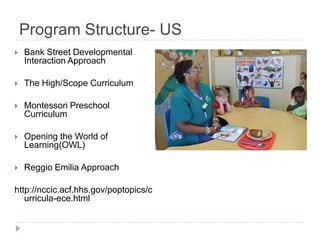
Program Structure- US
   Bank Street Developmental
    Interaction Approach

   The High/Scope Curriculum

   Montessori Preschool
    Curriculum

   Opening the World of
    Learning(OWL)

   Reggio Emilia Approach

http://nccic.acf.hhs.gov/poptopics/c
   urricula-ece.html
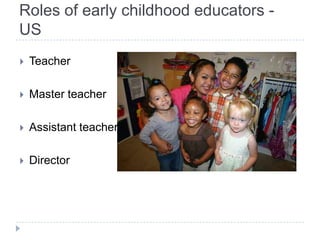
Roles of early childhood educators -
US
   Teacher

   Master teacher

   Assistant teacher

   Director
Training needed - US
   High school diploma or equivalent

   Work experiences

   Orientation

http://www.bls.gov/oco/cg/cgs032.htm#training
Underlying Philosophy - Canada
   Based upon the recognition emotional, physical, intellectual
    and social growth

   Different learning centers, childcare provided public and
    private care also provided such as day care, private homecare

   Child services among Canadians are distributed free with
    government and volunteer help

   YMCA is one of the largest non-profitable childcare provider

   Provides individual attention, and financial support for parents
    who aren’t able to provide it

   Helps provide disable children physical, and emotional help
Availability/Accessibility - Canada
   ―Canada ranked last among developed countries in terms
    of access to early learning and child care spaces — and
    last in terms of public investment."
    http://www.cbc.ca/news/story/2009/02/06/f-daycare.html
   child care is mainly private meaning majority of families
    have to pay for daycare and some have government
    assistance from provincial and territorial ministry.
    http://www.ccaac.ca/pdf/resources/factsheets/universality.
    pdf
   More daycare now are offering after hours compared to
    the 6am-6pm program
   "cbc chart http://www.cbc.ca/news/story/2009/02/06/f-
    daycare.html
Program Structure - Canada
According to ELECT(Early Learning for Every Child
 Today)

   Early child development sets the foundation for
    lifelong learning, behavior, and health.

   Partnerships with families and communities
    strengthen the ability of early childhood settings to
    meet the needs of young children

   Respect for diversity, equity, and inclusion are
    prerequisites for honoring children’s rights, optimal
    development, and learning.
Program Structure – Canada (con’t)
   A planned curriculum supports early learning

   Play is a means to early learning that capitalizes on
    children’s natural curiosity and exuberance
   Knowledgeable, responsive early childhood
    professionals are essential.

Toronto District School Board ―Child Care Resource
  Manual‖ 2nd Edition
Conclusion Canada/US
   Not enough child care; waiting lists are long, fess are
    way too high; there are far too few subsidies to help
    families.
   The lack of child care is affecting the quality of life for
    Toronto families
   Both countries have more similarities than
    differences in the child care
   Some differences in training programs like video
    teleconferences and CDA credential training of ECEs
    but their basic purpose is the same

http://mothersforchildcare.ca/?p=1592
http://www.mdrc.org/publications/353/policybrief.html

Global perspective child care

  • 1.
    Global perspective ChildCare Canada and United States Sofia Abubeker, Fareeda Hapy, Suwon Choi Huma Mir, Yuleisi Slina, Jenny Nguyen
  • 2.
    Contents  Formal/Informal  History  Underlying Philosophy  Program Structure  Roles of early childhood educators  Training needed
  • 3.
    Formal - US  Working families with children, child care expenses can consume a large portion of the family budget  Low-income families-the expenses can be significant  Some of the parents who use paid care may place their children in care they consider unsatisfactory because other arrangements are unaffordable, with potential effects on a variety of child outcomes.
  • 4.
    Informal - US  Families use informal care in response to low-wage working conditions  Sometimes informal care meets family’s needs but, in some cases the informal care met minimal standars of health and safety  A surprising number of families find the subsidy system unhelpful  Bureaucratic procedures and staff attitudes in agencies that manage subsidies often discourage parents who qualify from using this help http://www.mdrc.org/publications/353/policybrief.html
  • 5.
    History – US  Firs educator was in1500. ―Reading, Writing, Arithmet ic, and bookkeeping‖  Firs kindergarten opened for children aged about two to six years by Friedrich Wilhelm Froeble(1782- 1852)  ―Bible‖, ―New England Primer and the Horn Book‖
  • 6.
    Underlying Philosophy/Availability and Accessibility- US  Poorly distributed in both public and private providers  Child care fees paid by parents equal, on average  Only about 10% of eligible low-income parents get the subsidies  Less available to those who live in rural areas compared to those who live in urban cities.  Less professional training
  • 7.
    Underlying Philosophy/Availability and Accessibility– US(con’t)  Those who live in urban cities and belong to a middle class salaries have the same accessibility.  Single mothers received more financial help from the government then single fathers  Child care is ―…less available in the south..‖ compared to northern U.S  Lower-income areas have less availability compared to middle and higher income families
  • 8.
    Underlying Philosophy/Availability and Accessibility– US(con’t)  Child care is accessible in the United States, but the problem lies on whether parents can afford them  Child care in Washington and Massachusetts are the most expensive and the least expensive is in Mississippi -Infant cost are around $7,000-$14,000 a year -$3,400-$10,400 for school ages children http://www.naccrra.org/randd/docs/Cost%20of%20Chil d%20Care%20in%20the%20United%20States%202 010.pdf (cost by state)
  • 9.
    Program Structure- US  Bank Street Developmental Interaction Approach  The High/Scope Curriculum  Montessori Preschool Curriculum  Opening the World of Learning(OWL)  Reggio Emilia Approach http://nccic.acf.hhs.gov/poptopics/c urricula-ece.html
  • 10.
    Roles of earlychildhood educators - US  Teacher  Master teacher  Assistant teacher  Director
  • 11.
    Training needed -US  High school diploma or equivalent  Work experiences  Orientation http://www.bls.gov/oco/cg/cgs032.htm#training
  • 12.
    Underlying Philosophy -Canada  Based upon the recognition emotional, physical, intellectual and social growth  Different learning centers, childcare provided public and private care also provided such as day care, private homecare  Child services among Canadians are distributed free with government and volunteer help  YMCA is one of the largest non-profitable childcare provider  Provides individual attention, and financial support for parents who aren’t able to provide it  Helps provide disable children physical, and emotional help
  • 13.
    Availability/Accessibility - Canada  ―Canada ranked last among developed countries in terms of access to early learning and child care spaces — and last in terms of public investment." http://www.cbc.ca/news/story/2009/02/06/f-daycare.html  child care is mainly private meaning majority of families have to pay for daycare and some have government assistance from provincial and territorial ministry. http://www.ccaac.ca/pdf/resources/factsheets/universality. pdf  More daycare now are offering after hours compared to the 6am-6pm program  "cbc chart http://www.cbc.ca/news/story/2009/02/06/f- daycare.html
  • 14.
    Program Structure -Canada According to ELECT(Early Learning for Every Child Today)  Early child development sets the foundation for lifelong learning, behavior, and health.  Partnerships with families and communities strengthen the ability of early childhood settings to meet the needs of young children  Respect for diversity, equity, and inclusion are prerequisites for honoring children’s rights, optimal development, and learning.
  • 15.
    Program Structure –Canada (con’t)  A planned curriculum supports early learning  Play is a means to early learning that capitalizes on children’s natural curiosity and exuberance  Knowledgeable, responsive early childhood professionals are essential. Toronto District School Board ―Child Care Resource Manual‖ 2nd Edition
  • 16.
    Conclusion Canada/US  Not enough child care; waiting lists are long, fess are way too high; there are far too few subsidies to help families.  The lack of child care is affecting the quality of life for Toronto families  Both countries have more similarities than differences in the child care  Some differences in training programs like video teleconferences and CDA credential training of ECEs but their basic purpose is the same http://mothersforchildcare.ca/?p=1592 http://www.mdrc.org/publications/353/policybrief.html