Machine	
  Learning	
  with	
  MALLET
http://mallet.cs.umass.edu/mallet-­‐tutorial.pdf
David	
  Mimno	
  
Department	
  of	
  Information	
  Science,	
  
Cornell	
  University
License:	
  CC	
  BY	
  4.0
Outline
• About	
  MALLET	
  
• Representing	
  Data	
  
• Classification	
  
• Sequence	
  Tagging	
  
• Topic	
  Modeling
Outline
• About	
  MALLET	
  
• Representing	
  Data	
  
• Classification	
  
• Sequence	
  Tagging	
  
• Topic	
  Modeling
Who?
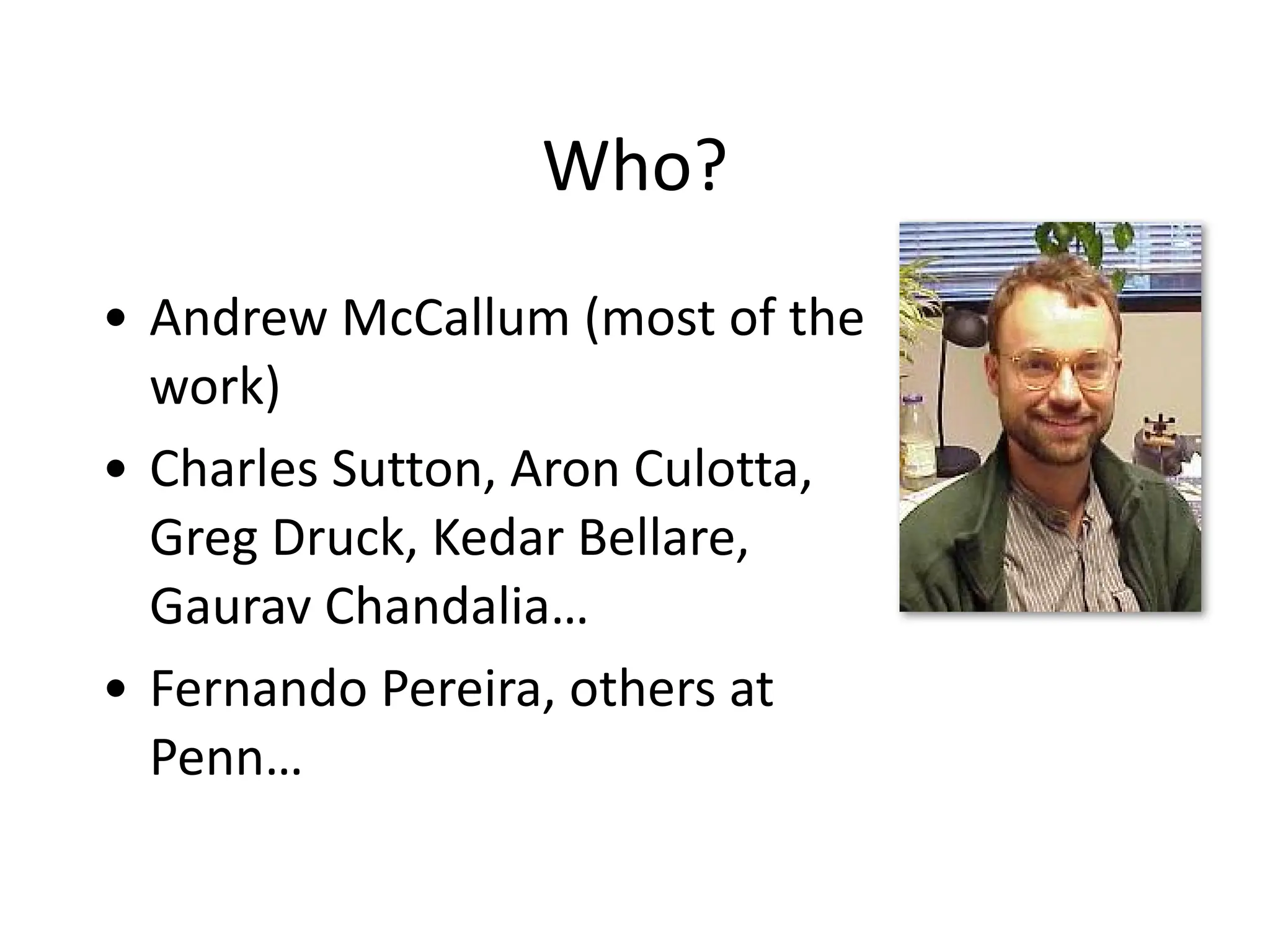
• Andrew	
  McCallum	
  (most	
  of	
  the	
  
work)	
  
• Charles	
  Sutton,	
  Aron	
  Culotta,	
  
Greg	
  Druck,	
  Kedar	
  Bellare,	
  
Gaurav	
  Chandalia…	
  
• Fernando	
  Pereira,	
  others	
  at	
  
Penn…
Who	
  am	
  I?
• Chief	
  maintainer	
  of	
  MALLET	
  
• Primary	
  author	
  of	
  MALLET	
  topic	
  modeling	
  
package
Why?
• Motivation:	
  text	
  classification	
  and	
  
information	
  extraction	
  
• Commercial	
  machine	
  learning	
  (Just	
  
Research,	
  WhizBang)	
  
• Analysis	
  and	
  indexing	
  of	
  academic	
  
publications:	
  Cora,	
  Rexa
What?
• Text	
  focus:	
  data	
  is	
  discrete	
  rather	
  than	
  
continuous,	
  even	
  when	
  values	
  could	
  be	
  
continuous:
double value = 3.0
How?
• Command	
  line	
  scripts:	
  
– bin/mallet	
  [command]	
  -­‐-­‐[option]	
  [value]	
  …	
  
– Text	
  User	
  Interface	
  (“tui”)	
  classes	
  
• Direct	
  Java	
  API	
  
– http://mallet.cs.umass.edu/api
Most of this talk
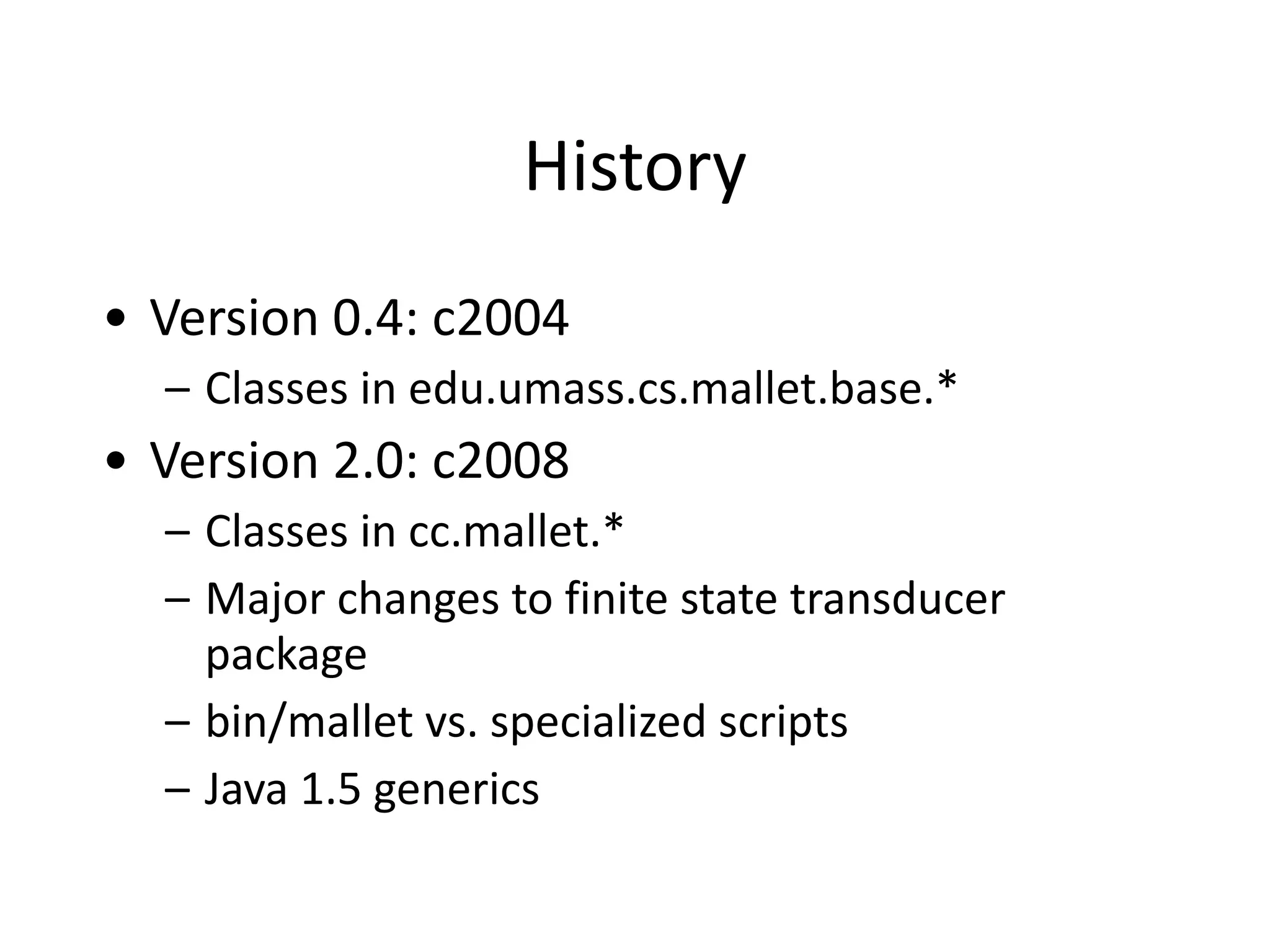
History
• Version	
  0.4:	
  c2004	
  
– Classes	
  in	
  edu.umass.cs.mallet.base.*	
  
• Version	
  2.0:	
  c2008	
  
– Classes	
  in	
  cc.mallet.*	
  
– Major	
  changes	
  to	
  finite	
  state	
  transducer	
  
package	
  
– bin/mallet	
  vs.	
  specialized	
  scripts	
  
– Java	
  1.5	
  generics
Learning	
  More
• http://mallet.cs.umass.edu	
  
– “Quick	
  Start”	
  guides,	
  focused	
  on	
  command	
  line	
  
processing	
  
– Developers’	
  guides,	
  with	
  Java	
  examples	
  
• mallet-­‐dev@cs.umass.edu	
  mailing	
  list	
  
– Low	
  volume,	
  but	
  can	
  be	
  bursty
Outline
• About	
  MALLET	
  
• Representing	
  Data	
  
• Classification	
  
• Sequence	
  Tagging	
  
• Topic	
  Modeling
Models	
  for	
  Text	
  Data
• Generative	
  models	
  (Multinomials)	
  
– Naïve	
  Bayes	
  
– Hidden	
  Markov	
  Models	
  (HMMs)	
  
– Latent	
  Dirichlet	
  Topic	
  Models	
  
• Discriminative	
  Regression	
  Models	
  
– MaxEnt/Logistic	
  regression	
  
– Conditional	
  Random	
  Fields	
  (CRFs)	
  
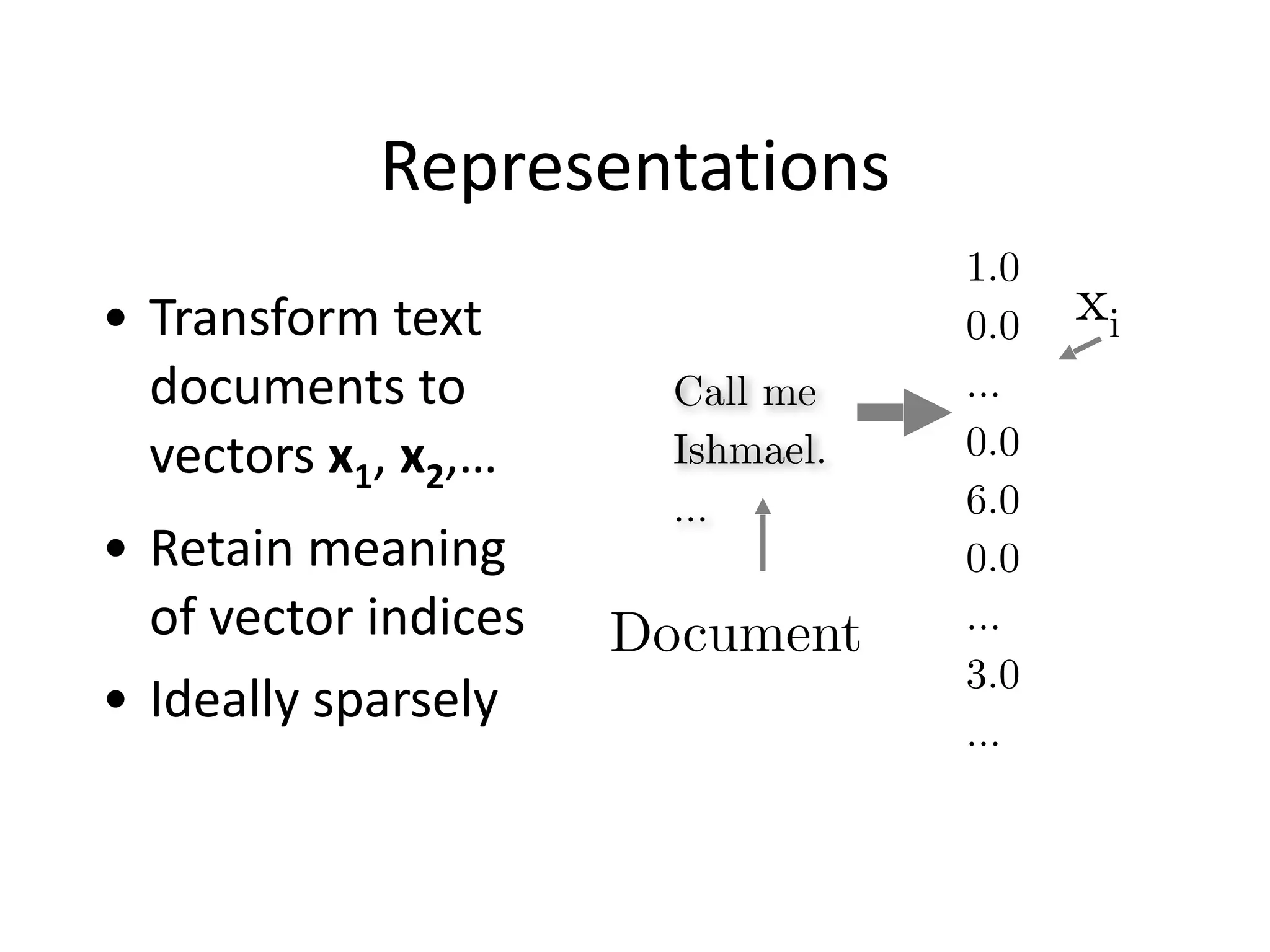
Representations
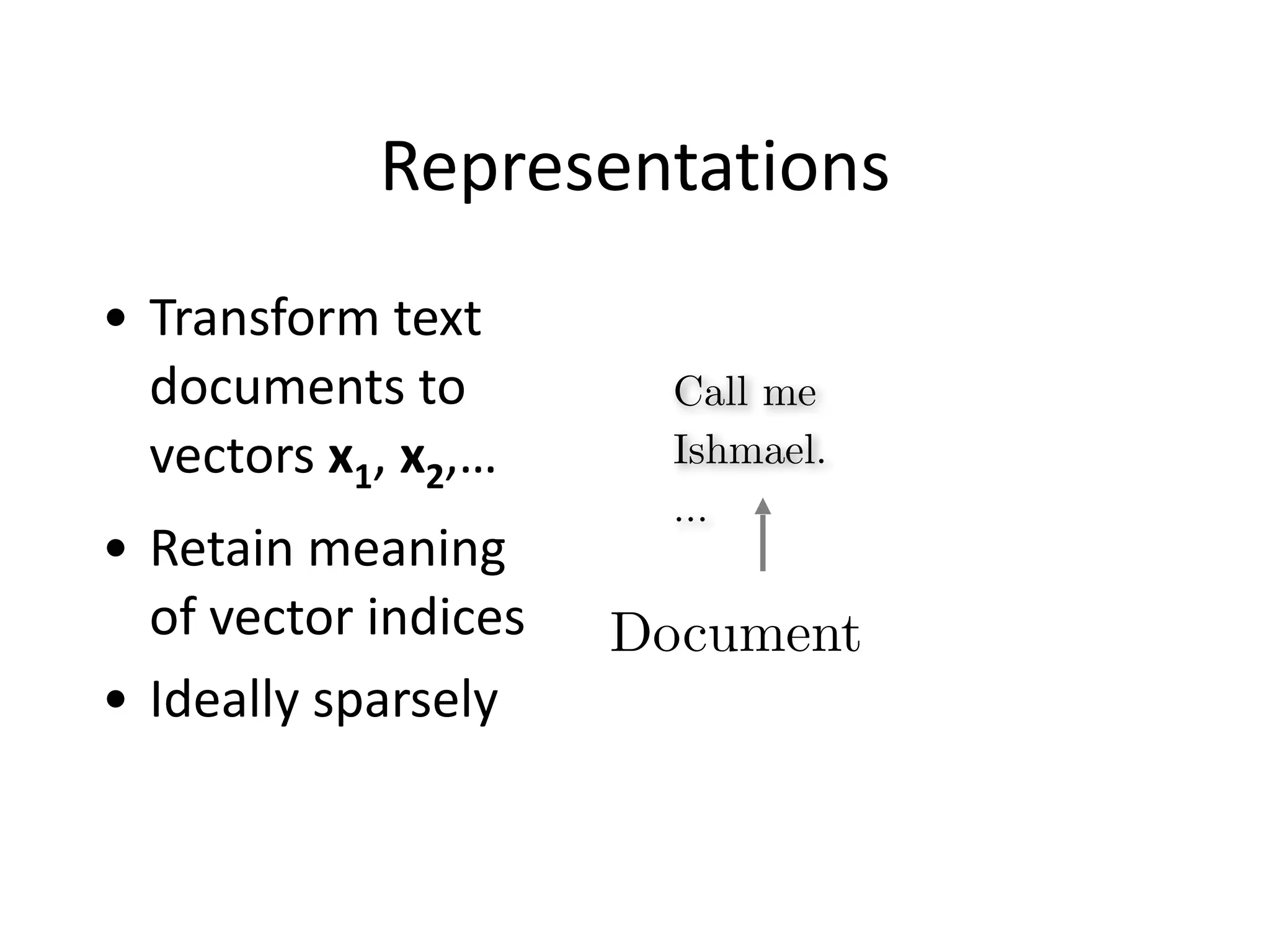
• Transform	
  text	
  
documents	
  to	
  
vectors	
  x1,	
  x2,…	
  
• Retain	
  meaning	
  
of	
  vector	
  indices	
  
• Ideally	
  sparsely
Call me
Ishmael.
…
Document
Representations
• Transform	
  text	
  
documents	
  to	
  
vectors	
  x1,	
  x2,…	
  
• Retain	
  meaning	
  
of	
  vector	
  indices	
  
• Ideally	
  sparsely
1.0
0.0
…
0.0
6.0
0.0
…
3.0
…
Call me
Ishmael.
…
xi
Document
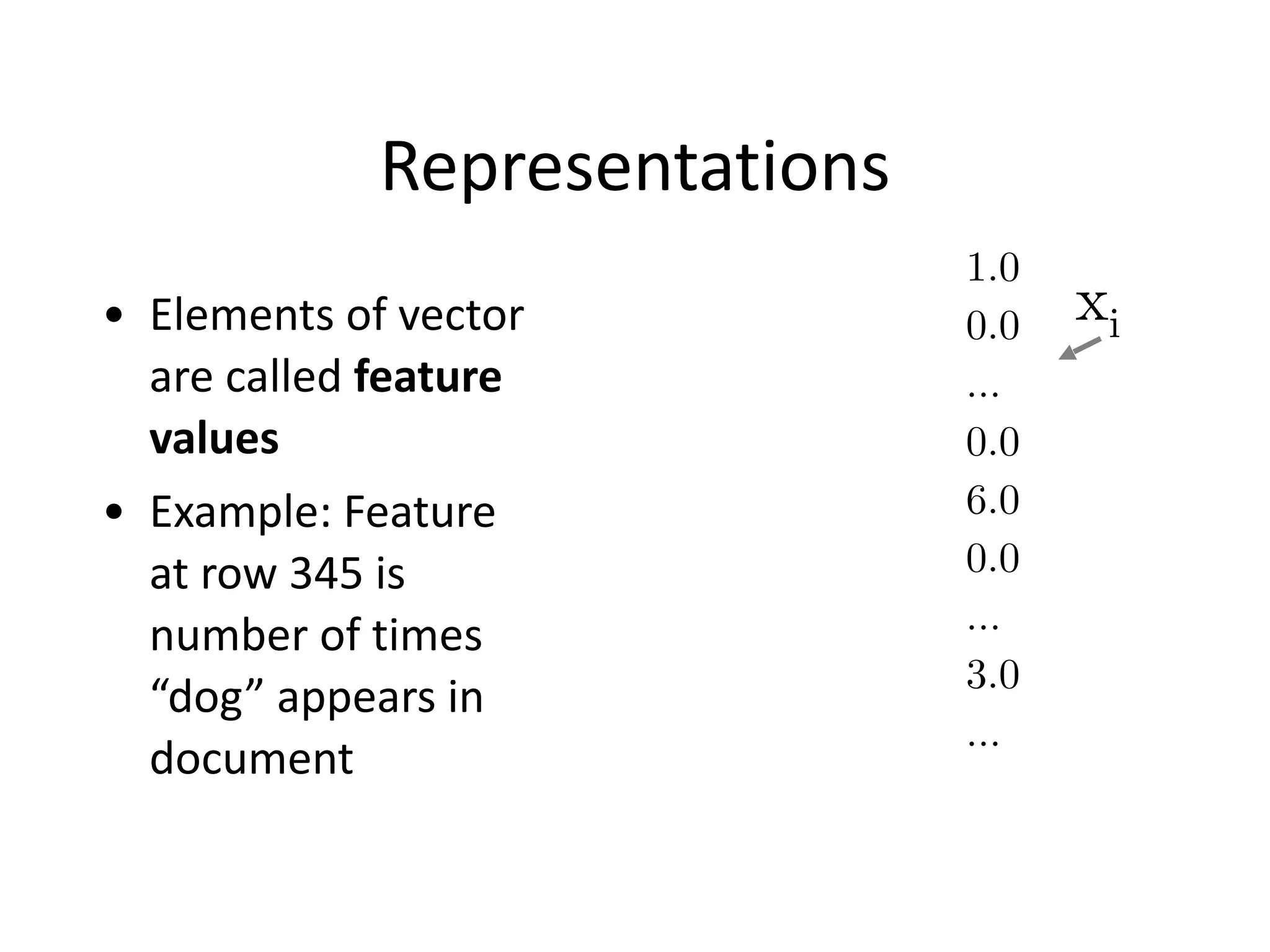
Representations
• Elements	
  of	
  vector	
  
are	
  called	
  feature	
  
values	
  
• Example:	
  Feature	
  
at	
  row	
  345	
  is	
  
number	
  of	
  times	
  
“dog”	
  appears	
  in	
  
document	
  	
  
1.0
0.0
…
0.0
6.0
0.0
…
3.0
…
xi
Documents	
  to	
  Vectors
Call me Ishmael.
Document
Documents	
  to	
  Vectors
Call me Ishmael.
Document
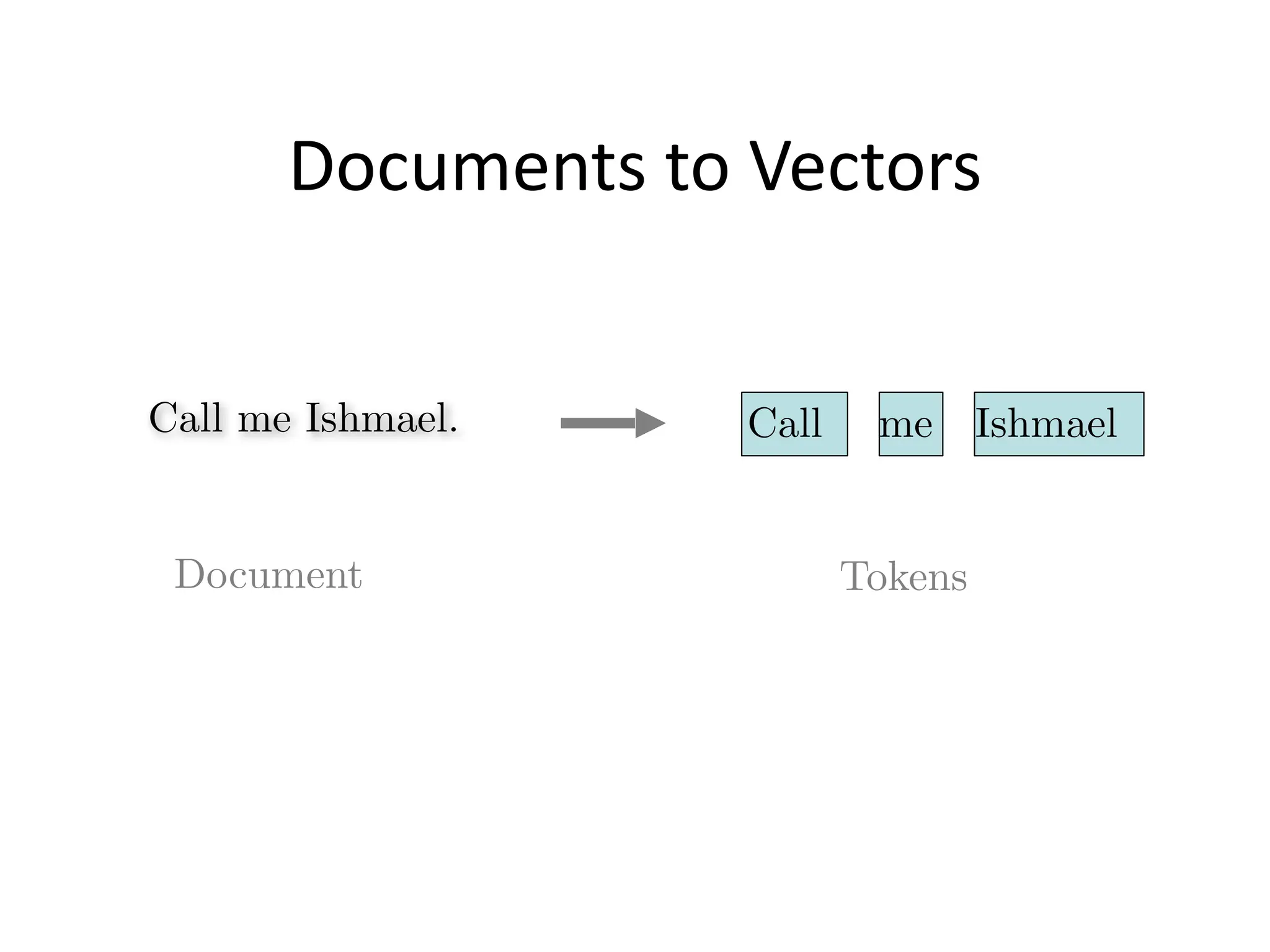
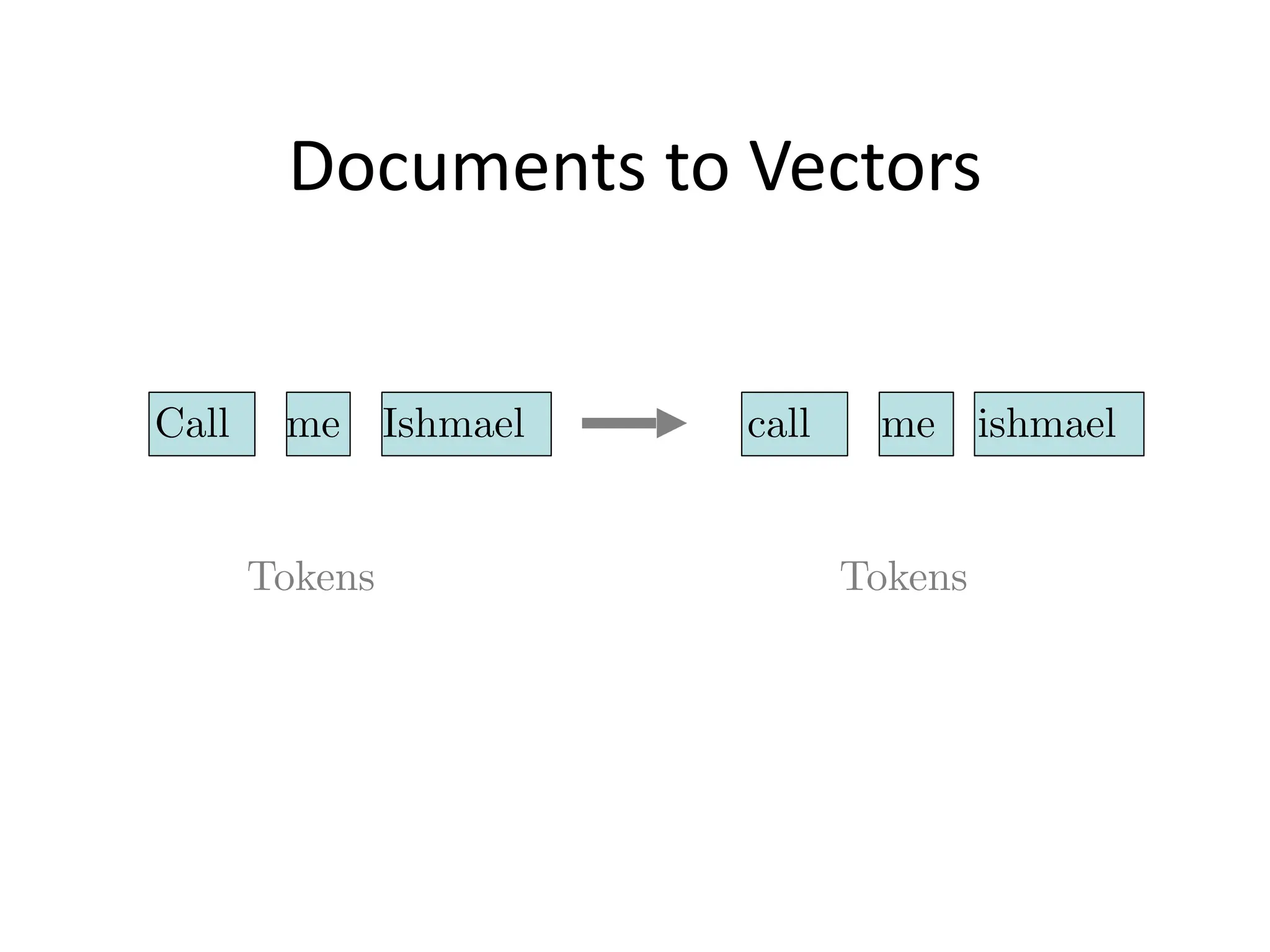
Call me Ishmael
Tokens
Documents	
  to	
  Vectors
Call me Ishmael
Tokens
call me ishmael
Tokens
Documents	
  to	
  Vectors
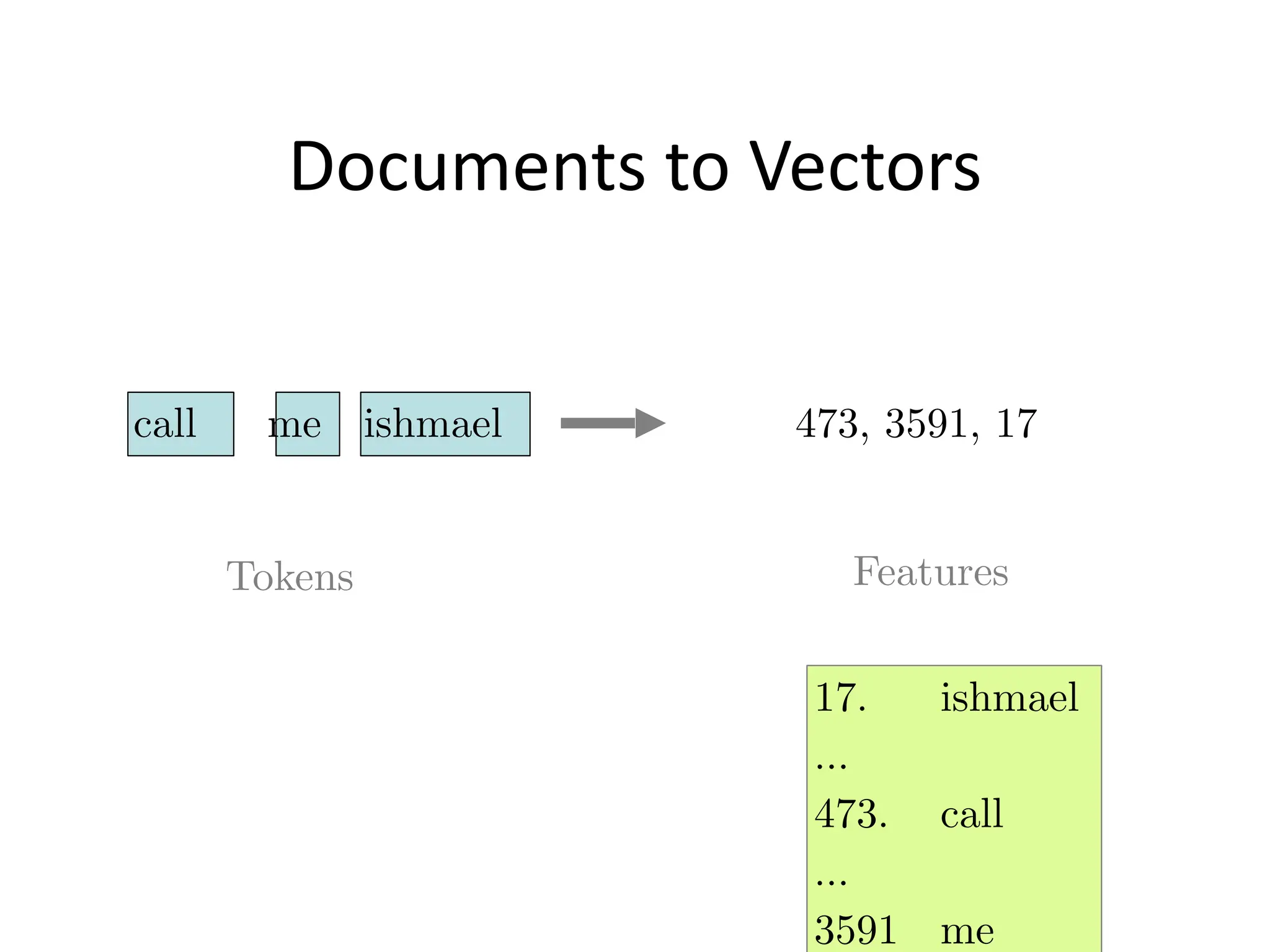
call me ishmael
Tokens
473, 3591, 17
Features
17. ishmael
…
473. call
…
3591 me
Documents	
  to	
  Vectors
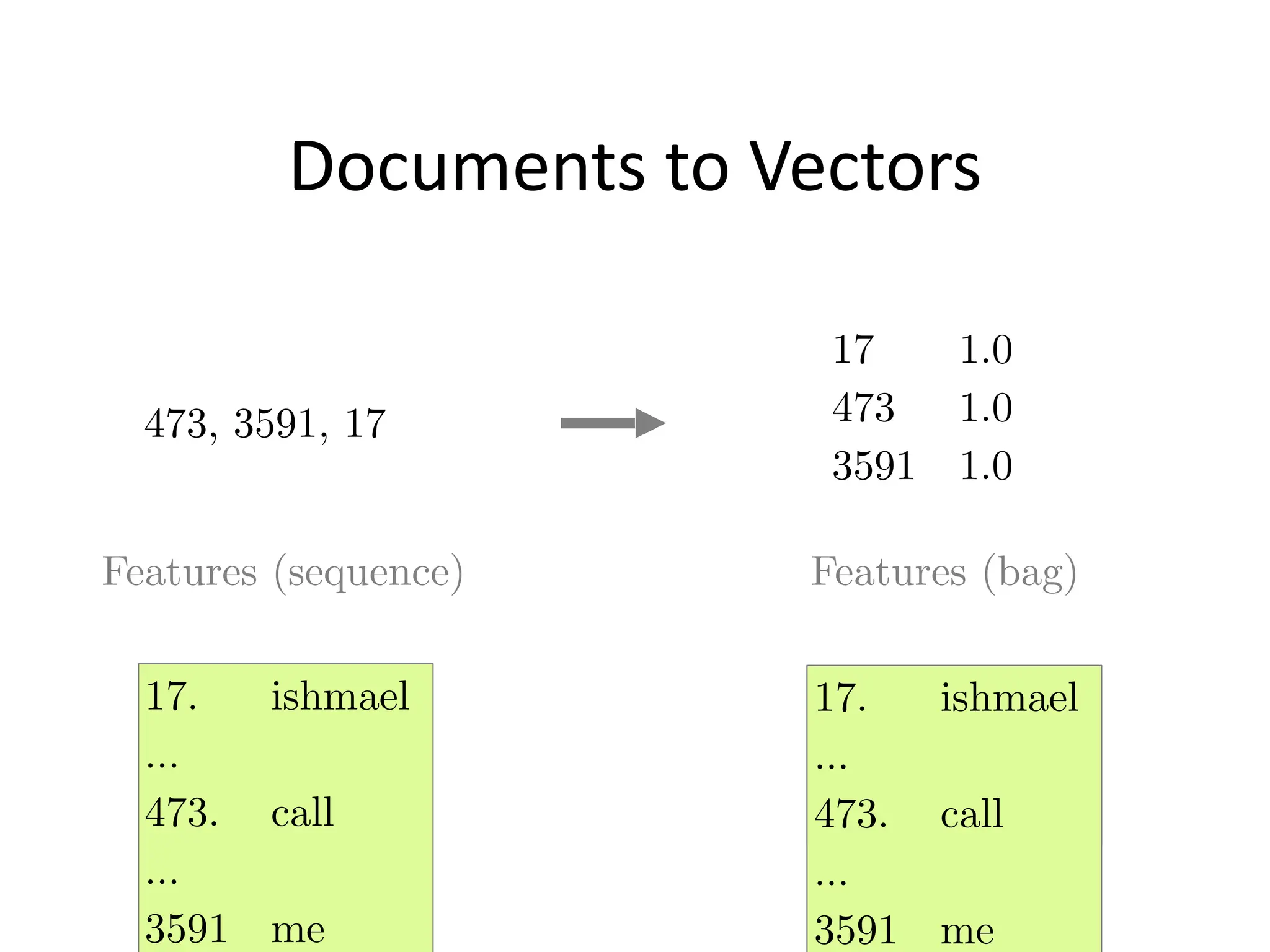
17 1.0
473 1.0
3591 1.0
Features (bag)
17. ishmael
473. call
3591 me
473, 3591, 17
Features (sequence)
17. ishmael
…
473. call
…
3591 me
17. ishmael
…
473. call
…
3591 me
Instances
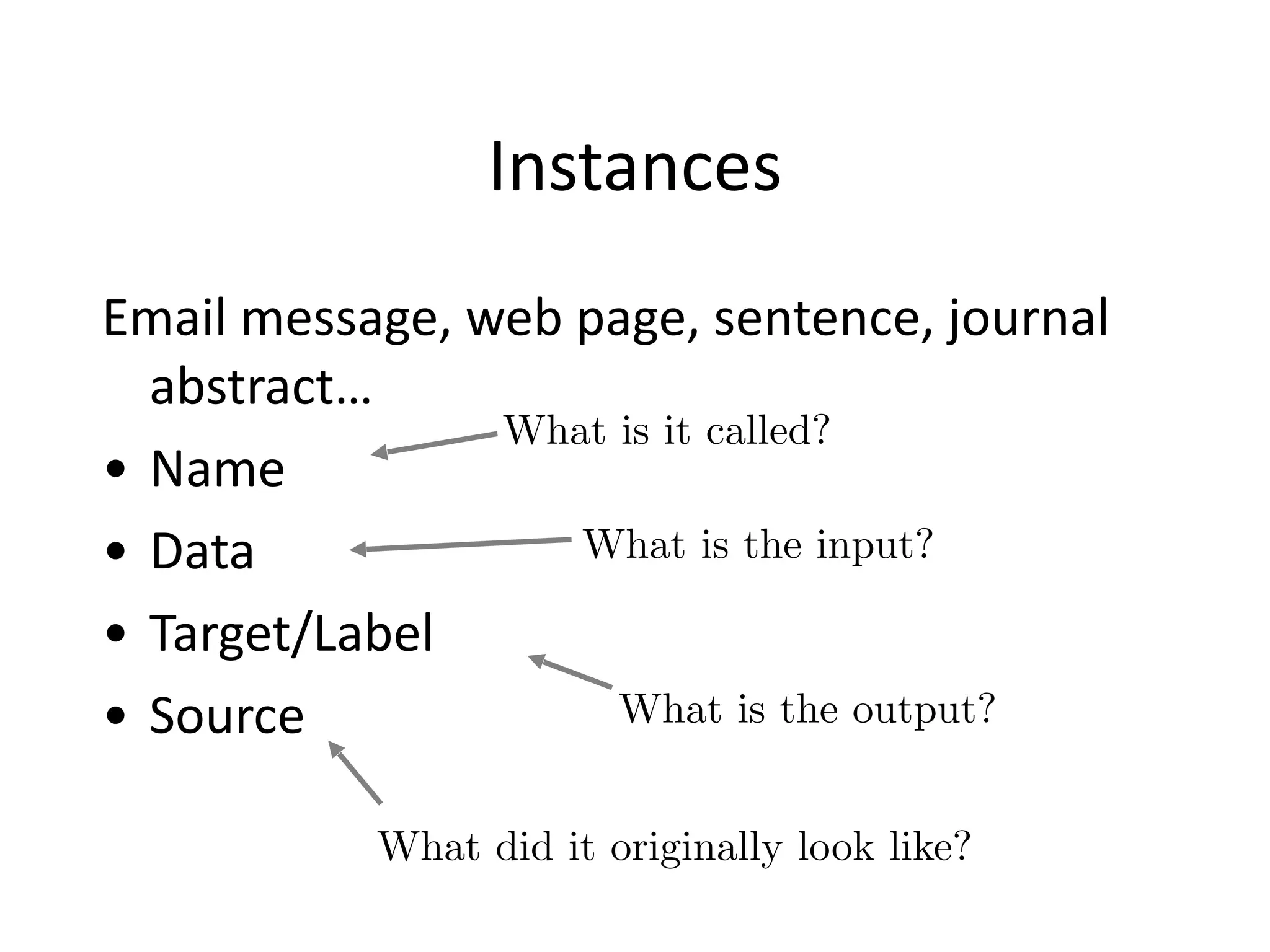
Email	
  message,	
  web	
  page,	
  sentence,	
  journal	
  
abstract…	
  	
  
• Name	
  
• Data	
  
• Target/Label	
  
• Source
What is it called?
What is the input?
What is the output?
What did it originally look like?
Instances
• Name	
  
• Data	
  
• Target	
  
• Source
String
!
TokenSequence
ArrayList<Token>
FeatureSequence
int[]
FeatureVector
int -> double map
cc.mallet.types
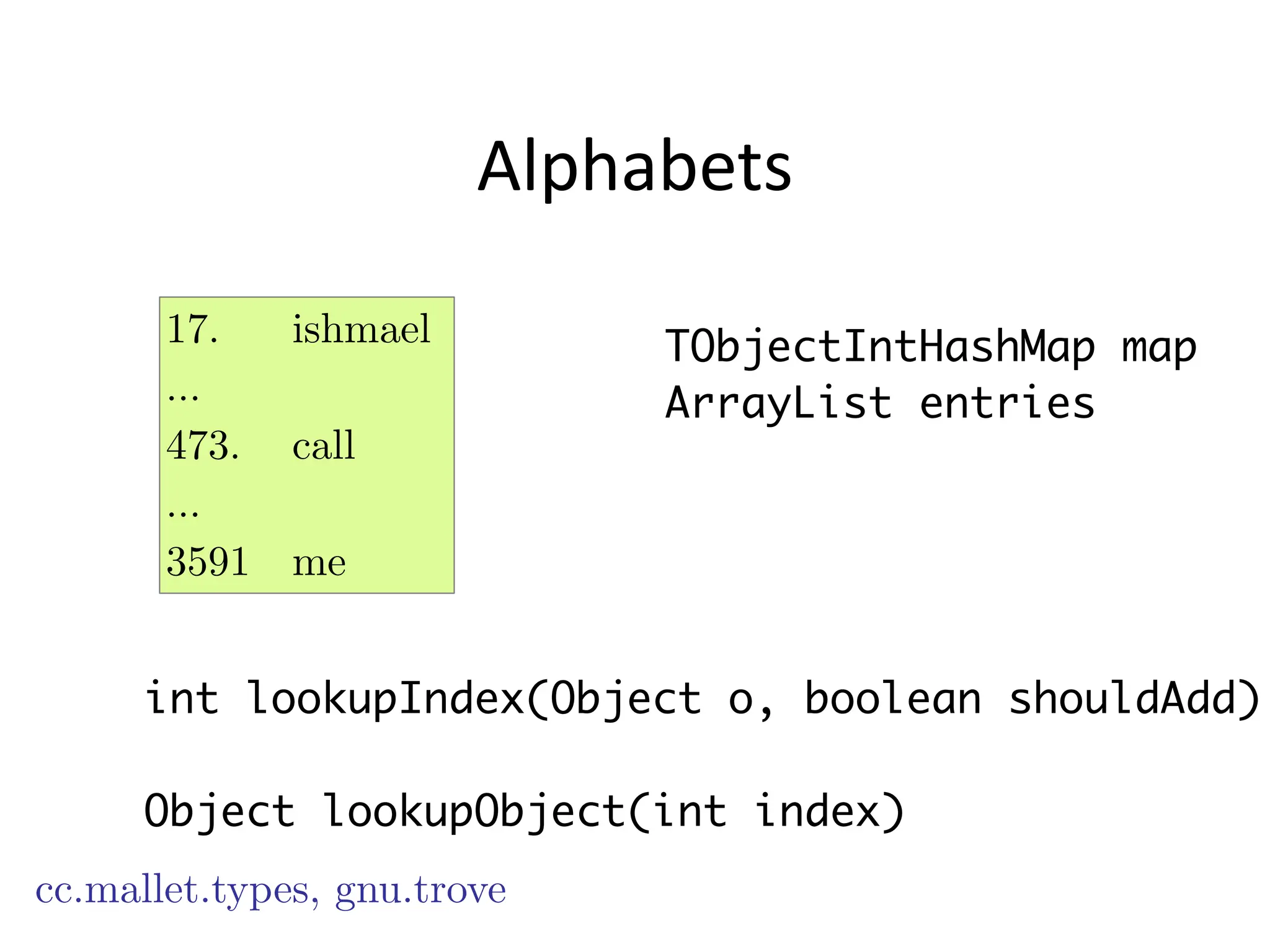
Alphabets
TObjectIntHashMap map
ArrayList entries
!
int lookupIndex(Object o, boolean shouldAdd)
!
Object lookupObject(int index)
cc.mallet.types, gnu.trove
17. ishmael
…
473. call
…
3591 me
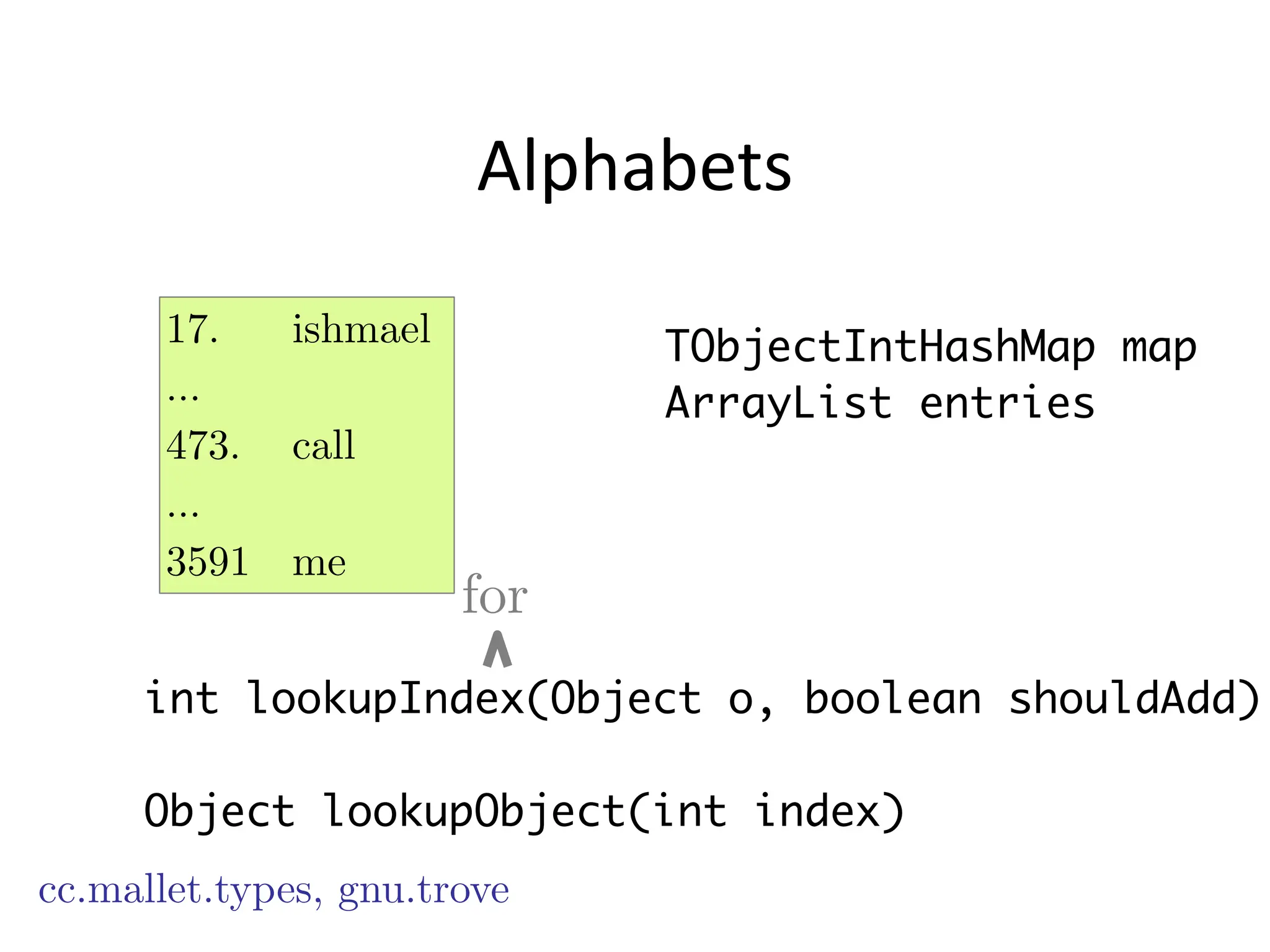
Alphabets
TObjectIntHashMap map
ArrayList entries
!
int lookupIndex(Object o, boolean shouldAdd)
!
Object lookupObject(int index)
cc.mallet.types, gnu.trove
17. ishmael
…
473. call
…
3591 me
for
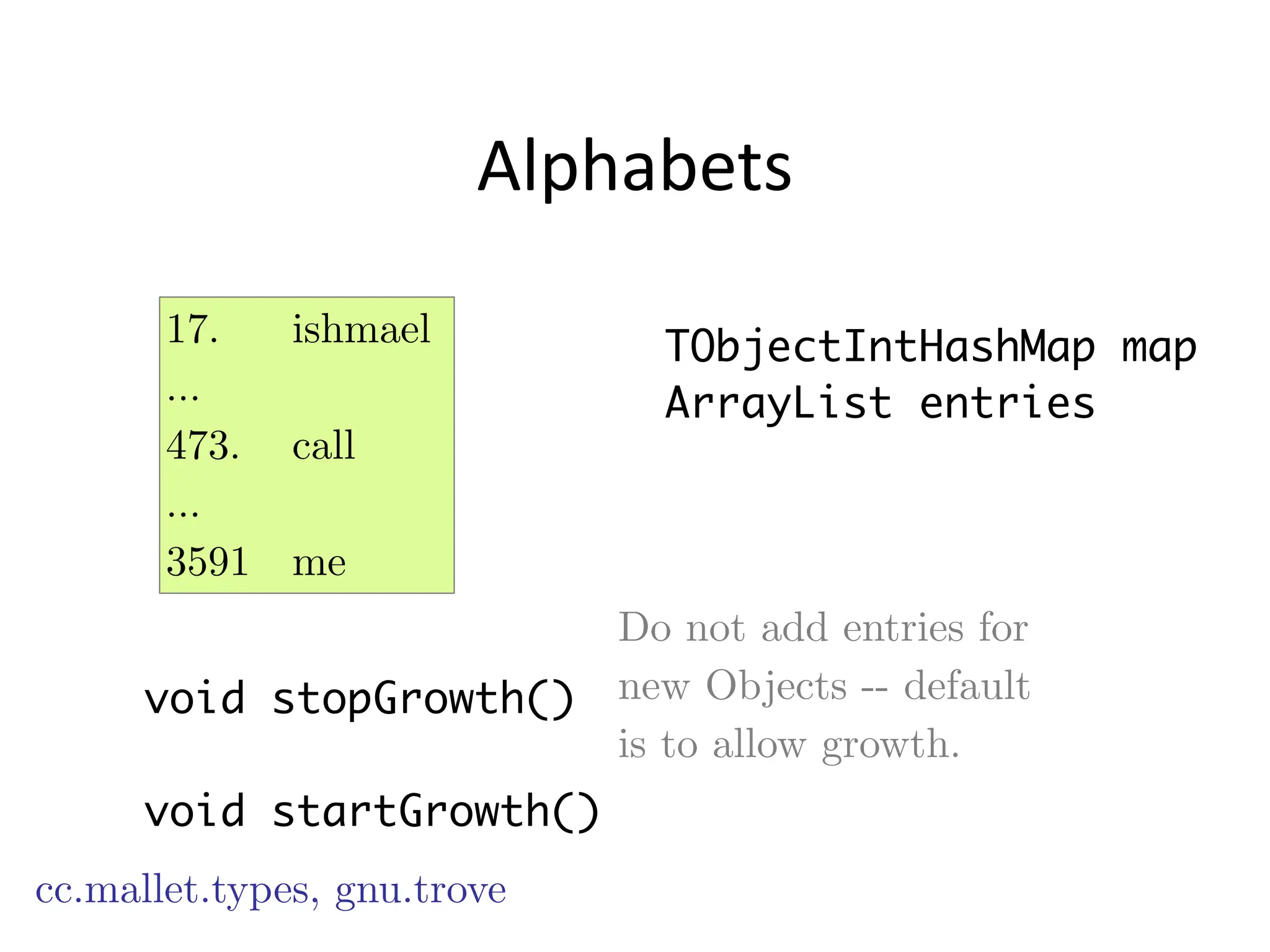
Alphabets
TObjectIntHashMap map
ArrayList entries
!
cc.mallet.types, gnu.trove
17. ishmael
…
473. call
…
3591 me
void stopGrowth()
!
void startGrowth()
Do not add entries for
new Objects -- default
is to allow growth.
Creating	
  Instances
• Instance	
  
constructor	
  
method	
  
• Iterators
new Instance(data, target,
name, source)
Iterator<Instance>
FileIterator(File[], …)
CsvIterator(FileReader, Pattern…)
ArrayIterator(Object[])
…
cc.mallet.pipe.iterator
Creating	
  Instances
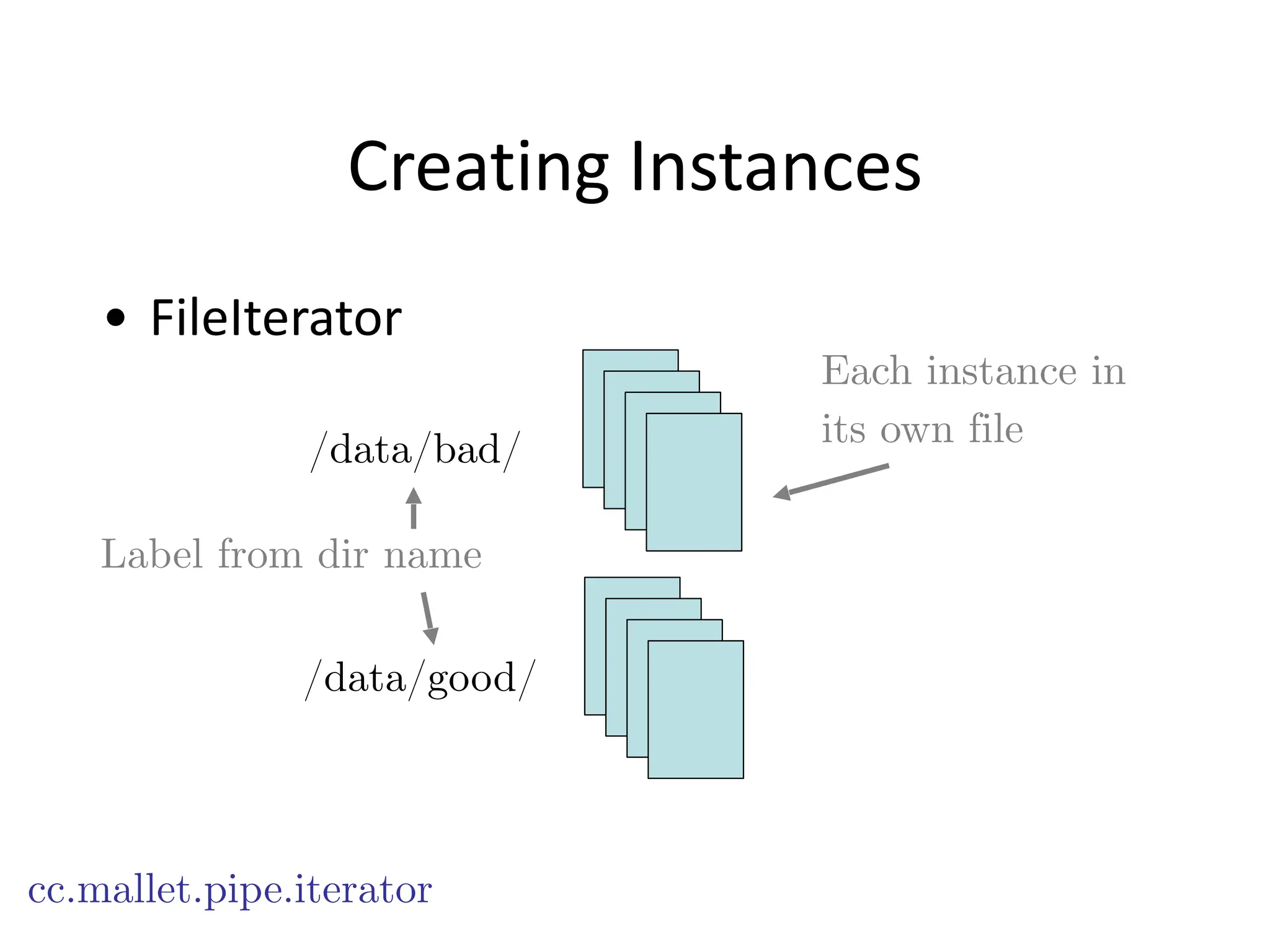
• FileIterator
cc.mallet.pipe.iterator
/data/bad/
/data/good/
Label from dir name
Each instance in
its own file
Creating	
  Instances
• CsvIterator
cc.mallet.pipe.iterator
Name, label, data from regular expression groups.
“CSV” is a lousy name. LineRegexIterator?
Each instance on
its own line
1001. Melville Call me Ishmael. Some years ago…
1002. Dickens It was the best of times, it was…
^([^t]+)t([^t]+)t(.*)
Instance	
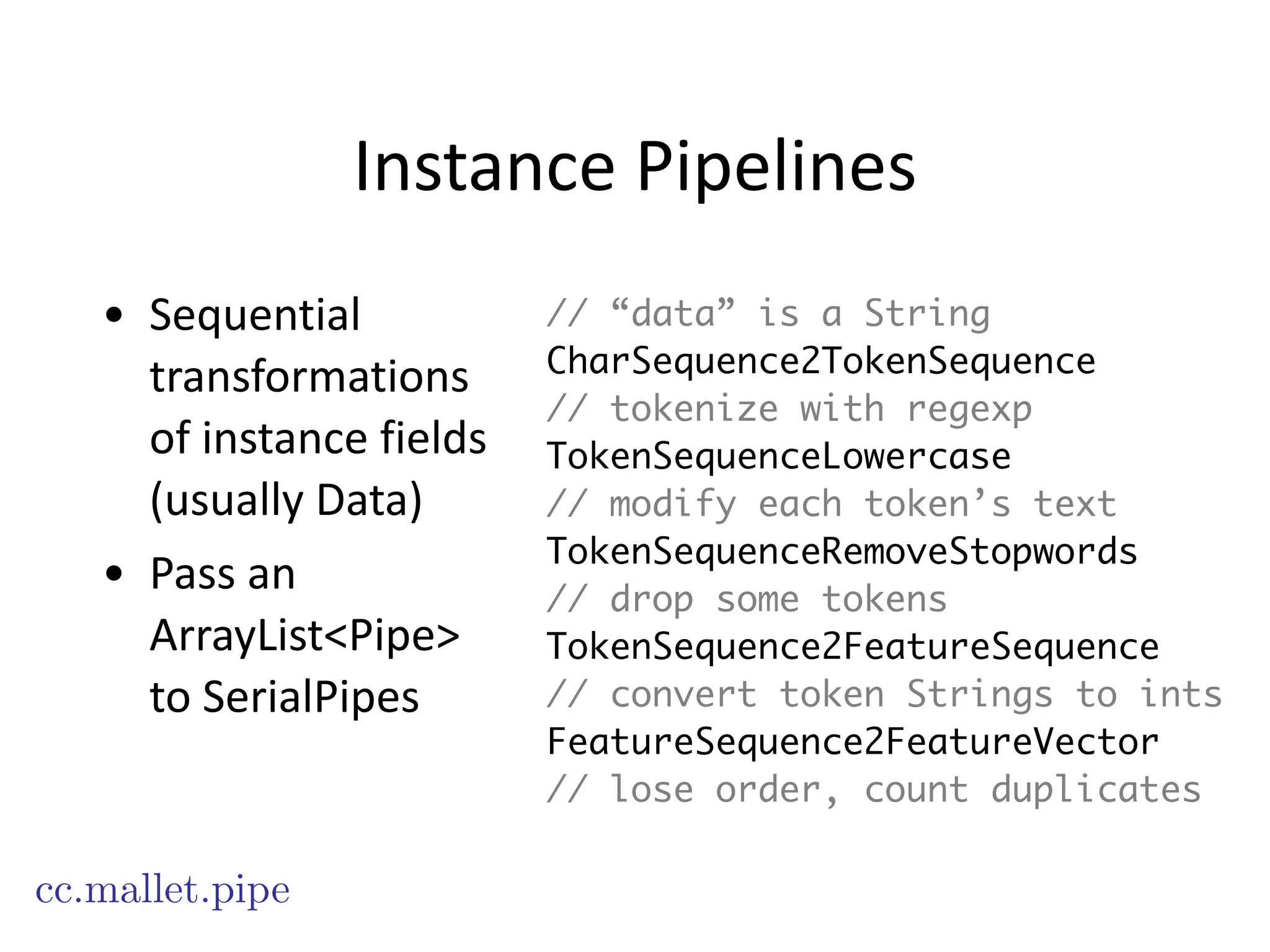
  Pipelines
• Sequential	
  
transformations	
  
of	
  instance	
  fields	
  
(usually	
  Data)	
  
• Pass	
  an	
  
ArrayList<Pipe>	
  
to	
  SerialPipes
cc.mallet.pipe
// “data” is a String
CharSequence2TokenSequence
// tokenize with regexp
TokenSequenceLowercase
// modify each token’s text
TokenSequenceRemoveStopwords
// drop some tokens
TokenSequence2FeatureSequence
// convert token Strings to ints
FeatureSequence2FeatureVector
// lose order, count duplicates
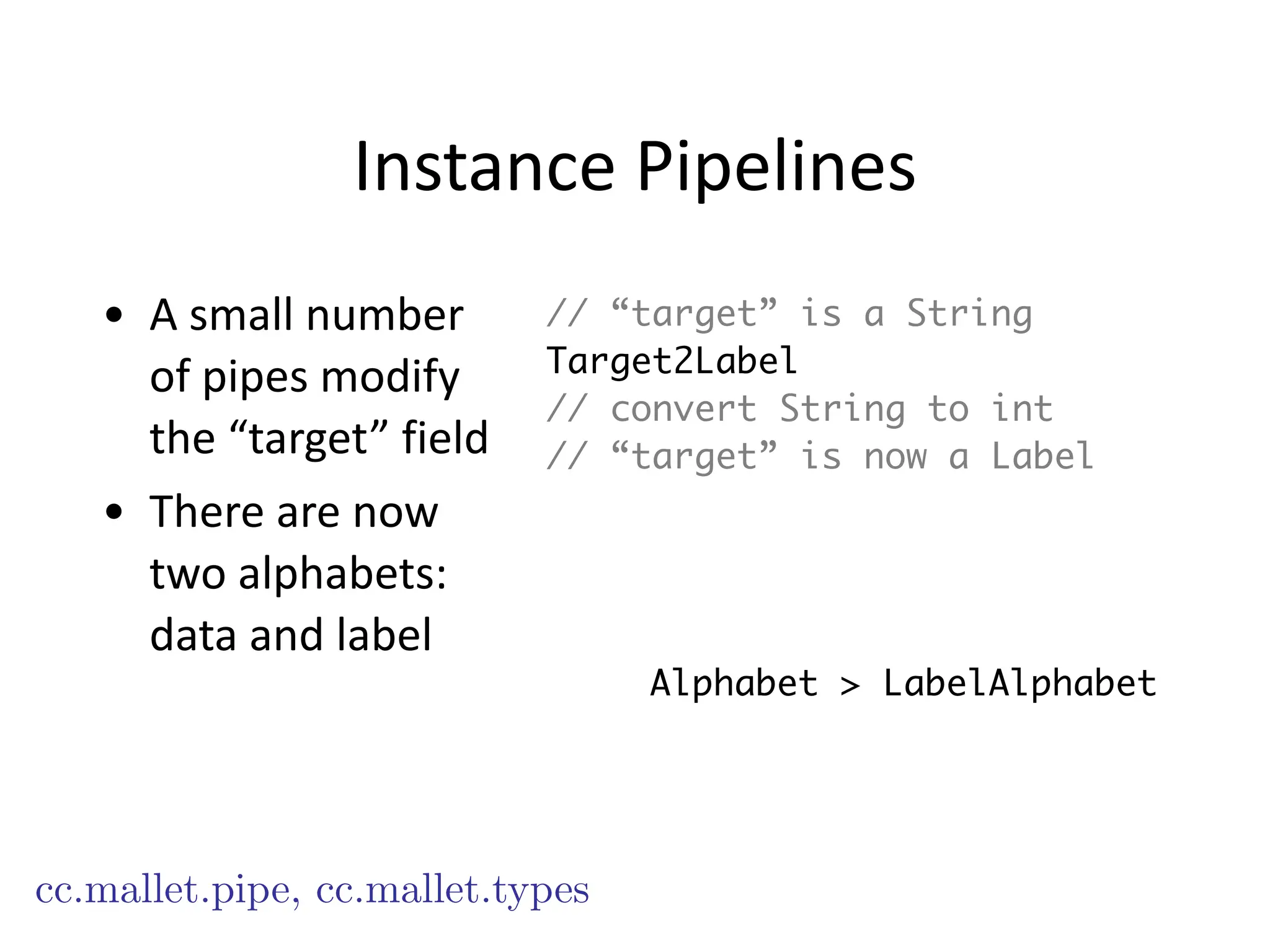
Instance	
  Pipelines
• A	
  small	
  number	
  
of	
  pipes	
  modify	
  
the	
  “target”	
  field	
  
• There	
  are	
  now	
  
two	
  alphabets:	
  
data	
  and	
  label
cc.mallet.pipe, cc.mallet.types
// “target” is a String
Target2Label
// convert String to int
// “target” is now a Label
Alphabet > LabelAlphabet
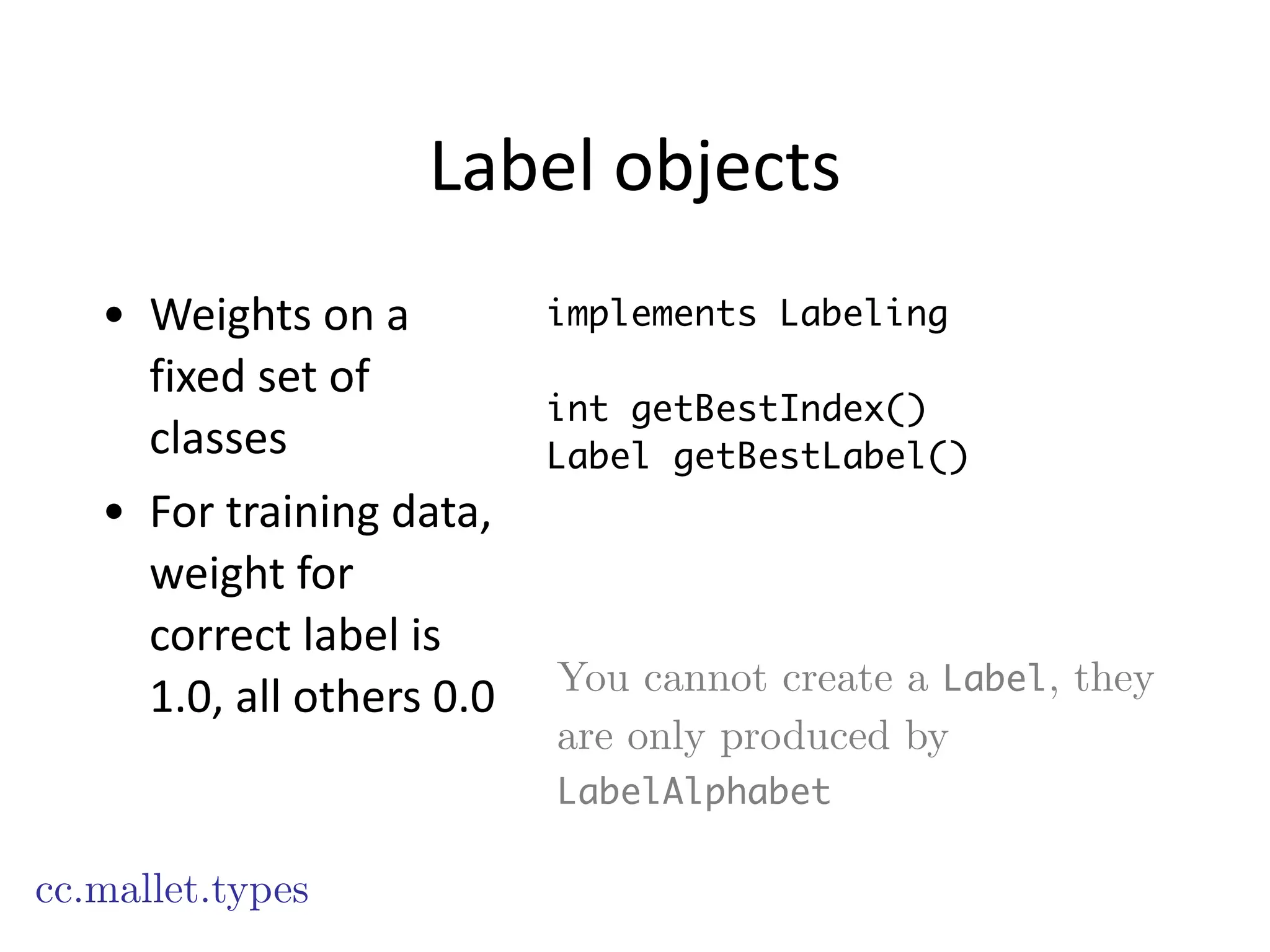
Label	
  objects
• Weights	
  on	
  a	
  
fixed	
  set	
  of	
  
classes	
  
• For	
  training	
  data,	
  
weight	
  for	
  
correct	
  label	
  is	
  
1.0,	
  all	
  others	
  0.0
cc.mallet.types
implements Labeling
!
int getBestIndex()
Label getBestLabel()
You cannot create a Label, they
are only produced by
LabelAlphabet
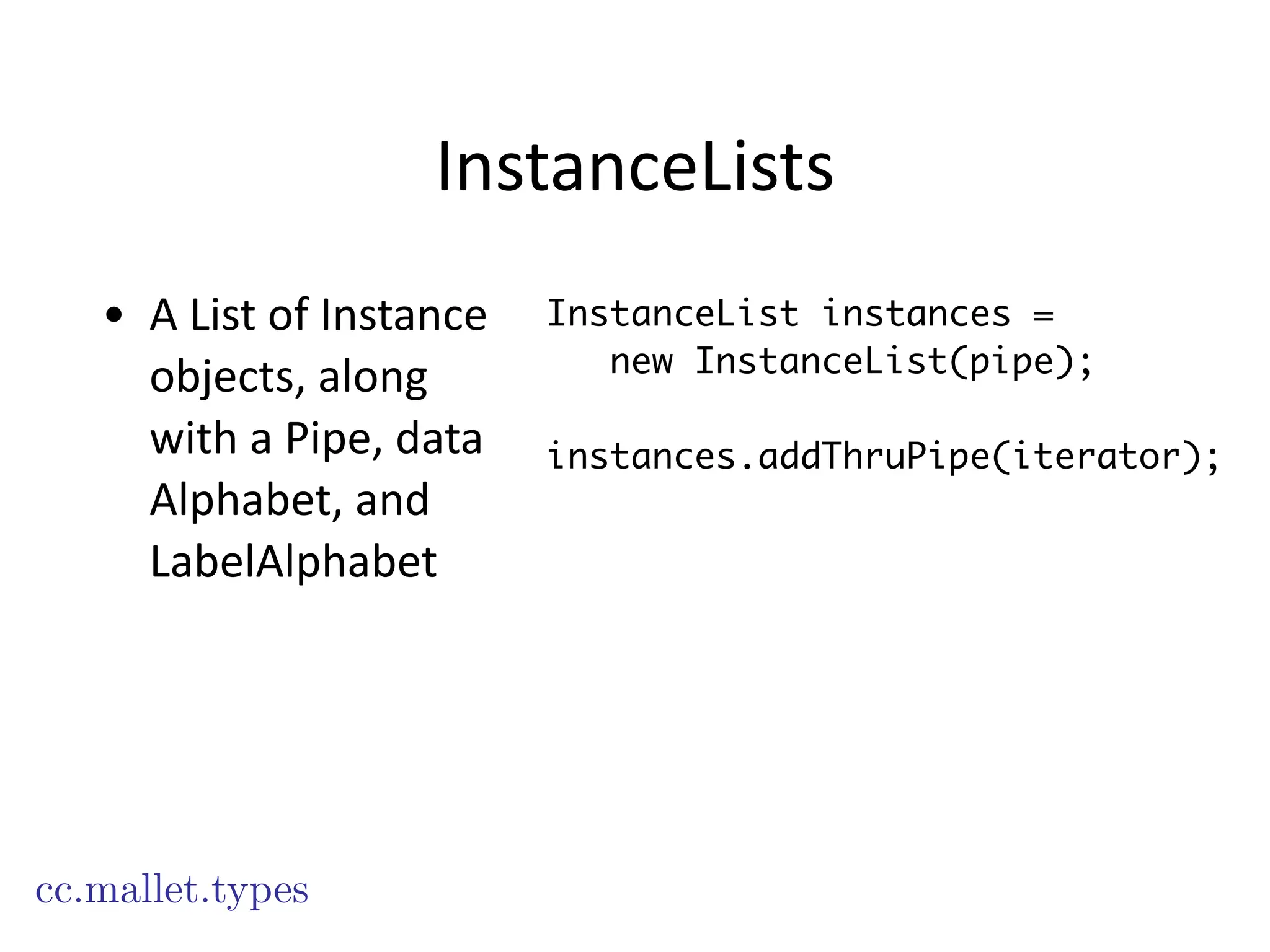
InstanceLists
• A	
  List	
  of	
  Instance	
  
objects,	
  along	
  
with	
  a	
  Pipe,	
  data	
  
Alphabet,	
  and	
  
LabelAlphabet
cc.mallet.types
InstanceList instances =
new InstanceList(pipe);
!
instances.addThruPipe(iterator);
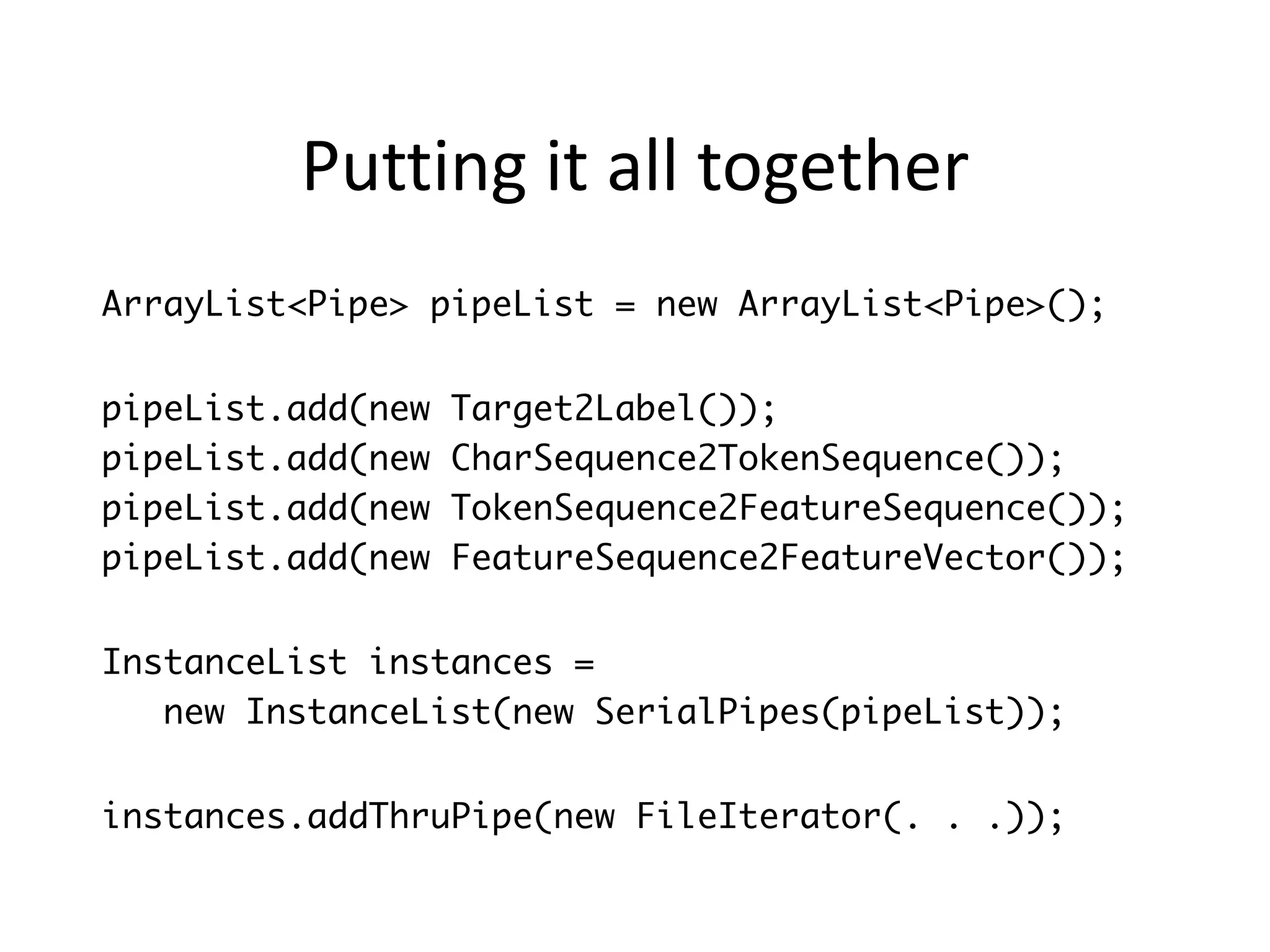
Putting	
  it	
  all	
  together
ArrayList<Pipe> pipeList = new ArrayList<Pipe>();
!
pipeList.add(new Target2Label());
pipeList.add(new CharSequence2TokenSequence());
pipeList.add(new TokenSequence2FeatureSequence());
pipeList.add(new FeatureSequence2FeatureVector());
!
InstanceList instances =
new InstanceList(new SerialPipes(pipeList));
!
instances.addThruPipe(new FileIterator(. . .));
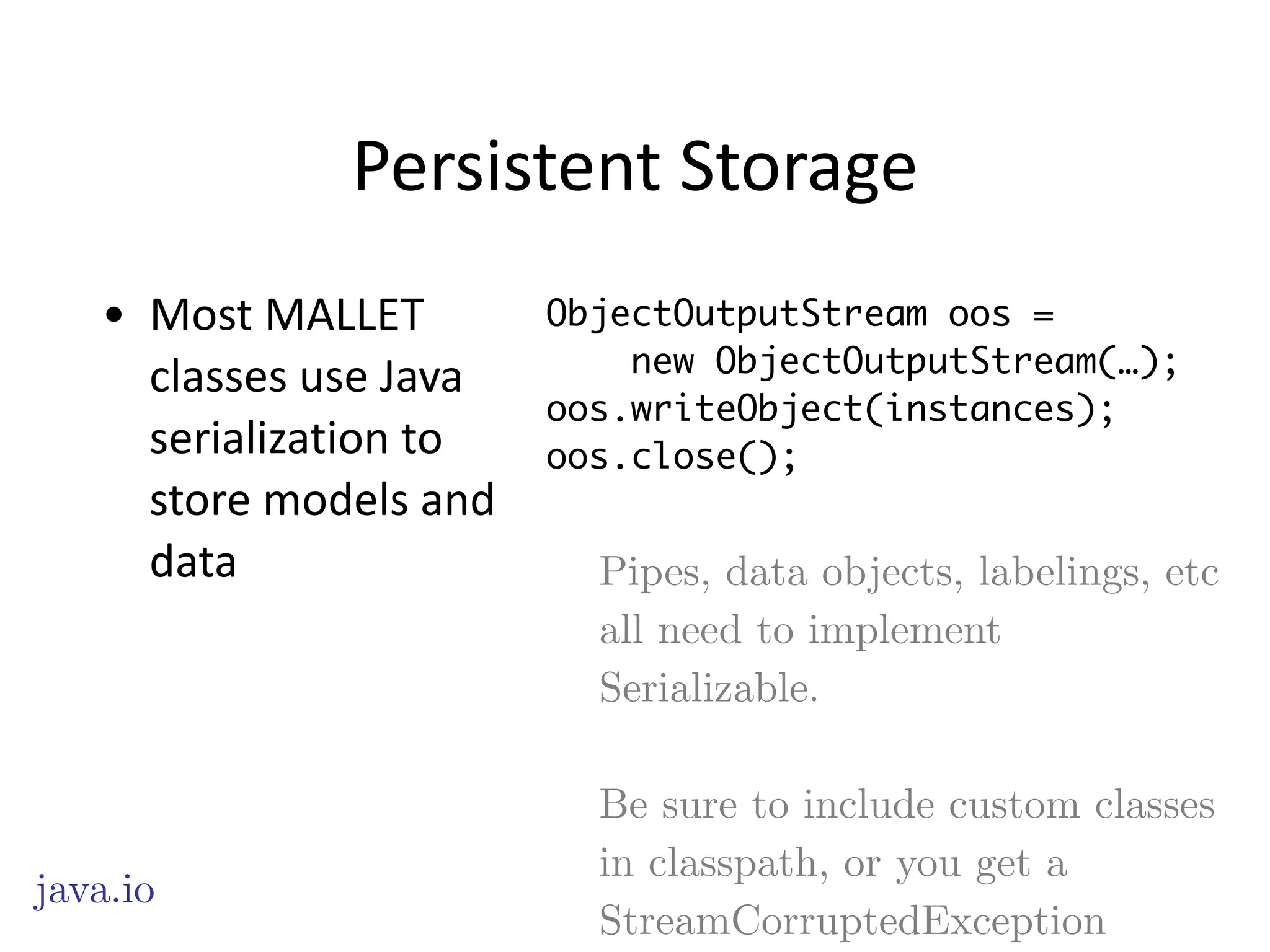
Persistent	
  Storage
• Most	
  MALLET	
  
classes	
  use	
  Java	
  
serialization	
  to	
  
store	
  models	
  and	
  
data
java.io
ObjectOutputStream oos =
new ObjectOutputStream(…);
oos.writeObject(instances);
oos.close();
Pipes, data objects, labelings, etc
all need to implement
Serializable.
!
Be sure to include custom classes
in classpath, or you get a
StreamCorruptedException
Review
• What	
  are	
  the	
  four	
  main	
  fields	
  in	
  an	
  
Instance?
Review
• What	
  are	
  the	
  four	
  main	
  fields	
  in	
  an	
  
Instance?	
  
• What	
  are	
  two	
  ways	
  to	
  generate	
  Instances?
Review
• What	
  are	
  the	
  four	
  main	
  fields	
  in	
  an	
  
Instance?	
  
• What	
  are	
  two	
  ways	
  to	
  generate	
  Instances?	
  
• How	
  do	
  we	
  modify	
  the	
  value	
  of	
  Instance	
  
fields?
Review
• What	
  are	
  the	
  four	
  main	
  fields	
  in	
  an	
  
Instance?	
  
• What	
  are	
  two	
  ways	
  to	
  generate	
  Instances?	
  
• How	
  do	
  we	
  modify	
  the	
  value	
  of	
  Instance	
  
fields?	
  
• Name	
  some	
  classes	
  that	
  appear	
  in	
  the	
  
“data”	
  field.
Outline
• About	
  MALLET	
  
• Representing	
  Data	
  
• Classification	
  
• Sequence	
  Tagging	
  
• Topic	
  Modeling
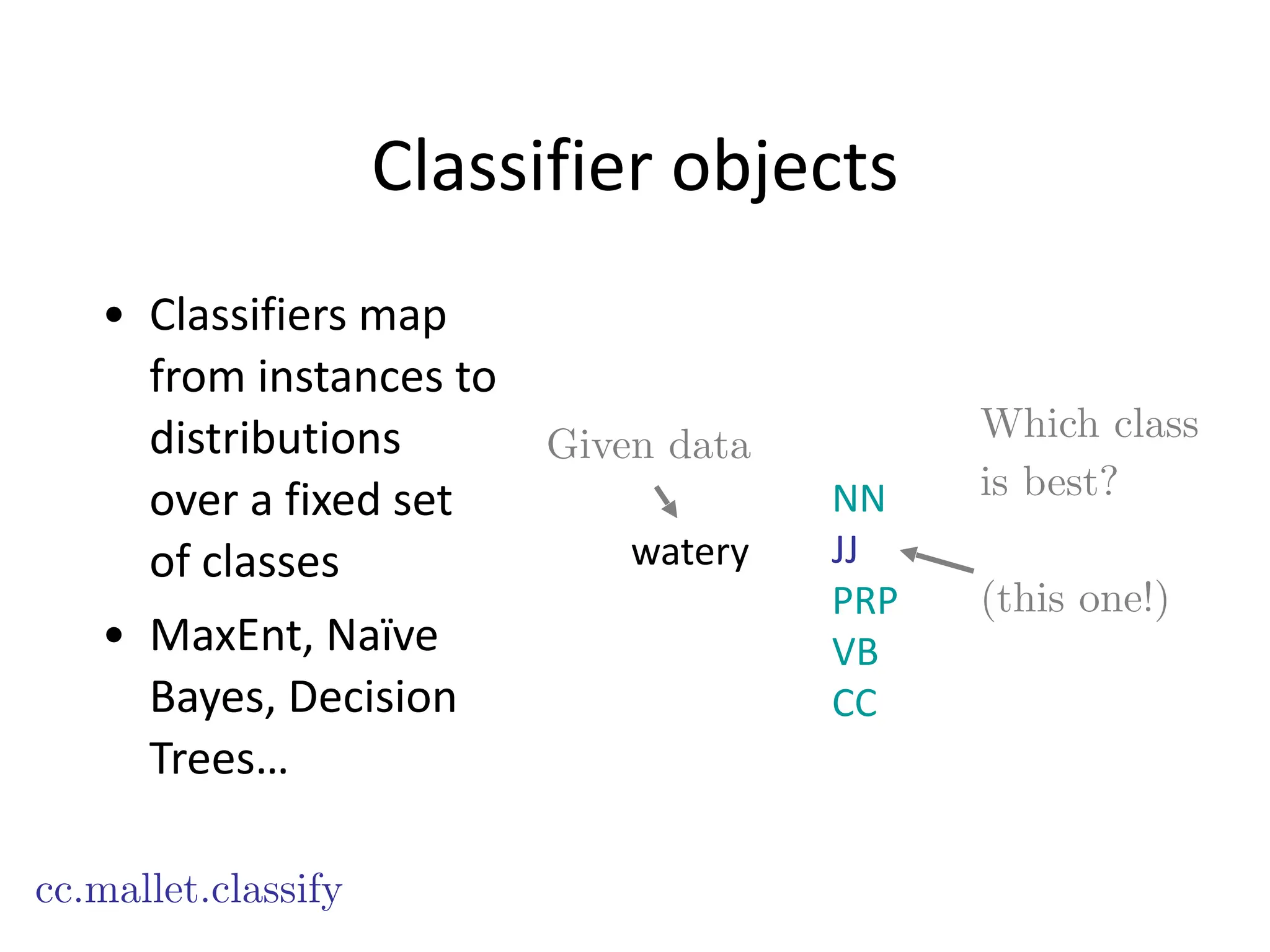
Classifier	
  objects
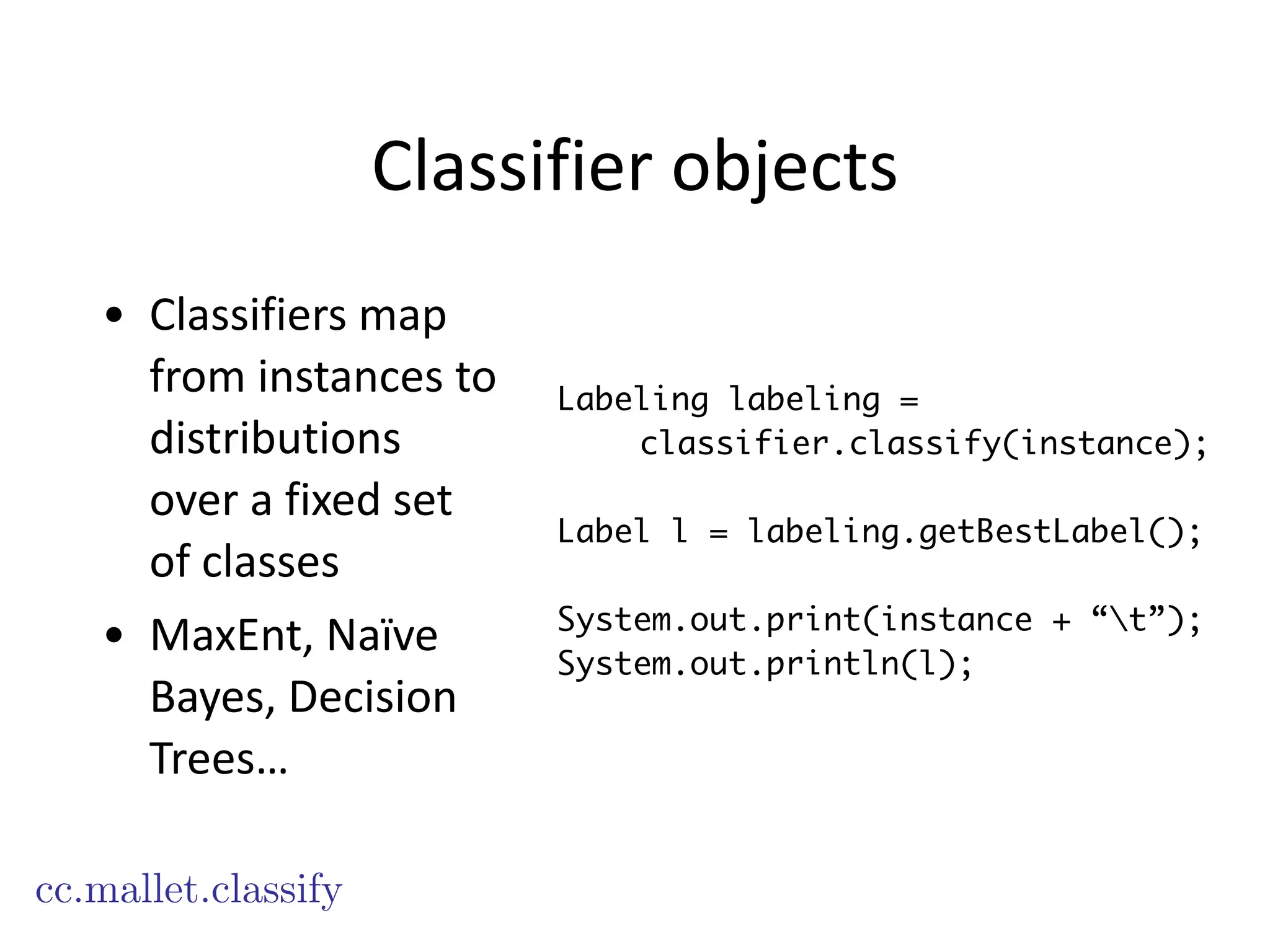
• Classifiers	
  map	
  
from	
  instances	
  to	
  
distributions	
  
over	
  a	
  fixed	
  set	
  
of	
  classes	
  
• MaxEnt,	
  Naïve	
  
Bayes,	
  Decision	
  
Trees…
cc.mallet.classify
Given data
Which class
is best?
!
(this one!)
watery
NN
JJ
PRP
VB
CC
Classifier	
  objects
• Classifiers	
  map	
  
from	
  instances	
  to	
  
distributions	
  
over	
  a	
  fixed	
  set	
  
of	
  classes	
  
• MaxEnt,	
  Naïve	
  
Bayes,	
  Decision	
  
Trees…
cc.mallet.classify
Labeling labeling =
classifier.classify(instance);
!
Label l = labeling.getBestLabel();
!
System.out.print(instance + “t”);
System.out.println(l);
Training	
  Classifier	
  objects
cc.mallet.classify
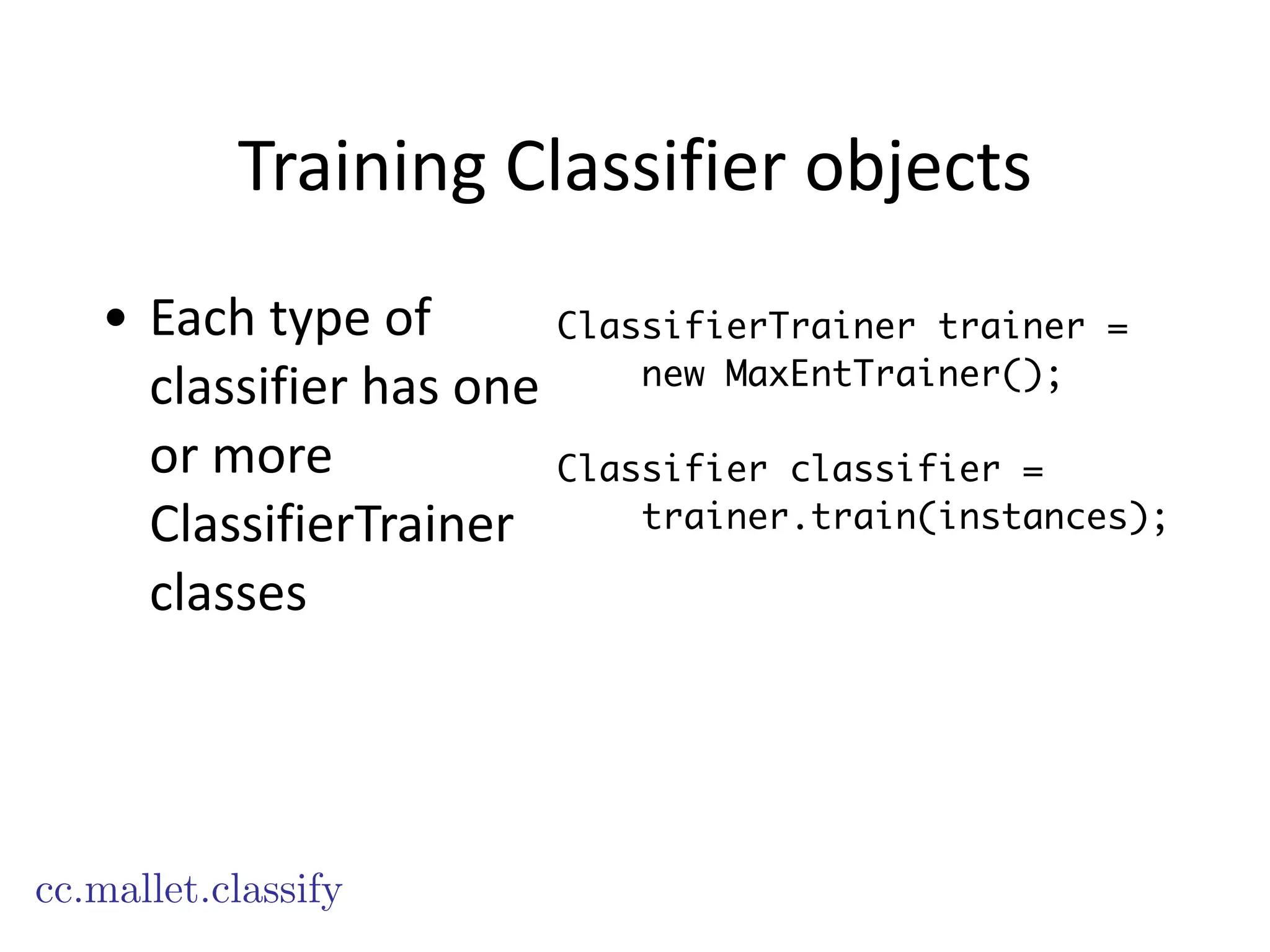
ClassifierTrainer trainer =
new MaxEntTrainer();
!
Classifier classifier =
trainer.train(instances);
• Each	
  type	
  of	
  
classifier	
  has	
  one	
  
or	
  more	
  
ClassifierTrainer	
  
classes
Training	
  Classifier	
  objects
cc.mallet.optimize
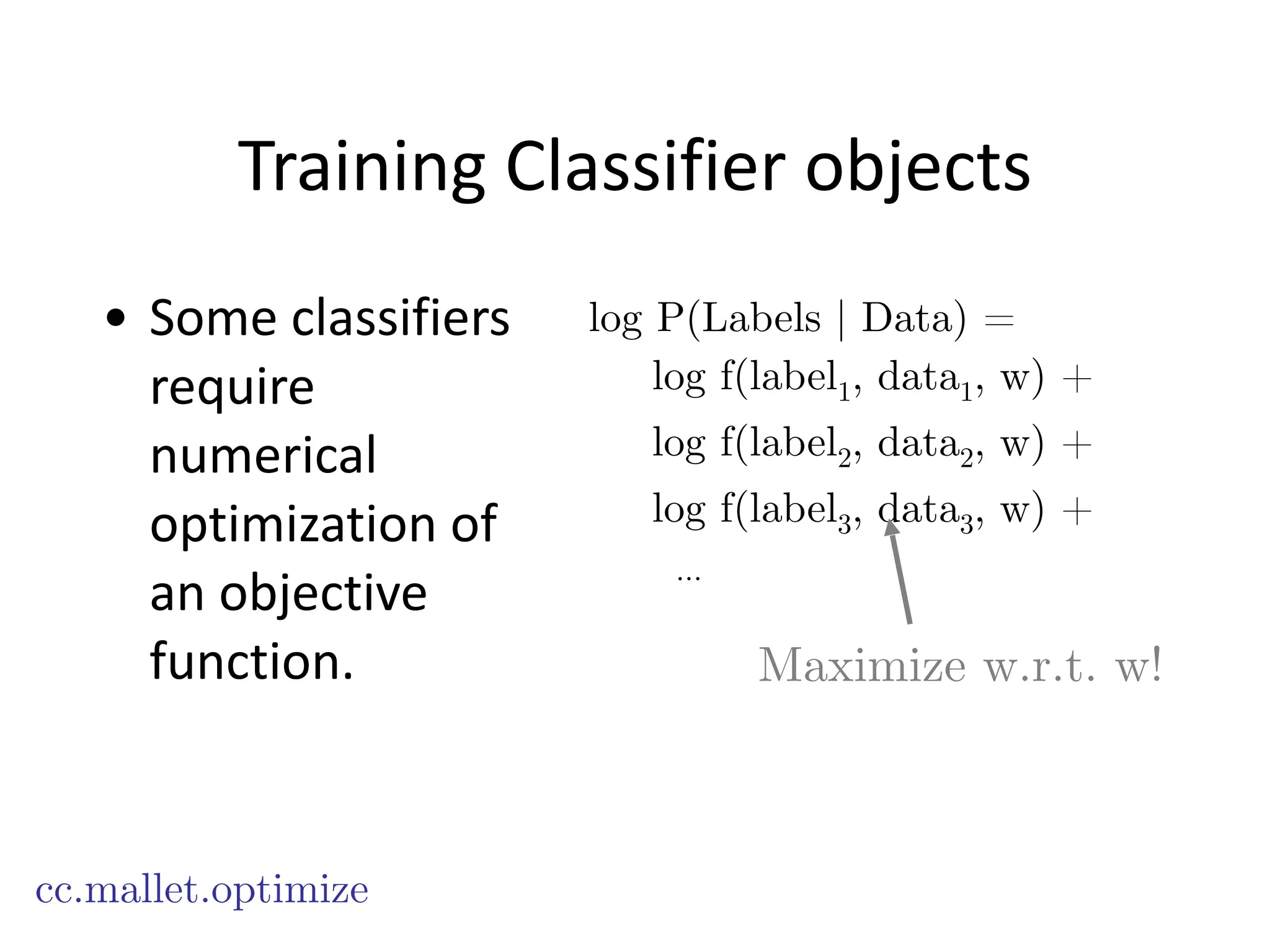
log P(Labels | Data) =
log f(label1, data1, w) +
log f(label2, data2, w) +
log f(label3, data3, w) +
…
• Some	
  classifiers	
  
require	
  
numerical	
  
optimization	
  of	
  
an	
  objective	
  
function. Maximize w.r.t. w!
Parameters	
  w
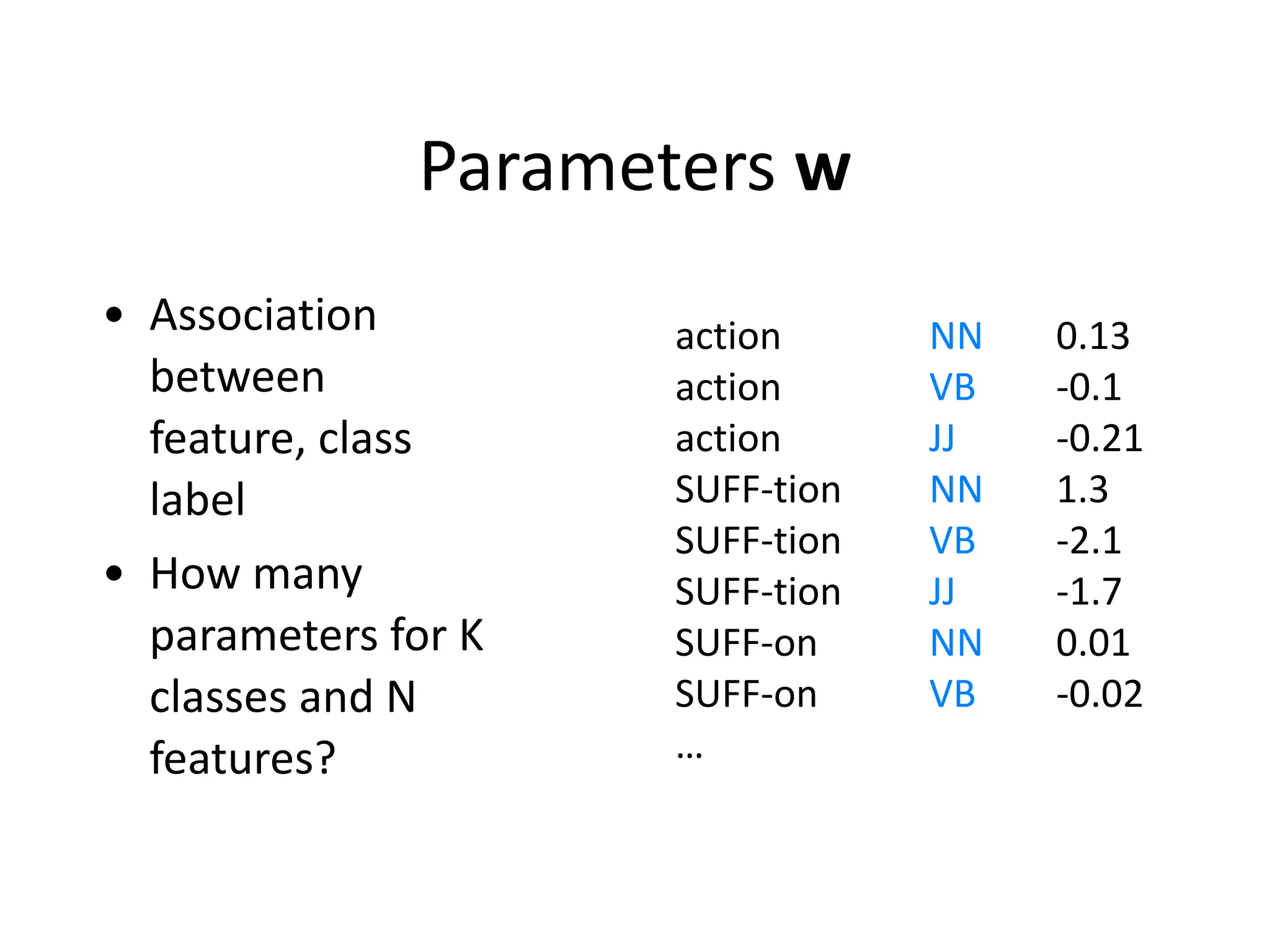
• Association	
  
between	
  
feature,	
  class	
  
label	
  
• How	
  many	
  
parameters	
  for	
  K	
  
classes	
  and	
  N	
  
features?
action	
   	
   NN	
   0.13	
  
action	
   	
   VB	
   -­‐0.1	
  
action	
   	
   JJ	
   -­‐0.21	
  
SUFF-­‐tion	
   NN	
   1.3	
  
SUFF-­‐tion	
   VB	
   -­‐2.1	
  
SUFF-­‐tion	
   JJ	
   -­‐1.7	
  
SUFF-­‐on	
   NN	
   0.01	
  
SUFF-­‐on	
   VB	
   -­‐0.02	
  
…	
  
Training	
  Classifier	
  objects
cc.mallet.optimize
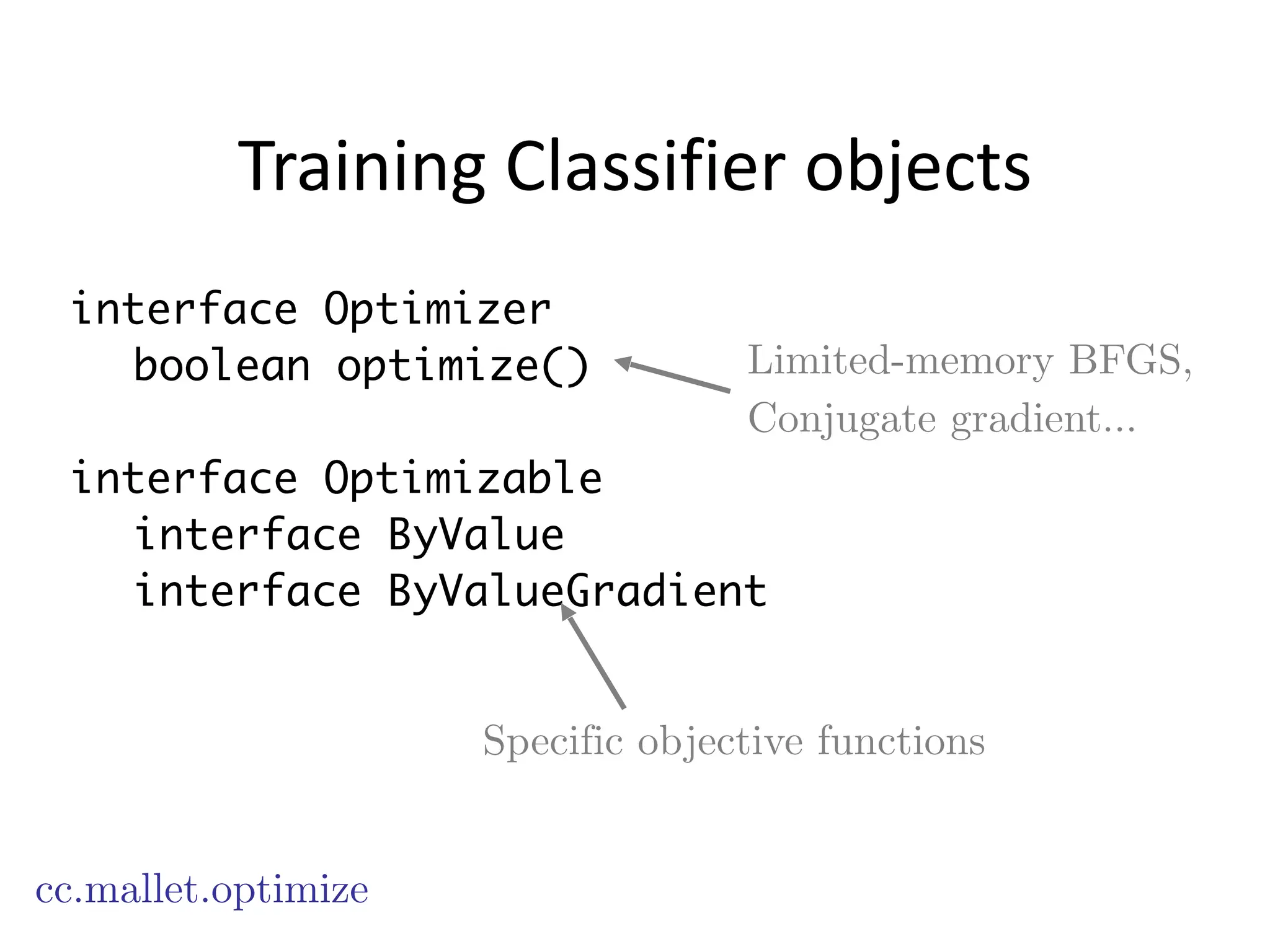
interface Optimizer
boolean optimize()
!
interface Optimizable
interface ByValue
interface ByValueGradient
Limited-memory BFGS,
Conjugate gradient…
Specific objective functions
Training	
  Classifier	
  objects
cc.mallet.classify
MaxEntOptimizableByLabelLikelihood
double[] getParameters()
void setParameters(double[] parameters)
…
!
double getValue()
void getValueGradient(double[] buffer)
Log likelihood and its first derivative
For
Optimizable
interface
Evaluation	
  of	
  Classifiers
• Create	
  
random	
  test/
train	
  splits
cc.mallet.types
InstanceList[] instanceLists =
instances.split(new Randoms(),
new double[] {0.9, 0.1, 0.0});
90% training
10% testing
0% validation
Evaluation	
  of	
  Classifiers
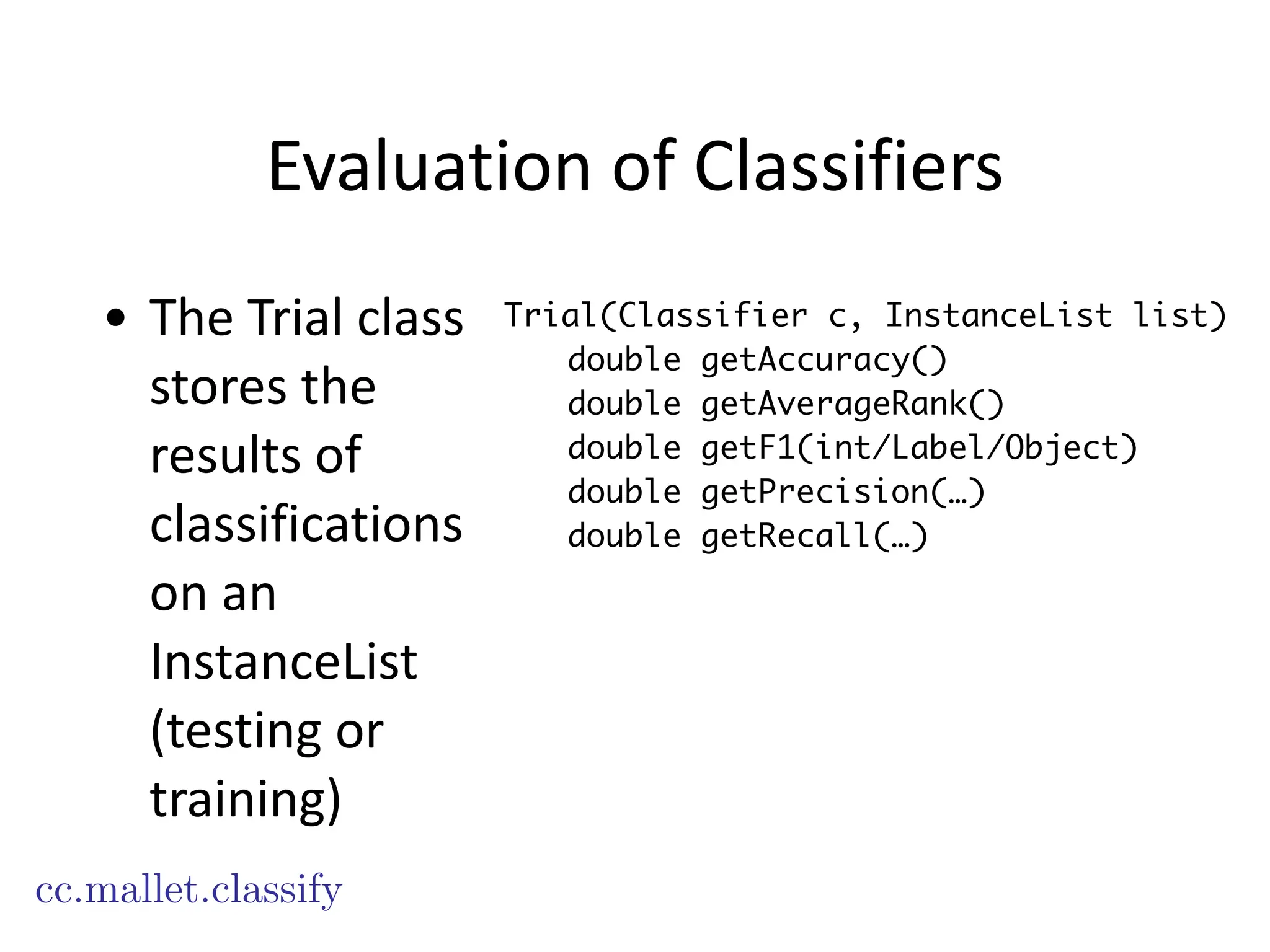
• The	
  Trial	
  class	
  
stores	
  the	
  
results	
  of	
  
classifications	
  
on	
  an	
  
InstanceList	
  
(testing	
  or	
  
training)
cc.mallet.classify
Trial(Classifier c, InstanceList list)
double getAccuracy()
double getAverageRank()
double getF1(int/Label/Object)
double getPrecision(…)
double getRecall(…)
Review
• I	
  have	
  invented	
  a	
  new	
  classifier:	
  David	
  
regression.	
  
– What	
  class	
  should	
  I	
  implement	
  to	
  classify	
  
instances?
Review
• I	
  have	
  invented	
  a	
  new	
  classifier:	
  David	
  
regression.	
  
– What	
  class	
  should	
  I	
  implement	
  to	
  train	
  a	
  David	
  
regression	
  classifier?
Review
• I	
  have	
  invented	
  a	
  new	
  classifier:	
  David	
  
regression.	
  
– I	
  want	
  to	
  train	
  using	
  ByValueGradient.	
  What	
  
mathematical	
  functions	
  do	
  I	
  need	
  to	
  code	
  up,	
  
and	
  what	
  class	
  should	
  I	
  put	
  them	
  in?
Review
• I	
  have	
  invented	
  a	
  new	
  classifier:	
  David	
  
regression.	
  
– How	
  would	
  I	
  check	
  whether	
  my	
  new	
  classifier	
  
works	
  better	
  than	
  Naïve	
  Bayes?
Outline
• About	
  MALLET	
  
• Representing	
  Data	
  
• Classification	
  
• Sequence	
  Tagging	
  
• Topic	
  Modeling
Sequence	
  Tagging
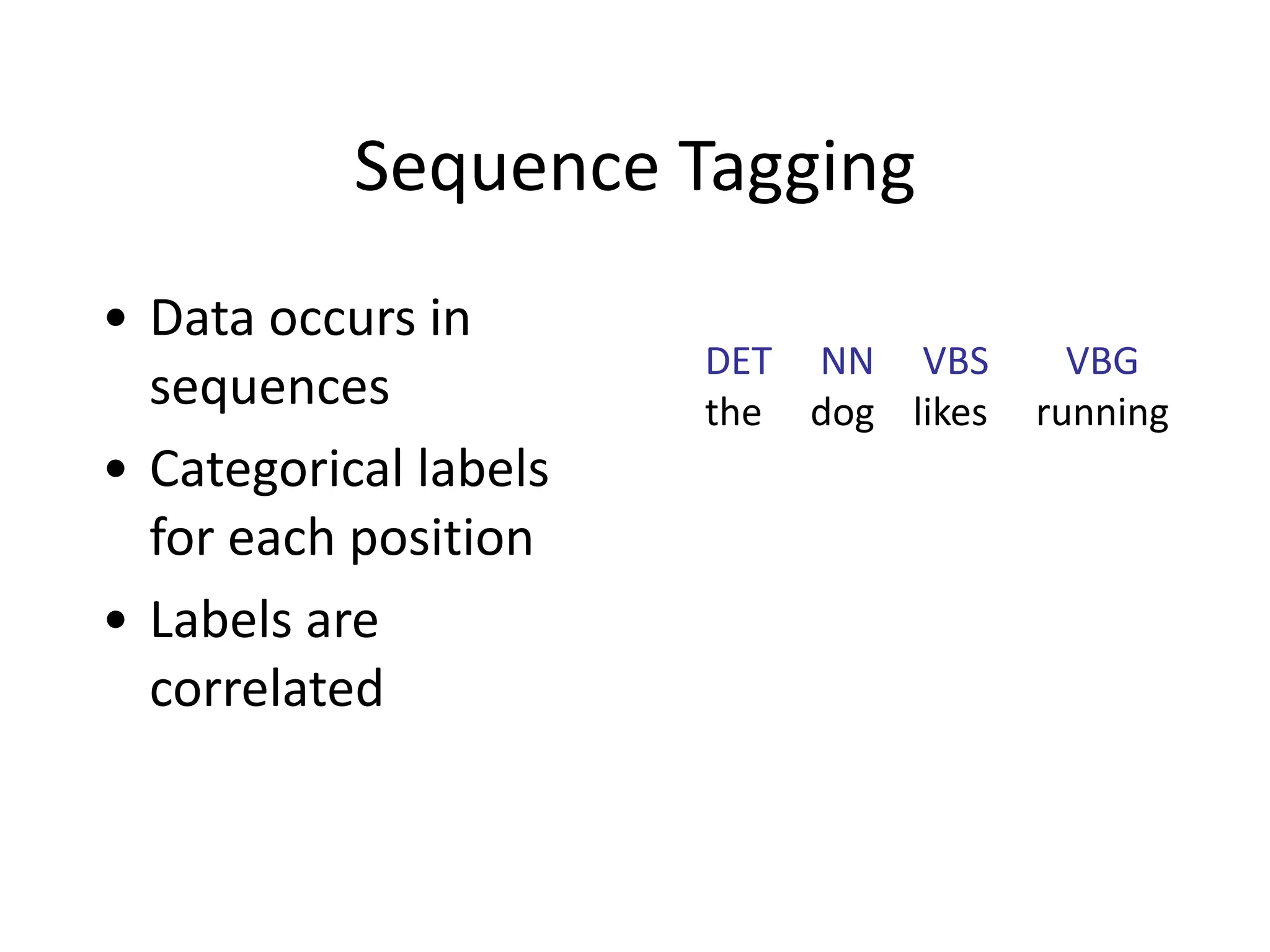
• Data	
  occurs	
  in	
  
sequences	
  
• Categorical	
  labels	
  
for	
  each	
  position	
  
• Labels	
  are	
  
correlated
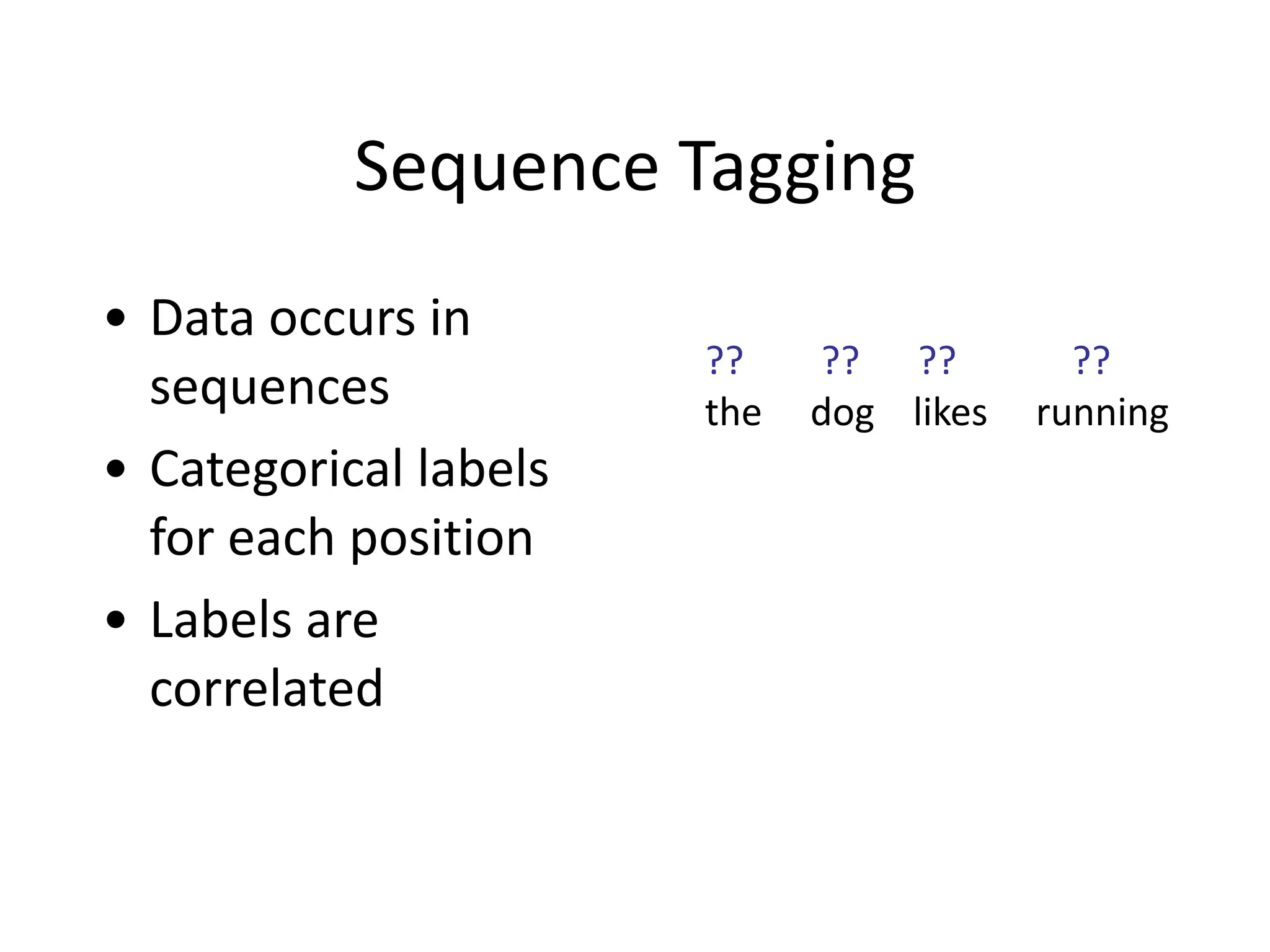
DET	


  NN	


  VBS	


  VBG
the	


  dog	


  likes	


  running
Sequence	
  Tagging
• Data	
  occurs	
  in	
  
sequences	
  
• Categorical	
  labels	
  
for	
  each	
  position	
  
• Labels	
  are	
  
correlated
??	


  ??	


  ??	


  ??
the	


  dog	


  likes	


  running
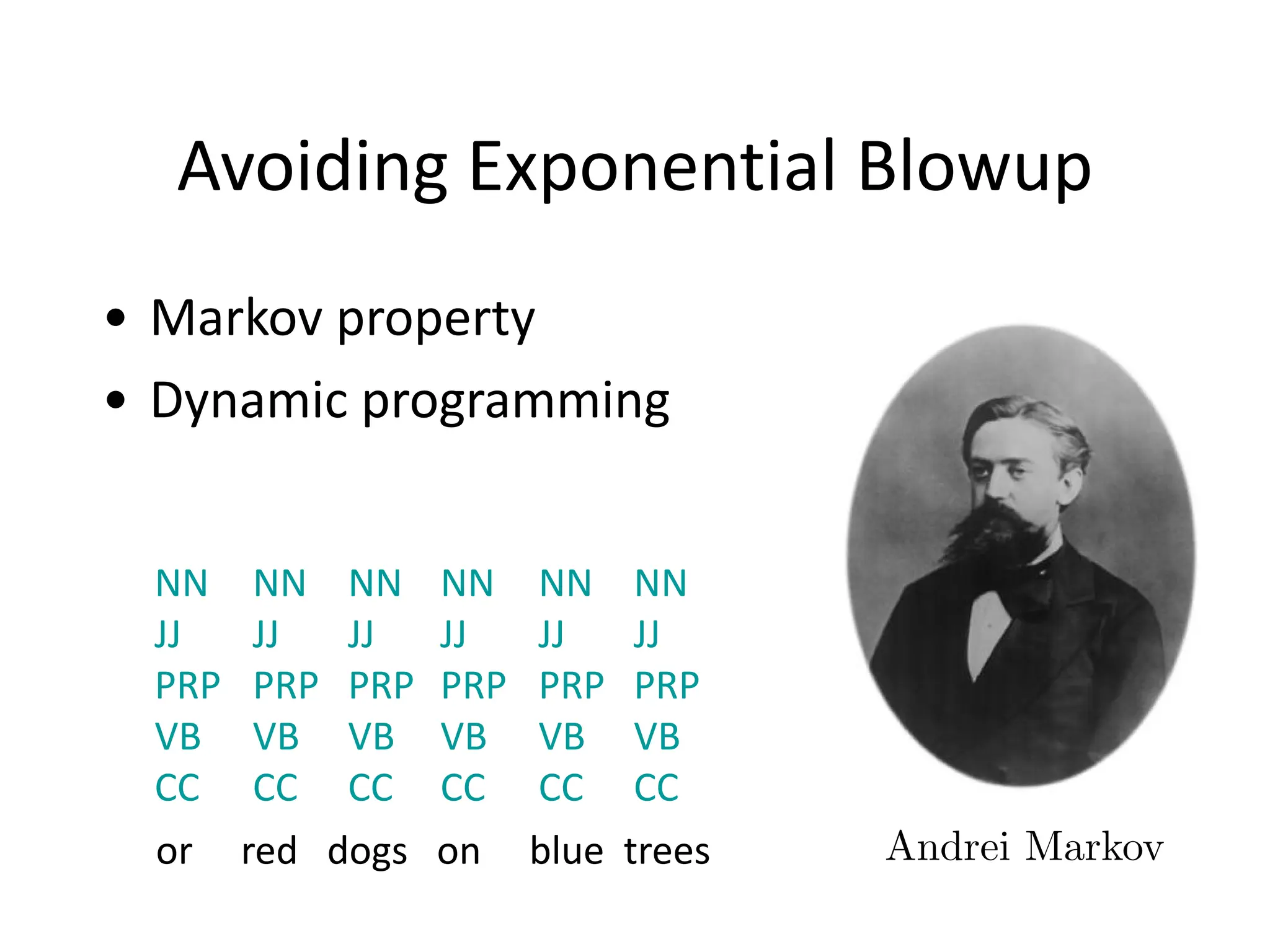
Sequence	
  Tagging
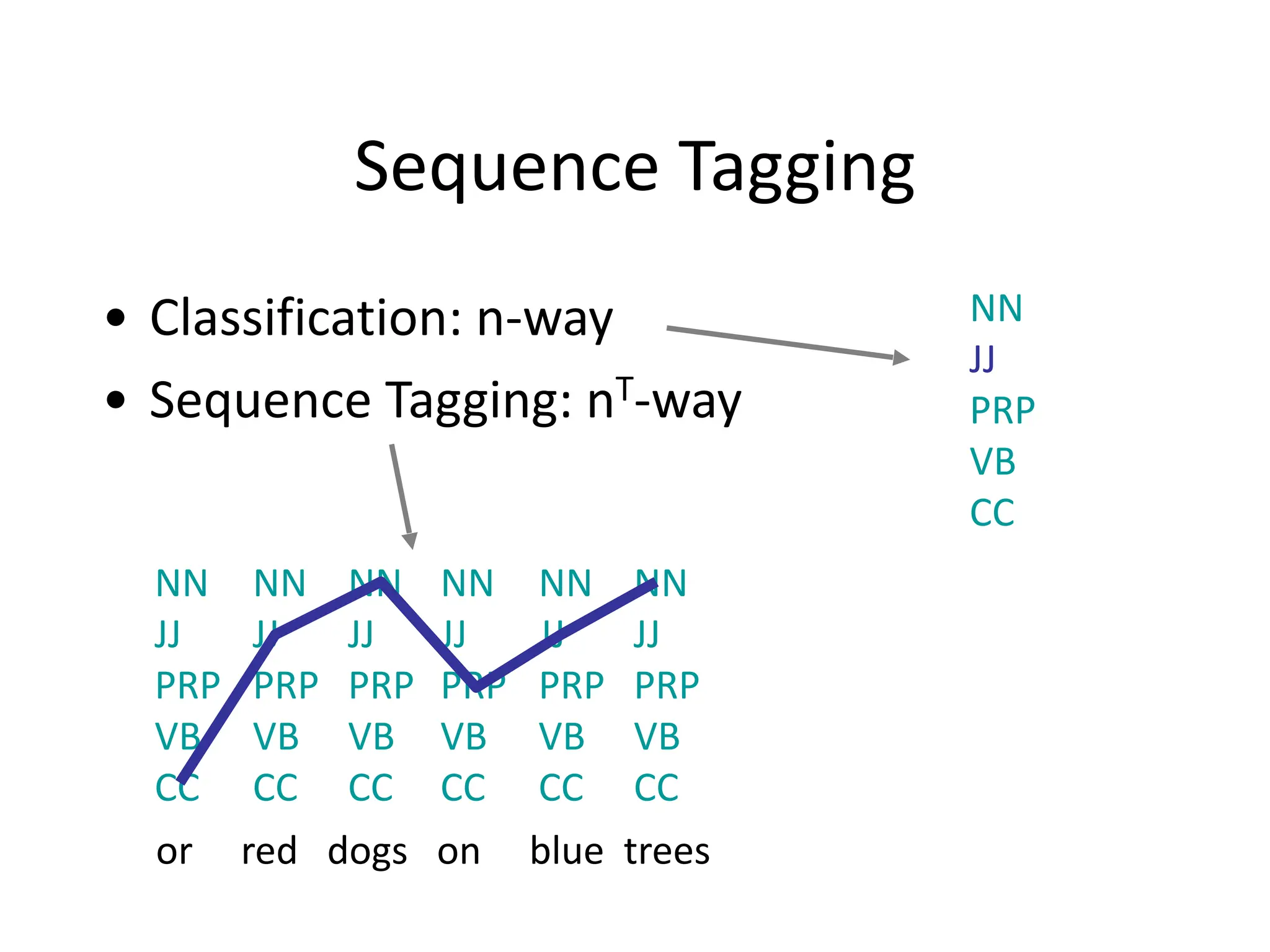
• Classification:	
  n-­‐way	
  
• Sequence	
  Tagging:	
  nT-­‐way
NN
JJ
PRP
VB
CC
NN
JJ
PRP
VB
CC
NN
JJ
PRP
VB
CC
NN
JJ
PRP
VB
CC
NN
JJ
PRP
VB
CC
NN
JJ
PRP
VB
CC
NN
JJ
PRP
VB
CC
or	


  red	
  	
  	
  dogs	
  	
  	
  on	


  blue	
  	
  trees
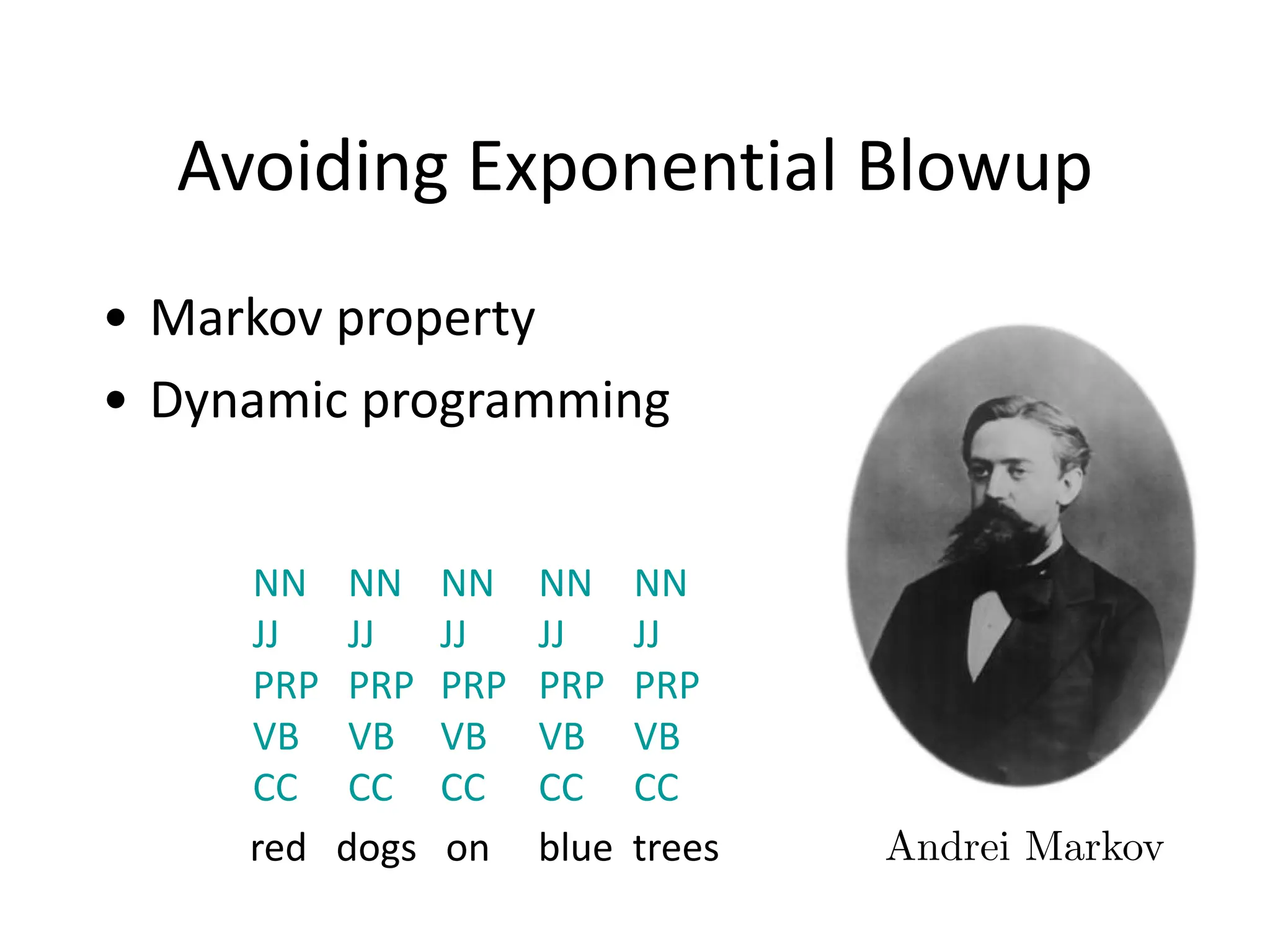
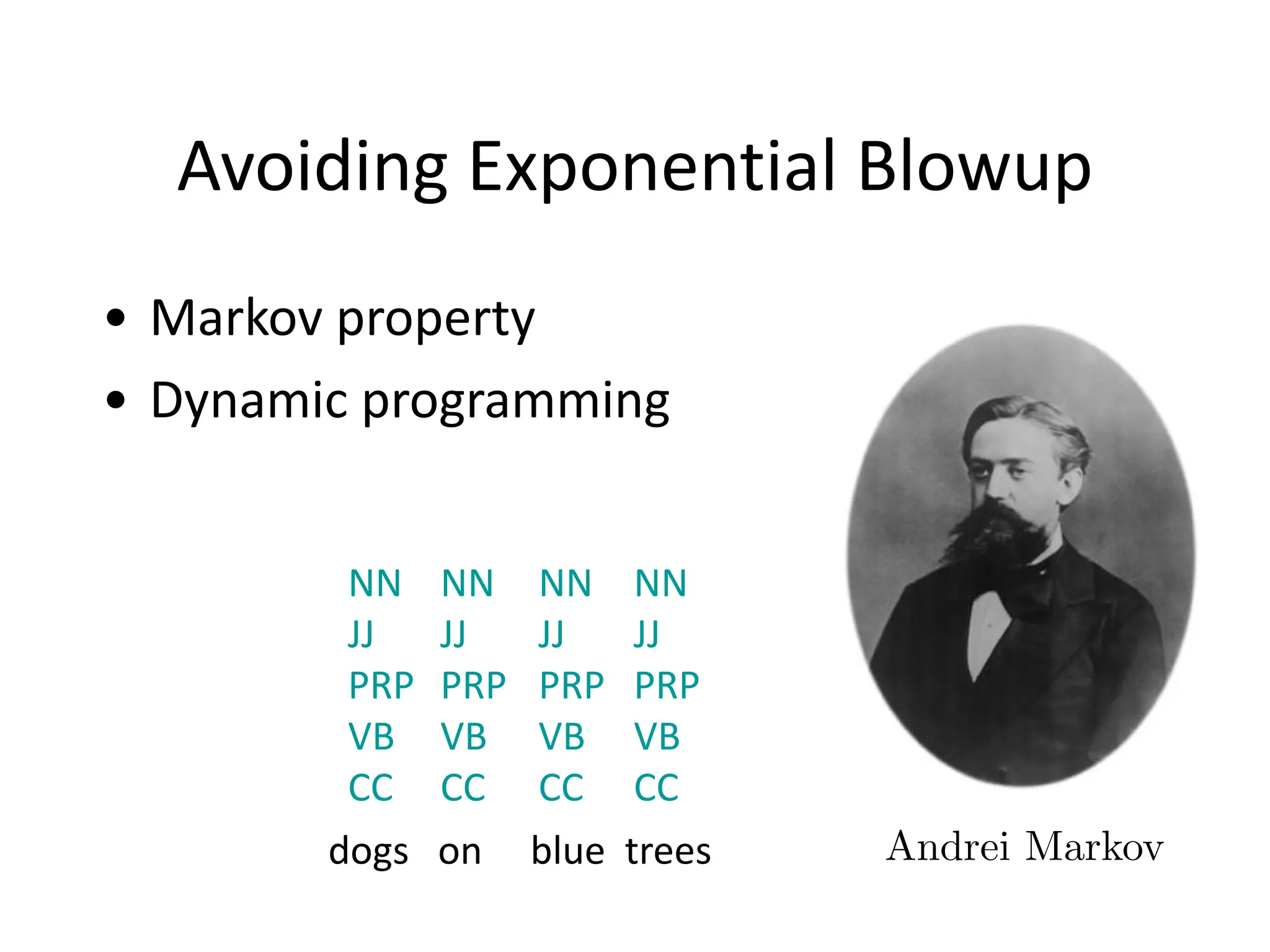
Avoiding	
  Exponential	
  Blowup
• Markov	
  property	
  
• Dynamic	
  programming
Andrei Markov
Avoiding	
  Exponential	
  Blowup
• Markov	
  property	
  
• Dynamic	
  programming
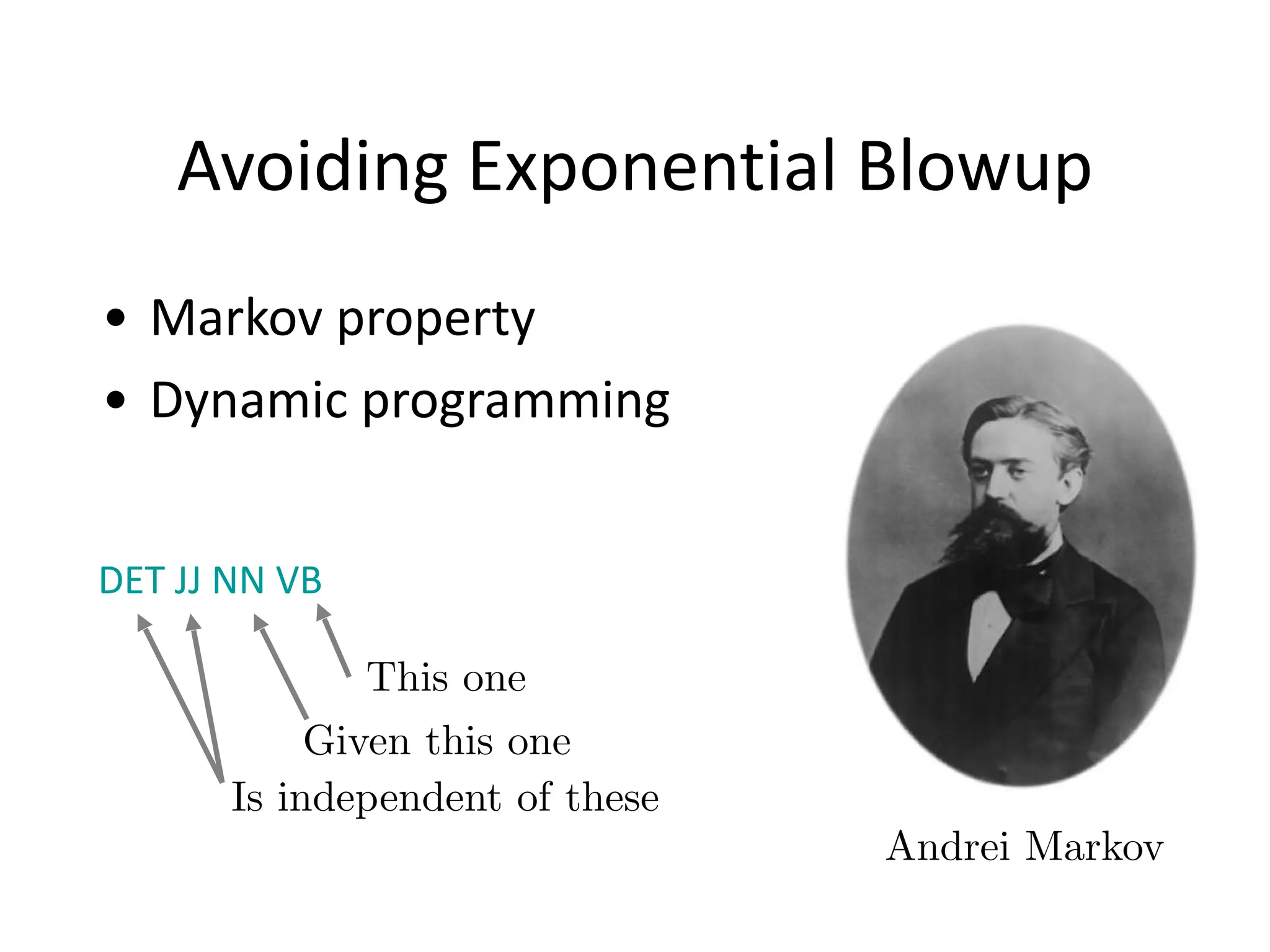
This one
Given this one
Is independent of these
Andrei Markov
DET	
  JJ	
  NN	
  VB
Avoiding	
  Exponential	
  Blowup
• Markov	
  property	
  
• Dynamic	
  programming
NN
JJ
PRP
VB
CC
NN
JJ
PRP
VB
CC
NN
JJ
PRP
VB
CC
NN
JJ
PRP
VB
CC
NN
JJ
PRP
VB
CC
NN
JJ
PRP
VB
CC
or	


  red	
  	
  	
  dogs	
  	
  	
  on	


  blue	
  	
  trees Andrei Markov
Avoiding	
  Exponential	
  Blowup
• Markov	
  property	
  
• Dynamic	
  programming
NN
JJ
PRP
VB
CC
NN
JJ
PRP
VB
CC
NN
JJ
PRP
VB
CC
NN
JJ
PRP
VB
CC
NN
JJ
PRP
VB
CC
red	
  	
  	
  dogs	
  	
  	
  on	


  blue	
  	
  trees Andrei Markov
Avoiding	
  Exponential	
  Blowup
• Markov	
  property	
  
• Dynamic	
  programming
NN
JJ
PRP
VB
CC
NN
JJ
PRP
VB
CC
NN
JJ
PRP
VB
CC
NN
JJ
PRP
VB
CC


  dogs	
  	
  	
  on	


  blue	
  	
  trees Andrei Markov
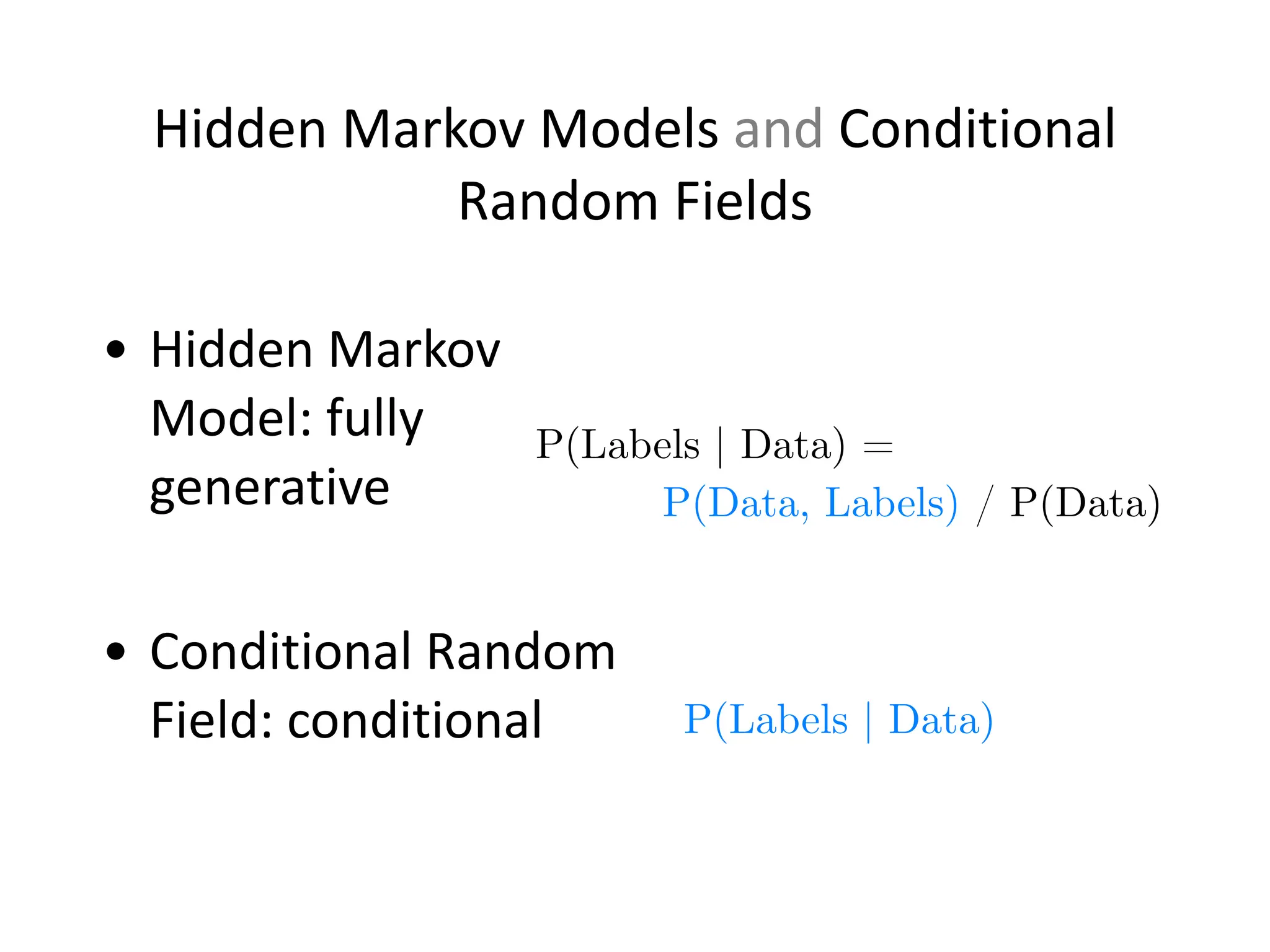
Hidden	
  Markov	
  Models	
  and	
  Conditional	
  
Random	
  Fields
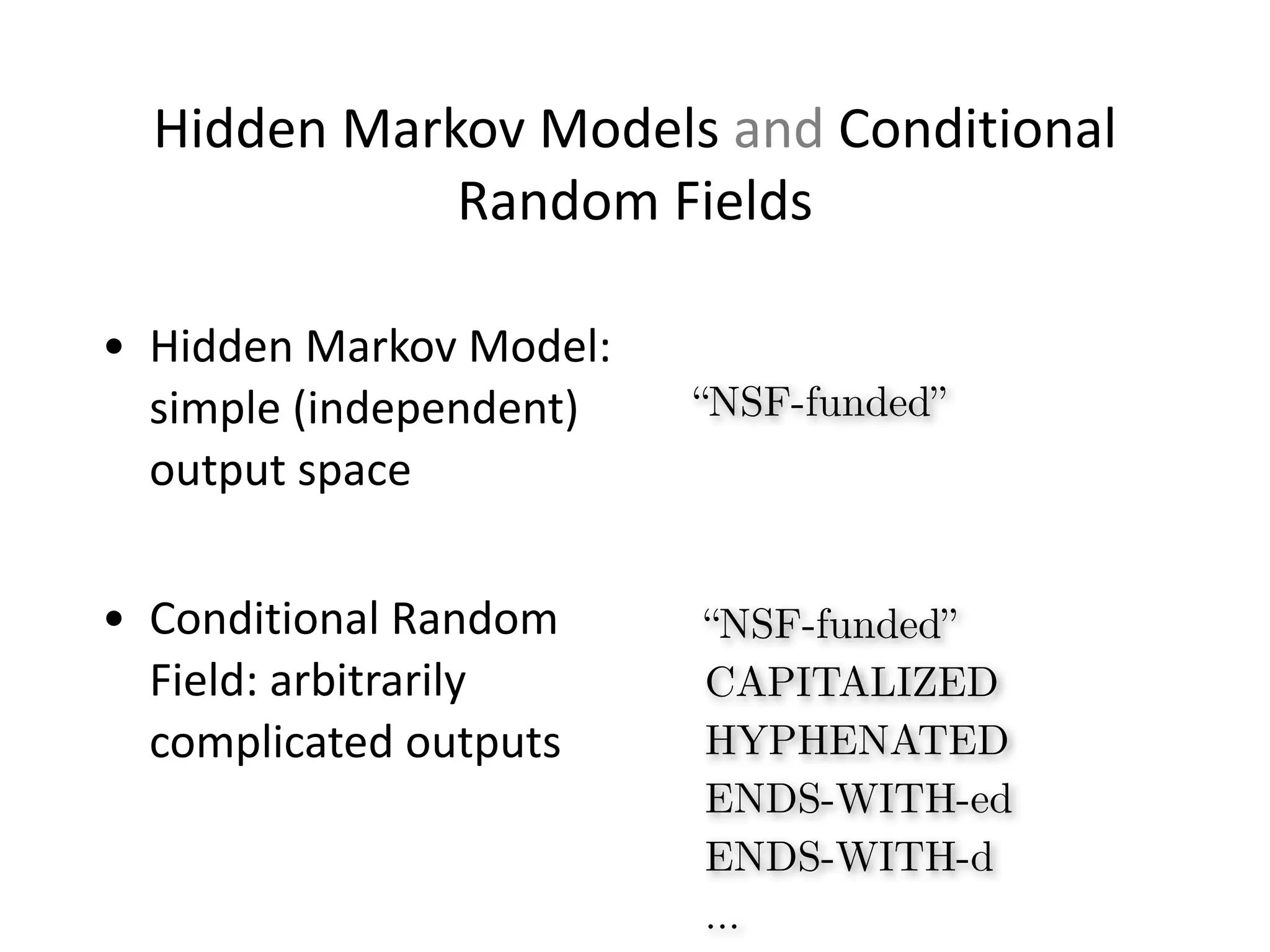
• Hidden	
  Markov	
  
Model:	
  fully	
  
generative	
  
!
• Conditional	
  Random	
  
Field:	
  conditional
P(Labels | Data) =
P(Data, Labels) / P(Data)
P(Labels | Data)
Hidden	
  Markov	
  Models	
  and	
  Conditional	
  
Random	
  Fields
• Hidden	
  Markov	
  Model:	
  
simple	
  (independent)	
  
output	
  space	
  
!
• Conditional	
  Random	
  
Field:	
  arbitrarily	
  
complicated	
  outputs
“NSF-funded”
“NSF-funded”
CAPITALIZED
HYPHENATED
ENDS-WITH-ed
ENDS-WITH-d
…
Hidden	
  Markov	
  Models	
  and	
  Conditional	
  
Random	
  Fields
FeatureSequence
FeatureVectorSequence
!
FeatureVector[]
int[]
• Hidden	
  Markov	
  Model:	
  
simple	
  (independent)	
  
output	
  space	
  
!
• Conditional	
  Random	
  
Field:	
  arbitrarily	
  
complicated	
  outputs
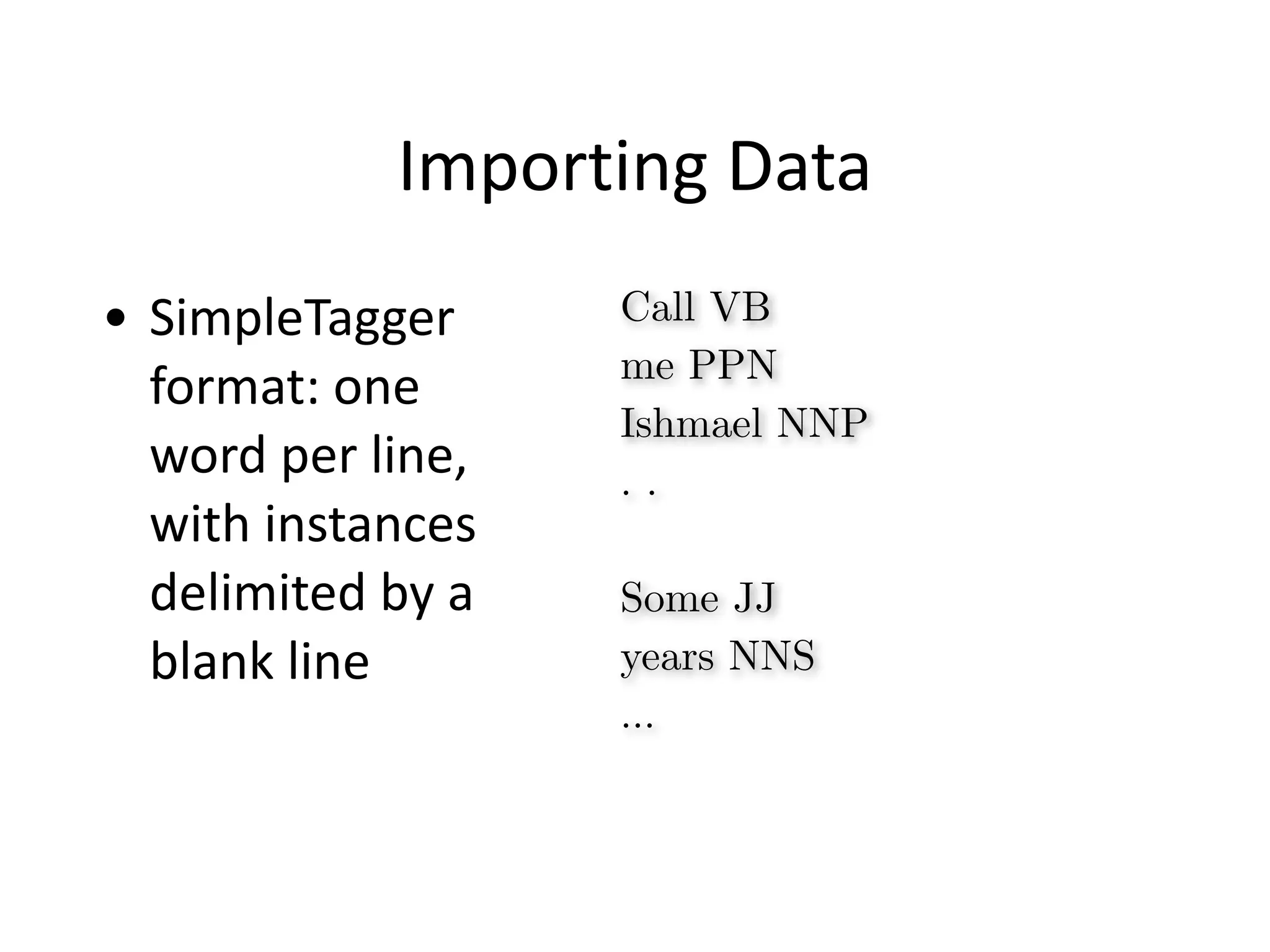
Importing	
  Data
• SimpleTagger	
  
format:	
  one	
  
word	
  per	
  line,	
  
with	
  instances	
  
delimited	
  by	
  a	
  
blank	
  line
Call VB
me PPN
Ishmael NNP
. .
!
Some JJ
years NNS
…
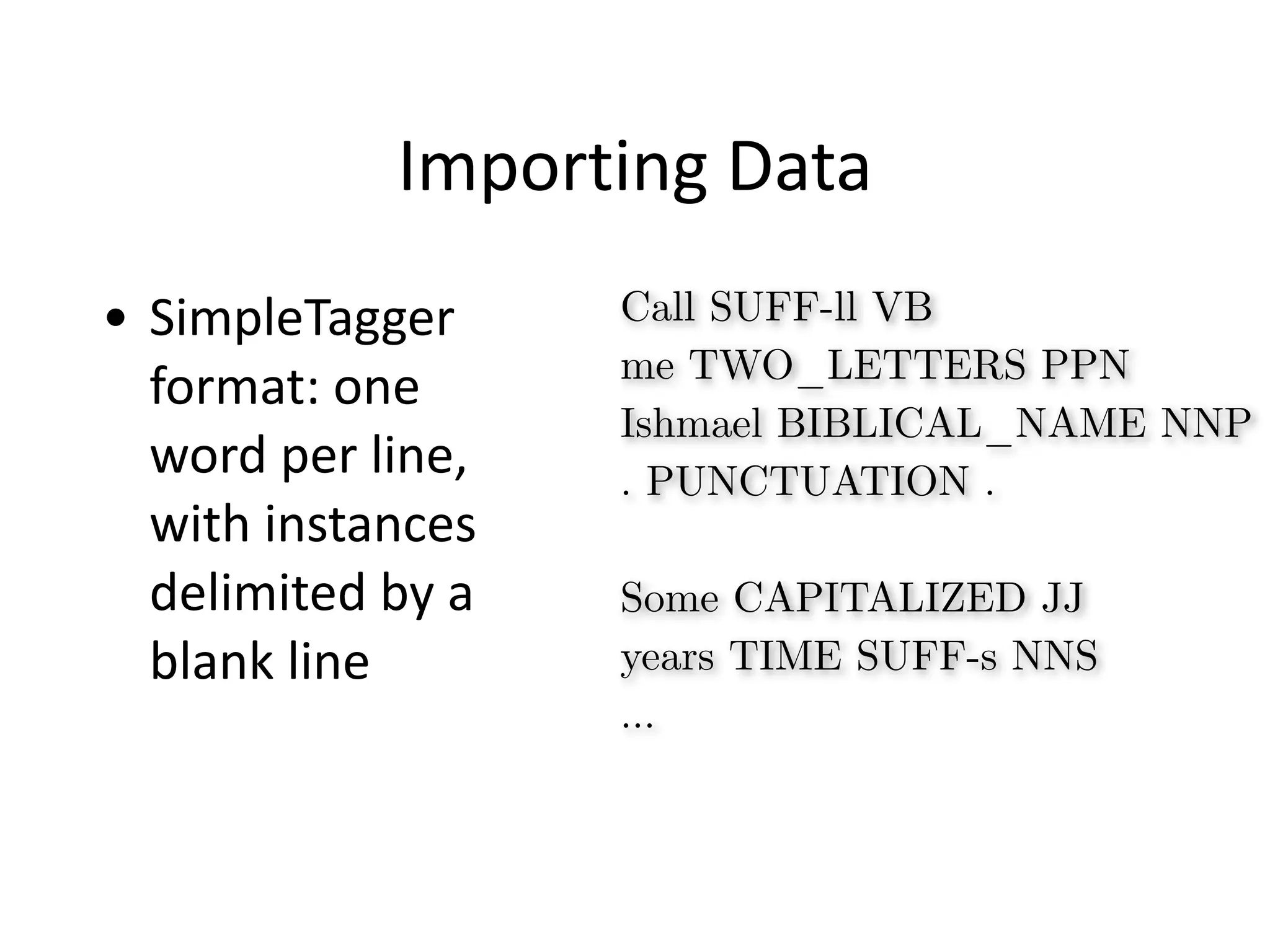
Importing	
  Data
• SimpleTagger	
  
format:	
  one	
  
word	
  per	
  line,	
  
with	
  instances	
  
delimited	
  by	
  a	
  
blank	
  line
Call SUFF-ll VB
me TWO_LETTERS PPN
Ishmael BIBLICAL_NAME NNP
. PUNCTUATION .
!
Some CAPITALIZED JJ
years TIME SUFF-s NNS
…
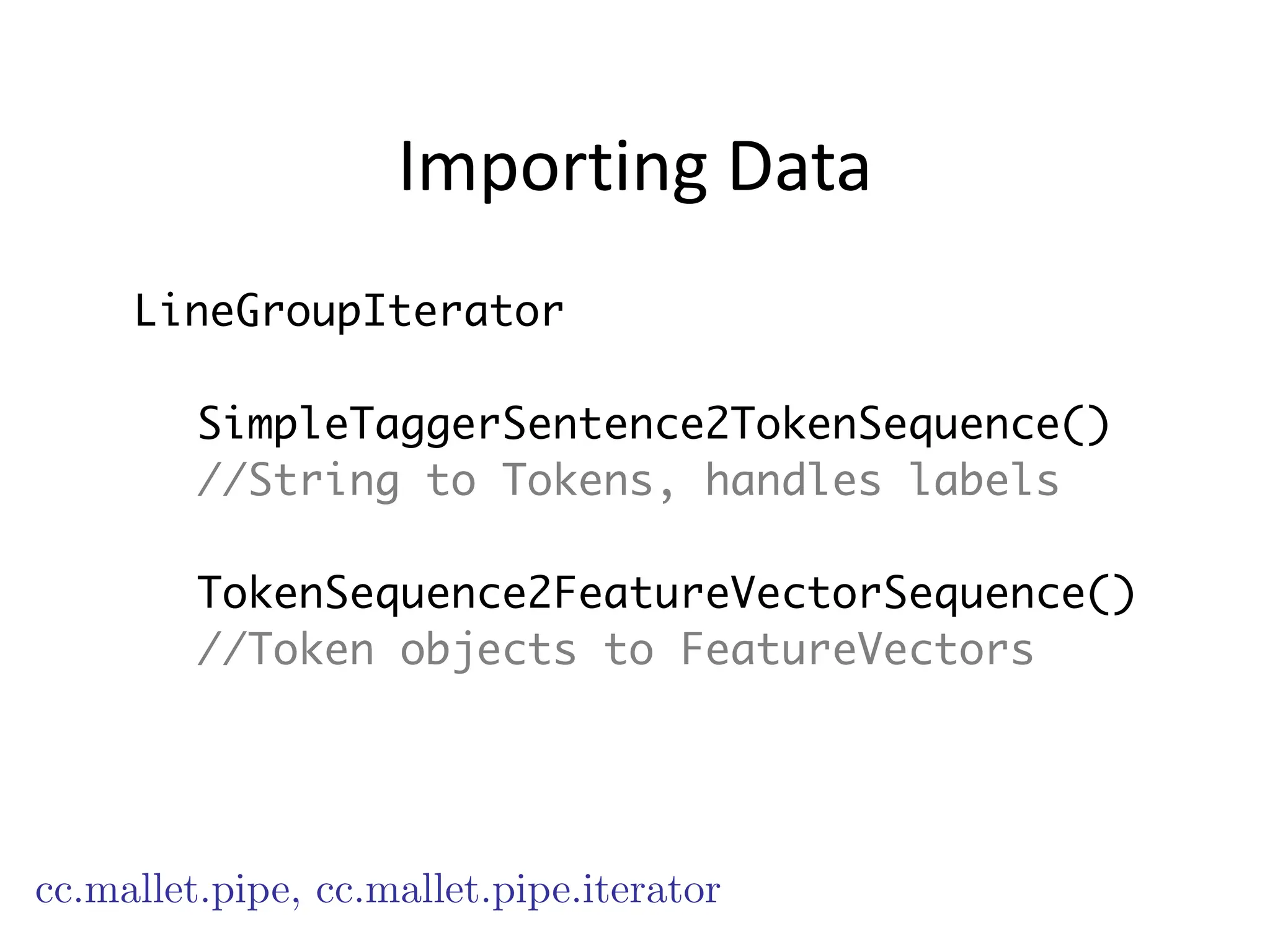
Importing	
  Data
LineGroupIterator
!
SimpleTaggerSentence2TokenSequence()
//String to Tokens, handles labels
!
TokenSequence2FeatureVectorSequence()
//Token objects to FeatureVectors
cc.mallet.pipe, cc.mallet.pipe.iterator
Importing	
  Data
LineGroupIterator
!
SimpleTaggerSentence2TokenSequence()
//String to Tokens, handles labels
!
[Pipes that modify tokens]
!
TokenSequence2FeatureVectorSequence()
//Token objects to FeatureVectors
cc.mallet.pipe, cc.mallet.pipe.iterator
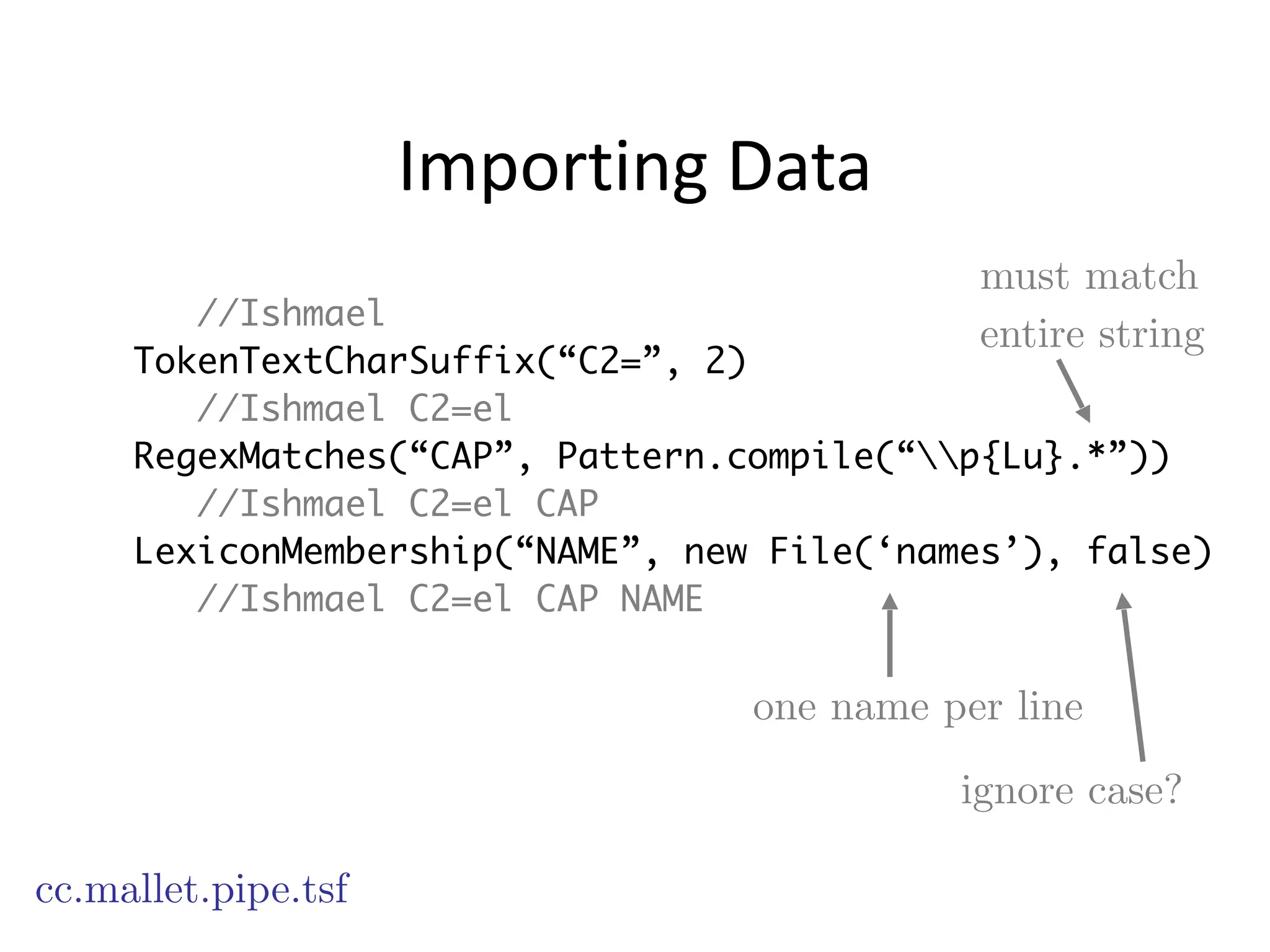
Importing	
  Data
//Ishmael
TokenTextCharSuffix(“C2=”, 2)
//Ishmael C2=el
RegexMatches(“CAP”, Pattern.compile(“p{Lu}.*”))
//Ishmael C2=el CAP
LexiconMembership(“NAME”, new File(‘names’), false)
//Ishmael C2=el CAP NAME
cc.mallet.pipe.tsf
must match
entire string
one name per line
ignore case?
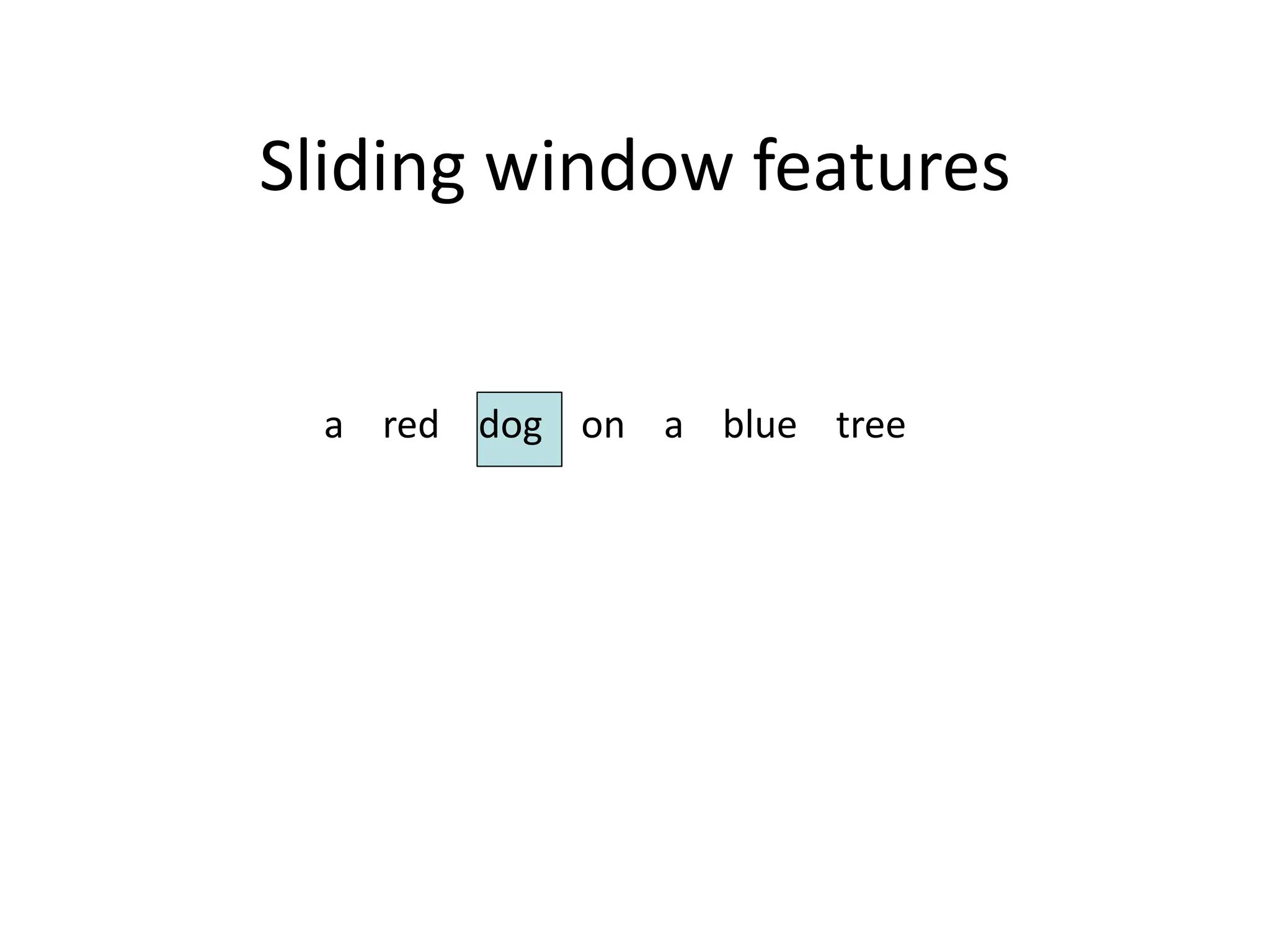
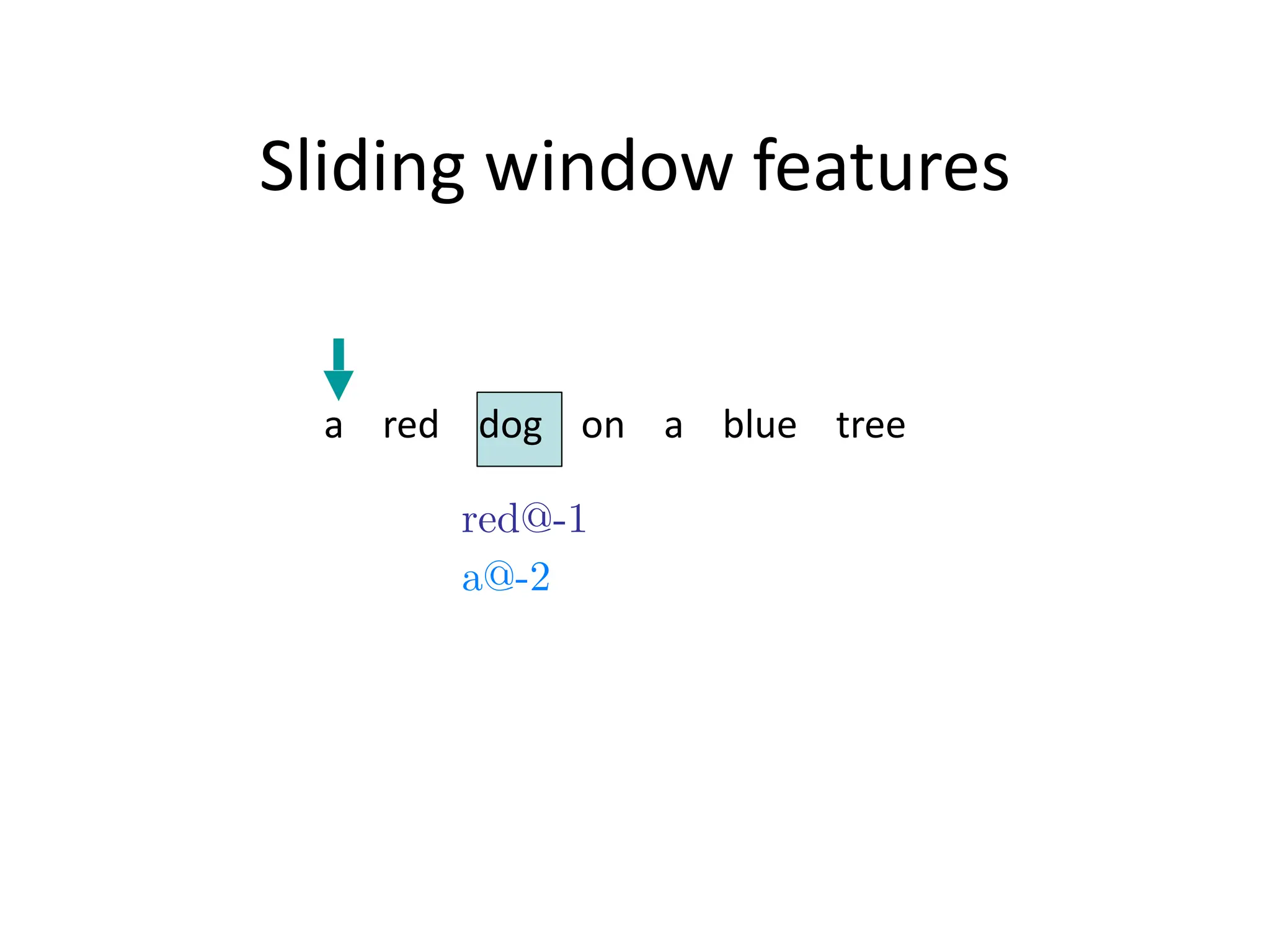
Sliding	
  window	
  features
a	


  red	


  dog	


  on	


  a	


  blue	


  tree
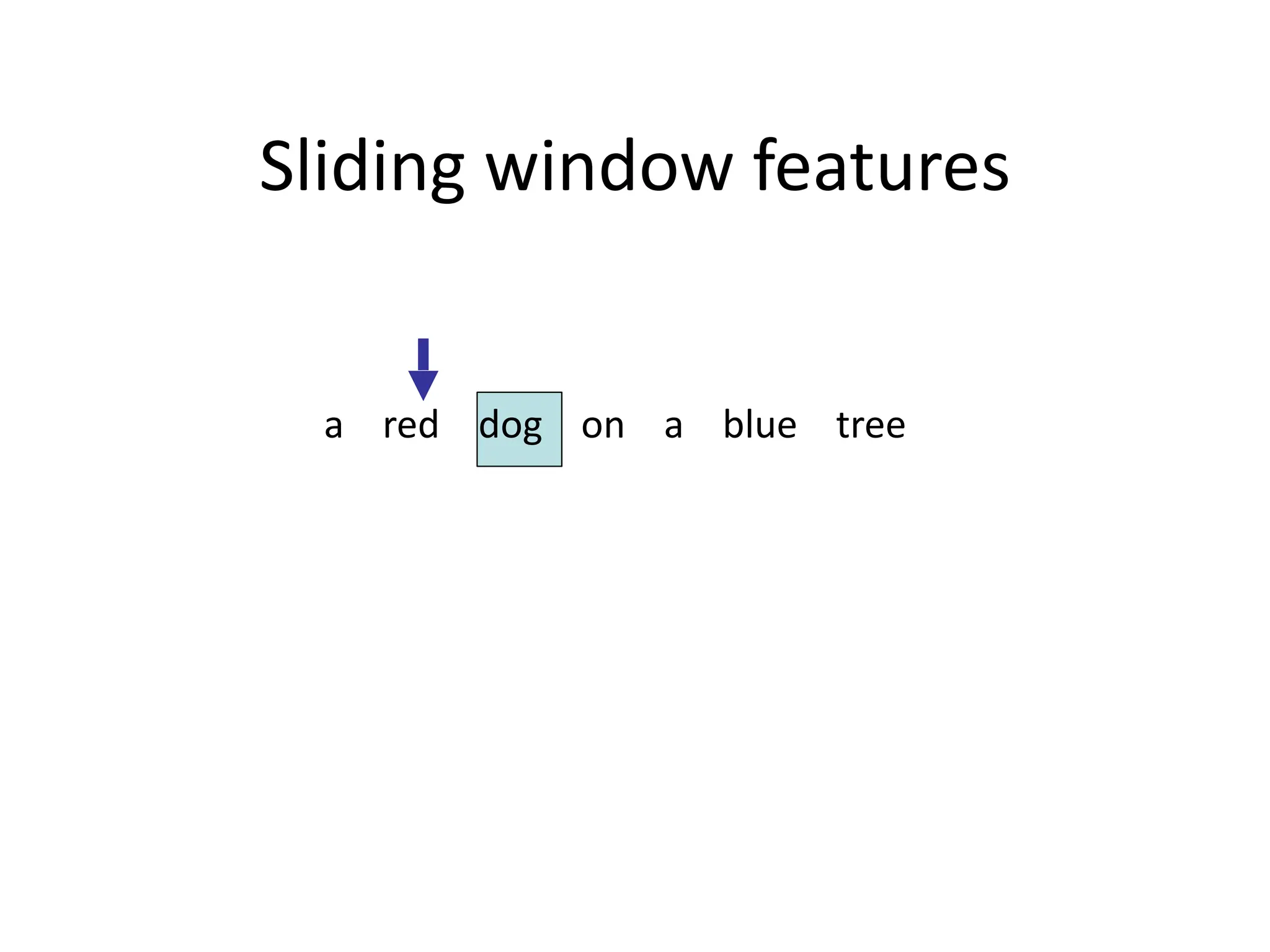
Sliding	
  window	
  features
a	


  red	


  dog	


  on	


  a	


  blue	


  tree
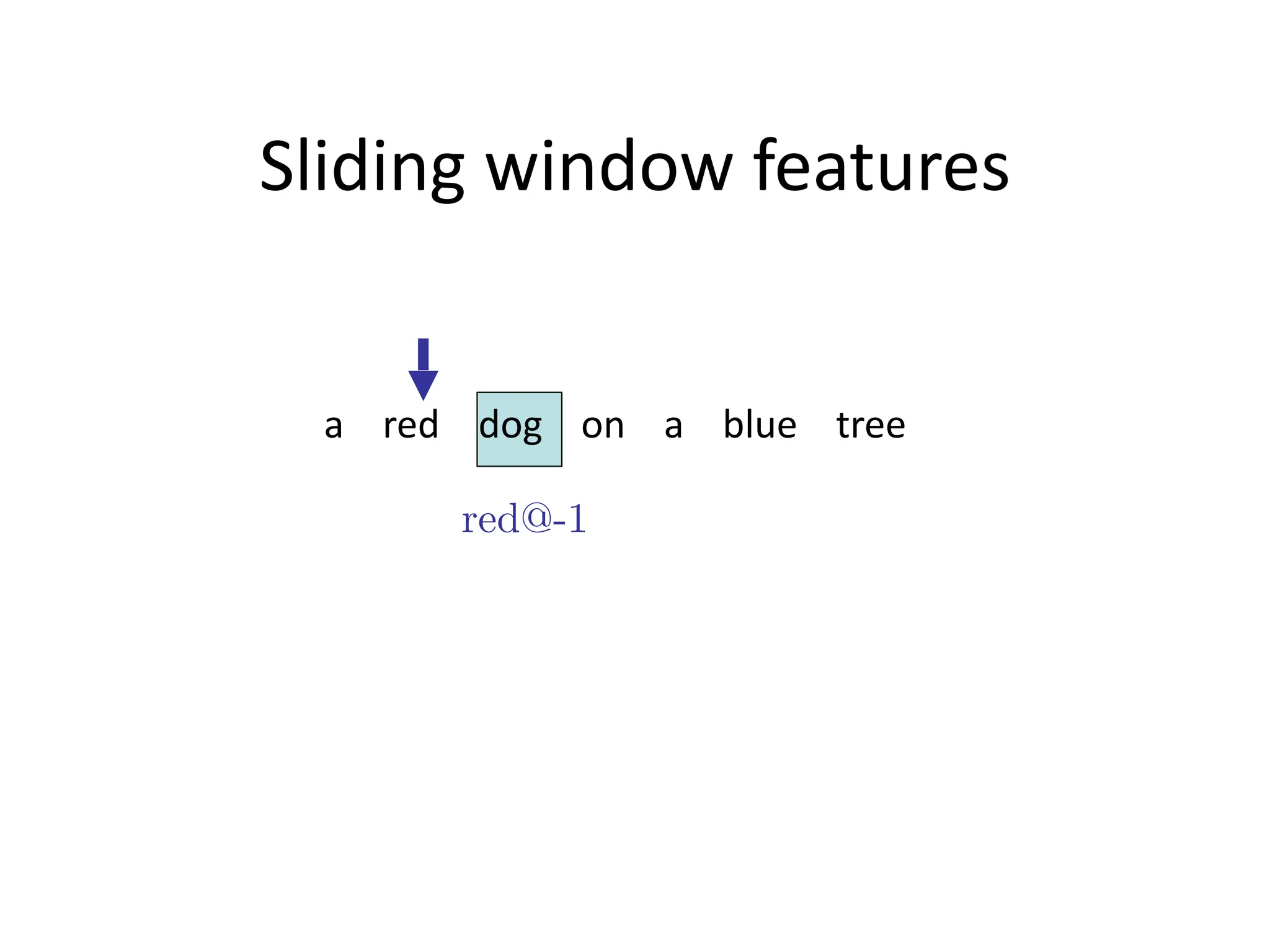
Sliding	
  window	
  features
a	


  red	


  dog	


  on	


  a	


  blue	


  tree
red@-1
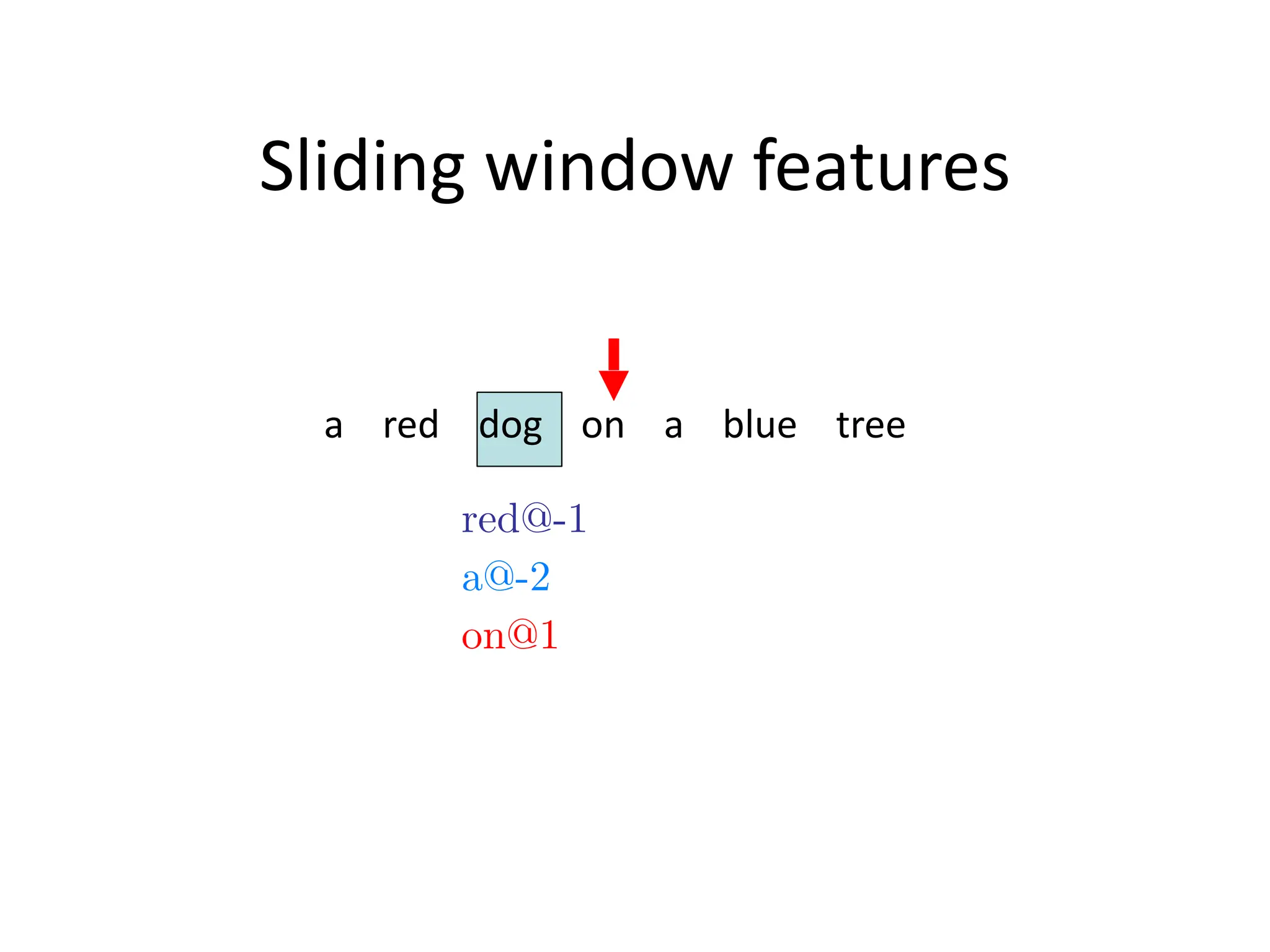
Sliding	
  window	
  features
a	


  red	


  dog	


  on	


  a	


  blue	


  tree
red@-1
a@-2
Sliding	
  window	
  features
a	


  red	


  dog	


  on	


  a	


  blue	


  tree
red@-1
a@-2
on@1
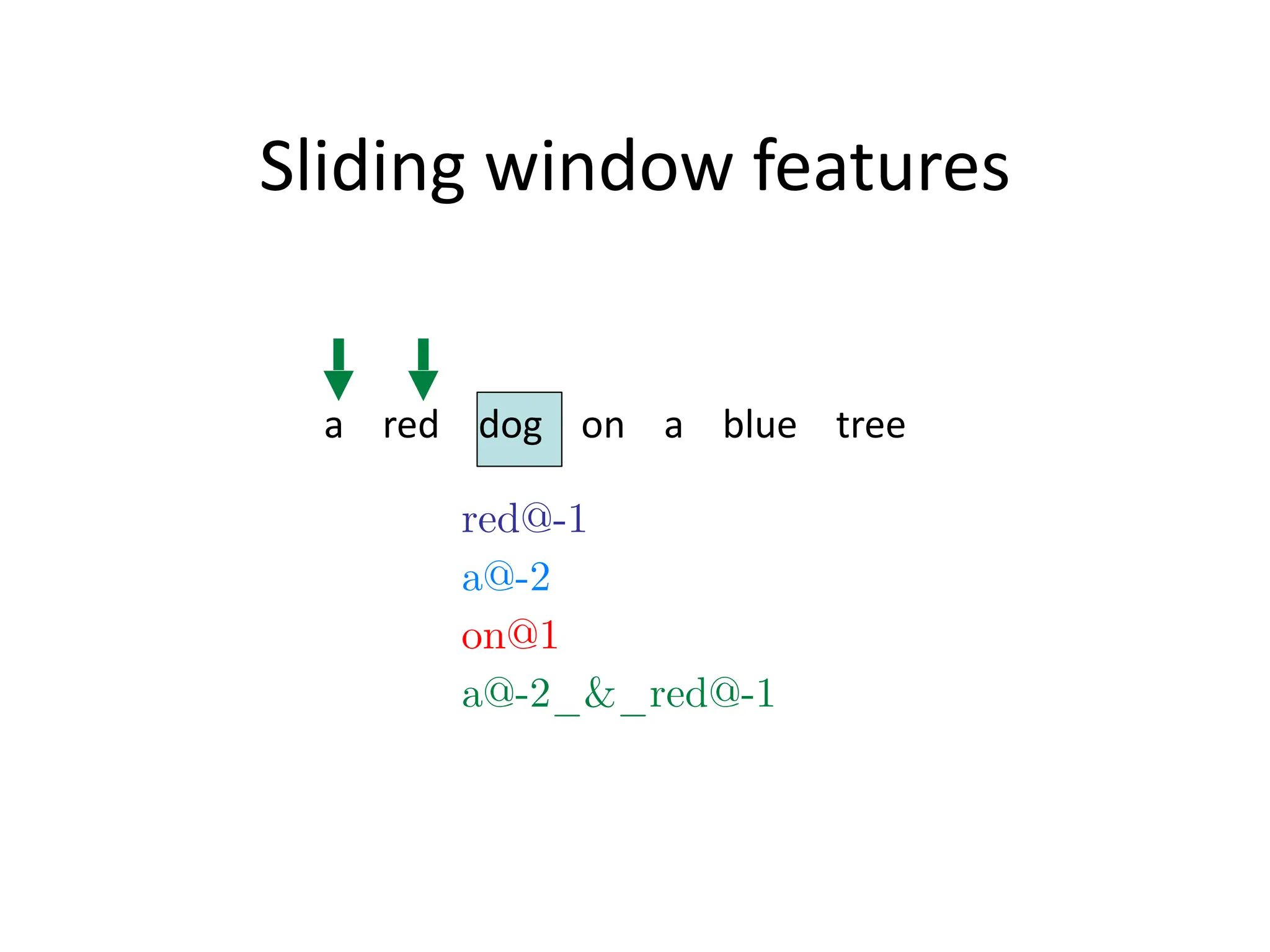
Sliding	
  window	
  features
a	


  red	


  dog	


  on	


  a	


  blue	


  tree
red@-1
a@-2
on@1
a@-2_&_red@-1
Importing	
  Data
int[][] conjunctions = new int[3][];
conjunctions[0] = new int[] { -1 };
conjunctions[1] = new int[] { 1 };
conjunctions[2] = new int[] { -2, -1 };
!
OffsetConjunctions(conjunctions)
!
// a@-2_&_red@-1 on@1
cc.mallet.pipe.tsf
previous
position
next position
previous two
Importing	
  Data
int[][] conjunctions = new int[3][];
conjunctions[0] = new int[] { -1 };
conjunctions[1] = new int[] { 1 };
conjunctions[2] = new int[] { -2, -1 };
!
TokenTextCharSuffix("C1=", 1)
OffsetConjunctions(conjunctions)
!
// a@-2_&_red@-1 a@-2_&_C1=d@-1
cc.mallet.pipe.tsf
previous
position
next position
previous two
Finite	
  State	
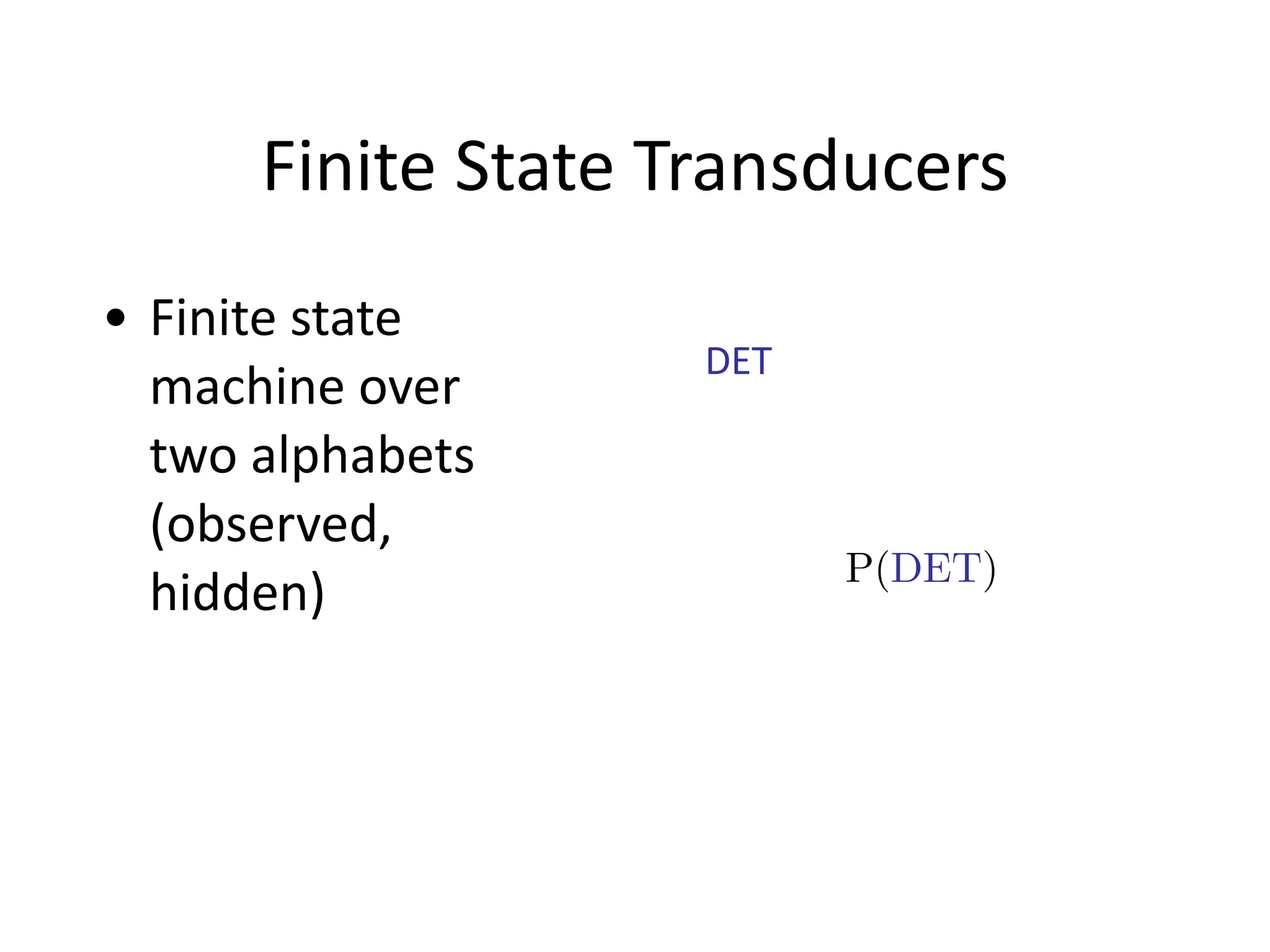
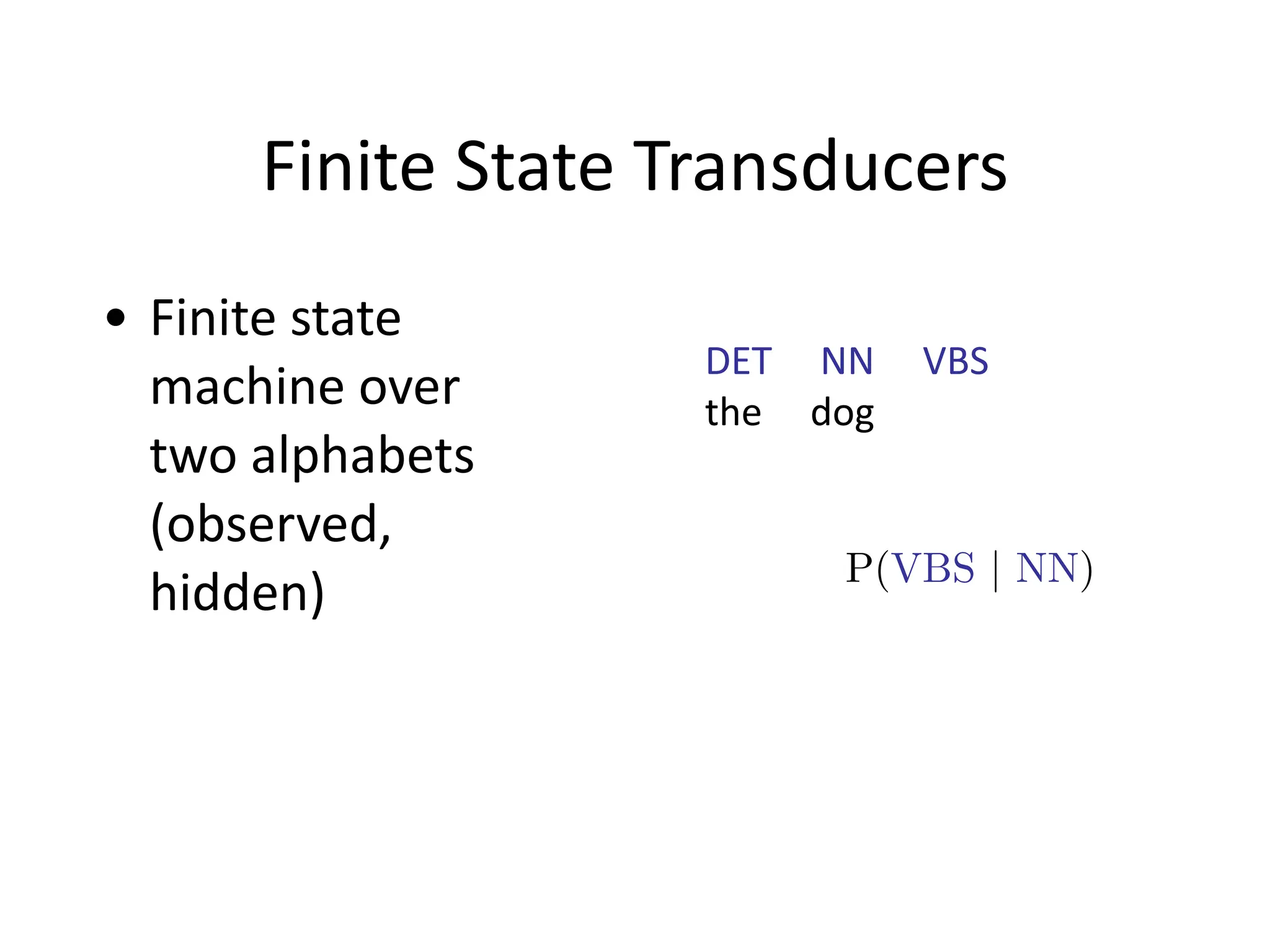
  Transducers
• Finite	
  state	
  
machine	
  over	
  
two	
  alphabets	
  
(observed,	
  
hidden)
Finite	
  State	
  Transducers
• Finite	
  state	
  
machine	
  over	
  
two	
  alphabets	
  
(observed,	
  
hidden)
DET
P(DET)
Finite	
  State	
  Transducers
• Finite	
  state	
  
machine	
  over	
  
two	
  alphabets	
  
(observed,	
  
hidden)
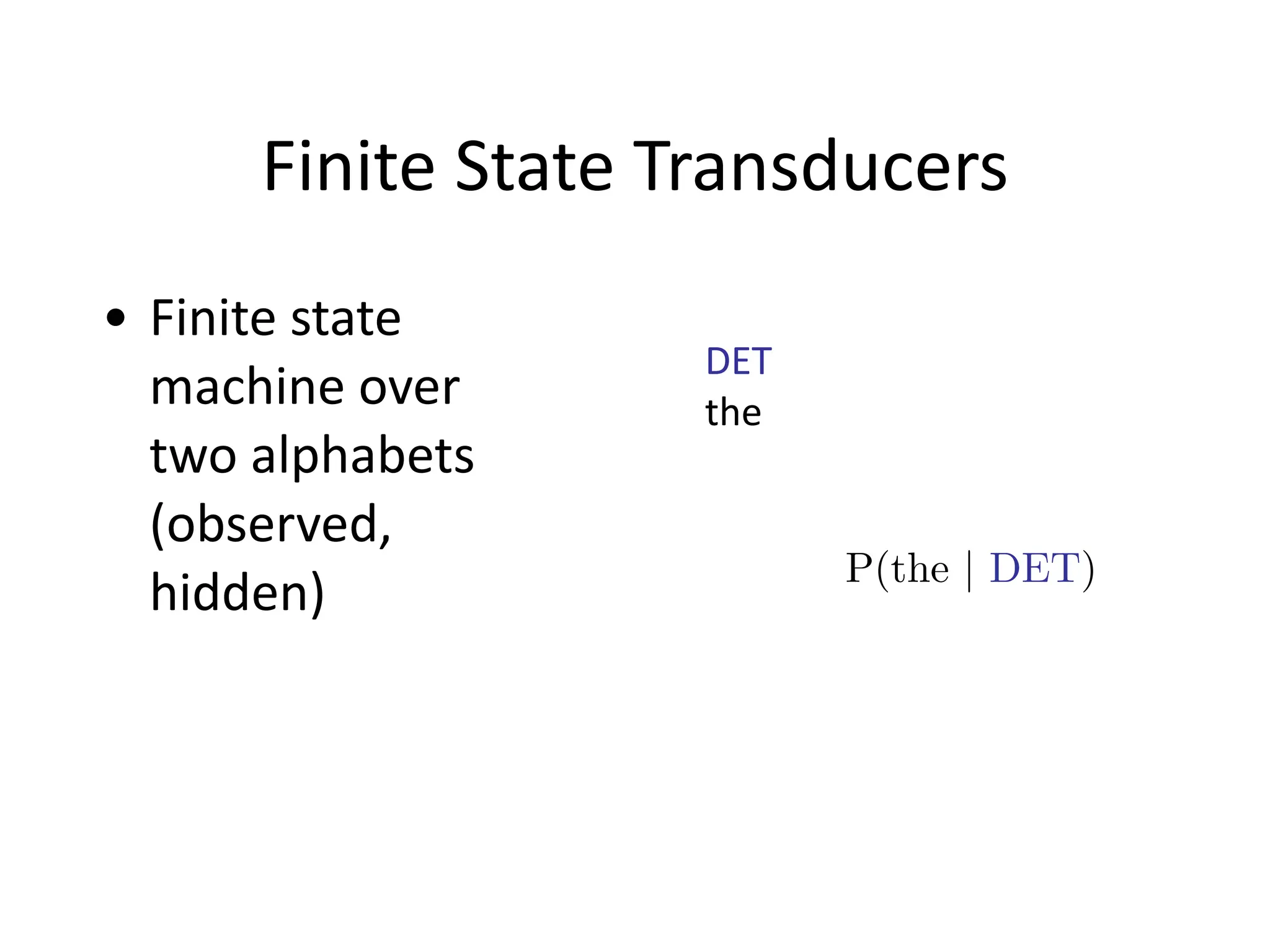
DET	


the
P(the | DET)
Finite	
  State	
  Transducers
• Finite	
  state	
  
machine	
  over	
  
two	
  alphabets	
  
(observed,	
  
hidden)
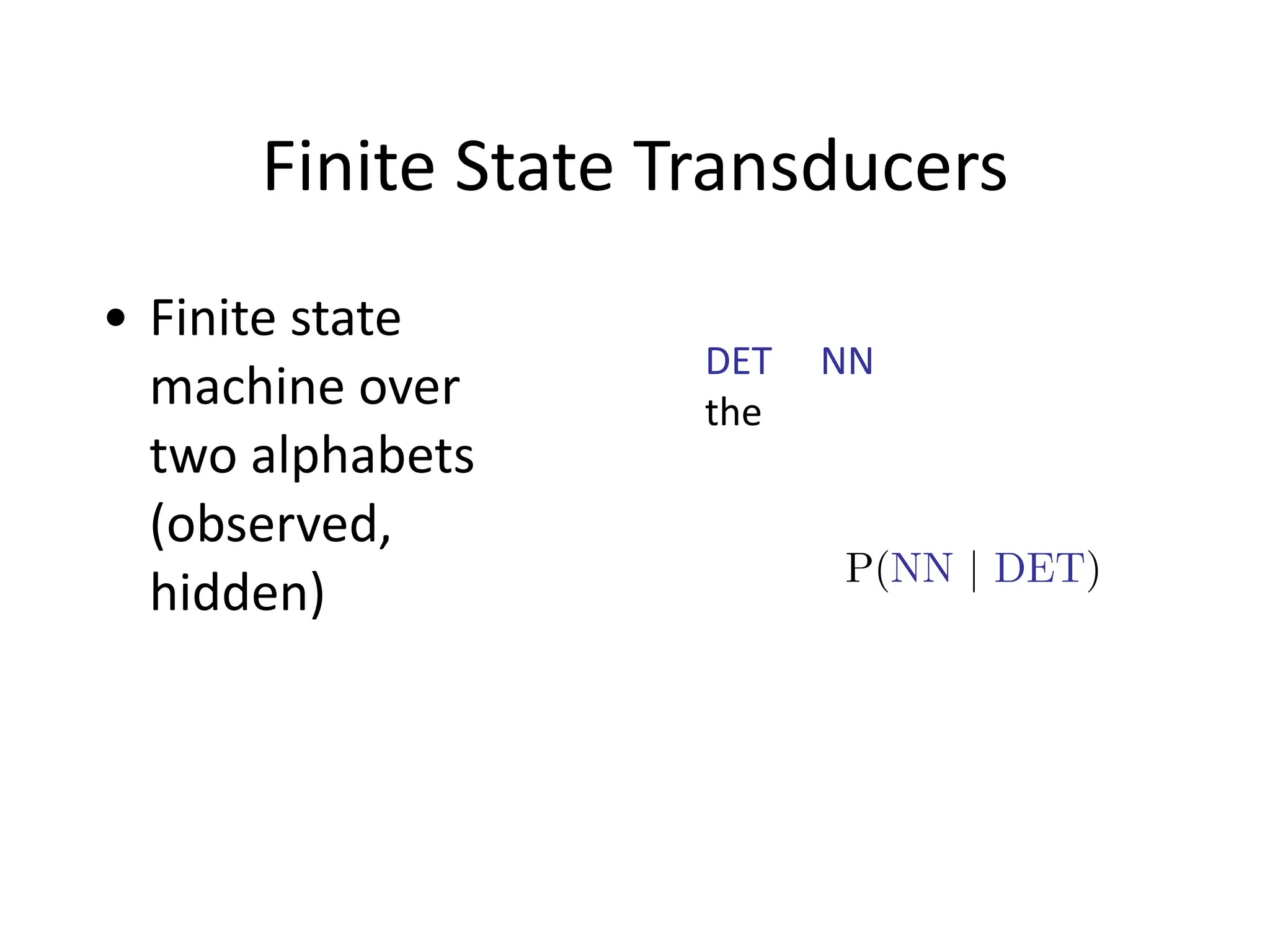
DET	


  NN
the
P(NN | DET)
Finite	
  State	
  Transducers
• Finite	
  state	
  
machine	
  over	
  
two	
  alphabets	
  
(observed,	
  
hidden)
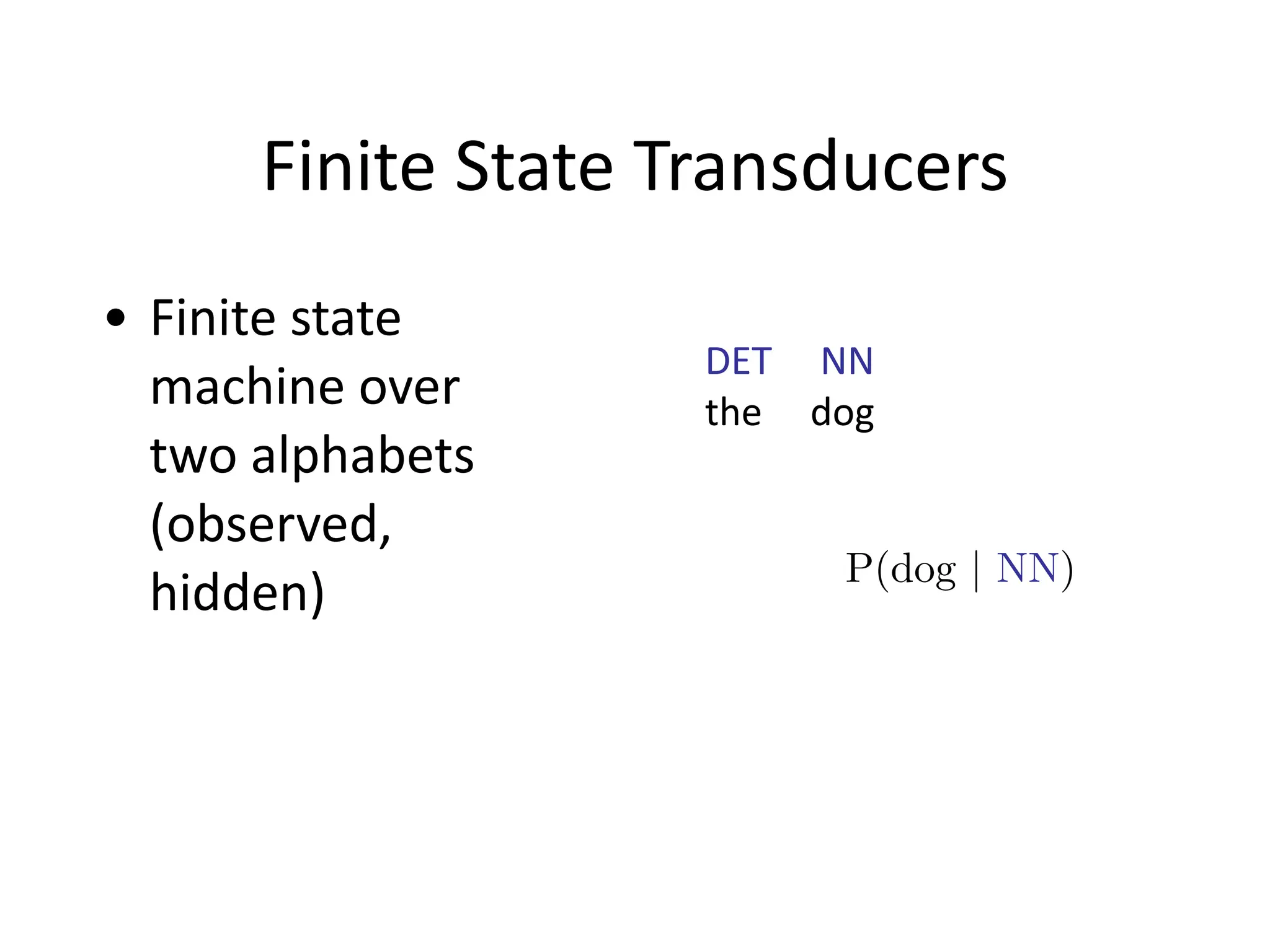
DET	


  NN
the	


  dog
P(dog | NN)
Finite	
  State	
  Transducers
• Finite	
  state	
  
machine	
  over	
  
two	
  alphabets	
  
(observed,	
  
hidden)
DET	


  NN	


  VBS
the	


  dog
P(VBS | NN)
How	
  many	
  parameters?
• Determines	
  
efficiency	
  of	
  
training	
  
• Too	
  many	
  leads	
  
to	
  overfitting
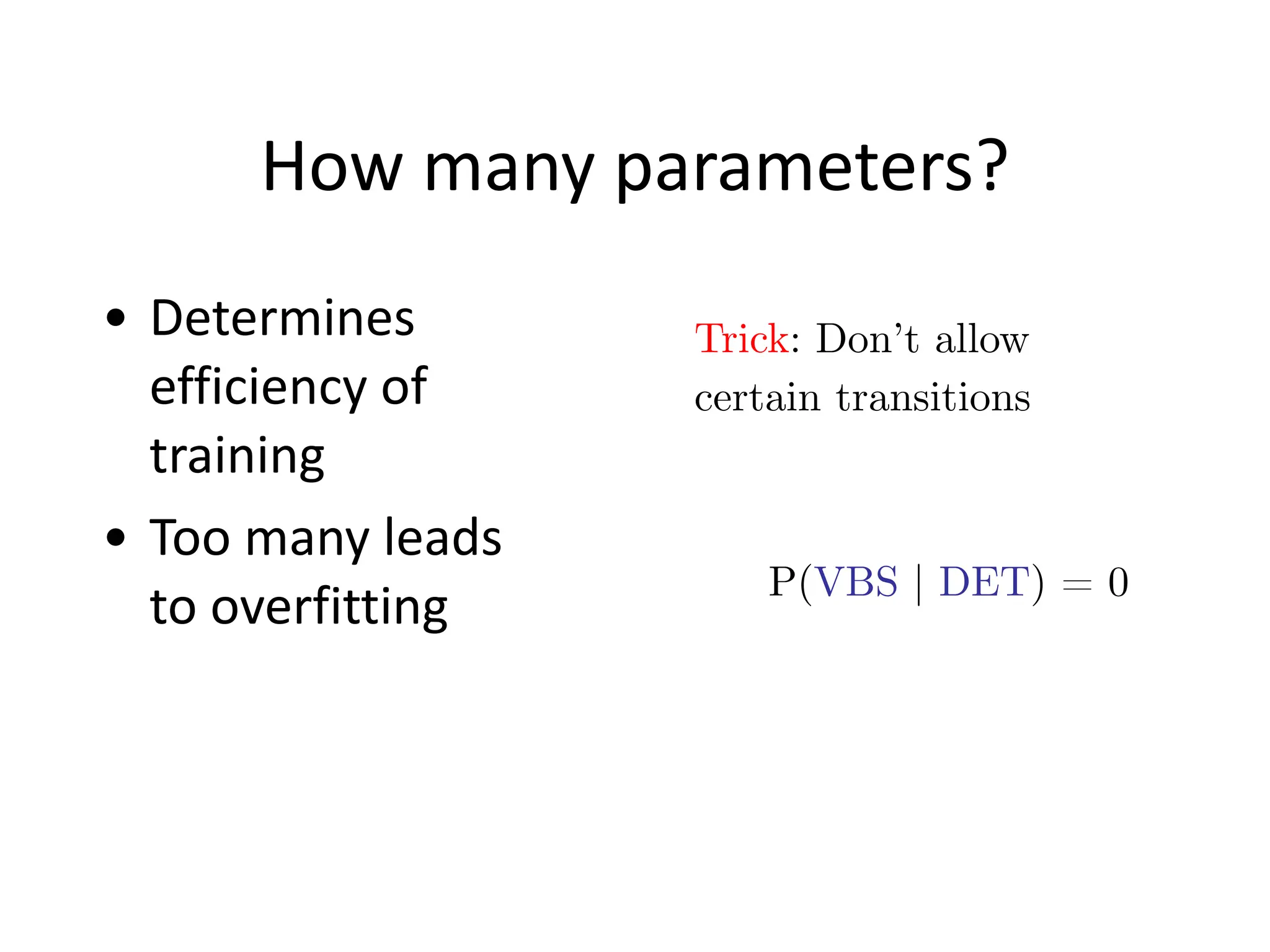
Trick: Don’t allow
certain transitions
P(VBS | DET) = 0
How	
  many	
  parameters?
• Determines	
  
efficiency	
  of	
  
training	
  
• Too	
  many	
  leads	
  
to	
  overfitting
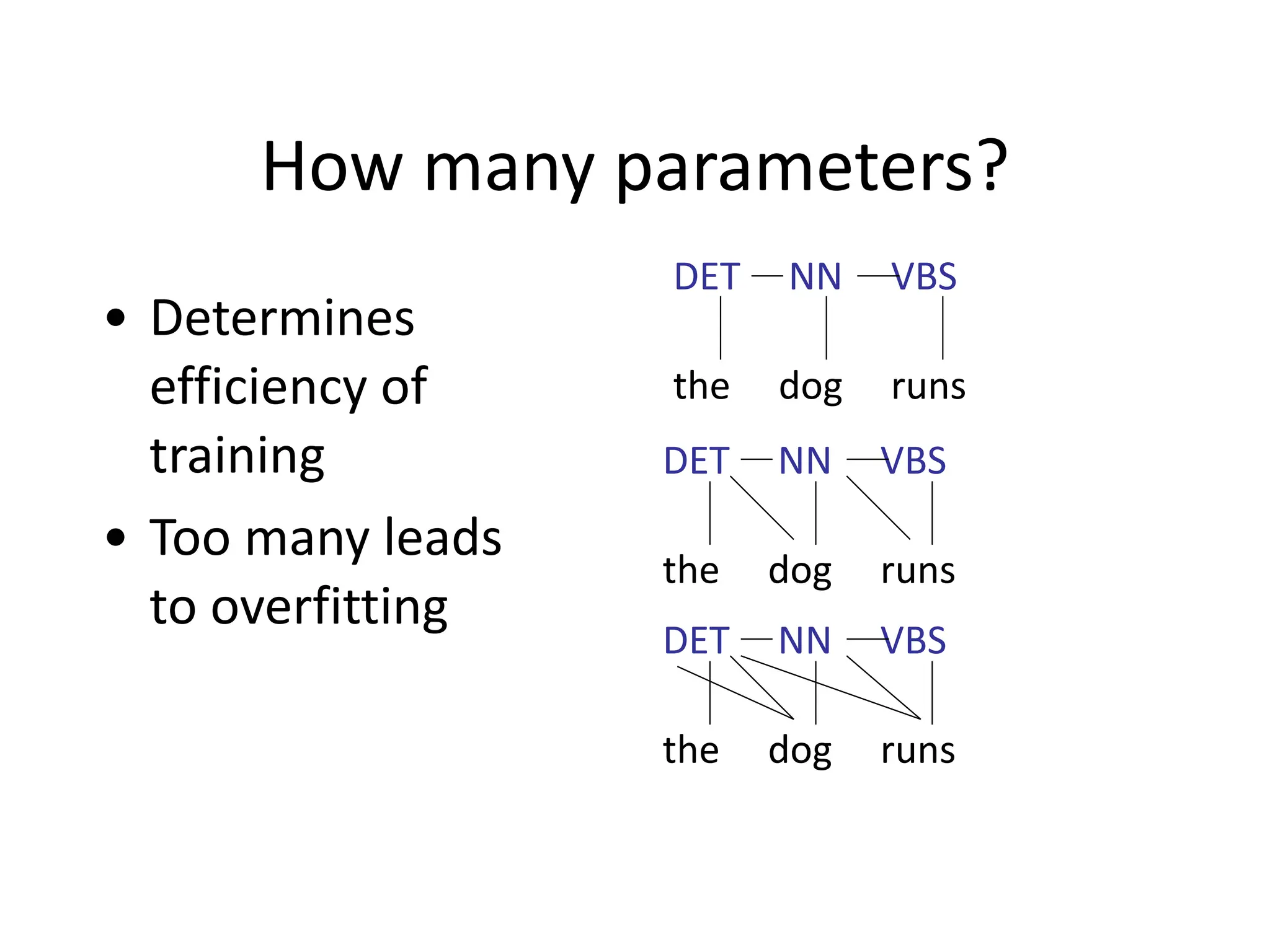
DET	


  NN	


  VBS
!
the	


  dog	


  runs
DET	


  NN	


  VBS
!
the	


  dog	


  runs
DET	


  NN	


  VBS
!
the	


  dog	


  runs
Finite	
  State	
  Transducers
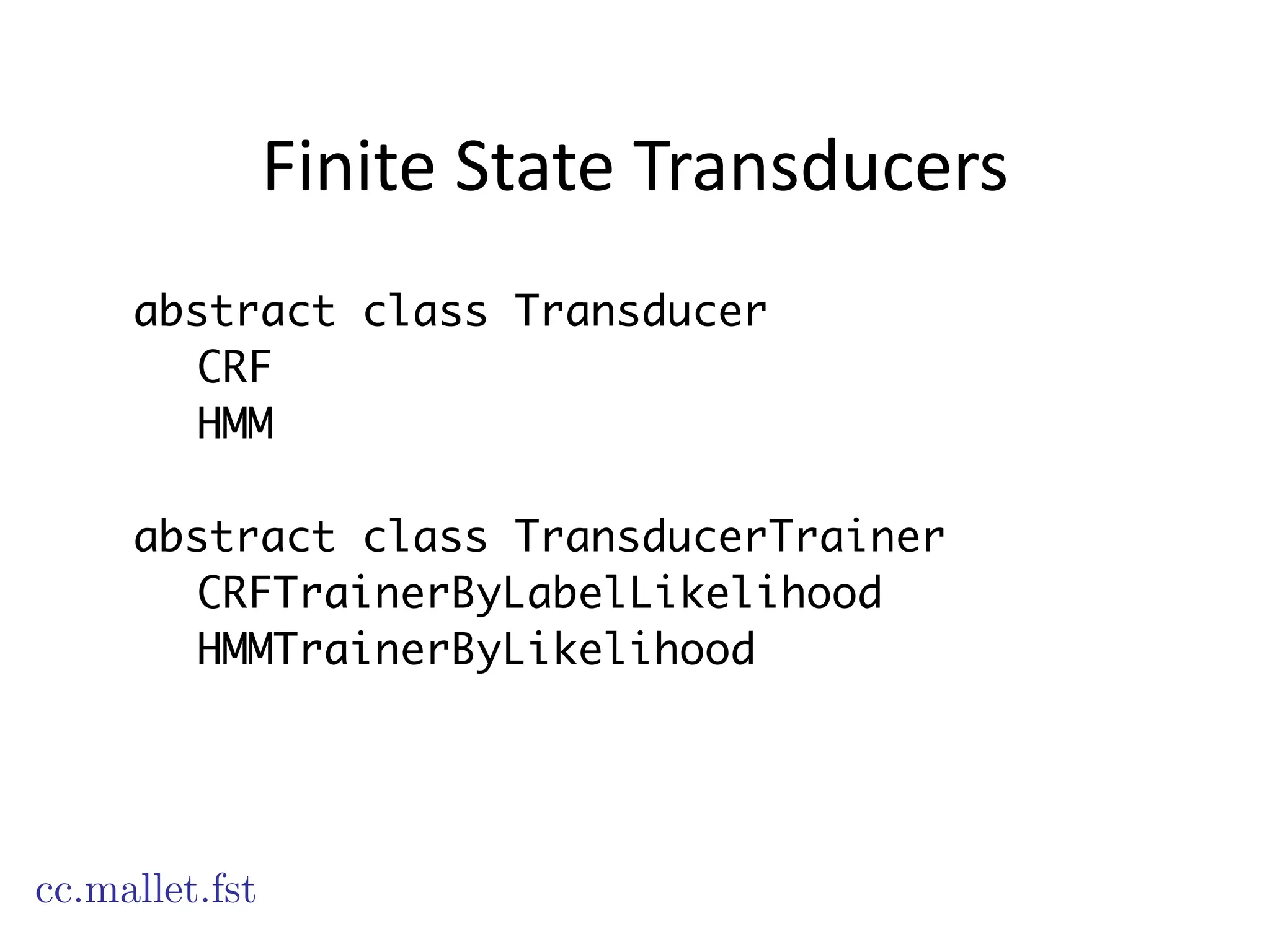
abstract class Transducer
CRF
HMM
!
abstract class TransducerTrainer
CRFTrainerByLabelLikelihood
HMMTrainerByLikelihood
cc.mallet.fst
Finite	
  State	
  Transducers
cc.mallet.fst
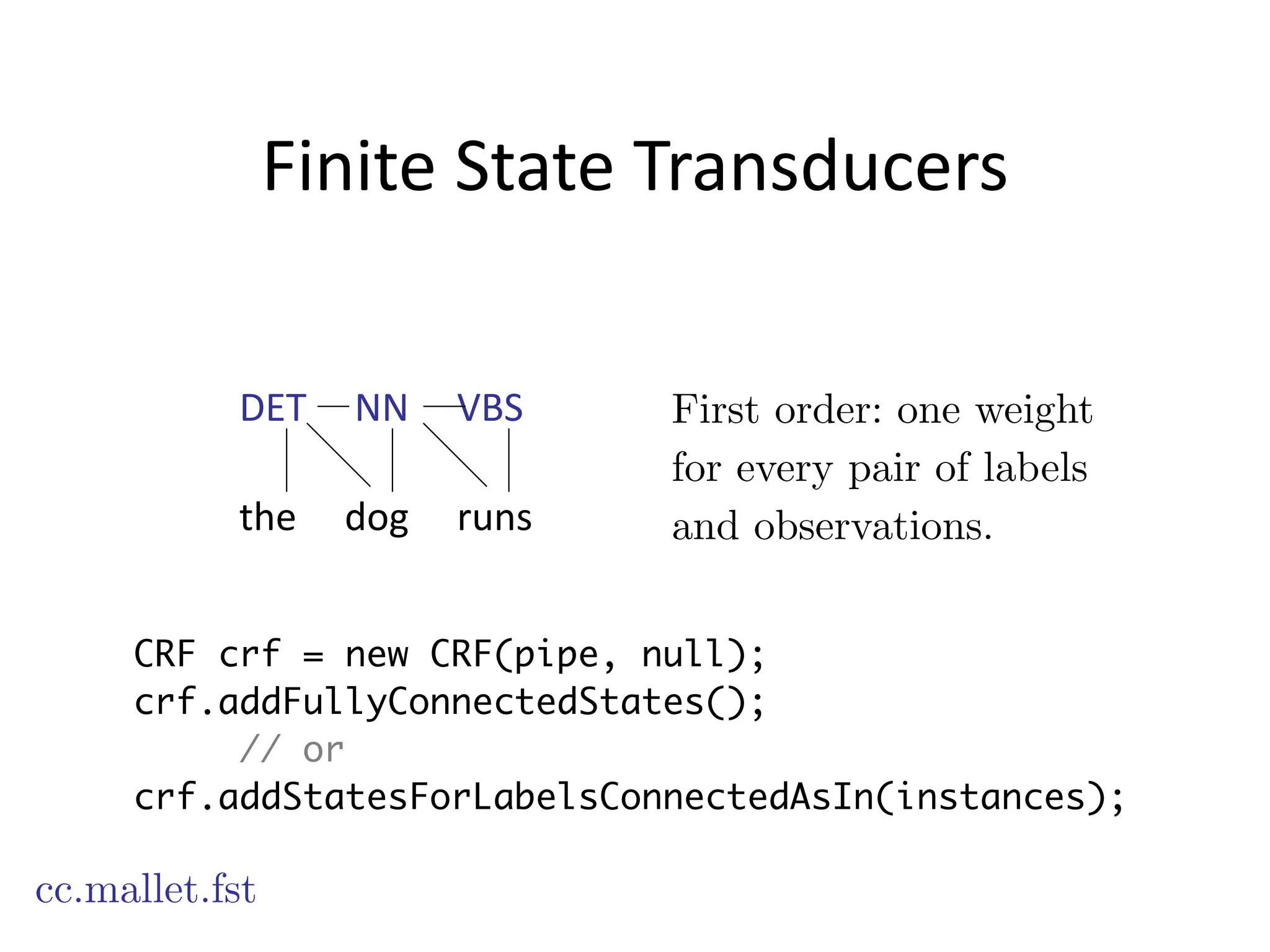
First order: one weight
for every pair of labels
and observations.
CRF crf = new CRF(pipe, null);
crf.addFullyConnectedStates();
// or
crf.addStatesForLabelsConnectedAsIn(instances);
DET	


  NN	


  VBS
!
the	


  dog	


  runs
Finite	
  State	
  Transducers
cc.mallet.fst
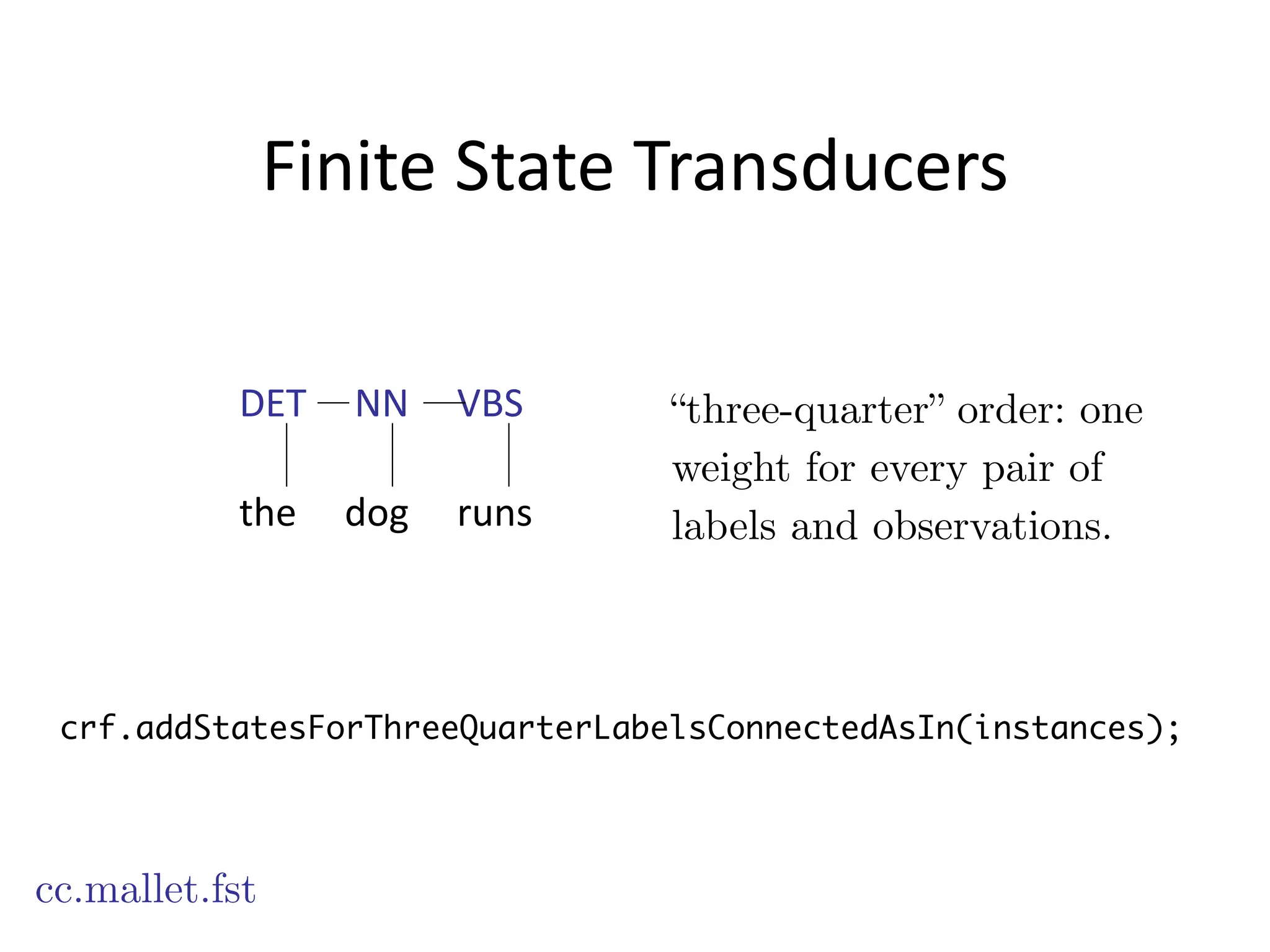
“three-quarter” order: one
weight for every pair of
labels and observations.
crf.addStatesForThreeQuarterLabelsConnectedAsIn(instances);
DET	


  NN	


  VBS
!
the	


  dog	


  runs
Finite	
  State	
  Transducers
cc.mallet.fst
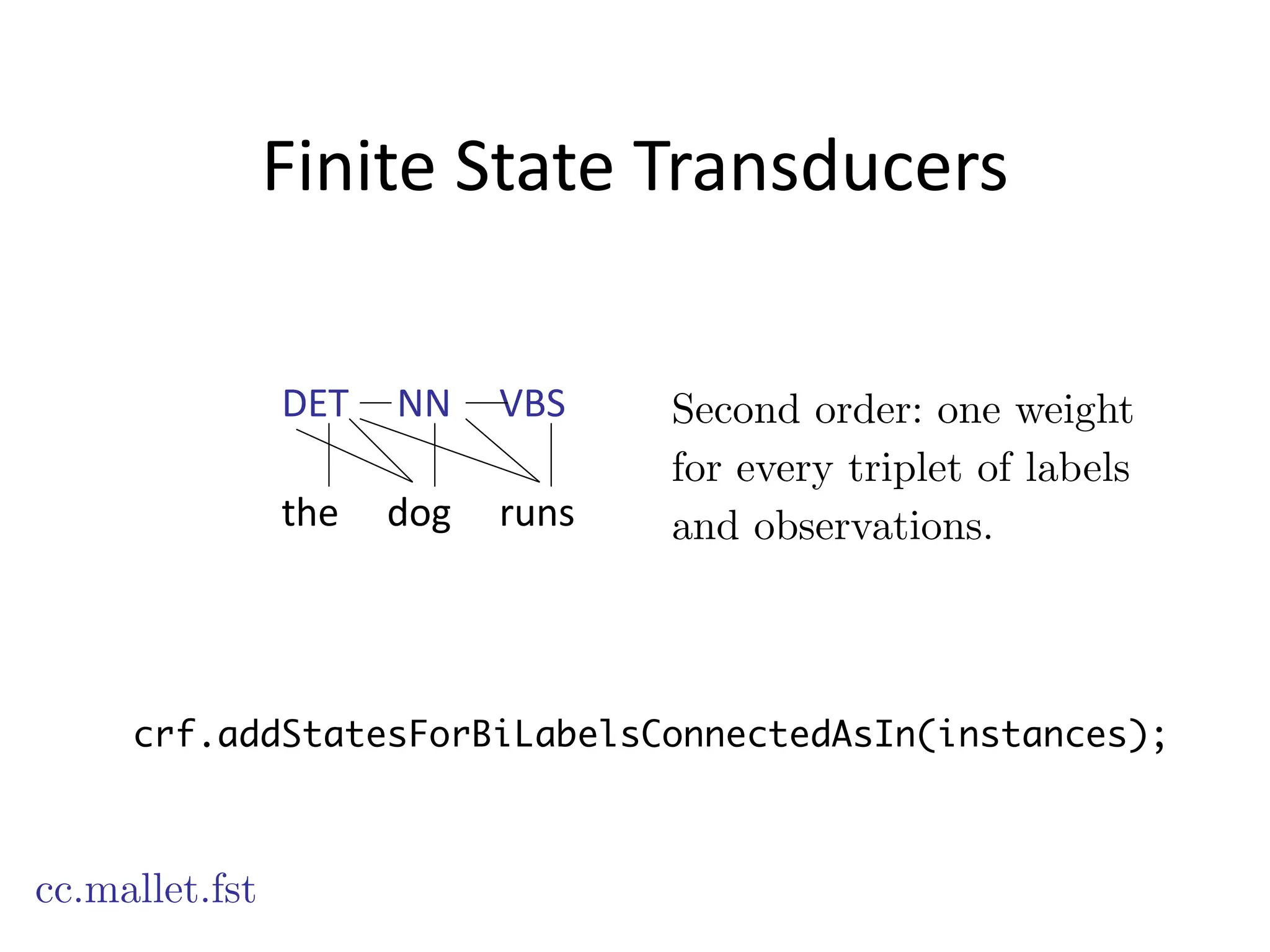
Second order: one weight
for every triplet of labels
and observations.
crf.addStatesForBiLabelsConnectedAsIn(instances);
DET	


  NN	


  VBS
!
the	


  dog	


  runs
Finite	
  State	
  Transducers
cc.mallet.fst
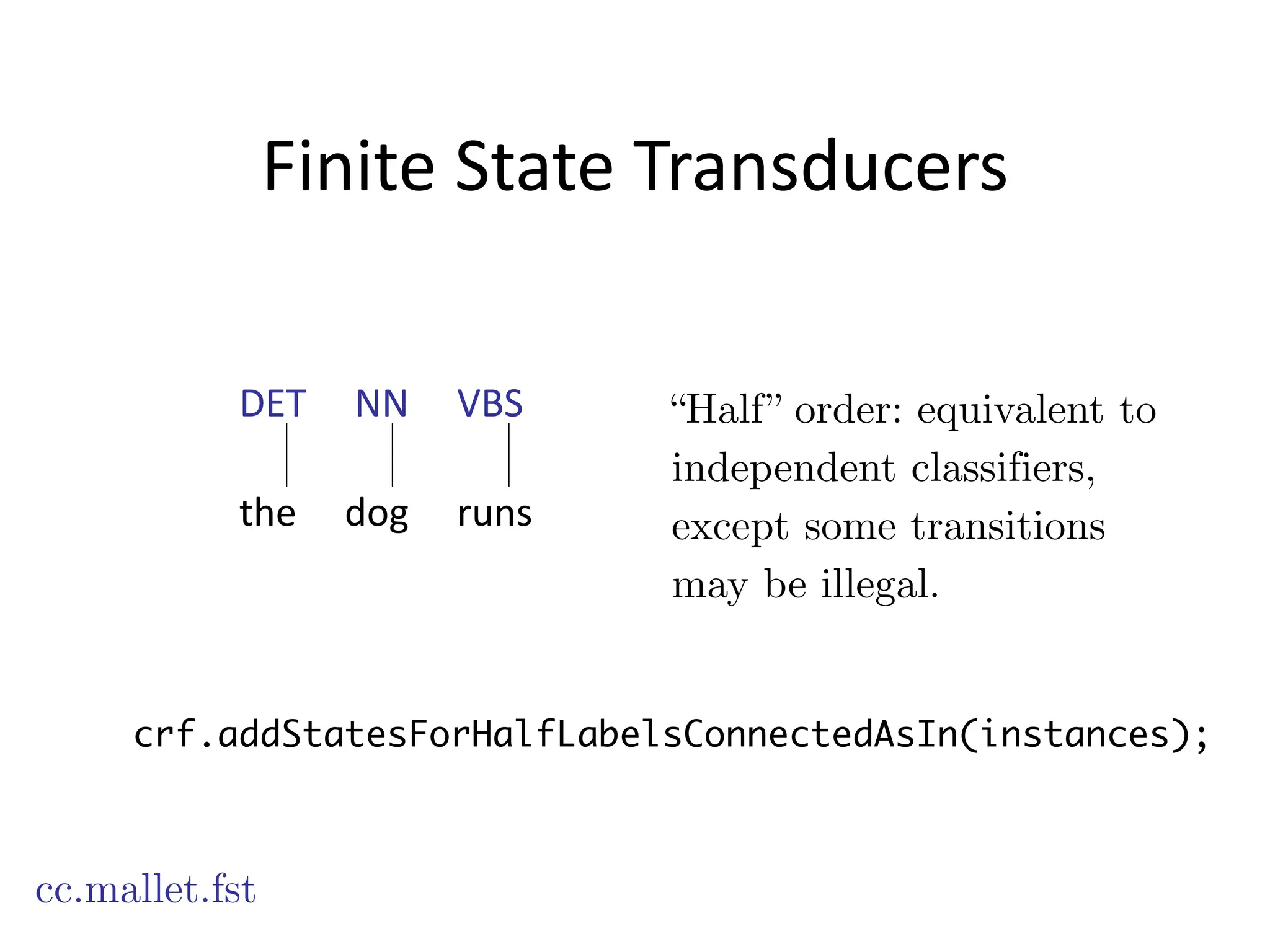
“Half” order: equivalent to
independent classifiers,
except some transitions
may be illegal.
crf.addStatesForHalfLabelsConnectedAsIn(instances);
DET	


  NN	


  VBS
!
the	


  dog	


  runs
Training	
  a	
  transducer
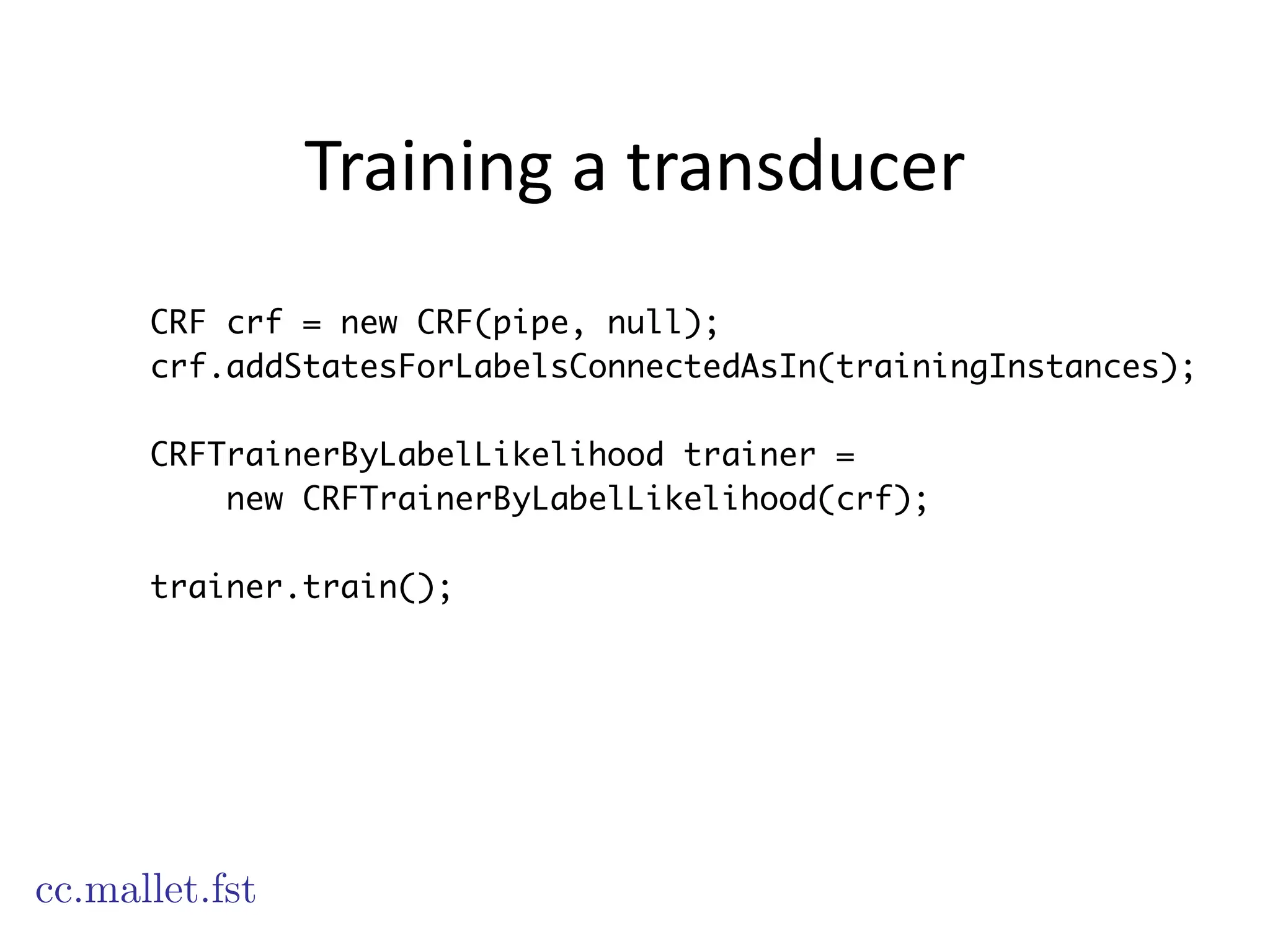
CRF crf = new CRF(pipe, null);
crf.addStatesForLabelsConnectedAsIn(trainingInstances);
CRFTrainerByLabelLikelihood trainer =
new CRFTrainerByLabelLikelihood(crf);
!
trainer.train();
cc.mallet.fst
Evaluating	
  a	
  transducer
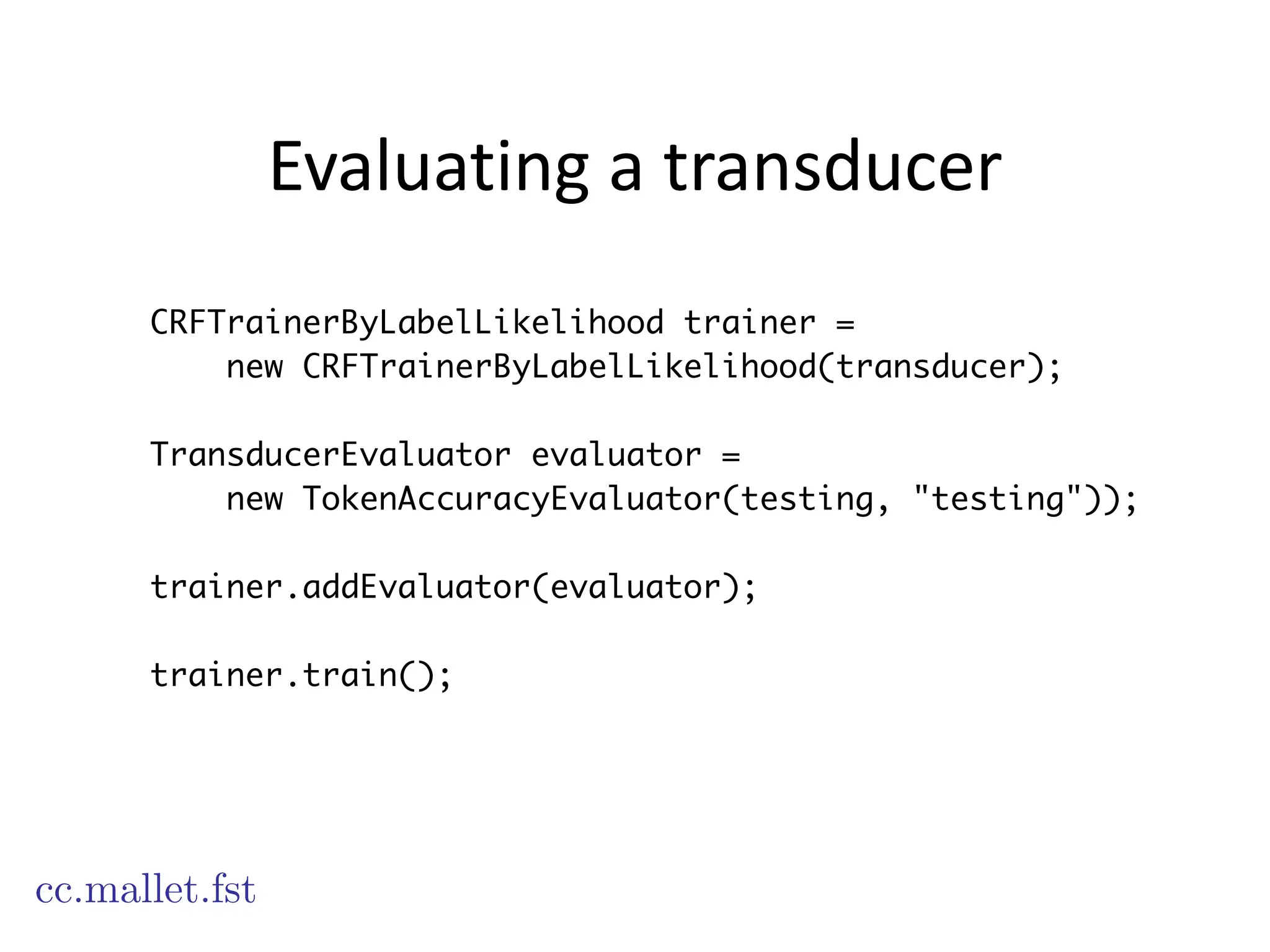
CRFTrainerByLabelLikelihood trainer =
new CRFTrainerByLabelLikelihood(transducer);
!
TransducerEvaluator evaluator =
new TokenAccuracyEvaluator(testing, "testing"));
!
trainer.addEvaluator(evaluator);
!
trainer.train();
cc.mallet.fst
Applying	
  a	
  transducer
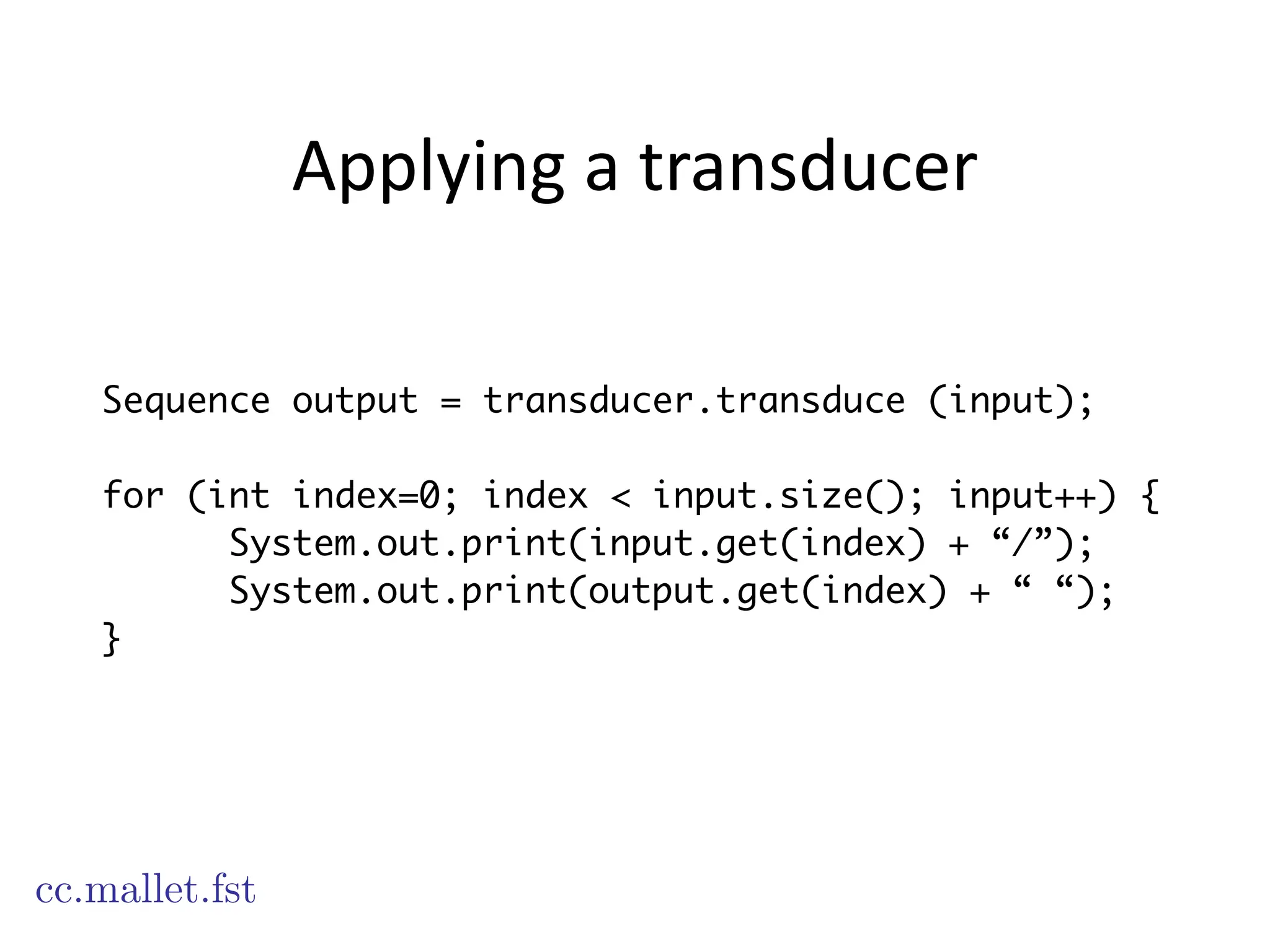
Sequence output = transducer.transduce (input);
!
for (int index=0; index < input.size(); input++) {
System.out.print(input.get(index) + “/”);
System.out.print(output.get(index) + “ “);
}
cc.mallet.fst
Review
• How	
  do	
  you	
  add	
  new	
  features	
  to	
  
TokenSequences?
Review
• How	
  do	
  you	
  add	
  new	
  features	
  to	
  
TokenSequences?	
  
• What	
  are	
  three	
  factors	
  that	
  affect	
  the	
  
number	
  of	
  parameters	
  in	
  a	
  model?
Outline
• About	
  MALLET	
  
• Representing	
  Data	
  
• Classification	
  
• Sequence	
  Tagging	
  
• Topic	
  Modeling
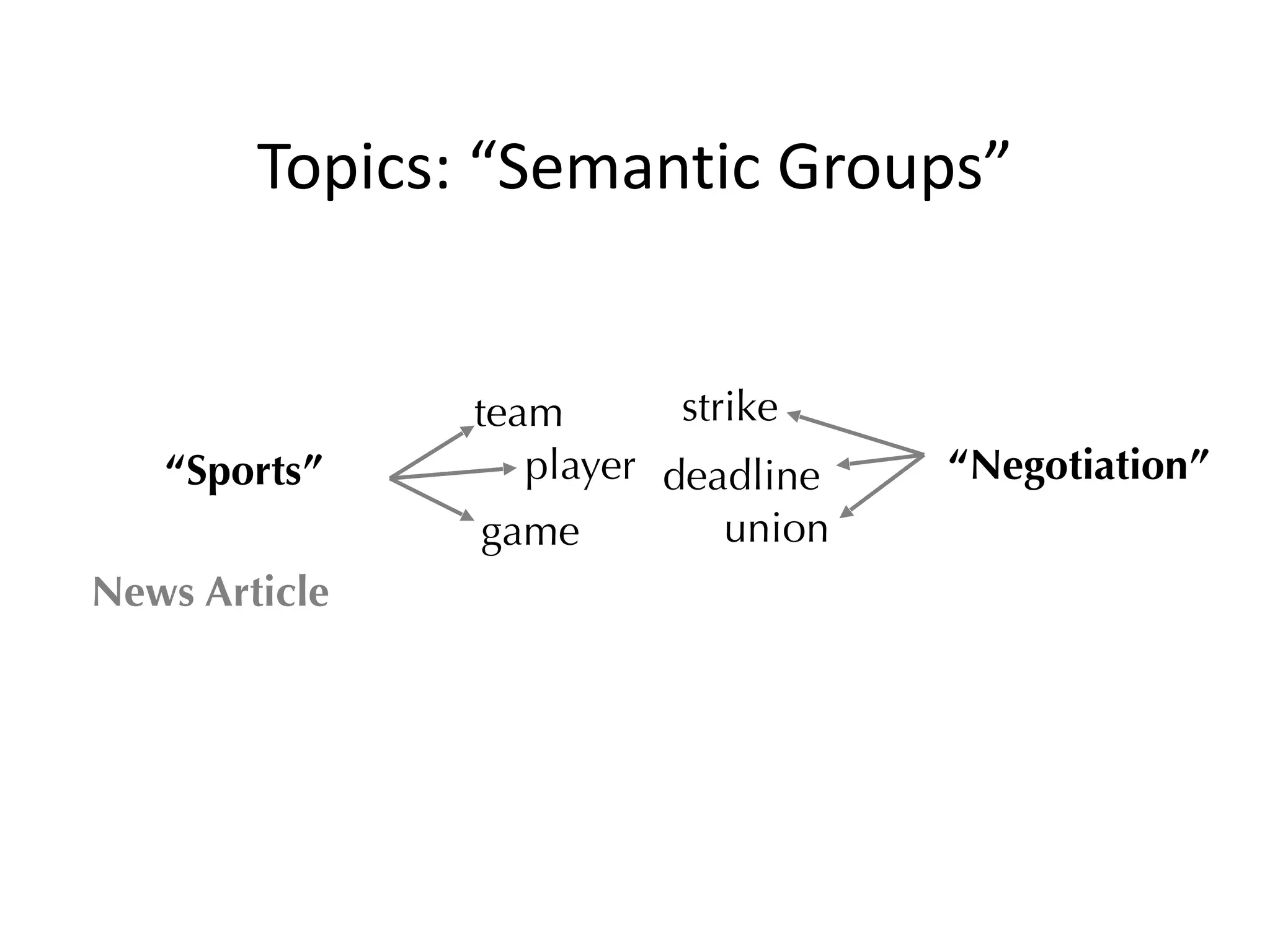
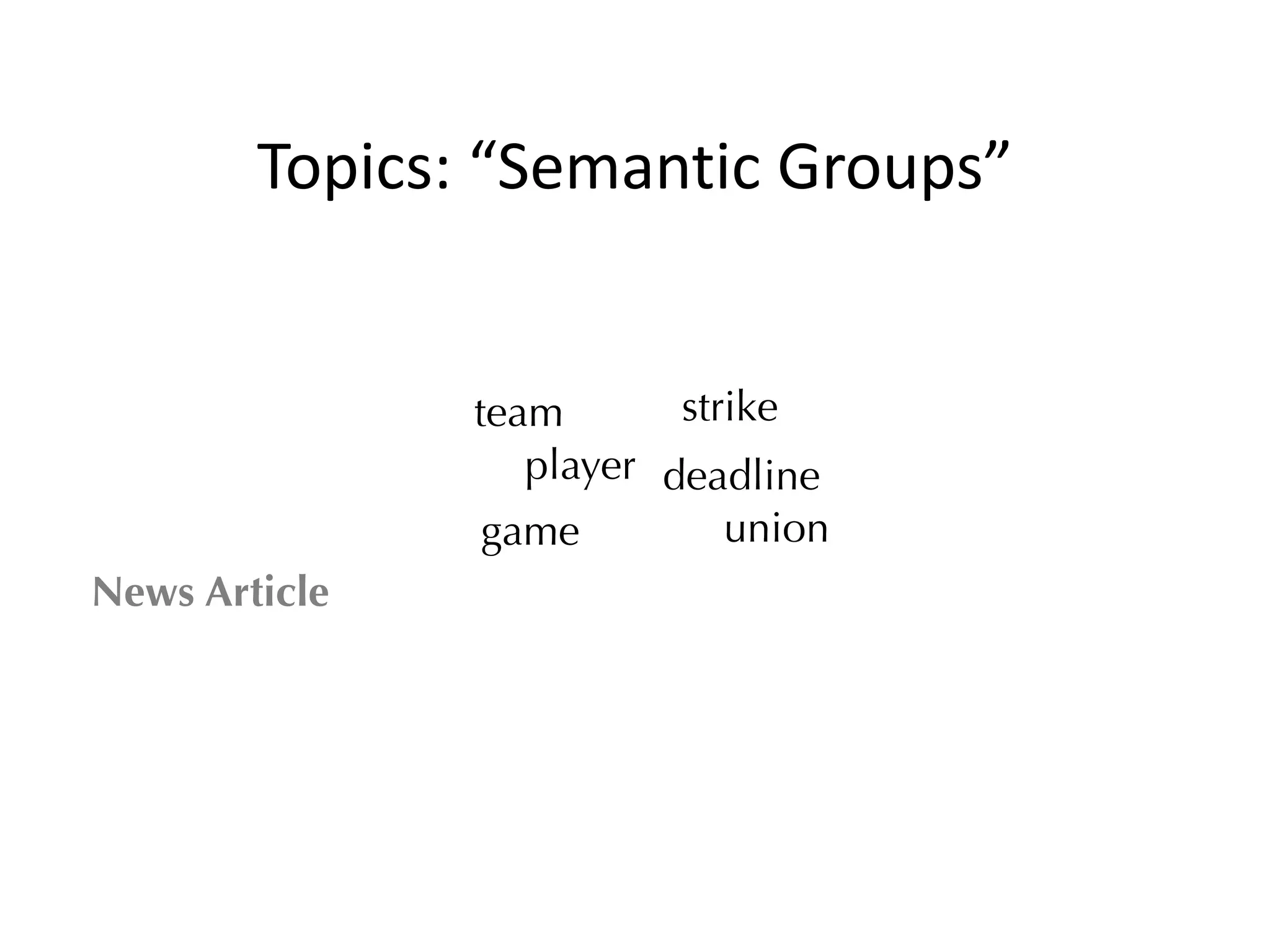
Topics:	
  “Semantic	
  Groups”
News Article
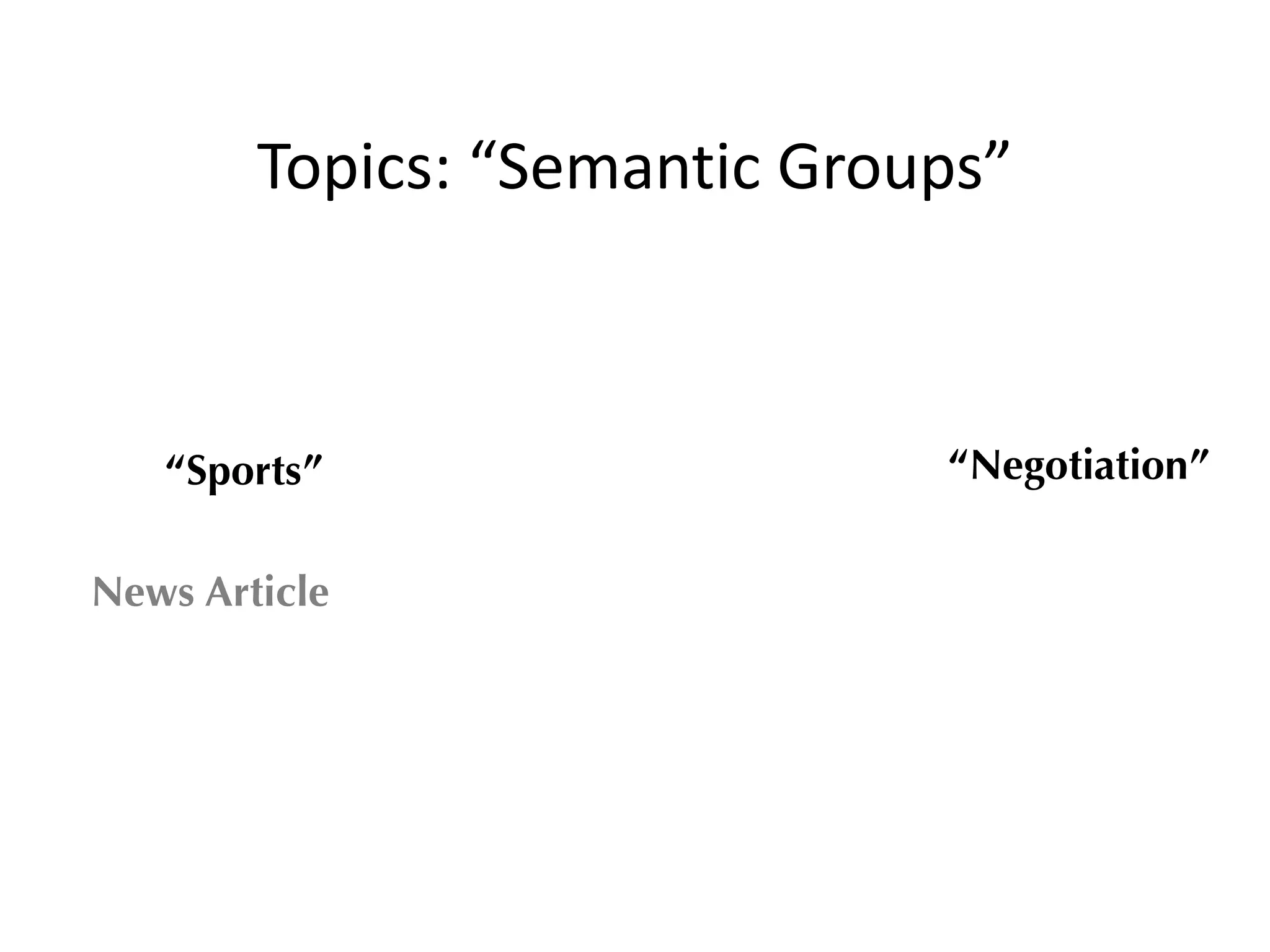
Topics:	
  “Semantic	
  Groups”
“Sports” “Negotiation”
News Article
Topics:	
  “Semantic	
  Groups”
“Sports” “Negotiation”
News Article
team
player
game
strike
deadline
union
Topics:	
  “Semantic	
  Groups”
News Article
team
player
game
strike
deadline
union
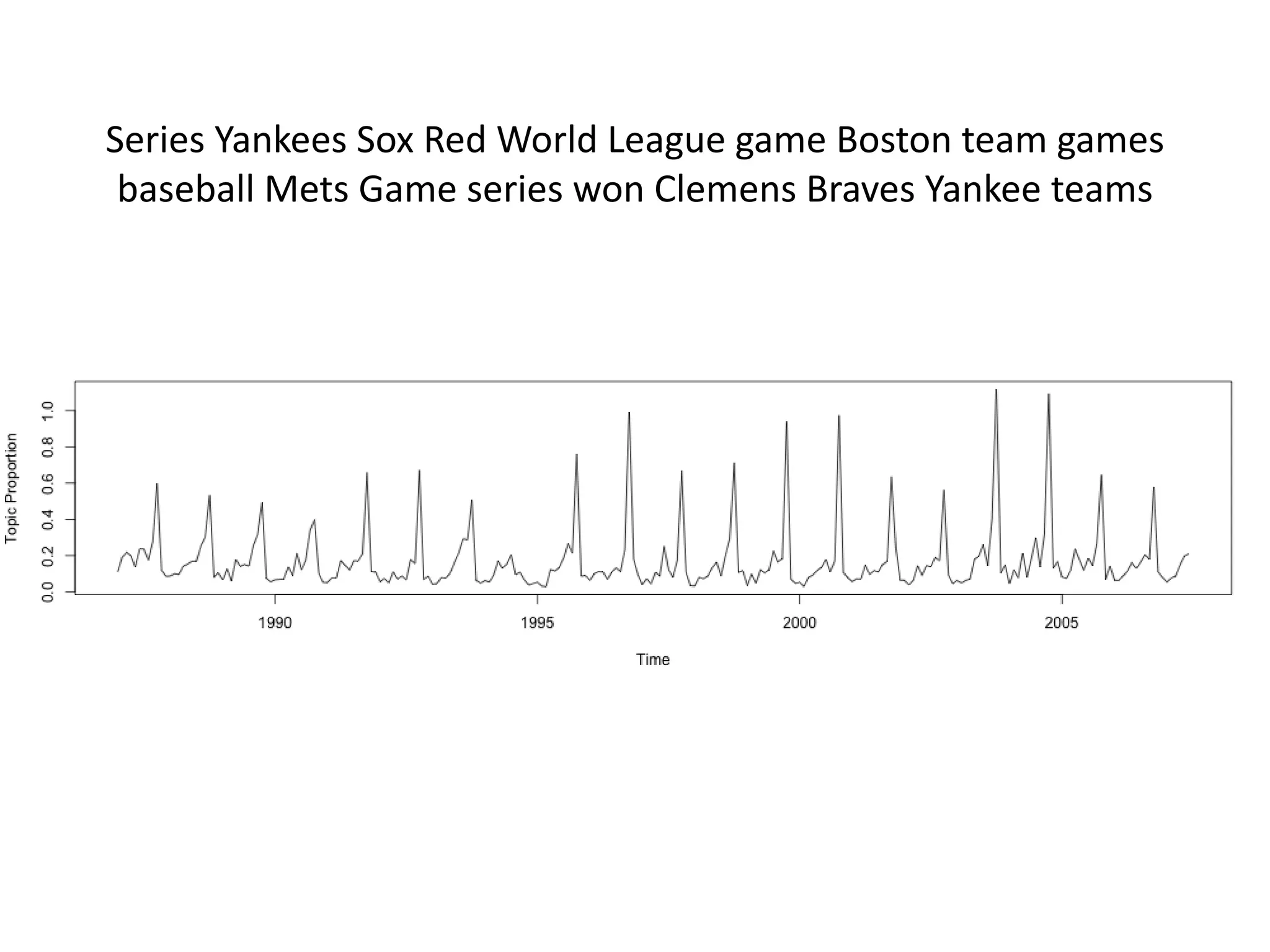
Series	
  Yankees	
  Sox	
  Red	
  World	
  League	
  game	
  Boston	
  team	
  games	
  
baseball	
  Mets	
  Game	
  series	
  won	
  Clemens	
  Braves	
  Yankee	
  teams
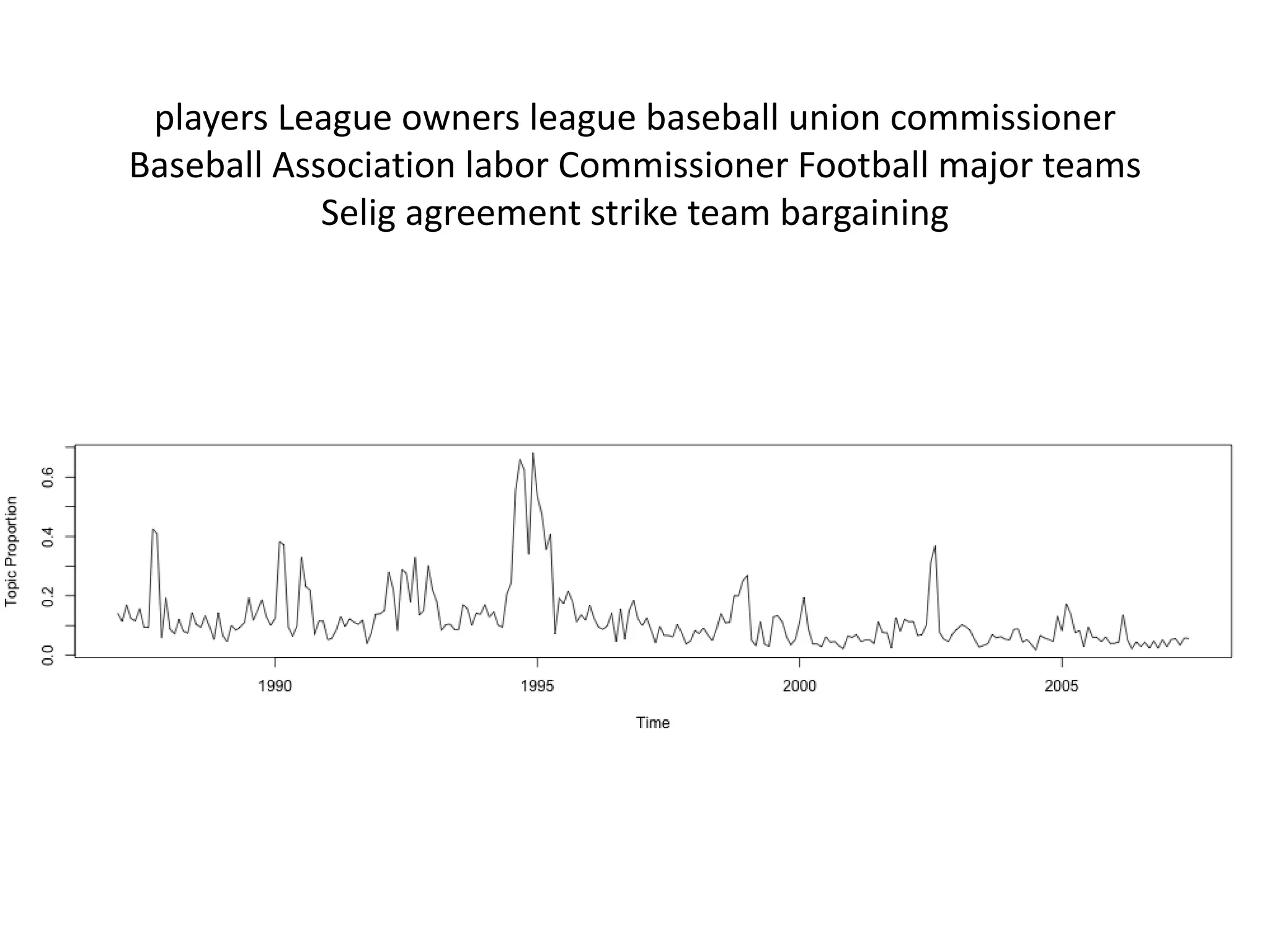
players	
  League	
  owners	
  league	
  baseball	
  union	
  commissioner	
  
Baseball	
  Association	
  labor	
  Commissioner	
  Football	
  major	
  teams	
  
Selig	
  agreement	
  strike	
  team	
  bargaining
Training	
  a	
  Topic	
  Model
cc.mallet.topics
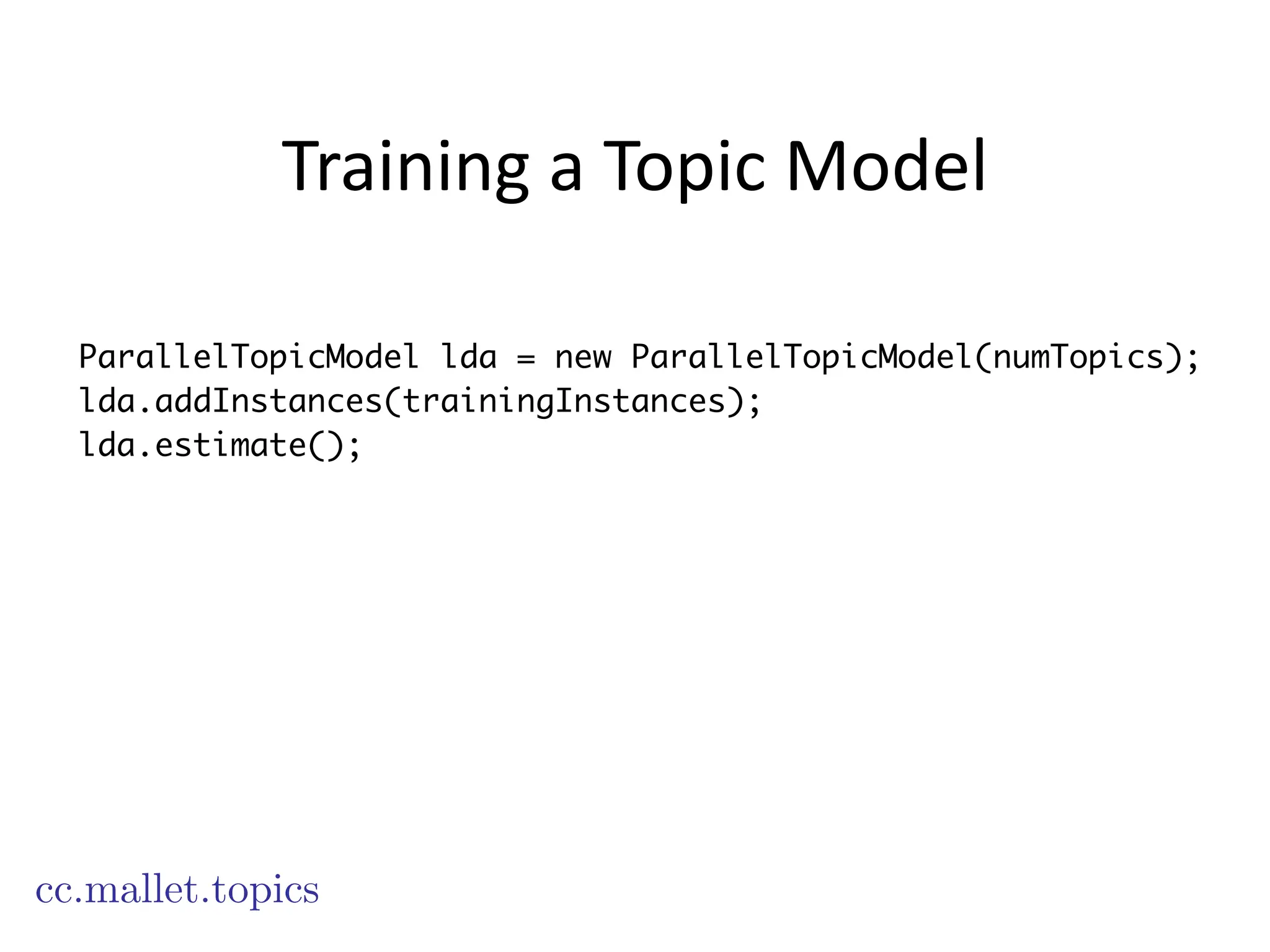
ParallelTopicModel lda = new ParallelTopicModel(numTopics);
lda.addInstances(trainingInstances);
lda.estimate();
Evaluating	
  a	
  Topic	
  Model
cc.mallet.topics
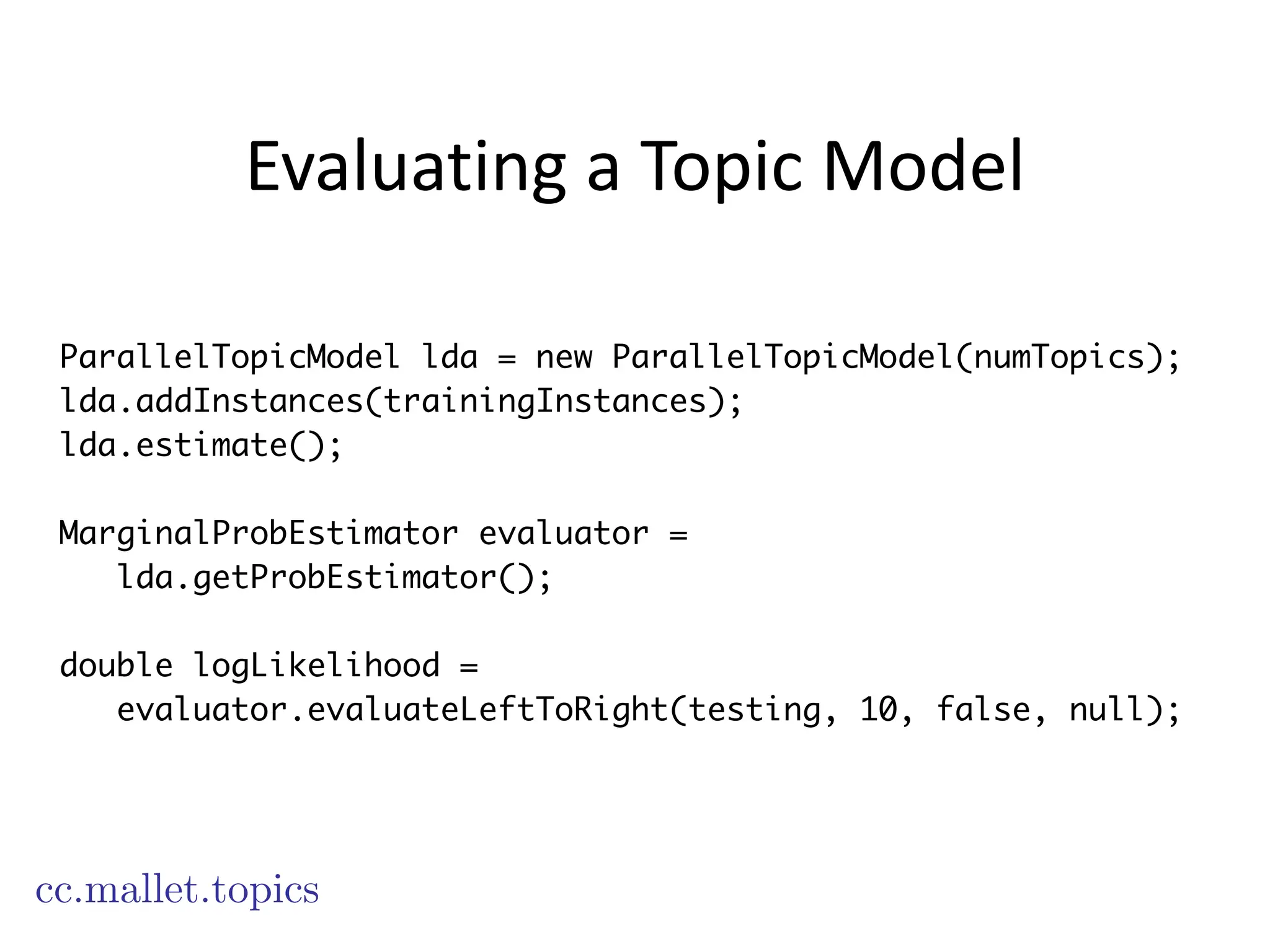
ParallelTopicModel lda = new ParallelTopicModel(numTopics);
lda.addInstances(trainingInstances);
lda.estimate();
!
MarginalProbEstimator evaluator =
lda.getProbEstimator();
!
double logLikelihood =
evaluator.evaluateLeftToRight(testing, 10, false, null);
Inferring	
  topics	
  for	
  new	
  documents
cc.mallet.topics
ParallelTopicModel lda = new ParallelTopicModel(numTopics);
lda.addInstances(trainingInstances);
lda.estimate();
!
TopicInferencer inferencer =
lda.getInferencer();
!
double[] topicProbs =
inferencer.getSampledDistribution(instance, 100,
10, 10);
More	
  than	
  words…
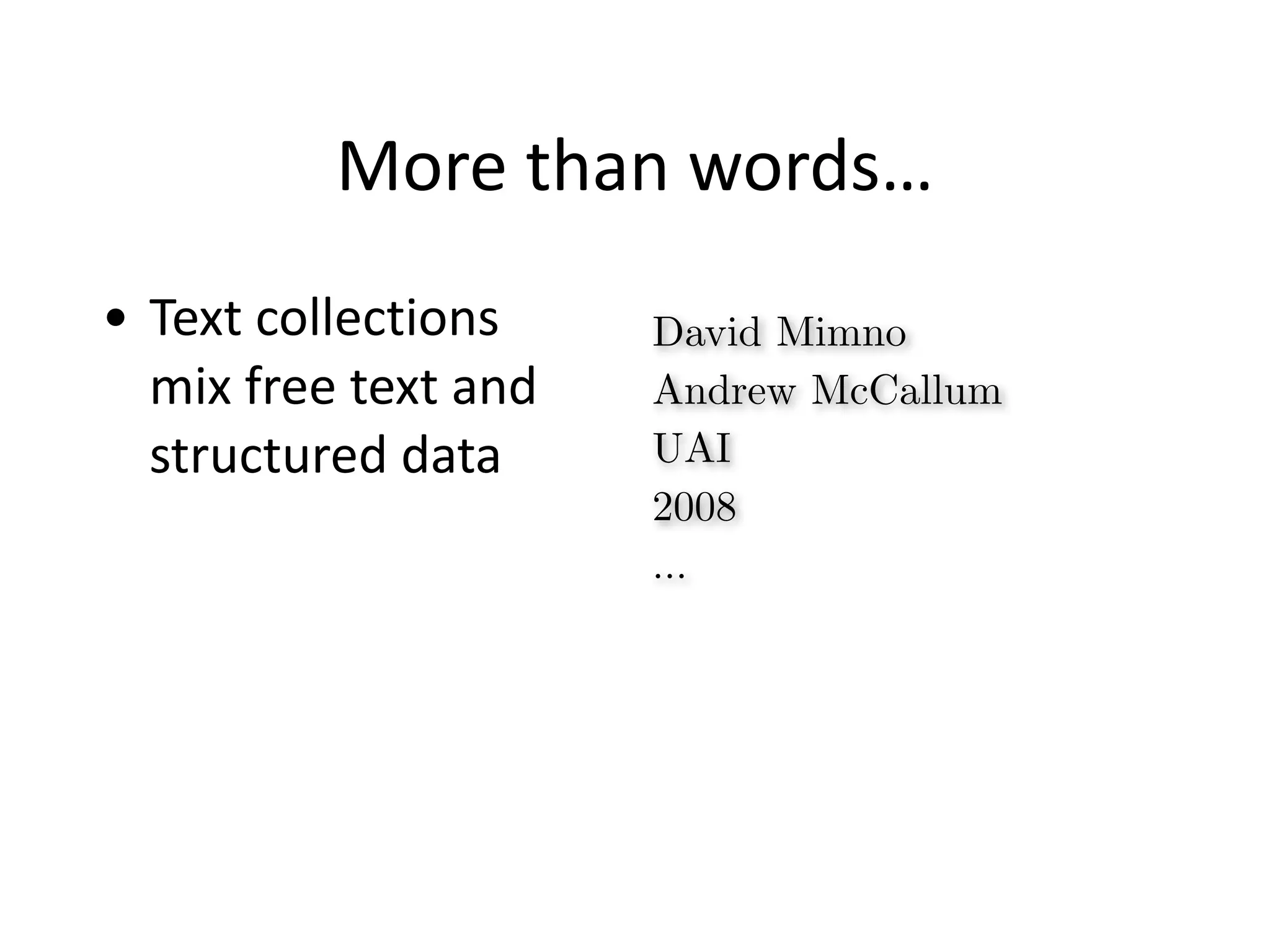
• Text	
  collections	
  
mix	
  free	
  text	
  and	
  
structured	
  data
David Mimno
Andrew McCallum
UAI
2008
…
More	
  than	
  words…
• Text	
  collections	
  
mix	
  free	
  text	
  and	
  
structured	
  data
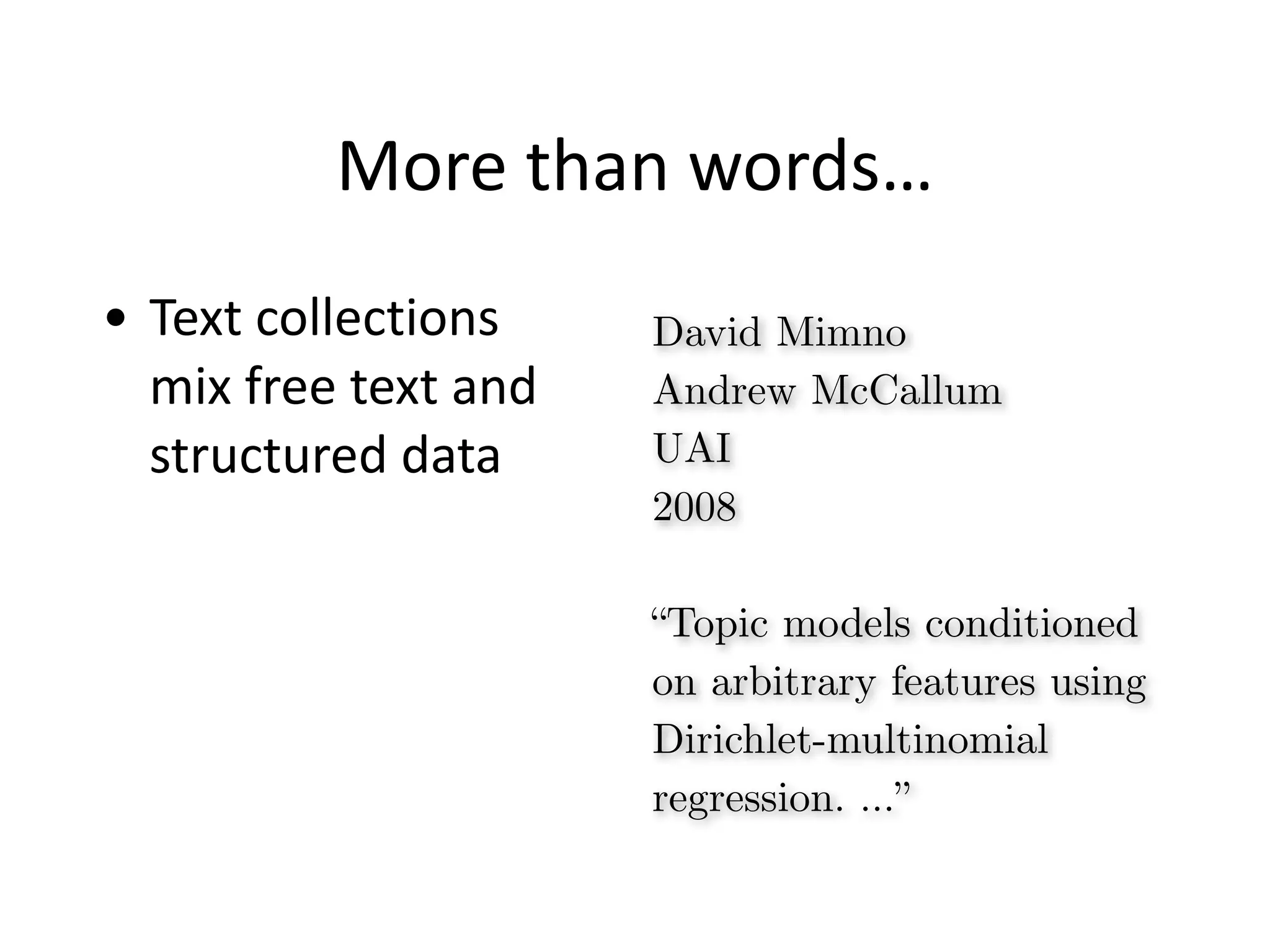
David Mimno
Andrew McCallum
UAI
2008
!
“Topic models conditioned
on arbitrary features using
Dirichlet-multinomial
regression. …”
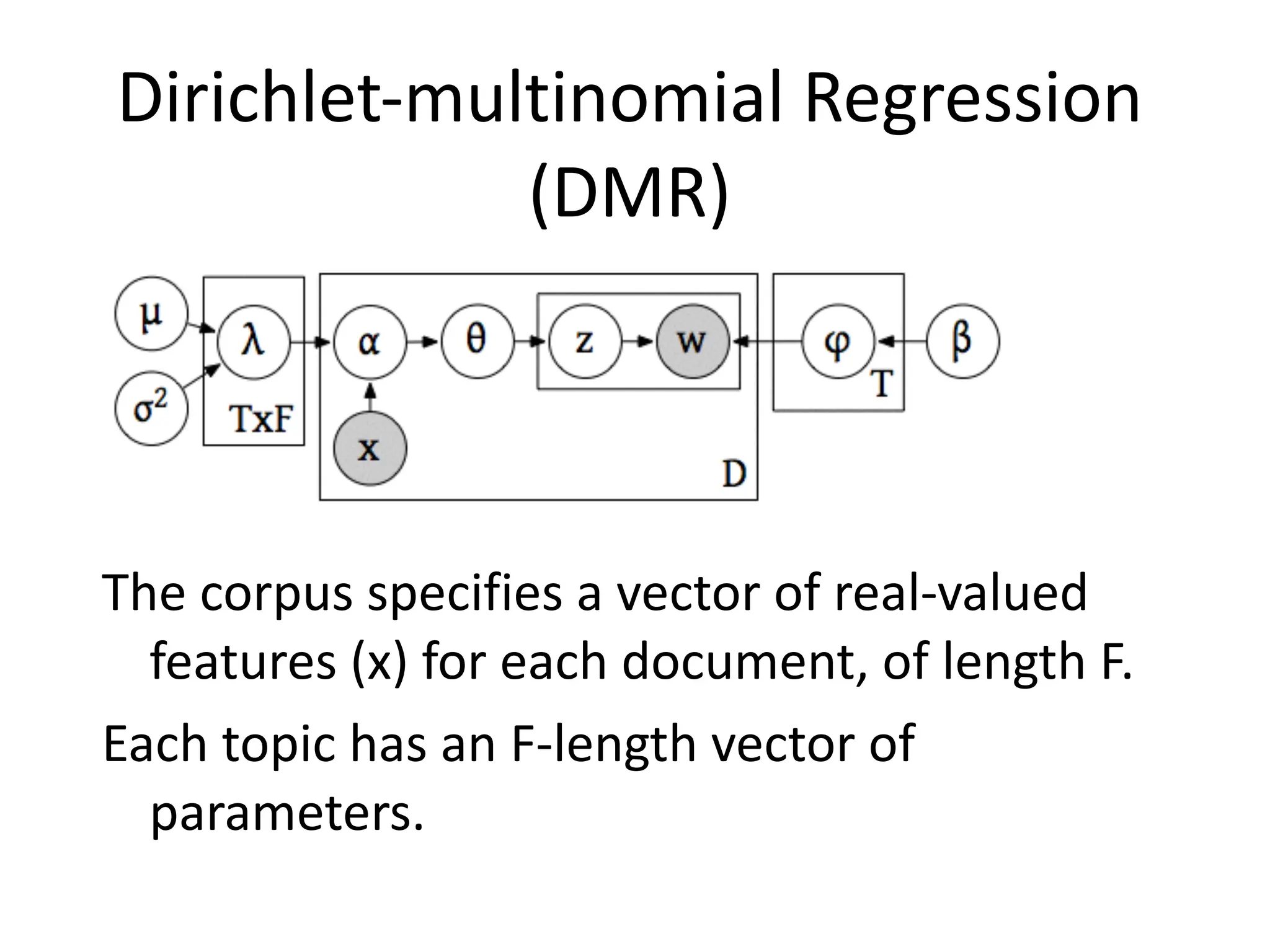
Dirichlet-­‐multinomial	
  Regression	
  
(DMR)
The	
  corpus	
  specifies	
  a	
  vector	
  of	
  real-­‐valued	
  
features	
  (x)	
  for	
  each	
  document,	
  of	
  length	
  F.	
  
Each	
  topic	
  has	
  an	
  F-­‐length	
  vector	
  of	
  
parameters.
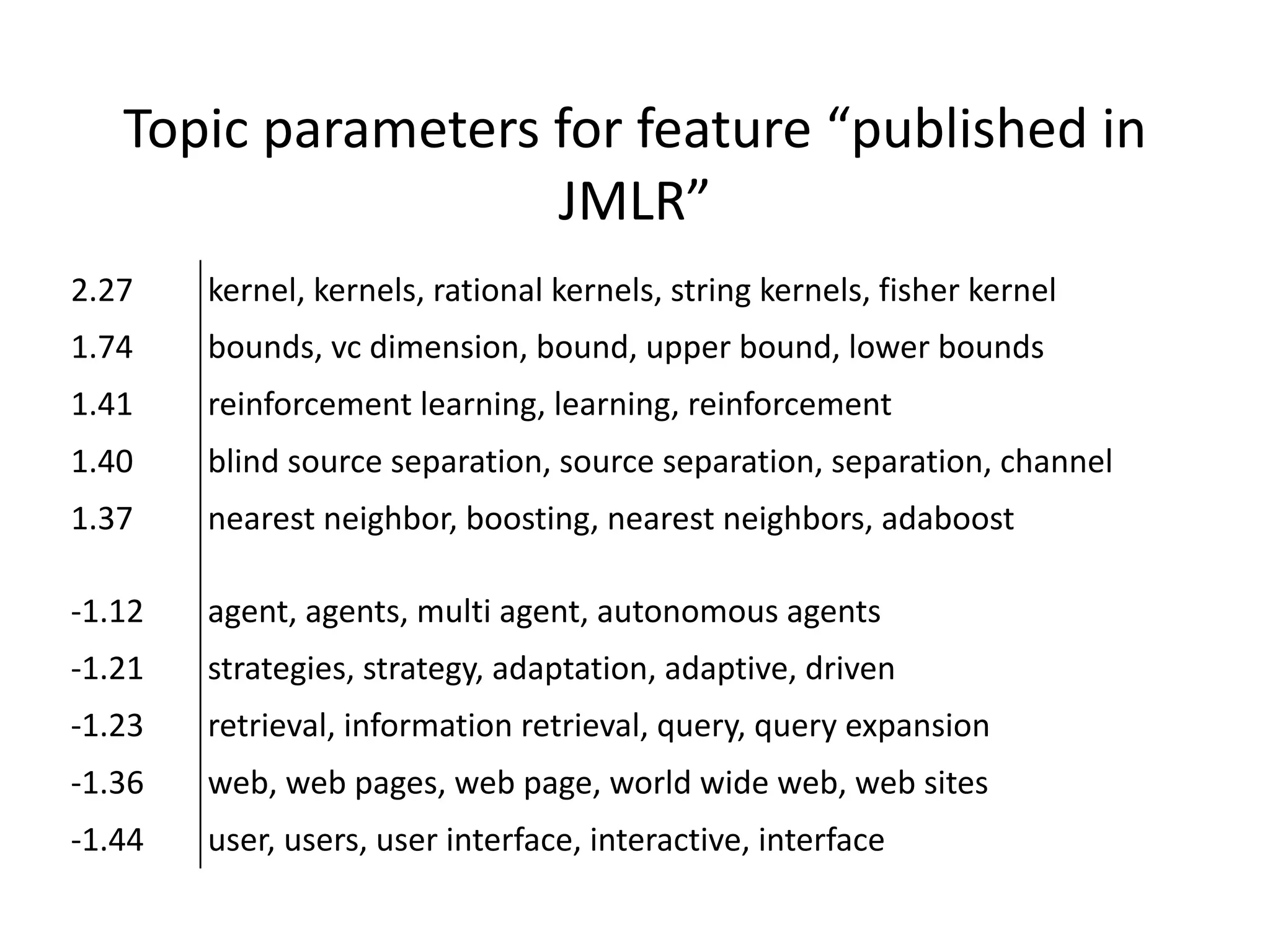
Topic	
  parameters	
  for	
  feature	
  “published	
  in	
  
JMLR”
2.27 kernel,	
  kernels,	
  rational	
  kernels,	
  string	
  kernels,	
  fisher	
  kernel
1.74 bounds,	
  vc	
  dimension,	
  bound,	
  upper	
  bound,	
  lower	
  bounds
1.41 reinforcement	
  learning,	
  learning,	
  reinforcement
1.40 blind	
  source	
  separation,	
  source	
  separation,	
  separation,	
  channel
1.37 nearest	
  neighbor,	
  boosting,	
  nearest	
  neighbors,	
  adaboost
-­‐1.12 agent,	
  agents,	
  multi	
  agent,	
  autonomous	
  agents
-­‐1.21 strategies,	
  strategy,	
  adaptation,	
  adaptive,	
  driven
-­‐1.23 retrieval,	
  information	
  retrieval,	
  query,	
  query	
  expansion
-­‐1.36 web,	
  web	
  pages,	
  web	
  page,	
  world	
  wide	
  web,	
  web	
  sites
-­‐1.44 user,	
  users,	
  user	
  interface,	
  interactive,	
  interface
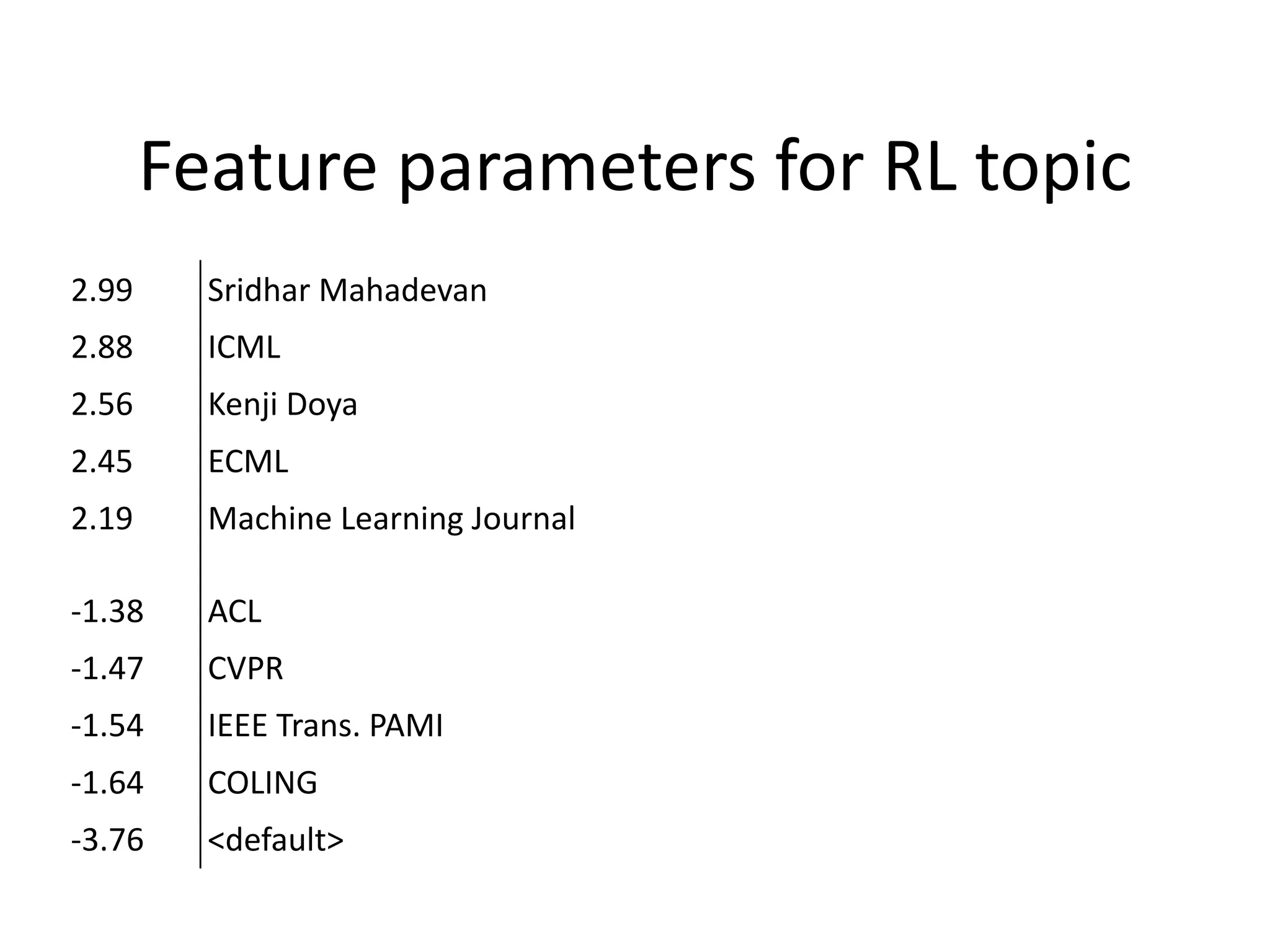
Feature	
  parameters	
  for	
  RL	
  topic
2.99 Sridhar	
  Mahadevan
2.88 ICML
2.56 Kenji	
  Doya
2.45 ECML
2.19 Machine	
  Learning	
  Journal
-­‐1.38 ACL
-­‐1.47 CVPR
-­‐1.54 IEEE	
  Trans.	
  PAMI
-­‐1.64 COLING
-­‐3.76 <default>
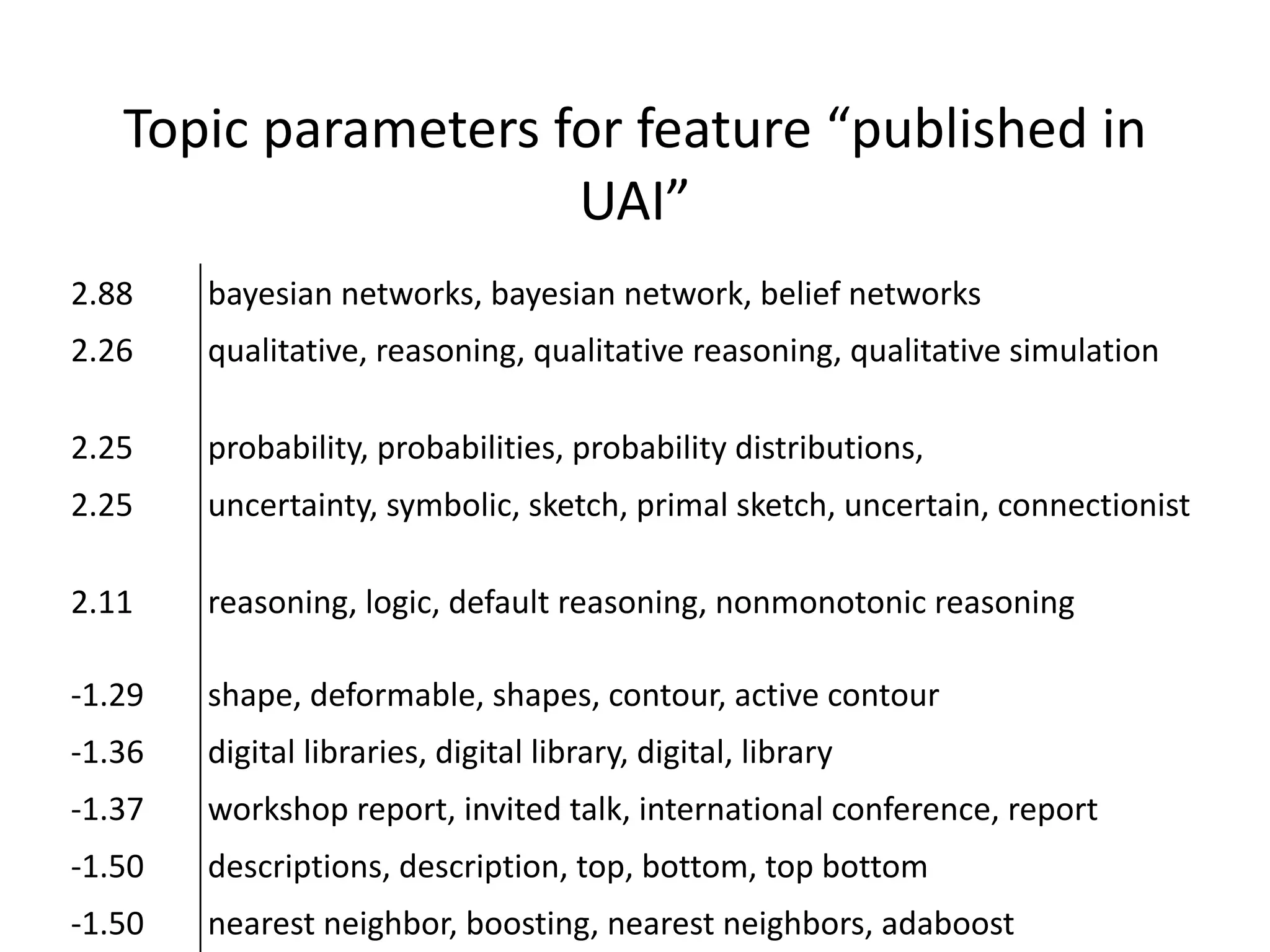
Topic	
  parameters	
  for	
  feature	
  “published	
  in	
  
UAI”
2.88 bayesian	
  networks,	
  bayesian	
  network,	
  belief	
  networks
2.26 qualitative,	
  reasoning,	
  qualitative	
  reasoning,	
  qualitative	
  simulation
2.25 probability,	
  probabilities,	
  probability	
  distributions,
2.25 uncertainty,	
  symbolic,	
  sketch,	
  primal	
  sketch,	
  uncertain,	
  connectionist
2.11 reasoning,	
  logic,	
  default	
  reasoning,	
  nonmonotonic	
  reasoning
-­‐1.29 shape,	
  deformable,	
  shapes,	
  contour,	
  active	
  contour
-­‐1.36 digital	
  libraries,	
  digital	
  library,	
  digital,	
  library
-­‐1.37 workshop	
  report,	
  invited	
  talk,	
  international	
  conference,	
  report
-­‐1.50 descriptions,	
  description,	
  top,	
  bottom,	
  top	
  bottom
-­‐1.50 nearest	
  neighbor,	
  boosting,	
  nearest	
  neighbors,	
  adaboost
Feature	
  parameters	
  for	
  Bayes	
  nets	
  topic
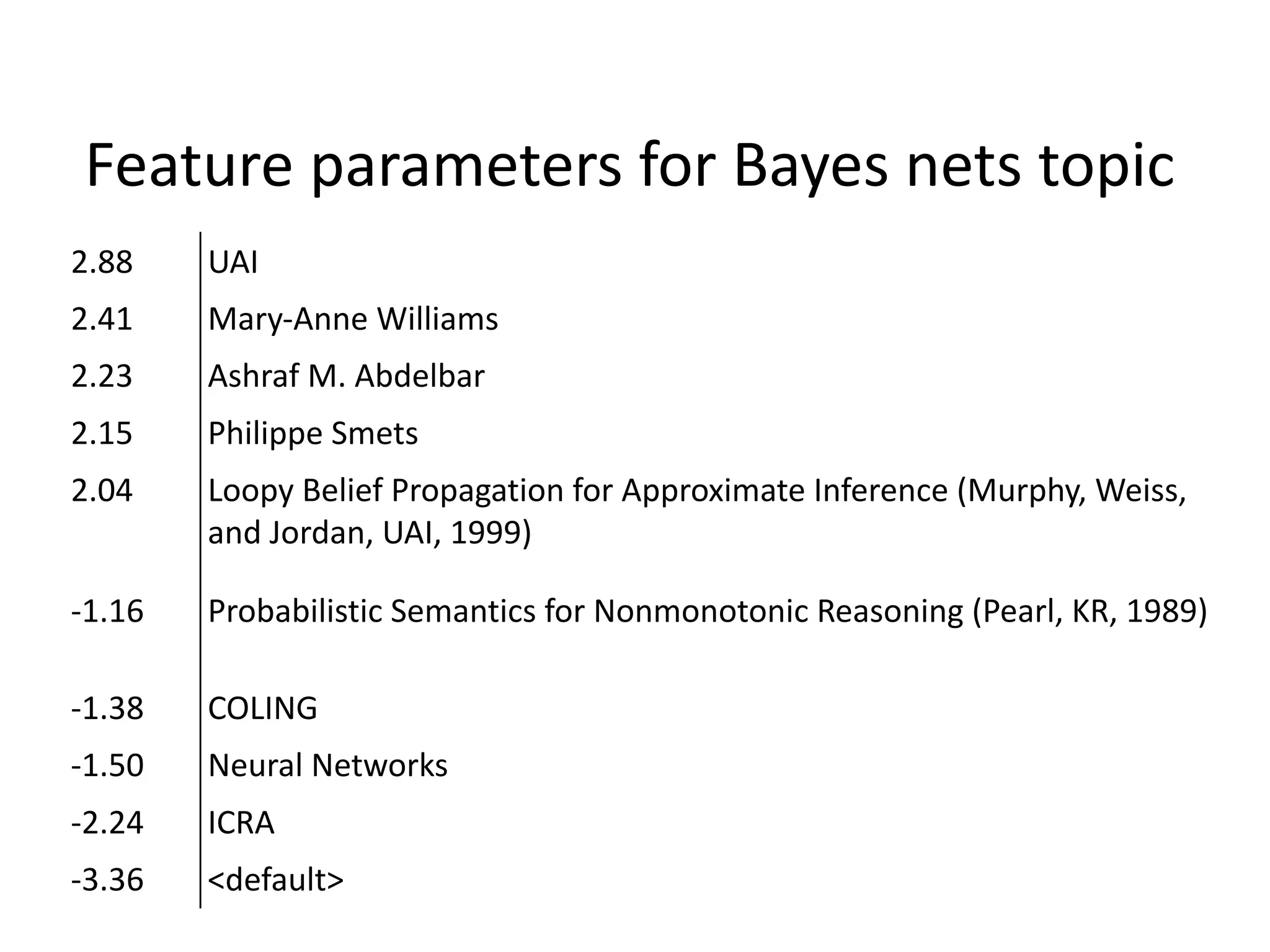
2.88 UAI
2.41 Mary-­‐Anne	
  Williams
2.23 Ashraf	
  M.	
  Abdelbar
2.15 Philippe	
  Smets
2.04 Loopy	
  Belief	
  Propagation	
  for	
  Approximate	
  Inference	
  (Murphy,	
  Weiss,	
  
and	
  Jordan,	
  UAI,	
  1999)
-­‐1.16 Probabilistic	
  Semantics	
  for	
  Nonmonotonic	
  Reasoning	
  (Pearl,	
  KR,	
  1989)
-­‐1.38 COLING
-­‐1.50 Neural	
  Networks
-­‐2.24 ICRA
-­‐3.36 <default>
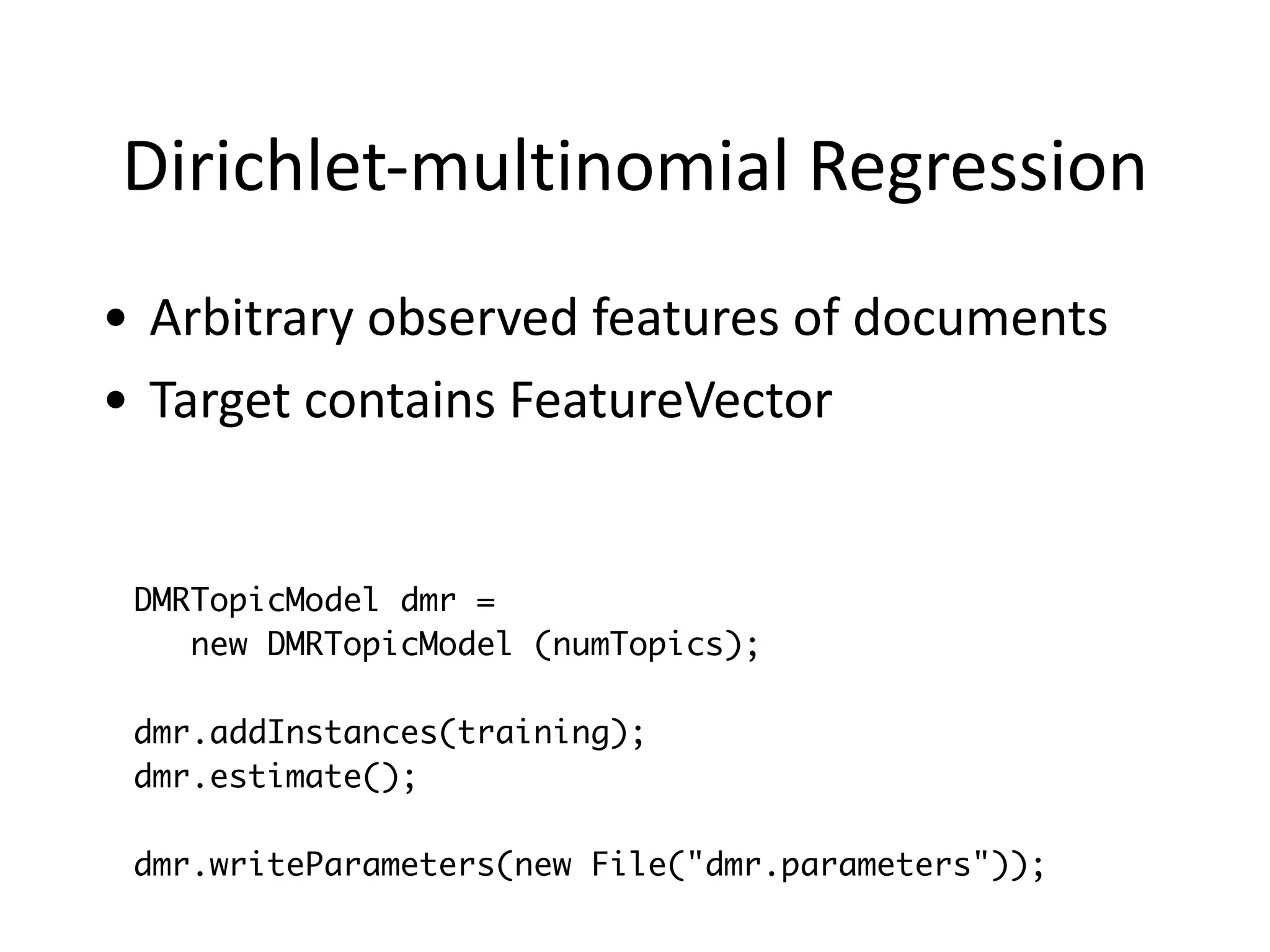
Dirichlet-­‐multinomial	
  Regression
• Arbitrary	
  observed	
  features	
  of	
  documents	
  
• Target	
  contains	
  FeatureVector
DMRTopicModel dmr =
new DMRTopicModel (numTopics);
!
dmr.addInstances(training);
dmr.estimate();
!
dmr.writeParameters(new File("dmr.parameters"));
Polylingual	
  Topic	
  Modeling
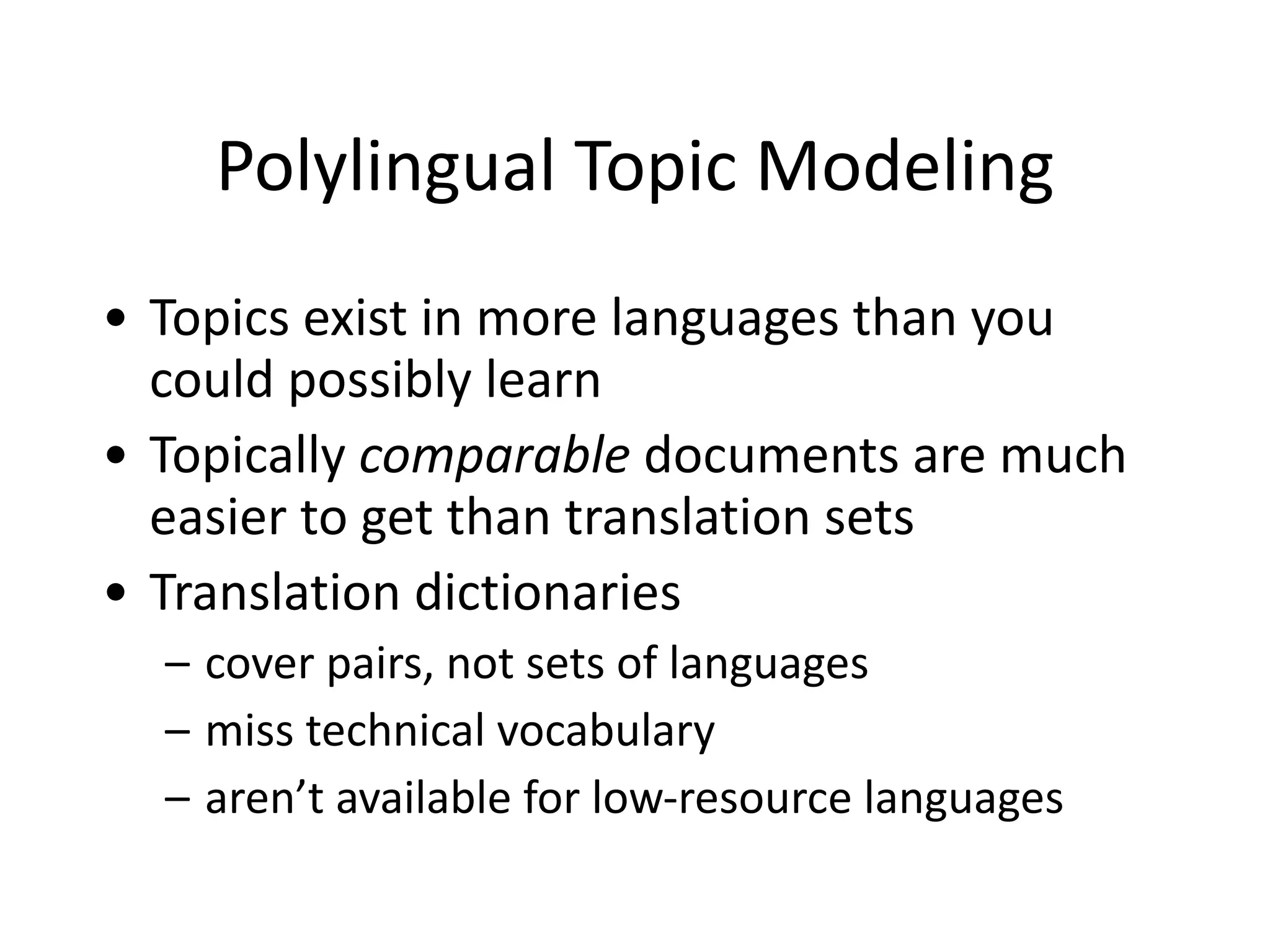
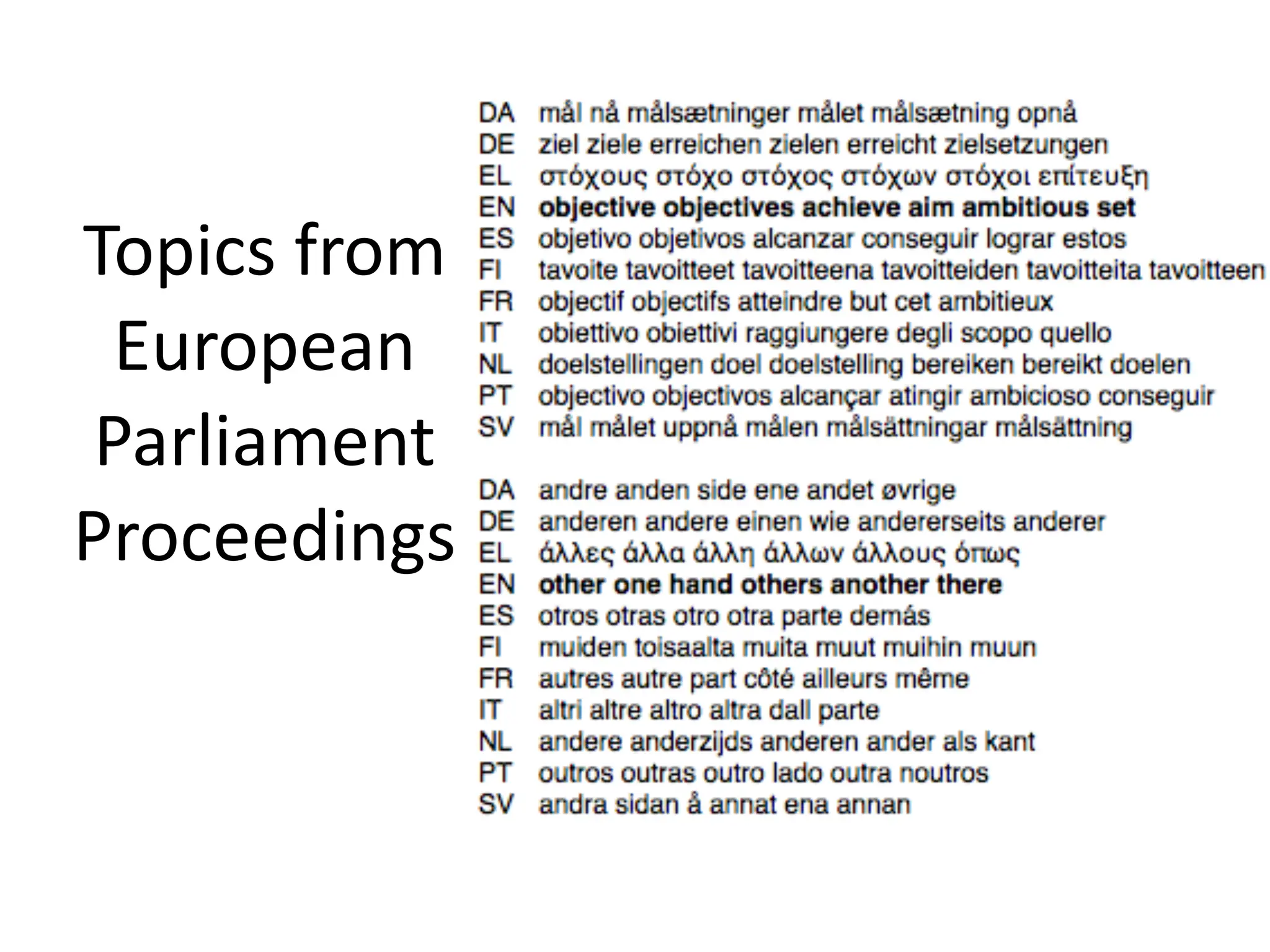
• Topics	
  exist	
  in	
  more	
  languages	
  than	
  you	
  
could	
  possibly	
  learn	
  
• Topically	
  comparable	
  documents	
  are	
  much	
  
easier	
  to	
  get	
  than	
  translation	
  sets	
  
• Translation	
  dictionaries	
  
– cover	
  pairs,	
  not	
  sets	
  of	
  languages	
  
– miss	
  technical	
  vocabulary	
  
– aren’t	
  available	
  for	
  low-­‐resource	
  languages
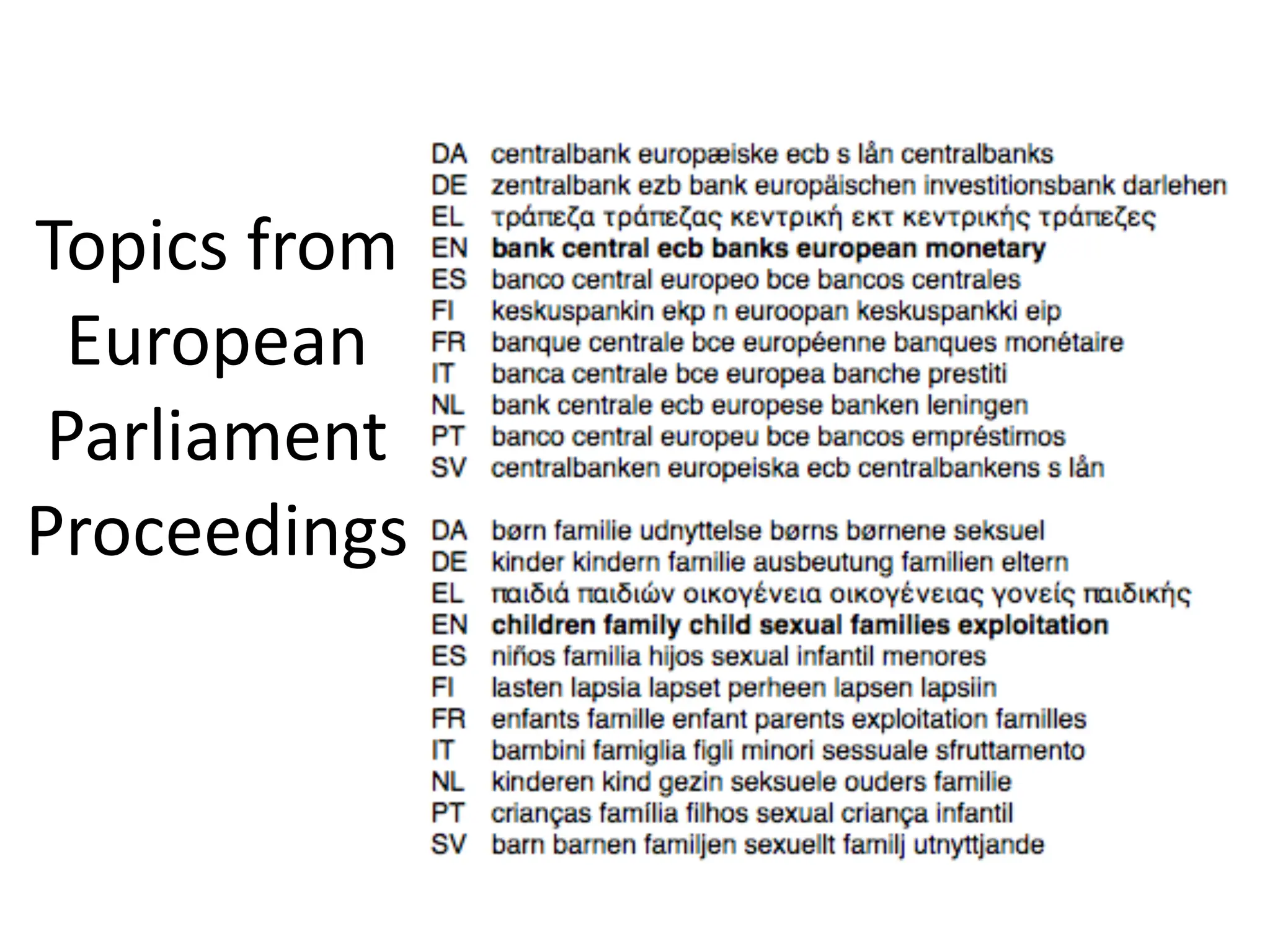
Topics	
  from	
  
European	
  
Parliament	
  
Proceedings
Topics	
  from	
  
European	
  
Parliament	
  
Proceedings
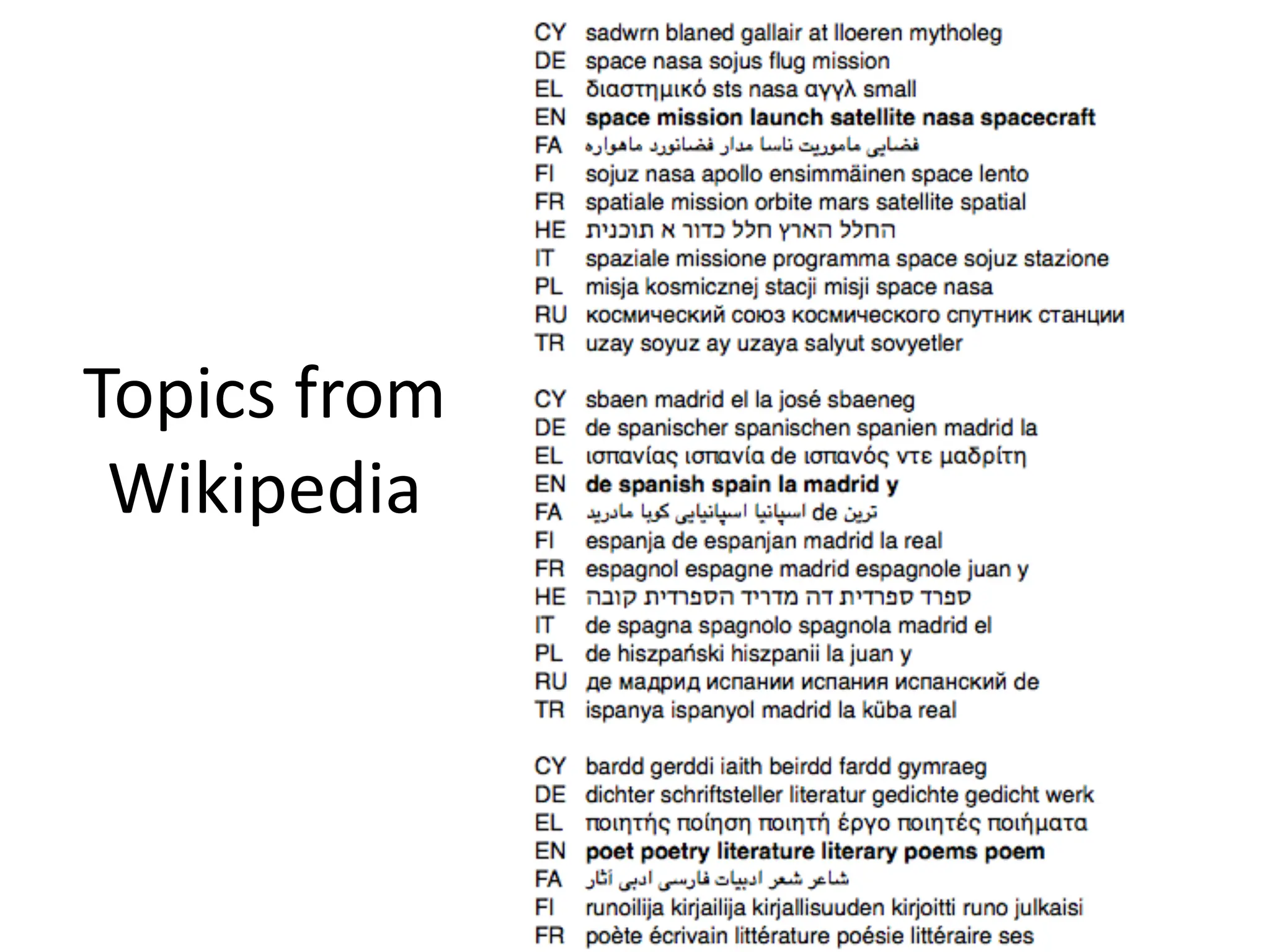
Topics	
  from	
  
Wikipedia
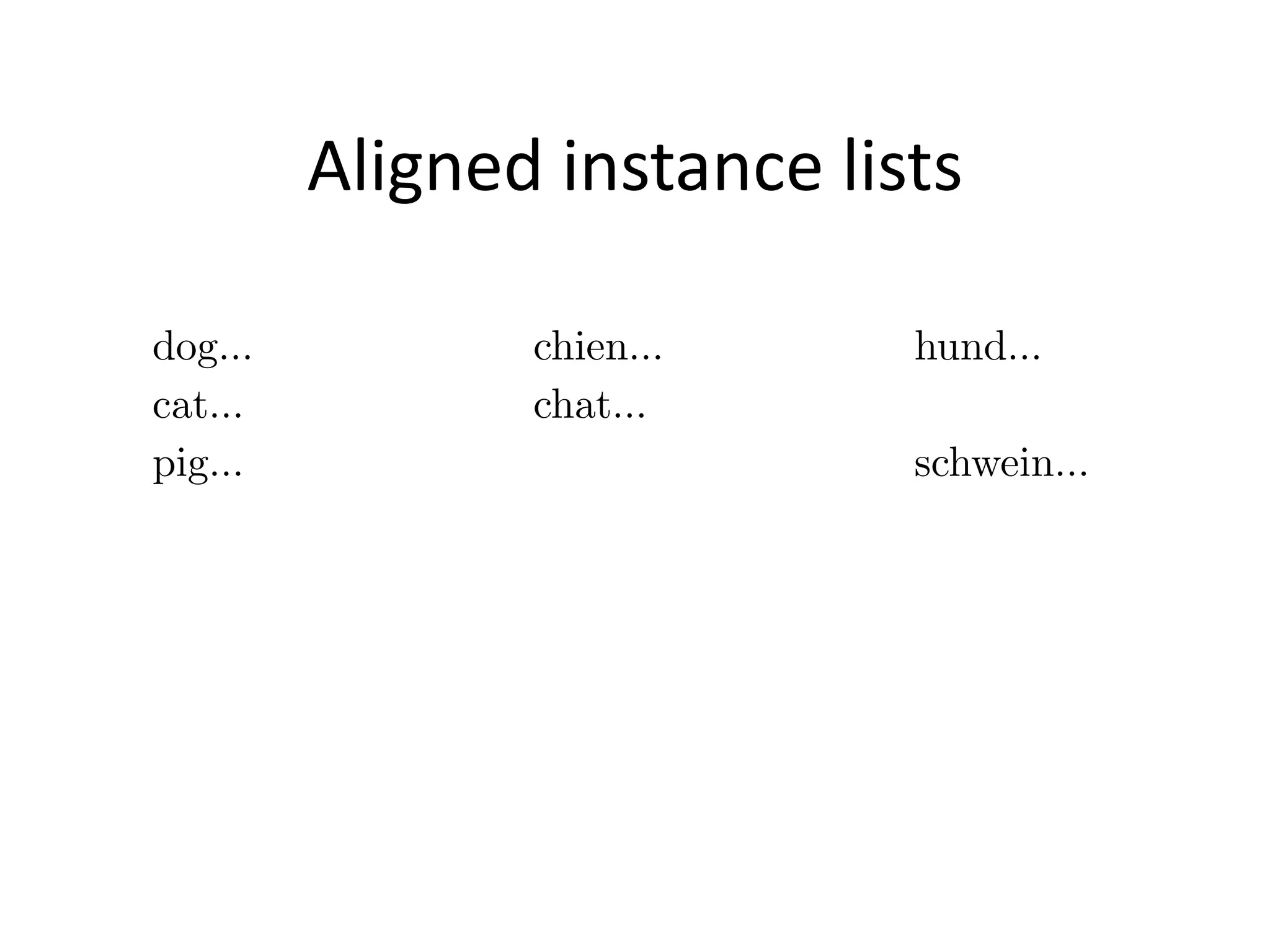
Aligned	
  instance	
  lists
dog… chien… hund…
cat… chat…
pig… schwein…
Polylingual	
  Topics
InstanceList[] training =
new InstanceList[] { english, german,
arabic, mahican };
!
PolylingualTopicModel pltm =
new PolylingualTopicModel(numTopics);
!
pltm.addInstances(training);
MALLET	
  hands-­‐on	
  tutorial
http://mallet.cs.umass.edu/mallet-­‐handson.tar.gz

mallet-tutorial.pdf mallet-tutorial.pdf mallet-tutorial.pdf

  • 1.
    Machine  Learning  with  MALLET http://mallet.cs.umass.edu/mallet-­‐tutorial.pdf David  Mimno   Department  of  Information  Science,   Cornell  University License:  CC  BY  4.0
  • 2.
    Outline • About  MALLET   • Representing  Data   • Classification   • Sequence  Tagging   • Topic  Modeling
  • 3.
    Outline • About  MALLET   • Representing  Data   • Classification   • Sequence  Tagging   • Topic  Modeling
  • 4.
    Who? • Andrew  McCallum  (most  of  the   work)   • Charles  Sutton,  Aron  Culotta,   Greg  Druck,  Kedar  Bellare,   Gaurav  Chandalia…   • Fernando  Pereira,  others  at   Penn…
  • 5.
    Who  am  I? •Chief  maintainer  of  MALLET   • Primary  author  of  MALLET  topic  modeling   package
  • 6.
    Why? • Motivation:  text  classification  and   information  extraction   • Commercial  machine  learning  (Just   Research,  WhizBang)   • Analysis  and  indexing  of  academic   publications:  Cora,  Rexa
  • 7.
    What? • Text  focus:  data  is  discrete  rather  than   continuous,  even  when  values  could  be   continuous: double value = 3.0
  • 8.
    How? • Command  line  scripts:   – bin/mallet  [command]  -­‐-­‐[option]  [value]  …   – Text  User  Interface  (“tui”)  classes   • Direct  Java  API   – http://mallet.cs.umass.edu/api Most of this talk
  • 9.
    History • Version  0.4:  c2004   – Classes  in  edu.umass.cs.mallet.base.*   • Version  2.0:  c2008   – Classes  in  cc.mallet.*   – Major  changes  to  finite  state  transducer   package   – bin/mallet  vs.  specialized  scripts   – Java  1.5  generics
  • 10.
    Learning  More • http://mallet.cs.umass.edu   – “Quick  Start”  guides,  focused  on  command  line   processing   – Developers’  guides,  with  Java  examples   • mallet-­‐dev@cs.umass.edu  mailing  list   – Low  volume,  but  can  be  bursty
  • 11.
    Outline • About  MALLET   • Representing  Data   • Classification   • Sequence  Tagging   • Topic  Modeling
  • 12.
    Models  for  Text  Data • Generative  models  (Multinomials)   – Naïve  Bayes   – Hidden  Markov  Models  (HMMs)   – Latent  Dirichlet  Topic  Models   • Discriminative  Regression  Models   – MaxEnt/Logistic  regression   – Conditional  Random  Fields  (CRFs)  
  • 13.
    Representations • Transform  text   documents  to   vectors  x1,  x2,…   • Retain  meaning   of  vector  indices   • Ideally  sparsely Call me Ishmael. … Document
  • 14.
    Representations • Transform  text   documents  to   vectors  x1,  x2,…   • Retain  meaning   of  vector  indices   • Ideally  sparsely 1.0 0.0 … 0.0 6.0 0.0 … 3.0 … Call me Ishmael. … xi Document
  • 15.
    Representations • Elements  of  vector   are  called  feature   values   • Example:  Feature   at  row  345  is   number  of  times   “dog”  appears  in   document     1.0 0.0 … 0.0 6.0 0.0 … 3.0 … xi
  • 16.
    Documents  to  Vectors Callme Ishmael. Document
  • 17.
    Documents  to  Vectors Callme Ishmael. Document Call me Ishmael Tokens
  • 18.
    Documents  to  Vectors Callme Ishmael Tokens call me ishmael Tokens
  • 19.
    Documents  to  Vectors callme ishmael Tokens 473, 3591, 17 Features 17. ishmael … 473. call … 3591 me
  • 20.
    Documents  to  Vectors 171.0 473 1.0 3591 1.0 Features (bag) 17. ishmael 473. call 3591 me 473, 3591, 17 Features (sequence) 17. ishmael … 473. call … 3591 me 17. ishmael … 473. call … 3591 me
  • 21.
    Instances Email  message,  web  page,  sentence,  journal   abstract…     • Name   • Data   • Target/Label   • Source What is it called? What is the input? What is the output? What did it originally look like?
  • 22.
    Instances • Name   •Data   • Target   • Source String ! TokenSequence ArrayList<Token> FeatureSequence int[] FeatureVector int -> double map cc.mallet.types
  • 23.
    Alphabets TObjectIntHashMap map ArrayList entries ! intlookupIndex(Object o, boolean shouldAdd) ! Object lookupObject(int index) cc.mallet.types, gnu.trove 17. ishmael … 473. call … 3591 me
  • 24.
    Alphabets TObjectIntHashMap map ArrayList entries ! intlookupIndex(Object o, boolean shouldAdd) ! Object lookupObject(int index) cc.mallet.types, gnu.trove 17. ishmael … 473. call … 3591 me for
  • 25.
    Alphabets TObjectIntHashMap map ArrayList entries ! cc.mallet.types,gnu.trove 17. ishmael … 473. call … 3591 me void stopGrowth() ! void startGrowth() Do not add entries for new Objects -- default is to allow growth.
  • 26.
    Creating  Instances • Instance   constructor   method   • Iterators new Instance(data, target, name, source) Iterator<Instance> FileIterator(File[], …) CsvIterator(FileReader, Pattern…) ArrayIterator(Object[]) … cc.mallet.pipe.iterator
  • 27.
  • 28.
    Creating  Instances • CsvIterator cc.mallet.pipe.iterator Name,label, data from regular expression groups. “CSV” is a lousy name. LineRegexIterator? Each instance on its own line 1001. Melville Call me Ishmael. Some years ago… 1002. Dickens It was the best of times, it was… ^([^t]+)t([^t]+)t(.*)
  • 29.
    Instance  Pipelines • Sequential   transformations   of  instance  fields   (usually  Data)   • Pass  an   ArrayList<Pipe>   to  SerialPipes cc.mallet.pipe // “data” is a String CharSequence2TokenSequence // tokenize with regexp TokenSequenceLowercase // modify each token’s text TokenSequenceRemoveStopwords // drop some tokens TokenSequence2FeatureSequence // convert token Strings to ints FeatureSequence2FeatureVector // lose order, count duplicates
  • 30.
    Instance  Pipelines • A  small  number   of  pipes  modify   the  “target”  field   • There  are  now   two  alphabets:   data  and  label cc.mallet.pipe, cc.mallet.types // “target” is a String Target2Label // convert String to int // “target” is now a Label Alphabet > LabelAlphabet
  • 31.
    Label  objects • Weights  on  a   fixed  set  of   classes   • For  training  data,   weight  for   correct  label  is   1.0,  all  others  0.0 cc.mallet.types implements Labeling ! int getBestIndex() Label getBestLabel() You cannot create a Label, they are only produced by LabelAlphabet
  • 32.
    InstanceLists • A  List  of  Instance   objects,  along   with  a  Pipe,  data   Alphabet,  and   LabelAlphabet cc.mallet.types InstanceList instances = new InstanceList(pipe); ! instances.addThruPipe(iterator);
  • 33.
    Putting  it  all  together ArrayList<Pipe> pipeList = new ArrayList<Pipe>(); ! pipeList.add(new Target2Label()); pipeList.add(new CharSequence2TokenSequence()); pipeList.add(new TokenSequence2FeatureSequence()); pipeList.add(new FeatureSequence2FeatureVector()); ! InstanceList instances = new InstanceList(new SerialPipes(pipeList)); ! instances.addThruPipe(new FileIterator(. . .));
  • 34.
    Persistent  Storage • Most  MALLET   classes  use  Java   serialization  to   store  models  and   data java.io ObjectOutputStream oos = new ObjectOutputStream(…); oos.writeObject(instances); oos.close(); Pipes, data objects, labelings, etc all need to implement Serializable. ! Be sure to include custom classes in classpath, or you get a StreamCorruptedException
  • 35.
    Review • What  are  the  four  main  fields  in  an   Instance?
  • 36.
    Review • What  are  the  four  main  fields  in  an   Instance?   • What  are  two  ways  to  generate  Instances?
  • 37.
    Review • What  are  the  four  main  fields  in  an   Instance?   • What  are  two  ways  to  generate  Instances?   • How  do  we  modify  the  value  of  Instance   fields?
  • 38.
    Review • What  are  the  four  main  fields  in  an   Instance?   • What  are  two  ways  to  generate  Instances?   • How  do  we  modify  the  value  of  Instance   fields?   • Name  some  classes  that  appear  in  the   “data”  field.
  • 39.
    Outline • About  MALLET   • Representing  Data   • Classification   • Sequence  Tagging   • Topic  Modeling
  • 40.
    Classifier  objects • Classifiers  map   from  instances  to   distributions   over  a  fixed  set   of  classes   • MaxEnt,  Naïve   Bayes,  Decision   Trees… cc.mallet.classify Given data Which class is best? ! (this one!) watery NN JJ PRP VB CC
  • 41.
    Classifier  objects • Classifiers  map   from  instances  to   distributions   over  a  fixed  set   of  classes   • MaxEnt,  Naïve   Bayes,  Decision   Trees… cc.mallet.classify Labeling labeling = classifier.classify(instance); ! Label l = labeling.getBestLabel(); ! System.out.print(instance + “t”); System.out.println(l);
  • 42.
    Training  Classifier  objects cc.mallet.classify ClassifierTrainertrainer = new MaxEntTrainer(); ! Classifier classifier = trainer.train(instances); • Each  type  of   classifier  has  one   or  more   ClassifierTrainer   classes
  • 43.
    Training  Classifier  objects cc.mallet.optimize logP(Labels | Data) = log f(label1, data1, w) + log f(label2, data2, w) + log f(label3, data3, w) + … • Some  classifiers   require   numerical   optimization  of   an  objective   function. Maximize w.r.t. w!
  • 44.
    Parameters  w • Association   between   feature,  class   label   • How  many   parameters  for  K   classes  and  N   features? action     NN   0.13   action     VB   -­‐0.1   action     JJ   -­‐0.21   SUFF-­‐tion   NN   1.3   SUFF-­‐tion   VB   -­‐2.1   SUFF-­‐tion   JJ   -­‐1.7   SUFF-­‐on   NN   0.01   SUFF-­‐on   VB   -­‐0.02   …  
  • 45.
    Training  Classifier  objects cc.mallet.optimize interfaceOptimizer boolean optimize() ! interface Optimizable interface ByValue interface ByValueGradient Limited-memory BFGS, Conjugate gradient… Specific objective functions
  • 46.
    Training  Classifier  objects cc.mallet.classify MaxEntOptimizableByLabelLikelihood double[]getParameters() void setParameters(double[] parameters) … ! double getValue() void getValueGradient(double[] buffer) Log likelihood and its first derivative For Optimizable interface
  • 47.
    Evaluation  of  Classifiers •Create   random  test/ train  splits cc.mallet.types InstanceList[] instanceLists = instances.split(new Randoms(), new double[] {0.9, 0.1, 0.0}); 90% training 10% testing 0% validation
  • 48.
    Evaluation  of  Classifiers •The  Trial  class   stores  the   results  of   classifications   on  an   InstanceList   (testing  or   training) cc.mallet.classify Trial(Classifier c, InstanceList list) double getAccuracy() double getAverageRank() double getF1(int/Label/Object) double getPrecision(…) double getRecall(…)
  • 49.
    Review • I  have  invented  a  new  classifier:  David   regression.   – What  class  should  I  implement  to  classify   instances?
  • 50.
    Review • I  have  invented  a  new  classifier:  David   regression.   – What  class  should  I  implement  to  train  a  David   regression  classifier?
  • 51.
    Review • I  have  invented  a  new  classifier:  David   regression.   – I  want  to  train  using  ByValueGradient.  What   mathematical  functions  do  I  need  to  code  up,   and  what  class  should  I  put  them  in?
  • 52.
    Review • I  have  invented  a  new  classifier:  David   regression.   – How  would  I  check  whether  my  new  classifier   works  better  than  Naïve  Bayes?
  • 53.
    Outline • About  MALLET   • Representing  Data   • Classification   • Sequence  Tagging   • Topic  Modeling
  • 54.
    Sequence  Tagging • Data  occurs  in   sequences   • Categorical  labels   for  each  position   • Labels  are   correlated DET          NN          VBS                VBG the          dog        likes          running
  • 55.
    Sequence  Tagging • Data  occurs  in   sequences   • Categorical  labels   for  each  position   • Labels  are   correlated ??                ??            ??                        ?? the          dog        likes          running
  • 56.
    Sequence  Tagging • Classification:  n-­‐way   • Sequence  Tagging:  nT-­‐way NN JJ PRP VB CC NN JJ PRP VB CC NN JJ PRP VB CC NN JJ PRP VB CC NN JJ PRP VB CC NN JJ PRP VB CC NN JJ PRP VB CC or          red      dogs      on          blue    trees
  • 57.
    Avoiding  Exponential  Blowup •Markov  property   • Dynamic  programming Andrei Markov
  • 58.
    Avoiding  Exponential  Blowup •Markov  property   • Dynamic  programming This one Given this one Is independent of these Andrei Markov DET  JJ  NN  VB
  • 59.
    Avoiding  Exponential  Blowup •Markov  property   • Dynamic  programming NN JJ PRP VB CC NN JJ PRP VB CC NN JJ PRP VB CC NN JJ PRP VB CC NN JJ PRP VB CC NN JJ PRP VB CC or          red      dogs      on          blue    trees Andrei Markov
  • 60.
    Avoiding  Exponential  Blowup •Markov  property   • Dynamic  programming NN JJ PRP VB CC NN JJ PRP VB CC NN JJ PRP VB CC NN JJ PRP VB CC NN JJ PRP VB CC red      dogs      on          blue    trees Andrei Markov
  • 61.
    Avoiding  Exponential  Blowup •Markov  property   • Dynamic  programming NN JJ PRP VB CC NN JJ PRP VB CC NN JJ PRP VB CC NN JJ PRP VB CC                                    dogs      on          blue    trees Andrei Markov
  • 62.
    Hidden  Markov  Models  and  Conditional   Random  Fields • Hidden  Markov   Model:  fully   generative   ! • Conditional  Random   Field:  conditional P(Labels | Data) = P(Data, Labels) / P(Data) P(Labels | Data)
  • 63.
    Hidden  Markov  Models  and  Conditional   Random  Fields • Hidden  Markov  Model:   simple  (independent)   output  space   ! • Conditional  Random   Field:  arbitrarily   complicated  outputs “NSF-funded” “NSF-funded” CAPITALIZED HYPHENATED ENDS-WITH-ed ENDS-WITH-d …
  • 64.
    Hidden  Markov  Models  and  Conditional   Random  Fields FeatureSequence FeatureVectorSequence ! FeatureVector[] int[] • Hidden  Markov  Model:   simple  (independent)   output  space   ! • Conditional  Random   Field:  arbitrarily   complicated  outputs
  • 65.
    Importing  Data • SimpleTagger   format:  one   word  per  line,   with  instances   delimited  by  a   blank  line Call VB me PPN Ishmael NNP . . ! Some JJ years NNS …
  • 66.
    Importing  Data • SimpleTagger   format:  one   word  per  line,   with  instances   delimited  by  a   blank  line Call SUFF-ll VB me TWO_LETTERS PPN Ishmael BIBLICAL_NAME NNP . PUNCTUATION . ! Some CAPITALIZED JJ years TIME SUFF-s NNS …
  • 67.
    Importing  Data LineGroupIterator ! SimpleTaggerSentence2TokenSequence() //String toTokens, handles labels ! TokenSequence2FeatureVectorSequence() //Token objects to FeatureVectors cc.mallet.pipe, cc.mallet.pipe.iterator
  • 68.
    Importing  Data LineGroupIterator ! SimpleTaggerSentence2TokenSequence() //String toTokens, handles labels ! [Pipes that modify tokens] ! TokenSequence2FeatureVectorSequence() //Token objects to FeatureVectors cc.mallet.pipe, cc.mallet.pipe.iterator
  • 69.
    Importing  Data //Ishmael TokenTextCharSuffix(“C2=”, 2) //IshmaelC2=el RegexMatches(“CAP”, Pattern.compile(“p{Lu}.*”)) //Ishmael C2=el CAP LexiconMembership(“NAME”, new File(‘names’), false) //Ishmael C2=el CAP NAME cc.mallet.pipe.tsf must match entire string one name per line ignore case?
  • 70.
    Sliding  window  features a        red        dog        on        a        blue        tree
  • 71.
    Sliding  window  features a        red        dog        on        a        blue        tree
  • 72.
    Sliding  window  features a        red        dog        on        a        blue        tree red@-1
  • 73.
    Sliding  window  features a        red        dog        on        a        blue        tree red@-1 a@-2
  • 74.
    Sliding  window  features a        red        dog        on        a        blue        tree red@-1 a@-2 on@1
  • 75.
    Sliding  window  features a        red        dog        on        a        blue        tree red@-1 a@-2 on@1 a@-2_&_red@-1
  • 76.
    Importing  Data int[][] conjunctions= new int[3][]; conjunctions[0] = new int[] { -1 }; conjunctions[1] = new int[] { 1 }; conjunctions[2] = new int[] { -2, -1 }; ! OffsetConjunctions(conjunctions) ! // a@-2_&_red@-1 on@1 cc.mallet.pipe.tsf previous position next position previous two
  • 77.
    Importing  Data int[][] conjunctions= new int[3][]; conjunctions[0] = new int[] { -1 }; conjunctions[1] = new int[] { 1 }; conjunctions[2] = new int[] { -2, -1 }; ! TokenTextCharSuffix("C1=", 1) OffsetConjunctions(conjunctions) ! // a@-2_&_red@-1 a@-2_&_C1=d@-1 cc.mallet.pipe.tsf previous position next position previous two
  • 78.
    Finite  State  Transducers •Finite  state   machine  over   two  alphabets   (observed,   hidden)
  • 79.
    Finite  State  Transducers •Finite  state   machine  over   two  alphabets   (observed,   hidden) DET P(DET)
  • 80.
    Finite  State  Transducers •Finite  state   machine  over   two  alphabets   (observed,   hidden) DET           the P(the | DET)
  • 81.
    Finite  State  Transducers •Finite  state   machine  over   two  alphabets   (observed,   hidden) DET          NN the P(NN | DET)
  • 82.
    Finite  State  Transducers •Finite  state   machine  over   two  alphabets   (observed,   hidden) DET          NN the          dog P(dog | NN)
  • 83.
    Finite  State  Transducers •Finite  state   machine  over   two  alphabets   (observed,   hidden) DET          NN          VBS the          dog P(VBS | NN)
  • 84.
    How  many  parameters? •Determines   efficiency  of   training   • Too  many  leads   to  overfitting Trick: Don’t allow certain transitions P(VBS | DET) = 0
  • 85.
    How  many  parameters? •Determines   efficiency  of   training   • Too  many  leads   to  overfitting DET          NN          VBS ! the          dog          runs DET          NN          VBS ! the          dog          runs DET          NN          VBS ! the          dog          runs
  • 86.
    Finite  State  Transducers abstractclass Transducer CRF HMM ! abstract class TransducerTrainer CRFTrainerByLabelLikelihood HMMTrainerByLikelihood cc.mallet.fst
  • 87.
    Finite  State  Transducers cc.mallet.fst Firstorder: one weight for every pair of labels and observations. CRF crf = new CRF(pipe, null); crf.addFullyConnectedStates(); // or crf.addStatesForLabelsConnectedAsIn(instances); DET          NN          VBS ! the          dog          runs
  • 88.
    Finite  State  Transducers cc.mallet.fst “three-quarter”order: one weight for every pair of labels and observations. crf.addStatesForThreeQuarterLabelsConnectedAsIn(instances); DET          NN          VBS ! the          dog          runs
  • 89.
    Finite  State  Transducers cc.mallet.fst Secondorder: one weight for every triplet of labels and observations. crf.addStatesForBiLabelsConnectedAsIn(instances); DET          NN          VBS ! the          dog          runs
  • 90.
    Finite  State  Transducers cc.mallet.fst “Half”order: equivalent to independent classifiers, except some transitions may be illegal. crf.addStatesForHalfLabelsConnectedAsIn(instances); DET          NN          VBS ! the          dog          runs
  • 91.
    Training  a  transducer CRFcrf = new CRF(pipe, null); crf.addStatesForLabelsConnectedAsIn(trainingInstances); CRFTrainerByLabelLikelihood trainer = new CRFTrainerByLabelLikelihood(crf); ! trainer.train(); cc.mallet.fst
  • 92.
    Evaluating  a  transducer CRFTrainerByLabelLikelihoodtrainer = new CRFTrainerByLabelLikelihood(transducer); ! TransducerEvaluator evaluator = new TokenAccuracyEvaluator(testing, "testing")); ! trainer.addEvaluator(evaluator); ! trainer.train(); cc.mallet.fst
  • 93.
    Applying  a  transducer Sequenceoutput = transducer.transduce (input); ! for (int index=0; index < input.size(); input++) { System.out.print(input.get(index) + “/”); System.out.print(output.get(index) + “ “); } cc.mallet.fst
  • 94.
    Review • How  do  you  add  new  features  to   TokenSequences?
  • 95.
    Review • How  do  you  add  new  features  to   TokenSequences?   • What  are  three  factors  that  affect  the   number  of  parameters  in  a  model?
  • 96.
    Outline • About  MALLET   • Representing  Data   • Classification   • Sequence  Tagging   • Topic  Modeling
  • 97.
  • 98.
    Topics:  “Semantic  Groups” “Sports”“Negotiation” News Article
  • 99.
    Topics:  “Semantic  Groups” “Sports”“Negotiation” News Article team player game strike deadline union
  • 100.
    Topics:  “Semantic  Groups” NewsArticle team player game strike deadline union
  • 101.
    Series  Yankees  Sox  Red  World  League  game  Boston  team  games   baseball  Mets  Game  series  won  Clemens  Braves  Yankee  teams
  • 102.
    players  League  owners  league  baseball  union  commissioner   Baseball  Association  labor  Commissioner  Football  major  teams   Selig  agreement  strike  team  bargaining
  • 103.
    Training  a  Topic  Model cc.mallet.topics ParallelTopicModel lda = new ParallelTopicModel(numTopics); lda.addInstances(trainingInstances); lda.estimate();
  • 104.
    Evaluating  a  Topic  Model cc.mallet.topics ParallelTopicModel lda = new ParallelTopicModel(numTopics); lda.addInstances(trainingInstances); lda.estimate(); ! MarginalProbEstimator evaluator = lda.getProbEstimator(); ! double logLikelihood = evaluator.evaluateLeftToRight(testing, 10, false, null);
  • 105.
    Inferring  topics  for  new  documents cc.mallet.topics ParallelTopicModel lda = new ParallelTopicModel(numTopics); lda.addInstances(trainingInstances); lda.estimate(); ! TopicInferencer inferencer = lda.getInferencer(); ! double[] topicProbs = inferencer.getSampledDistribution(instance, 100, 10, 10);
  • 106.
    More  than  words… •Text  collections   mix  free  text  and   structured  data David Mimno Andrew McCallum UAI 2008 …
  • 107.
    More  than  words… •Text  collections   mix  free  text  and   structured  data David Mimno Andrew McCallum UAI 2008 ! “Topic models conditioned on arbitrary features using Dirichlet-multinomial regression. …”
  • 108.
    Dirichlet-­‐multinomial  Regression   (DMR) The  corpus  specifies  a  vector  of  real-­‐valued   features  (x)  for  each  document,  of  length  F.   Each  topic  has  an  F-­‐length  vector  of   parameters.
  • 109.
    Topic  parameters  for  feature  “published  in   JMLR” 2.27 kernel,  kernels,  rational  kernels,  string  kernels,  fisher  kernel 1.74 bounds,  vc  dimension,  bound,  upper  bound,  lower  bounds 1.41 reinforcement  learning,  learning,  reinforcement 1.40 blind  source  separation,  source  separation,  separation,  channel 1.37 nearest  neighbor,  boosting,  nearest  neighbors,  adaboost -­‐1.12 agent,  agents,  multi  agent,  autonomous  agents -­‐1.21 strategies,  strategy,  adaptation,  adaptive,  driven -­‐1.23 retrieval,  information  retrieval,  query,  query  expansion -­‐1.36 web,  web  pages,  web  page,  world  wide  web,  web  sites -­‐1.44 user,  users,  user  interface,  interactive,  interface
  • 110.
    Feature  parameters  for  RL  topic 2.99 Sridhar  Mahadevan 2.88 ICML 2.56 Kenji  Doya 2.45 ECML 2.19 Machine  Learning  Journal -­‐1.38 ACL -­‐1.47 CVPR -­‐1.54 IEEE  Trans.  PAMI -­‐1.64 COLING -­‐3.76 <default>
  • 111.
    Topic  parameters  for  feature  “published  in   UAI” 2.88 bayesian  networks,  bayesian  network,  belief  networks 2.26 qualitative,  reasoning,  qualitative  reasoning,  qualitative  simulation 2.25 probability,  probabilities,  probability  distributions, 2.25 uncertainty,  symbolic,  sketch,  primal  sketch,  uncertain,  connectionist 2.11 reasoning,  logic,  default  reasoning,  nonmonotonic  reasoning -­‐1.29 shape,  deformable,  shapes,  contour,  active  contour -­‐1.36 digital  libraries,  digital  library,  digital,  library -­‐1.37 workshop  report,  invited  talk,  international  conference,  report -­‐1.50 descriptions,  description,  top,  bottom,  top  bottom -­‐1.50 nearest  neighbor,  boosting,  nearest  neighbors,  adaboost
  • 112.
    Feature  parameters  for  Bayes  nets  topic 2.88 UAI 2.41 Mary-­‐Anne  Williams 2.23 Ashraf  M.  Abdelbar 2.15 Philippe  Smets 2.04 Loopy  Belief  Propagation  for  Approximate  Inference  (Murphy,  Weiss,   and  Jordan,  UAI,  1999) -­‐1.16 Probabilistic  Semantics  for  Nonmonotonic  Reasoning  (Pearl,  KR,  1989) -­‐1.38 COLING -­‐1.50 Neural  Networks -­‐2.24 ICRA -­‐3.36 <default>
  • 113.
    Dirichlet-­‐multinomial  Regression • Arbitrary  observed  features  of  documents   • Target  contains  FeatureVector DMRTopicModel dmr = new DMRTopicModel (numTopics); ! dmr.addInstances(training); dmr.estimate(); ! dmr.writeParameters(new File("dmr.parameters"));
  • 114.
    Polylingual  Topic  Modeling •Topics  exist  in  more  languages  than  you   could  possibly  learn   • Topically  comparable  documents  are  much   easier  to  get  than  translation  sets   • Translation  dictionaries   – cover  pairs,  not  sets  of  languages   – miss  technical  vocabulary   – aren’t  available  for  low-­‐resource  languages
  • 115.
    Topics  from   European   Parliament   Proceedings
  • 116.
    Topics  from   European   Parliament   Proceedings
  • 117.
  • 118.
    Aligned  instance  lists dog…chien… hund… cat… chat… pig… schwein…
  • 119.
    Polylingual  Topics InstanceList[] training= new InstanceList[] { english, german, arabic, mahican }; ! PolylingualTopicModel pltm = new PolylingualTopicModel(numTopics); ! pltm.addInstances(training);
  • 120.