Feature Engineering
Geoff Hulten
Overview
• Feature engineering overview
• Common approaches to featurizing with text
• Feature selection
• Iterating and improving (and dealing with mistakes)
Goals of Feature Engineering
• Convert ‘context’ -> input to learning algorithm.
• Expose the structure of the concept to the learning algorithm.
• Work well with the structure of the model the algorithm will create.
• Balance number of features, complexity of concept, complexity of
model, amount of data.
Sample from SMS Spam
• SMS Message (arbitrary text) -> 5 dimensional array of binary features
• 1 if message is longer than 40 chars, 0 otherwise
• 1 if message contains a digit, 0 otherwise
• 1 if message contains word ‘call’, 0 otherwise
• 1 if message contains word ‘to’, 0 otherwise
• 1 if message contains word ‘your’, 0 otherwise
Long? HasDigit? ContainsWord(Call) ContainsWord(to) ContainsWord(your)
“SIX chances to win CASH! From 100 to 20,000 pounds txt> CSH11 and send to 87575. Cost 150p/day, 6days, 16+
TsandCs apply Reply HL 4 info”
Basic Feature Types
Binary Features
• ContainsWord(call)?
• IsLongSMSMessage?
• Contains(*#)?
• ContainsPunctuation?
Numeric Features
• CountOfWord(call)
• MessageLength
• FirstNumberInMessage
• WritingGradeLevel
Categorical Features
• FirstWordPOS ->
{ Verb, Noun, Other }
• MessageLength ->
{ Short, Medium, Long, VeryLong }
• TokenType ->
{ Number, URL, Word, Phone#, Unknown }
• GrammarAnalysis ->
• { Fragment, SimpleSentence,
ComplexSentence }
Converting Between Feature Types
Numeric Feature => Binary Feature
Length of text + [ 40 ] => { 0, 1 }
Numeric Feature => Categorical Feature
Length of text + [ 20, 40 ] => { short or medium or long }
Categorical Feature => Binary Features
{ short or medium or long } => [ 1, 0, 0] or [ 0, 1, 0] or [0, 0, 1]
Binary Feature => Numeric Feature
{ 0, 1 } => { 0, 1 }
Single threshold
Set of thresholds
One-hot encoding
…
Sources of Data for Features
• System State
• App in foreground?
• Roaming?
• Sensor readings
• Content Analysis
• Stuff we’ve been talking about
• Stuff we’re going to talk about next
• User Information
• Industry
• Demographics
• Interaction History
• User’s ‘report as junk’ rate
• # previous interactions with sender
• # messages sent/received
• Metadata
• Properties of phone #s referenced
• Properties of the sender
• Run other models on the content
• Grammar
• Language
• …
Feature Engineering for Text
• Tokenizing
• Bag of Words
• N-grams
• TF-IDF
• Embeddings
• NLP
Tokenizing
• Breaking text into words
“Nah, I don't think he goes to usf” ->
[ ‘Nah,’ ‘I’, ‘don't’, ‘think’, ‘he’, ‘goes’, ‘to’, ‘usf’ ]
• Dealing with punctuation
“Nah,” ->
[ ‘Nah,’ ] or [ ‘Nah’, ‘,’ ] or [ ‘Nah’ ]
“don't” ->
[ ‘don't’ ] or [ ‘don’, ‘'’, ‘t’ ] or [ ‘don’, ‘t’ ] or [ ‘do’, ‘n't’ ]
• Normalizing
“Nah,” ->
[ ‘Nah,’ ] or [ ‘nah,’ ]
“1452” ->
[ ‘1452’ ] or [ <number> ]
Some tips for deciding
• If you have lots of data / optimization…
• Keep as much information as possible
• Let the learning algorithm figure out what is
important and what isn’t
• If you don’t have much data / optimization...
• Reduce the number of features you maintain
• Normalize away irrelevant things
• Focus on things relevant to the concept…
• Explore data / use your intuition
• Overfitting / underfitting  much more later
Bag of Words
A word of text.
A word is a token.
Tokens and features.
Few features of text.
m1:
m2:
m3:
m4:
Training data
a
word of
text
a
word is
a
token
tokens
and
features
few features
of
text
Tokens
Bag of words
a
word
of
text
is
token
tokens
and
features
few
Features
One feature per unique token
Bag of Words: Example
A word of text.
A word is a token.
Tokens and features.
Few features of text.
m1:
m2:
m3:
m4:
a
word
of
text
is
token
tokens
and
features
few
Use bag of words when you have a lot of data, can use many features
m1 m2 m3 m4 test1
test1: Some features for a text example.
Selected Features Training X Test X
m1 m2 m3 m4
1 1 0 0
1 1 0 0
1 0 0 1
1 0 0 1
0 1 0 0
0 1 0 0
0 0 1 0
0 0 1 0
0 0 1 1
0 0 0 1
test1
1
0
0
1
0
0
0
0
1
0
Out of
vocabulary
N-Grams: Tokens
• Instead of using single tokens as features, use series of N tokens
• “down the bank” vs “from the bank”
Message 1: “Nah I don't think he goes to usf”
Message 2: “Text FA to 87121 to receive entry”
Nah I I don’t don’t
think
think
he
he goes goes to to usf … Text FA FA to 87121
to
To
receive
receive
entry
0 0 0 0 0 0 0 … 1 1 1 1 1
Message 2:
Use when you have a LOT of data, can use MANY features
N-Grams: Characters
• Instead of using series of tokens, use series of characters
Message 1: “Nah I don't think he goes to usf”
Message 2: “Text FA to 87121 to receive entry”
Na ah h
<space>
<space>
I
I
<space>
<space>
d
do … <space>
e
en nt tr ry
0 0 0 0 0 0 0 … 1 1 1 1 1
Message 2:
Helps with out of dictionary words & spelling errors
Fixed number of features for given N (but can be very large)
TF-IDF
Term Frequency – Inverse Document Frequency
• Instead of using binary: ContainsWord(<term>)
• Use numeric importance score TF-IDF:
TermFrequency(<term>, <document>) =
% of the words in <document> that are <term>
InverseDocumentFrequency(<term>, <documents>) =
log ( # documents / # documents that contain <term> )
Words that occur in many documents have low score ()
-20% 0% 20% 40% 60% 80% 100%
0
0.5
1
1.5
2
2.5
3
3.5
4
Term IDF Score
% of Documents Containing Term
Nah I don't think he goes to usf Text FA 87121 receive entry
BOW 0 0 0 0 0 0 1 0 1 1 1 1 1
TF-IDF 0 0 0 0 0 0 0 0 .099 .099 .099 .099 .099
Message 1: “Nah I don't think he goes to usf”
Message 2: “Text FA to 87121 to receive entry”
Message 2:
Importance to
Document
Novelty across
corpus
Embeddings-- Word2Vec and FastText
• Word -> Coordinate in N dimension
• Regions of space contain similar concepts
• Creating Features Options:
• Average vector across words
• Count in specific regions
• Commonly used with neural networks
Replaces words with their ‘meanings’ – sparse -> dense representation
Normalization (Numeric => Better Numeric)
36
74
22
81
105
113
77
91
-38.875
-0.875
-52.875
6.125
30.125
38.125
2.125
16.125
-1.31696
-0.02964
-1.79123
0.207495
1.020536
1.29155
0.071988
0.546262
Normalize
Mean
Raw X
Normalize
Variance
Mean: 74.875 Mean: 0
Std: 29.5188
Mean: 0
Std: 1
Subtract
Mean
Divide by
Stdev
Helps make model’s job easier
• No need to learn what is
‘big’ or ‘small’ for the
feature
• Some model types benefit
more than others
To use in practice:
• Estimate mean/stdev on
training data
• Apply normalization using
those parameters to
validation /train
Feature Selection
• Which features to use?
• How many features to use?
Approaches:
• Frequency
• Mutual Information
• Accuracy
Feature Selection: Frequency
Take top N most common features in the training set
Feature Count
to 1745
you 1526
I 1369
a 1337
the 1007
and 758
in 400
… …
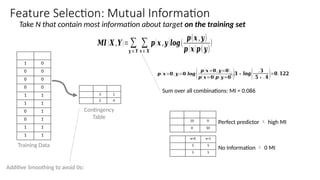
Feature Selection: Mutual Information
Take N that contain most information about target on the training set
3 1
2 4
Additive Smoothing to avoid 0s:
𝑴𝑰 (𝑿 ,𝒀)= ∑
𝒚 ∈𝒀
∑
𝒙∈ 𝑿
𝒑(𝒙 ,𝒚)𝒍𝒐𝒈(
𝒑(𝒙 ,𝒚)
𝒑(𝒙)𝒑(𝒚)
)
1 0
0 0
0 0
0 0
1 1
1 1
0 1
0 1
1 1
1 1
Training Data
Contingency
Table
𝒑 (𝒙=𝟎, 𝒚 =𝟎)𝒍𝒐𝒈
( 𝒑 (𝒙 =𝟎, 𝒚=𝟎)
𝒑(𝒙=𝟎)𝒑 (𝒚=𝟎))
Sum over all combinations: MI = 0.086
10 0
0 10
x=0 x=1
5 5
5 5
Perfect predictor  high MI
No Information  0 MI
¿.𝟑∗𝒍𝒐𝒈( .𝟑
.𝟓∗.𝟒)=𝟎.𝟏𝟐𝟐
Feature Selection: Accuracy (wrapper)
Take N that improve accuracy most on hold out data
Greedy search, adding or removing features
From baseline, try adding (removing) each candidate
Build a model
Evaluate on hold out data
Add (remove) the best
Repeat till you get to N
Remove Accuracy
<None> 88.2%
claim 82.1%
FREE 86.5%
or 87.8%
to 89.8%
… …
Important note about feature selection
• Do not use validation (or test) data when doing feature selection
• Use train data only to select features
• Then apply the selected features to the validation (or test) data
Simple Feature Engineering Pattern
TrainingContextX
Featurize
Training
TrainingY
Info needed to turn raw
context into features
Featurize
Data
Raw data to featurize and
do feature selection with
Featurize
Runtime
runtimeContextX
runtimeX
Input for machine learning
model at runtime
Selected words / n-grams and their
feature indexes
TF-IDF weights to use for each word
Normalize parameters for numeric
features: means and stdevs
Simple Feature Engineering Pattern: Pseudocode
for f in featureSelectionMethodsToTry:
(trainX, trainY, featureData) = FeaturizeTraining(rawTrainX, rawTrainY, f)
(validationX, validationY) = FeaturizeRuntime(rawValidationX, rawValidationY, f, featureData)
for hp in hyperParametersToTry:
model.fit(trainX, trainY, hp)
accuracies[hp, f] = evaluate(validationY, model.predict(validationX))
(bestHyperParametersFound, bestFeaturizerFound) = bestSettingFound(accuracies)
(finalTrainX, finalTrainY, featureData) =
FeaturizeTraining(rawTrainX + rawValidationX, rawTrainY + rawValidationY, bestFeaturizerFound)
(testX, testY) = FeaturizeRuntime(rawTextX, rawTestY, bestFeaturizerFound, featureData)
finalModel.fit(finalTrainX, finalTrainY, bestHyperParametersFound)
estimateOfGeneralizationPerformance = evaluate(testY, model.predict(testX))
Understanding Mistakes
• Noise in the data
• Encodings
• Bugs
• Missing values
• Corruption
• Noise in the labels
Ham: As per your request 'Melle Melle (Oru Minnaminunginte Nurungu Vettam)' has been set as your callertune for all Callers. Press *9 to
copy your friends Callertune
Spam: I’ll meet you at the resturant between 10 & 10:30 – can’t wait!
• Model being wrong…
• Reason?
Exploring Mistakes
• Examine N random false positive and N random false negatives
• Examine N worst false positives and N worst false negatives
• Model predicts very near 1, but true answer is 0
• Model predicts very near 0, but true answer is 1
Reason Count
Label Noise 2
Slang 5
Non-English 5
… …
Approach to Feature Engineering
• Start with ‘standard’ for your domain; 1 parameter per ~10 samples
• Try all the important variations on hold out data
• Tokenizing
• Bag of words
• N-grams
• …
• Use some form of feature selection to find the best, evaluate
• Look at your mistakes…
• Use your intuition about your domain and adapt standard approaches or invent new features…
• Iterate
• When you want to know how well you did, evaluate on test data
Feature Engineering in Other Domains
Computer Vision:
• Gradients
• Histograms
• Convolutions
Time Series:
• Window aggregated statistics
• Frequency domain transformations
Internet:
• IP Parts
• Domains
• Relationships
• Reputation
Neural Networks:
• A whole bunch of other things we’ll
talk about later…
Summary of Feature Engineering
• Feature engineering converts raw
context into inputs for machine
learning
• Goals are:
• Match structure of concept to
structure of model representation
• Balance number of feature, amount
of data, complexity of concept,
power of model
• Every domain has a library of proven
feature engineering approaches
• Text’s include: normalization,
tokenizing, n-grams, TF-IDF,
embeddings, & NLP
• Feature selection removes less
useful features and can greatly
increase accuracy

05 -- Feature Engineering (Text).pptxiuy

  • 1.
  • 2.
    Overview • Feature engineeringoverview • Common approaches to featurizing with text • Feature selection • Iterating and improving (and dealing with mistakes)
  • 3.
    Goals of FeatureEngineering • Convert ‘context’ -> input to learning algorithm. • Expose the structure of the concept to the learning algorithm. • Work well with the structure of the model the algorithm will create. • Balance number of features, complexity of concept, complexity of model, amount of data.
  • 4.
    Sample from SMSSpam • SMS Message (arbitrary text) -> 5 dimensional array of binary features • 1 if message is longer than 40 chars, 0 otherwise • 1 if message contains a digit, 0 otherwise • 1 if message contains word ‘call’, 0 otherwise • 1 if message contains word ‘to’, 0 otherwise • 1 if message contains word ‘your’, 0 otherwise Long? HasDigit? ContainsWord(Call) ContainsWord(to) ContainsWord(your) “SIX chances to win CASH! From 100 to 20,000 pounds txt> CSH11 and send to 87575. Cost 150p/day, 6days, 16+ TsandCs apply Reply HL 4 info”
  • 5.
    Basic Feature Types BinaryFeatures • ContainsWord(call)? • IsLongSMSMessage? • Contains(*#)? • ContainsPunctuation? Numeric Features • CountOfWord(call) • MessageLength • FirstNumberInMessage • WritingGradeLevel Categorical Features • FirstWordPOS -> { Verb, Noun, Other } • MessageLength -> { Short, Medium, Long, VeryLong } • TokenType -> { Number, URL, Word, Phone#, Unknown } • GrammarAnalysis -> • { Fragment, SimpleSentence, ComplexSentence }
  • 6.
    Converting Between FeatureTypes Numeric Feature => Binary Feature Length of text + [ 40 ] => { 0, 1 } Numeric Feature => Categorical Feature Length of text + [ 20, 40 ] => { short or medium or long } Categorical Feature => Binary Features { short or medium or long } => [ 1, 0, 0] or [ 0, 1, 0] or [0, 0, 1] Binary Feature => Numeric Feature { 0, 1 } => { 0, 1 } Single threshold Set of thresholds One-hot encoding …
  • 7.
    Sources of Datafor Features • System State • App in foreground? • Roaming? • Sensor readings • Content Analysis • Stuff we’ve been talking about • Stuff we’re going to talk about next • User Information • Industry • Demographics • Interaction History • User’s ‘report as junk’ rate • # previous interactions with sender • # messages sent/received • Metadata • Properties of phone #s referenced • Properties of the sender • Run other models on the content • Grammar • Language • …
  • 8.
    Feature Engineering forText • Tokenizing • Bag of Words • N-grams • TF-IDF • Embeddings • NLP
  • 9.
    Tokenizing • Breaking textinto words “Nah, I don't think he goes to usf” -> [ ‘Nah,’ ‘I’, ‘don't’, ‘think’, ‘he’, ‘goes’, ‘to’, ‘usf’ ] • Dealing with punctuation “Nah,” -> [ ‘Nah,’ ] or [ ‘Nah’, ‘,’ ] or [ ‘Nah’ ] “don't” -> [ ‘don't’ ] or [ ‘don’, ‘'’, ‘t’ ] or [ ‘don’, ‘t’ ] or [ ‘do’, ‘n't’ ] • Normalizing “Nah,” -> [ ‘Nah,’ ] or [ ‘nah,’ ] “1452” -> [ ‘1452’ ] or [ <number> ] Some tips for deciding • If you have lots of data / optimization… • Keep as much information as possible • Let the learning algorithm figure out what is important and what isn’t • If you don’t have much data / optimization... • Reduce the number of features you maintain • Normalize away irrelevant things • Focus on things relevant to the concept… • Explore data / use your intuition • Overfitting / underfitting  much more later
  • 10.
    Bag of Words Aword of text. A word is a token. Tokens and features. Few features of text. m1: m2: m3: m4: Training data a word of text a word is a token tokens and features few features of text Tokens Bag of words a word of text is token tokens and features few Features One feature per unique token
  • 11.
    Bag of Words:Example A word of text. A word is a token. Tokens and features. Few features of text. m1: m2: m3: m4: a word of text is token tokens and features few Use bag of words when you have a lot of data, can use many features m1 m2 m3 m4 test1 test1: Some features for a text example. Selected Features Training X Test X m1 m2 m3 m4 1 1 0 0 1 1 0 0 1 0 0 1 1 0 0 1 0 1 0 0 0 1 0 0 0 0 1 0 0 0 1 0 0 0 1 1 0 0 0 1 test1 1 0 0 1 0 0 0 0 1 0 Out of vocabulary
  • 12.
    N-Grams: Tokens • Insteadof using single tokens as features, use series of N tokens • “down the bank” vs “from the bank” Message 1: “Nah I don't think he goes to usf” Message 2: “Text FA to 87121 to receive entry” Nah I I don’t don’t think think he he goes goes to to usf … Text FA FA to 87121 to To receive receive entry 0 0 0 0 0 0 0 … 1 1 1 1 1 Message 2: Use when you have a LOT of data, can use MANY features
  • 13.
    N-Grams: Characters • Insteadof using series of tokens, use series of characters Message 1: “Nah I don't think he goes to usf” Message 2: “Text FA to 87121 to receive entry” Na ah h <space> <space> I I <space> <space> d do … <space> e en nt tr ry 0 0 0 0 0 0 0 … 1 1 1 1 1 Message 2: Helps with out of dictionary words & spelling errors Fixed number of features for given N (but can be very large)
  • 14.
    TF-IDF Term Frequency –Inverse Document Frequency • Instead of using binary: ContainsWord(<term>) • Use numeric importance score TF-IDF: TermFrequency(<term>, <document>) = % of the words in <document> that are <term> InverseDocumentFrequency(<term>, <documents>) = log ( # documents / # documents that contain <term> ) Words that occur in many documents have low score () -20% 0% 20% 40% 60% 80% 100% 0 0.5 1 1.5 2 2.5 3 3.5 4 Term IDF Score % of Documents Containing Term Nah I don't think he goes to usf Text FA 87121 receive entry BOW 0 0 0 0 0 0 1 0 1 1 1 1 1 TF-IDF 0 0 0 0 0 0 0 0 .099 .099 .099 .099 .099 Message 1: “Nah I don't think he goes to usf” Message 2: “Text FA to 87121 to receive entry” Message 2: Importance to Document Novelty across corpus
  • 15.
    Embeddings-- Word2Vec andFastText • Word -> Coordinate in N dimension • Regions of space contain similar concepts • Creating Features Options: • Average vector across words • Count in specific regions • Commonly used with neural networks Replaces words with their ‘meanings’ – sparse -> dense representation
  • 16.
    Normalization (Numeric =>Better Numeric) 36 74 22 81 105 113 77 91 -38.875 -0.875 -52.875 6.125 30.125 38.125 2.125 16.125 -1.31696 -0.02964 -1.79123 0.207495 1.020536 1.29155 0.071988 0.546262 Normalize Mean Raw X Normalize Variance Mean: 74.875 Mean: 0 Std: 29.5188 Mean: 0 Std: 1 Subtract Mean Divide by Stdev Helps make model’s job easier • No need to learn what is ‘big’ or ‘small’ for the feature • Some model types benefit more than others To use in practice: • Estimate mean/stdev on training data • Apply normalization using those parameters to validation /train
  • 17.
    Feature Selection • Whichfeatures to use? • How many features to use? Approaches: • Frequency • Mutual Information • Accuracy
  • 18.
    Feature Selection: Frequency Taketop N most common features in the training set Feature Count to 1745 you 1526 I 1369 a 1337 the 1007 and 758 in 400 … …
  • 19.
    Feature Selection: MutualInformation Take N that contain most information about target on the training set 3 1 2 4 Additive Smoothing to avoid 0s: 𝑴𝑰 (𝑿 ,𝒀)= ∑ 𝒚 ∈𝒀 ∑ 𝒙∈ 𝑿 𝒑(𝒙 ,𝒚)𝒍𝒐𝒈( 𝒑(𝒙 ,𝒚) 𝒑(𝒙)𝒑(𝒚) ) 1 0 0 0 0 0 0 0 1 1 1 1 0 1 0 1 1 1 1 1 Training Data Contingency Table 𝒑 (𝒙=𝟎, 𝒚 =𝟎)𝒍𝒐𝒈 ( 𝒑 (𝒙 =𝟎, 𝒚=𝟎) 𝒑(𝒙=𝟎)𝒑 (𝒚=𝟎)) Sum over all combinations: MI = 0.086 10 0 0 10 x=0 x=1 5 5 5 5 Perfect predictor  high MI No Information  0 MI ¿.𝟑∗𝒍𝒐𝒈( .𝟑 .𝟓∗.𝟒)=𝟎.𝟏𝟐𝟐
  • 20.
    Feature Selection: Accuracy(wrapper) Take N that improve accuracy most on hold out data Greedy search, adding or removing features From baseline, try adding (removing) each candidate Build a model Evaluate on hold out data Add (remove) the best Repeat till you get to N Remove Accuracy <None> 88.2% claim 82.1% FREE 86.5% or 87.8% to 89.8% … …
  • 21.
    Important note aboutfeature selection • Do not use validation (or test) data when doing feature selection • Use train data only to select features • Then apply the selected features to the validation (or test) data
  • 22.
    Simple Feature EngineeringPattern TrainingContextX Featurize Training TrainingY Info needed to turn raw context into features Featurize Data Raw data to featurize and do feature selection with Featurize Runtime runtimeContextX runtimeX Input for machine learning model at runtime Selected words / n-grams and their feature indexes TF-IDF weights to use for each word Normalize parameters for numeric features: means and stdevs
  • 23.
    Simple Feature EngineeringPattern: Pseudocode for f in featureSelectionMethodsToTry: (trainX, trainY, featureData) = FeaturizeTraining(rawTrainX, rawTrainY, f) (validationX, validationY) = FeaturizeRuntime(rawValidationX, rawValidationY, f, featureData) for hp in hyperParametersToTry: model.fit(trainX, trainY, hp) accuracies[hp, f] = evaluate(validationY, model.predict(validationX)) (bestHyperParametersFound, bestFeaturizerFound) = bestSettingFound(accuracies) (finalTrainX, finalTrainY, featureData) = FeaturizeTraining(rawTrainX + rawValidationX, rawTrainY + rawValidationY, bestFeaturizerFound) (testX, testY) = FeaturizeRuntime(rawTextX, rawTestY, bestFeaturizerFound, featureData) finalModel.fit(finalTrainX, finalTrainY, bestHyperParametersFound) estimateOfGeneralizationPerformance = evaluate(testY, model.predict(testX))
  • 24.
    Understanding Mistakes • Noisein the data • Encodings • Bugs • Missing values • Corruption • Noise in the labels Ham: As per your request 'Melle Melle (Oru Minnaminunginte Nurungu Vettam)' has been set as your callertune for all Callers. Press *9 to copy your friends Callertune Spam: I’ll meet you at the resturant between 10 & 10:30 – can’t wait! • Model being wrong… • Reason?
  • 25.
    Exploring Mistakes • ExamineN random false positive and N random false negatives • Examine N worst false positives and N worst false negatives • Model predicts very near 1, but true answer is 0 • Model predicts very near 0, but true answer is 1 Reason Count Label Noise 2 Slang 5 Non-English 5 … …
  • 26.
    Approach to FeatureEngineering • Start with ‘standard’ for your domain; 1 parameter per ~10 samples • Try all the important variations on hold out data • Tokenizing • Bag of words • N-grams • … • Use some form of feature selection to find the best, evaluate • Look at your mistakes… • Use your intuition about your domain and adapt standard approaches or invent new features… • Iterate • When you want to know how well you did, evaluate on test data
  • 27.
    Feature Engineering inOther Domains Computer Vision: • Gradients • Histograms • Convolutions Time Series: • Window aggregated statistics • Frequency domain transformations Internet: • IP Parts • Domains • Relationships • Reputation Neural Networks: • A whole bunch of other things we’ll talk about later…
  • 28.
    Summary of FeatureEngineering • Feature engineering converts raw context into inputs for machine learning • Goals are: • Match structure of concept to structure of model representation • Balance number of feature, amount of data, complexity of concept, power of model • Every domain has a library of proven feature engineering approaches • Text’s include: normalization, tokenizing, n-grams, TF-IDF, embeddings, & NLP • Feature selection removes less useful features and can greatly increase accuracy

Editor's Notes

  • #19 Log(1) = 0 Log(2) ~ .3