BY
AKASH GUPTA
A13558913055
MALL MANAGEMENT AND REVIVAL
STRATEGIES FOR SICK MALLS
LITERATURE REVIEW
• A shopping mall is typically, a shopping complex
connected by walkways. It provides shopping as well
as entertainment options to the target consumers. It
generally, contains one anchor store, which consumes
twenty five percent of its retail space. In addition a
mall contains specialty stores for clothes, accessories,
home needs, books, as well as food court, multiplexes
and entertainment zones.
• As per Jones Lang LaSalle, a global real estate
consulting baron, only a quarter of India’s 500+ malls
are making profits, rest all are bleeding,
LITERATURE REVIEW
• A shopping mall is typically, a shopping complex
connected by walkways. It provides shopping as well
as entertainment options to the target consumers. It
generally, contains one anchor store, which consumes
twenty five percent of its retail space. In addition a
mall contains specialty stores for clothes, accessories,
home needs, books, as well as food court, multiplexes
and entertainment zones.
• As per Jones Lang LaSalle, a global real estate
consulting baron, only a quarter of India’s 500+ malls
are making profits, rest all are bleeding,
LITERATURE REVIEW
• A shopping mall is typically, a shopping complex
connected by walkways. It provides shopping as well
as entertainment options to the target consumers. It
generally, contains one anchor store, which consumes
twenty five percent of its retail space. In addition a
mall contains specialty stores for clothes, accessories,
home needs, books, as well as food court, multiplexes
and entertainment zones.
• As per Jones Lang LaSalle, a global real estate
consulting baron, only a quarter of India’s 500+ malls
are making profits, rest all are bleeding,
LITERATURE REVIEW
• Through this study, we try to find the reasons,
issues and challenges faced by real estate
developers today.
• The main reason found is malls are not
differentiating themselves amongst themselves,
everyone is trying to imitate the successful
strategies and ultimately resulting into a blood
bath.
• We also through this study, try and suggest few
revival methodologies, through which a mall
which is bleeding can survive.
PROJECT OBJECTIVE
• Find out are the malls in India making money
or they are suffering loss.
• Reasons for shutting down of malls.
• Challenges faced by Mall Developers today
• Role of Tenant Mix behind mall success
• Revival Strategies
• E-Stores effecting mall success
• How malls Survive
METHODOLOGY
• Research will be conducted by doing field
visits- interviewing admin heads, tenants,
customers.
• Through secondary sources of information
• Analysing all the factors
• Summarising them
• Conclusion
About The Project
7 main reasons for shutting down of
malls
1. Bad Location
2. Bad Architecture
3. No Multiplex
4. Poorly Designed Food Court
5. Bad Shopping Mix
6. Scale Problem (i.e. too small compared to a
gigantic mall in same vicinity)
7. Bad Anchor Tenants
Challenges Faced By Malls
• Some of the key challenges broadly are as follows:
1. Positioning
2. Zoning (tenant mix and placement within mall)
3. Promotions and marketing
4. Facility management (infrastructure, footfalls, ambience)
5. Finance management
6. Planning the mall around anchor tenants
7. Lack of market research by developers
8. Tendency to lease out on a FCFS basis5
9. Perceive outsourcing as additional cost
10. Lack of accountability for in-house promotional activities
11. Improper planning for space (lack of parking space, single entry/ exit
points)
12. Lack of skilled manpower
Capital Sources for Mall
Private Funds
• Internal accruals Loan from banks
• Loan against property (LAP)
• Loan against future receivables
• Note and mortgage
• Contract for deeds
• Private Equity Investors
Capital Sources for Mall
Public Funds
• Commercial mortgage backed securities
• Corporate Bonds
• Real Estate Invt. Trusts
• Initial Public Offers
• Real Estate Mutual Funds
Revenue Sources
• Advertising & Promotion
• Temporary leasing of empty stores
• Parking facilities
• Media activity inside mall
• Food Courts
• Miscellaneous Sources
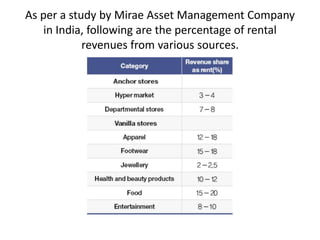
As per a study by Mirae Asset Management Company
in India, following are the percentage of rental
revenues from various sources.
The success Factors Of a Mall
• Tenant-mix
• Quality of location and accessibility
• Catchment size and Quality
• Car parking provision
• Internal layout and good ambience.
• Among these success factors, the tenant-mix of a
shopping mall widely recognized as a critical
factor for all parties concerned – consumers,
retail tenants and the developer/landlord
Benefits of Tenant Mix
1. Attracting customers
2. Holding shoppers for a longer time
3. Encouraging cross-shopping and impulse
buying.
4. Imparting distinctive image to the mall
5. Ensuring 100% location to all the tenants
Leasing Administration
• Flaws in the leasing administration can be killing, City Center
Mall of Vashi, Navi Mumbai, was on the verge of a closure
only due to flaws in the provisions of the lease agreements
created, no clarity as to who will bear maintenance charges,
fees, fines and charges, security deposits etc. The below two
images show what City Center Mall was before and what it
has become now!
• A lease agreement must cover significant clauses and
exigencies in the lease agreement. Basically each
parties responsibilities and actions must be clearly
defined, along with default actions etc.
Marketing and Promotion Activities
Symptoms of Sickness
1.Delays in rental payments
2. Mall facilities are not properly managed
3. Frequent landlord and tenant conflicts
4. Lower footfalls
5. Too much dependence on few tenants i.e. either
Anchor or Independent
6. Poor Food Court
7. Inability to have Promo’s and In-house Events few malls
like Center One say though being a small mall has around
200+ Promos each year.
8. Complacency
Precautions & Revival strategies
1.Fail-proof the business plan
2. Do a thorough re-checking of the catchment
3. Offer good occupant mix
4. Ensure good access
5. Avoid under sizing
6. Focus on design
A brief note by Mr. Anuj Puri then Chairman & MD of
Jones Lang LaSalle India, is as follows:
Following are the lessons worth learning:
1. Ensure that you have the right size, format and tenant mix for a
particular catchment
2. Provide adequate parking
3. Do not strata sell spaces
4. Provide professional mall management
5. Malls must, over a period of time, evolve their tenant mix and offerings so
that sales — and therefore rentals — continue to grow. In the event that a
catchment does not sustain the development or there is too much
completion, retailers will choose the dominant mall.
6. When a shopping centre is not the preferred one for retailers, value
retailers come in – when even value retailers cannot sustain, it is usually
because of a combination of reasons. These could be: bad location, bad
design, lack of adequate parking, lack of professional mall management
(often the result of strata selling spaces) and a mall’s inability to find alternate
usages of space.

Mall revival Strategies

  • 1.
    BY AKASH GUPTA A13558913055 MALL MANAGEMENTAND REVIVAL STRATEGIES FOR SICK MALLS
  • 2.
    LITERATURE REVIEW • Ashopping mall is typically, a shopping complex connected by walkways. It provides shopping as well as entertainment options to the target consumers. It generally, contains one anchor store, which consumes twenty five percent of its retail space. In addition a mall contains specialty stores for clothes, accessories, home needs, books, as well as food court, multiplexes and entertainment zones. • As per Jones Lang LaSalle, a global real estate consulting baron, only a quarter of India’s 500+ malls are making profits, rest all are bleeding,
  • 3.
    LITERATURE REVIEW • Ashopping mall is typically, a shopping complex connected by walkways. It provides shopping as well as entertainment options to the target consumers. It generally, contains one anchor store, which consumes twenty five percent of its retail space. In addition a mall contains specialty stores for clothes, accessories, home needs, books, as well as food court, multiplexes and entertainment zones. • As per Jones Lang LaSalle, a global real estate consulting baron, only a quarter of India’s 500+ malls are making profits, rest all are bleeding,
  • 4.
    LITERATURE REVIEW • Ashopping mall is typically, a shopping complex connected by walkways. It provides shopping as well as entertainment options to the target consumers. It generally, contains one anchor store, which consumes twenty five percent of its retail space. In addition a mall contains specialty stores for clothes, accessories, home needs, books, as well as food court, multiplexes and entertainment zones. • As per Jones Lang LaSalle, a global real estate consulting baron, only a quarter of India’s 500+ malls are making profits, rest all are bleeding,
  • 5.
    LITERATURE REVIEW • Throughthis study, we try to find the reasons, issues and challenges faced by real estate developers today. • The main reason found is malls are not differentiating themselves amongst themselves, everyone is trying to imitate the successful strategies and ultimately resulting into a blood bath. • We also through this study, try and suggest few revival methodologies, through which a mall which is bleeding can survive.
  • 6.
    PROJECT OBJECTIVE • Findout are the malls in India making money or they are suffering loss. • Reasons for shutting down of malls. • Challenges faced by Mall Developers today • Role of Tenant Mix behind mall success • Revival Strategies • E-Stores effecting mall success • How malls Survive
  • 7.
    METHODOLOGY • Research willbe conducted by doing field visits- interviewing admin heads, tenants, customers. • Through secondary sources of information • Analysing all the factors • Summarising them • Conclusion
  • 8.
  • 9.
    7 main reasonsfor shutting down of malls 1. Bad Location 2. Bad Architecture 3. No Multiplex 4. Poorly Designed Food Court 5. Bad Shopping Mix 6. Scale Problem (i.e. too small compared to a gigantic mall in same vicinity) 7. Bad Anchor Tenants
  • 10.
    Challenges Faced ByMalls • Some of the key challenges broadly are as follows: 1. Positioning 2. Zoning (tenant mix and placement within mall) 3. Promotions and marketing 4. Facility management (infrastructure, footfalls, ambience) 5. Finance management 6. Planning the mall around anchor tenants 7. Lack of market research by developers 8. Tendency to lease out on a FCFS basis5 9. Perceive outsourcing as additional cost 10. Lack of accountability for in-house promotional activities 11. Improper planning for space (lack of parking space, single entry/ exit points) 12. Lack of skilled manpower
  • 11.
    Capital Sources forMall Private Funds • Internal accruals Loan from banks • Loan against property (LAP) • Loan against future receivables • Note and mortgage • Contract for deeds • Private Equity Investors
  • 12.
    Capital Sources forMall Public Funds • Commercial mortgage backed securities • Corporate Bonds • Real Estate Invt. Trusts • Initial Public Offers • Real Estate Mutual Funds
  • 13.
    Revenue Sources • Advertising& Promotion • Temporary leasing of empty stores • Parking facilities • Media activity inside mall • Food Courts • Miscellaneous Sources
  • 14.
    As per astudy by Mirae Asset Management Company in India, following are the percentage of rental revenues from various sources.
  • 15.
    The success FactorsOf a Mall • Tenant-mix • Quality of location and accessibility • Catchment size and Quality • Car parking provision • Internal layout and good ambience. • Among these success factors, the tenant-mix of a shopping mall widely recognized as a critical factor for all parties concerned – consumers, retail tenants and the developer/landlord
  • 16.
    Benefits of TenantMix 1. Attracting customers 2. Holding shoppers for a longer time 3. Encouraging cross-shopping and impulse buying. 4. Imparting distinctive image to the mall 5. Ensuring 100% location to all the tenants
  • 17.
    Leasing Administration • Flawsin the leasing administration can be killing, City Center Mall of Vashi, Navi Mumbai, was on the verge of a closure only due to flaws in the provisions of the lease agreements created, no clarity as to who will bear maintenance charges, fees, fines and charges, security deposits etc. The below two images show what City Center Mall was before and what it has become now!
  • 18.
    • A leaseagreement must cover significant clauses and exigencies in the lease agreement. Basically each parties responsibilities and actions must be clearly defined, along with default actions etc.
  • 19.
  • 20.
    Symptoms of Sickness 1.Delaysin rental payments 2. Mall facilities are not properly managed 3. Frequent landlord and tenant conflicts 4. Lower footfalls 5. Too much dependence on few tenants i.e. either Anchor or Independent 6. Poor Food Court 7. Inability to have Promo’s and In-house Events few malls like Center One say though being a small mall has around 200+ Promos each year. 8. Complacency
  • 21.
    Precautions & Revivalstrategies 1.Fail-proof the business plan 2. Do a thorough re-checking of the catchment 3. Offer good occupant mix 4. Ensure good access 5. Avoid under sizing 6. Focus on design
  • 22.
    A brief noteby Mr. Anuj Puri then Chairman & MD of Jones Lang LaSalle India, is as follows: Following are the lessons worth learning: 1. Ensure that you have the right size, format and tenant mix for a particular catchment 2. Provide adequate parking 3. Do not strata sell spaces 4. Provide professional mall management 5. Malls must, over a period of time, evolve their tenant mix and offerings so that sales — and therefore rentals — continue to grow. In the event that a catchment does not sustain the development or there is too much completion, retailers will choose the dominant mall. 6. When a shopping centre is not the preferred one for retailers, value retailers come in – when even value retailers cannot sustain, it is usually because of a combination of reasons. These could be: bad location, bad design, lack of adequate parking, lack of professional mall management (often the result of strata selling spaces) and a mall’s inability to find alternate usages of space.