MALI PEACEKEEPING MISSION 
MINUSMA 
PRESENTED BY 
TNNV-SU JOSE LUIS ACOSTA GALARZA – TNNV-IM LUIS SANTIN VILLACRECES
OUTLINE 
1. GEOGRAPHICAL SITUATION 
2. ANTECEDENTS OF THE CONFLICT 
3. ORGANIZATION OF THE MISSION 
4. ESTABLISHMENT AND FUNCTIONING OF THE MISSION 
5. MANDATE ANALYSIS 
6. SECURITY SITUATION 
7. ESTADISTICS 
8. CONCLUSION 
9. RECOMENDATION
1. GEOGRAPHICAL SITUATION 
MINUSMA 
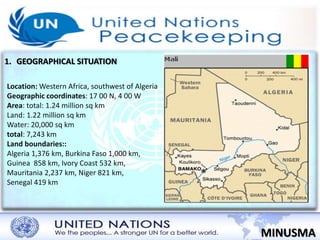
Location:Western Africa, southwest of Algeria 
Geographic coordinates: 17 00 N, 4 00 W 
Area: total: 1.24 million sq km 
Land: 1.22 million sq km 
Water: 20,000 sq km 
total: 7,243 km 
Land boundaries:: 
Algeria 1,376 km, Burkina Faso 1,000 km, 
Guinea 858 km, Ivory Coast 532 km, 
Mauritania 2,237 km, Niger 821 km, 
Senegal 419 km
1. GEOGRAPHICAL SITUATION 
MINUSMA 
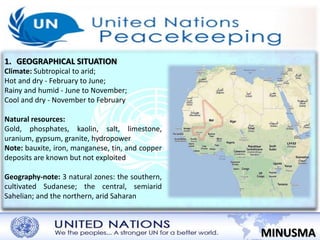
Climate: Subtropical to arid; 
Hot and dry - February to June; 
Rainy and humid - June to November; 
Cool and dry - November to February 
Natural resources: 
Gold, phosphates, kaolin, salt, limestone, 
uranium, gypsum, granite, hydropower 
Note: bauxite, iron, manganese, tin, and copper 
deposits are known but not exploited 
Geography-note: 3 natural zones: the southern, 
cultivated Sudanese; the central, semiarid 
Sahelian; and the northern, arid Saharan
1. GEOGRAPHICAL SITUATION 
MINUSMA 
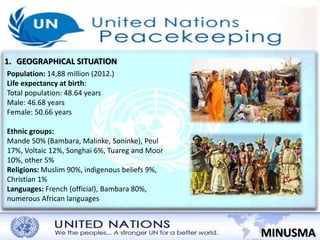
Population: 14,88 million (2012.) 
Life expectancy at birth: 
Total population: 48.64 years 
Male: 46.68 years 
Female: 50.66 years 
Ethnic groups: 
Mande 50% (Bambara, Malinke, Soninke), Peul 
17%, Voltaic 12%, Songhai 6%, Tuareg and Moor 
10%, other 5% 
Religions: Muslim 90%, indigenous beliefs 9%, 
Christian 1% 
Languages: French (official), Bambara 80%, 
numerous African languages
1. GEOGRAPHICAL SITUATION 
MINUSMA 
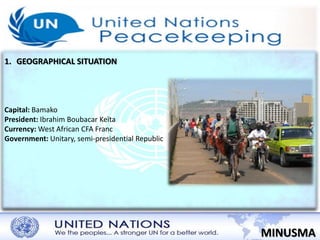
Capital: Bamako 
President: Ibrahim Boubacar Keïta 
Currency: West African CFA Franc 
Government: Unitary, semi-presidential Republic
2. ANTECEDENTS OF THE CONFLICT 
MINUSMA 
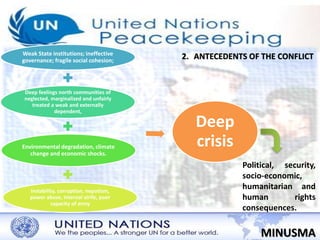
Weak State institutions; ineffective 
governance; fragile social cohesion; 
Deep feelings north communities of 
neglected, marginalized and unfairly 
treated a weak and externally 
dependent, 
Environmental degradation, climate 
change and economic shocks. 
Instability, corruption, nepotism, 
power abuse, internal strife, poor 
capacity of army 
Deep 
crisis 
Political, security, 
socio-economic, 
humanitarian and 
human rights 
consequences.
2. ANTECEDENTS OF THE CONFLICT 
• January 2012, Tuareg movement (MNLA), Islamic armed 
groups (Ansar Dine, Al-Qaida, MUJAO), deserters from the 
Malian armed forces, with well-equipped combatants 
returning from Libya. 
• March, a mutiny by disaffected soldiers resulted in a 
military coup d’état, led by Captain Amadou Sanogo 
• Independent State of Azawad on April 
• UN SRSG for West Africa offered support of the UN - 
political negotiation, elections, governance, security sector 
reform and humanitarian assistance 
• ECOWAS appointed the President of Burkina Faso to 
mediate the crisis 
• Interim President, agreement for a transitional 
Government, headed by a prime minister with executive 
powers. 
MINUSMA 
2012 
rebellion 
and 
coup 
d’état
2. ANTECEDENTS OF THE CONFLICT 
• Terrorist and other armed elements advanced 
southwards. 
• Also advanced in the west taking control of Diabaly. 
• Malian transitional authorities request the assistance 
of France - Operation Serval – Control restored 
• Security challenges remained - restore the integrity of 
Mali’s territory. 
• Terrorist attacks, weapons proliferation, drug 
smuggling and other related criminal . 
MINUSMA 
January 
2013 
crisis
3. ORGANIZATION OF THE MISSION 
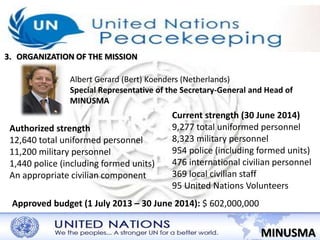
Albert Gerard (Bert) Koenders (Netherlands) 
Special Representative of the Secretary-General and Head of 
MINUSMA 
MINUSMA 
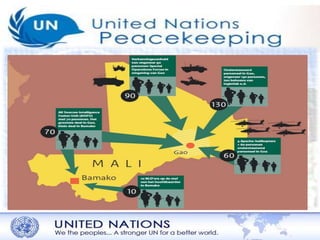
Authorized strength 
12,640 total uniformed personnel 
11,200 military personnel 
1,440 police (including formed units) 
An appropriate civilian component 
Current strength (30 June 2014) 
9,277 total uniformed personnel 
8,323 military personnel 
954 police (including formed units) 
476 international civilian personnel 
369 local civilian staff 
95 United Nations Volunteers 
Approved budget (1 July 2013 – 30 June 2014): $ 602,000,000
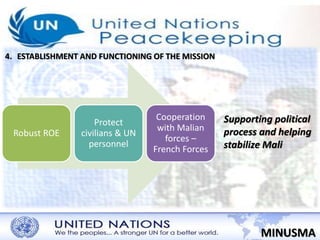
4. ESTABLISHMENT AND FUNCTIONING OF THE MISSION 
MINUSMA 
MINUSMA 
• United Nations Multidimensional Integrated Stabilization Mission 
in Mali 
• 25 April 2013 
• Political process and a number of security-related stabilization 
tasks 
• Population centres and lines of communication 
• Protecting civilians, human rights monitoring, humanitarian 
assistance, return of displaced persons, State authority, free 
and peaceful elections
4. ESTABLISHMENT AND FUNCTIONING OF THE MISSION 
MINUSMA 
Robust ROE 
Protect 
civilians & UN 
personnel 
Cooperation 
with Malian 
forces – 
French Forces 
Supporting political 
process and helping 
stabilize Mali
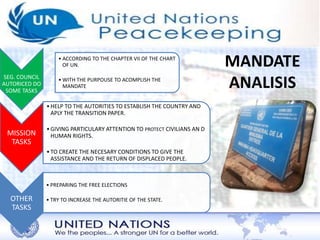
MANDATE 
ANALISIS SEG. COUNCIL 
AUTORICED DO 
SOME TASKS 
• ACCORDING TO THE CHAPTER VII OF THE CHART 
OF UN. 
• WITH THE PURPOUSE TO ACOMPLISH THE 
MANDATE 
MISSION 
TASKS 
• HELP TO THE AUTORITIES TO ESTABLISH THE COUNTRY AND 
APLY THE TRANSITION PAPER. 
• GIVING PARTICULARY ATTENTION TO PROTECT CIVILIANS AN D 
HUMAN RIGHTS. 
• TO CREATE THE NECESARY CONDITIONS TO GIVE THE 
ASSISTANCE AND THE RETURN OF DISPLACED PEOPLE. 
OTHER 
TASKS 
• PREPARING THE FREE ELECTIONS 
• TRY TO INCREASE THE AUTORITIE OF THE STATE.
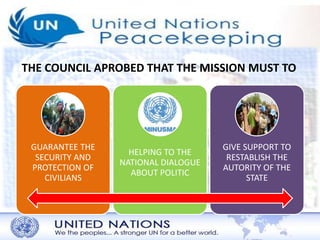
THE COUNCIL APROBED THAT THE MISSION MUST TO 
GUARANTEE THE 
SECURITY AND 
PROTECTION OF 
CIVILIANS 
HELPING TO THE 
NATIONAL DIALOGUE 
ABOUT POLITIC 
GIVE SUPPORT TO 
RESTABLISH THE 
AUTORITY OF THE 
STATE
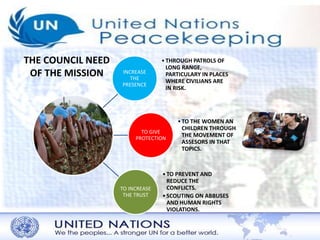
THE COUNCIL NEED 
OF THE MISSION INCREASE 
THE 
PRESENCE 
• THROUGH PATROLS OF 
LONG RANGE, 
PARTICULARY IN PLACES 
WHERE CIVILIANS ARE 
IN RISK. 
TO GIVE 
PROTECTION 
• TO THE WOMEN AN 
CHILDREN THROUGH 
THE MOVEMENT OF 
ASSESORS IN THAT 
TOPICS. 
TO INCREASE 
THE TRUST 
• TO PREVENT AND 
REDUCE THE 
CONFLICTS. 
• SCOUTING ON ABBUSES 
AND HUMAN RIGHTS 
VIOLATIONS.
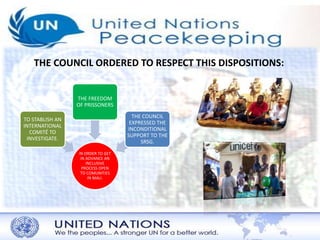
THE COUNCIL ORDERED TO RESPECT THIS DISPOSITIONS: 
IN ORDER TO GET 
IN ADVANCE AN 
INCLUSIVE 
PROCESS OPEN 
TO COMUNITIES 
IN MALI. 
TO STABLISH AN 
INTERNATIONAL 
COMITÉ TO 
INVESTIGATE. 
THE FREEDOM 
OF PRISSONERS 
THE COUNCIL 
EXPRESSED THE 
INCONDITIONAL 
SUPPORT TO THE 
SRSG.
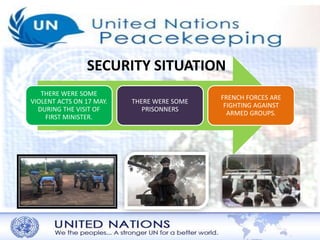
SECURITY SITUATION 
THERE WERE SOME 
VIOLENT ACTS ON 17 MAY. 
DURING THE VISIT OF 
FIRST MINISTER. 
THERE WERE SOME 
PRISONNERS 
FRENCH FORCES ARE 
FIGHTING AGAINST 
ARMED GROUPS.
SECURITY SITUATION 
AFTER TWO MONTHS OF THE FRANCAISE 
INERVENTION THERE WERE SIGNIFICATIVE 
ADVANCES. 
THE TERRITORIAL INTEGRITY IS IN PROCESS OF 
RESTABLISH COMPLETELY. 
THERE HAVE HAD STARTED DISCUSS BETWEEN THE 
SEC. COUNCIL WITH OTHER AFRICAN COUNTRIES.
THE POLITIC 
PROCESS IS THE 
CENTER OF 
ATENTION OF 
THE CRISIS 
THE PRESIDEN 
ANOUNCED 
THEY WILL 
HAVE FREE 
ELECTIONS. 
AT THIS FHASE 
OF 
STABLISHMENT 
IS NECESARY 
TO ANALISE 
THE 
DEVELOVMENT 
ASPECT. IN 
ORDER TO 
REACH THE 
PEACE. 
SECURITY SITUATION
SECURITY SITUATION 
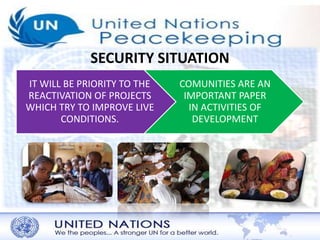
IT WILL BE PRIORITY TO THE 
REACTIVATION OF PROJECTS 
WHICH TRY TO IMPROVE LIVE 
CONDITIONS. 
COMUNITIES ARE AN 
IMPORTANT PAPER 
IN ACTIVITIES OF 
DEVELOPMENT
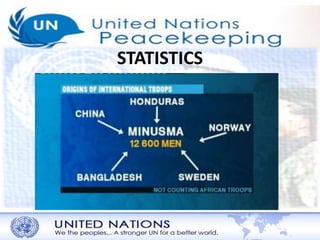
STATISTICS
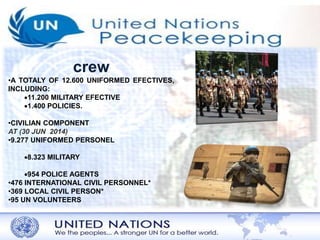
crew 
•A TOTALY OF 12.600 UNIFORMED EFECTIVES, 
INCLUDING: 
11.200 MILITARY EFECTIVE 
1.400 POLICIES. 
•CIVILIAN COMPONENT 
AT (30 JUN 2014) 
•9.277 UNIFORMED PERSONEL 
8.323 MILITARY 
954 POLICE AGENTS 
•476 INTERNATIONAL CIVIL PERSONNEL* 
•369 LOCAL CIVIL PERSON* 
•95 UN VOLUNTEERS
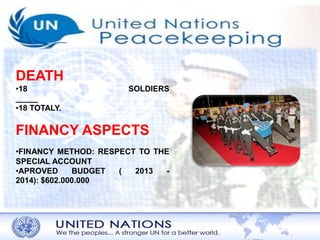
DEATH 
•18 SOLDIERS 
_____ 
•18 TOTALY. 
FINANCY ASPECTS 
•FINANCY METHOD: RESPECT TO THE 
SPECIAL ACCOUNT 
•APROVED BUDGET ( 2013 - 
2014): $602.000.000
8. CONCLUSION 
• The rebel attacks destroy the internal structure of Mali avoiding the nations 
development. 
• The support given by UN to Mali help that country to stabilize some internal 
process. 
9. RECOMMENDATION 
• Continue given support to Mali in order to complete the UN Mandate. 
• Increase the supervision on rebel groups in order to put down all the 
negatives efforts carried out by them.
MINUSMA 
PEACEKEEPING MISSION 
PRESENTED BY 
TNNV-SU JOSE LUIS ACOSTA GALARZA 
TNNV-IM LUIS SANTIN VILLACRECES

Mali peacekeeping mission

  • 1.
    MALI PEACEKEEPING MISSION MINUSMA PRESENTED BY TNNV-SU JOSE LUIS ACOSTA GALARZA – TNNV-IM LUIS SANTIN VILLACRECES
  • 2.
    OUTLINE 1. GEOGRAPHICALSITUATION 2. ANTECEDENTS OF THE CONFLICT 3. ORGANIZATION OF THE MISSION 4. ESTABLISHMENT AND FUNCTIONING OF THE MISSION 5. MANDATE ANALYSIS 6. SECURITY SITUATION 7. ESTADISTICS 8. CONCLUSION 9. RECOMENDATION
  • 3.
    1. GEOGRAPHICAL SITUATION MINUSMA Location:Western Africa, southwest of Algeria Geographic coordinates: 17 00 N, 4 00 W Area: total: 1.24 million sq km Land: 1.22 million sq km Water: 20,000 sq km total: 7,243 km Land boundaries:: Algeria 1,376 km, Burkina Faso 1,000 km, Guinea 858 km, Ivory Coast 532 km, Mauritania 2,237 km, Niger 821 km, Senegal 419 km
  • 4.
    1. GEOGRAPHICAL SITUATION MINUSMA Climate: Subtropical to arid; Hot and dry - February to June; Rainy and humid - June to November; Cool and dry - November to February Natural resources: Gold, phosphates, kaolin, salt, limestone, uranium, gypsum, granite, hydropower Note: bauxite, iron, manganese, tin, and copper deposits are known but not exploited Geography-note: 3 natural zones: the southern, cultivated Sudanese; the central, semiarid Sahelian; and the northern, arid Saharan
  • 5.
    1. GEOGRAPHICAL SITUATION MINUSMA Population: 14,88 million (2012.) Life expectancy at birth: Total population: 48.64 years Male: 46.68 years Female: 50.66 years Ethnic groups: Mande 50% (Bambara, Malinke, Soninke), Peul 17%, Voltaic 12%, Songhai 6%, Tuareg and Moor 10%, other 5% Religions: Muslim 90%, indigenous beliefs 9%, Christian 1% Languages: French (official), Bambara 80%, numerous African languages
  • 6.
    1. GEOGRAPHICAL SITUATION MINUSMA Capital: Bamako President: Ibrahim Boubacar Keïta Currency: West African CFA Franc Government: Unitary, semi-presidential Republic
  • 7.
    2. ANTECEDENTS OFTHE CONFLICT MINUSMA Weak State institutions; ineffective governance; fragile social cohesion; Deep feelings north communities of neglected, marginalized and unfairly treated a weak and externally dependent, Environmental degradation, climate change and economic shocks. Instability, corruption, nepotism, power abuse, internal strife, poor capacity of army Deep crisis Political, security, socio-economic, humanitarian and human rights consequences.
  • 8.
    2. ANTECEDENTS OFTHE CONFLICT • January 2012, Tuareg movement (MNLA), Islamic armed groups (Ansar Dine, Al-Qaida, MUJAO), deserters from the Malian armed forces, with well-equipped combatants returning from Libya. • March, a mutiny by disaffected soldiers resulted in a military coup d’état, led by Captain Amadou Sanogo • Independent State of Azawad on April • UN SRSG for West Africa offered support of the UN - political negotiation, elections, governance, security sector reform and humanitarian assistance • ECOWAS appointed the President of Burkina Faso to mediate the crisis • Interim President, agreement for a transitional Government, headed by a prime minister with executive powers. MINUSMA 2012 rebellion and coup d’état
  • 9.
    2. ANTECEDENTS OFTHE CONFLICT • Terrorist and other armed elements advanced southwards. • Also advanced in the west taking control of Diabaly. • Malian transitional authorities request the assistance of France - Operation Serval – Control restored • Security challenges remained - restore the integrity of Mali’s territory. • Terrorist attacks, weapons proliferation, drug smuggling and other related criminal . MINUSMA January 2013 crisis
  • 10.
    3. ORGANIZATION OFTHE MISSION Albert Gerard (Bert) Koenders (Netherlands) Special Representative of the Secretary-General and Head of MINUSMA MINUSMA Authorized strength 12,640 total uniformed personnel 11,200 military personnel 1,440 police (including formed units) An appropriate civilian component Current strength (30 June 2014) 9,277 total uniformed personnel 8,323 military personnel 954 police (including formed units) 476 international civilian personnel 369 local civilian staff 95 United Nations Volunteers Approved budget (1 July 2013 – 30 June 2014): $ 602,000,000
  • 11.
    4. ESTABLISHMENT ANDFUNCTIONING OF THE MISSION MINUSMA MINUSMA • United Nations Multidimensional Integrated Stabilization Mission in Mali • 25 April 2013 • Political process and a number of security-related stabilization tasks • Population centres and lines of communication • Protecting civilians, human rights monitoring, humanitarian assistance, return of displaced persons, State authority, free and peaceful elections
  • 12.
    4. ESTABLISHMENT ANDFUNCTIONING OF THE MISSION MINUSMA Robust ROE Protect civilians & UN personnel Cooperation with Malian forces – French Forces Supporting political process and helping stabilize Mali
  • 13.
    MANDATE ANALISIS SEG.COUNCIL AUTORICED DO SOME TASKS • ACCORDING TO THE CHAPTER VII OF THE CHART OF UN. • WITH THE PURPOUSE TO ACOMPLISH THE MANDATE MISSION TASKS • HELP TO THE AUTORITIES TO ESTABLISH THE COUNTRY AND APLY THE TRANSITION PAPER. • GIVING PARTICULARY ATTENTION TO PROTECT CIVILIANS AN D HUMAN RIGHTS. • TO CREATE THE NECESARY CONDITIONS TO GIVE THE ASSISTANCE AND THE RETURN OF DISPLACED PEOPLE. OTHER TASKS • PREPARING THE FREE ELECTIONS • TRY TO INCREASE THE AUTORITIE OF THE STATE.
  • 14.
    THE COUNCIL APROBEDTHAT THE MISSION MUST TO GUARANTEE THE SECURITY AND PROTECTION OF CIVILIANS HELPING TO THE NATIONAL DIALOGUE ABOUT POLITIC GIVE SUPPORT TO RESTABLISH THE AUTORITY OF THE STATE
  • 15.
    THE COUNCIL NEED OF THE MISSION INCREASE THE PRESENCE • THROUGH PATROLS OF LONG RANGE, PARTICULARY IN PLACES WHERE CIVILIANS ARE IN RISK. TO GIVE PROTECTION • TO THE WOMEN AN CHILDREN THROUGH THE MOVEMENT OF ASSESORS IN THAT TOPICS. TO INCREASE THE TRUST • TO PREVENT AND REDUCE THE CONFLICTS. • SCOUTING ON ABBUSES AND HUMAN RIGHTS VIOLATIONS.
  • 16.
    THE COUNCIL ORDEREDTO RESPECT THIS DISPOSITIONS: IN ORDER TO GET IN ADVANCE AN INCLUSIVE PROCESS OPEN TO COMUNITIES IN MALI. TO STABLISH AN INTERNATIONAL COMITÉ TO INVESTIGATE. THE FREEDOM OF PRISSONERS THE COUNCIL EXPRESSED THE INCONDITIONAL SUPPORT TO THE SRSG.
  • 17.
    SECURITY SITUATION THEREWERE SOME VIOLENT ACTS ON 17 MAY. DURING THE VISIT OF FIRST MINISTER. THERE WERE SOME PRISONNERS FRENCH FORCES ARE FIGHTING AGAINST ARMED GROUPS.
  • 18.
    SECURITY SITUATION AFTERTWO MONTHS OF THE FRANCAISE INERVENTION THERE WERE SIGNIFICATIVE ADVANCES. THE TERRITORIAL INTEGRITY IS IN PROCESS OF RESTABLISH COMPLETELY. THERE HAVE HAD STARTED DISCUSS BETWEEN THE SEC. COUNCIL WITH OTHER AFRICAN COUNTRIES.
  • 19.
    THE POLITIC PROCESSIS THE CENTER OF ATENTION OF THE CRISIS THE PRESIDEN ANOUNCED THEY WILL HAVE FREE ELECTIONS. AT THIS FHASE OF STABLISHMENT IS NECESARY TO ANALISE THE DEVELOVMENT ASPECT. IN ORDER TO REACH THE PEACE. SECURITY SITUATION
  • 20.
    SECURITY SITUATION ITWILL BE PRIORITY TO THE REACTIVATION OF PROJECTS WHICH TRY TO IMPROVE LIVE CONDITIONS. COMUNITIES ARE AN IMPORTANT PAPER IN ACTIVITIES OF DEVELOPMENT
  • 21.
  • 23.
    crew •A TOTALYOF 12.600 UNIFORMED EFECTIVES, INCLUDING: 11.200 MILITARY EFECTIVE 1.400 POLICIES. •CIVILIAN COMPONENT AT (30 JUN 2014) •9.277 UNIFORMED PERSONEL 8.323 MILITARY 954 POLICE AGENTS •476 INTERNATIONAL CIVIL PERSONNEL* •369 LOCAL CIVIL PERSON* •95 UN VOLUNTEERS
  • 24.
    DEATH •18 SOLDIERS _____ •18 TOTALY. FINANCY ASPECTS •FINANCY METHOD: RESPECT TO THE SPECIAL ACCOUNT •APROVED BUDGET ( 2013 - 2014): $602.000.000
  • 25.
    8. CONCLUSION •The rebel attacks destroy the internal structure of Mali avoiding the nations development. • The support given by UN to Mali help that country to stabilize some internal process. 9. RECOMMENDATION • Continue given support to Mali in order to complete the UN Mandate. • Increase the supervision on rebel groups in order to put down all the negatives efforts carried out by them.
  • 27.
    MINUSMA PEACEKEEPING MISSION PRESENTED BY TNNV-SU JOSE LUIS ACOSTA GALARZA TNNV-IM LUIS SANTIN VILLACRECES

Editor's Notes

  • #8 In recent years, Mali has been confronted by a profound crisis with serious political, security, socio-economic, humanitarian and human rights consequences. The crisis stems from long-standing structural conditions such as weak State institutions; ineffective governance; fragile social cohesion; deep-seated feelings among communities in the north of being neglected, marginalized and unfairly treated by the central Government; a weak and externally dependent, albeit vibrant, civil society; and the effects of environmental degradation, climate change and economic shocks. These conditions were exacerbated by more recent factors of instability, including corruption, nepotism, abuse of power, internal strife and deteriorating capacity of the national army.
  • #9 2012 Attacks against Government forces in the north. took power, suspended the Constitution and dissolved the Government institutions. The coup accelerated the collapse of the State in the north, allowing MNLA to easily overrun Government forces in the regions of Kidal, Gao and Timbuktu and proclaim an independent State of Azawad on 6 April. Shortly thereafter, tensions emerged among the armed groups in the north and, by 18 November, Ansar Dine and MUJAO had driven MNLA out of the main towns of Gao, Timbuktu and Kidal. Following the coup d’état, UN Secretary-General’s Special Representative for West Africa, Said Djinnit, offered the support of the United Nations to the Malian authorities. As a result, the Mali interim authorities requested United Nations assistance to build the capacity of the Malian transitional authorities in the areas of political negotiation, elections, governance, security sector reform and humanitarian assistance. Government of the Economic Community of West African States (ECOWAS) appointed the President of Burkina Faso, Blaise Compaoré, to mediate in the crisis. On 6 April, the military junta and ECOWAS signed a framework agreement that led to the resignation of the then President, Amadou Toumani Touré, on 8 April and the appointment of the Speaker of the National Assembly, Dioncounda Traoré, as interim President on 12 April. The agreement provided for the establishment of a transitional Government, headed by a prime minister with executive powers.
  • #10 The security situation in Mali underwent a serious deterioration in early January 2013, when elements of Ansar Dine and the Movement for Unity and Jihad in West Africa, with the support of Al-Qaida in the Islamic Maghreb, advanced southwards. They clashed with the Malian army north of the town of Konna, some 680 kilometres from Bamako, forcing the soldiers to withdraw. Terrorist and other armed elements also advanced in the west, taking control of the town of Diabaly on 14 January. The capture of Konna by extremist groups led the Malian transitional authorities to request the assistance of France to defend Mali’s sovereignty and restore its territorial integrity. In response, military operations against terrorist and associated elements were initiated on 11 January under “Operation Serval”, led by France, in support of the Malian defence and security forces. The deployment of AFISMA was accelerated following the military intervention, allowing some of the contingents to move into different parts of northern Mali in February. As a result of the French and African military operations alongside the Malian army in northern areas, the security situation in Mali significantly improved. By the end of January, State control had been restored in most major northern towns, such as Diabaly, Douentza, Gao, Konna and Timbuktu. Most terrorist and associated forces withdrew northwards into the Adrar des Ifoghas mountains while others, mainly local Malians, reportedly blended into local communities. Despite these gains, serious security challenges remained, including continued terrorist activities and military operations in some areas. The need to restore the integrity of Mali’s territory and ensure the physical security of communities in the north continued to be a central priority. Even when full territorial integrity is regained, many serious security risks will remain, including terrorist attacks, weapons proliferation, drug smuggling and other related criminal activities, which are likely to continue to undermine governance and development in Mali for the foreseeable future.
  • #12 The United Nations Multidimensional Integrated Stabilization Mission in Mali (MINUSMA) was established by Security Council resolution 2100 of 25 April 2013. Under the terms of the resolution, the mission would support the political process and carry out a number of security-related stabilization tasks, with a focus on major population centres and lines of communication, protecting civilians, human rights monitoring, the creation of conditions for the provision of humanitarian assistance and the return of displaced persons, the extension of State authority and the preparation of free, inclusive and peaceful elections.
  • #13 The Mission would operate under robust rules of engagement with a mandate to use all necessary means to address threats to the implementation of its mandate, which would include protection of civilians under imminent threat of physical violence and protection of United Nations personnel from residual threats, within its capabilities and its areas of deployment. This could include the conduct of operations on its own or in cooperation with the Malian defence and security forces. French forces deployed in Mali were also authorized to intervene in support of MINUSMA when under imminent and serious threat upon request of the Secretary-General.
  • #24 Peacekeeping has proven to be one of the most effective tools available to the UN to assist host countries navigate the difficult path from conflict to peace. Peacekeeping has unique strengths, including legitimacy, burden sharing, and an ability to deploy and sustain troops and police from around the globe, integrating them with civilian peacekeepers to advance multidimensional mandates.