ANNUALREPORT2015ECONOMICDEVELOPMENTSIN201533ANNUALREPORT2015ECONOMICDEVELOPMENTSIN2015
Assessing Demand-Supply Conditions in the Malaysian Property Market
Introduction
The Malaysian property market is characterised by unevenness across its sub-segments in recent times, with
demand outstripping supply in the housing market, while the office and retail markets are experiencing
oversupply. The rapid increase in house prices, particularly in the major urban centres, has been attributable
partly to a shortfall in supply. The shortage is particularly evident in the supply of affordable housing. This has
increasingly priced out more urban Malaysian households from the housing market. In contrast, the increase
in the construction of office buildings and retail malls, particularly in major cities, has raised the
potential of overbuilding of commercial properties that could adversely impact the real estate market.
This article identifies the current demand-supply dynamics and the outlook in three property segments
in Malaysia – housing, office and retail, with a focus on the key states1
(Kuala Lumpur, Selangor, Johor
and Pulau Pinang) and seeks to highlight lessons from the experiences of other countries.
Shortage of supply in the affordable housing market
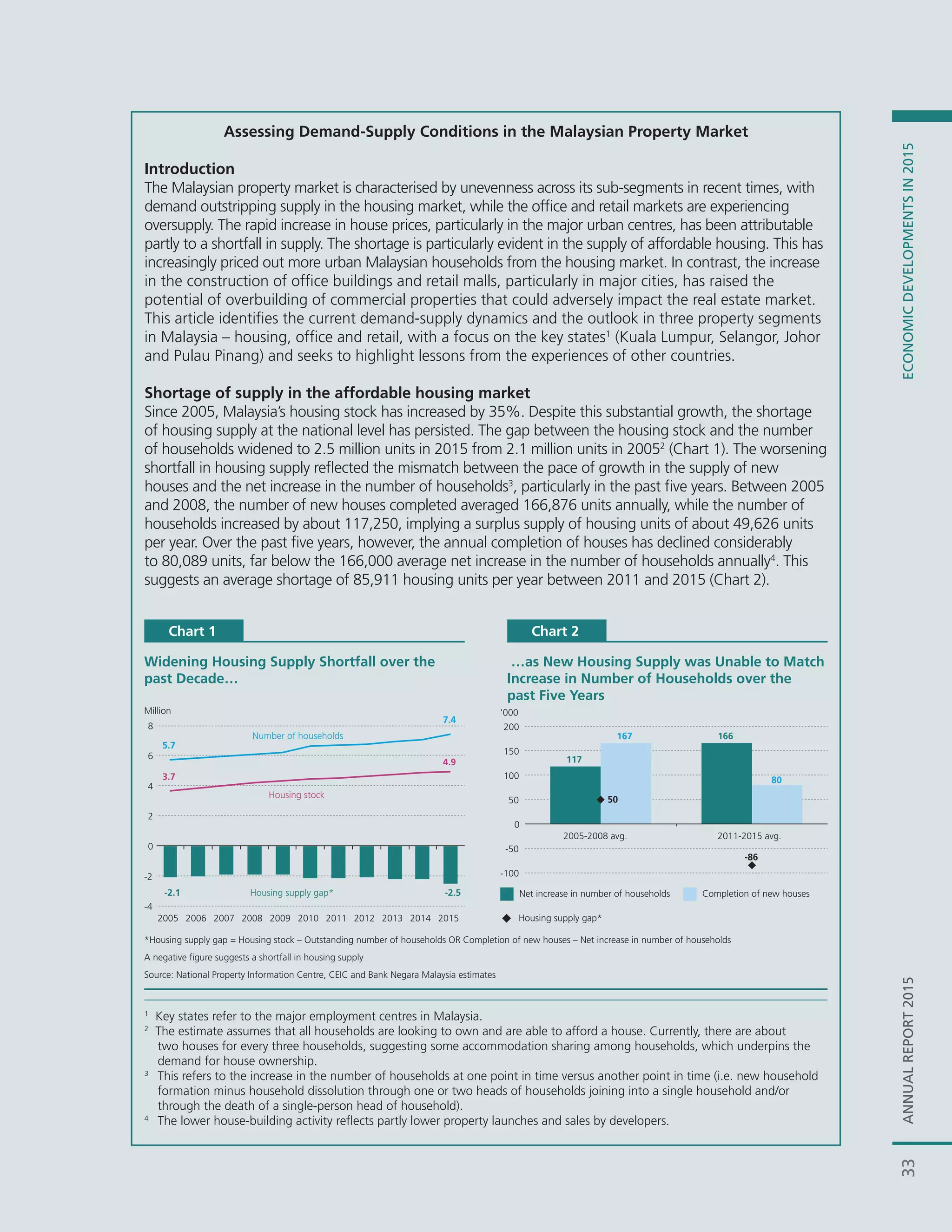
Since 2005, Malaysia’s housing stock has increased by 35%. Despite this substantial growth, the shortage
of housing supply at the national level has persisted. The gap between the housing stock and the number
of households widened to 2.5 million units in 2015 from 2.1 million units in 20052
(Chart 1). The worsening
shortfall in housing supply reflected the mismatch between the pace of growth in the supply of new
houses and the net increase in the number of households3
, particularly in the past five years. Between 2005
and 2008, the number of new houses completed averaged 166,876 units annually, while the number of
households increased by about 117,250, implying a surplus supply of housing units of about 49,626 units
per year. Over the past five years, however, the annual completion of houses has declined considerably
to 80,089 units, far below the 166,000 average net increase in the number of households annually4
. This
suggests an average shortage of 85,911 housing units per year between 2011 and 2015 (Chart 2).
1
Key states refer to the major employment centres in Malaysia.
2
The estimate assumes that all households are looking to own and are able to afford a house. Currently, there are about
two houses for every three households, suggesting some accommodation sharing among households, which underpins the
demand for house ownership.
3
This refers to the increase in the number of households at one point in time versus another point in time (i.e. new household
formation minus household dissolution through one or two heads of households joining into a single household and/or
through the death of a single-person head of household).
4
The lower house-building activity reflects partly lower property launches and sales by developers.
Chart 1 Chart 2
Widening Housing Supply Shortfall over the
past Decade…
…as New Housing Supply was Unable to Match
Increase in Number of Households over the
past Five Years
*Housing supply gap = Housing stock – Outstanding number of households OR Completion of new houses – Net increase in number of households
A negative figure suggests a shortfall in housing supply
Source: National Property Information Centre, CEIC and Bank Negara Malaysia estimates
-2.1 -2.5
5.7
7.4
3.7
4.9
-4
-2
0
2
4
6
8
2005 2006 2007 2008 2009 2010 2011 2012 2013 2014 2015
Million
Number of households
Housing stock
Housing supply gap*
117
166167
80
50
-86
-100
-50
0
50
100
150
200
2005-2008 avg. 2011-2015 avg.
'000
Net increase in number of households Completion of new houses
Housing supply gap*
ANNUALREPORT2015ECONOMICDEVELOPMENTSIN201534ANNUALREPORT2015ECONOMICDEVELOPMENTSIN2015
5
The oversupply of higher-end residential property is evident particularly in some areas in the key states and in selected
property segments (i.e. luxury condominiums).
6
Houses priced from RM540,000 are considered affordable for households earning at least RM15,000 a month (5.4% of
Malaysia’s total population in 2014).
7
Another contributing factor to the rapid increase in house prices over the past few years was the use of marketing tools
by developers and low real property gains tax (RPGT) rates. For example, the Developer Interest-Bearing Scheme (DIBS) not
only artificially inflated property prices, but also encouraged speculators to enter the property market with very small capital
outlays. In November 2013, DIBS was prohibited by Bank Negara Malaysia, along with the introduction of more punitive RPGT
rates by the Government.
8
The Compound Annual Growth Rate (CAGR) is the average annual growth rate over a specified period of time.
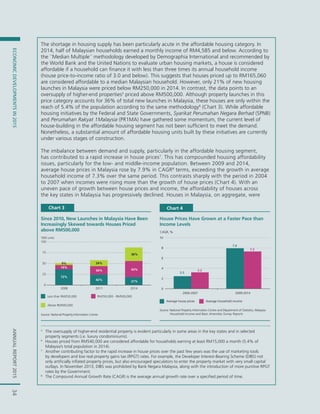
The shortage in housing supply has been particularly acute in the affordable housing category. In
2014, half of Malaysian households earned a monthly income of RM4,585 and below. According to
the ``Median Multiple´´ methodology developed by Demographia International and recommended by
the World Bank and the United Nations to evaluate urban housing markets, a house is considered
affordable if a household can finance it with less than three times its annual household income
(house price-to-income ratio of 3.0 and below). This suggests that houses priced up to RM165,060
are considered affordable to a median Malaysian household. However, only 21% of new housing
launches in Malaysia were priced below RM250,000 in 2014. In contrast, the data points to an
oversupply of higher-end properties5
priced above RM500,000. Although property launches in this
price category accounts for 36% of total new launches in Malaysia, these houses are only within the
reach of 5.4% of the population according to the same methodology6
(Chart 3). While affordable
housing initiatives by the Federal and State Governments, Syarikat Perumahan Negara Berhad (SPNB)
and Perumahan Rakyat 1Malaysia (PR1MA) have gathered some momentum, the current level of
house-building in the affordable housing segment has not been sufficient to meet the demand.
Nonetheless, a substantial amount of affordable housing units built by these initiatives are currently
under various stages of construction.
The imbalance between demand and supply, particularly in the affordable housing segment,
has contributed to a rapid increase in house prices7
. This has compounded housing affordability
issues, particularly for the low- and middle-income population. Between 2009 and 2014,
average house prices in Malaysia rose by 7.9% in CAGR8
terms, exceeding the growth in average
household income of 7.3% over the same period. This contrasts sharply with the period in 2004
to 2007 when incomes were rising more than the growth of house prices (Chart 4). With an
uneven pace of growth between house prices and income, the affordability of houses across
the key states in Malaysia has progressively declined. Houses in Malaysia, on aggregate, were
Chart 3
Since 2010, New Launches in Malaysia Have Been
Increasingly Skewed towards Houses Priced
above RM500,000
Source: National Property Information Centre
0
25
50
75
100
2008 2011 2014
RM250,000 - RM500,000
Above RM500,000
'000 units
72%
42% 21%
19%
34% 43%
9% 24%
36%
Less than RM250,000
Chart 4
House Prices Have Grown at a Faster Pace than
Income Levels
Source: National Property Information Centre and Department of Statistics, Malaysia
Household Income and Basic Amenities Survey Reports
2.5
7.9
3.2
7.3
0
2
4
6
8
10
2004-2007 2009-2014
Average house prices Average household income
CAGR, %
ANNUALREPORT2015ECONOMICDEVELOPMENTSIN201535ANNUALREPORT2015ECONOMICDEVELOPMENTSIN2015
9
Houses priced up to a maximum of three times the annual median household income is considered affordable (RM165,060).
House Prices are Severely Unaffordable in Kuala Lumpur and Pulau Pinang
Location
House Price-to-Income Ratio
Rating
House Price-to-Income
Ratio
2012 2014
Kuala Lumpur 4.9 5.4
Pulau Pinang 4.1 5.2 Severely Unaffordable 5.1 & Above
Johor 3.7 4.2 Seriously Unaffordable 4.1 to 5.0
Selangor 3.6 4.0 Moderately Unaffordable 3.1 to 4.0
Malaysia 4.0 4.4 Affordable 3.0 & Below
Source: Department of Statistics, Malaysia Household Income and Basic Amenities Survey Reports, National Property Information Centre and
12th Annual Demographia International Housing Affordability Survey 2016
Table 1
considered seriously unaffordable in 2014 (house price-to-income ratio of 4.4) according to the
``Median Multiple´´ methodology. In the key states, houses were severely unaffordable in Kuala
Lumpur and Pulau Pinang, while those in Johor and Selangor were seriously unaffordable and
moderately unaffordable, respectively (Table 1).
The gap between actual house prices and the levels that are considered affordable to the
majority of Malaysian households requires comprehensive resolution. In 2014, the median house
price prevailing in the market was RM242,000, which was RM76,940 more than what would be
an affordable price for a median household9
. Amongst the key states, the gap was most severe
in Kuala Lumpur at RM215,680 (Chart 5). In the major urban employment centres in these key
states, the situation is even more acute (Chart 6).
Chart 5
House Prices in Key States are beyond the Reach
of Most Malaysians in 2014…
Note: Figures in parentheses ( ) refer to each state’s median household monthly income in 2014
Figures in square brackets [ ] refer to the state’s urban median household monthly income in 2014, used as a proxy to the median household income in each urban city
*The cities in each state are based upon the delineation of (i) District: Petaling (Shah Alam, Subang Jaya and Petaling Jaya) in Selangor and Johor Bahru in Johor;
(ii) Mukim: Kuala Lumpur Town Centre in Kuala Lumpur and Georgetown in Pulau Pinang
Source: Department of Statistics, Malaysia, National Property Information Centre and Bank Negara Malaysia estimates
165
274
224 187 169
Malaysia
(4,585)
Kuala Lumpur
(7,620)
Selangor
(6,214)
Johor
(5,197)
Pulau Pinang
(4,702)
Ideal median house prices Actual median house prices
Chart 6
…and Even More so in the Key Urban
Employment Centres
Ideal median house prices Actual city* median house prices
274 233 198 173
0
100
200
300
400
500
600
700
Kuala Lumpur City
[7,620]
Petaling
[6,484]
Johor Bahru
[5,497]
Georgetown
[4,792]
RM '000
0
100
200
300
400
500
600
700
RM '000
165 274 224 187 169
242
490
300
260 295
274 233 198 173
560
470
335
600
ANNUALREPORT2015ECONOMICDEVELOPMENTSIN201536ANNUALREPORT2015ECONOMICDEVELOPMENTSIN2015
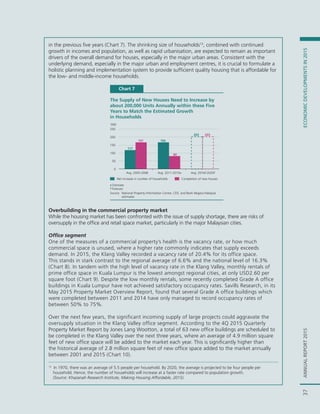
Moving forward, a substantial increase in the supply of affordable housing is necessary. An estimated
202,571 new houses12
will be required annually between 2016 and 2020 to match the estimated
growth in households during this period, approximately 2.5 times the number of houses built annually
10
Alfelt, Gustav, et.al. (2015). There is no general definition of how a debt-to-income limit should be designed and its effects
can vary depending on its construction. For example, a debt-to-income limit can be introduced to either target individual
households or the banks’ lending stock. Furthermore, the definition of debt and income may differ across countries.
11
The loan size is based on 30% housing debt service ratio* (using income net of statutory deductions), 35-year loan tenure,
housing loan-to-value ratio of 90% and lending rate of 5%.
12
The estimate reflects a continuation of historical trends in terms of household formation and the capacity of households to
exercise choice in owning a house. Net household growth is thus assumed to continue to expand at its long-term average
(between 2005 and 2015) of 2.6% annually between 2016 and 2020.
* Most young buyers tend to be indebted with existing debt obligations (i.e. car loan, outstanding credit card repayments),
implying a lesser amount of disposable income that can be allocated for a housing loan.
Information Box: Housing Loan Affordability
The assessment of housing affordability can alternatively be measured by the households’ ability to
service mortgage loans using their income. The debt-to-income measure, which has been increasingly
adopted by a number of countries with high household debt levels, establishes an upper limit to
a household’s total loan in relation to its disposable income10
. In this approach, we compare the
maximum loan11
amount that a bank can extend to a median household against the actual median
house prices. The results concur with our findings using the ``Median Multiple´´ approach.
A median household in Kuala Lumpur and Penang has insufficient capacity to service a mortgage
loan based on the median house prices in these areas (Chart A). In the key urban employment
centres, that capacity is even less (Chart B).
Chart A
House Prices in Kuala Lumpur and Penang are
Unaffordable to a Median Household
Max. affordables house prices Actual median house prices Max. affordables house prices Actual city* median house prices
261
404
342
293 267
242
490
300
260
295
0
Malaysia
(4,585)
Kuala Lumpur
(7,620)
Selangor
(6,214)
Johor
(5,197)
Pulau Pinang
(4,702)
RM '000
Note: Figures in parentheses ( ) refer to each state’s median household monthly income in 2014
Figures in square brackets [ ] refer to the state’s urban median household monthly income in 2014, used as a proxy to the median household income in each urban city
* The cities in each state are based upon the delineation of (i) District: Petaling (Shah Alam, Subang Jaya and Petaling Jaya) in Selangor and Johor Bahru in Johor,
(ii) Mukim: Kuala Lumpur Town Centre in Kuala Lumpur and Georgetown in Pulau Pinang
Source: Department of Statistics, Malaysia, National Property Information Centre and Bank Negara Malaysia estimates
Chart B
Even More Severe Situation in the Key Urban
Employment Centres
404 356
308 272
560
470
335
600
0
100
200
300
400
500
600
700
100
200
300
400
500
600
700
Kuala Lumpur City
[7,620]
Petaling
[6,484]
Johor Bahru
[5,497]
Georgetown
[4,792]
RM '000
ANNUALREPORT2015ECONOMICDEVELOPMENTSIN201537ANNUALREPORT2015ECONOMICDEVELOPMENTSIN2015
Overbuilding in the commercial property market
While the housing market has been confronted with the issue of supply shortage, there are risks of
oversupply in the office and retail space market, particularly in the major Malaysian cities.
Office segment
One of the measures of a commercial property’s health is the vacancy rate, or how much
commercial space is unused, where a higher rate commonly indicates that supply exceeds
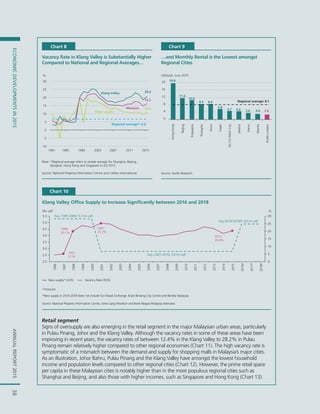
demand. In 2015, the Klang Valley recorded a vacancy rate of 20.4% for its office space.
This stands in stark contrast to the regional average of 6.6% and the national level of 16.3%
(Chart 8). In tandem with the high level of vacancy rate in the Klang Valley, monthly rentals of
prime office space in Kuala Lumpur is the lowest amongst regional cities, at only USD2.60 per
square foot (Chart 9). Despite the low monthly rentals, some recently completed Grade A office
buildings in Kuala Lumpur have not achieved satisfactory occupancy rates. Savills Research, in its
May 2015 Property Market Overview Report, found that several Grade A office buildings which
were completed between 2011 and 2014 have only managed to record occupancy rates of
between 50% to 75%.
Over the next few years, the significant incoming supply of large projects could aggravate the
oversupply situation in the Klang Valley office segment. According to the 4Q 2015 Quarterly
Property Market Report by Jones Lang Wootton, a total of 63 new office buildings are scheduled to
be completed in the Klang Valley over the next three years, where an average of 4.9 million square
feet of new office space will be added to the market each year. This is significantly higher than
the historical average of 2.8 million square feet of new office space added to the market annually
between 2001 and 2015 (Chart 10).
Chart 7
The Supply of New Houses Need to Increase by
about 200,000 Units Annually within these Five
Years to Match the Estimated Growth
in Households
Source: National Property Information Centre, CEIC and Bank Negara Malaysia
estimates
117
166
203
167
80
203
0
50
100
150
200
250
Avg. 2005-2008 Avg. 2011-2015e Avg. 2016f-2020f
Net increase in number of households Completion of new houses
'000
e Estimate
f Forecast
in the previous five years (Chart 7). The shrinking size of households13
, combined with continued
growth in incomes and population, as well as rapid urbanisation, are expected to remain as important
drivers of the overall demand for houses, especially in the major urban areas. Consistent with the
underlying demand, especially in the major urban and employment centres, it is crucial to formulate a
holistic planning and implementation system to provide sufficient quality housing that is affordable for
the low- and middle-income households.
13
In 1970, there was an average of 5.5 people per household. By 2020, the average is projected to be four people per
household. Hence, the number of households will increase at a faster rate compared to population growth.
(Source: Khazanah Research Institute, Making Housing Affordable, 2015).
ANNUALREPORT2015ECONOMICDEVELOPMENTSIN201538ANNUALREPORT2015ECONOMICDEVELOPMENTSIN2015
Retail segment
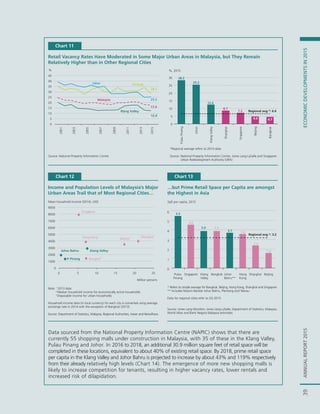
Signs of oversupply are also emerging in the retail segment in the major Malaysian urban areas, particularly
in Pulau Pinang, Johor and the Klang Valley. Although the vacancy rates in some of these areas have been
improving in recent years, the vacancy rates of between 12.4% in the Klang Valley to 28.2% in Pulau
Pinang remain relatively higher compared to other regional economies (Chart 11). The high vacancy rate is
symptomatic of a mismatch between the demand and supply for shopping malls in Malaysia’s major cities.
As an illustration, Johor Bahru, Pulau Pinang and the Klang Valley have amongst the lowest household
income and population levels compared to other regional cities (Chart 12). However, the prime retail space
per capita in these Malaysian cities is notably higher than in the more populous regional cities such as
Shanghai and Beijing, and also those with higher incomes, such as Singapore and Hong Kong (Chart 13).
Chart 10
Klang Valley Office Supply to Increase Significantly between 2016 and 2018
*New supply in 2016-2018 does not include Tun Razak Exchange, Bukit Bintang City Centre and Bandar Malaysia
Source: National Property Information Centre, Jones Lang Wootton and Bank Negara Malaysia estimates
New supply* (LHS)
f Forecast
0
5
10
15
20
25
30
2.0
2.5
3.0
3.5
4.0
4.5
5.0
5.5
1996
1997
1998
1999
2000
2001
2002
2003
2004
2005
2006
2007
2008
2009
2010
2011
2012
2013
2014
2015
2016f
2017f
2018f
Avg. (2001-2015): 2.8 mn sqft
Avg.(2016f-2018f): 4.9 mn sqft
1997:
5.1%
1998:
20.1%
2001:
25.3%
2015:
20.4%
Mn sqft %
Avg. (1991-2000): 5.3 mn sqft
Vacancy Rate (RHS)
Chart 9
…and Monthly Rental is the Lowest amongst
Regional Cities
Chart 8
Vacancy Rate in Klang Valley is Substantially Higher
Compared to National and Regional Averages…
Note: *Regional average refers to simple average for Shanghai, Beijing,
Bangkok, Hong Kong and Singapore in 2Q 2015
Source: National Property Information Centre and Colliers International
20.4
10.8
16.3
-10
-5
0
5
10
15
20
25
30
1991 1995 1999 2003 2007 2011 2015
Malaysia
Klang Valley
Other states
Regional average*: 6.6
%
19.8
11.6
8.5 8.4
5.8
4.7 4.6 3.6 3.0 2.6
0
4
8
12
16
20
HongKong
Beijing
Singapore
Shanghai
Seoul
Taipei
HoChiMinhCity
Jakarta
Hanoi
Manila
KualaLumpur
Regional average: 8.1
USD/sqft, June 2015
Source: Savills Research
10.6
ANNUALREPORT2015ECONOMICDEVELOPMENTSIN201539ANNUALREPORT2015ECONOMICDEVELOPMENTSIN2015
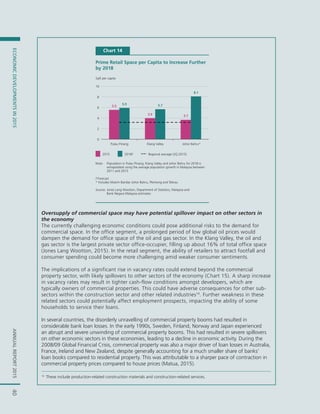
Data sourced from the National Property Information Centre (NAPIC) shows that there are
currently 55 shopping malls under construction in Malaysia, with 35 of these in the Klang Valley,
Pulau Pinang and Johor. In 2016 to 2018, an additional 30.9 million square feet of retail space will be
completed in these locations, equivalent to about 40% of existing retail space. By 2018, prime retail space
per capita in the Klang Valley and Johor Bahru is projected to increase by about 43% and 119% respectively
from their already relatively high levels (Chart 14). The emergence of more new shopping malls is
likely to increase competition for tenants, resulting in higher vacancy rates, lower rentals and
increased risk of dilapidation.
Chart 11
Retail Vacancy Rates Have Moderated in Some Major Urban Areas in Malaysia, but They Remain
Relatively Higher than in Other Regional Cities
*Regional average refers to 2014 data
28.2
25.2
12.4
8.7
7.2
4.9 4.7
0
5
10
15
20
25
30
PulauPinang
Johor
KlangValley
Shanghai
Singapore
Beijing
Bangkok
Regional avg.*: 6.4
%, 2015
12.4
28.2
25.2
17.6
0
5
10
15
20
25
30
35
40
45
2001
2003
2005
2007
2009
2011
2013
2015
Klang Valley
Johor Penang
Malaysia
%
Source: National Property Information Centre Source: National Property Information Centre, Jones Lang LaSalle and Singapore
Urban Redevelopment Authority (URA)
Chart 12
Income and Population Levels of Malaysia’s Major
Urban Areas Trail that of Most Regional Cities…
Mean household income (2014), USD
0
1000
2000
3000
4000
5000
6000
7000
8000
9000
0 5 10 15 20 25
Shanghai
3
Beijing 3
Singapore
Hong Kong2
Bangkok
1
P. Pinang
Million persons
Klang ValleyJohor Bahru
Note: 1
2013 data
2
Median household income for economically active households
3
Disposable income for urban households
Household income data (in local currency) for each city is converted using average
exchange rate in 2014 with the exception of Bangkok (2013)
Source: Department of Statistics, Malaysia, Regional Authorities, Haver and Newsflows
Chart 13
…but Prime Retail Space per Capita are amongst
the Highest in Asia
* Refers to simple average for Bangkok, Beijing, Hong Kong, Shanghai and Singapore
** Includes Mukim Bandar Johor Bahru, Plentong and Tebrau
Data for regional cities refer to 2Q 2015
Source: Jones Lang Wootton, Jones Lang LaSalle, Department of Statistics, Malaysia,
World Atlas and Bank Negara Malaysia estimates
Sqft per capita, 2015
5.5
4.6
3.9 3.9
3.7 3.6
2.4
1.6
0
1
2
3
4
5
6
Pulau
Pinang
Singapore Klang
Valley
Bangkok Johor
Bahru**
Hong
Kong
Shanghai Beijing
Regional avg.*: 3.2
ANNUALREPORT2015ECONOMICDEVELOPMENTSIN201540ANNUALREPORT2015ECONOMICDEVELOPMENTSIN2015
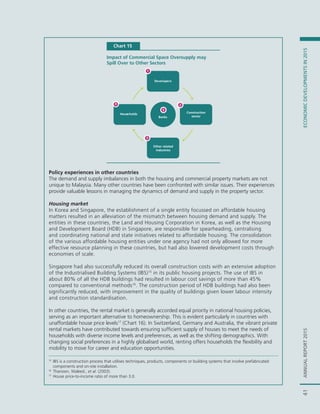
Oversupply of commercial space may have potential spillover impact on other sectors in
the economy
The currently challenging economic conditions could pose additional risks to the demand for
commercial space. In the office segment, a prolonged period of low global oil prices would
dampen the demand for office space of the oil and gas sector. In the Klang Valley, the oil and
gas sector is the largest private sector office-occupier, filling up about 16% of total office space
(Jones Lang Wootton, 2015). In the retail segment, the ability of retailers to attract footfall and
consumer spending could become more challenging amid weaker consumer sentiments.
The implications of a significant rise in vacancy rates could extend beyond the commercial
property sector, with likely spillovers to other sectors of the economy (Chart 15). A sharp increase
in vacancy rates may result in tighter cash-flow conditions amongst developers, which are
typically owners of commercial properties. This could have adverse consequences for other sub-
sectors within the construction sector and other related industries14
. Further weakness in these
related sectors could potentially affect employment prospects, impacting the ability of some
households to service their loans.
In several countries, the disorderly unravelling of commercial property booms had resulted in
considerable bank loan losses. In the early 1990s, Sweden, Finland, Norway and Japan experienced
an abrupt and severe unwinding of commercial property booms. This had resulted in severe spillovers
on other economic sectors in these economies, leading to a decline in economic activity. During the
2008/09 Global Financial Crisis, commercial property was also a major driver of loan losses in Australia,
France, Ireland and New Zealand, despite generally accounting for a much smaller share of banks’
loan books compared to residential property. This was attributable to a sharper pace of contraction in
commercial property prices compared to house prices (Matua, 2015).
14
These include production-related construction materials and construction-related services.
Chart 14
Prime Retail Space per Capita to Increase Further
by 2018
5.5
3.9 3.7
5.9 5.7
8.1
0
2
4
6
8
10
Pulau Pinang Klang Valley Johor Bahru*
Sqft per capita
2015 2018f Regional average (2Q 2015)
Note: Population in Pulau Pinang, Klang Valley and Johor Bahru for 2018 is
extrapolated using the average population growth in Malaysia between
2011 and 2015
f Forecast
* Includes Mukim Bandar Johor Bahru, Plentong and Tebrau
Source: Jones Lang Wootton, Department of Statistics, Malaysia and
Bank Negara Malaysia estimates
ANNUALREPORT2015ECONOMICDEVELOPMENTSIN201541ANNUALREPORT2015ECONOMICDEVELOPMENTSIN2015
15
IBS is a construction process that utilises techniques, products, components or building systems that involve prefabricated
components and on-site installation.
16
Thanoon, Waleed., et al. (2003).
17
House price-to-income ratio of more than 3.0.
Chart 15
Impact of Commercial Space Oversupply may
Spill Over to Other Sectors
Developers
Construction
sectorBanks
Households
Other related
industries
1
2
3
4
5
Policy experiences in other countries
The demand and supply imbalances in both the housing and commercial property markets are not
unique to Malaysia. Many other countries have been confronted with similar issues. Their experiences
provide valuable lessons in managing the dynamics of demand and supply in the property sector.
Housing market
In Korea and Singapore, the establishment of a single entity focussed on affordable housing
matters resulted in an alleviation of the mismatch between housing demand and supply. The
entities in these countries, the Land and Housing Corporation in Korea, as well as the Housing
and Development Board (HDB) in Singapore, are responsible for spearheading, centralising
and coordinating national and state initiatives related to affordable housing. The consolidation
of the various affordable housing entities under one agency had not only allowed for more
effective resource planning in these countries, but had also lowered development costs through
economies of scale.
Singapore had also successfully reduced its overall construction costs with an extensive adoption
of the Industrialised Building Systems (IBS)15
in its public housing projects. The use of IBS in
about 80% of all the HDB buildings had resulted in labour cost savings of more than 45%
compared to conventional methods16
. The construction period of HDB buildings had also been
significantly reduced, with improvement in the quality of buildings given lower labour intensity
and construction standardisation.
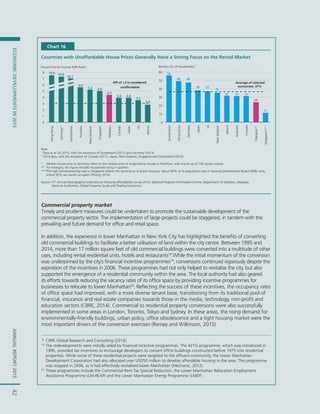
In other countries, the rental market is generally accorded equal priority in national housing policies,
serving as an important alternative to homeownership. This is evident particularly in countries with
unaffordable house price levels17
(Chart 16). In Switzerland, Germany and Australia, the vibrant private
rental markets have contributed towards ensuring sufficient supply of houses to meet the needs of
households with diverse income levels and preferences, as well as the shifting demographics. With
changing social preferences in a highly globalised world, renting offers households the flexibility and
mobility to move for career and education opportunities.
ANNUALREPORT2015ECONOMICDEVELOPMENTSIN201542ANNUALREPORT2015ECONOMICDEVELOPMENTSIN2015
Commercial property market
Timely and prudent measures could be undertaken to promote the sustainable development of the
commercial property sector. The implementation of large projects could be staggered, in tandem with the
prevailing and future demand for office and retail space.
In addition, the experience in lower Manhattan in New York City has highlighted the benefits of converting
old commercial buildings to facilitate a better utilisation of land within the city centre. Between 1995 and
2014, more than 17 million square feet of old commercial buildings were converted into a multitude of other
uses, including rental residential units, hotels and restaurants18
.While the initial momentum of the conversion
was underpinned by the city’s financial incentive programmes19
, conversions continued vigorously despite the
expiration of the incentives in 2006. These programmes had not only helped to revitalise the city, but also
supported the emergence of a residential community within the area. The local authority had also geared
its efforts towards reducing the vacancy rates of its office space by providing incentive programmes for
businesses to relocate to lower Manhattan20
. Reflecting the success of these incentives, the occupancy rates
of office space had improved, with a more diverse tenant base, transitioning from its traditional pool of
financial, insurance and real estate companies towards those in the media, technology, non-profit and
education sectors (CBRE, 2014). Commercial to residential property conversions were also successfully
implemented in some areas in London, Toronto, Tokyo and Sydney. In these areas, the rising demand for
environmentally-friendly buildings, urban policy, office obsolescence and a tight housing market were the
most important drivers of the conversion exercises (Remøy and Wilkinson, 2015).
18
CBRE Global Research and Consulting (2014).
19
The redevelopments were initially aided by financial incentive programmes. The 421G programme, which was introduced in
1995, provided tax incentives to encourage developers to convert office buildings constructed before 1975 into residential
properties. While some of these residential projects were targeted to the affluent community, the Lower Manhattan
Development Corporation had also allocated over USD50 million to develop affordable housing in the area. This programme
was stopped in 2006, as it had effectively revitalised lower Manhattan (Mechanic, 2012).
20
These programmes include the Commercial Rent Tax Special Reduction, the Lower Manhattan Relocation Employment
Assistance Programme (LM-REAP) and the Lower Manhattan Energy Programme (LMEP).
Chart 16
Countries with Unaffordable House Prices Generally Have a Strong Focus on the Rental Market
0
1
2
3
4
5
6
7
8
HongKong
Germany*
Switzerland
Australia
NewZealand
Singapore
Malaysia
Canada
Japan
US
Ireland
House Price-to-Income (HPI) Ratio1
HPI of >3 is considered
unaffordable
0
10
20
30
40
50
60
Switzerland
HongKong
Germany
Japan
US
NewZealand
Ireland
Australia
Canada
Malaysia**
Singapore***
Renters (% of Households)
2
Average of selected
economies: 37%
Note:
1
Data as at 3Q 2015, with the exception of Switzerland (2012) and Germany (2013)
2
2014 data, with the exception of Canada (2011), Japan, New Zealand, Singapore and Switzerland (2013)
* Median house price in Germany refers to the median price of single-family houses in Frankfurt, with a built-up of 150 square metres
** For Malaysia, the figure includes households living in quarters
***The high homeownership rate in Singapore reflects the dominance of public housing. About 80% of its population lives in Housing Development Board (HDB) units,
where 95% are owner occupiers (Phang, 2010)
Source:12th
Annual Demographia International Housing Affordability Survey 2016, National Property Information Centre, Department of Statistics, Malaysia,
National Authorities, Global Property Guide and Trading Economics
19.0 16.8
16.7
5.6
5.2 5.0
4.4
3.9 3.9
3.5
2.8
56
49 48
38 37
35
31 31 31
24
11
ANNUALREPORT2015ECONOMICDEVELOPMENTSIN201543ANNUALREPORT2015ECONOMICDEVELOPMENTSIN2015
Conclusion
Malaysia is experiencing an undersupply of affordable houses particularly in the major urban areas, but
an oversupply of office and retail space in several major cities and towns. Both of these trends, if left
unchecked, may lead to deeper imbalances in the property market, with negative spillovers to other parts of
the economy. A comprehensive and carefully-designed national planning policy is needed for the property
market and will help to support the Government’s aim of delivering more housing, whilst also managing the
oversupply of commercial properties. The conversion and repurposing of underutilised surplus commercial
space should be a part of that overall strategy, with the cost being borne by property owners rather than
taxpayers.
In the housing market, ensuring that the low- and middle-income households have access to quality
affordable housing involves not only commitment from the Government, but also the support of the private
sector. The experiences of other countries illustrate that constructing more public housing forms only a part
of the solution. There is a need for the consolidation of multiple providers of affordable housing across
the state and national levels and an equal focus on the rental market. In addition, macroprudential and
fiscal measures that are in place, such as the loan-to-value (LTV) measures, Responsible Lending Guideline,
higher real property gains taxes (RPGT) and the prohibition of Developer Interest-Bearing Scheme (DIBS),
remain instrumental towards maintaining the long-term sustainability of the property market and mitigating
potential risks to financial stability.
References
Alfelt, Gustav, Björn Lagerwall and Dilan Ölcer. (2015). `An analysis of the debt-to-income limit as a
policy measure´. Sveriges Riksbank Economic Commentaries, No. 8.
CBRE Global Research and Consulting. (2014). `Downtown Manhattan: A market transformed´.
Research Note, January 2014.
Jones Lang Wootton. (2015). The Quarterly Subscribers’ Forum, Kuala Lumpur.
Khazanah Research Institute. (2015). `Making Housing Affordable´. Kuala Lumpur: Khazanah
Research Institute.
Kragh-Sørensen, Kasper and Haakon Selheim. (2014). `What do banks lose money on during crises?´
Norges Bank Staff Memo, No.3.
Matua, Te. (2015). `Commercial property and financial stability´. Reserve Bank of New Zealand Bulletin,
78 (2).
Mechanic, Marc. (2012). `The future of lower Manhattan´. Lehigh University, Pennsylvania.
Phang, Sock-Yong. (2010). `Lessons from Singapore’s Central Provident Fund´. 4th Global Conference
on Housing Finance in Emerging Markets, World Bank, Washington DC.
Remøy, Hilde and Sara Wilkinson. (2015). `Adaptive reuse of offices´. 22nd Annual European Real
Estate Society (ERES) Conference, Istanbul.
Thanoon, Waleed, Lee Wah Peng, Mohd Razali Abdul Kadir, Mohd Saleh Jaafar and Mohd Sapuan
Salit. (2003). `The essential characteristics of industrialised building systems´. International Conference
on Industrialised Building Systems, Kuala Lumpur.

Malaysian property market

  • 1.
    ANNUALREPORT2015ECONOMICDEVELOPMENTSIN201533ANNUALREPORT2015ECONOMICDEVELOPMENTSIN2015 Assessing Demand-Supply Conditionsin the Malaysian Property Market Introduction The Malaysian property market is characterised by unevenness across its sub-segments in recent times, with demand outstripping supply in the housing market, while the office and retail markets are experiencing oversupply. The rapid increase in house prices, particularly in the major urban centres, has been attributable partly to a shortfall in supply. The shortage is particularly evident in the supply of affordable housing. This has increasingly priced out more urban Malaysian households from the housing market. In contrast, the increase in the construction of office buildings and retail malls, particularly in major cities, has raised the potential of overbuilding of commercial properties that could adversely impact the real estate market. This article identifies the current demand-supply dynamics and the outlook in three property segments in Malaysia – housing, office and retail, with a focus on the key states1 (Kuala Lumpur, Selangor, Johor and Pulau Pinang) and seeks to highlight lessons from the experiences of other countries. Shortage of supply in the affordable housing market Since 2005, Malaysia’s housing stock has increased by 35%. Despite this substantial growth, the shortage of housing supply at the national level has persisted. The gap between the housing stock and the number of households widened to 2.5 million units in 2015 from 2.1 million units in 20052 (Chart 1). The worsening shortfall in housing supply reflected the mismatch between the pace of growth in the supply of new houses and the net increase in the number of households3 , particularly in the past five years. Between 2005 and 2008, the number of new houses completed averaged 166,876 units annually, while the number of households increased by about 117,250, implying a surplus supply of housing units of about 49,626 units per year. Over the past five years, however, the annual completion of houses has declined considerably to 80,089 units, far below the 166,000 average net increase in the number of households annually4 . This suggests an average shortage of 85,911 housing units per year between 2011 and 2015 (Chart 2). 1 Key states refer to the major employment centres in Malaysia. 2 The estimate assumes that all households are looking to own and are able to afford a house. Currently, there are about two houses for every three households, suggesting some accommodation sharing among households, which underpins the demand for house ownership. 3 This refers to the increase in the number of households at one point in time versus another point in time (i.e. new household formation minus household dissolution through one or two heads of households joining into a single household and/or through the death of a single-person head of household). 4 The lower house-building activity reflects partly lower property launches and sales by developers. Chart 1 Chart 2 Widening Housing Supply Shortfall over the past Decade… …as New Housing Supply was Unable to Match Increase in Number of Households over the past Five Years *Housing supply gap = Housing stock – Outstanding number of households OR Completion of new houses – Net increase in number of households A negative figure suggests a shortfall in housing supply Source: National Property Information Centre, CEIC and Bank Negara Malaysia estimates -2.1 -2.5 5.7 7.4 3.7 4.9 -4 -2 0 2 4 6 8 2005 2006 2007 2008 2009 2010 2011 2012 2013 2014 2015 Million Number of households Housing stock Housing supply gap* 117 166167 80 50 -86 -100 -50 0 50 100 150 200 2005-2008 avg. 2011-2015 avg. '000 Net increase in number of households Completion of new houses Housing supply gap*
  • 2.
    ANNUALREPORT2015ECONOMICDEVELOPMENTSIN201534ANNUALREPORT2015ECONOMICDEVELOPMENTSIN2015 5 The oversupply ofhigher-end residential property is evident particularly in some areas in the key states and in selected property segments (i.e. luxury condominiums). 6 Houses priced from RM540,000 are considered affordable for households earning at least RM15,000 a month (5.4% of Malaysia’s total population in 2014). 7 Another contributing factor to the rapid increase in house prices over the past few years was the use of marketing tools by developers and low real property gains tax (RPGT) rates. For example, the Developer Interest-Bearing Scheme (DIBS) not only artificially inflated property prices, but also encouraged speculators to enter the property market with very small capital outlays. In November 2013, DIBS was prohibited by Bank Negara Malaysia, along with the introduction of more punitive RPGT rates by the Government. 8 The Compound Annual Growth Rate (CAGR) is the average annual growth rate over a specified period of time. The shortage in housing supply has been particularly acute in the affordable housing category. In 2014, half of Malaysian households earned a monthly income of RM4,585 and below. According to the ``Median Multiple´´ methodology developed by Demographia International and recommended by the World Bank and the United Nations to evaluate urban housing markets, a house is considered affordable if a household can finance it with less than three times its annual household income (house price-to-income ratio of 3.0 and below). This suggests that houses priced up to RM165,060 are considered affordable to a median Malaysian household. However, only 21% of new housing launches in Malaysia were priced below RM250,000 in 2014. In contrast, the data points to an oversupply of higher-end properties5 priced above RM500,000. Although property launches in this price category accounts for 36% of total new launches in Malaysia, these houses are only within the reach of 5.4% of the population according to the same methodology6 (Chart 3). While affordable housing initiatives by the Federal and State Governments, Syarikat Perumahan Negara Berhad (SPNB) and Perumahan Rakyat 1Malaysia (PR1MA) have gathered some momentum, the current level of house-building in the affordable housing segment has not been sufficient to meet the demand. Nonetheless, a substantial amount of affordable housing units built by these initiatives are currently under various stages of construction. The imbalance between demand and supply, particularly in the affordable housing segment, has contributed to a rapid increase in house prices7 . This has compounded housing affordability issues, particularly for the low- and middle-income population. Between 2009 and 2014, average house prices in Malaysia rose by 7.9% in CAGR8 terms, exceeding the growth in average household income of 7.3% over the same period. This contrasts sharply with the period in 2004 to 2007 when incomes were rising more than the growth of house prices (Chart 4). With an uneven pace of growth between house prices and income, the affordability of houses across the key states in Malaysia has progressively declined. Houses in Malaysia, on aggregate, were Chart 3 Since 2010, New Launches in Malaysia Have Been Increasingly Skewed towards Houses Priced above RM500,000 Source: National Property Information Centre 0 25 50 75 100 2008 2011 2014 RM250,000 - RM500,000 Above RM500,000 '000 units 72% 42% 21% 19% 34% 43% 9% 24% 36% Less than RM250,000 Chart 4 House Prices Have Grown at a Faster Pace than Income Levels Source: National Property Information Centre and Department of Statistics, Malaysia Household Income and Basic Amenities Survey Reports 2.5 7.9 3.2 7.3 0 2 4 6 8 10 2004-2007 2009-2014 Average house prices Average household income CAGR, %
  • 3.
    ANNUALREPORT2015ECONOMICDEVELOPMENTSIN201535ANNUALREPORT2015ECONOMICDEVELOPMENTSIN2015 9 Houses priced upto a maximum of three times the annual median household income is considered affordable (RM165,060). House Prices are Severely Unaffordable in Kuala Lumpur and Pulau Pinang Location House Price-to-Income Ratio Rating House Price-to-Income Ratio 2012 2014 Kuala Lumpur 4.9 5.4 Pulau Pinang 4.1 5.2 Severely Unaffordable 5.1 & Above Johor 3.7 4.2 Seriously Unaffordable 4.1 to 5.0 Selangor 3.6 4.0 Moderately Unaffordable 3.1 to 4.0 Malaysia 4.0 4.4 Affordable 3.0 & Below Source: Department of Statistics, Malaysia Household Income and Basic Amenities Survey Reports, National Property Information Centre and 12th Annual Demographia International Housing Affordability Survey 2016 Table 1 considered seriously unaffordable in 2014 (house price-to-income ratio of 4.4) according to the ``Median Multiple´´ methodology. In the key states, houses were severely unaffordable in Kuala Lumpur and Pulau Pinang, while those in Johor and Selangor were seriously unaffordable and moderately unaffordable, respectively (Table 1). The gap between actual house prices and the levels that are considered affordable to the majority of Malaysian households requires comprehensive resolution. In 2014, the median house price prevailing in the market was RM242,000, which was RM76,940 more than what would be an affordable price for a median household9 . Amongst the key states, the gap was most severe in Kuala Lumpur at RM215,680 (Chart 5). In the major urban employment centres in these key states, the situation is even more acute (Chart 6). Chart 5 House Prices in Key States are beyond the Reach of Most Malaysians in 2014… Note: Figures in parentheses ( ) refer to each state’s median household monthly income in 2014 Figures in square brackets [ ] refer to the state’s urban median household monthly income in 2014, used as a proxy to the median household income in each urban city *The cities in each state are based upon the delineation of (i) District: Petaling (Shah Alam, Subang Jaya and Petaling Jaya) in Selangor and Johor Bahru in Johor; (ii) Mukim: Kuala Lumpur Town Centre in Kuala Lumpur and Georgetown in Pulau Pinang Source: Department of Statistics, Malaysia, National Property Information Centre and Bank Negara Malaysia estimates 165 274 224 187 169 Malaysia (4,585) Kuala Lumpur (7,620) Selangor (6,214) Johor (5,197) Pulau Pinang (4,702) Ideal median house prices Actual median house prices Chart 6 …and Even More so in the Key Urban Employment Centres Ideal median house prices Actual city* median house prices 274 233 198 173 0 100 200 300 400 500 600 700 Kuala Lumpur City [7,620] Petaling [6,484] Johor Bahru [5,497] Georgetown [4,792] RM '000 0 100 200 300 400 500 600 700 RM '000 165 274 224 187 169 242 490 300 260 295 274 233 198 173 560 470 335 600
  • 4.
    ANNUALREPORT2015ECONOMICDEVELOPMENTSIN201536ANNUALREPORT2015ECONOMICDEVELOPMENTSIN2015 Moving forward, asubstantial increase in the supply of affordable housing is necessary. An estimated 202,571 new houses12 will be required annually between 2016 and 2020 to match the estimated growth in households during this period, approximately 2.5 times the number of houses built annually 10 Alfelt, Gustav, et.al. (2015). There is no general definition of how a debt-to-income limit should be designed and its effects can vary depending on its construction. For example, a debt-to-income limit can be introduced to either target individual households or the banks’ lending stock. Furthermore, the definition of debt and income may differ across countries. 11 The loan size is based on 30% housing debt service ratio* (using income net of statutory deductions), 35-year loan tenure, housing loan-to-value ratio of 90% and lending rate of 5%. 12 The estimate reflects a continuation of historical trends in terms of household formation and the capacity of households to exercise choice in owning a house. Net household growth is thus assumed to continue to expand at its long-term average (between 2005 and 2015) of 2.6% annually between 2016 and 2020. * Most young buyers tend to be indebted with existing debt obligations (i.e. car loan, outstanding credit card repayments), implying a lesser amount of disposable income that can be allocated for a housing loan. Information Box: Housing Loan Affordability The assessment of housing affordability can alternatively be measured by the households’ ability to service mortgage loans using their income. The debt-to-income measure, which has been increasingly adopted by a number of countries with high household debt levels, establishes an upper limit to a household’s total loan in relation to its disposable income10 . In this approach, we compare the maximum loan11 amount that a bank can extend to a median household against the actual median house prices. The results concur with our findings using the ``Median Multiple´´ approach. A median household in Kuala Lumpur and Penang has insufficient capacity to service a mortgage loan based on the median house prices in these areas (Chart A). In the key urban employment centres, that capacity is even less (Chart B). Chart A House Prices in Kuala Lumpur and Penang are Unaffordable to a Median Household Max. affordables house prices Actual median house prices Max. affordables house prices Actual city* median house prices 261 404 342 293 267 242 490 300 260 295 0 Malaysia (4,585) Kuala Lumpur (7,620) Selangor (6,214) Johor (5,197) Pulau Pinang (4,702) RM '000 Note: Figures in parentheses ( ) refer to each state’s median household monthly income in 2014 Figures in square brackets [ ] refer to the state’s urban median household monthly income in 2014, used as a proxy to the median household income in each urban city * The cities in each state are based upon the delineation of (i) District: Petaling (Shah Alam, Subang Jaya and Petaling Jaya) in Selangor and Johor Bahru in Johor, (ii) Mukim: Kuala Lumpur Town Centre in Kuala Lumpur and Georgetown in Pulau Pinang Source: Department of Statistics, Malaysia, National Property Information Centre and Bank Negara Malaysia estimates Chart B Even More Severe Situation in the Key Urban Employment Centres 404 356 308 272 560 470 335 600 0 100 200 300 400 500 600 700 100 200 300 400 500 600 700 Kuala Lumpur City [7,620] Petaling [6,484] Johor Bahru [5,497] Georgetown [4,792] RM '000
  • 5.
    ANNUALREPORT2015ECONOMICDEVELOPMENTSIN201537ANNUALREPORT2015ECONOMICDEVELOPMENTSIN2015 Overbuilding in thecommercial property market While the housing market has been confronted with the issue of supply shortage, there are risks of oversupply in the office and retail space market, particularly in the major Malaysian cities. Office segment One of the measures of a commercial property’s health is the vacancy rate, or how much commercial space is unused, where a higher rate commonly indicates that supply exceeds demand. In 2015, the Klang Valley recorded a vacancy rate of 20.4% for its office space. This stands in stark contrast to the regional average of 6.6% and the national level of 16.3% (Chart 8). In tandem with the high level of vacancy rate in the Klang Valley, monthly rentals of prime office space in Kuala Lumpur is the lowest amongst regional cities, at only USD2.60 per square foot (Chart 9). Despite the low monthly rentals, some recently completed Grade A office buildings in Kuala Lumpur have not achieved satisfactory occupancy rates. Savills Research, in its May 2015 Property Market Overview Report, found that several Grade A office buildings which were completed between 2011 and 2014 have only managed to record occupancy rates of between 50% to 75%. Over the next few years, the significant incoming supply of large projects could aggravate the oversupply situation in the Klang Valley office segment. According to the 4Q 2015 Quarterly Property Market Report by Jones Lang Wootton, a total of 63 new office buildings are scheduled to be completed in the Klang Valley over the next three years, where an average of 4.9 million square feet of new office space will be added to the market each year. This is significantly higher than the historical average of 2.8 million square feet of new office space added to the market annually between 2001 and 2015 (Chart 10). Chart 7 The Supply of New Houses Need to Increase by about 200,000 Units Annually within these Five Years to Match the Estimated Growth in Households Source: National Property Information Centre, CEIC and Bank Negara Malaysia estimates 117 166 203 167 80 203 0 50 100 150 200 250 Avg. 2005-2008 Avg. 2011-2015e Avg. 2016f-2020f Net increase in number of households Completion of new houses '000 e Estimate f Forecast in the previous five years (Chart 7). The shrinking size of households13 , combined with continued growth in incomes and population, as well as rapid urbanisation, are expected to remain as important drivers of the overall demand for houses, especially in the major urban areas. Consistent with the underlying demand, especially in the major urban and employment centres, it is crucial to formulate a holistic planning and implementation system to provide sufficient quality housing that is affordable for the low- and middle-income households. 13 In 1970, there was an average of 5.5 people per household. By 2020, the average is projected to be four people per household. Hence, the number of households will increase at a faster rate compared to population growth. (Source: Khazanah Research Institute, Making Housing Affordable, 2015).
  • 6.
    ANNUALREPORT2015ECONOMICDEVELOPMENTSIN201538ANNUALREPORT2015ECONOMICDEVELOPMENTSIN2015 Retail segment Signs ofoversupply are also emerging in the retail segment in the major Malaysian urban areas, particularly in Pulau Pinang, Johor and the Klang Valley. Although the vacancy rates in some of these areas have been improving in recent years, the vacancy rates of between 12.4% in the Klang Valley to 28.2% in Pulau Pinang remain relatively higher compared to other regional economies (Chart 11). The high vacancy rate is symptomatic of a mismatch between the demand and supply for shopping malls in Malaysia’s major cities. As an illustration, Johor Bahru, Pulau Pinang and the Klang Valley have amongst the lowest household income and population levels compared to other regional cities (Chart 12). However, the prime retail space per capita in these Malaysian cities is notably higher than in the more populous regional cities such as Shanghai and Beijing, and also those with higher incomes, such as Singapore and Hong Kong (Chart 13). Chart 10 Klang Valley Office Supply to Increase Significantly between 2016 and 2018 *New supply in 2016-2018 does not include Tun Razak Exchange, Bukit Bintang City Centre and Bandar Malaysia Source: National Property Information Centre, Jones Lang Wootton and Bank Negara Malaysia estimates New supply* (LHS) f Forecast 0 5 10 15 20 25 30 2.0 2.5 3.0 3.5 4.0 4.5 5.0 5.5 1996 1997 1998 1999 2000 2001 2002 2003 2004 2005 2006 2007 2008 2009 2010 2011 2012 2013 2014 2015 2016f 2017f 2018f Avg. (2001-2015): 2.8 mn sqft Avg.(2016f-2018f): 4.9 mn sqft 1997: 5.1% 1998: 20.1% 2001: 25.3% 2015: 20.4% Mn sqft % Avg. (1991-2000): 5.3 mn sqft Vacancy Rate (RHS) Chart 9 …and Monthly Rental is the Lowest amongst Regional Cities Chart 8 Vacancy Rate in Klang Valley is Substantially Higher Compared to National and Regional Averages… Note: *Regional average refers to simple average for Shanghai, Beijing, Bangkok, Hong Kong and Singapore in 2Q 2015 Source: National Property Information Centre and Colliers International 20.4 10.8 16.3 -10 -5 0 5 10 15 20 25 30 1991 1995 1999 2003 2007 2011 2015 Malaysia Klang Valley Other states Regional average*: 6.6 % 19.8 11.6 8.5 8.4 5.8 4.7 4.6 3.6 3.0 2.6 0 4 8 12 16 20 HongKong Beijing Singapore Shanghai Seoul Taipei HoChiMinhCity Jakarta Hanoi Manila KualaLumpur Regional average: 8.1 USD/sqft, June 2015 Source: Savills Research 10.6
  • 7.
    ANNUALREPORT2015ECONOMICDEVELOPMENTSIN201539ANNUALREPORT2015ECONOMICDEVELOPMENTSIN2015 Data sourced fromthe National Property Information Centre (NAPIC) shows that there are currently 55 shopping malls under construction in Malaysia, with 35 of these in the Klang Valley, Pulau Pinang and Johor. In 2016 to 2018, an additional 30.9 million square feet of retail space will be completed in these locations, equivalent to about 40% of existing retail space. By 2018, prime retail space per capita in the Klang Valley and Johor Bahru is projected to increase by about 43% and 119% respectively from their already relatively high levels (Chart 14). The emergence of more new shopping malls is likely to increase competition for tenants, resulting in higher vacancy rates, lower rentals and increased risk of dilapidation. Chart 11 Retail Vacancy Rates Have Moderated in Some Major Urban Areas in Malaysia, but They Remain Relatively Higher than in Other Regional Cities *Regional average refers to 2014 data 28.2 25.2 12.4 8.7 7.2 4.9 4.7 0 5 10 15 20 25 30 PulauPinang Johor KlangValley Shanghai Singapore Beijing Bangkok Regional avg.*: 6.4 %, 2015 12.4 28.2 25.2 17.6 0 5 10 15 20 25 30 35 40 45 2001 2003 2005 2007 2009 2011 2013 2015 Klang Valley Johor Penang Malaysia % Source: National Property Information Centre Source: National Property Information Centre, Jones Lang LaSalle and Singapore Urban Redevelopment Authority (URA) Chart 12 Income and Population Levels of Malaysia’s Major Urban Areas Trail that of Most Regional Cities… Mean household income (2014), USD 0 1000 2000 3000 4000 5000 6000 7000 8000 9000 0 5 10 15 20 25 Shanghai 3 Beijing 3 Singapore Hong Kong2 Bangkok 1 P. Pinang Million persons Klang ValleyJohor Bahru Note: 1 2013 data 2 Median household income for economically active households 3 Disposable income for urban households Household income data (in local currency) for each city is converted using average exchange rate in 2014 with the exception of Bangkok (2013) Source: Department of Statistics, Malaysia, Regional Authorities, Haver and Newsflows Chart 13 …but Prime Retail Space per Capita are amongst the Highest in Asia * Refers to simple average for Bangkok, Beijing, Hong Kong, Shanghai and Singapore ** Includes Mukim Bandar Johor Bahru, Plentong and Tebrau Data for regional cities refer to 2Q 2015 Source: Jones Lang Wootton, Jones Lang LaSalle, Department of Statistics, Malaysia, World Atlas and Bank Negara Malaysia estimates Sqft per capita, 2015 5.5 4.6 3.9 3.9 3.7 3.6 2.4 1.6 0 1 2 3 4 5 6 Pulau Pinang Singapore Klang Valley Bangkok Johor Bahru** Hong Kong Shanghai Beijing Regional avg.*: 3.2
  • 8.
    ANNUALREPORT2015ECONOMICDEVELOPMENTSIN201540ANNUALREPORT2015ECONOMICDEVELOPMENTSIN2015 Oversupply of commercialspace may have potential spillover impact on other sectors in the economy The currently challenging economic conditions could pose additional risks to the demand for commercial space. In the office segment, a prolonged period of low global oil prices would dampen the demand for office space of the oil and gas sector. In the Klang Valley, the oil and gas sector is the largest private sector office-occupier, filling up about 16% of total office space (Jones Lang Wootton, 2015). In the retail segment, the ability of retailers to attract footfall and consumer spending could become more challenging amid weaker consumer sentiments. The implications of a significant rise in vacancy rates could extend beyond the commercial property sector, with likely spillovers to other sectors of the economy (Chart 15). A sharp increase in vacancy rates may result in tighter cash-flow conditions amongst developers, which are typically owners of commercial properties. This could have adverse consequences for other sub- sectors within the construction sector and other related industries14 . Further weakness in these related sectors could potentially affect employment prospects, impacting the ability of some households to service their loans. In several countries, the disorderly unravelling of commercial property booms had resulted in considerable bank loan losses. In the early 1990s, Sweden, Finland, Norway and Japan experienced an abrupt and severe unwinding of commercial property booms. This had resulted in severe spillovers on other economic sectors in these economies, leading to a decline in economic activity. During the 2008/09 Global Financial Crisis, commercial property was also a major driver of loan losses in Australia, France, Ireland and New Zealand, despite generally accounting for a much smaller share of banks’ loan books compared to residential property. This was attributable to a sharper pace of contraction in commercial property prices compared to house prices (Matua, 2015). 14 These include production-related construction materials and construction-related services. Chart 14 Prime Retail Space per Capita to Increase Further by 2018 5.5 3.9 3.7 5.9 5.7 8.1 0 2 4 6 8 10 Pulau Pinang Klang Valley Johor Bahru* Sqft per capita 2015 2018f Regional average (2Q 2015) Note: Population in Pulau Pinang, Klang Valley and Johor Bahru for 2018 is extrapolated using the average population growth in Malaysia between 2011 and 2015 f Forecast * Includes Mukim Bandar Johor Bahru, Plentong and Tebrau Source: Jones Lang Wootton, Department of Statistics, Malaysia and Bank Negara Malaysia estimates
  • 9.
    ANNUALREPORT2015ECONOMICDEVELOPMENTSIN201541ANNUALREPORT2015ECONOMICDEVELOPMENTSIN2015 15 IBS is aconstruction process that utilises techniques, products, components or building systems that involve prefabricated components and on-site installation. 16 Thanoon, Waleed., et al. (2003). 17 House price-to-income ratio of more than 3.0. Chart 15 Impact of Commercial Space Oversupply may Spill Over to Other Sectors Developers Construction sectorBanks Households Other related industries 1 2 3 4 5 Policy experiences in other countries The demand and supply imbalances in both the housing and commercial property markets are not unique to Malaysia. Many other countries have been confronted with similar issues. Their experiences provide valuable lessons in managing the dynamics of demand and supply in the property sector. Housing market In Korea and Singapore, the establishment of a single entity focussed on affordable housing matters resulted in an alleviation of the mismatch between housing demand and supply. The entities in these countries, the Land and Housing Corporation in Korea, as well as the Housing and Development Board (HDB) in Singapore, are responsible for spearheading, centralising and coordinating national and state initiatives related to affordable housing. The consolidation of the various affordable housing entities under one agency had not only allowed for more effective resource planning in these countries, but had also lowered development costs through economies of scale. Singapore had also successfully reduced its overall construction costs with an extensive adoption of the Industrialised Building Systems (IBS)15 in its public housing projects. The use of IBS in about 80% of all the HDB buildings had resulted in labour cost savings of more than 45% compared to conventional methods16 . The construction period of HDB buildings had also been significantly reduced, with improvement in the quality of buildings given lower labour intensity and construction standardisation. In other countries, the rental market is generally accorded equal priority in national housing policies, serving as an important alternative to homeownership. This is evident particularly in countries with unaffordable house price levels17 (Chart 16). In Switzerland, Germany and Australia, the vibrant private rental markets have contributed towards ensuring sufficient supply of houses to meet the needs of households with diverse income levels and preferences, as well as the shifting demographics. With changing social preferences in a highly globalised world, renting offers households the flexibility and mobility to move for career and education opportunities.
  • 10.
    ANNUALREPORT2015ECONOMICDEVELOPMENTSIN201542ANNUALREPORT2015ECONOMICDEVELOPMENTSIN2015 Commercial property market Timelyand prudent measures could be undertaken to promote the sustainable development of the commercial property sector. The implementation of large projects could be staggered, in tandem with the prevailing and future demand for office and retail space. In addition, the experience in lower Manhattan in New York City has highlighted the benefits of converting old commercial buildings to facilitate a better utilisation of land within the city centre. Between 1995 and 2014, more than 17 million square feet of old commercial buildings were converted into a multitude of other uses, including rental residential units, hotels and restaurants18 .While the initial momentum of the conversion was underpinned by the city’s financial incentive programmes19 , conversions continued vigorously despite the expiration of the incentives in 2006. These programmes had not only helped to revitalise the city, but also supported the emergence of a residential community within the area. The local authority had also geared its efforts towards reducing the vacancy rates of its office space by providing incentive programmes for businesses to relocate to lower Manhattan20 . Reflecting the success of these incentives, the occupancy rates of office space had improved, with a more diverse tenant base, transitioning from its traditional pool of financial, insurance and real estate companies towards those in the media, technology, non-profit and education sectors (CBRE, 2014). Commercial to residential property conversions were also successfully implemented in some areas in London, Toronto, Tokyo and Sydney. In these areas, the rising demand for environmentally-friendly buildings, urban policy, office obsolescence and a tight housing market were the most important drivers of the conversion exercises (Remøy and Wilkinson, 2015). 18 CBRE Global Research and Consulting (2014). 19 The redevelopments were initially aided by financial incentive programmes. The 421G programme, which was introduced in 1995, provided tax incentives to encourage developers to convert office buildings constructed before 1975 into residential properties. While some of these residential projects were targeted to the affluent community, the Lower Manhattan Development Corporation had also allocated over USD50 million to develop affordable housing in the area. This programme was stopped in 2006, as it had effectively revitalised lower Manhattan (Mechanic, 2012). 20 These programmes include the Commercial Rent Tax Special Reduction, the Lower Manhattan Relocation Employment Assistance Programme (LM-REAP) and the Lower Manhattan Energy Programme (LMEP). Chart 16 Countries with Unaffordable House Prices Generally Have a Strong Focus on the Rental Market 0 1 2 3 4 5 6 7 8 HongKong Germany* Switzerland Australia NewZealand Singapore Malaysia Canada Japan US Ireland House Price-to-Income (HPI) Ratio1 HPI of >3 is considered unaffordable 0 10 20 30 40 50 60 Switzerland HongKong Germany Japan US NewZealand Ireland Australia Canada Malaysia** Singapore*** Renters (% of Households) 2 Average of selected economies: 37% Note: 1 Data as at 3Q 2015, with the exception of Switzerland (2012) and Germany (2013) 2 2014 data, with the exception of Canada (2011), Japan, New Zealand, Singapore and Switzerland (2013) * Median house price in Germany refers to the median price of single-family houses in Frankfurt, with a built-up of 150 square metres ** For Malaysia, the figure includes households living in quarters ***The high homeownership rate in Singapore reflects the dominance of public housing. About 80% of its population lives in Housing Development Board (HDB) units, where 95% are owner occupiers (Phang, 2010) Source:12th Annual Demographia International Housing Affordability Survey 2016, National Property Information Centre, Department of Statistics, Malaysia, National Authorities, Global Property Guide and Trading Economics 19.0 16.8 16.7 5.6 5.2 5.0 4.4 3.9 3.9 3.5 2.8 56 49 48 38 37 35 31 31 31 24 11
  • 11.
    ANNUALREPORT2015ECONOMICDEVELOPMENTSIN201543ANNUALREPORT2015ECONOMICDEVELOPMENTSIN2015 Conclusion Malaysia is experiencingan undersupply of affordable houses particularly in the major urban areas, but an oversupply of office and retail space in several major cities and towns. Both of these trends, if left unchecked, may lead to deeper imbalances in the property market, with negative spillovers to other parts of the economy. A comprehensive and carefully-designed national planning policy is needed for the property market and will help to support the Government’s aim of delivering more housing, whilst also managing the oversupply of commercial properties. The conversion and repurposing of underutilised surplus commercial space should be a part of that overall strategy, with the cost being borne by property owners rather than taxpayers. In the housing market, ensuring that the low- and middle-income households have access to quality affordable housing involves not only commitment from the Government, but also the support of the private sector. The experiences of other countries illustrate that constructing more public housing forms only a part of the solution. There is a need for the consolidation of multiple providers of affordable housing across the state and national levels and an equal focus on the rental market. In addition, macroprudential and fiscal measures that are in place, such as the loan-to-value (LTV) measures, Responsible Lending Guideline, higher real property gains taxes (RPGT) and the prohibition of Developer Interest-Bearing Scheme (DIBS), remain instrumental towards maintaining the long-term sustainability of the property market and mitigating potential risks to financial stability. References Alfelt, Gustav, Björn Lagerwall and Dilan Ölcer. (2015). `An analysis of the debt-to-income limit as a policy measure´. Sveriges Riksbank Economic Commentaries, No. 8. CBRE Global Research and Consulting. (2014). `Downtown Manhattan: A market transformed´. Research Note, January 2014. Jones Lang Wootton. (2015). The Quarterly Subscribers’ Forum, Kuala Lumpur. Khazanah Research Institute. (2015). `Making Housing Affordable´. Kuala Lumpur: Khazanah Research Institute. Kragh-Sørensen, Kasper and Haakon Selheim. (2014). `What do banks lose money on during crises?´ Norges Bank Staff Memo, No.3. Matua, Te. (2015). `Commercial property and financial stability´. Reserve Bank of New Zealand Bulletin, 78 (2). Mechanic, Marc. (2012). `The future of lower Manhattan´. Lehigh University, Pennsylvania. Phang, Sock-Yong. (2010). `Lessons from Singapore’s Central Provident Fund´. 4th Global Conference on Housing Finance in Emerging Markets, World Bank, Washington DC. Remøy, Hilde and Sara Wilkinson. (2015). `Adaptive reuse of offices´. 22nd Annual European Real Estate Society (ERES) Conference, Istanbul. Thanoon, Waleed, Lee Wah Peng, Mohd Razali Abdul Kadir, Mohd Saleh Jaafar and Mohd Sapuan Salit. (2003). `The essential characteristics of industrialised building systems´. International Conference on Industrialised Building Systems, Kuala Lumpur.