HX
●34 y/o Pakastanian male
●3d hx/o rigors, drenching sweats, & fever
●Croatia X14d’s
●Punjab Province
Physical Examination
●T 102.7° F
●Ill but nontoxic
●No specific findings on P.E.
●(-) spleenomegaly
Malaria
Frank Meissner,MD,FACP,FACC,FCCP
Emergency Medicine
Geo-epidemiology Pakastan
●Prevelance highest in Northwest Frontier
Province (6.5 % vs 3% baseline)
●Plasmodium falciparum increasing (54%
countrywide)
○33 % Punjab Province
○77% Sindh & Baluchistan Provinces
Transmission/Vector Ecology
●An. culicifacies
○Indoor feeder, breeds rice fields, channels, &
edges rivers/streams
●An. stephensi
○Indoor feeder, breeds polluted, fresh, and
brackish water
Transmission/Vector Ecology
●An. superpictus
○primarily outdoor feeder, breeds in rocky
streams and rivers
●An. sergenti
○Outdoor feeder, breeds in ditches, marshes,
ponds, & wells
Malaria- Worldwide
●60 million cases per annum
●Malaria increasing throughout tropics,
esp Indian subcontinent
Malaria- USA
●1988, 1,023 cases of malaria reported in
the United States
●43 % were Plasmodium vivax
●46 % P. falciparum
●Three % P. malariae
●Two % P. ovale
Malaria- USA
●All but 32 of the 1,023 cases acquired
outside of United States
●Six fatalities
Malaria- USA
●Malaria acquired by mosquito incrsing
●14 cases occurred USA 1950-1985
●Epidemiologic surveys California - 27
cases in 1987
●30 cases in 1988
●Eight cases in 1989
●All caused by P. vivax
Malaria - Life Cycle
●Incubation Period 12 to 14 days
●Sporozoites enter via bite of infected
female anopheline mosquito
●Parasites carried to the liver, where they
multiply inside parenchymal cells
○Preerythrocytic tissue phase
Malaria - Life Cycle
●Progeny released from ruptured
hepatocytes => RBC’s
●Inside RBC
●Progency degrade protein fraction of
hemoglobin
Malaria - Life Cycle
●Undergo asexual maturation from
trophozoite to merozoite
○Process known as schizogony
●Cycles of intracorpuscular multiplication,
rupture, and reinvasion responsible for
paroxysms of chills & fever
Malaria - Life Cycle
●Some parasites differentiate into
macrogametocytes or
microgametocytes, the sexual forms
●These infect mosquitoes that feed on the
victim
Malaria - Life Cycle
●In the gut of the mosquito, the definitive
host
○fertilization
○zygote formation
○production of new sporozoites take place
Clinical Features
●Malaise & Myalgias
●Headache
●Chills (with or without rigor)
Clinical Features
●Temperature to 41.5° C (106.7° F)
●Profuse sweating & Prostration may
appear
●Mild jaundice, hepatosplenomegaly, and
anemia often develop
Fever Patterns
●P. vivax & P. ovale infections cause QOD
(tertian) febrile paroxysms
○After maturation cycles synchronize
○Usually at end of first week
●P. malariae infection marked by
paroxysms Q3D (quartan periodicity)
P. falciparum
●Has capacity to obstruct microcirculation
in various organs
●Fever continuous or intermittent
●Cerebral involvement may lead to
delirium, focal disorders (e.g., seizures),
& coma
P. falciparum
●Splanchnic involvement may cause
protracted nausea, vomiting, diarrhea,
melena, & abdominal pain
●GI syndrome can be mistaken as
traveler's diarrhea
●Since there may be little or no fever
P. falciparum
●Lung involvement may cause pneumonia
& ARDS
●Hypoglycemia may be severe
●Rare syndrome of blackwater fever
○Massive intravascular hemolysis
○=> hemoglobinuria and ARF
P. malariae
●Can persist as an asymptomatic infection
for years or decades
●Usually responsible for late relapses
●This species likely to be cause of malaria
induced by transfusion
Laboratory Diagnosis
●Parasites in properly stained smears
peripheral blood
●Smears taken repeatedly for several
days because cyclic nature parasitemia
●Morphologic features of parasites (and
the infected host erythrocytes) useful in
species ID
Laboratory Diagnosis
●Indirect fluorescent antibody test- CDC
●Blood smear used to establish a Dx
●Serologic test useful in ID infected
donors in cases of transfusion malaria
●DNA probe being developed Dx P.
falciparum infection
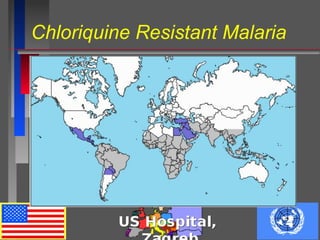
Drug Resistance
●Chloroquine-resistant strains in all
countries with P. falciparum malaria
except
○Haiti & the Dominican Republic
○Central America west of the Panama Canal
○Middle East & Egypt
Chloriquine Resistant Malaria
Drug Resistance
●Resistance to
pyrimethamine-sulfadoxine (Fansidar)
widespread
○Thailand, Burma, Cambodia, and the
Amazon River basin
○Has been reported in sub-Saharan Africa
●Mefloquine-resistant strains- P.
falciparum identified Thailand
PO Treatment
●1,250 mg of mefloquine in a single dose
●Mefloquine is a schizonticidal agent
structurally related to quinine
●Primaquine 15mg po qd X 2wks
●If G-6-PD deficient than 45 mg po 1X/wk
X 8wks
IV Therapy-Indications
●Intolerant oral therapy
●Neurologic symptoms
●Peripheral asexual parasitemia > 5%
RBC’s infected
IV Therapy-Regimen
●Life-threatening P. falciparum malaria
●Intravenous quinidine gluconate
○Loading dose 10 mg/kg (maximum 600 mg)
NS infused over 1 to 2 hrs
○Then continuous infusion of 0.02 mg/kg/min
IV Therapy-Cautions
●Slow infusion rate
○Plasma quinidine levels > 6 mg/ml
○QT interval greater than 0.6 second
○QRS widening beyond 25 percent of
baseline
●Hypoglycemia, may be exacerbated
●Parenteral therapy until parasitemia <1%
Transitions to PO Therapy
●In most cases, PO Rx can be substituted
within 48 - 72 hrs
●Oral therapy, usually with quinine,
continued for 3-7 d’s
●Add additional agent (e.g., TCN 250 mg
p.o. Q6h X 7 d’s)

Malaria

  • 1.
    HX ●34 y/o Pakastanianmale ●3d hx/o rigors, drenching sweats, & fever ●Croatia X14d’s ●Punjab Province
  • 2.
    Physical Examination ●T 102.7°F ●Ill but nontoxic ●No specific findings on P.E. ●(-) spleenomegaly
  • 3.
  • 4.
    Geo-epidemiology Pakastan ●Prevelance highestin Northwest Frontier Province (6.5 % vs 3% baseline) ●Plasmodium falciparum increasing (54% countrywide) ○33 % Punjab Province ○77% Sindh & Baluchistan Provinces
  • 5.
    Transmission/Vector Ecology ●An. culicifacies ○Indoorfeeder, breeds rice fields, channels, & edges rivers/streams ●An. stephensi ○Indoor feeder, breeds polluted, fresh, and brackish water
  • 6.
    Transmission/Vector Ecology ●An. superpictus ○primarilyoutdoor feeder, breeds in rocky streams and rivers ●An. sergenti ○Outdoor feeder, breeds in ditches, marshes, ponds, & wells
  • 7.
    Malaria- Worldwide ●60 millioncases per annum ●Malaria increasing throughout tropics, esp Indian subcontinent
  • 8.
    Malaria- USA ●1988, 1,023cases of malaria reported in the United States ●43 % were Plasmodium vivax ●46 % P. falciparum ●Three % P. malariae ●Two % P. ovale
  • 9.
    Malaria- USA ●All but32 of the 1,023 cases acquired outside of United States ●Six fatalities
  • 10.
    Malaria- USA ●Malaria acquiredby mosquito incrsing ●14 cases occurred USA 1950-1985 ●Epidemiologic surveys California - 27 cases in 1987 ●30 cases in 1988 ●Eight cases in 1989 ●All caused by P. vivax
  • 11.
    Malaria - LifeCycle ●Incubation Period 12 to 14 days ●Sporozoites enter via bite of infected female anopheline mosquito ●Parasites carried to the liver, where they multiply inside parenchymal cells ○Preerythrocytic tissue phase
  • 12.
    Malaria - LifeCycle ●Progeny released from ruptured hepatocytes => RBC’s ●Inside RBC ●Progency degrade protein fraction of hemoglobin
  • 13.
    Malaria - LifeCycle ●Undergo asexual maturation from trophozoite to merozoite ○Process known as schizogony ●Cycles of intracorpuscular multiplication, rupture, and reinvasion responsible for paroxysms of chills & fever
  • 14.
    Malaria - LifeCycle ●Some parasites differentiate into macrogametocytes or microgametocytes, the sexual forms ●These infect mosquitoes that feed on the victim
  • 15.
    Malaria - LifeCycle ●In the gut of the mosquito, the definitive host ○fertilization ○zygote formation ○production of new sporozoites take place
  • 16.
    Clinical Features ●Malaise &Myalgias ●Headache ●Chills (with or without rigor)
  • 17.
    Clinical Features ●Temperature to41.5° C (106.7° F) ●Profuse sweating & Prostration may appear ●Mild jaundice, hepatosplenomegaly, and anemia often develop
  • 18.
    Fever Patterns ●P. vivax& P. ovale infections cause QOD (tertian) febrile paroxysms ○After maturation cycles synchronize ○Usually at end of first week ●P. malariae infection marked by paroxysms Q3D (quartan periodicity)
  • 19.
    P. falciparum ●Has capacityto obstruct microcirculation in various organs ●Fever continuous or intermittent ●Cerebral involvement may lead to delirium, focal disorders (e.g., seizures), & coma
  • 20.
    P. falciparum ●Splanchnic involvementmay cause protracted nausea, vomiting, diarrhea, melena, & abdominal pain ●GI syndrome can be mistaken as traveler's diarrhea ●Since there may be little or no fever
  • 21.
    P. falciparum ●Lung involvementmay cause pneumonia & ARDS ●Hypoglycemia may be severe ●Rare syndrome of blackwater fever ○Massive intravascular hemolysis ○=> hemoglobinuria and ARF
  • 22.
    P. malariae ●Can persistas an asymptomatic infection for years or decades ●Usually responsible for late relapses ●This species likely to be cause of malaria induced by transfusion
  • 23.
    Laboratory Diagnosis ●Parasites inproperly stained smears peripheral blood ●Smears taken repeatedly for several days because cyclic nature parasitemia ●Morphologic features of parasites (and the infected host erythrocytes) useful in species ID
  • 24.
    Laboratory Diagnosis ●Indirect fluorescentantibody test- CDC ●Blood smear used to establish a Dx ●Serologic test useful in ID infected donors in cases of transfusion malaria ●DNA probe being developed Dx P. falciparum infection
  • 25.
    Drug Resistance ●Chloroquine-resistant strainsin all countries with P. falciparum malaria except ○Haiti & the Dominican Republic ○Central America west of the Panama Canal ○Middle East & Egypt
  • 26.
  • 27.
    Drug Resistance ●Resistance to pyrimethamine-sulfadoxine(Fansidar) widespread ○Thailand, Burma, Cambodia, and the Amazon River basin ○Has been reported in sub-Saharan Africa ●Mefloquine-resistant strains- P. falciparum identified Thailand
  • 28.
    PO Treatment ●1,250 mgof mefloquine in a single dose ●Mefloquine is a schizonticidal agent structurally related to quinine ●Primaquine 15mg po qd X 2wks ●If G-6-PD deficient than 45 mg po 1X/wk X 8wks
  • 29.
    IV Therapy-Indications ●Intolerant oraltherapy ●Neurologic symptoms ●Peripheral asexual parasitemia > 5% RBC’s infected
  • 30.
    IV Therapy-Regimen ●Life-threatening P.falciparum malaria ●Intravenous quinidine gluconate ○Loading dose 10 mg/kg (maximum 600 mg) NS infused over 1 to 2 hrs ○Then continuous infusion of 0.02 mg/kg/min
  • 31.
    IV Therapy-Cautions ●Slow infusionrate ○Plasma quinidine levels > 6 mg/ml ○QT interval greater than 0.6 second ○QRS widening beyond 25 percent of baseline ●Hypoglycemia, may be exacerbated ●Parenteral therapy until parasitemia <1%
  • 32.
    Transitions to POTherapy ●In most cases, PO Rx can be substituted within 48 - 72 hrs ●Oral therapy, usually with quinine, continued for 3-7 d’s ●Add additional agent (e.g., TCN 250 mg p.o. Q6h X 7 d’s)