Decoding Adult ADHD: Why You’re Not Just Lazy
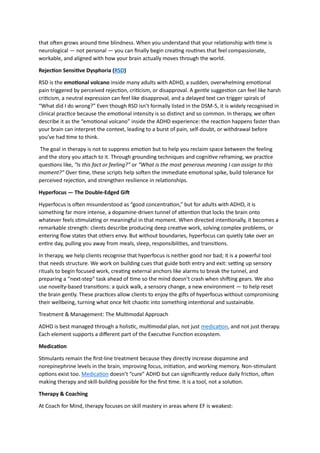
If you’ve spent years wondering why simple tasks feel impossibly heavy, why your mind races while
your hands won’t move, or why you can ace complex work yet forget to reply to a message, we want
you to hear this gently and clearly: You are not lazy. You are not irresponsible. You are not failing at
being an adult.
Many adults with ADHD describe their inner world as “a Ferrari brain with bicycle brakes.” They
know they can perform brilliantly yet daily life feels like a constant tug-of-war between intention and
action. And for decades, society has deeply misunderstood this struggle. ADHD was framed as a
childhood condition or worse, a behaviour problem, leading generations of adults to internalise
shame that never belonged to them.
But ADHD is not a character flaw. It is a neurodevelopmental condition rooted in differences in the
brain’s self-regulation system, and it continues well into adulthood, sometimes unnoticed for years.
ADHD is primarily defined by deficits in Executive Functioning (EF) and self-regulation, not just
attention. It is a biological, highly heritable condition that persists throughout the lifespan. And this
guide is our attempt to bring you clarity, validation, and actionable strategies, all grounded in science
and delivered with warmth.
The Executive Function Lens
Most people think ADHD is about attention. But in therapy, we help clients zoom out and see the real
picture: ADHD is a disorder of regulation, not willpower.
The brain’s prefrontal cortex, the centre for decision-making, prioritising, planning, starting tasks,
organising time, and shifting attention (often called Executive Functions or EF) works differently.
Neurobiologically, research consistently shows reduced availability of dopamine and norepinephrine
in the synaptic clefts, which directly impacts how motivation, focus, and reward are processed. Tasks
that are routine, boring, or offer delayed gratification simply don’t generate enough internal “go”
signals to initiate or sustain action.
This explains the classic ADHD contradiction:
• Inattention during low-interest, routine, or multi-step tasks.
• Hyperfocus on something stimulating, new, or exciting.
It’s not inconsistency; it’s neural wiring. Your brain isn’t refusing to cooperate, instead it’s waiting for
the dopamine necessary to make action feel possible.
At Coach for Mind, many clients find deep relief in learning this. When they understand that their
struggles originate in neurobiology, a lifetime of shame begins to loosen its grip, paving the way for
self-compassion and effective strategy development.
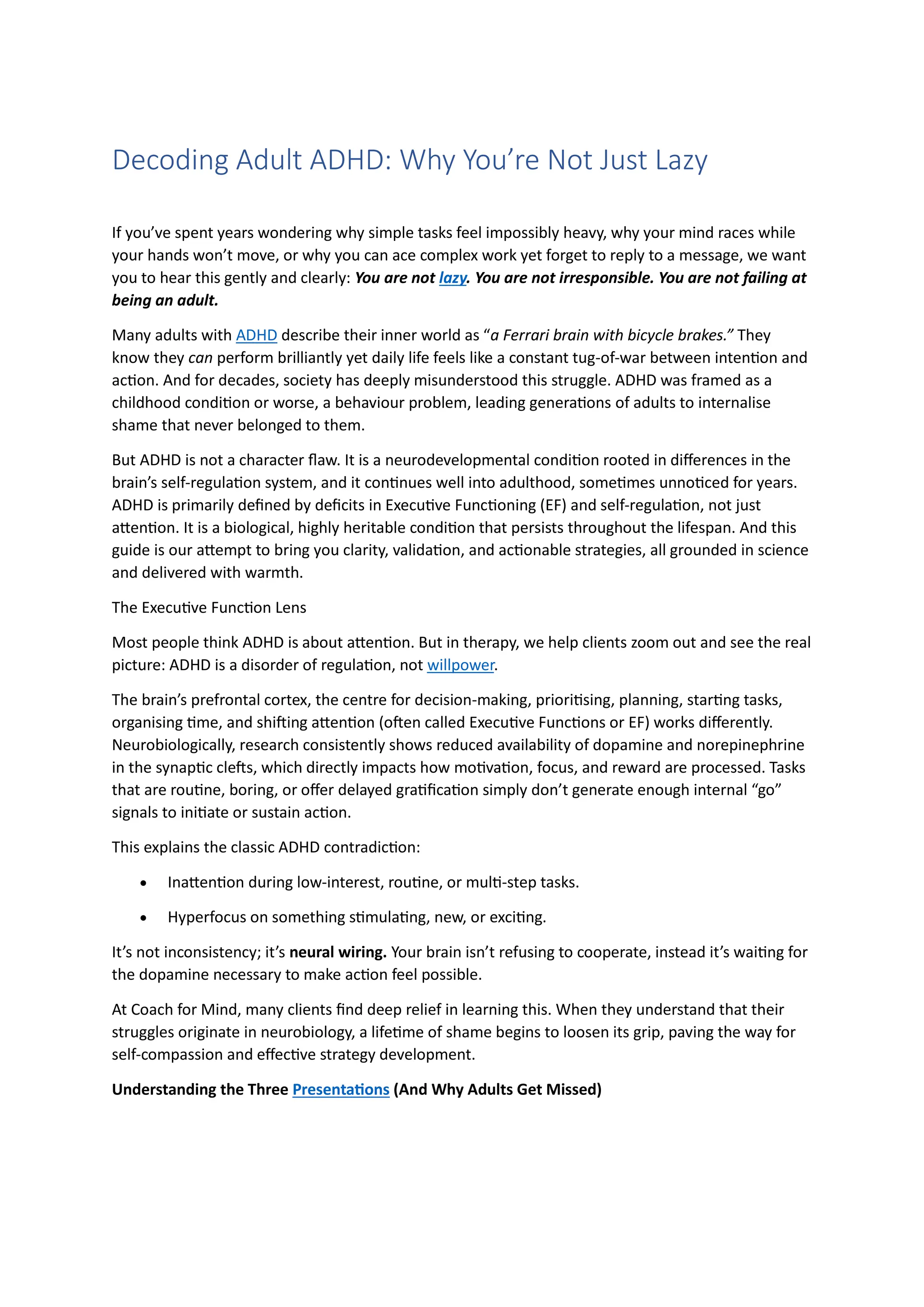
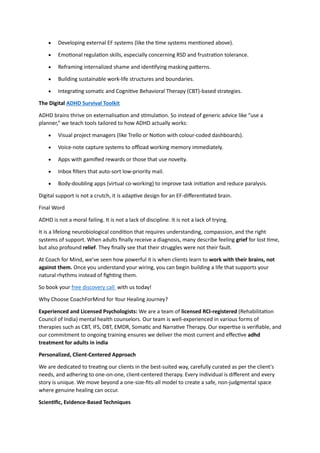
Understanding the Three Presentations (And Why Adults Get Missed)
Presentation Description Common Manifestations
Predominantly
Inattentive
Difficulty organizing, following instructions, sustaining
attention, and frequent loss of items. Less visible
hyperactivity.
Forgetfulness, disorganization, po
working memory, "spacing out," i
restlessness.
Predominantly
Hyperactive-Impulsive
Excessive motor activity, restlessness, difficulty waiting
turns, interrupting others, and acting without thinking.
Fidgeting, excessive talking, impu
indecisions (financial, relational).
Combined
Presentation
Meets the criteria for both inattention and
hyperactivity/impulsivity.
The most common presentation i
childhood.
The Underdiagnosed Adult and Female Experience
It is critical to note that symptom presentation differs significantly by gender. Girls often learn to
mask early: they overcompensate, become hyper-organised, perfectionistic, people-pleasing, or the
“quiet good child.” Their distress is internal and hidden, so teachers and families miss it. In
adulthood, this masking breaks down under increasing life demands, and the resulting distress is
frequently misdiagnosed as anxiety, depression, or mood disorders.
A 2023 study highlights that women with ADHD frequently present with emotional dysregulation and
inattention, symptoms that clinicians historically overlooked. At Coach for Mind, we see this pattern
every week: brilliant women who have spent years blaming themselves for struggles they never
understood. Unmasking is a crucial part of the healing process.
The Diagnostic Process
Diagnosis of adult ADHD is a clinical process, not a quick checklist. It involves a detailed history,
symptom mapping, developmental patterns, and an assessment of functional impairment.
Three criteria matter:
1. Symptom Count: Five or more symptoms in inattentive or hyperactive-impulsive categories
(for adults) detailed in DSM.
2. Functional Impairment: The symptoms must meaningfully impact work, home, relationships,
or wellbeing.
3. Onset: Symptoms began before age 12, though research now shows this age cutoff was
historically too strict. Research suggests that symptoms emerging up to age 12–14 have the
same clinical and neurobiological profile..
This shift is life-changing for many adults who were told they “can’t have ADHD because they did fine
in school.” So many of our clients carried this misunderstanding for years, not realising that masking,
cultural expectations, or academic strengths can hide underlying ADHD until adulthood introduces
more complex demands.
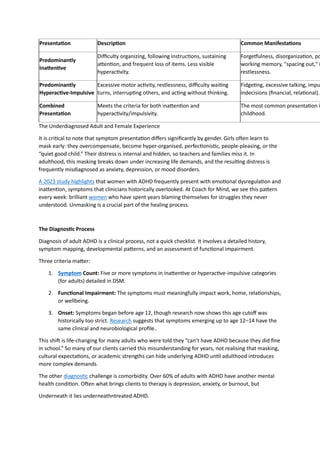
The other diagnostic challenge is comorbidity. Over 60% of adults with ADHD have another mental
health condition. Often what brings clients to therapy is depression, anxiety, or burnout, but
Underneath it lies underneathntreated ADHD.
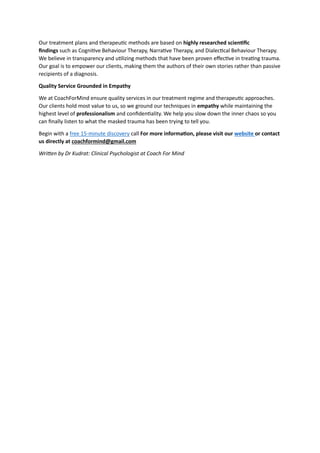
When you treat the EF deficits, emotional symptoms begin to ease.
The Invisible Symptoms That Shape Daily Life
Many adults with ADHD don’t struggle with attention as much as with the “hidden” symptoms, the
ones that people rarely associate with ADHD but deeply impact functioning. In therapy, naming these
is often liberating.
Time Blindness
Many adults with ADHD describe time as something slippery, either overwhelmingly urgent or
completely invisible. It often feels like there are only two categories: now and not now. This isn’t
carelessness; it’s a neurological difference in how the ADHD brain perceives time. Because executive
functions like working memory, sequencing, and monitoring are impacted, it becomes difficult to feel
the passage of time, estimate how long tasks will take, or hold the future in mind in a meaningful
way. Hours can disappear in hyperfocus, and important tasks can stay “out of sight, out of mind” until
a sudden rush of panic appears. In therapy, we often hear clients say, “I genuinely don’t feel time
passing the way others do,” and that honesty becomes the first step in removing years of shame
around lateness, inconsistency, or planning difficulties.
Therapy doesn’t try to “fix” your internal clock because ADHD isn’t a problem of willpower; it’s a
difference in wiring. Instead, we help you externalise time so you no longer depend on internal cues
that aren’t reliable. We build systems that act as extensions of executive function: visual timers that
show time running out, alarms paired with specific actions, reminders placed exactly where you need
them, and time-blocking that fits your natural energy rhythms. These tools anchor you in the present
and reduce the emotional burden of remembering. We also work on reframing the deep self-blame
that often grows around time blindness. When you understand that your relationship with time is
neurological — not personal — you can finally begin creating routines that feel compassionate,
workable, and aligned with how your brain actually moves through the world.
Rejection Sensitive Dysphoria (RSD)
RSD is the emotional volcano inside many adults with ADHD, a sudden, overwhelming emotional
pain triggered by perceived rejection, criticism, or disapproval. A gentle suggestion can feel like harsh
criticism, a neutral expression can feel like disapproval, and a delayed text can trigger spirals of
“What did I do wrong?” Even though RSD isn’t formally listed in the DSM-5, it is widely recognised in
clinical practice because the emotional intensity is so distinct and so common. In therapy, we often
describe it as the “emotional volcano” inside the ADHD experience: the reaction happens faster than
your brain can interpret the context, leading to a burst of pain, self-doubt, or withdrawal before
you’ve had time to think.
The goal in therapy is not to suppress emotion but to help you reclaim space between the feeling
and the story you attach to it. Through grounding techniques and cognitive reframing, we practice
questions like, “Is this fact or feeling?” or “What is the most generous meaning I can assign to this
moment?” Over time, these scripts help soften the immediate emotional spike, build tolerance for
perceived rejection, and strengthen resilience in relationships.
Hyperfocus — The Double-Edged Gift
Hyperfocus is often misunderstood as “good concentration,” but for adults with ADHD, it is
something far more intense, a dopamine-driven tunnel of attention that locks the brain onto
whatever feels stimulating or meaningful in that moment. When directed intentionally, it becomes a
remarkable strength: clients describe producing deep creative work, solving complex problems, or
entering flow states that others envy. But without boundaries, hyperfocus can quietly take over an
entire day, pulling you away from meals, sleep, responsibilities, and transitions.
In therapy, we help clients recognise that hyperfocus is neither good nor bad; it is a powerful tool
that needs structure. We work on building cues that guide both entry and exit: setting up sensory
rituals to begin focused work, creating external anchors like alarms to break the tunnel, and
preparing a “next-step” task ahead of time so the mind doesn’t crash when shifting gears. We also
use novelty-based transitions: a quick walk, a sensory change, a new environment — to help reset
the brain gently. These practices allow clients to enjoy the gifts of hyperfocus without compromising
their wellbeing, turning what once felt chaotic into something intentional and sustainable.
Treatment & Management: The Multimodal Approach
ADHD is best managed through a holistic, multimodal plan, not just medication, and not just therapy.
Each element supports a different part of the Executive Function ecosystem.
Medication
Stimulants remain the first-line treatment because they directly increase dopamine and
norepinephrine levels in the brain, improving focus, initiation, and working memory. Non-stimulant
options exist too. Medication doesn’t “cure” ADHD but can significantly reduce daily friction, often
making therapy and skill-building possible for the first time. It is a tool, not a solution.
Therapy & Coaching
At Coach for Mind, therapy focuses on skill mastery in areas where EF is weakest:
• Developing external EF systems (like the time systems mentioned above).
• Emotional regulation skills, especially concerning RSD and frustration tolerance.
• Reframing internalized shame and identifying masking patterns.
• Building sustainable work-life structures and boundaries.
• Integrating somatic and Cognitive Behavioral Therapy (CBT)-based strategies.
The Digital ADHD Survival Toolkit
ADHD brains thrive on externalisation and stimulation. So instead of generic advice like “use a
planner,” we teach tools tailored to how ADHD actually works:
• Visual project managers (like Trello or Notion with colour-coded dashboards).
• Voice-note capture systems to offload working memory immediately.
• Apps with gamified rewards or those that use novelty.
• Inbox filters that auto-sort low-priority mail.
• Body-doubling apps (virtual co-working) to improve task initiation and reduce paralysis.
Digital support is not a crutch, it is adaptive design for an EF-differentiated brain.
Final Word
ADHD is not a moral failing. It is not a lack of discipline. It is not a lack of trying.
It is a lifelong neurobiological condition that requires understanding, compassion, and the right
systems of support. When adults finally receive a diagnosis, many describe feeling grief for lost time,
but also profound relief. They finally see that their struggles were not their fault.
At Coach for Mind, we’ve seen how powerful it is when clients learn to work with their brains, not
against them. Once you understand your wiring, you can begin building a life that supports your
natural rhythms instead of fighting them.
So book your free discovery call with us today!
Why Choose CoachForMind for Your Healing Journey?
Experienced and Licensed Psychologists: We are a team of licensed RCI-registered (Rehabilitation
Council of India) mental health counselors. Our team is well-experienced in various forms of
therapies such as CBT, IFS, DBT, EMDR, Somatic and Narrative Therapy. Our expertise is verifiable, and
our commitment to ongoing training ensures we deliver the most current and effective adhd
treatment for adults in india
Personalized, Client-Centered Approach
We are dedicated to treating our clients in the best-suited way, carefully curated as per the client's
needs, and adhering to one-on-one, client-centered therapy. Every individual is different and every
story is unique. We move beyond a one-size-fits-all model to create a safe, non-judgmental space
where genuine healing can occur.
Scientific, Evidence-Based Techniques
Our treatment plans and therapeutic methods are based on highly researched scientific
findings such as Cognitive Behaviour Therapy, Narrative Therapy, and Dialectical Behaviour Therapy.
We believe in transparency and utilizing methods that have been proven effective in treating trauma.
Our goal is to empower our clients, making them the authors of their own stories rather than passive
recipients of a diagnosis.
Quality Service Grounded in Empathy
We at CoachForMind ensure quality services in our treatment regime and therapeutic approaches.
Our clients hold most value to us, so we ground our techniques in empathy while maintaining the
highest level of professionalism and confidentiality. We help you slow down the inner chaos so you
can finally listen to what the masked trauma has been trying to tell you.
Begin with a free 15-minute discovery call For more information, please visit our website or contact
us directly at coachformind@gmail.com
Written by Dr Kudrat: Clinical Psychologist at Coach For Mind

Decoding Adult ADHD Why You’re Not Just Lazy.pdf

  • 1.
    Decoding Adult ADHD:Why You’re Not Just Lazy If you’ve spent years wondering why simple tasks feel impossibly heavy, why your mind races while your hands won’t move, or why you can ace complex work yet forget to reply to a message, we want you to hear this gently and clearly: You are not lazy. You are not irresponsible. You are not failing at being an adult. Many adults with ADHD describe their inner world as “a Ferrari brain with bicycle brakes.” They know they can perform brilliantly yet daily life feels like a constant tug-of-war between intention and action. And for decades, society has deeply misunderstood this struggle. ADHD was framed as a childhood condition or worse, a behaviour problem, leading generations of adults to internalise shame that never belonged to them. But ADHD is not a character flaw. It is a neurodevelopmental condition rooted in differences in the brain’s self-regulation system, and it continues well into adulthood, sometimes unnoticed for years. ADHD is primarily defined by deficits in Executive Functioning (EF) and self-regulation, not just attention. It is a biological, highly heritable condition that persists throughout the lifespan. And this guide is our attempt to bring you clarity, validation, and actionable strategies, all grounded in science and delivered with warmth. The Executive Function Lens Most people think ADHD is about attention. But in therapy, we help clients zoom out and see the real picture: ADHD is a disorder of regulation, not willpower. The brain’s prefrontal cortex, the centre for decision-making, prioritising, planning, starting tasks, organising time, and shifting attention (often called Executive Functions or EF) works differently. Neurobiologically, research consistently shows reduced availability of dopamine and norepinephrine in the synaptic clefts, which directly impacts how motivation, focus, and reward are processed. Tasks that are routine, boring, or offer delayed gratification simply don’t generate enough internal “go” signals to initiate or sustain action. This explains the classic ADHD contradiction: • Inattention during low-interest, routine, or multi-step tasks. • Hyperfocus on something stimulating, new, or exciting. It’s not inconsistency; it’s neural wiring. Your brain isn’t refusing to cooperate, instead it’s waiting for the dopamine necessary to make action feel possible. At Coach for Mind, many clients find deep relief in learning this. When they understand that their struggles originate in neurobiology, a lifetime of shame begins to loosen its grip, paving the way for self-compassion and effective strategy development. Understanding the Three Presentations (And Why Adults Get Missed)
  • 2.
    Presentation Description CommonManifestations Predominantly Inattentive Difficulty organizing, following instructions, sustaining attention, and frequent loss of items. Less visible hyperactivity. Forgetfulness, disorganization, po working memory, "spacing out," i restlessness. Predominantly Hyperactive-Impulsive Excessive motor activity, restlessness, difficulty waiting turns, interrupting others, and acting without thinking. Fidgeting, excessive talking, impu indecisions (financial, relational). Combined Presentation Meets the criteria for both inattention and hyperactivity/impulsivity. The most common presentation i childhood. The Underdiagnosed Adult and Female Experience It is critical to note that symptom presentation differs significantly by gender. Girls often learn to mask early: they overcompensate, become hyper-organised, perfectionistic, people-pleasing, or the “quiet good child.” Their distress is internal and hidden, so teachers and families miss it. In adulthood, this masking breaks down under increasing life demands, and the resulting distress is frequently misdiagnosed as anxiety, depression, or mood disorders. A 2023 study highlights that women with ADHD frequently present with emotional dysregulation and inattention, symptoms that clinicians historically overlooked. At Coach for Mind, we see this pattern every week: brilliant women who have spent years blaming themselves for struggles they never understood. Unmasking is a crucial part of the healing process. The Diagnostic Process Diagnosis of adult ADHD is a clinical process, not a quick checklist. It involves a detailed history, symptom mapping, developmental patterns, and an assessment of functional impairment. Three criteria matter: 1. Symptom Count: Five or more symptoms in inattentive or hyperactive-impulsive categories (for adults) detailed in DSM. 2. Functional Impairment: The symptoms must meaningfully impact work, home, relationships, or wellbeing. 3. Onset: Symptoms began before age 12, though research now shows this age cutoff was historically too strict. Research suggests that symptoms emerging up to age 12–14 have the same clinical and neurobiological profile.. This shift is life-changing for many adults who were told they “can’t have ADHD because they did fine in school.” So many of our clients carried this misunderstanding for years, not realising that masking, cultural expectations, or academic strengths can hide underlying ADHD until adulthood introduces more complex demands. The other diagnostic challenge is comorbidity. Over 60% of adults with ADHD have another mental health condition. Often what brings clients to therapy is depression, anxiety, or burnout, but Underneath it lies underneathntreated ADHD.
  • 3.
    When you treatthe EF deficits, emotional symptoms begin to ease. The Invisible Symptoms That Shape Daily Life Many adults with ADHD don’t struggle with attention as much as with the “hidden” symptoms, the ones that people rarely associate with ADHD but deeply impact functioning. In therapy, naming these is often liberating. Time Blindness Many adults with ADHD describe time as something slippery, either overwhelmingly urgent or completely invisible. It often feels like there are only two categories: now and not now. This isn’t carelessness; it’s a neurological difference in how the ADHD brain perceives time. Because executive functions like working memory, sequencing, and monitoring are impacted, it becomes difficult to feel the passage of time, estimate how long tasks will take, or hold the future in mind in a meaningful way. Hours can disappear in hyperfocus, and important tasks can stay “out of sight, out of mind” until a sudden rush of panic appears. In therapy, we often hear clients say, “I genuinely don’t feel time passing the way others do,” and that honesty becomes the first step in removing years of shame around lateness, inconsistency, or planning difficulties. Therapy doesn’t try to “fix” your internal clock because ADHD isn’t a problem of willpower; it’s a difference in wiring. Instead, we help you externalise time so you no longer depend on internal cues that aren’t reliable. We build systems that act as extensions of executive function: visual timers that show time running out, alarms paired with specific actions, reminders placed exactly where you need them, and time-blocking that fits your natural energy rhythms. These tools anchor you in the present and reduce the emotional burden of remembering. We also work on reframing the deep self-blame
  • 4.
    that often growsaround time blindness. When you understand that your relationship with time is neurological — not personal — you can finally begin creating routines that feel compassionate, workable, and aligned with how your brain actually moves through the world. Rejection Sensitive Dysphoria (RSD) RSD is the emotional volcano inside many adults with ADHD, a sudden, overwhelming emotional pain triggered by perceived rejection, criticism, or disapproval. A gentle suggestion can feel like harsh criticism, a neutral expression can feel like disapproval, and a delayed text can trigger spirals of “What did I do wrong?” Even though RSD isn’t formally listed in the DSM-5, it is widely recognised in clinical practice because the emotional intensity is so distinct and so common. In therapy, we often describe it as the “emotional volcano” inside the ADHD experience: the reaction happens faster than your brain can interpret the context, leading to a burst of pain, self-doubt, or withdrawal before you’ve had time to think. The goal in therapy is not to suppress emotion but to help you reclaim space between the feeling and the story you attach to it. Through grounding techniques and cognitive reframing, we practice questions like, “Is this fact or feeling?” or “What is the most generous meaning I can assign to this moment?” Over time, these scripts help soften the immediate emotional spike, build tolerance for perceived rejection, and strengthen resilience in relationships. Hyperfocus — The Double-Edged Gift Hyperfocus is often misunderstood as “good concentration,” but for adults with ADHD, it is something far more intense, a dopamine-driven tunnel of attention that locks the brain onto whatever feels stimulating or meaningful in that moment. When directed intentionally, it becomes a remarkable strength: clients describe producing deep creative work, solving complex problems, or entering flow states that others envy. But without boundaries, hyperfocus can quietly take over an entire day, pulling you away from meals, sleep, responsibilities, and transitions. In therapy, we help clients recognise that hyperfocus is neither good nor bad; it is a powerful tool that needs structure. We work on building cues that guide both entry and exit: setting up sensory rituals to begin focused work, creating external anchors like alarms to break the tunnel, and preparing a “next-step” task ahead of time so the mind doesn’t crash when shifting gears. We also use novelty-based transitions: a quick walk, a sensory change, a new environment — to help reset the brain gently. These practices allow clients to enjoy the gifts of hyperfocus without compromising their wellbeing, turning what once felt chaotic into something intentional and sustainable. Treatment & Management: The Multimodal Approach ADHD is best managed through a holistic, multimodal plan, not just medication, and not just therapy. Each element supports a different part of the Executive Function ecosystem. Medication Stimulants remain the first-line treatment because they directly increase dopamine and norepinephrine levels in the brain, improving focus, initiation, and working memory. Non-stimulant options exist too. Medication doesn’t “cure” ADHD but can significantly reduce daily friction, often making therapy and skill-building possible for the first time. It is a tool, not a solution. Therapy & Coaching At Coach for Mind, therapy focuses on skill mastery in areas where EF is weakest:
  • 5.
    • Developing externalEF systems (like the time systems mentioned above). • Emotional regulation skills, especially concerning RSD and frustration tolerance. • Reframing internalized shame and identifying masking patterns. • Building sustainable work-life structures and boundaries. • Integrating somatic and Cognitive Behavioral Therapy (CBT)-based strategies. The Digital ADHD Survival Toolkit ADHD brains thrive on externalisation and stimulation. So instead of generic advice like “use a planner,” we teach tools tailored to how ADHD actually works: • Visual project managers (like Trello or Notion with colour-coded dashboards). • Voice-note capture systems to offload working memory immediately. • Apps with gamified rewards or those that use novelty. • Inbox filters that auto-sort low-priority mail. • Body-doubling apps (virtual co-working) to improve task initiation and reduce paralysis. Digital support is not a crutch, it is adaptive design for an EF-differentiated brain. Final Word ADHD is not a moral failing. It is not a lack of discipline. It is not a lack of trying. It is a lifelong neurobiological condition that requires understanding, compassion, and the right systems of support. When adults finally receive a diagnosis, many describe feeling grief for lost time, but also profound relief. They finally see that their struggles were not their fault. At Coach for Mind, we’ve seen how powerful it is when clients learn to work with their brains, not against them. Once you understand your wiring, you can begin building a life that supports your natural rhythms instead of fighting them. So book your free discovery call with us today! Why Choose CoachForMind for Your Healing Journey? Experienced and Licensed Psychologists: We are a team of licensed RCI-registered (Rehabilitation Council of India) mental health counselors. Our team is well-experienced in various forms of therapies such as CBT, IFS, DBT, EMDR, Somatic and Narrative Therapy. Our expertise is verifiable, and our commitment to ongoing training ensures we deliver the most current and effective adhd treatment for adults in india Personalized, Client-Centered Approach We are dedicated to treating our clients in the best-suited way, carefully curated as per the client's needs, and adhering to one-on-one, client-centered therapy. Every individual is different and every story is unique. We move beyond a one-size-fits-all model to create a safe, non-judgmental space where genuine healing can occur. Scientific, Evidence-Based Techniques
  • 6.
    Our treatment plansand therapeutic methods are based on highly researched scientific findings such as Cognitive Behaviour Therapy, Narrative Therapy, and Dialectical Behaviour Therapy. We believe in transparency and utilizing methods that have been proven effective in treating trauma. Our goal is to empower our clients, making them the authors of their own stories rather than passive recipients of a diagnosis. Quality Service Grounded in Empathy We at CoachForMind ensure quality services in our treatment regime and therapeutic approaches. Our clients hold most value to us, so we ground our techniques in empathy while maintaining the highest level of professionalism and confidentiality. We help you slow down the inner chaos so you can finally listen to what the masked trauma has been trying to tell you. Begin with a free 15-minute discovery call For more information, please visit our website or contact us directly at coachformind@gmail.com Written by Dr Kudrat: Clinical Psychologist at Coach For Mind