Making the Case for Regional
Clearing Brokers
www.catalyst.co.uk
April 2013
The End of Convergence
We believe that while top tier banks focus their energy and attention on the 100 largest buy-side
firms, there are outstanding opportunities for aspiring clearing brokers to offer a compelling
proposition to the thousands OTC derivatives end users left out in the cold.
Current Landscape and Opportunities
Global banks to sign up the largest buy-side
firms to their client clearing offerings. Typically,
such offerings focus on the needs of complex
global clients, facilitating access to multiple
CCPs, and spanning numerous jurisdictions.
But it is clear that this global approach is not the
only possible model for a successful client
clearing business. We are also seeing the
emergence of a regional approach to client
clearing, with a more targeted offering of CCP
access and asset classes. This emerging model
will increasingly be offered by banks with strong
regional franchises, acting as Regional Clearing
Brokers.
Indeed, it is clear that the existing global
services are not well suited to the needs of
smaller, regional buy-side firms, who may only
trade a limited set of instruments and currencies.
At present, when assessing the existing clearing
broker offerings, such regional buy-side firms
are faced with
 costly and time-consuming on-boarding
processes
© Catalyst Development Ltd 2
 sprawling legal documentation to cover
different clearing venues
 complex operational arrangements,
including the need for arrangements
outside home jurisdictions
 a significant queue for access, caused
by an existing backlogs
 second class treatment, when compared
to larger buy-side firms.
We therefore think that there is a compelling
case for Regional Clearing Brokers, to better
service the needs of smaller buy-side OTC
derivative users.
We also think that such a regional model could
position itself to win business by offering a
tailored clearing service, with a bespoke choice
of CCPs and a streamlined on-boarding
process. By focussing on this tailored solution,
and prioritising superior client service over
global connectivity, there is a real opportunity for
Regional Clearing Brokers to establish a strong,
profitable and enduring business.
What’s involved in becoming an RCB?
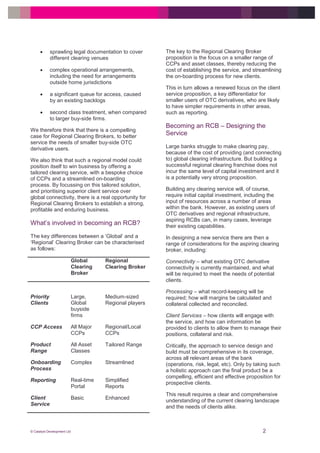
The key differences between a ‘Global’ and a
‘Regional’ Clearing Broker can be characterised
as follows:
Global
Clearing
Broker
Regional
Clearing Broker
Priority
Clients
Large,
Global
buyside
firms
Medium-sized
Regional players
CCP Access All Major
CCPs
Regional/Local
CCPs
Product
Range
All Asset
Classes
Tailored Range
Onboarding
Process
Complex Streamlined
Reporting Real-time
Portal
Simplified
Reports
Client
Service
Basic Enhanced
The key to the Regional Clearing Broker
proposition is the focus on a smaller range of
CCPs and asset classes, thereby reducing the
cost of establishing the service, and streamlining
the on-boarding process for new clients.
This in turn allows a renewed focus on the client
service proposition, a key differentiator for
smaller users of OTC derivatives, who are likely
to have simpler requirements in other areas,
such as reporting.
Becoming an RCB – Designing the
Service
Large banks struggle to make clearing pay,
because of the cost of providing (and connecting
to) global clearing infrastructure. But building a
successful regional clearing franchise does not
incur the same level of capital investment and it
is a potentially very strong proposition.
Building any clearing service will, of course,
require initial capital investment, including the
input of resources across a number of areas
within the bank. However, as existing users of
OTC derivatives and regional infrastructure,
aspiring RCBs can, in many cases, leverage
their existing capabilities.
In designing a new service there are then a
range of considerations for the aspiring clearing
broker, including:
Connectivity – what existing OTC derivative
connectivity is currently maintained, and what
will be required to meet the needs of potential
clients.
Processing – what record-keeping will be
required; how will margins be calculated and
collateral collected and reconciled.
Client Services – how clients will engage with
the service, and how can information be
provided to clients to allow them to manage their
positions, collateral and risk.
Critically, the approach to service design and
build must be comprehensive in its coverage,
across all relevant areas of the bank
(operations, risk, legal, etc). Only by taking such
a holistic approach can the final product be a
compelling, efficient and effective proposition for
prospective clients.
This result requires a clear and comprehensive
understanding of the current clearing landscape
and the needs of clients alike.
© Catalyst Development Ltd 3
Managing the Service
In additions to the nuts and bolts of how the
service operates, the ongoing management of
the clearing service must be a key consideration
from the outset. As with the design of the
service, there will be some scope to leverage
existing infrastructure and procedures.
To build an enduring clearing franchise, it is
essential that aspiring brokers are able to
demonstrate:
An effective control environment - spanning the
credit, market and operational risks which arise
from the clearing of client positions.
Demonstrable Client protection – clients are
increasingly focussed on the protection of their
positions and their assets, which should be
demonstrated through front-to-back segregation
arrangements.
Regulatory Compliance – the regulatory
environment is increasingly onerous and
complex. A broker must ensure that it allows its
clients to comply with the regulations in all
relevant jurisdictions.
A Compelling Client Service Proposition – by
offering a better client experience than the top
tier banks, Regional Clearing Brokers can
position themselves to win the business of
smaller buy-side clients who currently feel
neglected by the existing offerings.
Local specialism – many clients will find a
regional model attractive because it will be more
tailored to their needs and have local market
expertise to better service those needs.
The importance of these considerations
demands that they be addressed in parallel with
the design of the service to ensure a successful
launch.
Delivering the Service
A well designed clearing service, although
critical, is no guarantee of success – the mode
of delivery will also have a significant bearing on
the prospects for the service.
Our experience in the design and delivery of a
client clearing service indicates that:
A phased approach is optimal – a phased
introduction of products and clients is more
achievable than a ‘big bang’ approach, which
introduces additional complexity and delay.
Standardisation is key – to onboard clients
efficiently, standardisation of documents and
operational procedures is a significant
advantage.
Scalability is essential – to build an enduring
business amongst smaller OTC Derivatives
users, number are important. Plans to allow the
service to grow substantially over time will be
required.
The most important consideration is ensuring
that the approach to delivery is aligned to the
objectives of the service – a big bang approach
is unlikely to be appropriate for a service which
has an objective of steadily growing a client
base.
However, as a large number of active clients will
ultimately be required for success, it is essential
to ensure that preparations are in place to
accommodate increasing volumes of trades and
clients over time.
Assessing the Business Case
The volume of potential clients for an RCB
service is very large, providing a strong basis to
commit resources to winning this business. In
addition, linked services such as collateral
transformation have the potential to deliver
additional revenue streams.
Banks should engage with their current and
prospective clients to understand their needs,
and identify the potential volumes which could
be captured by a tailored, regional model.
However, it is also important for aspiring RCBs
to make a comprehensive assessment of
potential costs. The number of CCP connections
and the nature of the services to be provided to
clients are both important factors. However, by
opting for a tailored solution, and leveraging
existing infrastructure, such costs can be
substantially constrained.
Any assessment of the business case must also
account for the cost of inaction. As OTC
derivatives become increasingly commoditised,
spreads are likely to fall. In addition, mandatory
clearing may force existing clients elsewhere if
their current broker does not allow access to
CCP clearing.
© Catalyst Development Ltd 4
Disclaimer: Comments in this presentation on are based on Catalyst's understanding of the global regulatory landscape as of
April 2013. This document is neither intended to be comprehensive, nor to provide legal or accounting advice.
Although the initial costs may seem high, and
the challenges significant, we at Catalyst are
already seeing signs that a number of second
tier banks will be successful in establishing
successful and profitable clearing offerings.
Our Unique Experience
Catalyst have an unmatched pedigree in helping
CCPs, clearing brokers and the buy-side realise
their ambitions to build a successful OTC
derivatives franchise.
To support these ambitions, we offer:
 unparalleled knowledge of the world’s
OTC CCPs – we have played a key role
in the design and development of
numerous CCPs OTC services, across
Europe, the US and Asia Pacific.
 deep experience of the clearing broker
proposition, having worked with a
number of global and regional banks to
develop their client clearing services
 unique insight into the needs and
concerns of the buy-side, having worked
with a number of buy-side clients to
develop their OTC clearing strategy.
Catalyst is the only truly specialist consultant in
the OTC clearing space. Our knowledge and
experience makes us ideally placed to assist
you in developing an enduring, successful client
clearing service.
Meet our authors
christianlee@catalyst.co.uk damonbatten@catalyst.co.uk
Christian Lee
Christian is Head of our
Clearing, Risk and
Regulatory Practice and
one of the world’s most
experienced risk
management
professionals.
He is a specialist in OTC
clearing, market and
credit risk, financial
markets, middle office,
APAC, and Latin
America.
Damon Batten
Damon is a risk
specialist, with
experience and strong
knowledge of traded and
non-traded market risk,
CCP clearing and current
regulatory initiatives,
including the FSAs ILAA
regime, Basel 3,
European Market
Infrastructure Regulation
and Dodd-Frank.
Tom Lodge
Tom is an expert in OTC
with 15 years’ investment
banking experience
spanning change
management, product
control, and finance and
trading. Tom has a
thorough understanding of
front to back OTC clearing
and has successfully
delivered on multiple
accounts.
tomlodge@catalyst.co.uk
Catalyst uniquely combines
teams of financial markets
experts with organisational
change specialists to
deliver enduring results. We
provide honest guidance to
help you succeed. We are
catalysts for enduring
excellence.
Catalyst Development
Ltd167 Fleet Street, London,
EC4A 2EA
T +44 (0) 870 901 4155
F +44 (0) 871 433 8876
www.catalyst.co.uk

Making the case for regional clearing brokers

  • 1.
    Making the Casefor Regional Clearing Brokers www.catalyst.co.uk April 2013 The End of Convergence We believe that while top tier banks focus their energy and attention on the 100 largest buy-side firms, there are outstanding opportunities for aspiring clearing brokers to offer a compelling proposition to the thousands OTC derivatives end users left out in the cold. Current Landscape and Opportunities Global banks to sign up the largest buy-side firms to their client clearing offerings. Typically, such offerings focus on the needs of complex global clients, facilitating access to multiple CCPs, and spanning numerous jurisdictions. But it is clear that this global approach is not the only possible model for a successful client clearing business. We are also seeing the emergence of a regional approach to client clearing, with a more targeted offering of CCP access and asset classes. This emerging model will increasingly be offered by banks with strong regional franchises, acting as Regional Clearing Brokers. Indeed, it is clear that the existing global services are not well suited to the needs of smaller, regional buy-side firms, who may only trade a limited set of instruments and currencies. At present, when assessing the existing clearing broker offerings, such regional buy-side firms are faced with  costly and time-consuming on-boarding processes
  • 2.
    © Catalyst DevelopmentLtd 2  sprawling legal documentation to cover different clearing venues  complex operational arrangements, including the need for arrangements outside home jurisdictions  a significant queue for access, caused by an existing backlogs  second class treatment, when compared to larger buy-side firms. We therefore think that there is a compelling case for Regional Clearing Brokers, to better service the needs of smaller buy-side OTC derivative users. We also think that such a regional model could position itself to win business by offering a tailored clearing service, with a bespoke choice of CCPs and a streamlined on-boarding process. By focussing on this tailored solution, and prioritising superior client service over global connectivity, there is a real opportunity for Regional Clearing Brokers to establish a strong, profitable and enduring business. What’s involved in becoming an RCB? The key differences between a ‘Global’ and a ‘Regional’ Clearing Broker can be characterised as follows: Global Clearing Broker Regional Clearing Broker Priority Clients Large, Global buyside firms Medium-sized Regional players CCP Access All Major CCPs Regional/Local CCPs Product Range All Asset Classes Tailored Range Onboarding Process Complex Streamlined Reporting Real-time Portal Simplified Reports Client Service Basic Enhanced The key to the Regional Clearing Broker proposition is the focus on a smaller range of CCPs and asset classes, thereby reducing the cost of establishing the service, and streamlining the on-boarding process for new clients. This in turn allows a renewed focus on the client service proposition, a key differentiator for smaller users of OTC derivatives, who are likely to have simpler requirements in other areas, such as reporting. Becoming an RCB – Designing the Service Large banks struggle to make clearing pay, because of the cost of providing (and connecting to) global clearing infrastructure. But building a successful regional clearing franchise does not incur the same level of capital investment and it is a potentially very strong proposition. Building any clearing service will, of course, require initial capital investment, including the input of resources across a number of areas within the bank. However, as existing users of OTC derivatives and regional infrastructure, aspiring RCBs can, in many cases, leverage their existing capabilities. In designing a new service there are then a range of considerations for the aspiring clearing broker, including: Connectivity – what existing OTC derivative connectivity is currently maintained, and what will be required to meet the needs of potential clients. Processing – what record-keeping will be required; how will margins be calculated and collateral collected and reconciled. Client Services – how clients will engage with the service, and how can information be provided to clients to allow them to manage their positions, collateral and risk. Critically, the approach to service design and build must be comprehensive in its coverage, across all relevant areas of the bank (operations, risk, legal, etc). Only by taking such a holistic approach can the final product be a compelling, efficient and effective proposition for prospective clients. This result requires a clear and comprehensive understanding of the current clearing landscape and the needs of clients alike.
  • 3.
    © Catalyst DevelopmentLtd 3 Managing the Service In additions to the nuts and bolts of how the service operates, the ongoing management of the clearing service must be a key consideration from the outset. As with the design of the service, there will be some scope to leverage existing infrastructure and procedures. To build an enduring clearing franchise, it is essential that aspiring brokers are able to demonstrate: An effective control environment - spanning the credit, market and operational risks which arise from the clearing of client positions. Demonstrable Client protection – clients are increasingly focussed on the protection of their positions and their assets, which should be demonstrated through front-to-back segregation arrangements. Regulatory Compliance – the regulatory environment is increasingly onerous and complex. A broker must ensure that it allows its clients to comply with the regulations in all relevant jurisdictions. A Compelling Client Service Proposition – by offering a better client experience than the top tier banks, Regional Clearing Brokers can position themselves to win the business of smaller buy-side clients who currently feel neglected by the existing offerings. Local specialism – many clients will find a regional model attractive because it will be more tailored to their needs and have local market expertise to better service those needs. The importance of these considerations demands that they be addressed in parallel with the design of the service to ensure a successful launch. Delivering the Service A well designed clearing service, although critical, is no guarantee of success – the mode of delivery will also have a significant bearing on the prospects for the service. Our experience in the design and delivery of a client clearing service indicates that: A phased approach is optimal – a phased introduction of products and clients is more achievable than a ‘big bang’ approach, which introduces additional complexity and delay. Standardisation is key – to onboard clients efficiently, standardisation of documents and operational procedures is a significant advantage. Scalability is essential – to build an enduring business amongst smaller OTC Derivatives users, number are important. Plans to allow the service to grow substantially over time will be required. The most important consideration is ensuring that the approach to delivery is aligned to the objectives of the service – a big bang approach is unlikely to be appropriate for a service which has an objective of steadily growing a client base. However, as a large number of active clients will ultimately be required for success, it is essential to ensure that preparations are in place to accommodate increasing volumes of trades and clients over time. Assessing the Business Case The volume of potential clients for an RCB service is very large, providing a strong basis to commit resources to winning this business. In addition, linked services such as collateral transformation have the potential to deliver additional revenue streams. Banks should engage with their current and prospective clients to understand their needs, and identify the potential volumes which could be captured by a tailored, regional model. However, it is also important for aspiring RCBs to make a comprehensive assessment of potential costs. The number of CCP connections and the nature of the services to be provided to clients are both important factors. However, by opting for a tailored solution, and leveraging existing infrastructure, such costs can be substantially constrained. Any assessment of the business case must also account for the cost of inaction. As OTC derivatives become increasingly commoditised, spreads are likely to fall. In addition, mandatory clearing may force existing clients elsewhere if their current broker does not allow access to CCP clearing.
  • 4.
    © Catalyst DevelopmentLtd 4 Disclaimer: Comments in this presentation on are based on Catalyst's understanding of the global regulatory landscape as of April 2013. This document is neither intended to be comprehensive, nor to provide legal or accounting advice. Although the initial costs may seem high, and the challenges significant, we at Catalyst are already seeing signs that a number of second tier banks will be successful in establishing successful and profitable clearing offerings. Our Unique Experience Catalyst have an unmatched pedigree in helping CCPs, clearing brokers and the buy-side realise their ambitions to build a successful OTC derivatives franchise. To support these ambitions, we offer:  unparalleled knowledge of the world’s OTC CCPs – we have played a key role in the design and development of numerous CCPs OTC services, across Europe, the US and Asia Pacific.  deep experience of the clearing broker proposition, having worked with a number of global and regional banks to develop their client clearing services  unique insight into the needs and concerns of the buy-side, having worked with a number of buy-side clients to develop their OTC clearing strategy. Catalyst is the only truly specialist consultant in the OTC clearing space. Our knowledge and experience makes us ideally placed to assist you in developing an enduring, successful client clearing service. Meet our authors christianlee@catalyst.co.uk damonbatten@catalyst.co.uk Christian Lee Christian is Head of our Clearing, Risk and Regulatory Practice and one of the world’s most experienced risk management professionals. He is a specialist in OTC clearing, market and credit risk, financial markets, middle office, APAC, and Latin America. Damon Batten Damon is a risk specialist, with experience and strong knowledge of traded and non-traded market risk, CCP clearing and current regulatory initiatives, including the FSAs ILAA regime, Basel 3, European Market Infrastructure Regulation and Dodd-Frank. Tom Lodge Tom is an expert in OTC with 15 years’ investment banking experience spanning change management, product control, and finance and trading. Tom has a thorough understanding of front to back OTC clearing and has successfully delivered on multiple accounts. tomlodge@catalyst.co.uk Catalyst uniquely combines teams of financial markets experts with organisational change specialists to deliver enduring results. We provide honest guidance to help you succeed. We are catalysts for enduring excellence. Catalyst Development Ltd167 Fleet Street, London, EC4A 2EA T +44 (0) 870 901 4155 F +44 (0) 871 433 8876 www.catalyst.co.uk