Make Half Your Plate Fruits and
Vegetables!
Presenter name and affiliation
What Does It Mean?
Make Half Your Plate
Fruits and Vegetables!
a. Eat any fruit or vegetable as long as it fits on half
your plate.
b. Choose nutrient-rich fruits and vegetables to fill up
about half your plate.
c. Both a and b
2
What Does It Mean?
Make Half Your Plate
Fruits and Vegetables!
a. Eat any fruit or vegetable as long as it fits on half
your plate.
b. Choose nutrient-rich fruits and vegetables to fill up
about half your plate.
c. Both a and b
3
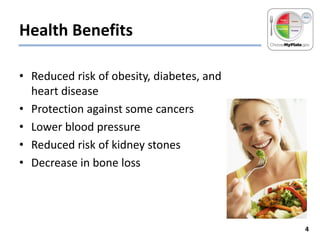
Health Benefits
• Reduced risk of obesity, diabetes, and
heart disease
• Protection against some cancers
• Lower blood pressure
• Reduced risk of kidney stones
• Decrease in bone loss

4
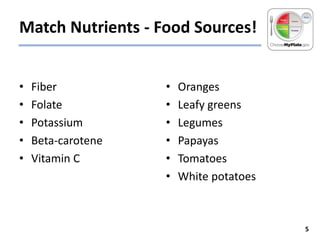
Match Nutrients - Food Sources!
•
•
•
•
•

Fiber
Folate
Potassium
Beta-carotene
Vitamin C

•
•
•
•
•
•

Oranges
Leafy greens
Legumes
Papayas
Tomatoes
White potatoes

5
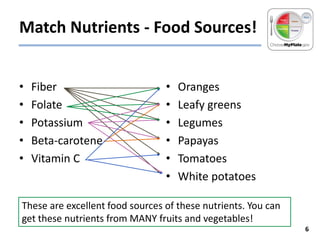
Match Nutrients - Food Sources!
•
•
•
•
•

Fiber
Folate
Potassium
Beta-carotene
Vitamin C

•
•
•
•
•
•

Oranges
Leafy greens
Legumes
Papayas
Tomatoes
White potatoes

These are excellent food sources of these nutrients. You can
get these nutrients from MANY fruits and vegetables!
6
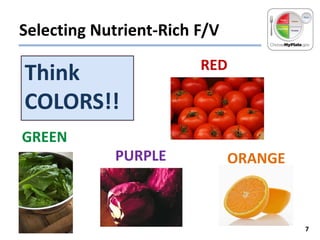
Selecting Nutrient-Rich F/V

Think
COLORS!!

RED

GREEN
PURPLE

ORANGE

7
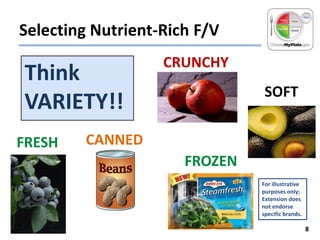
Selecting Nutrient-Rich F/V

Think
VARIETY!!
FRESH

CRUNCHY
SOFT

CANNED
FROZEN
For illustrative
purposes only;
Extension does
not endorse
specific brands.

8
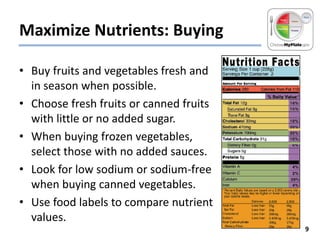
Maximize Nutrients: Buying
• Buy fruits and vegetables fresh and
in season when possible.
• Choose fresh fruits or canned fruits
with little or no added sugar.
• When buying frozen vegetables,
select those with no added sauces.
• Look for low sodium or sodium-free
when buying canned vegetables.
• Use food labels to compare nutrient
values.
9
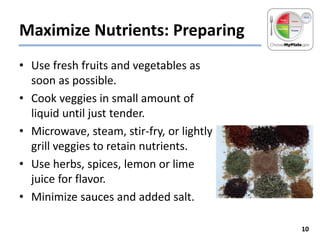
Maximize Nutrients: Preparing
• Use fresh fruits and vegetables as
soon as possible.
• Cook veggies in small amount of
liquid until just tender.
• Microwave, steam, stir-fry, or lightly
grill veggies to retain nutrients.
• Use herbs, spices, lemon or lime
juice for flavor.
• Minimize sauces and added salt.
10
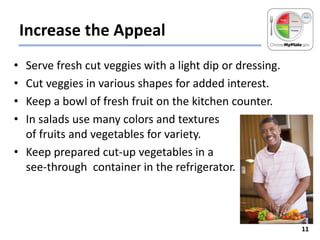
Increase the Appeal
•
•
•
•

Serve fresh cut veggies with a light dip or dressing.
Cut veggies in various shapes for added interest.
Keep a bowl of fresh fruit on the kitchen counter.
In salads use many colors and textures
of fruits and vegetables for variety.
• Keep prepared cut-up vegetables in a
see-through container in the refrigerator.

11
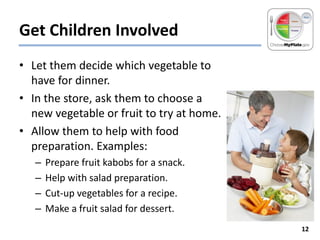
Get Children Involved
• Let them decide which vegetable to
have for dinner.
• In the store, ask them to choose a
new vegetable or fruit to try at home.
• Allow them to help with food
preparation. Examples:
–
–
–
–

Prepare fruit kabobs for a snack.
Help with salad preparation.
Cut-up vegetables for a recipe.
Make a fruit salad for dessert.
12
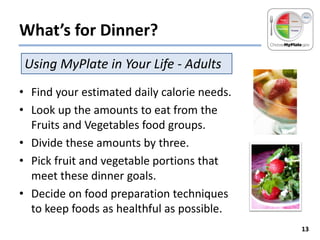
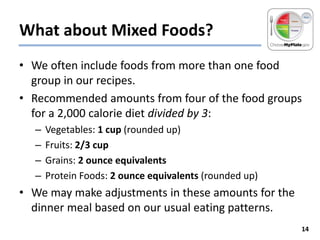
What’s for Dinner?
Using MyPlate in Your Life - Adults
• Find your estimated daily calorie needs.
• Look up the amounts to eat from the
Fruits and Vegetables food groups.
• Divide these amounts by three.
• Pick fruit and vegetable portions that
meet these dinner goals.
• Decide on food preparation techniques
to keep foods as healthful as possible.
13
What about Mixed Foods?
• We often include foods from more than one food
group in our recipes.
• Recommended amounts from four of the food groups
for a 2,000 calorie diet divided by 3:
–
–
–
–

Vegetables: 1 cup (rounded up)
Fruits: 2/3 cup
Grains: 2 ounce equivalents
Protein Foods: 2 ounce equivalents (rounded up)

• We may make adjustments in these amounts for the
dinner meal based on our usual eating patterns.
14
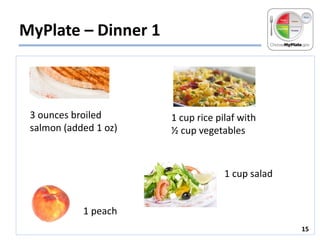
MyPlate – Dinner 1

3 ounces broiled
salmon (added 1 oz)

1 cup rice pilaf with
½ cup vegetables

1 cup salad

1 peach
15
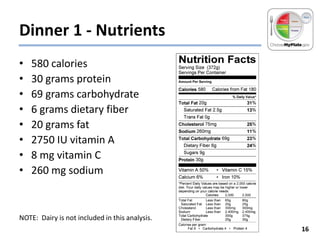
Dinner 1 - Nutrients
•
•
•
•
•
•
•
•

580 calories
30 grams protein
69 grams carbohydrate
6 grams dietary fiber
20 grams fat
2750 IU vitamin A
8 mg vitamin C
260 mg sodium

NOTE: Dairy is not included in this analysis.
16
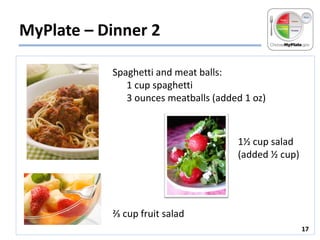
MyPlate – Dinner 2
Spaghetti and meat balls:
1 cup spaghetti
3 ounces meatballs (added 1 oz)

1½ cup salad
(added ½ cup)

⅔ cup fruit salad
17
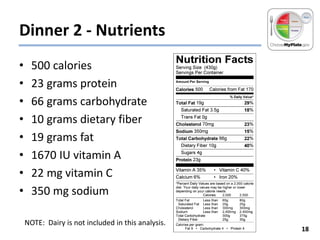
Dinner 2 - Nutrients
•
•
•
•
•
•
•
•

500 calories
23 grams protein
66 grams carbohydrate
10 grams dietary fiber
19 grams fat
1670 IU vitamin A
22 mg vitamin C
350 mg sodium
NOTE: Dairy is not included in this analysis.

18
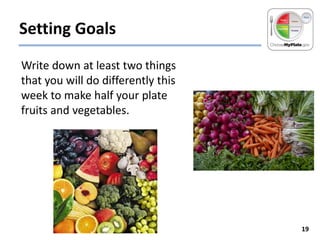
Setting Goals
Write down at least two things
that you will do differently this
week to make half your plate
fruits and vegetables.

19
Questions?
Are there any questions?

20
Slide set developed by:
Linda B. Bobroff, Ph.D., RD
Professor and Extension Nutrition Specialist
Department of Family, Youth and Community Sciences
University of Florida
September 2011

21

Make half your_plate_fruits_and_vegetables-1

  • 1.
    Make Half YourPlate Fruits and Vegetables! Presenter name and affiliation
  • 2.
    What Does ItMean? Make Half Your Plate Fruits and Vegetables! a. Eat any fruit or vegetable as long as it fits on half your plate. b. Choose nutrient-rich fruits and vegetables to fill up about half your plate. c. Both a and b 2
  • 3.
    What Does ItMean? Make Half Your Plate Fruits and Vegetables! a. Eat any fruit or vegetable as long as it fits on half your plate. b. Choose nutrient-rich fruits and vegetables to fill up about half your plate. c. Both a and b 3
  • 4.
    Health Benefits • Reducedrisk of obesity, diabetes, and heart disease • Protection against some cancers • Lower blood pressure • Reduced risk of kidney stones • Decrease in bone loss 4
  • 5.
    Match Nutrients -Food Sources! • • • • • Fiber Folate Potassium Beta-carotene Vitamin C • • • • • • Oranges Leafy greens Legumes Papayas Tomatoes White potatoes 5
  • 6.
    Match Nutrients -Food Sources! • • • • • Fiber Folate Potassium Beta-carotene Vitamin C • • • • • • Oranges Leafy greens Legumes Papayas Tomatoes White potatoes These are excellent food sources of these nutrients. You can get these nutrients from MANY fruits and vegetables! 6
  • 7.
  • 8.
    Selecting Nutrient-Rich F/V Think VARIETY!! FRESH CRUNCHY SOFT CANNED FROZEN Forillustrative purposes only; Extension does not endorse specific brands. 8
  • 9.
    Maximize Nutrients: Buying •Buy fruits and vegetables fresh and in season when possible. • Choose fresh fruits or canned fruits with little or no added sugar. • When buying frozen vegetables, select those with no added sauces. • Look for low sodium or sodium-free when buying canned vegetables. • Use food labels to compare nutrient values. 9
  • 10.
    Maximize Nutrients: Preparing •Use fresh fruits and vegetables as soon as possible. • Cook veggies in small amount of liquid until just tender. • Microwave, steam, stir-fry, or lightly grill veggies to retain nutrients. • Use herbs, spices, lemon or lime juice for flavor. • Minimize sauces and added salt. 10
  • 11.
    Increase the Appeal • • • • Servefresh cut veggies with a light dip or dressing. Cut veggies in various shapes for added interest. Keep a bowl of fresh fruit on the kitchen counter. In salads use many colors and textures of fruits and vegetables for variety. • Keep prepared cut-up vegetables in a see-through container in the refrigerator. 11
  • 12.
    Get Children Involved •Let them decide which vegetable to have for dinner. • In the store, ask them to choose a new vegetable or fruit to try at home. • Allow them to help with food preparation. Examples: – – – – Prepare fruit kabobs for a snack. Help with salad preparation. Cut-up vegetables for a recipe. Make a fruit salad for dessert. 12
  • 13.
    What’s for Dinner? UsingMyPlate in Your Life - Adults • Find your estimated daily calorie needs. • Look up the amounts to eat from the Fruits and Vegetables food groups. • Divide these amounts by three. • Pick fruit and vegetable portions that meet these dinner goals. • Decide on food preparation techniques to keep foods as healthful as possible. 13
  • 14.
    What about MixedFoods? • We often include foods from more than one food group in our recipes. • Recommended amounts from four of the food groups for a 2,000 calorie diet divided by 3: – – – – Vegetables: 1 cup (rounded up) Fruits: 2/3 cup Grains: 2 ounce equivalents Protein Foods: 2 ounce equivalents (rounded up) • We may make adjustments in these amounts for the dinner meal based on our usual eating patterns. 14
  • 15.
    MyPlate – Dinner1 3 ounces broiled salmon (added 1 oz) 1 cup rice pilaf with ½ cup vegetables 1 cup salad 1 peach 15
  • 16.
    Dinner 1 -Nutrients • • • • • • • • 580 calories 30 grams protein 69 grams carbohydrate 6 grams dietary fiber 20 grams fat 2750 IU vitamin A 8 mg vitamin C 260 mg sodium NOTE: Dairy is not included in this analysis. 16
  • 17.
    MyPlate – Dinner2 Spaghetti and meat balls: 1 cup spaghetti 3 ounces meatballs (added 1 oz) 1½ cup salad (added ½ cup) ⅔ cup fruit salad 17
  • 18.
    Dinner 2 -Nutrients • • • • • • • • 500 calories 23 grams protein 66 grams carbohydrate 10 grams dietary fiber 19 grams fat 1670 IU vitamin A 22 mg vitamin C 350 mg sodium NOTE: Dairy is not included in this analysis. 18
  • 19.
    Setting Goals Write downat least two things that you will do differently this week to make half your plate fruits and vegetables. 19
  • 20.
  • 21.
    Slide set developedby: Linda B. Bobroff, Ph.D., RD Professor and Extension Nutrition Specialist Department of Family, Youth and Community Sciences University of Florida September 2011 21