Major weeds of Bottle gourd,
Brinjal and Cucumber
Presented by :-
Ankit Kumar(05)
Rita Kumari (17)
Raj Nandani(35)
Submitted to:-
Mr. Suresh Kumar Mahto
What is weed?
Weeds are the unwanted plants grow in
the garden or fields of crops and prevent
the growth of desirable plants and compete
with the crop plants for nutrition and
various other factors.
Weeds compete with the main crop plant
for air, water ,sunlight and nutrients in the
soil making them deficient for the main
crop. Also, they are not of use to humans.
Major weeds of bottle gourd
AMARANTHUS
Local name: Gandhari sag
Scientific name: Amaranthus viridis
Family: Amaranthaceeae
• It is an annual herb with an upright, light green stem that grows to about 60–80 cm
in height.
• Numerous branches emerge from the base, and the leaves are ovate, 3–6 cm long,
2–4 cm wide, with long petioles of about 5 cm.
• Benefits: Green Amaranth can contain up to 38% protein by dry weight
• Amaranthus viridis is eaten as a boiled green or as a vegetable in many parts of
the world.
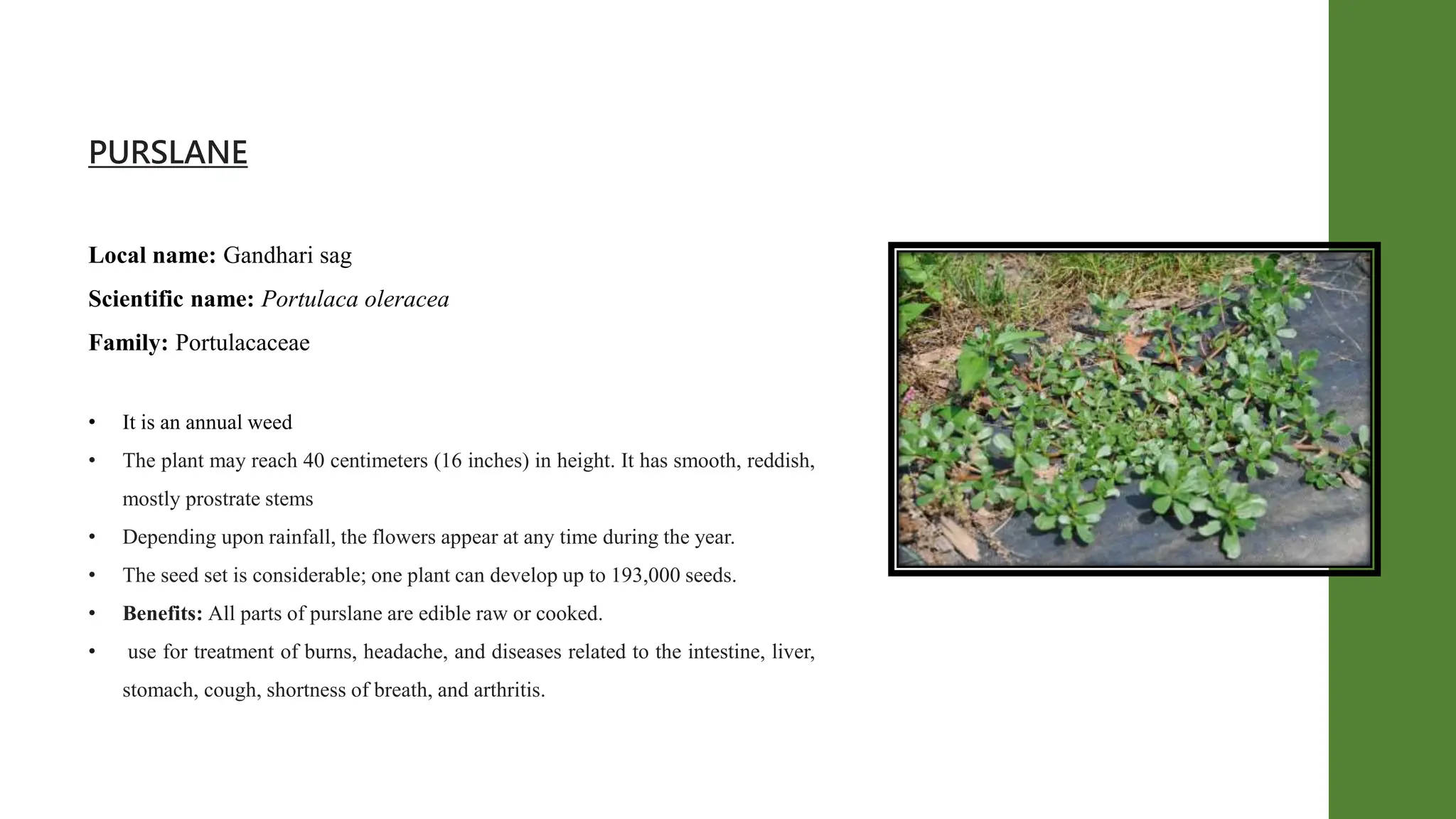
PURSLANE
Local name: Gandhari sag
Scientific name: Portulaca oleracea
Family: Portulacaceae
• It is an annual weed
• The plant may reach 40 centimeters (16 inches) in height. It has smooth, reddish,
mostly prostrate stems
• Depending upon rainfall, the flowers appear at any time during the year.
• The seed set is considerable; one plant can develop up to 193,000 seeds.
• Benefits: All parts of purslane are edible raw or cooked.
• use for treatment of burns, headache, and diseases related to the intestine, liver,
stomach, cough, shortness of breath, and arthritis.
NUTSAGE
Local name: Motha ghas
Scientific name: Cyperus rotundus
Family: Cyperaceae
• May reach a height of up to 140 cm (55 in).
• Benefits: Ayurvedic physicians use the plant for medicinal purposes in
treating fevers, digestive system disorders
INDIAN GOOSEGRASS
Scientific name: Eleusine indica
Family: Poaceae
• It is a small annual grass distributed throughout the warmer areas.
• It is an important weed of cultivated crops, lawns, and golf courses.
• It may survive for more than a year in climates not subject to frost.
CRABGRASS
Scientific name: Digitaria sanguinalis
Family: Poaceae
• Most spread vegetatively and root at the joints of the stems.
• Benefits: It is used as animal fodder.
BERMUNDA GRASS
Scientific name: Cynodont dactylon
Family: Poaceae
• The blades are a grey-green colour and are short, usually 2–15 cm (0.79–5.91 in)
long with rough edges.
• It has a deep root system; the root system can grow to over 2 meters (6.6 ft) deep.
• It is fast-growing and tough, making it popular and useful for sports fields, as when
damaged it will recover quickly.
• Benefits: This grass is usually offered during puja (worship).
Harmful effects of weeds
• Weeds compete with crop plants for inputs.
• Weeds reduce the quantity/ quality of farm products.
• Weeds harbour insect pests and diseases thus they act as a reservoir of infection for cultivated crop plants.
• Weeds increases cost of labour which ultimately increases the cost of cultivation of crop.
• Some weeds are poisonous and cause health hazards to human beings and animals viz., parthenium.
Different methods of weed control:
• Preventative Weed Control
• Weed free crop seed and seedling, not using fresh or partially decomposed FYM, proper cleaning
of farm machinery before moving from infested field to clean field, following legal and
quarantine measures and inter country movements.
• Cultural
• Good seedbed preparation, timely sowing, optimum crop stand establishment smoother crops,
line sowing for intercultivation, summer ploughing, crop rotation etc.
• Mechanical
• Hand weeding, hand pulling, digging, sickling, burning, mulching, mowing etc.
• Biological
• Use of living organisms to reduce the vigour reproductive capacity, density or impact of weeds.
Ex- cows, snails, fish, beetles etc.
• Chemical
• Chemical weed control refers to any technique that involves the application of a chemical
(herbicide) to weeds or soil to control the germination or growth of the weed species. Common
examples :2,4-D; Atrazine; Butachlor, Glyphosate etc.
BRINJAL
Solanum melongena L.
Common name:-swollen
fingergrass
Botanical Name:- Chloris
barbata
Family:-Poaceae
Description:-
Fingergrass
Growth Form: Erect grass.
Foliage: Leaves are linear with
smooth edges (4 – 40 cm long, 2-3
mm wide).
Flowers: Inflorescence is composed
of 5-20 linear racemes (4 – 8 cm long)
that are connected at the base. Flowers
are wedge-shaped and fleshy.
Fruit: Dry, 1-seeded, indehiscent fruits
are known as caryopses.
Discription:-
Reddish-purple colour of the flower
spikelets is the easiest way of differentiating
nutgrass from False Onion Weed.
A long-lived grass-like plant usually
growing 20-50 cm tall. It produces a
network of creeping underground stems
with small tubers (10-25 mm long).
These branches bear several elongated
Common name:- Nutgrass
Botanical Name:- Cyprus
rotunds
Family:- Cyperaceae
Nutgrass
Common name:-sweetclover
Botanical Name:-Melilotus
officinalis
Family:-Fabaceae
sweetclover
It is an annual or biennial herb from 10
to 50 centimetres (3.9 to 19.7 inches)
in height (rarely to one metre), with
trifoliate leaves and small yellow
flowers borne in dense racemes.
The flowers are 2 – 3 mm long and
produce a hairless pod of similar
length.
Discription:-
Common name :- Bermuda
grass
Botanical name:- Cynodon
dactylon
Family:-Pocease
Discription:-
It is long lived parennial grass.
Bermuda grass (Cynodon dactylon
Pers.) is a major tropical grass found in
all tropical and subtropical areas. It is
highly tolerant to drought and heavy
grazing and therefore extremely
valuable for pasture.
Bermuda
Common name:- congress
grass
Botanical name :-Parthenium
hysterophorus
Family:-Asteraceae
Discription:-
It is commonly known as ‘altamisa’,
carrot grass, bitter weed, star weed, white
top, wild feverfew, the “Scourge of India”
and congress grass
Parthenium hysterophorus is a much-
branched, short-lived (annual), upright
(erect) herbaceous plant It usually grows
0.5-1.5 m tall, but can occasionally reach
up to 2 m or more in height.
Congress grass
Common name :- hairy crabgrass
Botanical name :-Digitaria
sanguinalis
Family:-Poaceae
Discription:-
Digitaria is a genus of plants in the
grass family native to tropical and
warm temperate regions .
It is an annual grass with an
inflorescence of up to nine very long,
very thin, radiating branches atop its
stems. Each branch is lined with pairs
Hairy crabgrass
Different methods of weed control :-
• Culture and Physical Method :-
Summer ploughing ,Proper crop stand,Intercropping,Crop
rotation,Solarisation,Burning the crop residues and weeds
and Mulching.
• Manual weeding:-
Remove the weeds by hoeing on 30th day of planting and
earthing up.
Depending upon the need, hoeing should be repeated once in
a month.
• Biological Method:-
Allow cattle for grazing during the lean period.
• Chemical method:-
Technique that involves the application of a chemical
WEEDS OF CUCUMBER
Common Lambsquarters AmaranthusretroflexusL Ivyleaf
morningglory
Chenopodium album is a fast-growing annual
plant in the flowering plant family Amaranthaceae.
Though cultivated in some regions, the plant is
elsewhere considered a weed. Common names
include lamb’s quarters, melde, goosefoot, wild
spinach and fat-hen, though the latter two are also
applied to other species of the genus Chenopodium,
for which reason it is often distinguished as white
goosefoot.
Chenopodium album is extensively cultivated and
consumed in Northern India, and Nepal as a food crop
known as bathua.
Common Lambsquarters (Chenopodiumalbum L.)
FIG :-This graph shows the percent cumulative emergence for common
lambsquarters in seven locations. The line represents predicted values and the
triangles represent actual values. Predicted values were determined using soil
degree days with a base temperature of 48ºF starting.
Biological
Field mice, sowbugs, millipedes, crickets, slugs, and carabid
beetles all feed on common lambsquarters seeds lying on
the soil surface.
Mechanical
Tillage: Tilling at night (dark tillage) will reduce
lambsquarters emergence by 30 to 70%.
Rotary hoeing: When common lambsquarters is less than
1/4" tall it is easily controlled with a rotary hoe.
Flaming: At heights of 1/2" or less, flaming is an effective
way to control common lambsquarters.
Management
Cultural
Crop rotation: Adding small grains to the rotations helps
suppress common lambsquarters.
Planting date: Tilling in the spring and planting later (mid-
May) will reduce lambsquarters infestations because many
of the plants will have emerged and been controlled by
tillage.
CHEMICAL
Adding 2,4-D ester to burndown treatments can help ensure
effective control.
REDROOT PIGWEED : Amaranthus
retroflexus L
Family: Amaranthaceae
Life Cycle: Annual
Plant status: Weed
Amaranthus retroflexus is a species of flowering plant in the
family Amaranthaceae with several common names, including red-root
amaranth, redroot pigweed, red-rooted pigweed, common amaranth,
pigweed amaranth, and common tumbleweed
REDROOT PIGWEED
Ivyleaf morning glory Ipomoea
hederacea (L.)
Family: Convolvulaceae (Morning glory family)
Life cycle: Annual
Habitat: Crop fields, disturbed habitats
Native status: Introduced
General description: Twining, herbaceous vine
with alternate, leaves with three deeply-divided
lobes. First leaves sometimes are non-lobed. Light
blue, pink to white, funnel-shaped flowers. Butterfly
or saddle shaped cotyledons.
Ivyleaf morning glory
WEED MANAGEMENT COMPONENTS
PREEMERGENCE REGISTERED HERBICIDES ANDTHEIR COMMON
NAMES
Major weeds of bottle guard,brinjal and cucumber.pptx

Major weeds of bottle guard,brinjal and cucumber.pptx

  • 1.
    Major weeds ofBottle gourd, Brinjal and Cucumber Presented by :- Ankit Kumar(05) Rita Kumari (17) Raj Nandani(35) Submitted to:- Mr. Suresh Kumar Mahto
  • 2.
    What is weed? Weedsare the unwanted plants grow in the garden or fields of crops and prevent the growth of desirable plants and compete with the crop plants for nutrition and various other factors. Weeds compete with the main crop plant for air, water ,sunlight and nutrients in the soil making them deficient for the main crop. Also, they are not of use to humans.
  • 3.
    Major weeds ofbottle gourd
  • 4.
    AMARANTHUS Local name: Gandharisag Scientific name: Amaranthus viridis Family: Amaranthaceeae • It is an annual herb with an upright, light green stem that grows to about 60–80 cm in height. • Numerous branches emerge from the base, and the leaves are ovate, 3–6 cm long, 2–4 cm wide, with long petioles of about 5 cm. • Benefits: Green Amaranth can contain up to 38% protein by dry weight • Amaranthus viridis is eaten as a boiled green or as a vegetable in many parts of the world.
  • 5.
    PURSLANE Local name: Gandharisag Scientific name: Portulaca oleracea Family: Portulacaceae • It is an annual weed • The plant may reach 40 centimeters (16 inches) in height. It has smooth, reddish, mostly prostrate stems • Depending upon rainfall, the flowers appear at any time during the year. • The seed set is considerable; one plant can develop up to 193,000 seeds. • Benefits: All parts of purslane are edible raw or cooked. • use for treatment of burns, headache, and diseases related to the intestine, liver, stomach, cough, shortness of breath, and arthritis.
  • 6.
    NUTSAGE Local name: Mothaghas Scientific name: Cyperus rotundus Family: Cyperaceae • May reach a height of up to 140 cm (55 in). • Benefits: Ayurvedic physicians use the plant for medicinal purposes in treating fevers, digestive system disorders
  • 7.
    INDIAN GOOSEGRASS Scientific name:Eleusine indica Family: Poaceae • It is a small annual grass distributed throughout the warmer areas. • It is an important weed of cultivated crops, lawns, and golf courses. • It may survive for more than a year in climates not subject to frost.
  • 8.
    CRABGRASS Scientific name: Digitariasanguinalis Family: Poaceae • Most spread vegetatively and root at the joints of the stems. • Benefits: It is used as animal fodder.
  • 9.
    BERMUNDA GRASS Scientific name:Cynodont dactylon Family: Poaceae • The blades are a grey-green colour and are short, usually 2–15 cm (0.79–5.91 in) long with rough edges. • It has a deep root system; the root system can grow to over 2 meters (6.6 ft) deep. • It is fast-growing and tough, making it popular and useful for sports fields, as when damaged it will recover quickly. • Benefits: This grass is usually offered during puja (worship).
  • 10.
    Harmful effects ofweeds • Weeds compete with crop plants for inputs. • Weeds reduce the quantity/ quality of farm products. • Weeds harbour insect pests and diseases thus they act as a reservoir of infection for cultivated crop plants. • Weeds increases cost of labour which ultimately increases the cost of cultivation of crop. • Some weeds are poisonous and cause health hazards to human beings and animals viz., parthenium.
  • 11.
    Different methods ofweed control: • Preventative Weed Control • Weed free crop seed and seedling, not using fresh or partially decomposed FYM, proper cleaning of farm machinery before moving from infested field to clean field, following legal and quarantine measures and inter country movements. • Cultural • Good seedbed preparation, timely sowing, optimum crop stand establishment smoother crops, line sowing for intercultivation, summer ploughing, crop rotation etc. • Mechanical • Hand weeding, hand pulling, digging, sickling, burning, mulching, mowing etc. • Biological • Use of living organisms to reduce the vigour reproductive capacity, density or impact of weeds. Ex- cows, snails, fish, beetles etc. • Chemical • Chemical weed control refers to any technique that involves the application of a chemical (herbicide) to weeds or soil to control the germination or growth of the weed species. Common examples :2,4-D; Atrazine; Butachlor, Glyphosate etc.
  • 12.
  • 13.
    Common name:-swollen fingergrass Botanical Name:-Chloris barbata Family:-Poaceae Description:- Fingergrass Growth Form: Erect grass. Foliage: Leaves are linear with smooth edges (4 – 40 cm long, 2-3 mm wide). Flowers: Inflorescence is composed of 5-20 linear racemes (4 – 8 cm long) that are connected at the base. Flowers are wedge-shaped and fleshy. Fruit: Dry, 1-seeded, indehiscent fruits are known as caryopses.
  • 14.
    Discription:- Reddish-purple colour ofthe flower spikelets is the easiest way of differentiating nutgrass from False Onion Weed. A long-lived grass-like plant usually growing 20-50 cm tall. It produces a network of creeping underground stems with small tubers (10-25 mm long). These branches bear several elongated Common name:- Nutgrass Botanical Name:- Cyprus rotunds Family:- Cyperaceae Nutgrass
  • 15.
    Common name:-sweetclover Botanical Name:-Melilotus officinalis Family:-Fabaceae sweetclover Itis an annual or biennial herb from 10 to 50 centimetres (3.9 to 19.7 inches) in height (rarely to one metre), with trifoliate leaves and small yellow flowers borne in dense racemes. The flowers are 2 – 3 mm long and produce a hairless pod of similar length. Discription:-
  • 16.
    Common name :-Bermuda grass Botanical name:- Cynodon dactylon Family:-Pocease Discription:- It is long lived parennial grass. Bermuda grass (Cynodon dactylon Pers.) is a major tropical grass found in all tropical and subtropical areas. It is highly tolerant to drought and heavy grazing and therefore extremely valuable for pasture. Bermuda
  • 17.
    Common name:- congress grass Botanicalname :-Parthenium hysterophorus Family:-Asteraceae Discription:- It is commonly known as ‘altamisa’, carrot grass, bitter weed, star weed, white top, wild feverfew, the “Scourge of India” and congress grass Parthenium hysterophorus is a much- branched, short-lived (annual), upright (erect) herbaceous plant It usually grows 0.5-1.5 m tall, but can occasionally reach up to 2 m or more in height. Congress grass
  • 18.
    Common name :-hairy crabgrass Botanical name :-Digitaria sanguinalis Family:-Poaceae Discription:- Digitaria is a genus of plants in the grass family native to tropical and warm temperate regions . It is an annual grass with an inflorescence of up to nine very long, very thin, radiating branches atop its stems. Each branch is lined with pairs Hairy crabgrass
  • 19.
    Different methods ofweed control :- • Culture and Physical Method :- Summer ploughing ,Proper crop stand,Intercropping,Crop rotation,Solarisation,Burning the crop residues and weeds and Mulching. • Manual weeding:- Remove the weeds by hoeing on 30th day of planting and earthing up. Depending upon the need, hoeing should be repeated once in a month. • Biological Method:- Allow cattle for grazing during the lean period. • Chemical method:- Technique that involves the application of a chemical
  • 20.
  • 21.
  • 22.
    Chenopodium album isa fast-growing annual plant in the flowering plant family Amaranthaceae. Though cultivated in some regions, the plant is elsewhere considered a weed. Common names include lamb’s quarters, melde, goosefoot, wild spinach and fat-hen, though the latter two are also applied to other species of the genus Chenopodium, for which reason it is often distinguished as white goosefoot. Chenopodium album is extensively cultivated and consumed in Northern India, and Nepal as a food crop known as bathua. Common Lambsquarters (Chenopodiumalbum L.)
  • 23.
    FIG :-This graphshows the percent cumulative emergence for common lambsquarters in seven locations. The line represents predicted values and the triangles represent actual values. Predicted values were determined using soil degree days with a base temperature of 48ºF starting.
  • 24.
    Biological Field mice, sowbugs,millipedes, crickets, slugs, and carabid beetles all feed on common lambsquarters seeds lying on the soil surface. Mechanical Tillage: Tilling at night (dark tillage) will reduce lambsquarters emergence by 30 to 70%. Rotary hoeing: When common lambsquarters is less than 1/4" tall it is easily controlled with a rotary hoe. Flaming: At heights of 1/2" or less, flaming is an effective way to control common lambsquarters. Management
  • 25.
    Cultural Crop rotation: Addingsmall grains to the rotations helps suppress common lambsquarters. Planting date: Tilling in the spring and planting later (mid- May) will reduce lambsquarters infestations because many of the plants will have emerged and been controlled by tillage. CHEMICAL Adding 2,4-D ester to burndown treatments can help ensure effective control.
  • 26.
    REDROOT PIGWEED :Amaranthus retroflexus L Family: Amaranthaceae Life Cycle: Annual Plant status: Weed Amaranthus retroflexus is a species of flowering plant in the family Amaranthaceae with several common names, including red-root amaranth, redroot pigweed, red-rooted pigweed, common amaranth, pigweed amaranth, and common tumbleweed REDROOT PIGWEED
  • 27.
    Ivyleaf morning gloryIpomoea hederacea (L.) Family: Convolvulaceae (Morning glory family) Life cycle: Annual Habitat: Crop fields, disturbed habitats Native status: Introduced General description: Twining, herbaceous vine with alternate, leaves with three deeply-divided lobes. First leaves sometimes are non-lobed. Light blue, pink to white, funnel-shaped flowers. Butterfly or saddle shaped cotyledons. Ivyleaf morning glory
  • 28.
  • 30.