COPRODUCT 
FindingOpportunitiesforCarbonDioxide 
Revenues 
By Sam Rushing 
A few years ago. a primary source of refined camon 
dioxide (C02) was as a byproduct produced during 
the manufacture of anhydrous ammonia. In fact. 
only a handful of primary sources of raw C02 were refined 
and liquefied from ethanol for the merchant CO2 industry. 
While a majority of anhydrous ammonia is traditionally ded-icated 
to the agriculture sector, many plants are closed or 
going through restructuring and bankruptcy largely due to 
ramped-up production from mega-sized facilities in Latin 
America. the Caribbean. China and Russia. These countries 
and regions have cheaper labor and extremely cheap natural 
gas feedstocks. 
The result of the drastic reduction of domestic anhy-drous 
ammonia manufacturing has been a shift in the loca-tions 
of C02 facilities. forcing the relocation of merchant 
C02 production in the United States. 
Another factor affecting the domestic market is that it's 
not economically feasible to produce unsubsidized merchant 
C02 from flue gas derived from power plants. CO2 volume in 
the raw flue gas is often 3 percent to 15 percent versus up to 
99 percent in ethanol and ammonia plant coproducts. 
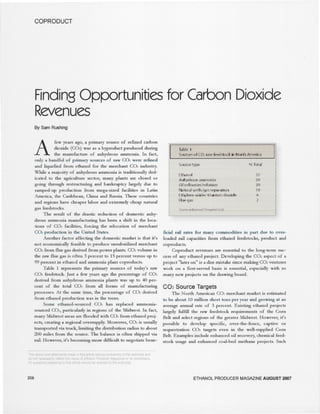
Table 1 represents the primary sources of today's raw 
C02 feedstock. Just a few years ago the percentage of C02 
derived from anhydrous ammonia plants was up to 40 per-cent 
of the total C02 from all forms of manufacturing 
processes. At the same time. the percentage of C02 derived 
from ethanol production was in the teens. 
Some ethanol-sourced C02 has replaced ammonia-sourced 
C02. particularly in regions of the Midwest. In fact. 
many Midwest areas are flooded with C02 from ethanol proj-ects. 
creating a regional oversupply. Moreover, C02 is usually 
transported via truck. limiting the distribution radius to about 
200 miles from the source. The balance is often shipped via 
rail. However. it's becoming more difficult to negotiate bene- 
208 
T~' 
S<o..(~ of (0, ,~W h.d51.xk '" fio'lt'e AA'lic'I'(o) 
1 
II 
I 
r th.t)01 
N}hyd,.)u,> ~mMOn.' 
(10.I~r.).~n';~i.d(lll"'~ 
N.1 IIwdl:..'{W' ,>"p-',...Uon 
Hhyl...ne .~ld../tJl um <S.)xld.. 
flu.. gas 
n 
20 
20 
,q 
6 
2 
ficial rail rates for many commodities in part due to over-loaded 
rail capacities from ethanol feedstocks. product and 
coproducts. 
Coproduct revenues are essential to the long-term suc-cess 
of any ethanol project. Developing the C02 aspect of a 
project "later on" is a dire mistake since making C02 ventures 
work on a first-served basis is essential. especially with so 
many new projects on the drawing board. 
C02 Source Targets 
The North American C02 merchant market is estimated 
to be about 10 million short tons per year and growing at an 
average annual rate of 3 percent. Existing ethanol projects 
largely fulfill the raw feedstock requirements of the Com 
Belt and select regions of the greater Midwest. However. it's 
possible to develop specific. over-the-fence. captive or 
sequestration C02 targets even in the well-supplied Com 
Belt. Examples include enhanced oil recovery. chemical feed-stock 
usage and enhanced coal-bed methane projects. Such 
ETHANOLPRODUCERMAGAZINEAUGUST2007
Agri-Systems 
PICKUP 
July07 EPM page 93 
Size: 2/3V 
Color:4/c 
building2thirds010406 
ETHANOL PRODUCER MAGAZINE AUGUST 2007 
COPRODUCT 
projects are found adjacent to 
viable oilfields, or cbemical manu-facturing 
and coal production proj-ects, 
and require distribution infra-structure. 
The food processing 
industry is also a possible market. 
Markets having large concentrated 
poultry projects use cryogenic 
freezing that utilizes fluids sucb as 
C02 to replace mecbanical refriger-ation. 
Selling C02 to gas companies 
via direct, over-the-fence raw mar-keting, 
a joint venture, or possible 
equity position for refinement and 
liquefaction, would supply the mer-cbant 
markets sucb as food proces-sors. 
This is the wholesale version 
of supply to the mercbant markets. 
For under-supplied regions 
that import C02, ethanol projects 
can benefit the local CO2 industry. 
Those regions include markets in 
the West, Southwest, Middle 
South, Middle Atlantic, Florida and 
New England. Some Canadian 
markets, including the Pacific and 
Atlantic regions, as well as specific 
areas of populated provinces, are 
better targets for the wholesale ver-sion 
of C02 sales. 
A proper evaluation should be 
conducted to devise sucb captive 
marketing to the oil or chemical 
sector. The same goes for selecting 
the best gas company to purchase 
and refine C02 on a wholesale 
level. 
The possibility also exists for 
refining and liquefying C02 for sale 
to the direct consumer market, 
something some ethanol firms 
have achieved. Of course, this 
form of marketing involves the 
greatest amount of risk. However, 
it also holds the greatest profit 
potential. 
An Environmental 
Perspective 
Since the United States isn't 
party to the Kyoto Protocol or 
209
CENTRYSIS 
PICK UP 
July EPM Page 68 
Size: 1/3V 
Color: 4/c 
New & Used Centri. 
210 
COPRODUCT 
.. 
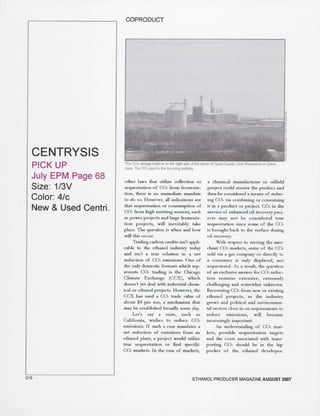
The CO2 storage bullet is on the rig~ side of the phoro of Quad County Com Processors in Galva, 
Iowa. The CO2 plant is the low-Iying building. 
other laws that urilize collection or 
sequestration of CO2 from fermenta-tion. 
there is no immediate mandate 
to do so. However. all indications are 
that sequestration or consumption of 
C02 from high emitting sources. such 
as power projects and la.:ge fermenta-tion 
projects. will inevitably take 
place. The question is when and how 
will this occur. 
Trading carbon credits isn't appli-cable 
to the ethanol industry today 
and isn't a true solution to a net 
reduction of C02 emissions. One of 
the only domestic formats which rep-resents 
C02 trading is the Chicago 
Climate Exchange (CCX). which 
doesn't yet deal with industrial chem-ical 
or ethanol projects. However. the 
CCX has used a C02 trade value of 
about $4 per ton. a mechanism that 
may be established broadly some day. 
Let's say a state. such as 
California. wishes to reduce C02 
emissions. If such a case mandates a 
net reduction of emissions from an 
ethanol plant. a project would utilize 
true sequestration or find specific 
C02 markets. In the case of markets. 
a chemical manufacturer or oilfield 
project could receive the product and 
then be considered a means of reduc-ing 
C02 via combining or consuming 
it in a product or project. C02 in the 
service of enhanced oil recovery proj-ects 
may not be considered true 
sequestration since some of the C02 
is brought back to the surface during 
oil recovery. 
With respect to serving the mer-chant 
C02 markets. some of the C02 
sold via a gas company or directly to 
a consumer is only displaced, not 
sequestered As a result. the question 
of an exclusive answer for C02 reduc-tion 
remains extensive. extremely 
challenging and somewhat unknown. 
Recovering C02 from new or existing 
ethanol projects. as the industry 
grows and political and environmen-tal 
sectors close in on requirements to 
reduce emissions. will become 
increasingly important. 
An understanding of C02 mar-kets. 
possible sequestration targets 
and the costs associated with trans-porting 
C02 should be in the hip 
pocket of the ethanol developer. 
ETHANOL PRODUCER MAGAZINE AUGUST 2007
Further data will be required beyond 
the immediate knowledge of the 
most profitable and beneficial means 
of C02 marketing from the ethanol 
project. 
Conclusions 
The United States holds per-haps 
40 percent of the approximate 
total of 20 million metric tons of 
global merchant C02. The balance 
of North America is approximately 
another 2 million tons per year in 
consumption. Western Europe and 
Japan are the other significant mer-chant 
markets, while developing 
economies are largely solely bever-age 
carbonation markets. Developed 
economies are highly diversified in 
terms of the broad application of 
C02, including agricultural, solvent 
technologies, cryogenic freezing, 
food preservation, metallurgical 
applications, oil and gas applications, 
plus many usages in the chemical 
and water treatment industries. 
The dynamics for C02 usage 
continues to change, as would the 
source types found in some regions, 
such as that described with the fertil-izer 
ammonia production sector now 
replaced in part by C02 off the fer-mentation 
sector. 
C02 continues to be a relatively 
routine and simple process for 
purification when derived from dry-grind, 
continuous fermentation 
ethanol operations. It is essential to 
understand the costs and require-ments 
for production of C02 in 
order to factor it into a clear under-standing 
of the value of C02 when 
sold over the fence to the gas refin-er, 
or when selling direcdy to the 
markets at large. 
There remain many target 
opportunities for C02 in numerous 
regions of North America and inter-nationally. 
However, to understand 
the impact, competition, costs, 
requirements and essential market 
values, a proper evaluation of these 
ETHANOL PRODUCER MAGAZINE AUGUST 2007 
COPRODUCT 
elements is necessary to yield the great-est 
dollar value to the ethanol project. 
Even $1 or $2 per ton variation over 
many years represents a great deal of 
money. 
There will continue to be a growing 
push to control and reduce C02 emis-sions 
from all emitters, whether a single 
family car, an ethanol project, or the 
mega-sized coal-fired power plant. In the 
long term, C02 recovery, sequestration, 
or another form of C02 management 
will direcdy affect the growing ethanol 
industry. 
More information is available at 
www.carbondioxideconsultants.com. 
Sam Rushing is president of Advanced 
Cryogenics Ltd" a carbon dioxide con-sulting 
firm based in Tavernier, Fla. 
Reach him at rushing@terranova.net or 
(305) 852-2597. 
CrossCommodity 
MarginNetting 
IJ 
I ., ;Tci11~~'ino~Y~~~' '."1~!./"~~.,: ..,>~~:>'. i' ~.<:.:t,';/;;;?' ,(.'li':.,lr.:!.,;::.:~".I ,I;', ,.:J ,', 
, 'H~rifo1((J1TreY '."" AnoaWJrd I. :: " i; j! ",'::.': I I: 
'N;rtu~' G:l5SuPPt# "Rali!W;)tJle Fuels RJ5kM;:mj'~effientJn.j Rn.nce':.: "..!i . 
. ~.. .' .' . " " ,I. ! r.' ) !'. ,. I'" ,',., I' ,''', ,,'f' "",, I, 'c.'.!," '. P ",' 
.Mzqu.r1eCoIIEnergr ., /OI;n:quJIE8.Jnkl:.1rT1tB::1REpresentllNeorl1l:E, ... '." , 
.TetJ(3'H])7&92W'. Telr{l11)EU89 " !,'. ':::., ,:1'"_" ,.'- "r':" :'-, " . '. , , " 'I' . ., I: I:., 
211

Eth prod mag draft for aug 07 publication

  • 1.
    COPRODUCT FindingOpportunitiesforCarbonDioxide Revenues By Sam Rushing A few years ago. a primary source of refined camon dioxide (C02) was as a byproduct produced during the manufacture of anhydrous ammonia. In fact. only a handful of primary sources of raw C02 were refined and liquefied from ethanol for the merchant CO2 industry. While a majority of anhydrous ammonia is traditionally ded-icated to the agriculture sector, many plants are closed or going through restructuring and bankruptcy largely due to ramped-up production from mega-sized facilities in Latin America. the Caribbean. China and Russia. These countries and regions have cheaper labor and extremely cheap natural gas feedstocks. The result of the drastic reduction of domestic anhy-drous ammonia manufacturing has been a shift in the loca-tions of C02 facilities. forcing the relocation of merchant C02 production in the United States. Another factor affecting the domestic market is that it's not economically feasible to produce unsubsidized merchant C02 from flue gas derived from power plants. CO2 volume in the raw flue gas is often 3 percent to 15 percent versus up to 99 percent in ethanol and ammonia plant coproducts. Table 1 represents the primary sources of today's raw C02 feedstock. Just a few years ago the percentage of C02 derived from anhydrous ammonia plants was up to 40 per-cent of the total C02 from all forms of manufacturing processes. At the same time. the percentage of C02 derived from ethanol production was in the teens. Some ethanol-sourced C02 has replaced ammonia-sourced C02. particularly in regions of the Midwest. In fact. many Midwest areas are flooded with C02 from ethanol proj-ects. creating a regional oversupply. Moreover, C02 is usually transported via truck. limiting the distribution radius to about 200 miles from the source. The balance is often shipped via rail. However. it's becoming more difficult to negotiate bene- 208 T~' S<o..(~ of (0, ,~W h.d51.xk '" fio'lt'e AA'lic'I'(o) 1 II I r th.t)01 N}hyd,.)u,> ~mMOn.' (10.I~r.).~n';~i.d(lll"'~ N.1 IIwdl:..'{W' ,>"p-',...Uon Hhyl...ne .~ld../tJl um <S.)xld.. flu.. gas n 20 20 ,q 6 2 ficial rail rates for many commodities in part due to over-loaded rail capacities from ethanol feedstocks. product and coproducts. Coproduct revenues are essential to the long-term suc-cess of any ethanol project. Developing the C02 aspect of a project "later on" is a dire mistake since making C02 ventures work on a first-served basis is essential. especially with so many new projects on the drawing board. C02 Source Targets The North American C02 merchant market is estimated to be about 10 million short tons per year and growing at an average annual rate of 3 percent. Existing ethanol projects largely fulfill the raw feedstock requirements of the Com Belt and select regions of the greater Midwest. However. it's possible to develop specific. over-the-fence. captive or sequestration C02 targets even in the well-supplied Com Belt. Examples include enhanced oil recovery. chemical feed-stock usage and enhanced coal-bed methane projects. Such ETHANOLPRODUCERMAGAZINEAUGUST2007
  • 2.
    Agri-Systems PICKUP July07EPM page 93 Size: 2/3V Color:4/c building2thirds010406 ETHANOL PRODUCER MAGAZINE AUGUST 2007 COPRODUCT projects are found adjacent to viable oilfields, or cbemical manu-facturing and coal production proj-ects, and require distribution infra-structure. The food processing industry is also a possible market. Markets having large concentrated poultry projects use cryogenic freezing that utilizes fluids sucb as C02 to replace mecbanical refriger-ation. Selling C02 to gas companies via direct, over-the-fence raw mar-keting, a joint venture, or possible equity position for refinement and liquefaction, would supply the mer-cbant markets sucb as food proces-sors. This is the wholesale version of supply to the mercbant markets. For under-supplied regions that import C02, ethanol projects can benefit the local CO2 industry. Those regions include markets in the West, Southwest, Middle South, Middle Atlantic, Florida and New England. Some Canadian markets, including the Pacific and Atlantic regions, as well as specific areas of populated provinces, are better targets for the wholesale ver-sion of C02 sales. A proper evaluation should be conducted to devise sucb captive marketing to the oil or chemical sector. The same goes for selecting the best gas company to purchase and refine C02 on a wholesale level. The possibility also exists for refining and liquefying C02 for sale to the direct consumer market, something some ethanol firms have achieved. Of course, this form of marketing involves the greatest amount of risk. However, it also holds the greatest profit potential. An Environmental Perspective Since the United States isn't party to the Kyoto Protocol or 209
  • 3.
    CENTRYSIS PICK UP July EPM Page 68 Size: 1/3V Color: 4/c New & Used Centri. 210 COPRODUCT .. The CO2 storage bullet is on the rig~ side of the phoro of Quad County Com Processors in Galva, Iowa. The CO2 plant is the low-Iying building. other laws that urilize collection or sequestration of CO2 from fermenta-tion. there is no immediate mandate to do so. However. all indications are that sequestration or consumption of C02 from high emitting sources. such as power projects and la.:ge fermenta-tion projects. will inevitably take place. The question is when and how will this occur. Trading carbon credits isn't appli-cable to the ethanol industry today and isn't a true solution to a net reduction of C02 emissions. One of the only domestic formats which rep-resents C02 trading is the Chicago Climate Exchange (CCX). which doesn't yet deal with industrial chem-ical or ethanol projects. However. the CCX has used a C02 trade value of about $4 per ton. a mechanism that may be established broadly some day. Let's say a state. such as California. wishes to reduce C02 emissions. If such a case mandates a net reduction of emissions from an ethanol plant. a project would utilize true sequestration or find specific C02 markets. In the case of markets. a chemical manufacturer or oilfield project could receive the product and then be considered a means of reduc-ing C02 via combining or consuming it in a product or project. C02 in the service of enhanced oil recovery proj-ects may not be considered true sequestration since some of the C02 is brought back to the surface during oil recovery. With respect to serving the mer-chant C02 markets. some of the C02 sold via a gas company or directly to a consumer is only displaced, not sequestered As a result. the question of an exclusive answer for C02 reduc-tion remains extensive. extremely challenging and somewhat unknown. Recovering C02 from new or existing ethanol projects. as the industry grows and political and environmen-tal sectors close in on requirements to reduce emissions. will become increasingly important. An understanding of C02 mar-kets. possible sequestration targets and the costs associated with trans-porting C02 should be in the hip pocket of the ethanol developer. ETHANOL PRODUCER MAGAZINE AUGUST 2007
  • 4.
    Further data willbe required beyond the immediate knowledge of the most profitable and beneficial means of C02 marketing from the ethanol project. Conclusions The United States holds per-haps 40 percent of the approximate total of 20 million metric tons of global merchant C02. The balance of North America is approximately another 2 million tons per year in consumption. Western Europe and Japan are the other significant mer-chant markets, while developing economies are largely solely bever-age carbonation markets. Developed economies are highly diversified in terms of the broad application of C02, including agricultural, solvent technologies, cryogenic freezing, food preservation, metallurgical applications, oil and gas applications, plus many usages in the chemical and water treatment industries. The dynamics for C02 usage continues to change, as would the source types found in some regions, such as that described with the fertil-izer ammonia production sector now replaced in part by C02 off the fer-mentation sector. C02 continues to be a relatively routine and simple process for purification when derived from dry-grind, continuous fermentation ethanol operations. It is essential to understand the costs and require-ments for production of C02 in order to factor it into a clear under-standing of the value of C02 when sold over the fence to the gas refin-er, or when selling direcdy to the markets at large. There remain many target opportunities for C02 in numerous regions of North America and inter-nationally. However, to understand the impact, competition, costs, requirements and essential market values, a proper evaluation of these ETHANOL PRODUCER MAGAZINE AUGUST 2007 COPRODUCT elements is necessary to yield the great-est dollar value to the ethanol project. Even $1 or $2 per ton variation over many years represents a great deal of money. There will continue to be a growing push to control and reduce C02 emis-sions from all emitters, whether a single family car, an ethanol project, or the mega-sized coal-fired power plant. In the long term, C02 recovery, sequestration, or another form of C02 management will direcdy affect the growing ethanol industry. More information is available at www.carbondioxideconsultants.com. Sam Rushing is president of Advanced Cryogenics Ltd" a carbon dioxide con-sulting firm based in Tavernier, Fla. Reach him at rushing@terranova.net or (305) 852-2597. CrossCommodity MarginNetting IJ I ., ;Tci11~~'ino~Y~~~' '."1~!./"~~.,: ..,>~~:>'. i' ~.<:.:t,';/;;;?' ,(.'li':.,lr.:!.,;::.:~".I ,I;', ,.:J ,', , 'H~rifo1((J1TreY '."" AnoaWJrd I. :: " i; j! ",'::.': I I: 'N;rtu~' G:l5SuPPt# "Rali!W;)tJle Fuels RJ5kM;:mj'~effientJn.j Rn.nce':.: "..!i . . ~.. .' .' . " " ,I. ! r.' ) !'. ,. I'" ,',., I' ,''', ,,'f' "",, I, 'c.'.!," '. P ",' .Mzqu.r1eCoIIEnergr ., /OI;n:quJIE8.Jnkl:.1rT1tB::1REpresentllNeorl1l:E, ... '." , .TetJ(3'H])7&92W'. Telr{l11)EU89 " !,'. ':::., ,:1'"_" ,.'- "r':" :'-, " . '. , , " 'I' . ., I: I:., 211