Understanding Maintenance of Certification Presented By:  The American Board of Pediatrics
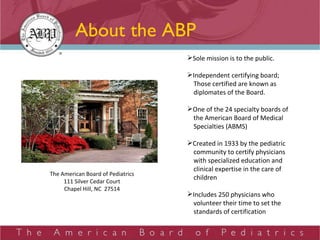
About the ABP Sole mission is to the public. Independent certifying board; Those certified are known as diplomates of the Board.  One of the 24 specialty boards of  the American Board of Medical  Specialties (ABMS) Created in 1933 by the pediatric  community to certify physicians  with specialized education and  clinical expertise in the care of  children Includes 250 physicians who  volunteer their time to set the  standards of certification The American Board of Pediatrics 111 Silver Cedar Court Chapel Hill, NC  27514
The Evolution of Board Certification Permanent Certification Until 1988, certification was done by successfully passing a test of knowledge only once in a career, typically at the end of training.  Time-Limited Certification Beginning in 1989, a diplomate was required to successfully pass a similar test of knowledge every 7 years.  Maintenance of Certification (MOC) Beginning in 2010, diplomates will maintain certification by continual evaluation of the competencies verified during residency. A secure test of knowledge is one part of this four-part program.
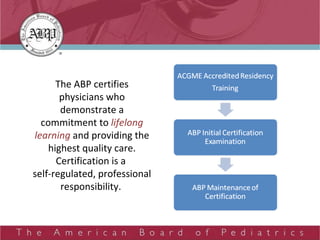
The ABP certifies physicians who demonstrate a commitment to  lifelong learning  and providing the highest quality care. Certification is a  self-regulated, professional responsibility.
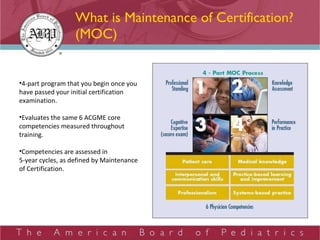
What is Maintenance of Certification?  (MOC) 4-part program that you begin once you have passed your initial certification examination. Evaluates the same 6 ACGME core competencies measured throughout training. Competencies are assessed in  5-year cycles, as defined by Maintenance of Certification.
The Purpose of MOC For The Public: MOC has been developed to assure the public that diplomates certified by the American Board of Pediatrics have demonstrated: Professionalism Commitment to lifelong learning Specialized knowledge of Pediatrics Dedication to continuously improving care For The Pediatrician: Participation in MOC: Leads to better care for children May help you meet payer, regulatory and consumer demands for quality Represents to the public your commitment to providing quality care Acknowledges your achievement of the gold standard in pediatric care
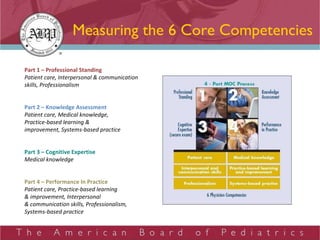
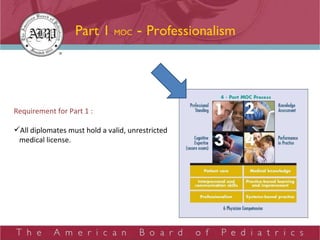
Measuring the 6 Core Competencies Part 1 – Professional Standing Patient care, Interpersonal & communication  skills, Professionalism Part 2 – Knowledge Assessment Patient care, Medical knowledge,  Practice-based learning &  improvement, Systems-based practice Part 3 – Cognitive Expertise Medical knowledge Part 4 – Performance In Practice Patient care, Practice-based learning  & improvement, Interpersonal  & communication skills, Professionalism,  Systems-based practice
Part 1  MOC  -  Professionalism Requirement for Part 1 : All diplomates must hold a valid, unrestricted  medical license.
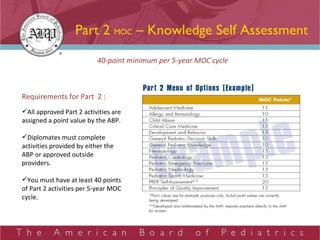
Part 2  MOC  – Knowledge Self Assessment Requirements for Part  2 : All approved Part 2 activities are assigned a point value by the ABP. Diplomates must complete activities provided by either the ABP or approved outside providers.  You must have at least 40 points of Part 2 activities per 5-year MOC cycle. 40-point minimum per 5-year MOC cycle
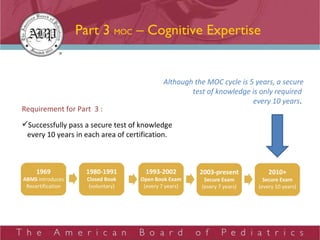
Part 3  MOC  – Cognitive Expertise Requirement for Part  3 : Successfully pass a secure test of knowledge every 10 years in each area of certification. Although the MOC cycle is 5 years, a secure test of knowledge is only required  every 10 years .  1993 - 2002 1969 ABMS  introduces Recertification 1980-1991 Closed Book (voluntary) 1993-2002 Open Book Exam (every 7 years) 2003-present Secure Exam (every 7 years) 2010+ Secure Exam (every 10 years)
Because examinations are only required every 10 years, it’s important to note that the exam does not necessarily coincide with the  beginning or end of your  5-year MOC cycle. NOTE!
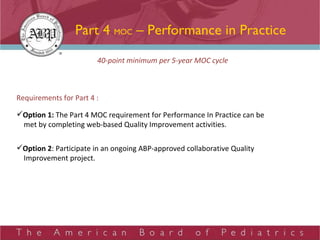
Part 4  MOC  – Performance in Practice 40-point minimum per 5-year MOC cycle Requirements for Part 4 : Option 1:  The Part 4 MOC requirement for Performance In Practice can be met by completing web-based Quality Improvement activities.  Option 2 : Participate in an ongoing ABP-approved collaborative Quality Improvement project.
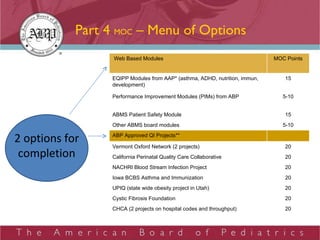
Part 4  MOC  – Menu of Options 2 options for completion   Web Based Modules MOC Points EQIPP Modules from AAP* (asthma, ADHD, nutrition, immun, development) 15 Performance Improvement Modules (PIMs) from ABP 5-10 ABMS Patient Safety Module 15 Other ABMS board modules 5-10 ABP Approved QI Projects**   Vermont Oxford Network (2 projects)  20 California Perinatal Quality Care Collaborative 20 NACHRI Blood Stream Infection Project 20 Iowa BCBS Asthma and Immunization 20 UPIQ (state wide obesity project in Utah) 20 Cystic Fibrosis Foundation 20 CHCA (2 projects on hospital codes and throughput) 20
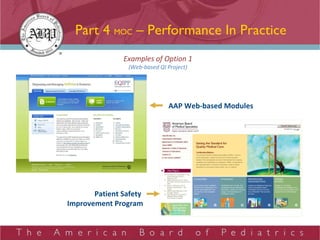
Part 4  MOC  – Performance In Practice AAP Web-based Modules Patient Safety  Improvement Program Examples of Option 1 (Web-based QI Project)
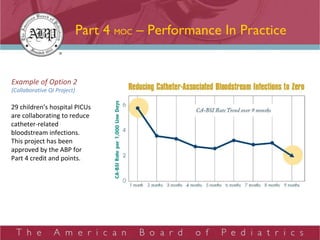
Part 4  MOC  – Performance In Practice 29 children’s hospital PICUs are collaborating to reduce catheter-related bloodstream infections. This project has been approved by the ABP for Part 4 credit and points.  Example of Option 2 (Collaborative QI Project)
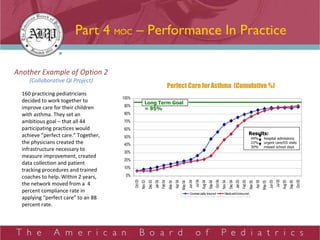
Part 4  MOC  – Performance In Practice Another Example of Option 2 (Collaborative QI Project) 160 practicing pediatricians decided to work together to improve care for their children with asthma. They set an ambitious goal – that all 44 participating practices would achieve “perfect care.” Together, the physicians created the infrastructure necessary to measure improvement, created data collection and patient tracking procedures and trained coaches to help. Within 2 years, the network moved from a  4 percent compliance rate in applying “perfect care” to an 88 percent rate.  Perfect Care for Asthma  (Cumulative %) Long Term Goal = 95% Results:   44%  hospital admissions   22%  urgent care/ED visits   30%  missed school days
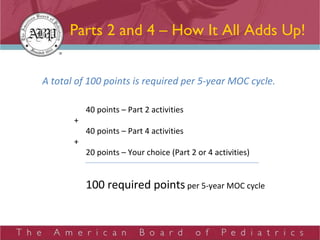
Parts 2 and 4 – How It All Adds Up! A total of 100 points is required per 5-year MOC cycle.  40 points – Part 2 activities   + 40 points – Part 4 activities   +  20 points – Your choice (Part 2 or 4 activities) 100 required points  per 5-year MOC cycle
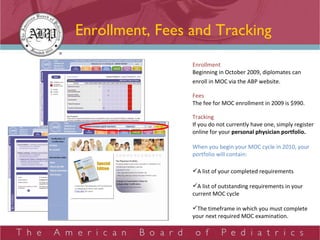
Enrollment, Fees and Tracking Enrollment Beginning in October 2009, diplomates can enroll in MOC via the ABP website.   Fees The fee for MOC enrollment in 2009 is $990.  Tracking If you do not currently have one, simply register online for your  personal physician portfolio.  When you begin your MOC cycle in 2010, your portfolio will contain: A list of your completed requirements A list of outstanding requirements in your current MOC cycle The timeframe in which you must complete your next required MOC examination.
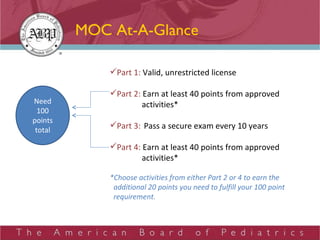
MOC At-A-Glance Part 1:  Valid, unrestricted license Part 2:  Earn at least 40 points from approved  activities* Part 3:  Pass a secure exam every 10 years Part 4:  Earn at least 40 points from approved  activities* *Choose activities from either Part 2 or 4 to earn the  additional 20 points you need to fulfill your 100 point  requirement.  Need 100 points total
Questions? Visit the ABP website at  www.abp.org. Contact the ABP: Initial Certification:  [email_address] Subspecialty Certification:  [email_address] Maintenance of Certification:  [email_address] By phone:  (919) 929-0461

Pediatric Maintenance of Certification

  • 1.
    Understanding Maintenance ofCertification Presented By: The American Board of Pediatrics
  • 2.
    About the ABPSole mission is to the public. Independent certifying board; Those certified are known as diplomates of the Board. One of the 24 specialty boards of the American Board of Medical Specialties (ABMS) Created in 1933 by the pediatric community to certify physicians with specialized education and clinical expertise in the care of children Includes 250 physicians who volunteer their time to set the standards of certification The American Board of Pediatrics 111 Silver Cedar Court Chapel Hill, NC 27514
  • 3.
    The Evolution ofBoard Certification Permanent Certification Until 1988, certification was done by successfully passing a test of knowledge only once in a career, typically at the end of training. Time-Limited Certification Beginning in 1989, a diplomate was required to successfully pass a similar test of knowledge every 7 years. Maintenance of Certification (MOC) Beginning in 2010, diplomates will maintain certification by continual evaluation of the competencies verified during residency. A secure test of knowledge is one part of this four-part program.
  • 4.
    The ABP certifiesphysicians who demonstrate a commitment to lifelong learning and providing the highest quality care. Certification is a self-regulated, professional responsibility.
  • 5.
    What is Maintenanceof Certification? (MOC) 4-part program that you begin once you have passed your initial certification examination. Evaluates the same 6 ACGME core competencies measured throughout training. Competencies are assessed in 5-year cycles, as defined by Maintenance of Certification.
  • 6.
    The Purpose ofMOC For The Public: MOC has been developed to assure the public that diplomates certified by the American Board of Pediatrics have demonstrated: Professionalism Commitment to lifelong learning Specialized knowledge of Pediatrics Dedication to continuously improving care For The Pediatrician: Participation in MOC: Leads to better care for children May help you meet payer, regulatory and consumer demands for quality Represents to the public your commitment to providing quality care Acknowledges your achievement of the gold standard in pediatric care
  • 7.
    Measuring the 6Core Competencies Part 1 – Professional Standing Patient care, Interpersonal & communication skills, Professionalism Part 2 – Knowledge Assessment Patient care, Medical knowledge, Practice-based learning & improvement, Systems-based practice Part 3 – Cognitive Expertise Medical knowledge Part 4 – Performance In Practice Patient care, Practice-based learning & improvement, Interpersonal & communication skills, Professionalism, Systems-based practice
  • 8.
    Part 1 MOC - Professionalism Requirement for Part 1 : All diplomates must hold a valid, unrestricted medical license.
  • 9.
    Part 2 MOC – Knowledge Self Assessment Requirements for Part 2 : All approved Part 2 activities are assigned a point value by the ABP. Diplomates must complete activities provided by either the ABP or approved outside providers. You must have at least 40 points of Part 2 activities per 5-year MOC cycle. 40-point minimum per 5-year MOC cycle
  • 10.
    Part 3 MOC – Cognitive Expertise Requirement for Part 3 : Successfully pass a secure test of knowledge every 10 years in each area of certification. Although the MOC cycle is 5 years, a secure test of knowledge is only required every 10 years . 1993 - 2002 1969 ABMS introduces Recertification 1980-1991 Closed Book (voluntary) 1993-2002 Open Book Exam (every 7 years) 2003-present Secure Exam (every 7 years) 2010+ Secure Exam (every 10 years)
  • 11.
    Because examinations areonly required every 10 years, it’s important to note that the exam does not necessarily coincide with the beginning or end of your 5-year MOC cycle. NOTE!
  • 12.
    Part 4 MOC – Performance in Practice 40-point minimum per 5-year MOC cycle Requirements for Part 4 : Option 1: The Part 4 MOC requirement for Performance In Practice can be met by completing web-based Quality Improvement activities. Option 2 : Participate in an ongoing ABP-approved collaborative Quality Improvement project.
  • 13.
    Part 4 MOC – Menu of Options 2 options for completion   Web Based Modules MOC Points EQIPP Modules from AAP* (asthma, ADHD, nutrition, immun, development) 15 Performance Improvement Modules (PIMs) from ABP 5-10 ABMS Patient Safety Module 15 Other ABMS board modules 5-10 ABP Approved QI Projects**   Vermont Oxford Network (2 projects) 20 California Perinatal Quality Care Collaborative 20 NACHRI Blood Stream Infection Project 20 Iowa BCBS Asthma and Immunization 20 UPIQ (state wide obesity project in Utah) 20 Cystic Fibrosis Foundation 20 CHCA (2 projects on hospital codes and throughput) 20
  • 14.
    Part 4 MOC – Performance In Practice AAP Web-based Modules Patient Safety Improvement Program Examples of Option 1 (Web-based QI Project)
  • 15.
    Part 4 MOC – Performance In Practice 29 children’s hospital PICUs are collaborating to reduce catheter-related bloodstream infections. This project has been approved by the ABP for Part 4 credit and points. Example of Option 2 (Collaborative QI Project)
  • 16.
    Part 4 MOC – Performance In Practice Another Example of Option 2 (Collaborative QI Project) 160 practicing pediatricians decided to work together to improve care for their children with asthma. They set an ambitious goal – that all 44 participating practices would achieve “perfect care.” Together, the physicians created the infrastructure necessary to measure improvement, created data collection and patient tracking procedures and trained coaches to help. Within 2 years, the network moved from a 4 percent compliance rate in applying “perfect care” to an 88 percent rate. Perfect Care for Asthma (Cumulative %) Long Term Goal = 95% Results: 44% hospital admissions 22% urgent care/ED visits 30% missed school days
  • 17.
    Parts 2 and4 – How It All Adds Up! A total of 100 points is required per 5-year MOC cycle. 40 points – Part 2 activities + 40 points – Part 4 activities + 20 points – Your choice (Part 2 or 4 activities) 100 required points per 5-year MOC cycle
  • 18.
    Enrollment, Fees andTracking Enrollment Beginning in October 2009, diplomates can enroll in MOC via the ABP website. Fees The fee for MOC enrollment in 2009 is $990. Tracking If you do not currently have one, simply register online for your personal physician portfolio. When you begin your MOC cycle in 2010, your portfolio will contain: A list of your completed requirements A list of outstanding requirements in your current MOC cycle The timeframe in which you must complete your next required MOC examination.
  • 19.
    MOC At-A-Glance Part1: Valid, unrestricted license Part 2: Earn at least 40 points from approved activities* Part 3: Pass a secure exam every 10 years Part 4: Earn at least 40 points from approved activities* *Choose activities from either Part 2 or 4 to earn the additional 20 points you need to fulfill your 100 point requirement. Need 100 points total
  • 20.
    Questions? Visit theABP website at www.abp.org. Contact the ABP: Initial Certification: [email_address] Subspecialty Certification: [email_address] Maintenance of Certification: [email_address] By phone: (919) 929-0461