What are the functions of
the Family ?
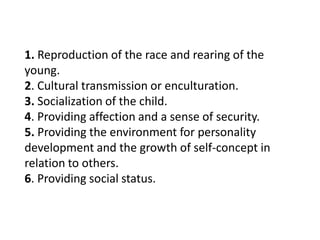
1. Reproduction of the race and rearing of the
young.
2. Cultural transmission or enculturation.
3. Socialization of the child.
4. Providing affection and a sense of security.
5. Providing the environment for personality
development and the growth of self-concept in
relation to others.
6. Providing social status.
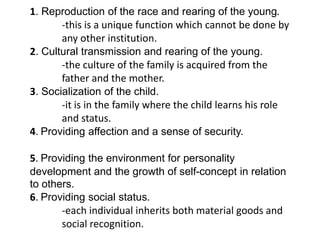
1. Reproduction of the race and rearing of the young.
-this is a unique function which cannot be done by
any other institution.
2. Cultural transmission and rearing of the young.
-the culture of the family is acquired from the
father and the mother.
3. Socialization of the child.
-it is in the family where the child learns his role
and status.
4. Providing affection and a sense of security.
5. Providing the environment for personality
development and the growth of self-concept in relation
to others.
6. Providing social status.
-each individual inherits both material goods and
social recognition.
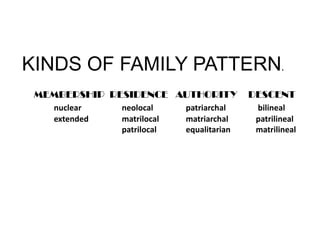
KINDS OF FAMILY PATTERN.
MEMBERSHIP RESIDENCE AUTHORITY
nuclear
extended

neolocal
matrilocal
patrilocal

patriarchal
matriarchal
equalitarian

DESCENT
bilineal
patrilineal
matrilineal
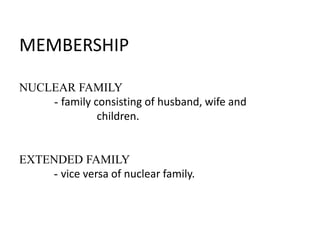
MEMBERSHIP
NUCLEAR FAMILY
- family consisting of husband, wife and
children.

EXTENDED FAMILY
- vice versa of nuclear family.
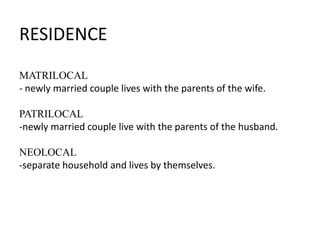
RESIDENCE
MATRILOCAL
- newly married couple lives with the parents of the wife.
PATRILOCAL
-newly married couple live with the parents of the husband.
NEOLOCAL
-separate household and lives by themselves.
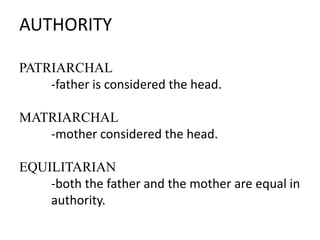
AUTHORITY
PATRIARCHAL
-father is considered the head.
MATRIARCHAL
-mother considered the head.

EQUILITARIAN
-both the father and the mother are equal in
authority.
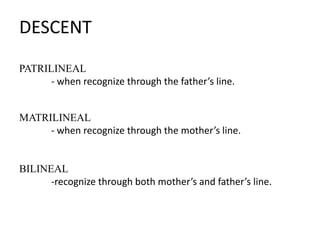
DESCENT
PATRILINEAL
- when recognize through the father’s line.
MATRILINEAL
- when recognize through the mother’s line.

BILINEAL
-recognize through both mother’s and father’s line.
Mae...toots
Mae...toots
Mae...toots

Mae...toots

  • 1.
    What are thefunctions of the Family ?
  • 2.
    1. Reproduction ofthe race and rearing of the young. 2. Cultural transmission or enculturation. 3. Socialization of the child. 4. Providing affection and a sense of security. 5. Providing the environment for personality development and the growth of self-concept in relation to others. 6. Providing social status.
  • 3.
    1. Reproduction ofthe race and rearing of the young. -this is a unique function which cannot be done by any other institution. 2. Cultural transmission and rearing of the young. -the culture of the family is acquired from the father and the mother. 3. Socialization of the child. -it is in the family where the child learns his role and status. 4. Providing affection and a sense of security. 5. Providing the environment for personality development and the growth of self-concept in relation to others. 6. Providing social status. -each individual inherits both material goods and social recognition.
  • 4.
    KINDS OF FAMILYPATTERN. MEMBERSHIP RESIDENCE AUTHORITY nuclear extended neolocal matrilocal patrilocal patriarchal matriarchal equalitarian DESCENT bilineal patrilineal matrilineal
  • 5.
    MEMBERSHIP NUCLEAR FAMILY - familyconsisting of husband, wife and children. EXTENDED FAMILY - vice versa of nuclear family.
  • 6.
    RESIDENCE MATRILOCAL - newly marriedcouple lives with the parents of the wife. PATRILOCAL -newly married couple live with the parents of the husband. NEOLOCAL -separate household and lives by themselves.
  • 7.
    AUTHORITY PATRIARCHAL -father is consideredthe head. MATRIARCHAL -mother considered the head. EQUILITARIAN -both the father and the mother are equal in authority.
  • 8.
    DESCENT PATRILINEAL - when recognizethrough the father’s line. MATRILINEAL - when recognize through the mother’s line. BILINEAL -recognize through both mother’s and father’s line.