Rapid and Reliable Developing with
HTML5 & GWT.
Manuel Carrasco Moñino
manolo@apache.org
http://twitter.com/dodotisMadrid Java User Group 4th Apr 2013
About me
● Apache James Project Member Committee
● HUPA
● GWT
● Gquery & Gquery-plugins
● GwtExporter
● GwtUpload
● Chronoscope
● Jenkins
● Performance plugin
● Emma plugin
● Linux
● LXP a light and visual window manager based on icewm
Proposal I
Move apps from Desktop to Browser:
HTML5 + JS
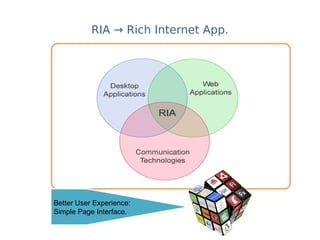
RIA → Rich Internet App.
Better User Experience:
Simple Page Interface.
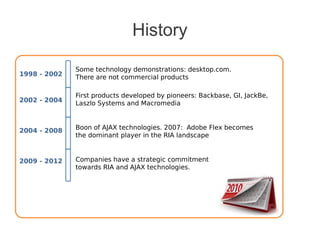
History
1998 - 2002
2002 - 2004
2004 - 2008
2009 - 2012
Some technology demonstrations: desktop.com.
There are not commercial products
First products developed by pioneers: Backbase, GI, JackBe,
Laszlo Systems and Macromedia
Boon of AJAX technologies. 2007: Adobe Flex becomes
the dominant player in the RIA landscape
Companies have a strategic commitment
towards RIA and AJAX technologies.
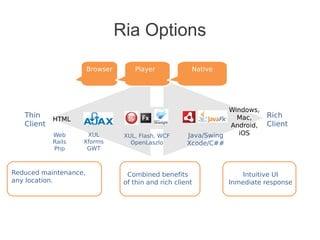
Ria Options
Browser Player Native
XUL
Xforms
GWT
XUL, Flash, WCF
OpenLaszlo
Java/Swing
Xcode/C##
Reduced maintenance,
any location.
Combined benefits
of thin and rich client
Intuitive UI
Inmediate response
Thin
Client
Rich
Client
HTML
Windows,
Mac,
Android,
iOSWeb
Rails
Php
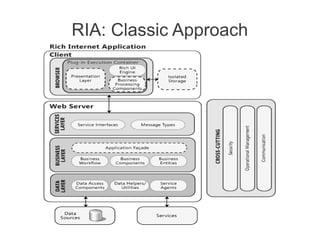
RIA: Classic Approach
Proposal II
HTML5: Desktop, mobile, tablets.
Art Status
HTML5 & JavaScript is everywhere
Mobiles have fast and modern
Browser run-times
HTML5 / JS
Develop Html5/Javascript Run Anywhere
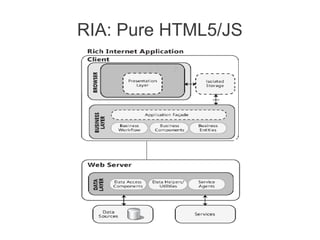
RIA: Pure HTML5/JS
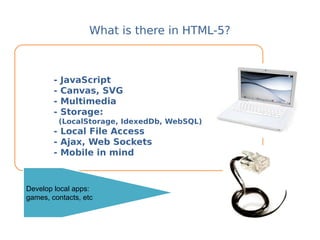
- JavaScript
- Canvas, SVG
- Multimedia
- Storage:
(LocalStorage, IdexedDb, WebSQL)
- Local File Access
- Ajax, Web Sockets
- Mobile in mind
Develop local apps:
games, contacts, etc
What is there in HTML-5?
Proposal III
Use HTML5 in your mobile native apps:
Apache cordova (a.k.a. Phonegap)
Apache Cordova (Phonegap)
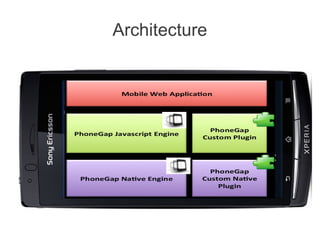
●A framework for mobile applications that allows developers to implement
their projects using standard web technologies: HTML5, CSS3 and
Javascript
● It converts them into native applications for different mobile platforms with
access to much of the native API.
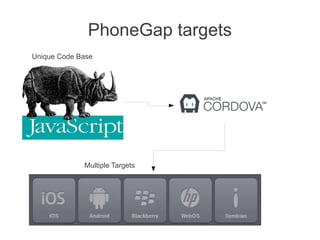
PhoneGap targets
Unique Code Base
Multiple Targets
Architecture
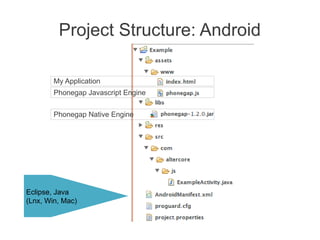
Project Structure: Android
My Application
Phonegap Native Engine
Phonegap Javascript Engine
Eclipse, Java
(Lnx, Win, Mac)
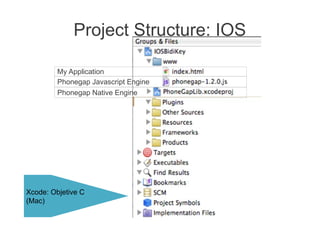
Project Structure: IOS
My Application
Phonegap Native Engine
Phonegap Javascript Engine
Xcode: Objetive C
(Mac)
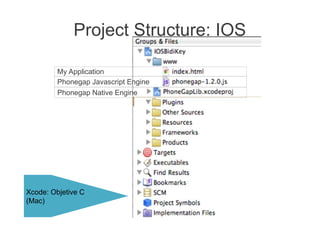
Project Structure: IOS
My Application
Phonegap Native Engine
Phonegap Javascript Engine
Xcode: Objetive C
(Mac)
Proposal IV
Use a high level language Java:
GWT (Google Web Toolkit)
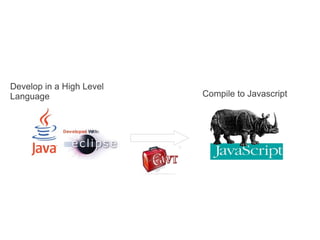
Develop in a High Level
Language Compile to Javascript
Google Web Toolkit
GWT's mission is to radically improve
the web experience for users by
enabling developers to use existing
Java tools to build no-compromise
AJAX for any modern browser
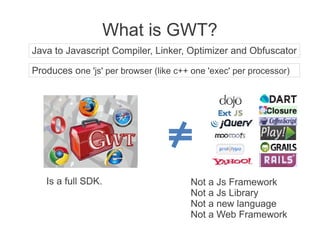
What is GWT?
Is a full SDK. Not a Js Framework
Not a Js Library
Not a new language
Not a Web Framework
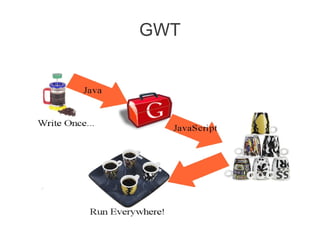
Java to Javascript Compiler, Linker, Optimizer and Obfuscator
Produces one 'js' per browser (like c++ one 'exec' per processor)
Why Java?
● A high level language allows that the developer doesn't get lost with low
level details: DOM, Ajax, Cross-domain, Compression, Obfuscation,
Dependencies, Browser tweaks, etc.
● Huge Java ecosystem: IDE, Re-factoring, Debug, Code assist, Maven.
● Metrics, TDD, CI, Reusing (libraries)
● Patterns, Builders …
● Type safe, syntax checking, reduce errors.
● Separate code maintenance from the effectiveness of the executable.
● Normally, the compiler would produce better js code than the code we
could write by hand (less code, compressed, obfuscated, remove dead
code, etc).
● Developers know java
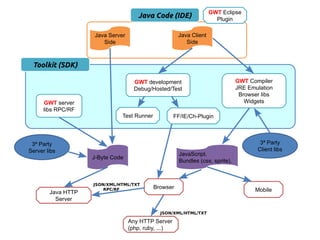
Java Server
Side
Java Client
Side
Java Code (IDE)
GWT server
libs RPC/RF
GWT development
Debug/Hosted/Test
GWT Compiler
JRE Emulation
Browser libs
Widgets
Test Runner FF/IE/Ch-Plugin
Java HTTP
Server
J-Byte Code
3ª Party
Server libs
Browser
Any HTTP Server
(php, ruby, ...)
JavaScript.
Bundles (css, sprite).
3ª Party
Client libs
Toolkit (SDK)
JSON/XML/HTML/TXT
RPC/RF
JSON/XML/HTML/TXT
GWT Eclipse
Plugin
Mobile
New with 2.5.0
● SuperDev Mode
● Source Maps
● Elemental
● Size & Split optimitations
● Closure compiler
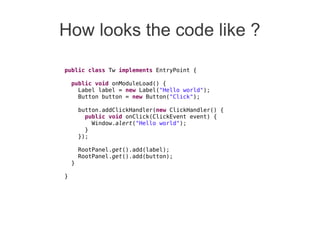
How looks the code like ?
public class Tw implements EntryPoint {
public void onModuleLoad() {
Label label = new Label("Hello world");
Button button = new Button("Click");
button.addClickHandler(new ClickHandler() {
public void onClick(ClickEvent event) {
Window.alert("Hello world");
}
});
RootPanel.get().add(label);
RootPanel.get().add(button);
}
}
Project Structure
Browser: Java → JS
Both: Java → [JS or BitCode]
Server: Java → BitCode
Assets: html, images, css
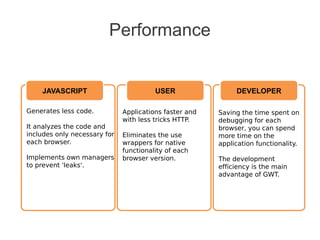
Performance
Generates less code.
It analyzes the code and
includes only necessary for
each browser.
Implements own managers
to prevent 'leaks'.
Applications faster and
with less tricks HTTP.
Eliminates the use
wrappers for native
functionality of each
browser version.
Saving the time spent on
debugging for each
browser, you can spend
more time on the
application functionality.
The development
efficiency is the main
advantage of GWT.
JAVASCRIPT USER DEVELOPER
Summary
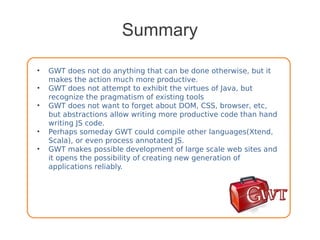
• GWT does not do anything that can be done otherwise, but it
makes the action much more productive.
• GWT does not attempt to exhibit the virtues of Java, but
recognize the pragmatism of existing tools
• GWT does not want to forget about DOM, CSS, browser, etc,
but abstractions allow writing more productive code than hand
writing JS code.
• Perhaps someday GWT could compile other languages(Xtend,
Scala), or even process annotated JS.
• GWT makes possible development of large scale web sites and
it opens the possibility of creating new generation of
applications reliably.
Proposal V:
Bring GWT to Mobile
GWT
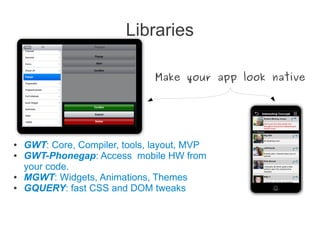
Libraries
● GWT: Core, Compiler, tools, layout, MVP
● GWT-Phonegap: Access mobile HW from
your code.
● MGWT: Widgets, Animations, Themes
● GQUERY: fast CSS and DOM tweaks
Make your app look native
Advantages:
Java + Gwt + Cordova
● Maintain just one code base.
● Use one language for all.
● Reuse libraries written in java instead of rewrite
them in JS.
● Develop using a browser instead of an emulator.
● Realtime debug.
● Unit testing.
● Everything is open sourced
Proposal VI
Use a common framework to create visual apps:
PlayN
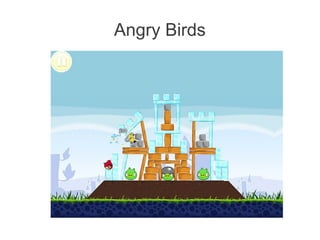
Angry Birds
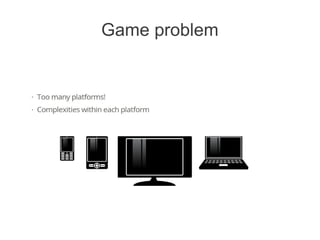
Game problem
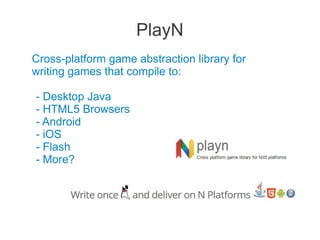
PlayN
Cross-platform game abstraction library for
writing games that compile to:
- Desktop Java
- HTML5 Browsers
- Android
- iOS
- Flash
- More?
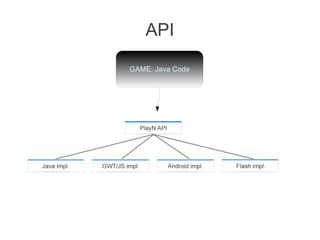
API
GAME: Java Code
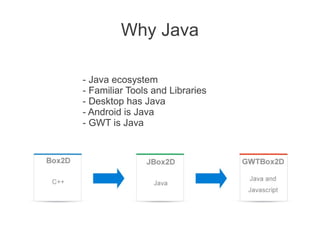
Why Java
- Java ecosystem
- Familiar Tools and Libraries
- Desktop has Java
- Android is Java
- GWT is Java
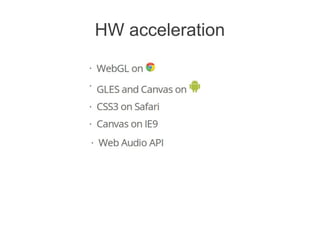
HW acceleration
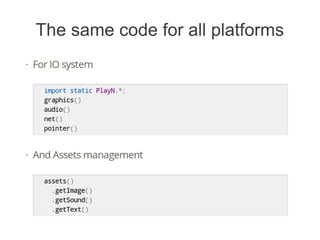
The same code for all platforms
Proposal VII
NoSQL Databases
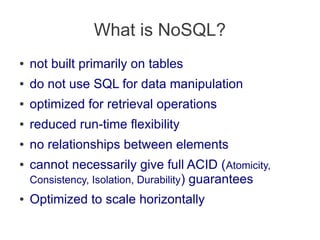
What is NoSQL?
● not built primarily on tables
● do not use SQL for data manipulation
● optimized for retrieval operations
● reduced run-time flexibility
● no relationships between elements
● cannot necessarily give full ACID (Atomicity,
Consistency, Isolation, Durability) guarantees
● Optimized to scale horizontally
NoSQL Types
● Document: key-document (couchdb, mongodb,
jackrabbit)
● Graph: elements interconnected (DB2)
● KeyValue: not fixed datamodel (Cassandra,
Dynamo, BigTable)
● Others: actually each product has its own
features (nosql is not a standard).
Solutions
● BigTable: Google App Engine
● Proprietary Query Language
● MySQL like layer
● Map-reduce
● Document based: CouchDb
● Ajax Service
● Map-reduce
● KeyValue: Cassandra
● Map-reduce
● API
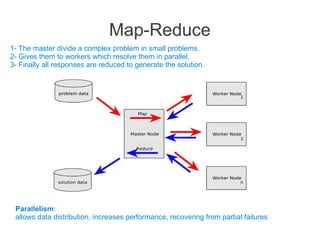
Map-Reduce
Parallelism:
allows data distribution, increases performance, recovering from partial failures
1- The master divide a complex problem in small problems.
2- Gives them to workers which resolve them in parallel.
3- Finally all responses are reduced to generate the solution.
GAE
● Google's cloud solution.
● Runs its own runtime (Java or Python): so consider
GAE restrictions and API.
● Integration with Eclipse: really easy to start and deploy
a project.
● Free until your app starts consuming a lot of
resources.
● Easy to administrate (console)
● 100% scalable.
● Suitable for RIA (Ajax, GWT, PlayN ...)
CouchDB
● Light weight database. Developed by Apache in Erlang.
● Json oriented: documents are json, dialog is json.
● Js map-reduce
● HTTP service (not any proprietary protocol)
● Replica/Cluster out-of-the-box
● High performance and scalability
● Web administration Panel
● Ideal for Ajax apps
● Java Api to access it in a JPA like way
● Push to client mechanism
Real Case: Talkwheel
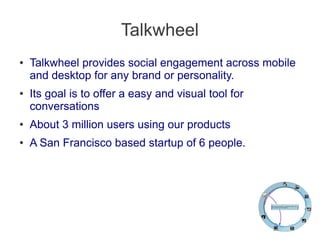
Talkwheel
● Talkwheel provides social engagement across mobile
and desktop for any brand or personality.
● Its goal is to offer a easy and visual tool for
conversations
● About 3 million users using our products
● A San Francisco based startup of 6 people.
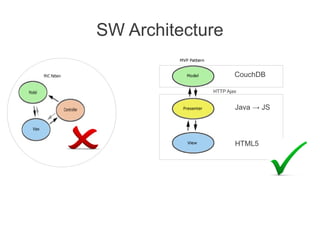
SW Architecture
CouchDB
HTTP Ajax
Java → JS
HTML5
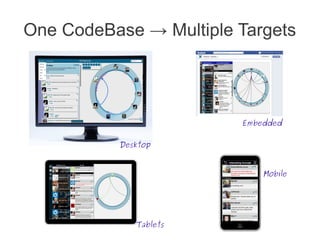
One CodeBase → Multiple Targets
Desktop
Embedded
Tablets
Mobile
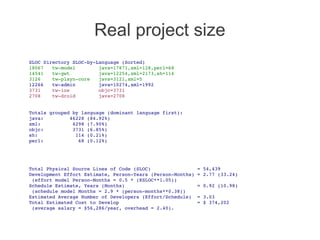
Real project size
SLOC Directory SLOC­by­Language (Sorted)
18067   tw­model        java=17871,xml=128,perl=68
14541   tw­gwt          java=12254,xml=2173,sh=114
3126    tw­playn­core   java=3121,xml=5
12266   tw­admin        java=10274,xml=1992
3731    tw­ios          objc=3731
2708    tw­droid        java=2708
Totals grouped by language (dominant language first):
java:         46228 (84.92%)
xml:           4298 (7.90%)
objc:          3731 (6.85%)
sh:             114 (0.21%)
perl:            68 (0.12%)
Total Physical Source Lines of Code (SLOC)                = 54,439
Development Effort Estimate, Person­Years (Person­Months) = 2.77 (33.24)
 (effort model Person­Months = 0.5 * (KSLOC**1.05))
Schedule Estimate, Years (Months)                         = 0.92 (10.98)
 (schedule model Months = 2.9 * (person­months**0.38))
Estimated Average Number of Developers (Effort/Schedule)  = 3.03
Total Estimated Cost to Develop                           = $ 374,202
 (average salary = $56,286/year, overhead = 2.40).
Off topic:
Contributing the Open Source
Become an opensource
contributor
● Checkout the code.
● Play with it, test it, find bugs.
● Open tickets reporting problems, asking for improvements.
● Attach patches which fix bugs, add new features, improve
performance, contribute to readability, etc. Don't forget unit Tests.
● Subscribe to mailing lists, and participate asking and answering
questions.
● Committers will appreciate your work and will propose you to be part
of the team.
● Other way you can utilize is to propose new projects: Apache
incubator, labs, GSOC, etc. Find a mentor or use mailing-lists for
that.

Rapid and Reliable Developing with HTML5 & GWT

  • 1.
    Rapid and ReliableDeveloping with HTML5 & GWT. Manuel Carrasco Moñino manolo@apache.org http://twitter.com/dodotisMadrid Java User Group 4th Apr 2013
  • 2.
    About me ● ApacheJames Project Member Committee ● HUPA ● GWT ● Gquery & Gquery-plugins ● GwtExporter ● GwtUpload ● Chronoscope ● Jenkins ● Performance plugin ● Emma plugin ● Linux ● LXP a light and visual window manager based on icewm
  • 3.
    Proposal I Move appsfrom Desktop to Browser: HTML5 + JS
  • 4.
    RIA → RichInternet App. Better User Experience: Simple Page Interface.
  • 5.
    History 1998 - 2002 2002- 2004 2004 - 2008 2009 - 2012 Some technology demonstrations: desktop.com. There are not commercial products First products developed by pioneers: Backbase, GI, JackBe, Laszlo Systems and Macromedia Boon of AJAX technologies. 2007: Adobe Flex becomes the dominant player in the RIA landscape Companies have a strategic commitment towards RIA and AJAX technologies.
  • 6.
    Ria Options Browser PlayerNative XUL Xforms GWT XUL, Flash, WCF OpenLaszlo Java/Swing Xcode/C## Reduced maintenance, any location. Combined benefits of thin and rich client Intuitive UI Inmediate response Thin Client Rich Client HTML Windows, Mac, Android, iOSWeb Rails Php
  • 7.
  • 8.
  • 9.
  • 10.
    HTML5 & JavaScriptis everywhere Mobiles have fast and modern Browser run-times
  • 11.
    HTML5 / JS DevelopHtml5/Javascript Run Anywhere
  • 12.
  • 13.
    - JavaScript - Canvas,SVG - Multimedia - Storage: (LocalStorage, IdexedDb, WebSQL) - Local File Access - Ajax, Web Sockets - Mobile in mind Develop local apps: games, contacts, etc What is there in HTML-5?
  • 14.
    Proposal III Use HTML5in your mobile native apps: Apache cordova (a.k.a. Phonegap)
  • 15.
    Apache Cordova (Phonegap) ●Aframework for mobile applications that allows developers to implement their projects using standard web technologies: HTML5, CSS3 and Javascript ● It converts them into native applications for different mobile platforms with access to much of the native API.
  • 16.
    PhoneGap targets Unique CodeBase Multiple Targets
  • 17.
  • 18.
    Project Structure: Android MyApplication Phonegap Native Engine Phonegap Javascript Engine Eclipse, Java (Lnx, Win, Mac)
  • 19.
    Project Structure: IOS MyApplication Phonegap Native Engine Phonegap Javascript Engine Xcode: Objetive C (Mac)
  • 20.
    Project Structure: IOS MyApplication Phonegap Native Engine Phonegap Javascript Engine Xcode: Objetive C (Mac)
  • 21.
    Proposal IV Use ahigh level language Java: GWT (Google Web Toolkit)
  • 22.
    Develop in aHigh Level Language Compile to Javascript
  • 23.
    Google Web Toolkit GWT'smission is to radically improve the web experience for users by enabling developers to use existing Java tools to build no-compromise AJAX for any modern browser
  • 24.
    What is GWT? Isa full SDK. Not a Js Framework Not a Js Library Not a new language Not a Web Framework Java to Javascript Compiler, Linker, Optimizer and Obfuscator Produces one 'js' per browser (like c++ one 'exec' per processor)
  • 25.
    Why Java? ● Ahigh level language allows that the developer doesn't get lost with low level details: DOM, Ajax, Cross-domain, Compression, Obfuscation, Dependencies, Browser tweaks, etc. ● Huge Java ecosystem: IDE, Re-factoring, Debug, Code assist, Maven. ● Metrics, TDD, CI, Reusing (libraries) ● Patterns, Builders … ● Type safe, syntax checking, reduce errors. ● Separate code maintenance from the effectiveness of the executable. ● Normally, the compiler would produce better js code than the code we could write by hand (less code, compressed, obfuscated, remove dead code, etc). ● Developers know java
  • 26.
    Java Server Side Java Client Side JavaCode (IDE) GWT server libs RPC/RF GWT development Debug/Hosted/Test GWT Compiler JRE Emulation Browser libs Widgets Test Runner FF/IE/Ch-Plugin Java HTTP Server J-Byte Code 3ª Party Server libs Browser Any HTTP Server (php, ruby, ...) JavaScript. Bundles (css, sprite). 3ª Party Client libs Toolkit (SDK) JSON/XML/HTML/TXT RPC/RF JSON/XML/HTML/TXT GWT Eclipse Plugin Mobile
  • 27.
    New with 2.5.0 ●SuperDev Mode ● Source Maps ● Elemental ● Size & Split optimitations ● Closure compiler
  • 28.
    How looks thecode like ? public class Tw implements EntryPoint { public void onModuleLoad() { Label label = new Label("Hello world"); Button button = new Button("Click"); button.addClickHandler(new ClickHandler() { public void onClick(ClickEvent event) { Window.alert("Hello world"); } }); RootPanel.get().add(label); RootPanel.get().add(button); } }
  • 29.
    Project Structure Browser: Java→ JS Both: Java → [JS or BitCode] Server: Java → BitCode Assets: html, images, css
  • 30.
    Performance Generates less code. Itanalyzes the code and includes only necessary for each browser. Implements own managers to prevent 'leaks'. Applications faster and with less tricks HTTP. Eliminates the use wrappers for native functionality of each browser version. Saving the time spent on debugging for each browser, you can spend more time on the application functionality. The development efficiency is the main advantage of GWT. JAVASCRIPT USER DEVELOPER
  • 31.
    Summary • GWT doesnot do anything that can be done otherwise, but it makes the action much more productive. • GWT does not attempt to exhibit the virtues of Java, but recognize the pragmatism of existing tools • GWT does not want to forget about DOM, CSS, browser, etc, but abstractions allow writing more productive code than hand writing JS code. • Perhaps someday GWT could compile other languages(Xtend, Scala), or even process annotated JS. • GWT makes possible development of large scale web sites and it opens the possibility of creating new generation of applications reliably.
  • 32.
  • 33.
  • 34.
    Libraries ● GWT: Core,Compiler, tools, layout, MVP ● GWT-Phonegap: Access mobile HW from your code. ● MGWT: Widgets, Animations, Themes ● GQUERY: fast CSS and DOM tweaks Make your app look native
  • 35.
    Advantages: Java + Gwt+ Cordova ● Maintain just one code base. ● Use one language for all. ● Reuse libraries written in java instead of rewrite them in JS. ● Develop using a browser instead of an emulator. ● Realtime debug. ● Unit testing. ● Everything is open sourced
  • 36.
    Proposal VI Use acommon framework to create visual apps: PlayN
  • 37.
  • 38.
  • 39.
    PlayN Cross-platform game abstractionlibrary for writing games that compile to: - Desktop Java - HTML5 Browsers - Android - iOS - Flash - More?
  • 40.
  • 41.
    Why Java - Javaecosystem - Familiar Tools and Libraries - Desktop has Java - Android is Java - GWT is Java
  • 42.
  • 43.
    The same codefor all platforms
  • 44.
  • 45.
    What is NoSQL? ●not built primarily on tables ● do not use SQL for data manipulation ● optimized for retrieval operations ● reduced run-time flexibility ● no relationships between elements ● cannot necessarily give full ACID (Atomicity, Consistency, Isolation, Durability) guarantees ● Optimized to scale horizontally
  • 46.
    NoSQL Types ● Document:key-document (couchdb, mongodb, jackrabbit) ● Graph: elements interconnected (DB2) ● KeyValue: not fixed datamodel (Cassandra, Dynamo, BigTable) ● Others: actually each product has its own features (nosql is not a standard).
  • 47.
    Solutions ● BigTable: GoogleApp Engine ● Proprietary Query Language ● MySQL like layer ● Map-reduce ● Document based: CouchDb ● Ajax Service ● Map-reduce ● KeyValue: Cassandra ● Map-reduce ● API
  • 48.
    Map-Reduce Parallelism: allows data distribution,increases performance, recovering from partial failures 1- The master divide a complex problem in small problems. 2- Gives them to workers which resolve them in parallel. 3- Finally all responses are reduced to generate the solution.
  • 49.
    GAE ● Google's cloudsolution. ● Runs its own runtime (Java or Python): so consider GAE restrictions and API. ● Integration with Eclipse: really easy to start and deploy a project. ● Free until your app starts consuming a lot of resources. ● Easy to administrate (console) ● 100% scalable. ● Suitable for RIA (Ajax, GWT, PlayN ...)
  • 50.
    CouchDB ● Light weightdatabase. Developed by Apache in Erlang. ● Json oriented: documents are json, dialog is json. ● Js map-reduce ● HTTP service (not any proprietary protocol) ● Replica/Cluster out-of-the-box ● High performance and scalability ● Web administration Panel ● Ideal for Ajax apps ● Java Api to access it in a JPA like way ● Push to client mechanism
  • 51.
  • 52.
    Talkwheel ● Talkwheel providessocial engagement across mobile and desktop for any brand or personality. ● Its goal is to offer a easy and visual tool for conversations ● About 3 million users using our products ● A San Francisco based startup of 6 people.
  • 53.
  • 54.
    One CodeBase →Multiple Targets Desktop Embedded Tablets Mobile
  • 55.
    Real project size SLOCDirectory SLOC­by­Language (Sorted) 18067   tw­model        java=17871,xml=128,perl=68 14541   tw­gwt          java=12254,xml=2173,sh=114 3126    tw­playn­core   java=3121,xml=5 12266   tw­admin        java=10274,xml=1992 3731    tw­ios          objc=3731 2708    tw­droid        java=2708 Totals grouped by language (dominant language first): java:         46228 (84.92%) xml:           4298 (7.90%) objc:          3731 (6.85%) sh:             114 (0.21%) perl:            68 (0.12%) Total Physical Source Lines of Code (SLOC)                = 54,439 Development Effort Estimate, Person­Years (Person­Months) = 2.77 (33.24)  (effort model Person­Months = 0.5 * (KSLOC**1.05)) Schedule Estimate, Years (Months)                         = 0.92 (10.98)  (schedule model Months = 2.9 * (person­months**0.38)) Estimated Average Number of Developers (Effort/Schedule)  = 3.03 Total Estimated Cost to Develop                           = $ 374,202  (average salary = $56,286/year, overhead = 2.40).
  • 56.
  • 57.
    Become an opensource contributor ●Checkout the code. ● Play with it, test it, find bugs. ● Open tickets reporting problems, asking for improvements. ● Attach patches which fix bugs, add new features, improve performance, contribute to readability, etc. Don't forget unit Tests. ● Subscribe to mailing lists, and participate asking and answering questions. ● Committers will appreciate your work and will propose you to be part of the team. ● Other way you can utilize is to propose new projects: Apache incubator, labs, GSOC, etc. Find a mentor or use mailing-lists for that.