MACROECONOMICS SIXTH EDITION
N. GREGORY MANKIW
PowerPoint®
Slides by Ron Cronovich
© 2007 Worth Publishers, all rights reserved
C H A P T E
R
The Data of Macroeconomics
2
In this chapter, you will learn…
CHAPTER 2 The Data of Macroeconomics slide 2
…the meaning and measurement of the
most important macroeconomic statistics:
▪ Gross Domestic Product (GDP)
▪ The Consumer Price Index (CPI)
▪ The unemployment rate
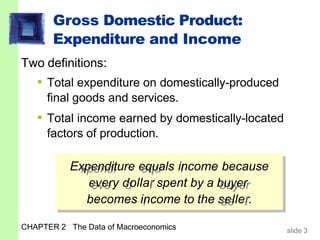
Gross Domestic Product:
Expenditure and Income
Two definitions:
▪ Total expenditure on domestically-produced
final goods and services.
▪ Total income earned by domestically-located
factors of production.
Ex
x
p
p
e
e
n
n
d
d
ii
ture e
e
q
q
u
u
als ii
ncome because
e
e
v
v
e
e
ry d
d
ollar
l spent by a b
b
u
u
y
y
e
e
rr
becomes ii
ncome to the s
se
eller
l.
CHAPTER 2 The Data of Macroeconomics slide 3
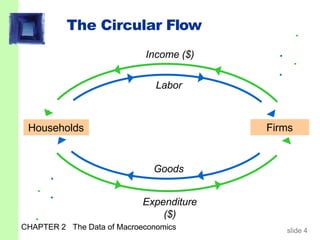
The Circular Flow
Households Firms
Goods
Expenditure
($)
Income ($)
Labor
CHAPTER 2 The Data of Macroeconomics slide 4
Value added
CHAPTER 2 The Data of Macroeconomics slide 5
definition:
A firm’s value added is
the value of its output
minus
the value of the intermediate goods
the firm used to produce that output.
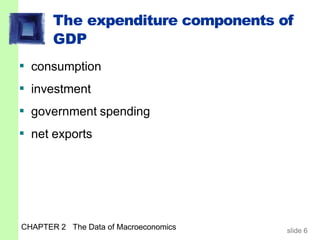
The expenditure components of
GDP
CHAPTER 2 The Data of Macroeconomics slide 6
▪ consumption
▪ investment
▪ government spending
▪ net exports
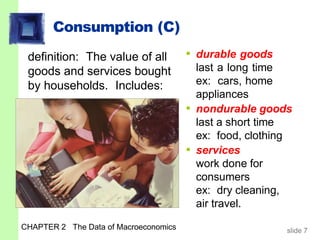
Consumption (C)
CHAPTER 2 The Data of Macroeconomics slide 7
▪ durable goods
last a long time
ex: cars, home
appliances
▪ nondurable goods
last a short time
ex: food, clothing
▪ services
work done for
consumers
ex: dry cleaning,
air travel.
definition: The value of all
goods and services bought
by households. Includes:
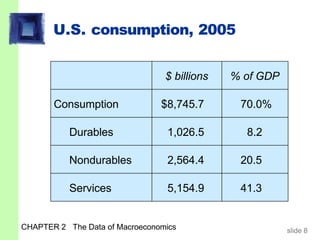
U.S. consumption, 2005
CHAPTER 2 The Data of Macroeconomics slide 8
$ billions % of GDP
Consumption $8,745.7 70.0%
Durables 1,026.5 8.2
Nondurables 2,564.4 20.5
Services 5,154.9 41.3
Investment (I)
CHAPTER 2 The Data of Macroeconomics slide 9
Definition 1: Spending on [the factor of production]
capital.
Definition 2: Spending on goods bought for future use
Includes:
▪ business fixed investment
Spending on plant and equipment that firms will use
to produce other goods & services.
▪ residential fixed investment
Spending on housing units by consumers and
landlords.
▪ inventory investment
The change in the value of all firms’ inventories.
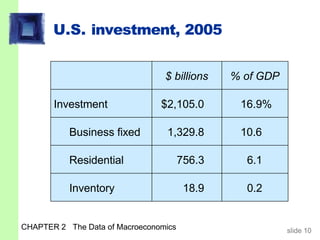
U.S. investment, 2005
CHAPTER 2 The Data of Macroeconomics slide 10
$ billions % of GDP
Investment $2,105.0 16.9%
Business fixed 1,329.8 10.6
Residential 756.3 6.1
Inventory 18.9 0.2
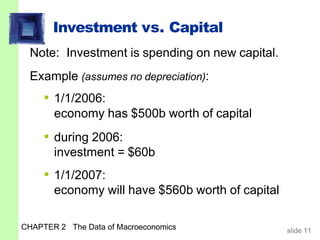
Investment vs. Capital
CHAPTER 2 The Data of Macroeconomics slide 11
Note: Investment is spending on new capital.
Example (assumes no depreciation):
▪ 1/1/2006:
economy has $500b worth of capital
▪ during 2006:
investment = $60b
▪ 1/1/2007:
economy will have $560b worth of capital
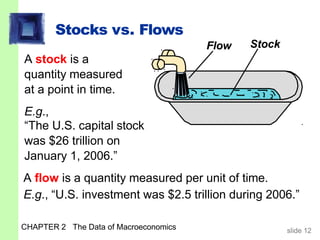
Stocks vs. Flows
Flow Stock
A stock is a
quantity measured
at a point in time.
E.g.,
“The U.S. capital stock
was $26 trillion on
January 1, 2006.”
A flow is a quantity measured per unit of time.
E.g., “U.S. investment was $2.5 trillion during 2006.”
CHAPTER 2 The Data of Macroeconomics slide 12
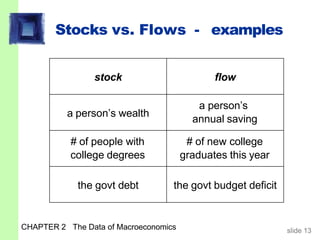
Stocks vs. Flows - examples
CHAPTER 2 The Data of Macroeconomics slide 13
stock flow
a person’s wealth
a person’s
annual saving
# of people with
college degrees
# of new college
graduates this year
the govt debt the govt budget deficit
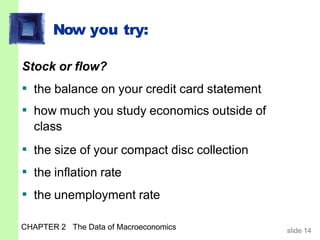
Now you try:
CHAPTER 2 The Data of Macroeconomics slide 14
Stock or flow?
▪ the balance on your credit card statement
▪ how much you study economics outside of
class
▪ the size of your compact disc collection
▪ the inflation rate
▪ the unemployment rate
Government spending (G)
CHAPTER 2 The Data of Macroeconomics slide 15
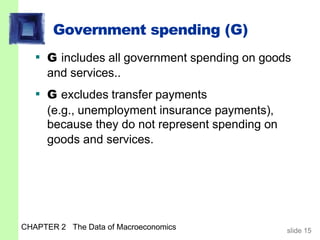
▪ G includes all government spending on goods
and services..
▪ G excludes transfer payments
(e.g., unemployment insurance payments),
because they do not represent spending on
goods and services.
U.S. government spending, 2005
CHAPTER 2 The Data of Macroeconomics slide 16
$ billions % of GDP
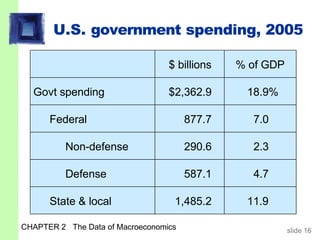
Govt spending $2,362.9 18.9%
Federal 877.7 7.0
Non-defense 290.6 2.3
Defense 587.1 4.7
State & local 1,485.2 11.9
Net exports: NX = EX – IM
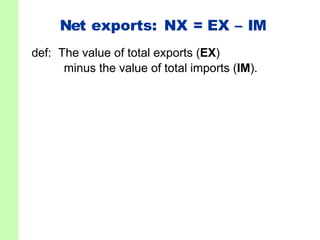
def: The value of total exports (EX)
minus the value of total imports (IM).
GDP:
An important and versatile concept
CHAPTER 2 The Data of Macroeconomics slide 18
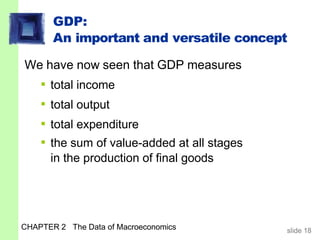
We have now seen that GDP measures
▪ total income
▪ total output
▪ total expenditure
▪ the sum of value-added at all stages
in the production of final goods
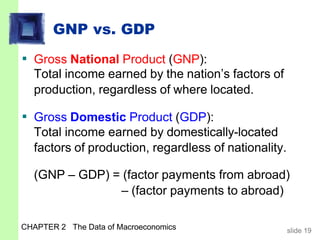
GNP vs. GDP
CHAPTER 2 The Data of Macroeconomics slide 19
▪ Gross National Product (GNP):
Total income earned by the nation’s factors of
production, regardless of where located.
▪ Gross Domestic Product (GDP):
Total income earned by domestically-located
factors of production, regardless of nationality.
(GNP – GDP) = (factor payments from abroad)
– (factor payments to abroad)
Discussion question:
CHAPTER 2 The Data of Macroeconomics slide 20
In your country,
which would you want
to be bigger, GDP, or GNP?
Why?
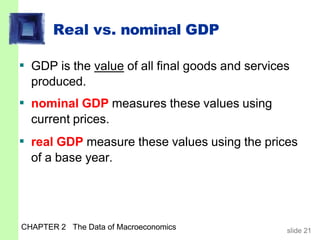
Real vs. nominal GDP
CHAPTER 2 The Data of Macroeconomics slide 21
▪ GDP is the value of all final goods and services
produced.
▪ nominal GDP measures these values using
current prices.
▪ real GDP measure these values using the prices
of a base year.
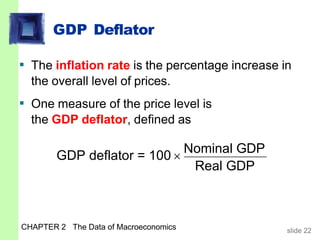
GDP Deflator
▪ The inflation rate is the percentage increase in
the overall level of prices.
▪ One measure of the price level is
the GDP deflator, defined as
GDP deflator = 100 
Nominal GDP
CHAPTER 2 The Data of Macroeconomics slide 22
Real GDP
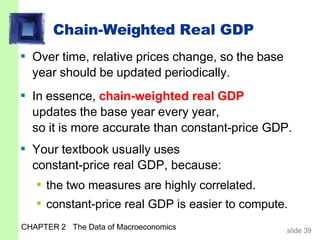
Chain-Weighted Real GDP
CHAPTER 2 The Data of Macroeconomics slide 39
▪ Over time, relative prices change, so the base
year should be updated periodically.
▪ In essence, chain-weighted real GDP
updates the base year every year,
so it is more accurate than constant-price GDP.
▪ Your textbook usually uses
constant-price real GDP, because:
▪ the two measures are highly correlated.
▪ constant-price real GDP is easier to compute.
Consumer Price Index (CPI)
CHAPTER 2 The Data of Macroeconomics slide 40
▪ A measure of the overall level of prices
▪ Published by the Bureau of Labor Statistics
(BLS)
▪ Uses:
▪ tracks changes in the typical household’s
cost of living
▪ adjusts many contracts for inflation (“COLAs”)
▪ allows comparisons of dollar amounts over time
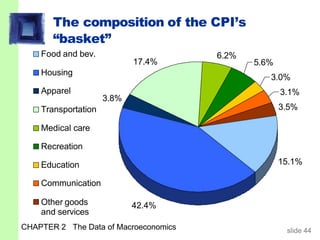
The composition of the CPI’s
“basket”
15.1%
42.4%
3.8%
17.4%
6.2%
5.6%
3.0%
3.1%
3.5%
Food and bev.
Housing
Apparel
Transportation
Medical care
Recreation
Education
Communication
Other goods
and services
CHAPTER 2 The Data of Macroeconomics slide 44
Reasons why
the CPI may overstate inflation
CHAPTER 2 The Data of Macroeconomics slide 47
▪ Substitution bias: The CPI uses fixed weights,
so it cannot reflect consumers’ ability to substitute
toward goods whose relative prices have fallen.
▪ Introduction of new goods: The introduction of
new goods makes consumers better off and, in effect,
increases the real value of the dollar. But it does not
reduce the CPI, because the CPI uses fixed weights.
▪ Unmeasured changes in quality:
Quality improvements increase the value of the dollar,
but are often not fully measured.
CPI vs. GDP Deflator
CHAPTER 2 The Data of Macroeconomics slide 50
prices of capital goods
▪ included in GDP deflator (if produced domestically)
▪ excluded from CPI
prices of imported consumer goods
▪ included in CPI
▪ excluded from GDP deflator
the basket of goods
▪ CPI: fixed
▪ GDP deflator: changes every year
Categories of the population
CHAPTER 2 The Data of Macroeconomics slide 52
▪ employed
working at a paid job
▪ unemployed
not employed but looking for a job
▪ labor force
the amount of labor available for producing
goods and services; all employed plus
unemployed persons
▪ not in the labor force
not employed, not looking for work
Two important labor force
concepts
CHAPTER 2 The Data of Macroeconomics slide 53
▪ unemployment rate
percentage of the labor force that is unemployed
▪ labor force participation rate
the fraction of the adult population
that “participates” in the labor force
The establishment survey
CHAPTER 2 The Data of Macroeconomics slide 57
▪ The BLS obtains a second measure of
employment by surveying businesses, asking
how many workers are on their payrolls.
▪ Neither measure is perfect, and they
occasionally diverge due to:
▪ treatment of self-employed persons
▪ new firms not counted in establishment survey
▪ technical issues involving population inferences
from sample data
Chapter Summary
1. Gross Domestic Product (GDP) measures both
total income and total expenditure on the
economy’s output of goods & services.
2. Nominal GDP values output at current prices;
real GDP values output at constant prices.
Changes in output affect both measures,
but changes in prices only affect nominal GDP.
3. GDP is the sum of consumption, investment,
government purchases, and net exports.
CHAPTER 2 The Data of Macroeconomics slide 59
Chapter Summary
4. The overall level of prices can be measured by
either
▪ the Consumer Price Index (CPI),
the price of a fixed basket of goods
purchased by the typical consumer, or
▪ the GDP deflator,
the ratio of nominal to real GDP
5. The unemployment rate is the fraction of the labor
force that is not employed.
CHAPTER 2 The Data of Macroeconomics slide 60

macroeconomic chapter2 all details on this chapter

  • 1.
    MACROECONOMICS SIXTH EDITION N.GREGORY MANKIW PowerPoint® Slides by Ron Cronovich © 2007 Worth Publishers, all rights reserved C H A P T E R The Data of Macroeconomics 2
  • 2.
    In this chapter,you will learn… CHAPTER 2 The Data of Macroeconomics slide 2 …the meaning and measurement of the most important macroeconomic statistics: ▪ Gross Domestic Product (GDP) ▪ The Consumer Price Index (CPI) ▪ The unemployment rate
  • 3.
    Gross Domestic Product: Expenditureand Income Two definitions: ▪ Total expenditure on domestically-produced final goods and services. ▪ Total income earned by domestically-located factors of production. Ex x p p e e n n d d ii ture e e q q u u als ii ncome because e e v v e e ry d d ollar l spent by a b b u u y y e e rr becomes ii ncome to the s se eller l. CHAPTER 2 The Data of Macroeconomics slide 3
  • 4.
    The Circular Flow HouseholdsFirms Goods Expenditure ($) Income ($) Labor CHAPTER 2 The Data of Macroeconomics slide 4
  • 5.
    Value added CHAPTER 2The Data of Macroeconomics slide 5 definition: A firm’s value added is the value of its output minus the value of the intermediate goods the firm used to produce that output.
  • 6.
    The expenditure componentsof GDP CHAPTER 2 The Data of Macroeconomics slide 6 ▪ consumption ▪ investment ▪ government spending ▪ net exports
  • 7.
    Consumption (C) CHAPTER 2The Data of Macroeconomics slide 7 ▪ durable goods last a long time ex: cars, home appliances ▪ nondurable goods last a short time ex: food, clothing ▪ services work done for consumers ex: dry cleaning, air travel. definition: The value of all goods and services bought by households. Includes:
  • 8.
    U.S. consumption, 2005 CHAPTER2 The Data of Macroeconomics slide 8 $ billions % of GDP Consumption $8,745.7 70.0% Durables 1,026.5 8.2 Nondurables 2,564.4 20.5 Services 5,154.9 41.3
  • 9.
    Investment (I) CHAPTER 2The Data of Macroeconomics slide 9 Definition 1: Spending on [the factor of production] capital. Definition 2: Spending on goods bought for future use Includes: ▪ business fixed investment Spending on plant and equipment that firms will use to produce other goods & services. ▪ residential fixed investment Spending on housing units by consumers and landlords. ▪ inventory investment The change in the value of all firms’ inventories.
  • 10.
    U.S. investment, 2005 CHAPTER2 The Data of Macroeconomics slide 10 $ billions % of GDP Investment $2,105.0 16.9% Business fixed 1,329.8 10.6 Residential 756.3 6.1 Inventory 18.9 0.2
  • 11.
    Investment vs. Capital CHAPTER2 The Data of Macroeconomics slide 11 Note: Investment is spending on new capital. Example (assumes no depreciation): ▪ 1/1/2006: economy has $500b worth of capital ▪ during 2006: investment = $60b ▪ 1/1/2007: economy will have $560b worth of capital
  • 12.
    Stocks vs. Flows FlowStock A stock is a quantity measured at a point in time. E.g., “The U.S. capital stock was $26 trillion on January 1, 2006.” A flow is a quantity measured per unit of time. E.g., “U.S. investment was $2.5 trillion during 2006.” CHAPTER 2 The Data of Macroeconomics slide 12
  • 13.
    Stocks vs. Flows- examples CHAPTER 2 The Data of Macroeconomics slide 13 stock flow a person’s wealth a person’s annual saving # of people with college degrees # of new college graduates this year the govt debt the govt budget deficit
  • 14.
    Now you try: CHAPTER2 The Data of Macroeconomics slide 14 Stock or flow? ▪ the balance on your credit card statement ▪ how much you study economics outside of class ▪ the size of your compact disc collection ▪ the inflation rate ▪ the unemployment rate
  • 15.
    Government spending (G) CHAPTER2 The Data of Macroeconomics slide 15 ▪ G includes all government spending on goods and services.. ▪ G excludes transfer payments (e.g., unemployment insurance payments), because they do not represent spending on goods and services.
  • 16.
    U.S. government spending,2005 CHAPTER 2 The Data of Macroeconomics slide 16 $ billions % of GDP Govt spending $2,362.9 18.9% Federal 877.7 7.0 Non-defense 290.6 2.3 Defense 587.1 4.7 State & local 1,485.2 11.9
  • 17.
    Net exports: NX= EX – IM def: The value of total exports (EX) minus the value of total imports (IM).
  • 18.
    GDP: An important andversatile concept CHAPTER 2 The Data of Macroeconomics slide 18 We have now seen that GDP measures ▪ total income ▪ total output ▪ total expenditure ▪ the sum of value-added at all stages in the production of final goods
  • 19.
    GNP vs. GDP CHAPTER2 The Data of Macroeconomics slide 19 ▪ Gross National Product (GNP): Total income earned by the nation’s factors of production, regardless of where located. ▪ Gross Domestic Product (GDP): Total income earned by domestically-located factors of production, regardless of nationality. (GNP – GDP) = (factor payments from abroad) – (factor payments to abroad)
  • 20.
    Discussion question: CHAPTER 2The Data of Macroeconomics slide 20 In your country, which would you want to be bigger, GDP, or GNP? Why?
  • 21.
    Real vs. nominalGDP CHAPTER 2 The Data of Macroeconomics slide 21 ▪ GDP is the value of all final goods and services produced. ▪ nominal GDP measures these values using current prices. ▪ real GDP measure these values using the prices of a base year.
  • 22.
    GDP Deflator ▪ Theinflation rate is the percentage increase in the overall level of prices. ▪ One measure of the price level is the GDP deflator, defined as GDP deflator = 100  Nominal GDP CHAPTER 2 The Data of Macroeconomics slide 22 Real GDP
  • 23.
    Chain-Weighted Real GDP CHAPTER2 The Data of Macroeconomics slide 39 ▪ Over time, relative prices change, so the base year should be updated periodically. ▪ In essence, chain-weighted real GDP updates the base year every year, so it is more accurate than constant-price GDP. ▪ Your textbook usually uses constant-price real GDP, because: ▪ the two measures are highly correlated. ▪ constant-price real GDP is easier to compute.
  • 24.
    Consumer Price Index(CPI) CHAPTER 2 The Data of Macroeconomics slide 40 ▪ A measure of the overall level of prices ▪ Published by the Bureau of Labor Statistics (BLS) ▪ Uses: ▪ tracks changes in the typical household’s cost of living ▪ adjusts many contracts for inflation (“COLAs”) ▪ allows comparisons of dollar amounts over time
  • 25.
    The composition ofthe CPI’s “basket” 15.1% 42.4% 3.8% 17.4% 6.2% 5.6% 3.0% 3.1% 3.5% Food and bev. Housing Apparel Transportation Medical care Recreation Education Communication Other goods and services CHAPTER 2 The Data of Macroeconomics slide 44
  • 26.
    Reasons why the CPImay overstate inflation CHAPTER 2 The Data of Macroeconomics slide 47 ▪ Substitution bias: The CPI uses fixed weights, so it cannot reflect consumers’ ability to substitute toward goods whose relative prices have fallen. ▪ Introduction of new goods: The introduction of new goods makes consumers better off and, in effect, increases the real value of the dollar. But it does not reduce the CPI, because the CPI uses fixed weights. ▪ Unmeasured changes in quality: Quality improvements increase the value of the dollar, but are often not fully measured.
  • 27.
    CPI vs. GDPDeflator CHAPTER 2 The Data of Macroeconomics slide 50 prices of capital goods ▪ included in GDP deflator (if produced domestically) ▪ excluded from CPI prices of imported consumer goods ▪ included in CPI ▪ excluded from GDP deflator the basket of goods ▪ CPI: fixed ▪ GDP deflator: changes every year
  • 28.
    Categories of thepopulation CHAPTER 2 The Data of Macroeconomics slide 52 ▪ employed working at a paid job ▪ unemployed not employed but looking for a job ▪ labor force the amount of labor available for producing goods and services; all employed plus unemployed persons ▪ not in the labor force not employed, not looking for work
  • 29.
    Two important laborforce concepts CHAPTER 2 The Data of Macroeconomics slide 53 ▪ unemployment rate percentage of the labor force that is unemployed ▪ labor force participation rate the fraction of the adult population that “participates” in the labor force
  • 30.
    The establishment survey CHAPTER2 The Data of Macroeconomics slide 57 ▪ The BLS obtains a second measure of employment by surveying businesses, asking how many workers are on their payrolls. ▪ Neither measure is perfect, and they occasionally diverge due to: ▪ treatment of self-employed persons ▪ new firms not counted in establishment survey ▪ technical issues involving population inferences from sample data
  • 31.
    Chapter Summary 1. GrossDomestic Product (GDP) measures both total income and total expenditure on the economy’s output of goods & services. 2. Nominal GDP values output at current prices; real GDP values output at constant prices. Changes in output affect both measures, but changes in prices only affect nominal GDP. 3. GDP is the sum of consumption, investment, government purchases, and net exports. CHAPTER 2 The Data of Macroeconomics slide 59
  • 32.
    Chapter Summary 4. Theoverall level of prices can be measured by either ▪ the Consumer Price Index (CPI), the price of a fixed basket of goods purchased by the typical consumer, or ▪ the GDP deflator, the ratio of nominal to real GDP 5. The unemployment rate is the fraction of the labor force that is not employed. CHAPTER 2 The Data of Macroeconomics slide 60