Mackey Glass Time Series Prediction:
Comparison between LMS, KLMS and the novel NLMS-FL
Student: Giovanni Murru
 Professor: Aurelio Uncini
MGTS prediction: Comparison LMS, KLMS, FL-NLMS 1
Time Series Prediction
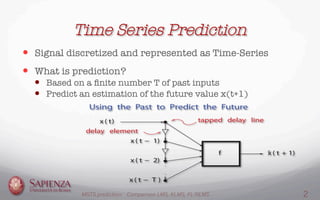
—  Signal discretized and represented as Time-Series 
—  What is prediction?
—  Based on a finite number T of past inputs
—  Predict an estimation of the future value x(t+1)
MGTS prediction: Comparison LMS, KLMS, FL-NLMS 2
The LMS algorithm
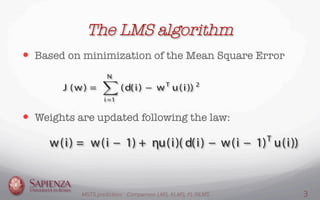
—  Based on minimization of the Mean Square Error
J (w) =
N
i=1
(d(i) − wT
u(i)) 2
—  Weights are updated following the law:
w(i) = w(i − 1) + ηu(i)( d(i) − w(i − 1)T
u(i
MGTS prediction: Comparison LMS, KLMS, FL-NLMS 3
The KLMS algorithm
—  Map the input data into a High Dimensional Feature Space.
—  Gaussian Kernel:
—  Compute the estimated value "
and update the coefficients:
MGTS prediction: Comparison LMS, KLMS, FL-NLMS 4
The Functional Link Nonlinear Filter
—  An artificial neural network with a single layer
—  Creation of Enhanced Input Pattern z[n]
—  Adaptive filtering through NLMS algorithm

—  Weight Vector:
—  Error on the prediction:

—  Weight Update Rule:
—  Output of the Functional Link Filter:
MGTS prediction: Comparison LMS, KLMS, FL-NLMS 5
Creation of Enhanced Input Pattern
x[1,n]
x[2,n]
x[3,n]
x[Lin,n]
cos( πx[1,n])
sin(2πx[1,n])
cos(5πx[1,n])
sin(6πx[1,n])
cos(3πx[1,n])
sin(4πx[1,n])
1
2*exord =
= 6
cos( πx[Lin,n])
sin(2πx[Lin,n])
cos(5πx[Lin,n])
sin(6πx[Lin,n])
cos(3πx[Lin,n])
sin(4πx[Lin,n])
2*exord * Lin =
= 6*10 = ∆
bias = 1x[n]
z[n]
∆ + bias = 61 = Len
MGTS prediction: Comparison LMS, KLMS, FL-NLMS 6
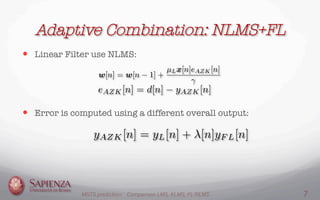
Adaptive Combination: NLMS+FL
—  Linear Filter use NLMS:
—  Error is computed using a different overall output:
MGTS prediction: Comparison LMS, KLMS, FL-NLMS 7
A Robust Architecture
—  How is the adaptive parameter λ[n] computed?
—  It’s computed in function of an adaptive parameter a[n]:


—  How is the adaptive parameter a[n] computed?
—  It’s computed in function of another adaptive parameter r[n]:
—  r[n] is the estimated power of yFL[n]:
MGTS prediction: Comparison LMS, KLMS, FL-NLMS 8
0
100
200
300
400
500
0
2
4
6
8
10
−0.8
−0.6
−0.4
−0.2
0
0.2
0.4
0.6
Mackey-Glass Time-Series
—  Highly Nonlinear
—  Time delay
—  Describes Chaotic and Periodic
Dynamics
—  Initialization:
MGTS prediction: Comparison LMS, KLMS, FL-NLMS 9
0 50 100 150 200 250 300 350 400 450 500
−0.8
−0.6
−0.4
−0.2
0
0.2
0.4
0.6
Experimental Results
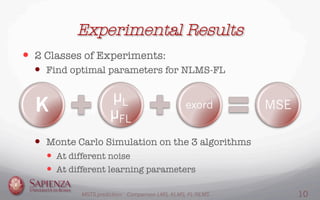
—  2 Classes of Experiments:
—  Find optimal parameters for NLMS-FL
—  Monte Carlo Simulation on the 3 algorithms
—  At different noise
—  At different learning parameters
K
µL
µFL
exord MSE
MGTS prediction: Comparison LMS, KLMS, FL-NLMS 10
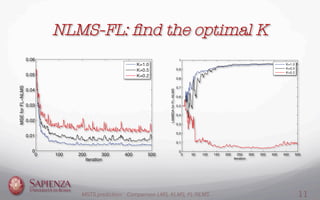
NLMS-FL: find the optimal K
0 100 200 300 400 500
0
0.01
0.02
0.03
0.04
0.05
0.06
iteration
MSEforFL−NLMS
K=1.0
K=0.5
K=0.2
0 50 100 150 200 250 300 350 400 450 500
0
0.1
0.2
0.3
0.4
0.5
0.6
0.7
0.8
0.9
1
iteration
LAMBDAforFL−NLMS
K=1.0
K=0.5
K=0.2
MGTS prediction: Comparison LMS, KLMS, FL-NLMS 11
NLMS-FL: find best expansion order
0 100 200 300 400 500
0
0.01
0.02
0.03
0.04
0.05
0.06
iteration
MSEforFL−NLMS
exord=1
exord=3
exord=9
0 50 100 150 200 250 300 350 400 450 500
0.4
0.5
0.6
0.7
0.8
0.9
1
iteration
LAMBDAforFL−NLMS
exord=1
exord=3
exord=9
MGTS prediction: Comparison LMS, KLMS, FL-NLMS 12
NLMS-FL: find best learning parameters 
0 50 100 150 200 250 300 350 400 450 500
0
0.01
0.02
0.03
0.04
0.05
0.06
iteration
MSEforFL−NLMS
muL=0.1, muNL=0.3
muL=0.3, muNL=0.1
muL=0.7, muNL=0.7
muL=0.01, muNL=0.01
0 50 100 150 200 250 300 350 400 450 500
0
0.01
0.02
0.03
0.04
0.05
0.06
iteration
MSEforFL−NLMS
muL=0.1, muNL=0.3
muL=0.3, muNL=0.1
muL=0.7, muNL=0.7
muL=0.01, muNL=0.01
MGTS prediction: Comparison LMS, KLMS, FL-NLMS 13
Comparison between NLMS-FL, KLMS
and LMS, using the optimal values
0 100 200 300 400 500
0.4
0.5
0.6
0.7
0.8
0.9
1
iteration
LAMBDA
LAMBDA
0 100 200 300 400 500
0.4
0.5
0.6
0.7
0.8
0.9
1
iteration
LAMBDA
LAMBDA
0 100 200 300 400 500
0.4
0.5
0.6
0.7
0.8
0.9
1
iteration
LAMBDA
LAMBDA
0 100 200 300 400 500
0
0.01
0.02
0.03
0.04
0.05
0.06
iteration
MSE
LMS
KLMS
FL−NLMS
0 100 200 300 400 500
0
0.01
0.02
0.03
0.04
0.05
0.06
iterationMSE
LMS
KLMS
FL−NLMS
0 100 200 300 400 500
0
0.01
0.02
0.03
0.04
0.05
0.06
iteration
MSE
LMS
KLMS
FL−NLMS
noise = 0.04noise = 0.01 noise = 0.07
MGTS prediction: Comparison LMS, KLMS, FL-NLMS 14
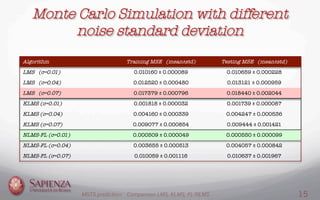
Monte Carlo Simulation with different
noise standard deviation
Algorithm
 Training MSE (mean±std)
 Testing MSE (mean±std)
LMS (σ=0.01)
 0.010160 ± 0.000089
 0.010659 ± 0.000228
LMS (σ=0.04)
 0.012520 ± 0.000480
 0.013121 ± 0.000959
LMS (σ=0.07)
 0.017379 ± 0.000796
 0.018440 ± 0.002044
KLMS (σ=0.01)
 0.001818 ± 0.000032
 0.001739 ± 0.000087
KLMS (σ=0.04)
 0.004160 ± 0.000339
 0.004247 ± 0.000536
KLMS (σ=0.07)
 0.009077 ± 0.000854
 0.009444 ± 0.001421
NLMS-FL (σ=0.01)
 0.000509 ± 0.000049
 0.000550 ± 0.000099
NLMS-FL (σ=0.04)
 0.003655 ± 0.000513
 0.004057 ± 0.000842
NLMS-FL (σ=0.07)
 0.010059 ± 0.001116
 0.010637 ± 0.001967
MGTS prediction: Comparison LMS, KLMS, FL-NLMS 15
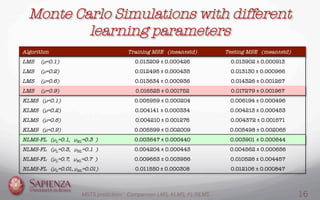
Monte Carlo Simulations with different
learning parameters
Algorithm
 Training MSE (mean±std)
 Testing MSE (mean±std)
LMS (µ=0.1)
 0.013209 ± 0.000426
 0.013902 ± 0.000913
LMS (µ=0.2)
 0.012495 ± 0.000435
 0.013130 ± 0.000966
LMS (µ=0.6)
 0.013634 ± 0.000936
 0.014326 ± 0.001267
LMS (µ=0.9)
 0.016525 ± 0.001752
 0.017279 ± 0.001967
KLMS (µ=0.1)
 0.005959 ± 0.000204
 0.006194 ± 0.000496
KLMS (µ=0.2)
 0.004141 ± 0.000334
 0.004213 ± 0.000453
KLMS (µ=0.6)
 0.004210 ± 0.001276
 0.004372 ± 0.001571
KLMS (µ=0.9)
 0.005599 ± 0.002009
 0.005498 ± 0.002065
NLMS-FL (µL=0.1, µNL=0.3 )
 0.003647 ± 0.000440
 0.003901 ± 0.000644
NLMS-FL (µL=0.3, µNL=0.1 )
 0.004204 ± 0.000443
 0.004562 ± 0.000656
NLMS-FL (µL=0.7, µNL=0.7 )
 0.009653 ± 0.003956
 0.010526 ± 0.004457
NLMS-FL (µL=0.01, µNL=0.01)
 0.011550 ± 0.000308
 0.012106 ± 0.000847
MGTS prediction: Comparison LMS, KLMS, FL-NLMS 16
Conclusion and Results
—  NLMS-FL is the best performer!
—  Great difference in performance at low noise!
—  Very Rapid Convergence of the learning curve!
High Speed of Adaptation!
—  Monte Carlo simulation confirms the results as
regard the best learning parameters!
—  KLMS is still a good solution. LMS is not enough.
MGTS prediction: Comparison LMS, KLMS, FL-NLMS 17
Thanks for
Your Attention!"

References:

[1] D.Comminiello, A.Uncini, R. Parisi and
M.Scarpiniti, A Functional Link Based
Nonlinear Echo Canceller Exploiting
Sparsity.

[2] D.Comminiello, A.Uncini, M.Scarpiniti,
L.A.Azpicueta-Ruiz and J.Arenas-Garcia,
Functional Link Based Architectures For
Nonlinear Acoustic Echo Cancellation.

[3] Y.H.Pao, Adaptive Pattern Recognition
and Neural Networks.

[4] A.Uncini, Neural Networks: 
Computational and Biological Inspired
Intelligent Circuits.

[5] Weifeng Liu, Jose C. Principe, and Simon
Haykin, Kernel Adaptive Filtering: 
A Comprehensive Introduction.

[6] Dave Touretzky and Kornel Laskowski,
15-486/782: Artificial Neural Network, FALL
2006, Neural Networks for Time Series
Prediction.

MGTS prediction: Comparison LMS, KLMS, FL-NLMS 18

Mackey Glass Time Series Prediction

  • 1.
    Mackey Glass TimeSeries Prediction: Comparison between LMS, KLMS and the novel NLMS-FL Student: Giovanni Murru Professor: Aurelio Uncini MGTS prediction: Comparison LMS, KLMS, FL-NLMS 1
  • 2.
    Time Series Prediction — Signal discretized and represented as Time-Series —  What is prediction? —  Based on a finite number T of past inputs —  Predict an estimation of the future value x(t+1) MGTS prediction: Comparison LMS, KLMS, FL-NLMS 2
  • 3.
    The LMS algorithm — Based on minimization of the Mean Square Error J (w) = N i=1 (d(i) − wT u(i)) 2 —  Weights are updated following the law: w(i) = w(i − 1) + ηu(i)( d(i) − w(i − 1)T u(i MGTS prediction: Comparison LMS, KLMS, FL-NLMS 3
  • 4.
    The KLMS algorithm — Map the input data into a High Dimensional Feature Space. —  Gaussian Kernel: —  Compute the estimated value " and update the coefficients: MGTS prediction: Comparison LMS, KLMS, FL-NLMS 4
  • 5.
    The Functional LinkNonlinear Filter —  An artificial neural network with a single layer —  Creation of Enhanced Input Pattern z[n] —  Adaptive filtering through NLMS algorithm —  Weight Vector: —  Error on the prediction: —  Weight Update Rule: —  Output of the Functional Link Filter: MGTS prediction: Comparison LMS, KLMS, FL-NLMS 5
  • 6.
    Creation of EnhancedInput Pattern x[1,n] x[2,n] x[3,n] x[Lin,n] cos( πx[1,n]) sin(2πx[1,n]) cos(5πx[1,n]) sin(6πx[1,n]) cos(3πx[1,n]) sin(4πx[1,n]) 1 2*exord = = 6 cos( πx[Lin,n]) sin(2πx[Lin,n]) cos(5πx[Lin,n]) sin(6πx[Lin,n]) cos(3πx[Lin,n]) sin(4πx[Lin,n]) 2*exord * Lin = = 6*10 = ∆ bias = 1x[n] z[n] ∆ + bias = 61 = Len MGTS prediction: Comparison LMS, KLMS, FL-NLMS 6
  • 7.
    Adaptive Combination: NLMS+FL — Linear Filter use NLMS: —  Error is computed using a different overall output: MGTS prediction: Comparison LMS, KLMS, FL-NLMS 7
  • 8.
    A Robust Architecture — How is the adaptive parameter λ[n] computed? —  It’s computed in function of an adaptive parameter a[n]: —  How is the adaptive parameter a[n] computed? —  It’s computed in function of another adaptive parameter r[n]: —  r[n] is the estimated power of yFL[n]: MGTS prediction: Comparison LMS, KLMS, FL-NLMS 8
  • 9.
    0 100 200 300 400 500 0 2 4 6 8 10 −0.8 −0.6 −0.4 −0.2 0 0.2 0.4 0.6 Mackey-Glass Time-Series —  HighlyNonlinear —  Time delay —  Describes Chaotic and Periodic Dynamics —  Initialization: MGTS prediction: Comparison LMS, KLMS, FL-NLMS 9 0 50 100 150 200 250 300 350 400 450 500 −0.8 −0.6 −0.4 −0.2 0 0.2 0.4 0.6
  • 10.
    Experimental Results —  2Classes of Experiments: —  Find optimal parameters for NLMS-FL —  Monte Carlo Simulation on the 3 algorithms —  At different noise —  At different learning parameters K µL µFL exord MSE MGTS prediction: Comparison LMS, KLMS, FL-NLMS 10
  • 11.
    NLMS-FL: find theoptimal K 0 100 200 300 400 500 0 0.01 0.02 0.03 0.04 0.05 0.06 iteration MSEforFL−NLMS K=1.0 K=0.5 K=0.2 0 50 100 150 200 250 300 350 400 450 500 0 0.1 0.2 0.3 0.4 0.5 0.6 0.7 0.8 0.9 1 iteration LAMBDAforFL−NLMS K=1.0 K=0.5 K=0.2 MGTS prediction: Comparison LMS, KLMS, FL-NLMS 11
  • 12.
    NLMS-FL: find bestexpansion order 0 100 200 300 400 500 0 0.01 0.02 0.03 0.04 0.05 0.06 iteration MSEforFL−NLMS exord=1 exord=3 exord=9 0 50 100 150 200 250 300 350 400 450 500 0.4 0.5 0.6 0.7 0.8 0.9 1 iteration LAMBDAforFL−NLMS exord=1 exord=3 exord=9 MGTS prediction: Comparison LMS, KLMS, FL-NLMS 12
  • 13.
    NLMS-FL: find bestlearning parameters 0 50 100 150 200 250 300 350 400 450 500 0 0.01 0.02 0.03 0.04 0.05 0.06 iteration MSEforFL−NLMS muL=0.1, muNL=0.3 muL=0.3, muNL=0.1 muL=0.7, muNL=0.7 muL=0.01, muNL=0.01 0 50 100 150 200 250 300 350 400 450 500 0 0.01 0.02 0.03 0.04 0.05 0.06 iteration MSEforFL−NLMS muL=0.1, muNL=0.3 muL=0.3, muNL=0.1 muL=0.7, muNL=0.7 muL=0.01, muNL=0.01 MGTS prediction: Comparison LMS, KLMS, FL-NLMS 13
  • 14.
    Comparison between NLMS-FL,KLMS and LMS, using the optimal values 0 100 200 300 400 500 0.4 0.5 0.6 0.7 0.8 0.9 1 iteration LAMBDA LAMBDA 0 100 200 300 400 500 0.4 0.5 0.6 0.7 0.8 0.9 1 iteration LAMBDA LAMBDA 0 100 200 300 400 500 0.4 0.5 0.6 0.7 0.8 0.9 1 iteration LAMBDA LAMBDA 0 100 200 300 400 500 0 0.01 0.02 0.03 0.04 0.05 0.06 iteration MSE LMS KLMS FL−NLMS 0 100 200 300 400 500 0 0.01 0.02 0.03 0.04 0.05 0.06 iterationMSE LMS KLMS FL−NLMS 0 100 200 300 400 500 0 0.01 0.02 0.03 0.04 0.05 0.06 iteration MSE LMS KLMS FL−NLMS noise = 0.04noise = 0.01 noise = 0.07 MGTS prediction: Comparison LMS, KLMS, FL-NLMS 14
  • 15.
    Monte Carlo Simulationwith different noise standard deviation Algorithm Training MSE (mean±std) Testing MSE (mean±std) LMS (σ=0.01) 0.010160 ± 0.000089 0.010659 ± 0.000228 LMS (σ=0.04) 0.012520 ± 0.000480 0.013121 ± 0.000959 LMS (σ=0.07) 0.017379 ± 0.000796 0.018440 ± 0.002044 KLMS (σ=0.01) 0.001818 ± 0.000032 0.001739 ± 0.000087 KLMS (σ=0.04) 0.004160 ± 0.000339 0.004247 ± 0.000536 KLMS (σ=0.07) 0.009077 ± 0.000854 0.009444 ± 0.001421 NLMS-FL (σ=0.01) 0.000509 ± 0.000049 0.000550 ± 0.000099 NLMS-FL (σ=0.04) 0.003655 ± 0.000513 0.004057 ± 0.000842 NLMS-FL (σ=0.07) 0.010059 ± 0.001116 0.010637 ± 0.001967 MGTS prediction: Comparison LMS, KLMS, FL-NLMS 15
  • 16.
    Monte Carlo Simulationswith different learning parameters Algorithm Training MSE (mean±std) Testing MSE (mean±std) LMS (µ=0.1) 0.013209 ± 0.000426 0.013902 ± 0.000913 LMS (µ=0.2) 0.012495 ± 0.000435 0.013130 ± 0.000966 LMS (µ=0.6) 0.013634 ± 0.000936 0.014326 ± 0.001267 LMS (µ=0.9) 0.016525 ± 0.001752 0.017279 ± 0.001967 KLMS (µ=0.1) 0.005959 ± 0.000204 0.006194 ± 0.000496 KLMS (µ=0.2) 0.004141 ± 0.000334 0.004213 ± 0.000453 KLMS (µ=0.6) 0.004210 ± 0.001276 0.004372 ± 0.001571 KLMS (µ=0.9) 0.005599 ± 0.002009 0.005498 ± 0.002065 NLMS-FL (µL=0.1, µNL=0.3 ) 0.003647 ± 0.000440 0.003901 ± 0.000644 NLMS-FL (µL=0.3, µNL=0.1 ) 0.004204 ± 0.000443 0.004562 ± 0.000656 NLMS-FL (µL=0.7, µNL=0.7 ) 0.009653 ± 0.003956 0.010526 ± 0.004457 NLMS-FL (µL=0.01, µNL=0.01) 0.011550 ± 0.000308 0.012106 ± 0.000847 MGTS prediction: Comparison LMS, KLMS, FL-NLMS 16
  • 17.
    Conclusion and Results — NLMS-FL is the best performer! —  Great difference in performance at low noise! —  Very Rapid Convergence of the learning curve! High Speed of Adaptation! —  Monte Carlo simulation confirms the results as regard the best learning parameters! —  KLMS is still a good solution. LMS is not enough. MGTS prediction: Comparison LMS, KLMS, FL-NLMS 17
  • 18.
    Thanks for Your Attention!" References: [1]D.Comminiello, A.Uncini, R. Parisi and M.Scarpiniti, A Functional Link Based Nonlinear Echo Canceller Exploiting Sparsity. [2] D.Comminiello, A.Uncini, M.Scarpiniti, L.A.Azpicueta-Ruiz and J.Arenas-Garcia, Functional Link Based Architectures For Nonlinear Acoustic Echo Cancellation. [3] Y.H.Pao, Adaptive Pattern Recognition and Neural Networks. [4] A.Uncini, Neural Networks: Computational and Biological Inspired Intelligent Circuits. [5] Weifeng Liu, Jose C. Principe, and Simon Haykin, Kernel Adaptive Filtering: A Comprehensive Introduction. [6] Dave Touretzky and Kornel Laskowski, 15-486/782: Artificial Neural Network, FALL 2006, Neural Networks for Time Series Prediction. MGTS prediction: Comparison LMS, KLMS, FL-NLMS 18