

MACHINES FOR
ACCOUNTING RECORDS
1). CALCULATORS
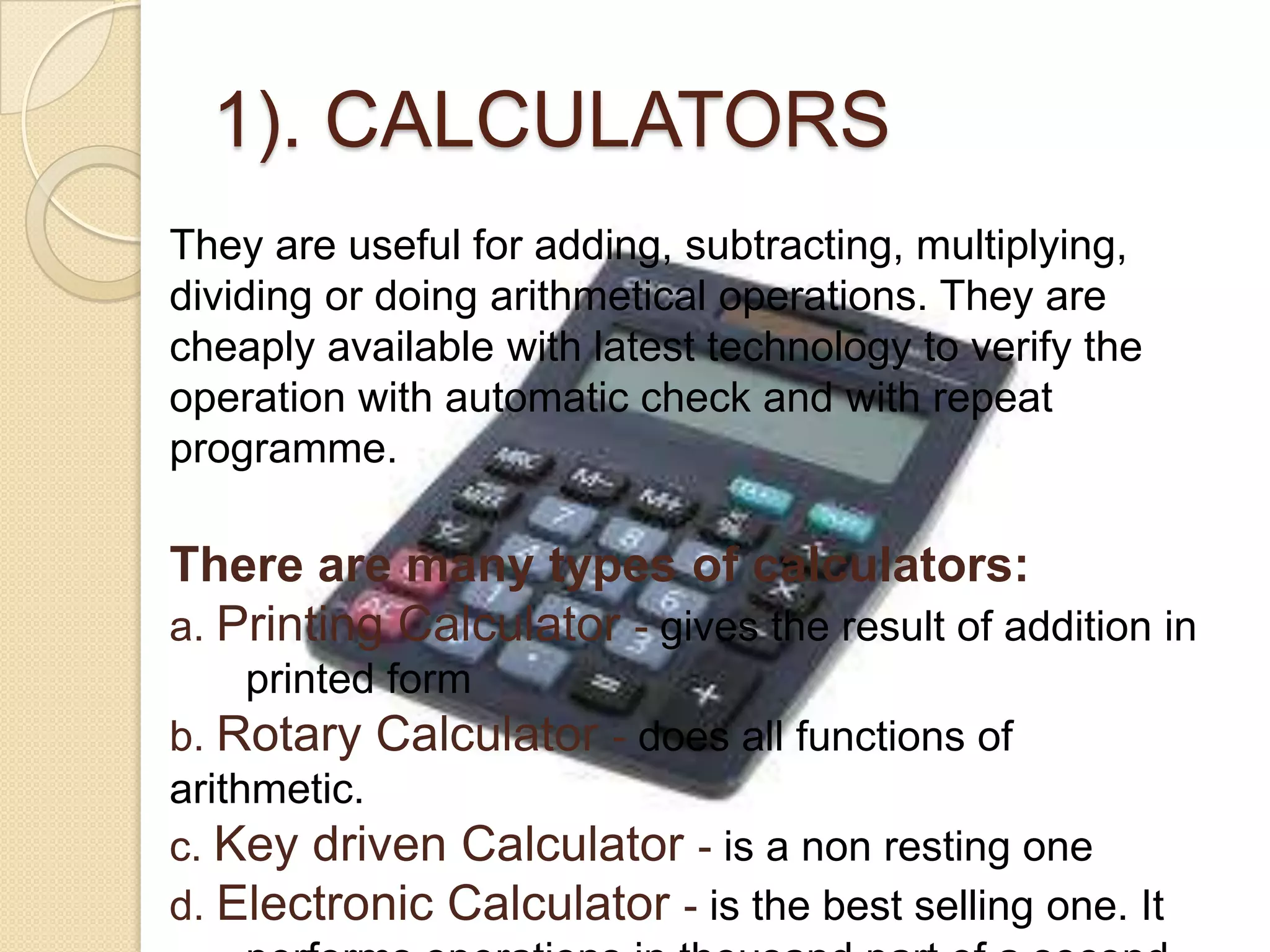
They are useful for adding, subtracting, multiplying,
dividing or doing arithmetical operations. They are
cheaply available with latest technology to verify the
operation with automatic check and with repeat
programme.

There are many types of calculators:
a. Printing Calculator - gives the result of addition in
printed form
b. Rotary Calculator - does all functions of
arithmetic.
c. Key driven Calculator - is a non resting one
d. Electronic Calculator - is the best selling one. It
Advantages:
minimize errors
 ensure speed/accuracy
 mental strain is reduced
 very handy machine
 cheap
 available in all models with many
users attachment
 its operation is very simple
 arithmetical operations can be done

Disadvantages:
a. Costly
b. utility is limited compare to computers
c. complex and complicated issues cannot be
considered by calculators.
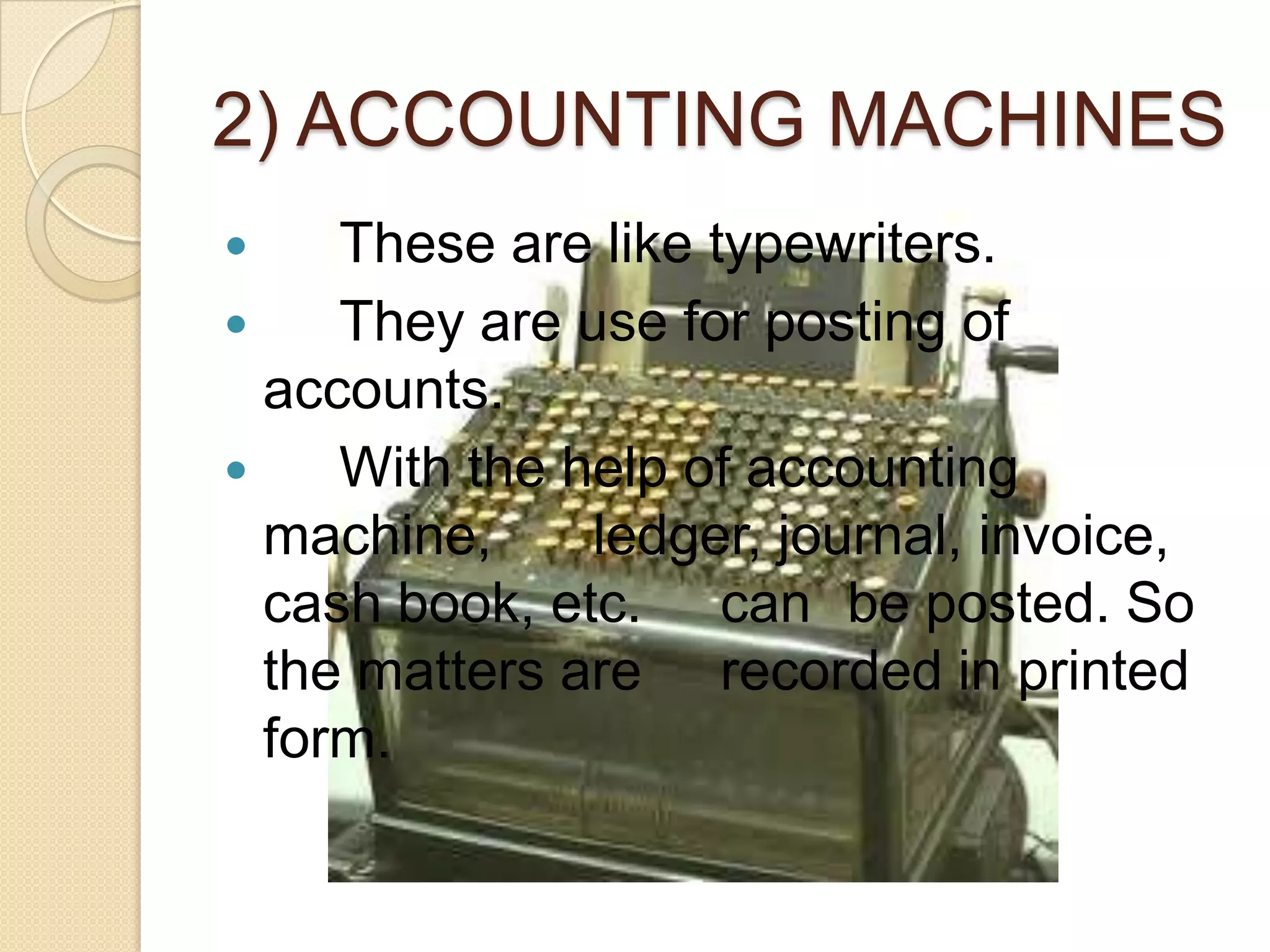
2) ACCOUNTING MACHINES
These are like typewriters.

They are use for posting of
accounts.

With the help of accounting
machine,
ledger, journal, invoice,
cash book, etc. can be posted. So
the matters are recorded in printed
form.

Advantages:
a. it works faster than men
b. errors in posting minimize
c. ledgers are posted and balance
d. results are accurate and reliable
e. accounting work is done as soon as
postings are
 over.
 f. only little training is needed to operate
the machine.
 g. printed records are readily available.





Disadvantages:
It is costly. The accounting operations
must be voluminous enough to
warrant the employment of accounting
machines.
 Breakdown of power will lead to
stoppage of the machine.
 It may lead to the problem of
unemployment of persons with special
knowledge in Accountancy.

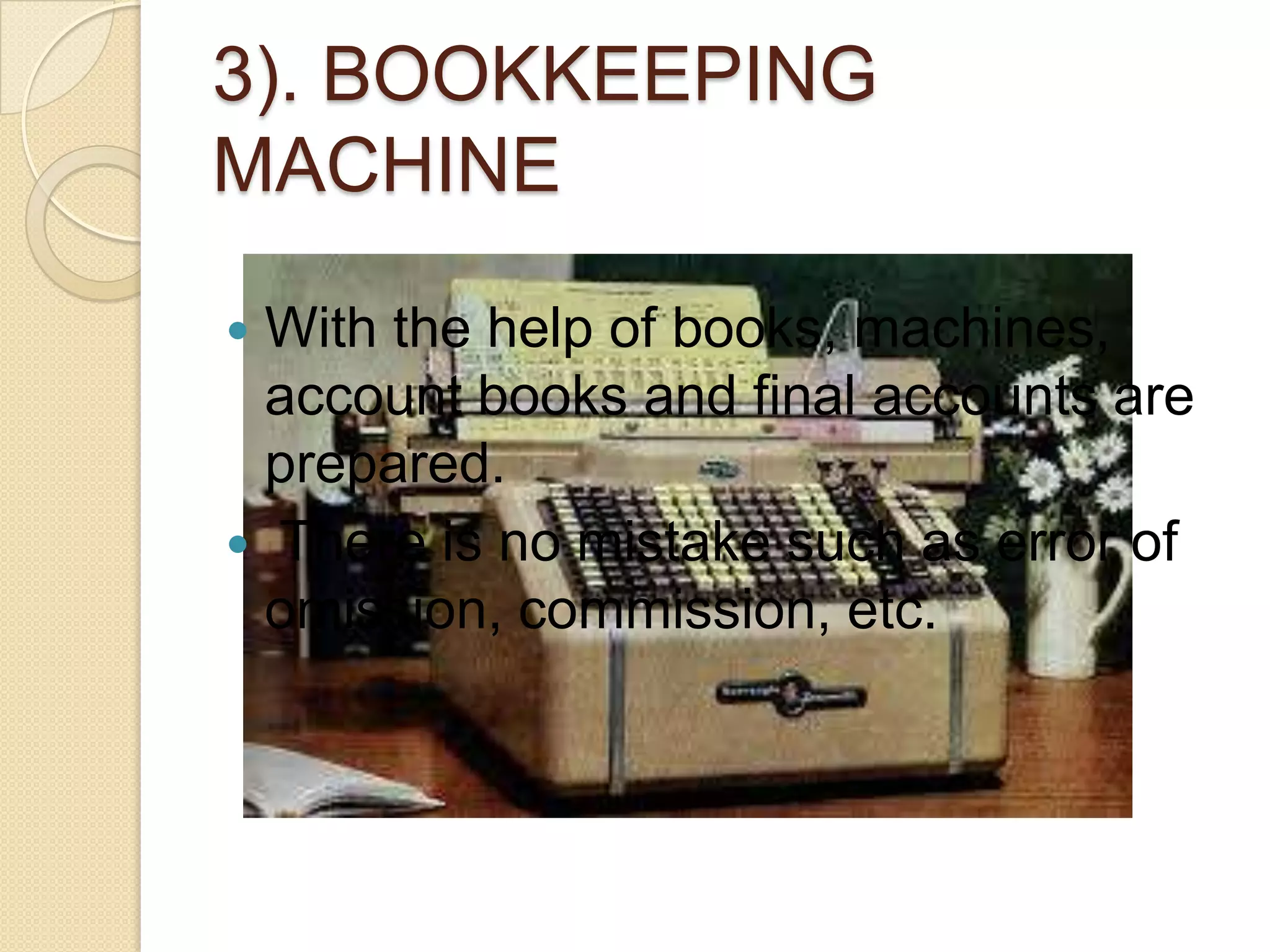
3). BOOKKEEPING
MACHINE
With the help of books, machines,
account books and final accounts are
prepared.
 There is no mistake such as error of
omission, commission, etc.

MACHINES FOR
HANDLING CASH
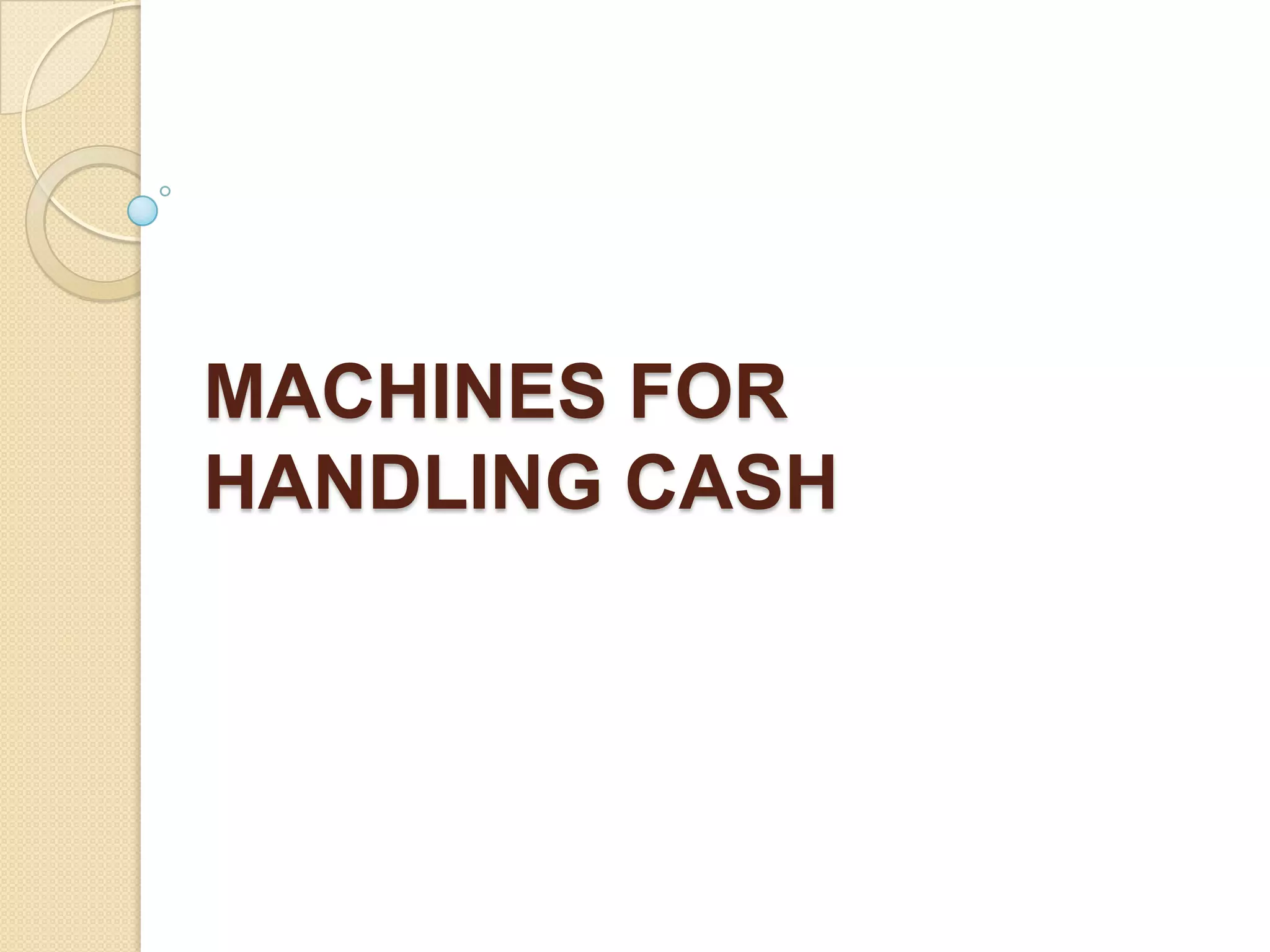
1). CASH REGISTER
◦ It is a device for recording and checking cash
receipts. It is like internal check system. At any
time cashier can count the cash in hand and verify
it with balance shown by the cash register.

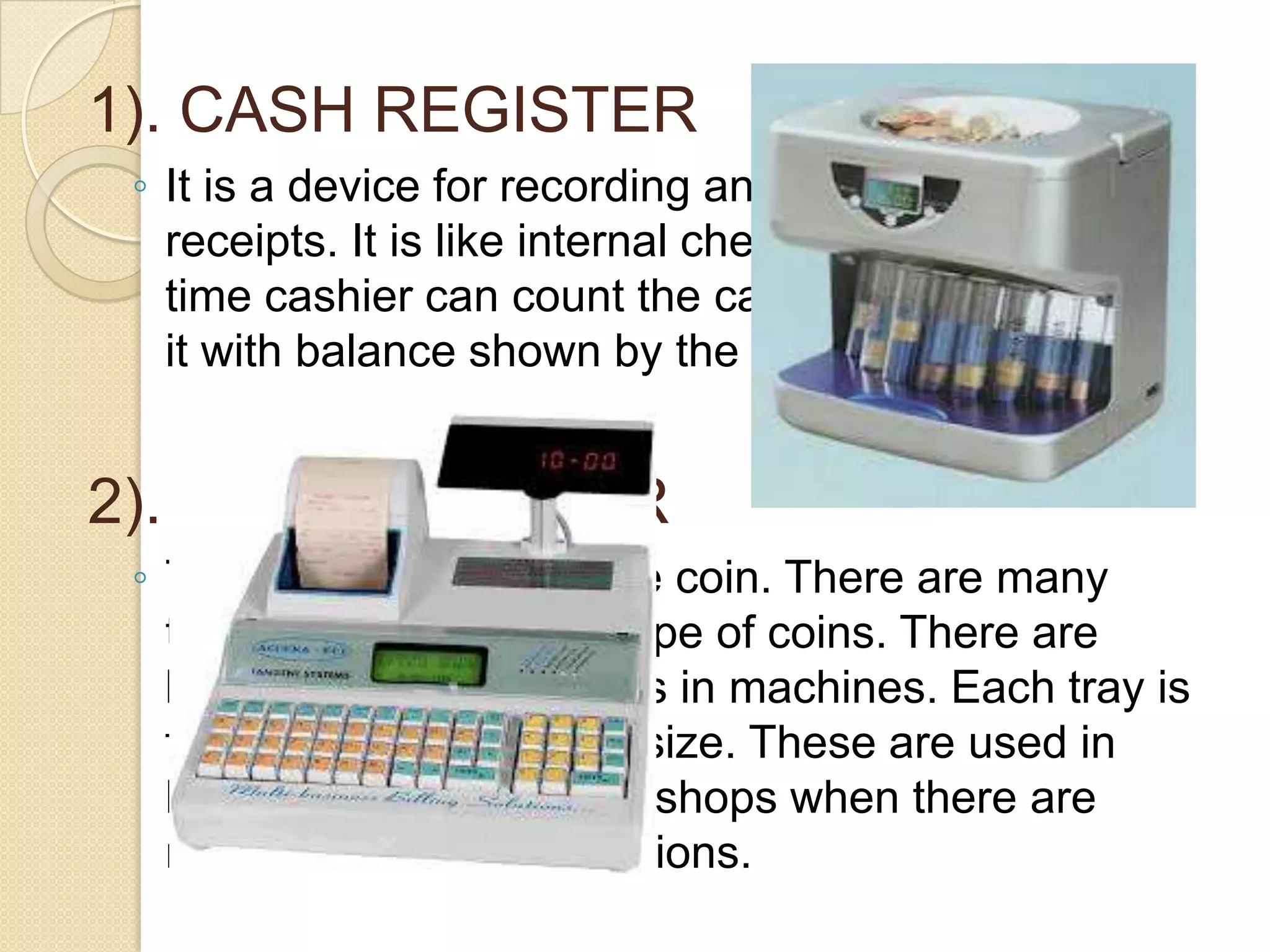
2). COIN COUNTER
◦ This machine counts the coin. There are many
trays according to the type of coins. There are
layers of trays with holes in machines. Each tray is
for coins of a particular size. These are used in
banks, railways and big shops when there are
numerous cash transactions.
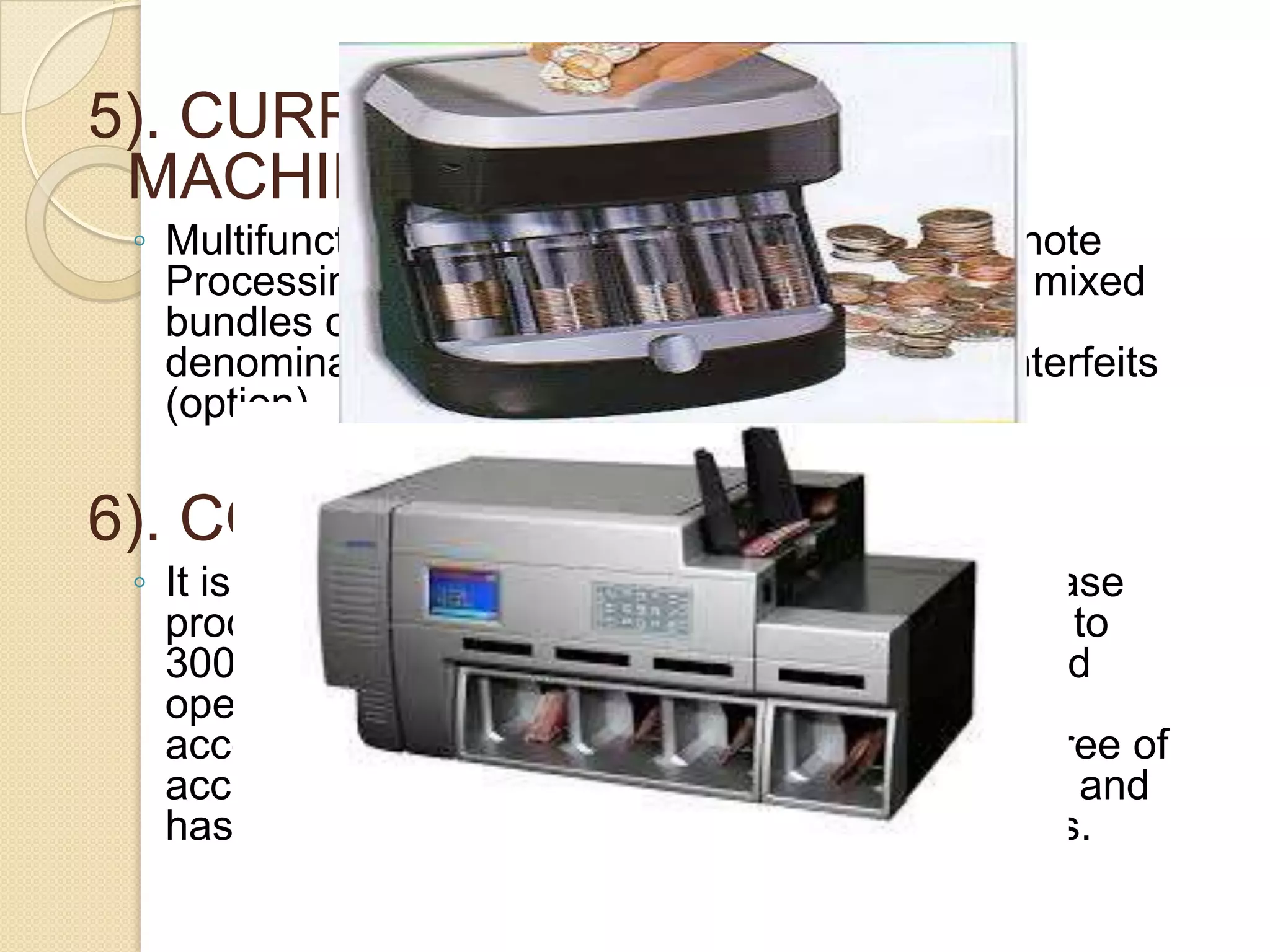
3). CHEQUE PROTECTORCHEQUE WRITING MACHINES
◦ The machines write the amount, does crossing
etc. on the surface of the cheque. It shreds into
fibers of the cheque paper, the shreds being form
under pressure and then filled with acid proof ink.
No alteration can be made. It cannot be erased. It
ensures the safety of the cheque.

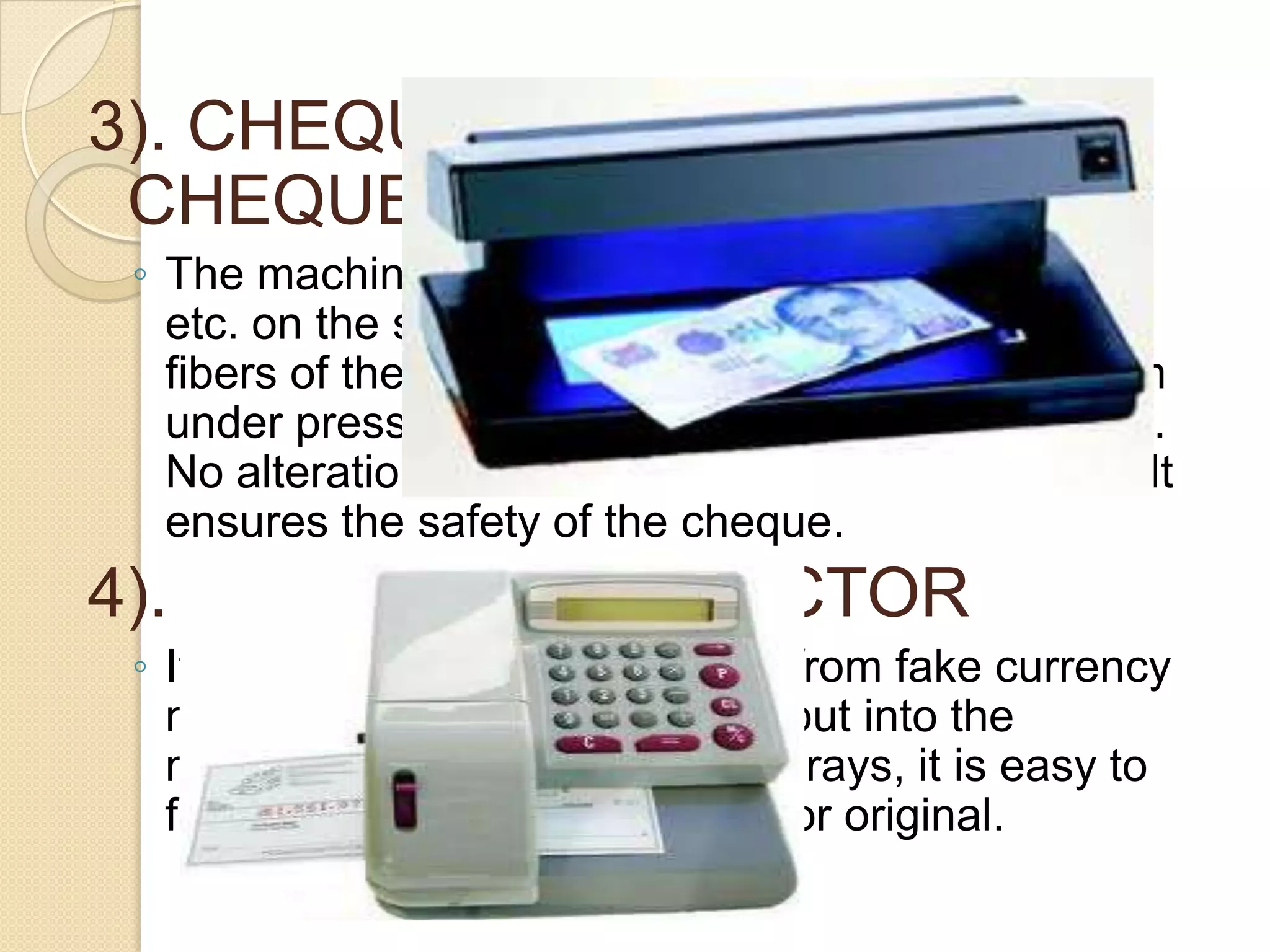
4). FAKE NOTE DETECTOR
◦ It is used to detect good notes from fake currency
notes. The currency notes are put into the
machine. with the help of violet rays, it is easy to
find out whether a note is fake or original.
5). CURRENCY SORTING
MACHINES
◦ Multifunctional parallel-working Desktop Banknote
Processing system for counting and sorting of mixed
bundles of notes by currency (including issue)
denomination, orientation and suspected counterfeits
(option)

6). COIN SORTING MACHINES
◦ It is a tabletop coin sorter/counter that can increase
productivity by accurate sorting and counting up to
3000 coins per minute. Offering quiet, high-speed
operation, this cost efficient unit increases
accountability while maintaining the highest degree of
accuracy. Comes in a compact size, easy to use and
has a multiple functions, all catering to the needs.
OTHER OFFICE MACHINES
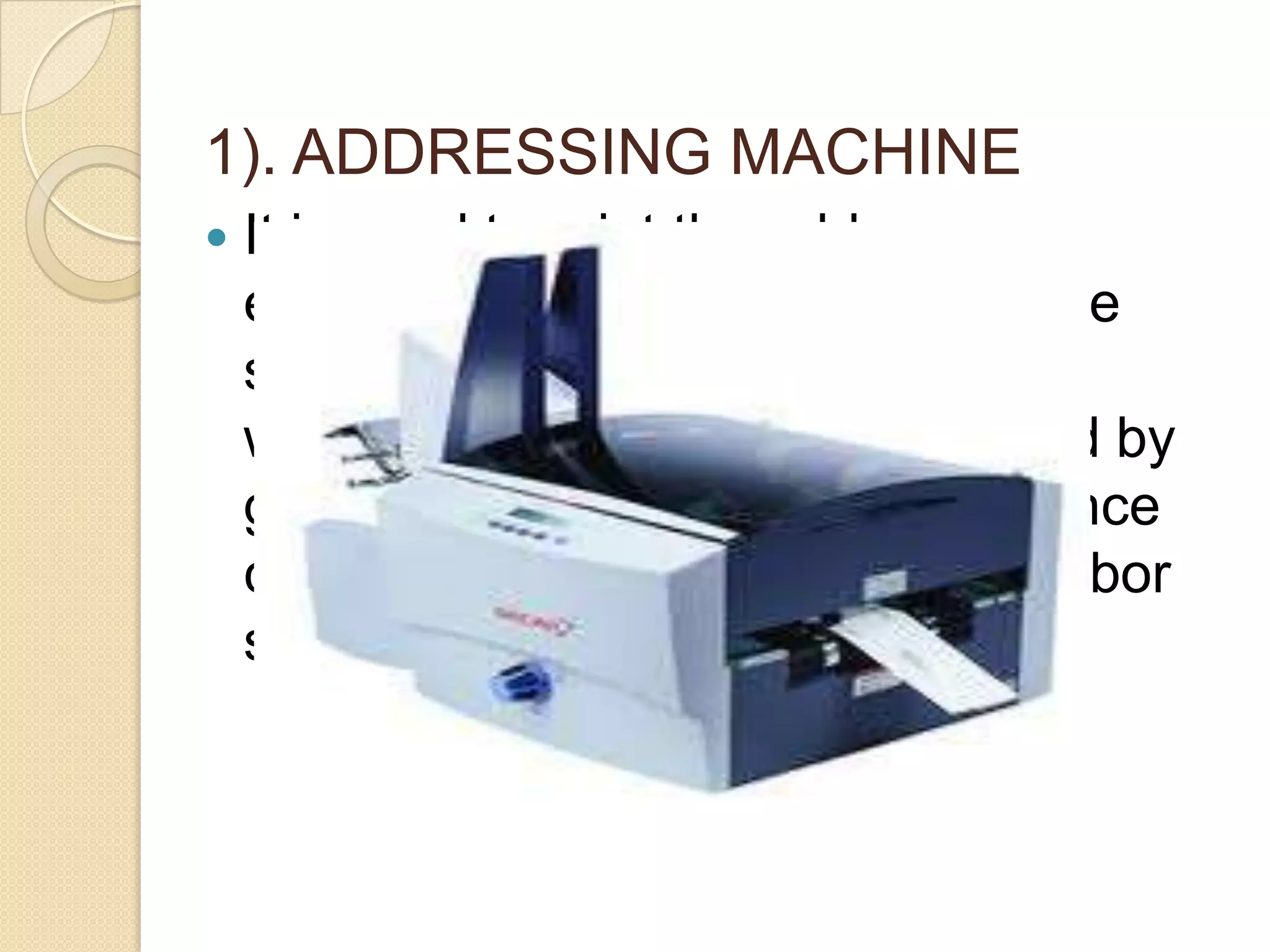
1). ADDRESSING MACHINE


It is used to print the address on
envelopes, labels, postcards, wage
sheet, invoices, notices dividend
warrants etc. The machine is used by
gas companies, electricity, insurance
companies. It is a time saving , labor
service device.
There are three types of
addressing machine:
a. Metal plate machine - the addresses
are stenciled or embossed on metal
process. Envelopes are inserted one by
one. The machine is operated with a
lever. The required address is printed.
b. Film stencil machine - it uses a film
stencil mounted in a cardboard frame. To
facilitate reference, the frame has a
label, bearing the same information as
the stencil.
c. Spirit master process addressing
machine
- addressing machine are also available
with
user attachments like dating
device, numbering device, automatic feed,
etc. The
machine are easy to operate
and can be operated electrically or
manually. There is
no need for
checking the address.
◦ Spirit masters are made of art paper, and are
typed with chectographic carbon at the back.
After they have been prepared, they are
mounted in plastic (or) cardboard frames.
2). LETTER OPENERS
◦ It is a machine having a revolving knife edge
which can cut open envelope at a great speed.

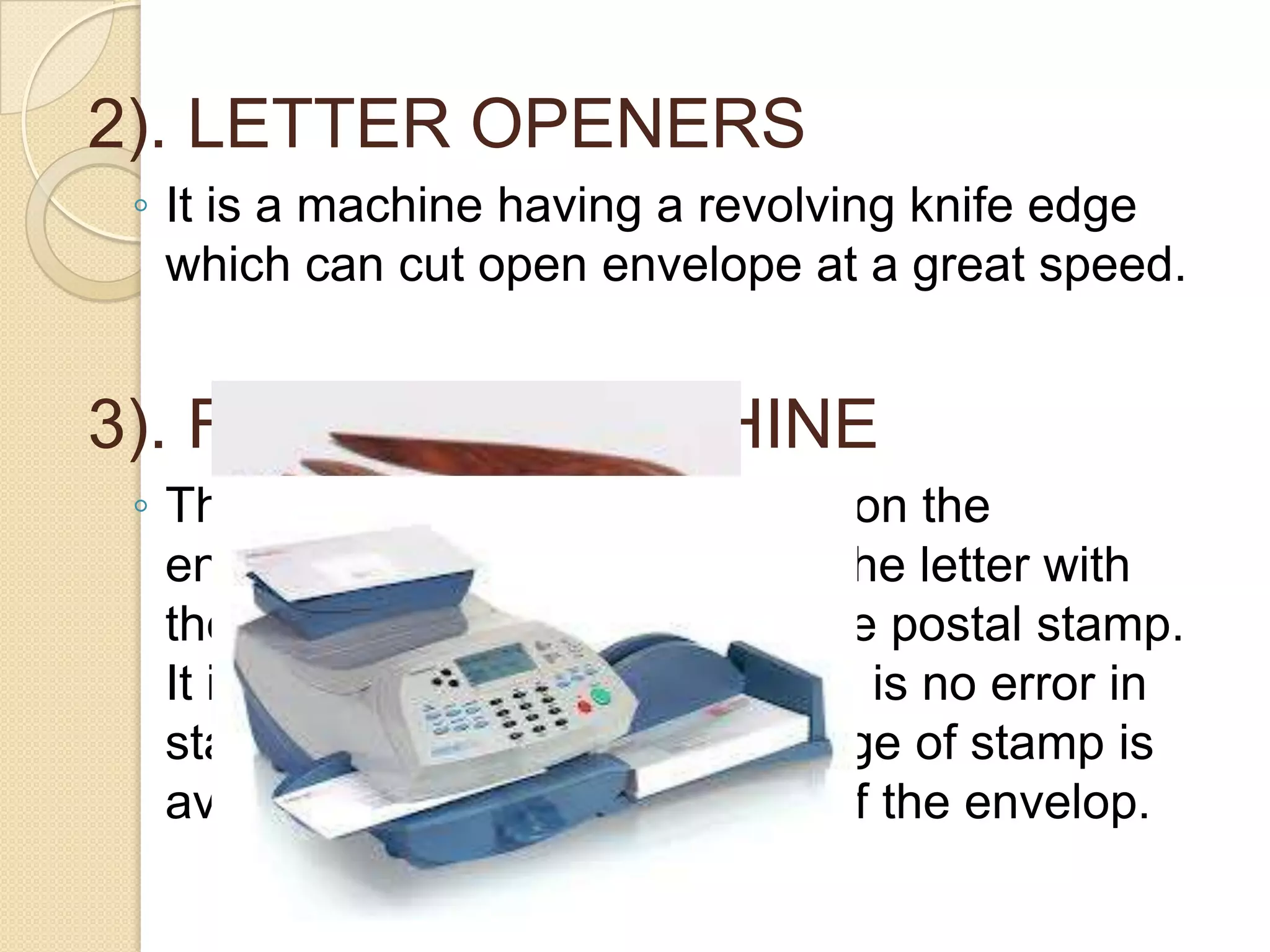
3). FRANKING MACHINE
◦ These are used to affix stamps on the
envelops. The machine marks the letter with
the required denomination of the postal stamp.
It is a time saving device. There is no error in
stamping. Obliteration or spoilage of stamp is
avoided. It adds to the beauty of the envelop.
4). PAPER FOLDING MACHINE
◦ These are used by large business houses to fold
papers, circulars, documents, etc. It is electrically
operated. It can fold up to 20,000 sheets of paper per
hour.

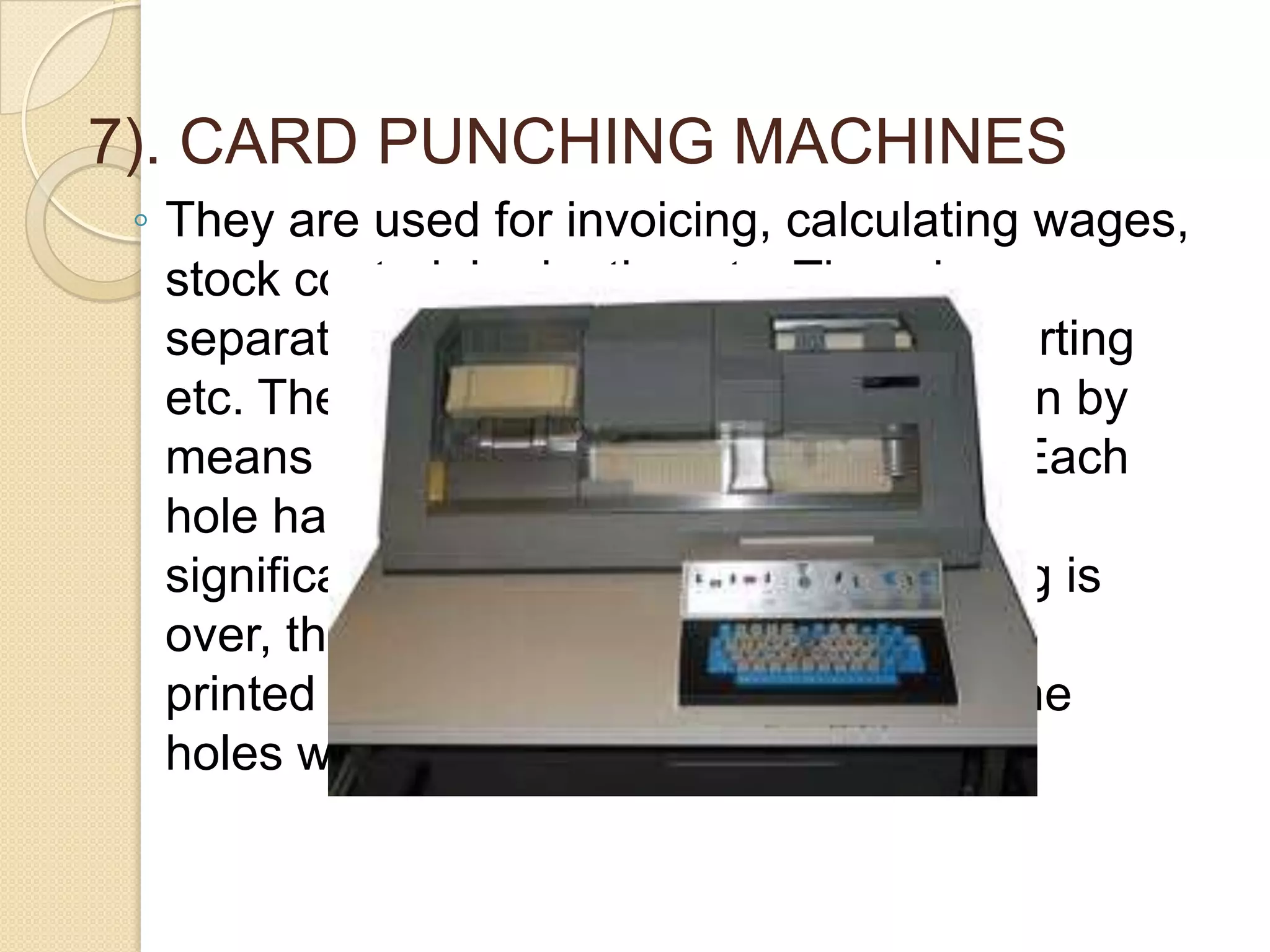
5). ENVELOPE-SEALING MACHINE
◦ This machine automatically seals the envelope. The
machine glues and pastes the flaps (side edges) of the
envelopes. it also works at a great speed.

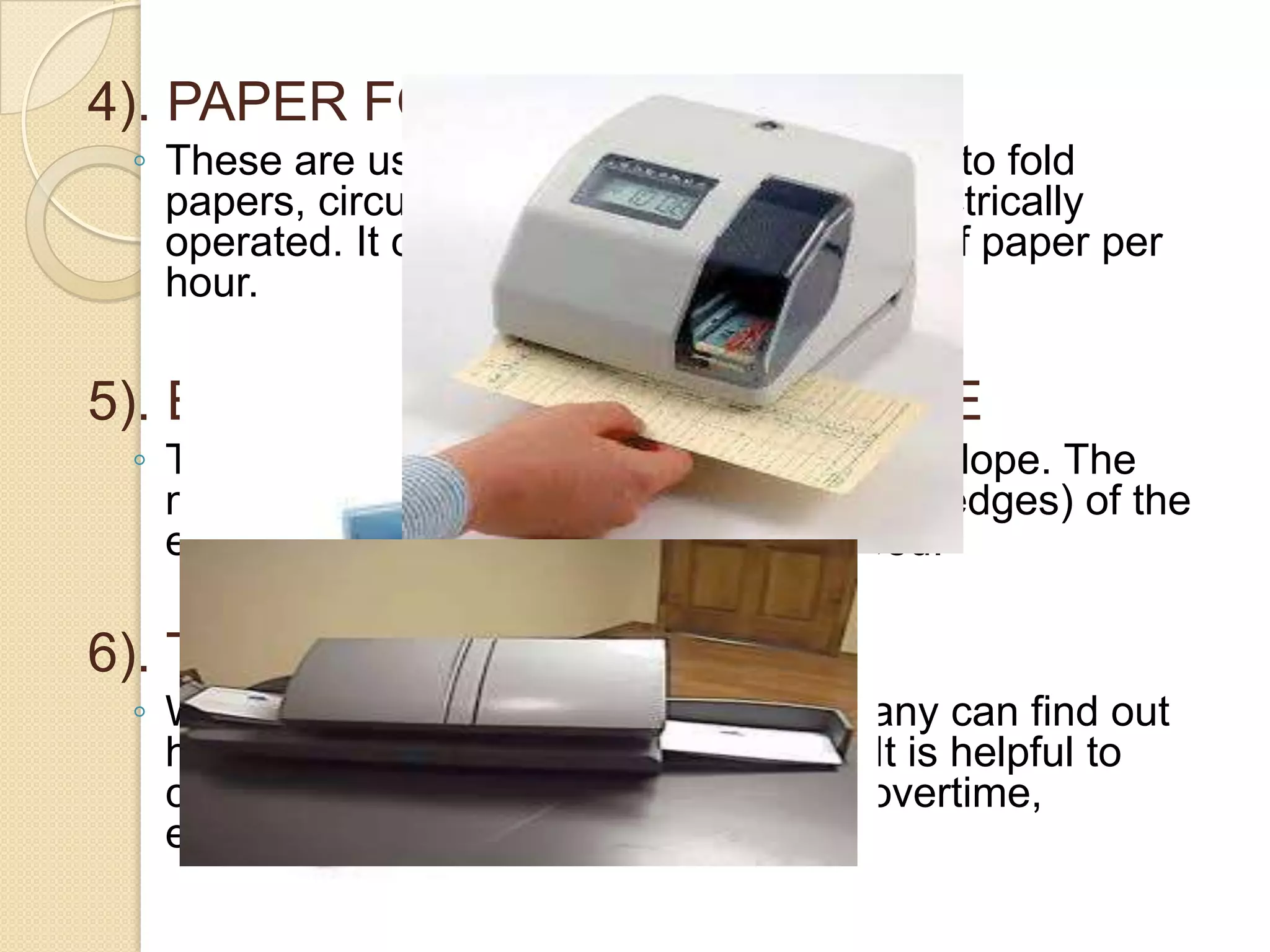
6). TIME RECORDING CLOCK
◦ With the help of this machine, a company can find out
how long a person was in the factory. It is helpful to
calculate many matters like idle time, overtime,
effective labors hours etc.
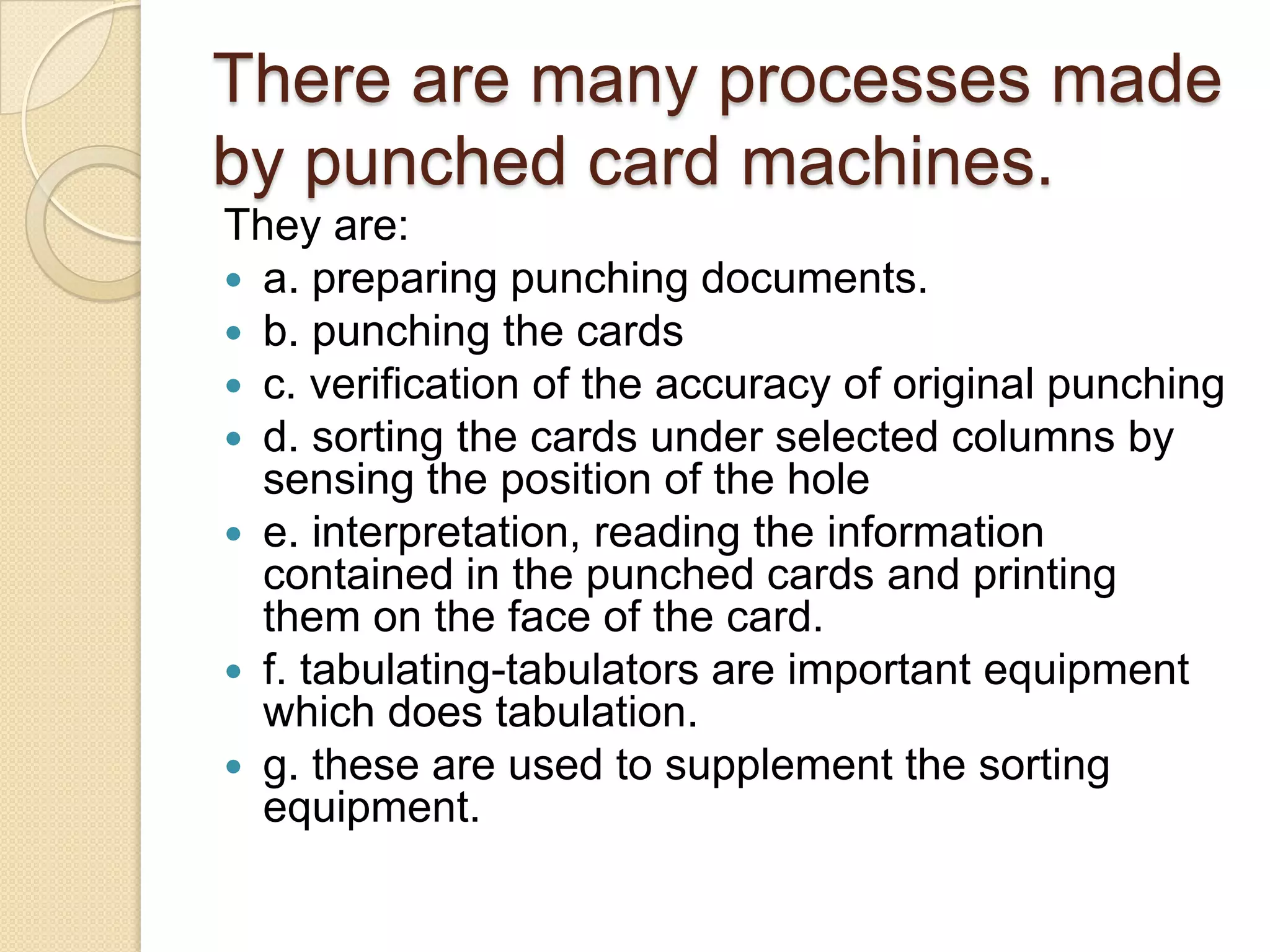
7). CARD PUNCHING MACHINES
◦ They are used for invoicing, calculating wages,
stock control, budgeting etc. They do
separations such as writing, copying, sorting
etc. The machine records the information by
means of punched holes on the cards. Each
hole has a code number indicating the
significance of the punch. After punching is
over, the cards are mechanically sorted,
printed cards are obtained by sensing the
holes with electronic device.
There are many processes made
by punched card machines.
They are:
 a. preparing punching documents.
 b. punching the cards
 c. verification of the accuracy of original punching
 d. sorting the cards under selected columns by
sensing the position of the hole
 e. interpretation, reading the information
contained in the punched cards and printing
them on the face of the card.
 f. tabulating-tabulators are important equipment
which does tabulation.
 g. these are used to supplement the sorting
equipment.
The punched card machine
contains different equipments:
punching machine
 punched cards
 verifier
 reproducing punches
 sorting machine
 interpreter
 collators
 tabulators

Advantages:
◦ a. the machine not only punches information but
also analyses them
◦ b. they are used in preparation of wage sheet,
cost analysis, etc.
◦ c. they are useful in stock control, production
control, etc.
◦ d. these machines are used in libraries, factories,
police, research institutions etc.
◦ e. data are processed at a greater speed
◦ f. there is greater accuracy
◦ g. all functions like recording, analyzing,
interpretation of data can be done.
Disadvantages:
a. the machine is costly
 b. big companies only can use them to
their fullest capacity
 c. extensive learning must be given to
operator to operate machinery
 d. it should be installed in a special
place
 e. there is always problem of
machinemachine becoming out-dated
due to rpid change in technology

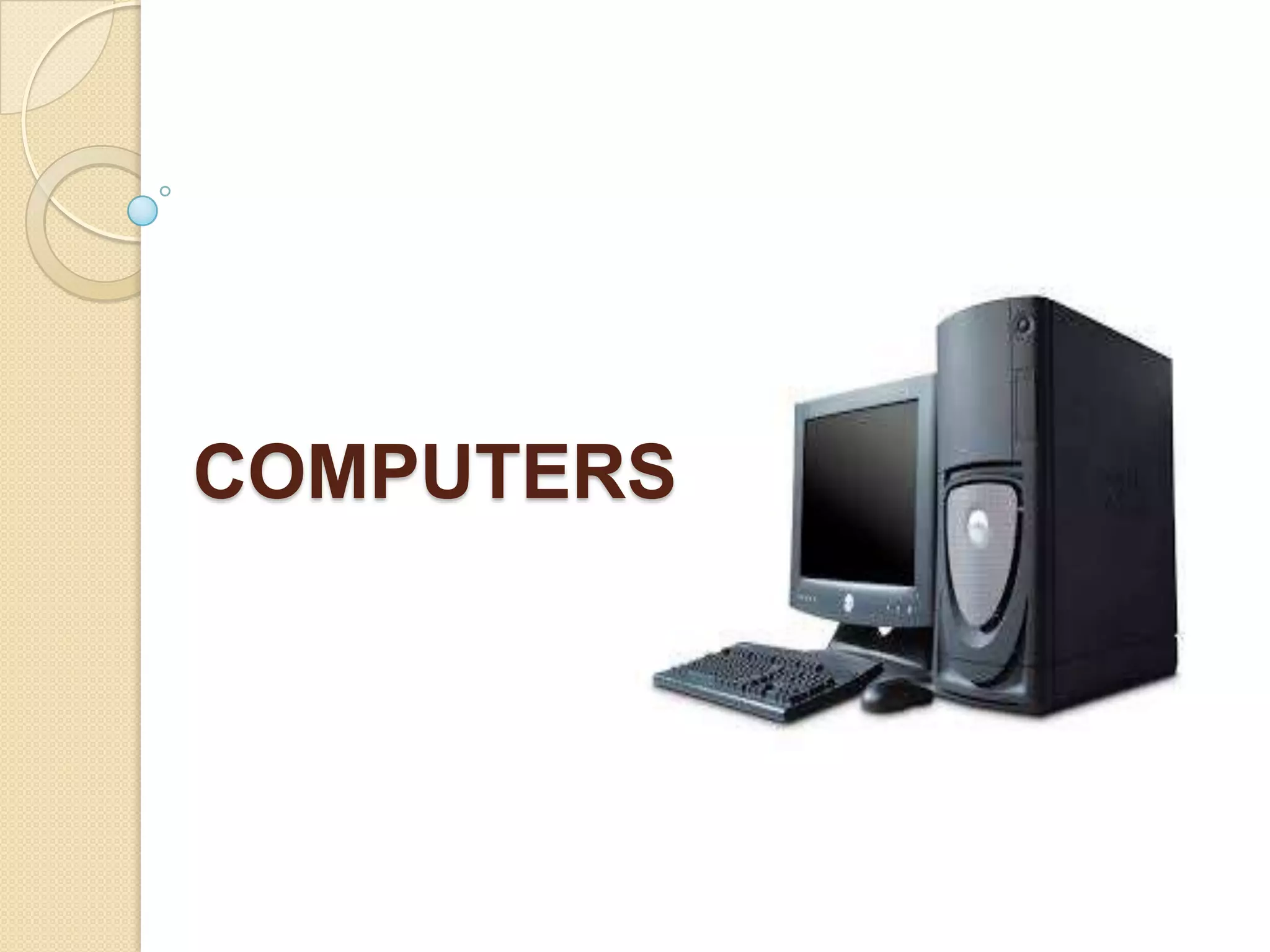
COMPUTERS
It replaced many types of machinery hitherto used in
offices
such as calculators, adding machine, punched card
machines,
etc. Computers combine all facilities of the above
machineries.

Functions of Computers:
a. it receives, records, stores voluminous information
b. it provides quick and ready reference
c. it performs all types of arithmetical operations
d. it selects and carries out alternative course of action
e. it checks data, the grammatical accuracy, etc.
f. it provides an inbuilt mechanism for learning
computers
 g. it analyses, tabulates, interpret data
 h. now, all forms of computers are available like laptop






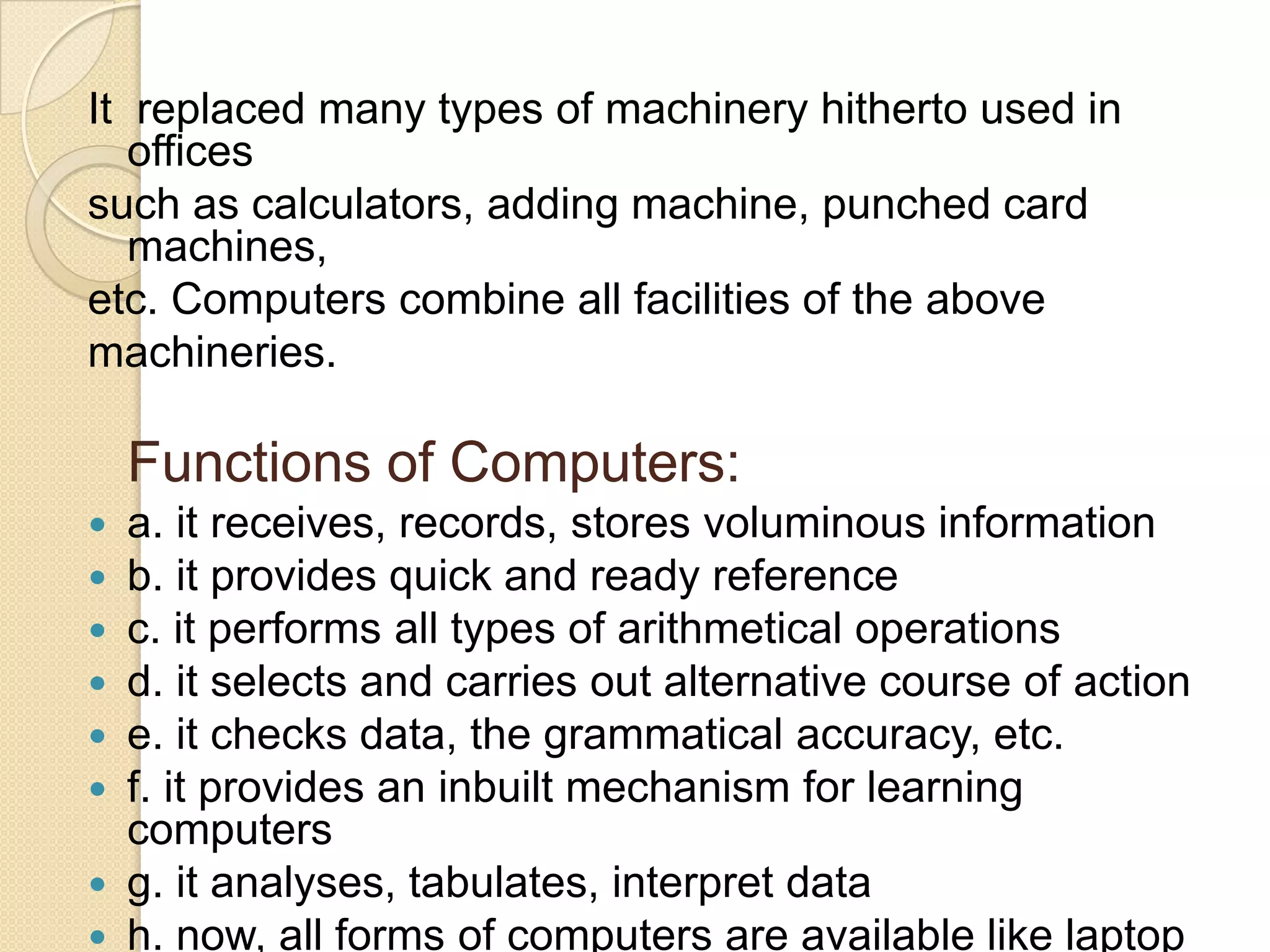
PRINTERS
Given the amount of documentation created
in business, a printer is the most necessary
piece of equipment needed next to the
computer.
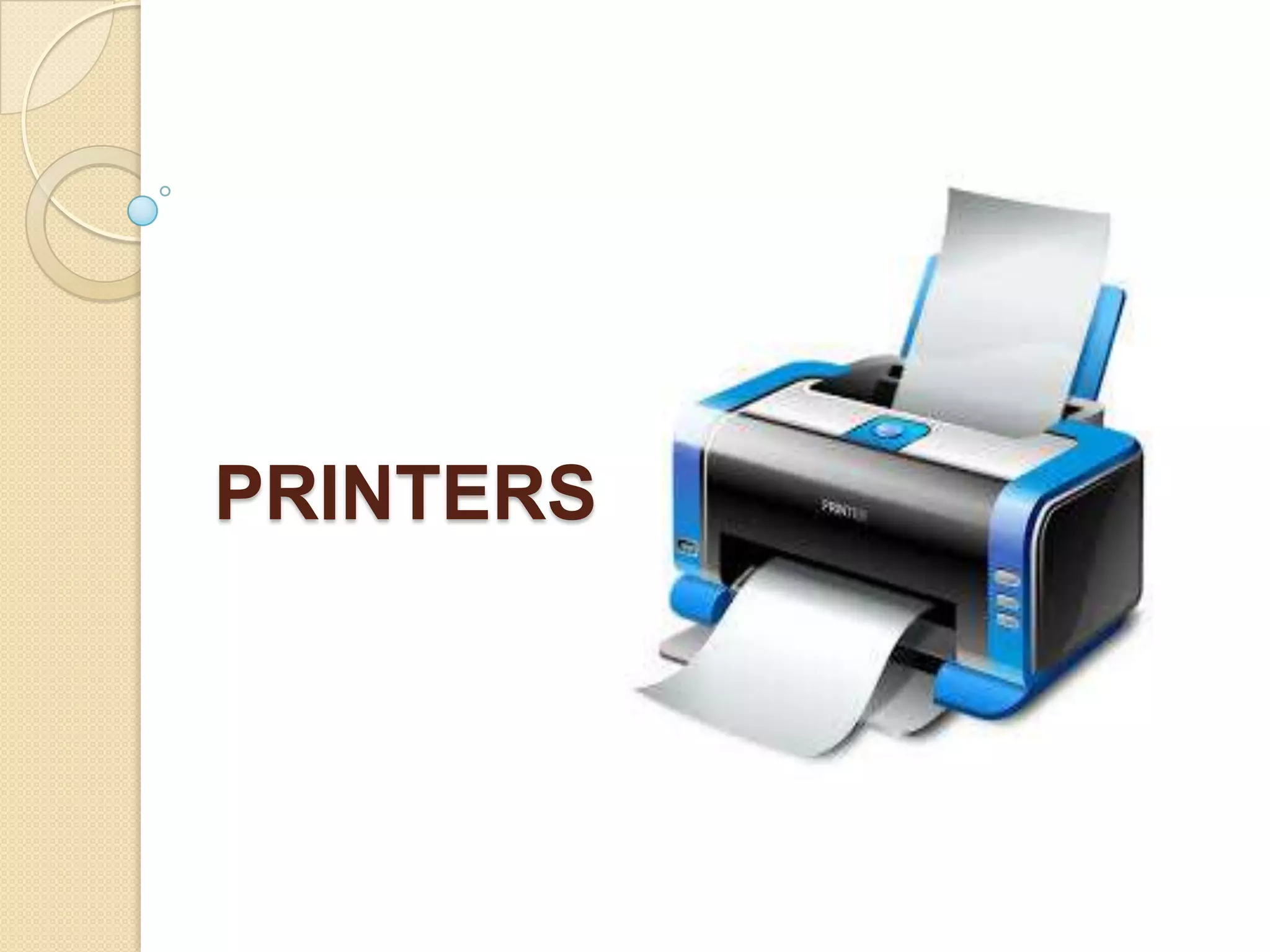
 The most common printers today are laser
printers, inkjet printers and dot-matrix
printers.
a. Laser printers- offers the fastest, most
efficient way to produce text and images,
offering high speed and good resolution at
relatively low cost.
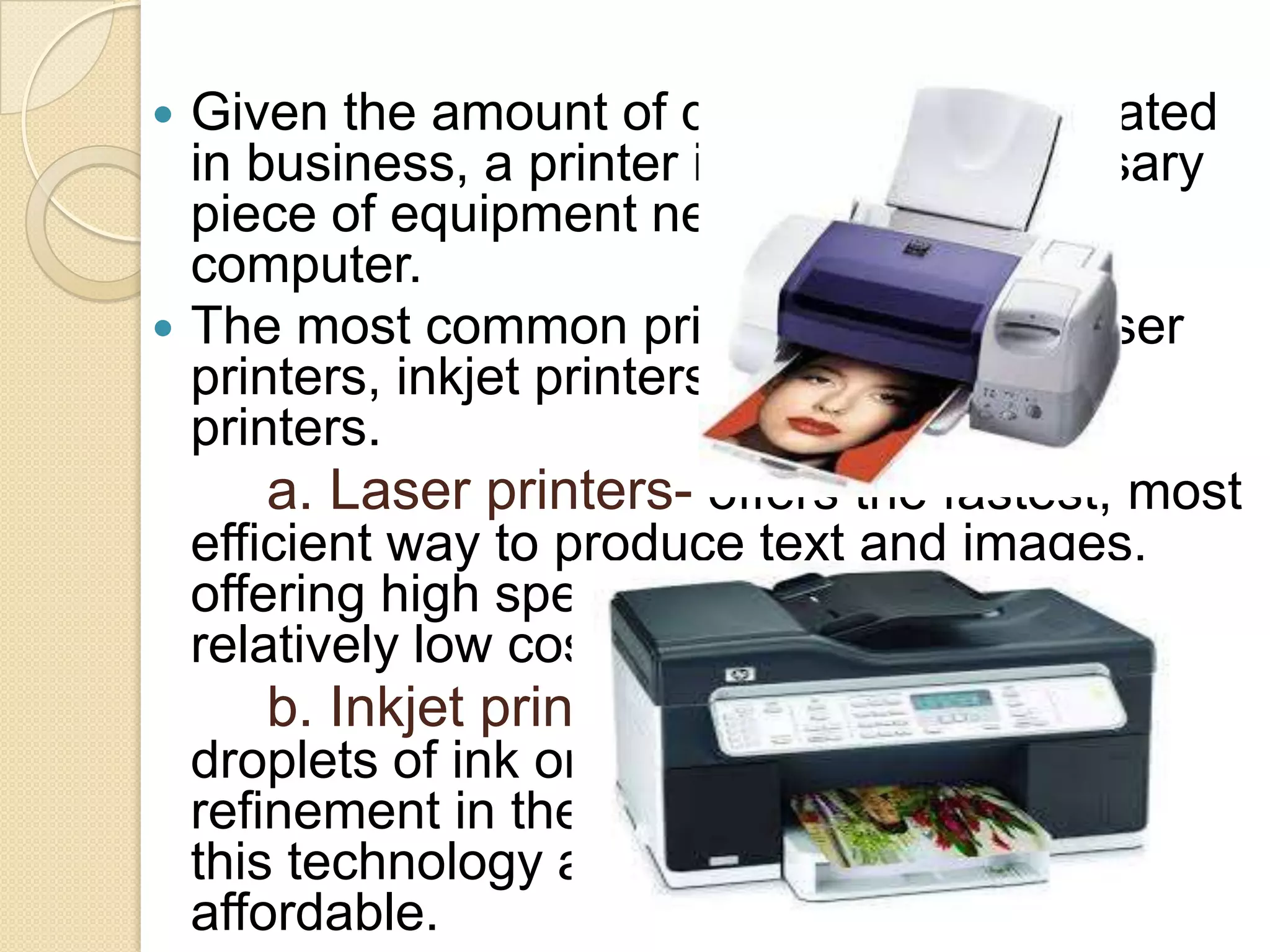
b. Inkjet printers- use tiny jets to spray
droplets of ink onto the page, and the
refinement in the ink compound has made
this technology attractive and highly
affordable.

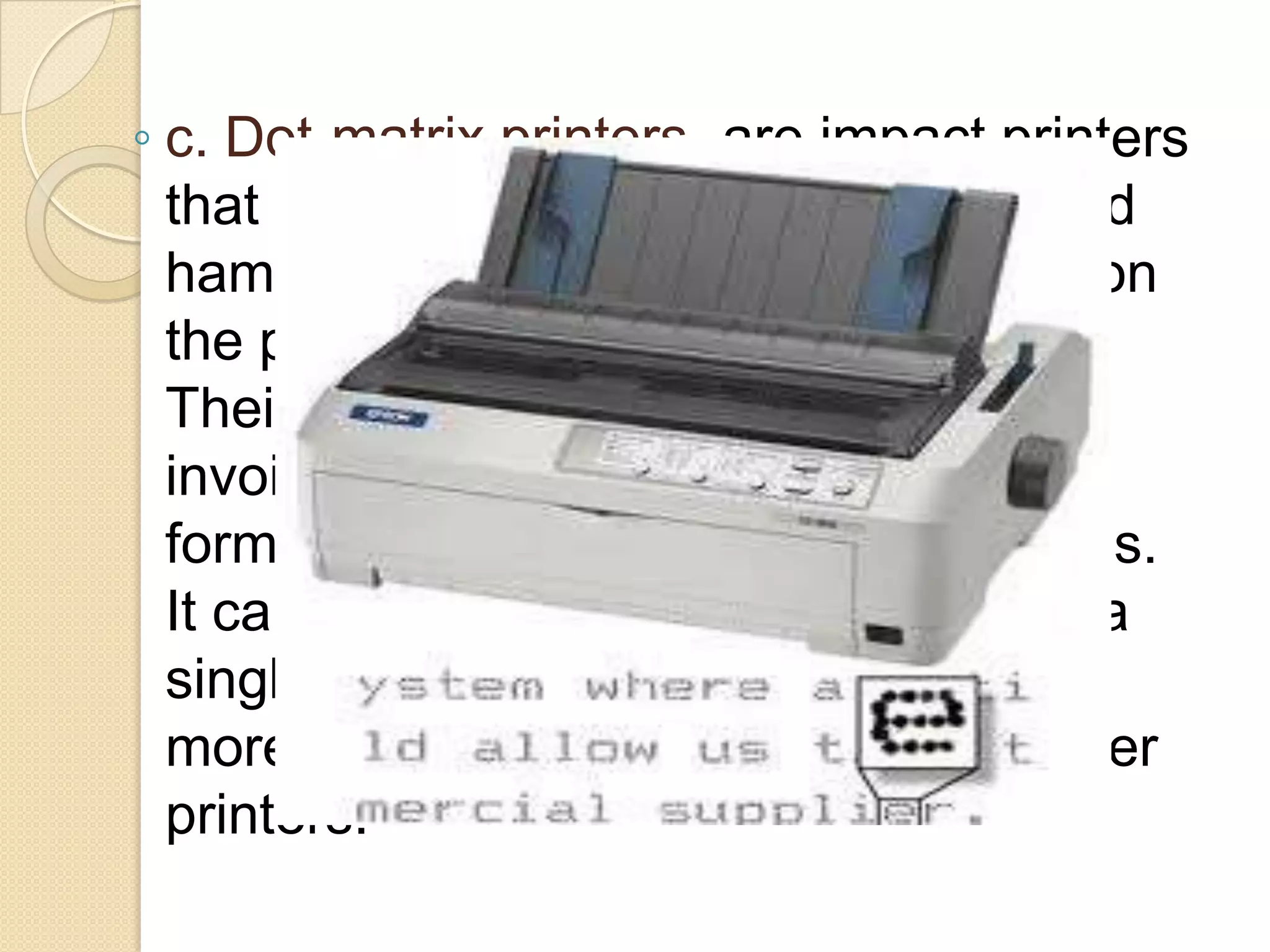
◦ c. Dot-matrix printers- are impact printers
that use a row of small pins, wires, and
hammers that shoot up to make dots on
the paper, creating text and graphics.
Their most common use is for printing
invoices, purchase orders, shipping
forms, labels, and other multipart forms.
It can print through multipart forms in a
single pass, allowing them to produce
more pages than even high-speed laser
printers.
Choosing a Printer
◦ Printers are pretty much a commodity product, so
pricing is very competitive among the major
brands.
◦ following points are to be considered before
choosing a printer:

1. Printing speed. This is the no. of pages the
printers can print out per minute. Speed is determined by
the processor in the
printer: high-speed printers cost
more.
2. Paper tray capacity. A capacity of up to 250
pages in one tray is adequate for some and not for others.
Some printers offer more than one tray, which is a valuable
feature, if you switch from plain paper to letterhead, and
also handle envelopes and documents with the same
printer.
3. Black-and-white versus color. Graphic artists
and people involve in marketing communications probably
have a regular need for color printing.
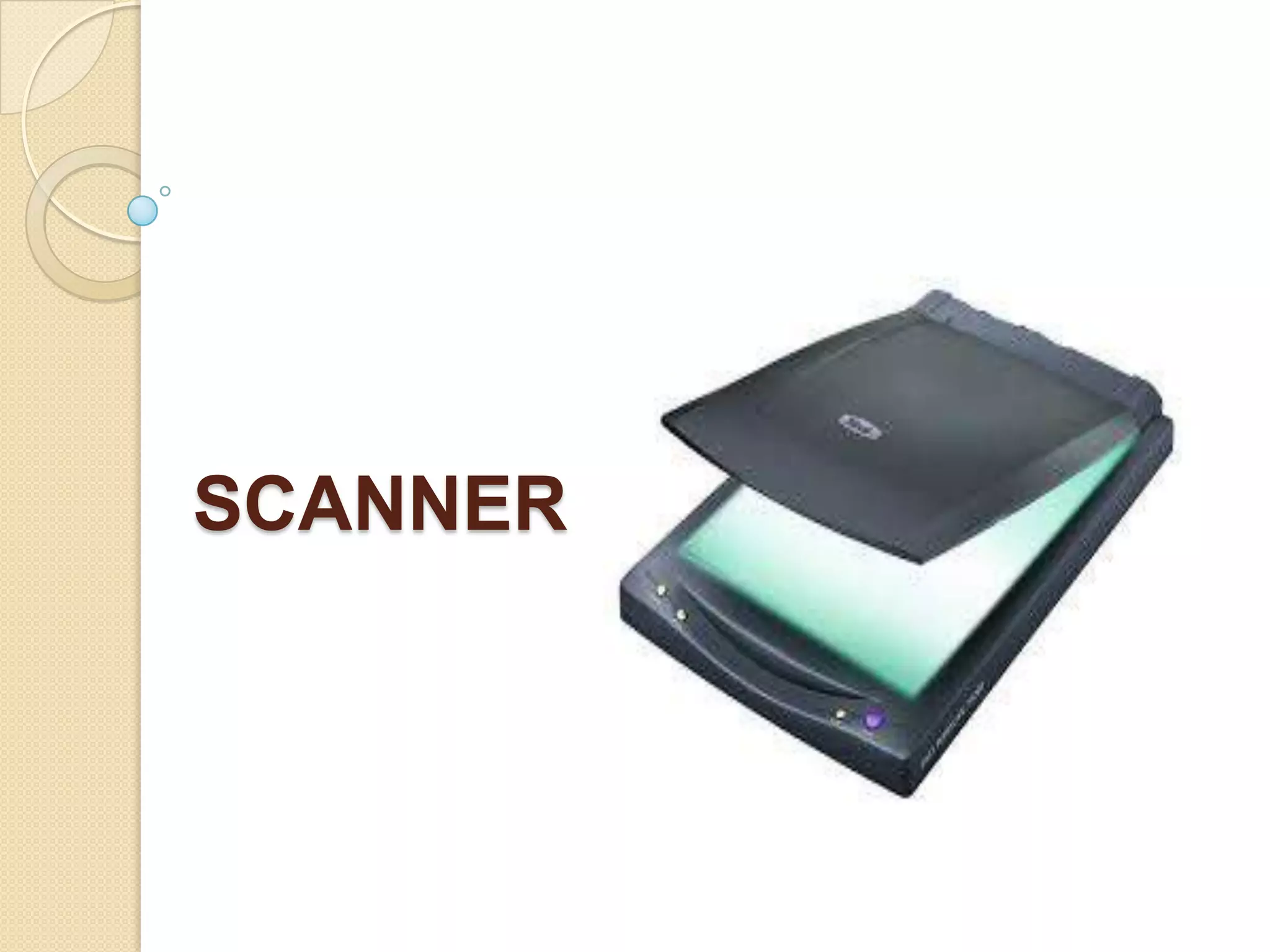
SCANNER
◦ Is a device that can read text and graphics. A
copy of the scanned image is stored on
magnetic media as it simultaneously
reproduces on a monitor.
◦ Accuracy depends on the quality of document
being scanned, so the smart user should
review the scanned image for the occasional
error resulting from the scanner misreading
data.
◦ Most scanners come bundled with Optical
Character Recognition(OCR) capability that
can convert images into computer editable
format. Scanners are available at affordable
prices for every level of user.
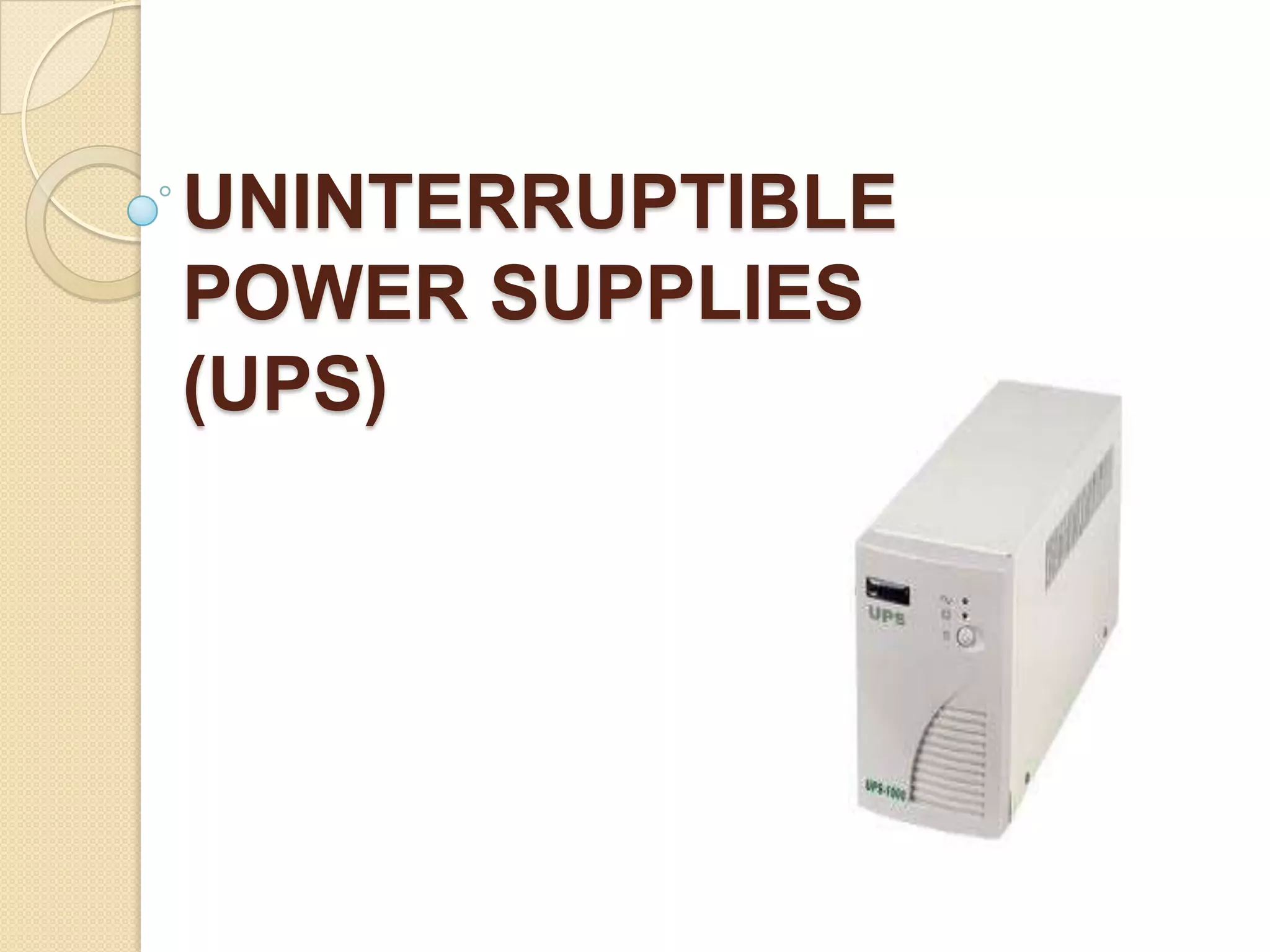
UNINTERRUPTIBLE
POWER SUPPLIES
(UPS)
◦ This device contains a large battery and
circuitry. The battery in UPS gives enough time
to stop working, save our work on a disk, and
conduct an orderly shutdown of our system.
The cost of UPSs vary from very inexpensive
to expensive, depending on our requirements.
These devices re now available wherever
computer and computer peripherals are sold.
VALUE ADDED DATA
COMMUNICATION
SERVICES
Some of the well known value
added services are:
1. E-mail is becoming necessity for many of
today's businesses

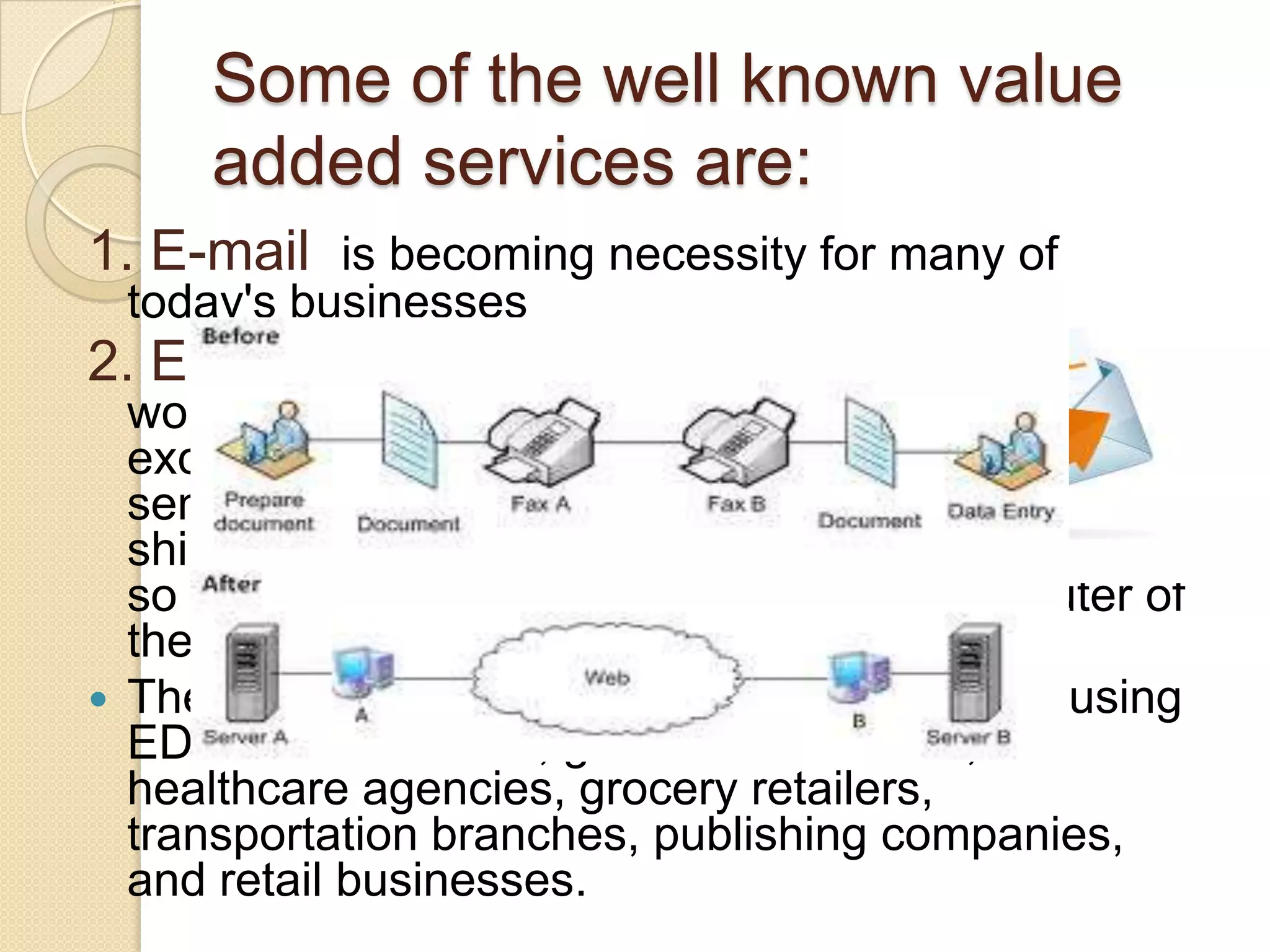
2. Electronic Data Interchange (EDI) is a
worldwide movement. Is a computer-to-computer
exchange of business information. A company can
send purchase orders, invoices, confirmations,
shipping papers, inquiries, financial reports, and
so on directly from its computer to the computer of
the trading partner.
 The following are just some of the industries using
EDI: manufacturers, government offices,
healthcare agencies, grocery retailers,
transportation branches, publishing companies,
and retail businesses.
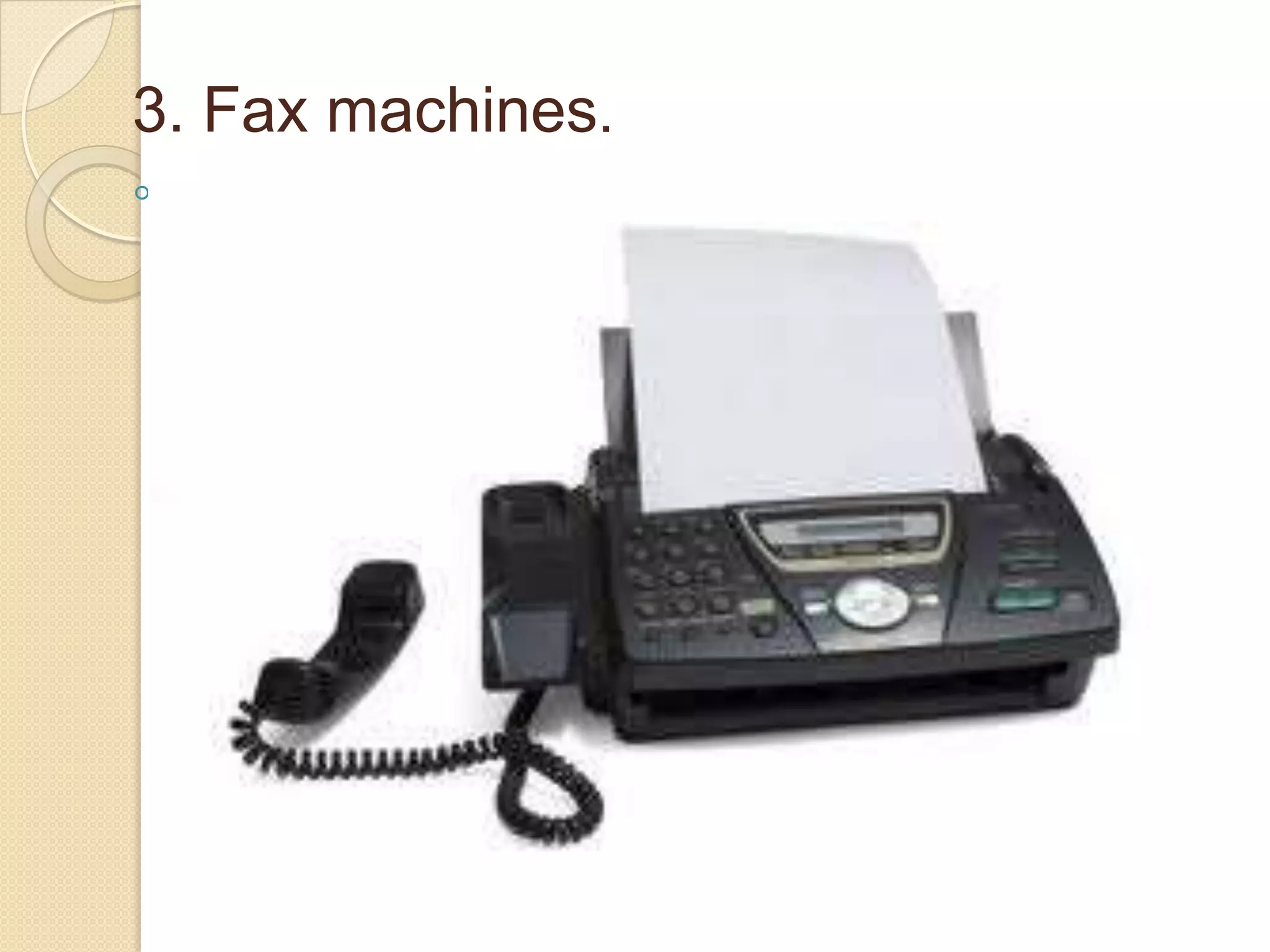
3. Fax machines.
◦ are installed with telephone connections
at both end (sending end and receiving
end). The document/paper is inserted
into the machine. With the help of
telephone connection the information is
decoded, carried through, reaches the
sender and again encoded into its
original form and its copy is produced at
the receiving end. All these processes
are done within minutes.
The objectives of mechanization are:
◦
◦
◦
◦
◦
◦
◦
◦

speed
reduction in labor cost
accuracy
facilitates control
uniformity
legibility
improved efficiency
pride of work
4. Telex.
◦ It is an improved version of the
electromechanical teleprinter. Telex machines have
to be registered with the public telex
exchange operated by Telecommunications
Department. Each registered subscriber is
given a telex number. Telex machine of
each subscriber is connected with machines
of
other subscribers through the telex
exchange.
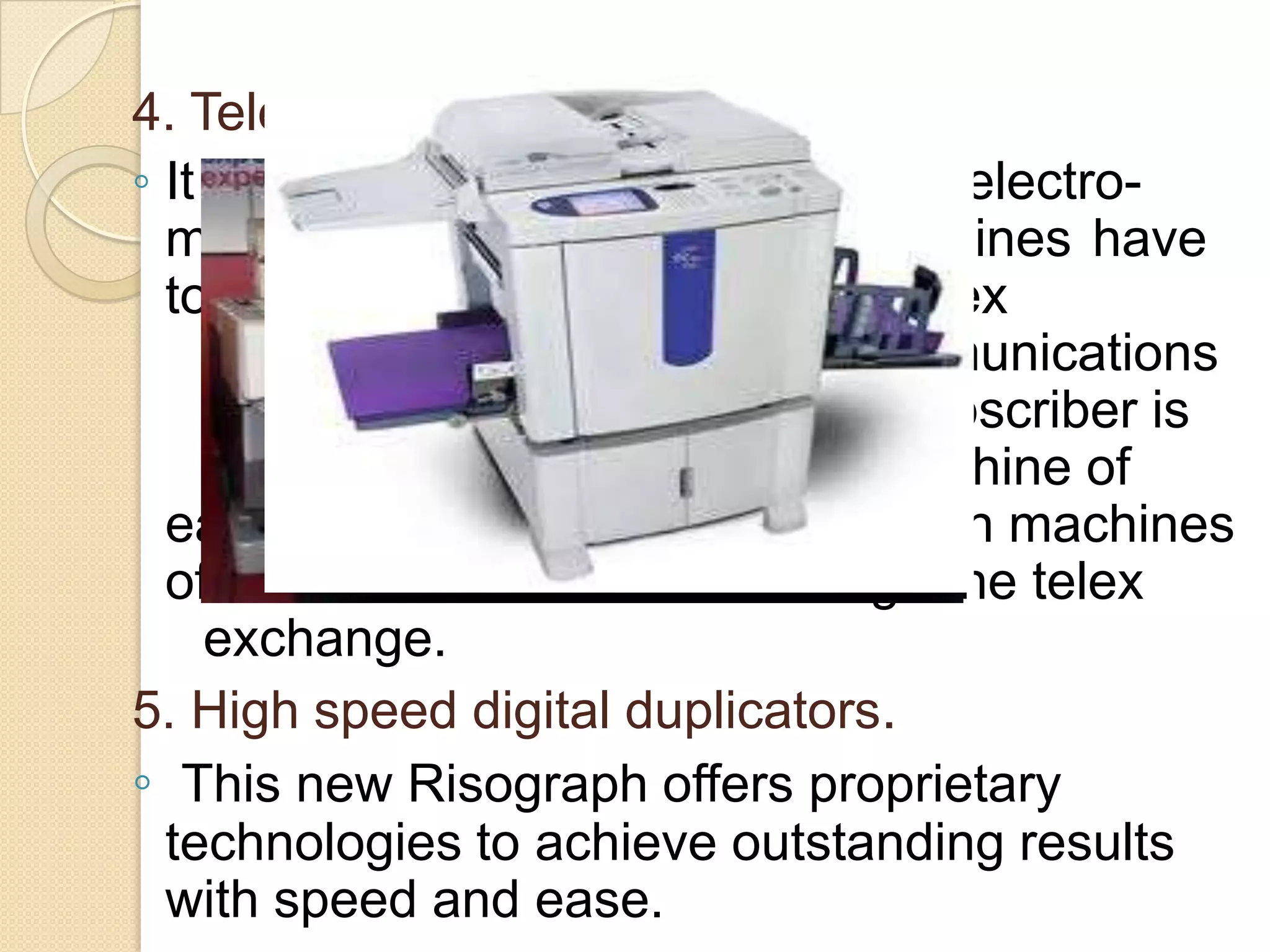
5. High speed digital duplicators.
◦ This new Risograph offers proprietary
technologies to achieve outstanding results
with speed and ease.
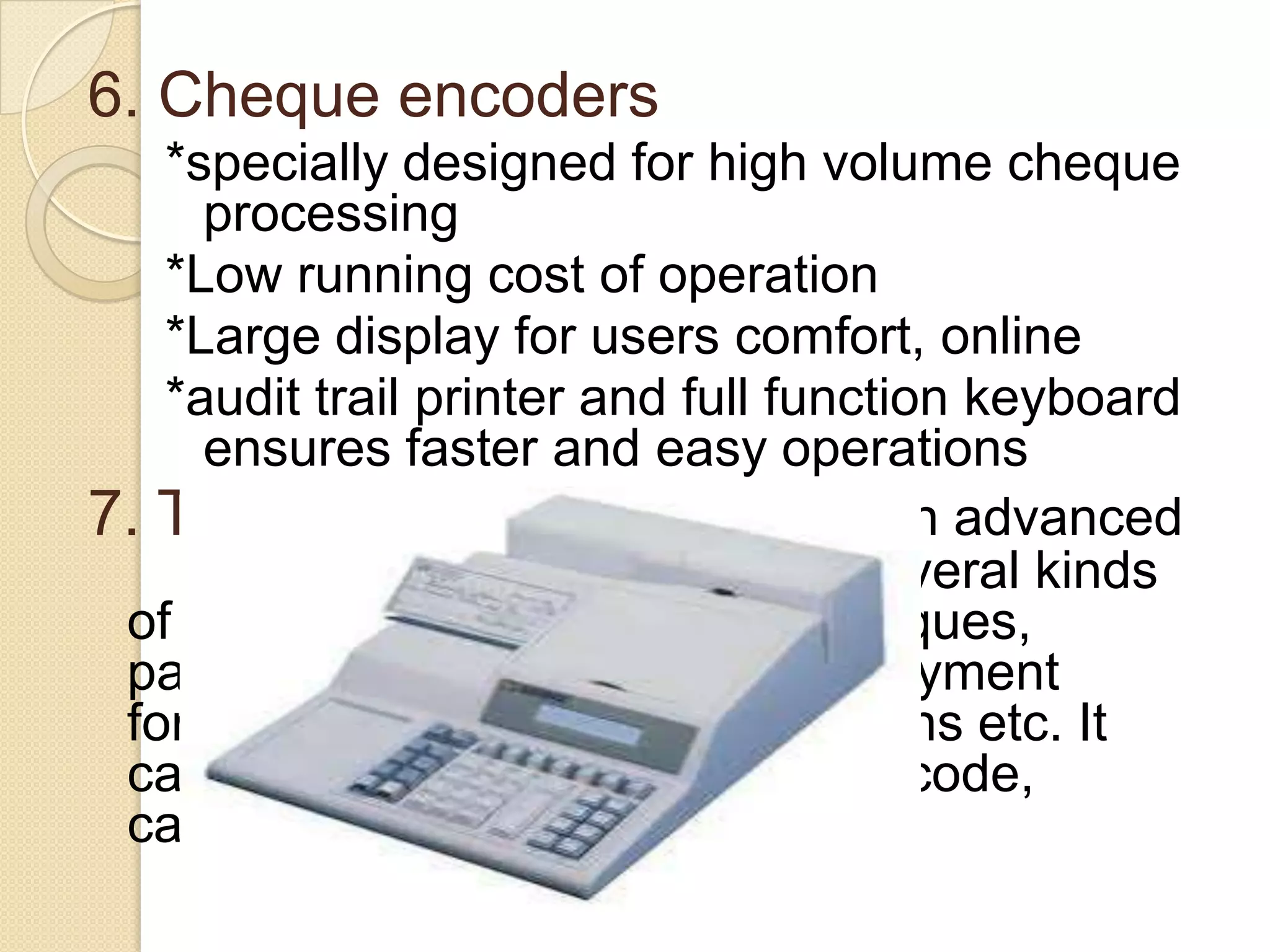
6. Cheque encoders
*specially designed for high volume cheque
processing
*Low running cost of operation
*Large display for users comfort, online
*audit trail printer and full function keyboard
ensures faster and easy operations
7. Table top reader sorter. is an advanced
system, created to process several kinds
of documents, such as bank cheques,
payment
vouchers, postal payment
forms, restaurant tickets, coupons etc. It
can automatically feed, read, encode,
cancel, print, scan, and sort.
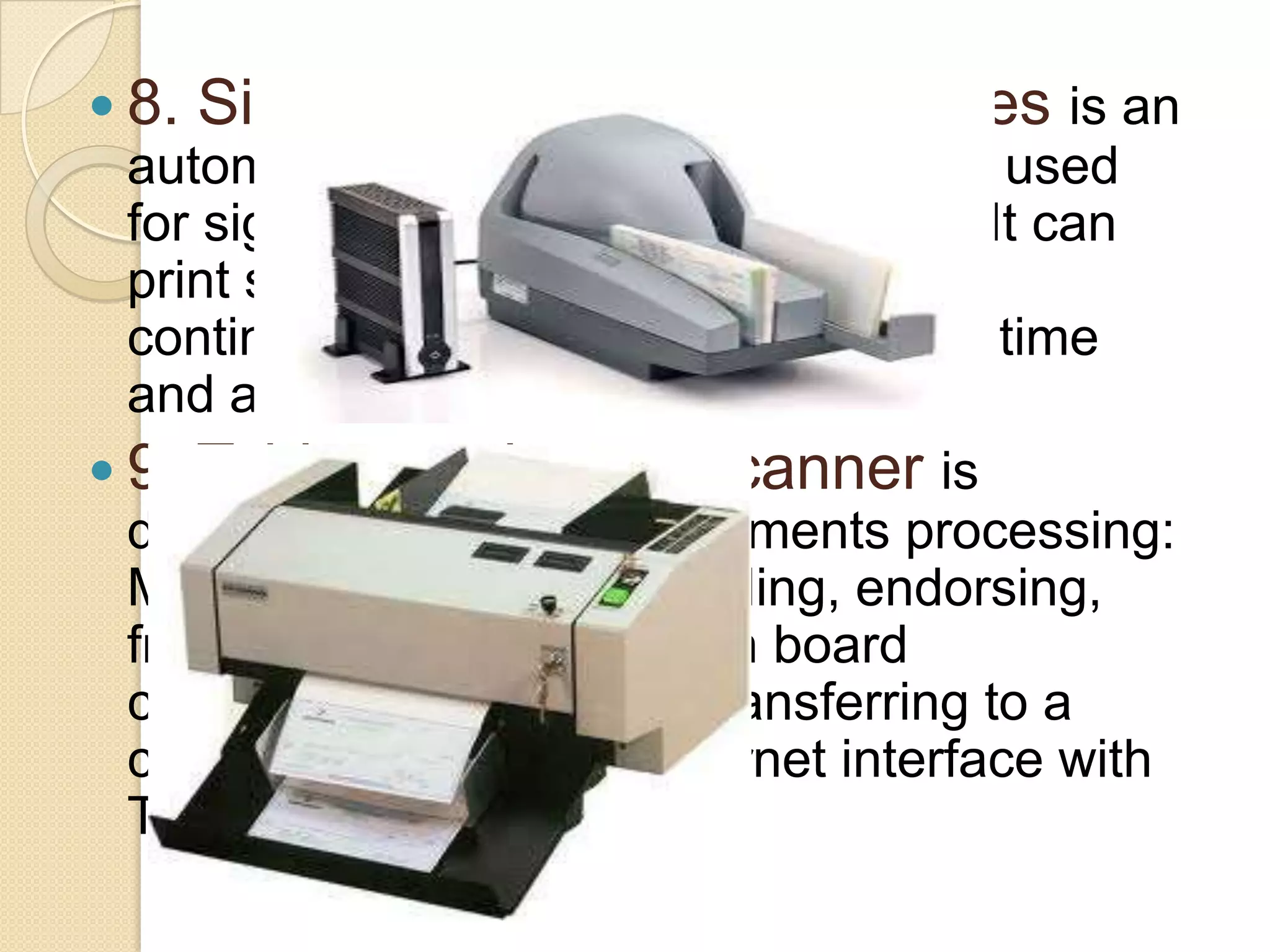
 8. Signature imprinting machines is an
automatic signature printing machine used
for signing cheques, documents etc. It can
print signature, logos and dates on
continuous stationary thereby saving time
and automating the office.
 9. Table top cheque scanner is
designed for banking documents processing:
MICR, OCR, Barcode reading, endorsing,
front and rear scanning, on board
compression and image transferring to a
computer system via Ethernet interface with
TCP/IP protocol.
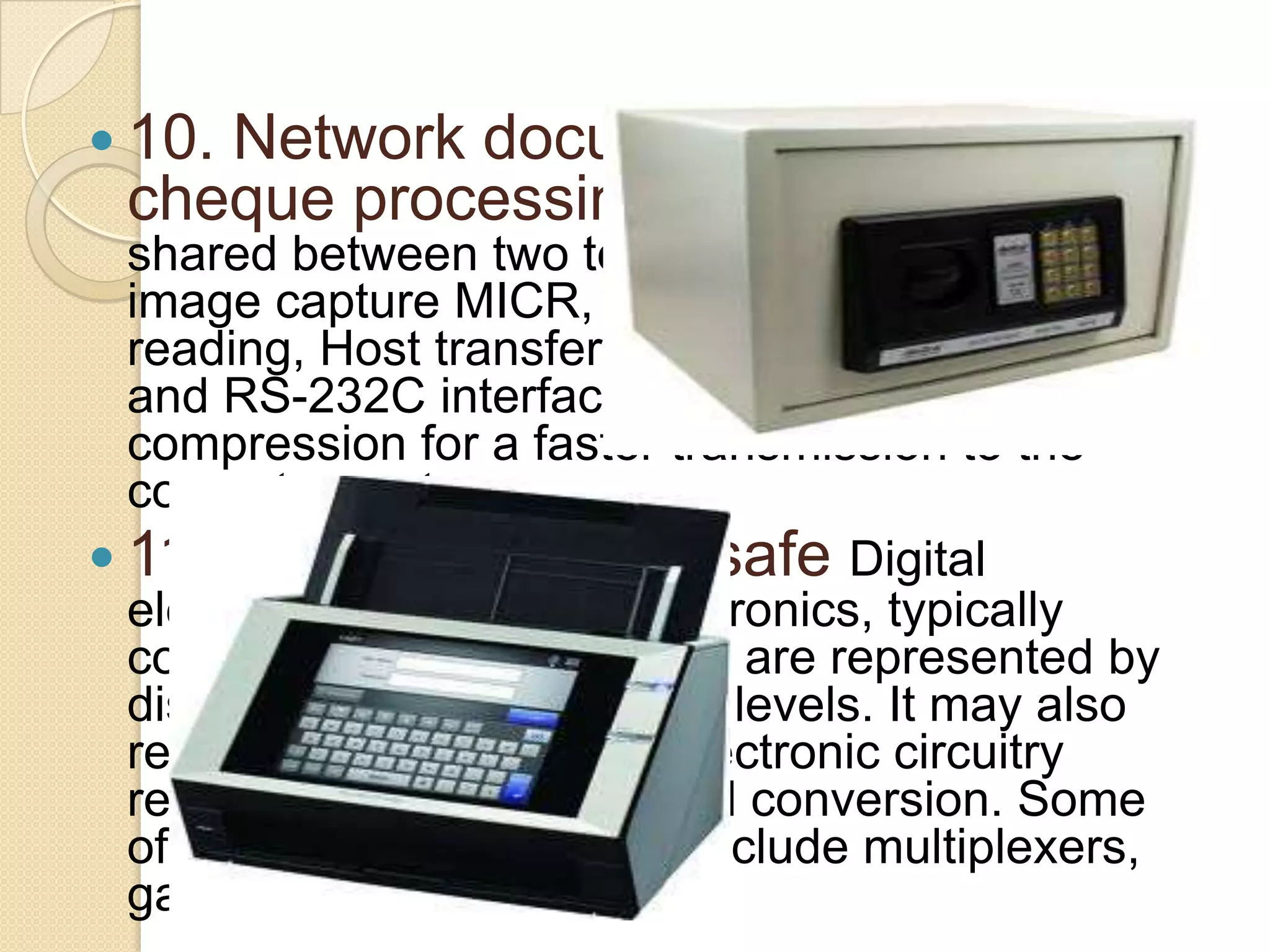
 10.

Network document scanner for
cheque processing. The scanner can be

shared between two tellers. High performance
image capture MICR, OCR and Barcode
reading, Host transfer by USB, Ethernet TCP/IP
and RS-232C interfaces. On board image
compression for a faster transmission to the
computer system.
 11. Digital electronic safe Digital
electronics is a field in electronics, typically
computers, in which signals are represented by
discrete bands of analogue levels. It may also
refer to the portion of an electronic circuitry
responsible for digital signal conversion. Some
of the devices in this field include multiplexers,
gates and decoders.
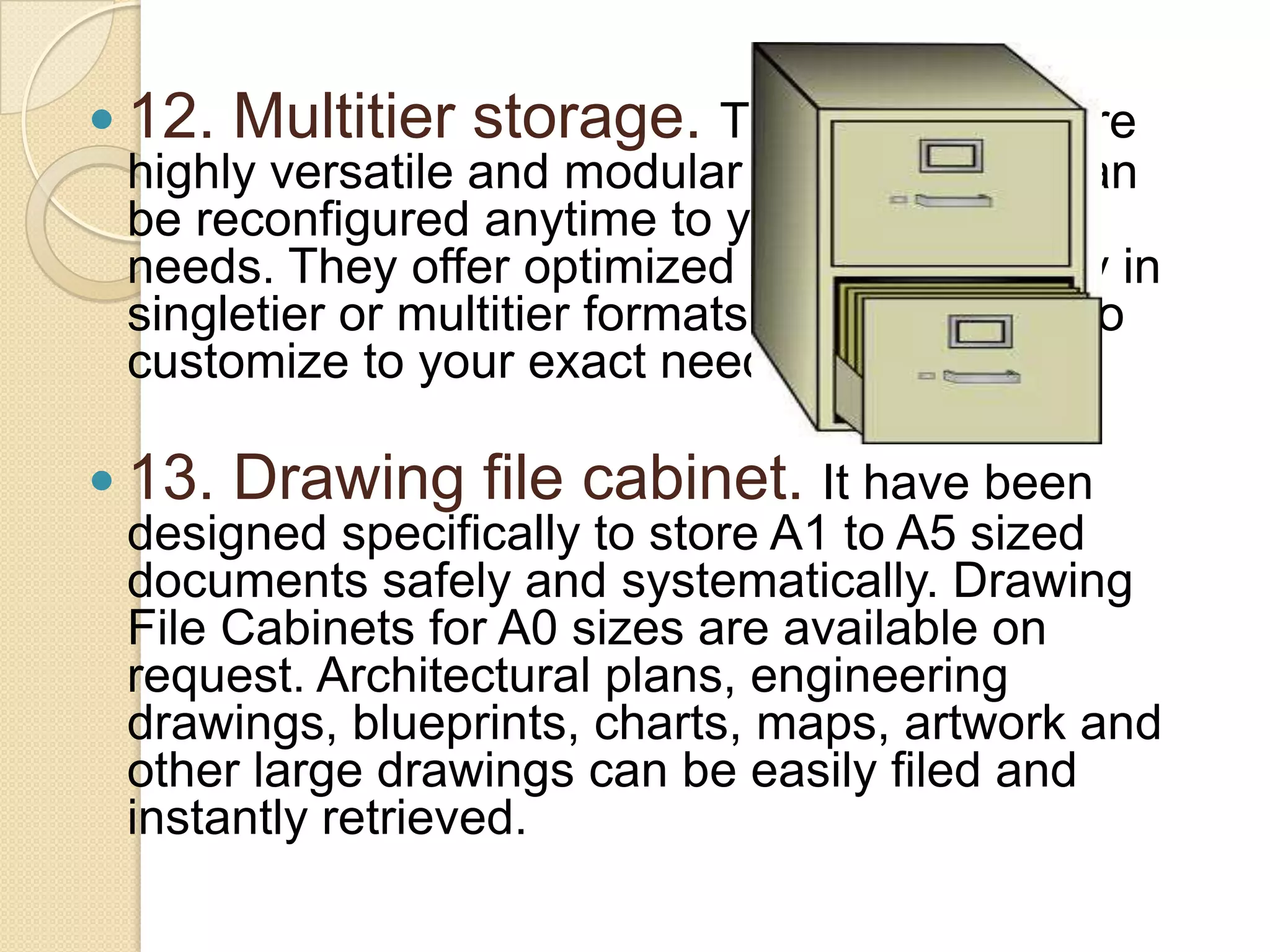
 12. Multitier storage. These systems are
highly versatile and modular in nature and can
be reconfigured anytime to your changing
needs. They offer optimized storage capacity in
singletier or multitier formats with capability to
customize to your exact needs.
 13. Drawing file cabinet. It have been
designed specifically to store A1 to A5 sized
documents safely and systematically. Drawing
File Cabinets for A0 sizes are available on
request. Architectural plans, engineering
drawings, blueprints, charts, maps, artwork and
other large drawings can be easily filed and
instantly retrieved.
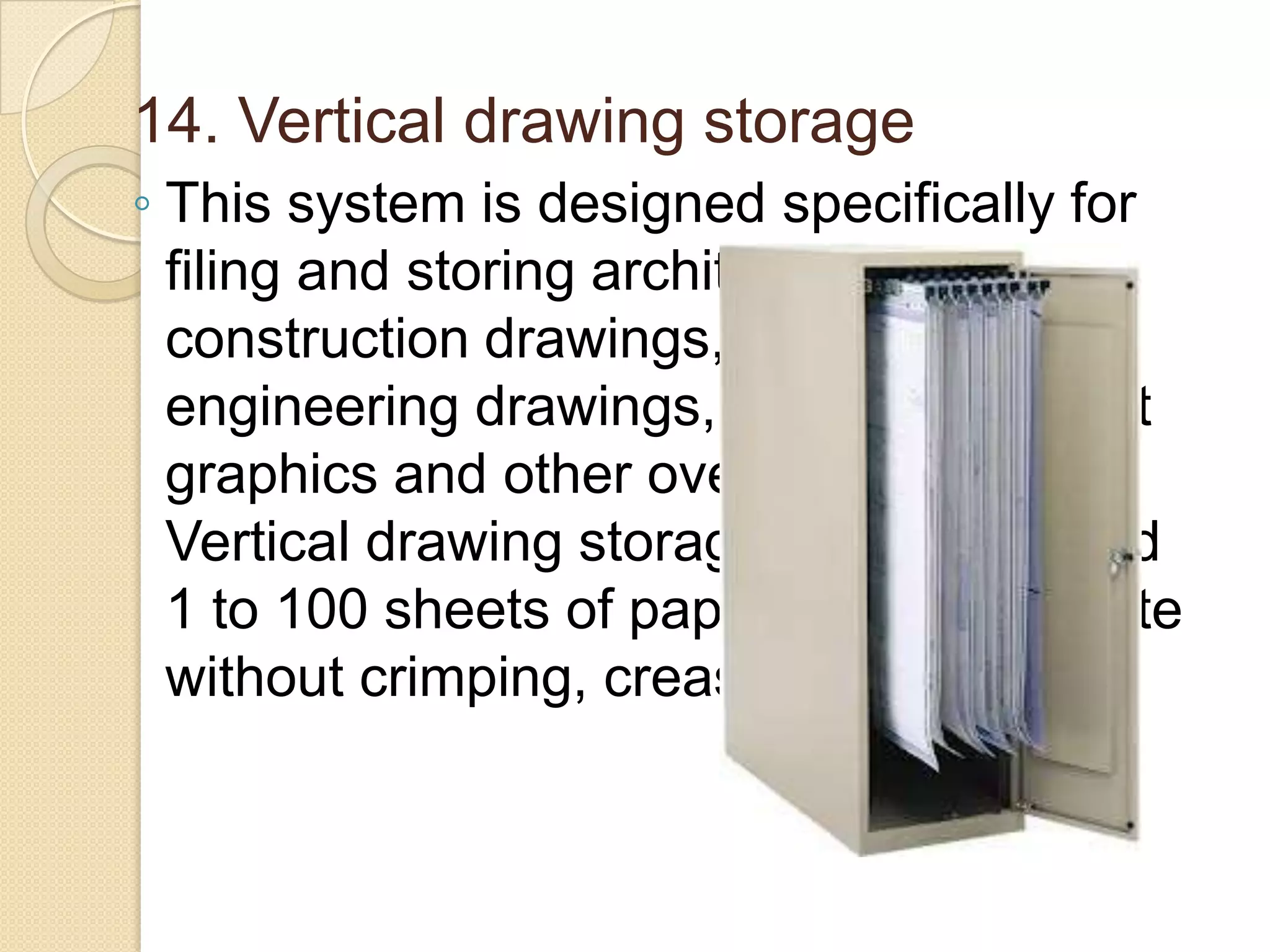
14. Vertical drawing storage
◦ This system is designed specifically for
filing and storing architectural plans,
construction drawings, blueprints,
engineering drawings, charts, maps, art
graphics and other oversized sheets.
Vertical drawing storage clamp can hold
1 to 100 sheets of paper, film or laminate
without crimping, creasing or slipping.
Thank You

Prepared by:

Jenny Urbaña

Machines for accounting records

  • 1.
  • 2.
    1). CALCULATORS They areuseful for adding, subtracting, multiplying, dividing or doing arithmetical operations. They are cheaply available with latest technology to verify the operation with automatic check and with repeat programme. There are many types of calculators: a. Printing Calculator - gives the result of addition in printed form b. Rotary Calculator - does all functions of arithmetic. c. Key driven Calculator - is a non resting one d. Electronic Calculator - is the best selling one. It
  • 3.
    Advantages: minimize errors  ensurespeed/accuracy  mental strain is reduced  very handy machine  cheap  available in all models with many users attachment  its operation is very simple  arithmetical operations can be done 
  • 4.
    Disadvantages: a. Costly b. utilityis limited compare to computers c. complex and complicated issues cannot be considered by calculators.
  • 5.
    2) ACCOUNTING MACHINES Theseare like typewriters.  They are use for posting of accounts.  With the help of accounting machine, ledger, journal, invoice, cash book, etc. can be posted. So the matters are recorded in printed form. 
  • 6.
    Advantages: a. it worksfaster than men b. errors in posting minimize c. ledgers are posted and balance d. results are accurate and reliable e. accounting work is done as soon as postings are  over.  f. only little training is needed to operate the machine.  g. printed records are readily available.     
  • 7.
    Disadvantages: It is costly.The accounting operations must be voluminous enough to warrant the employment of accounting machines.  Breakdown of power will lead to stoppage of the machine.  It may lead to the problem of unemployment of persons with special knowledge in Accountancy. 
  • 8.
    3). BOOKKEEPING MACHINE With thehelp of books, machines, account books and final accounts are prepared.  There is no mistake such as error of omission, commission, etc. 
  • 9.
  • 10.
    1). CASH REGISTER ◦It is a device for recording and checking cash receipts. It is like internal check system. At any time cashier can count the cash in hand and verify it with balance shown by the cash register. 2). COIN COUNTER ◦ This machine counts the coin. There are many trays according to the type of coins. There are layers of trays with holes in machines. Each tray is for coins of a particular size. These are used in banks, railways and big shops when there are numerous cash transactions.
  • 11.
    3). CHEQUE PROTECTORCHEQUEWRITING MACHINES ◦ The machines write the amount, does crossing etc. on the surface of the cheque. It shreds into fibers of the cheque paper, the shreds being form under pressure and then filled with acid proof ink. No alteration can be made. It cannot be erased. It ensures the safety of the cheque. 4). FAKE NOTE DETECTOR ◦ It is used to detect good notes from fake currency notes. The currency notes are put into the machine. with the help of violet rays, it is easy to find out whether a note is fake or original.
  • 12.
    5). CURRENCY SORTING MACHINES ◦Multifunctional parallel-working Desktop Banknote Processing system for counting and sorting of mixed bundles of notes by currency (including issue) denomination, orientation and suspected counterfeits (option) 6). COIN SORTING MACHINES ◦ It is a tabletop coin sorter/counter that can increase productivity by accurate sorting and counting up to 3000 coins per minute. Offering quiet, high-speed operation, this cost efficient unit increases accountability while maintaining the highest degree of accuracy. Comes in a compact size, easy to use and has a multiple functions, all catering to the needs.
  • 13.
  • 14.
    1). ADDRESSING MACHINE  Itis used to print the address on envelopes, labels, postcards, wage sheet, invoices, notices dividend warrants etc. The machine is used by gas companies, electricity, insurance companies. It is a time saving , labor service device.
  • 15.
    There are threetypes of addressing machine: a. Metal plate machine - the addresses are stenciled or embossed on metal process. Envelopes are inserted one by one. The machine is operated with a lever. The required address is printed. b. Film stencil machine - it uses a film stencil mounted in a cardboard frame. To facilitate reference, the frame has a label, bearing the same information as the stencil.
  • 16.
    c. Spirit masterprocess addressing machine - addressing machine are also available with user attachments like dating device, numbering device, automatic feed, etc. The machine are easy to operate and can be operated electrically or manually. There is no need for checking the address. ◦ Spirit masters are made of art paper, and are typed with chectographic carbon at the back. After they have been prepared, they are mounted in plastic (or) cardboard frames.
  • 17.
    2). LETTER OPENERS ◦It is a machine having a revolving knife edge which can cut open envelope at a great speed. 3). FRANKING MACHINE ◦ These are used to affix stamps on the envelops. The machine marks the letter with the required denomination of the postal stamp. It is a time saving device. There is no error in stamping. Obliteration or spoilage of stamp is avoided. It adds to the beauty of the envelop.
  • 18.
    4). PAPER FOLDINGMACHINE ◦ These are used by large business houses to fold papers, circulars, documents, etc. It is electrically operated. It can fold up to 20,000 sheets of paper per hour. 5). ENVELOPE-SEALING MACHINE ◦ This machine automatically seals the envelope. The machine glues and pastes the flaps (side edges) of the envelopes. it also works at a great speed. 6). TIME RECORDING CLOCK ◦ With the help of this machine, a company can find out how long a person was in the factory. It is helpful to calculate many matters like idle time, overtime, effective labors hours etc.
  • 19.
    7). CARD PUNCHINGMACHINES ◦ They are used for invoicing, calculating wages, stock control, budgeting etc. They do separations such as writing, copying, sorting etc. The machine records the information by means of punched holes on the cards. Each hole has a code number indicating the significance of the punch. After punching is over, the cards are mechanically sorted, printed cards are obtained by sensing the holes with electronic device.
  • 20.
    There are manyprocesses made by punched card machines. They are:  a. preparing punching documents.  b. punching the cards  c. verification of the accuracy of original punching  d. sorting the cards under selected columns by sensing the position of the hole  e. interpretation, reading the information contained in the punched cards and printing them on the face of the card.  f. tabulating-tabulators are important equipment which does tabulation.  g. these are used to supplement the sorting equipment.
  • 21.
    The punched cardmachine contains different equipments: punching machine  punched cards  verifier  reproducing punches  sorting machine  interpreter  collators  tabulators 
  • 22.
    Advantages: ◦ a. themachine not only punches information but also analyses them ◦ b. they are used in preparation of wage sheet, cost analysis, etc. ◦ c. they are useful in stock control, production control, etc. ◦ d. these machines are used in libraries, factories, police, research institutions etc. ◦ e. data are processed at a greater speed ◦ f. there is greater accuracy ◦ g. all functions like recording, analyzing, interpretation of data can be done.
  • 23.
    Disadvantages: a. the machineis costly  b. big companies only can use them to their fullest capacity  c. extensive learning must be given to operator to operate machinery  d. it should be installed in a special place  e. there is always problem of machinemachine becoming out-dated due to rpid change in technology 
  • 24.
  • 25.
    It replaced manytypes of machinery hitherto used in offices such as calculators, adding machine, punched card machines, etc. Computers combine all facilities of the above machineries. Functions of Computers: a. it receives, records, stores voluminous information b. it provides quick and ready reference c. it performs all types of arithmetical operations d. it selects and carries out alternative course of action e. it checks data, the grammatical accuracy, etc. f. it provides an inbuilt mechanism for learning computers  g. it analyses, tabulates, interpret data  h. now, all forms of computers are available like laptop      
  • 26.
  • 27.
    Given the amountof documentation created in business, a printer is the most necessary piece of equipment needed next to the computer.  The most common printers today are laser printers, inkjet printers and dot-matrix printers. a. Laser printers- offers the fastest, most efficient way to produce text and images, offering high speed and good resolution at relatively low cost. b. Inkjet printers- use tiny jets to spray droplets of ink onto the page, and the refinement in the ink compound has made this technology attractive and highly affordable. 
  • 28.
    ◦ c. Dot-matrixprinters- are impact printers that use a row of small pins, wires, and hammers that shoot up to make dots on the paper, creating text and graphics. Their most common use is for printing invoices, purchase orders, shipping forms, labels, and other multipart forms. It can print through multipart forms in a single pass, allowing them to produce more pages than even high-speed laser printers.
  • 29.
    Choosing a Printer ◦Printers are pretty much a commodity product, so pricing is very competitive among the major brands. ◦ following points are to be considered before choosing a printer: 1. Printing speed. This is the no. of pages the printers can print out per minute. Speed is determined by the processor in the printer: high-speed printers cost more. 2. Paper tray capacity. A capacity of up to 250 pages in one tray is adequate for some and not for others. Some printers offer more than one tray, which is a valuable feature, if you switch from plain paper to letterhead, and also handle envelopes and documents with the same printer. 3. Black-and-white versus color. Graphic artists and people involve in marketing communications probably have a regular need for color printing.
  • 30.
  • 31.
    ◦ Is adevice that can read text and graphics. A copy of the scanned image is stored on magnetic media as it simultaneously reproduces on a monitor. ◦ Accuracy depends on the quality of document being scanned, so the smart user should review the scanned image for the occasional error resulting from the scanner misreading data. ◦ Most scanners come bundled with Optical Character Recognition(OCR) capability that can convert images into computer editable format. Scanners are available at affordable prices for every level of user.
  • 32.
  • 33.
    ◦ This devicecontains a large battery and circuitry. The battery in UPS gives enough time to stop working, save our work on a disk, and conduct an orderly shutdown of our system. The cost of UPSs vary from very inexpensive to expensive, depending on our requirements. These devices re now available wherever computer and computer peripherals are sold.
  • 34.
  • 35.
    Some of thewell known value added services are: 1. E-mail is becoming necessity for many of today's businesses 2. Electronic Data Interchange (EDI) is a worldwide movement. Is a computer-to-computer exchange of business information. A company can send purchase orders, invoices, confirmations, shipping papers, inquiries, financial reports, and so on directly from its computer to the computer of the trading partner.  The following are just some of the industries using EDI: manufacturers, government offices, healthcare agencies, grocery retailers, transportation branches, publishing companies, and retail businesses.
  • 36.
    3. Fax machines. ◦are installed with telephone connections at both end (sending end and receiving end). The document/paper is inserted into the machine. With the help of telephone connection the information is decoded, carried through, reaches the sender and again encoded into its original form and its copy is produced at the receiving end. All these processes are done within minutes.
  • 37.
    The objectives ofmechanization are: ◦ ◦ ◦ ◦ ◦ ◦ ◦ ◦ speed reduction in labor cost accuracy facilitates control uniformity legibility improved efficiency pride of work
  • 38.
    4. Telex. ◦ Itis an improved version of the electromechanical teleprinter. Telex machines have to be registered with the public telex exchange operated by Telecommunications Department. Each registered subscriber is given a telex number. Telex machine of each subscriber is connected with machines of other subscribers through the telex exchange. 5. High speed digital duplicators. ◦ This new Risograph offers proprietary technologies to achieve outstanding results with speed and ease.
  • 39.
    6. Cheque encoders *speciallydesigned for high volume cheque processing *Low running cost of operation *Large display for users comfort, online *audit trail printer and full function keyboard ensures faster and easy operations 7. Table top reader sorter. is an advanced system, created to process several kinds of documents, such as bank cheques, payment vouchers, postal payment forms, restaurant tickets, coupons etc. It can automatically feed, read, encode, cancel, print, scan, and sort.
  • 40.
     8. Signatureimprinting machines is an automatic signature printing machine used for signing cheques, documents etc. It can print signature, logos and dates on continuous stationary thereby saving time and automating the office.  9. Table top cheque scanner is designed for banking documents processing: MICR, OCR, Barcode reading, endorsing, front and rear scanning, on board compression and image transferring to a computer system via Ethernet interface with TCP/IP protocol.
  • 41.
     10. Network documentscanner for cheque processing. The scanner can be shared between two tellers. High performance image capture MICR, OCR and Barcode reading, Host transfer by USB, Ethernet TCP/IP and RS-232C interfaces. On board image compression for a faster transmission to the computer system.  11. Digital electronic safe Digital electronics is a field in electronics, typically computers, in which signals are represented by discrete bands of analogue levels. It may also refer to the portion of an electronic circuitry responsible for digital signal conversion. Some of the devices in this field include multiplexers, gates and decoders.
  • 42.
     12. Multitierstorage. These systems are highly versatile and modular in nature and can be reconfigured anytime to your changing needs. They offer optimized storage capacity in singletier or multitier formats with capability to customize to your exact needs.  13. Drawing file cabinet. It have been designed specifically to store A1 to A5 sized documents safely and systematically. Drawing File Cabinets for A0 sizes are available on request. Architectural plans, engineering drawings, blueprints, charts, maps, artwork and other large drawings can be easily filed and instantly retrieved.
  • 43.
    14. Vertical drawingstorage ◦ This system is designed specifically for filing and storing architectural plans, construction drawings, blueprints, engineering drawings, charts, maps, art graphics and other oversized sheets. Vertical drawing storage clamp can hold 1 to 100 sheets of paper, film or laminate without crimping, creasing or slipping.
  • 44.